Surrogacy

Articles in a legal collective publication

contribution in a collective legal publication

📝L’invention du “droit à l’enfant”. Les conséquences de la pratique contractuelle comme source d’engendrement de l’enfant (The invention of the “right to a child”. The consequences of the contractual practice as a source of childbearing), in 📗Nouvelles filiations (New Filiations)

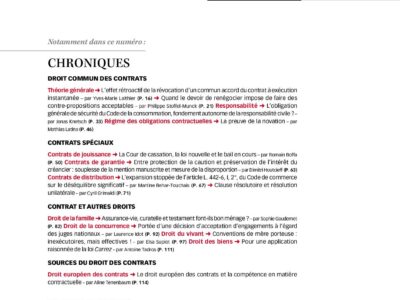
► Full Reference: M.-A. Frison-Roche,  « L'invention du "droit à l'enfant". Les conséquences de la pratique contractuelle comme source d'engendrement de l'enfant (The invention of the "right to a child". The consequences of the contractual practice as a source of childbearing)", in Special Issue Nouvelles filiations (New Filiations), AJ Famille, Lefebvre Dalloz, Nov. 2025, pp. 568-571.    - 📗read the table of content of the special issue in which this article is published (in French) - 📝read this article (in French) - 🚧Read the underlying bilingual working document, which includes additional technical developments, technical references and hyperlinks. - ► English summary of this article: Every legal system is built on concepts that form its pillars. Filiation is one such concept. A cas-law solution, presented as pragmatic and casuistic, can overturn this concept. Whether one agrees with it or not, it must first be acknowledged and assessed. Through a series of rulings on surrogacy, notably a ruling by its First Civil Chamber granting exequatur to a judgment recognising the filiation established by surrogacy between a child and persons with no biological link to the child and without recourse to adoption, the French Cour de Cassation has introduced the possibility of creating parentage by contract. This not only changes the concept of filiation but also changes the very structure of the French legal system, which is based on the distinction between persons and things. One may agree or disagree with this, but it must be said. Since the judge gives force to such a contract establishing filiation, with the foreign judge simply recognising it and the French judge ensuring only that the contract is balanced, the prospect opens up of a society in which individuals will be able to contractually create institutions at their disposal, within the private normative space of the contract, with the State's only function being to give effect to their right to legal recognition of their unique "project". Parentage is only a first example. Thus constructed on what was "inconceivable", i.e. a "right to a child", thanks to the contractual power to which the State should lend its force a posteriori, the judge makes parentage resulting .the judge technically declares a parentage arising from a contract to be "admissible". Is opening a society in institutions were contractually governed.  - 🌐follow Marie-Anne Frison-Roche on LinkedIn 🌐follow Marie-Anne Frison-Roche on Instagram 🌐subscribe to the Newsletter MAFR Regulation, Compliance, Law 🌐subscribe to the Video Newsletter MAFR Surplomb 🌐subscribe to theNewsletter MaFR Droit & Art

Articles

💬L’interdiction de la GPA posée par le Code civil n’existe plus

► Full Reference: M.-A. Frison-Roche, "GPA : "L’interdiction de la GPA posée par le Code civil n’existe plus" ("The French Civil Code ban on surrogacy no longer exists"), interview with Olivia Dufour, Actu-Juridique, 26 November 2024 - 💬read the interview (in French) - ► Presentation of the interview by the journal: "Un simple arrêt de section rendu par la première civile de la Cour de cassation le 14 novembre 2024 peut-il donner plein effet à une "pure convention de GPA" ? Telle est la question que l’on peut se poser à la suite de cette décision. Éléments de réponse avec le professeur Marie-Anne Frison-Roche. ". - 🕴️M.-A. Frison-Roche, 📕GPA : dire Oui ou dire Non, 2018 - ► Questions posées, réponses apportées :  Actu-Juridique. Question : Un arrêt de section de la première chambre civile de la Cour de cassation rendu le 14 novembre dernier en matière de gestation pour autrui (GPA) a suscité l’émotion. Est-il exact de dire qu’en pratique, suite à cette décision, la prohibition en France de la GPA n’existe plus ?   Marie-Anne Frison-Roche. Réponse. :    A.J. Q. : Quels étaient les faits de l’espèce et en quoi diffèrent-ils des autres affaires ? MaFR. R. : O A.J. Q. : L’Europe avait-elle déjà pris position sur la GPA et si oui, par quels textes et dans quel sens ? MaFR. R. : En Europe, c'est la jurisprudence de la CEDH qui en 2014 (arrêts Mennesson) est venu briser la jurisprudence française pour imposer que la filiation de l'enfant né d'une GPA réalisée à l'étranger dans un pays où la GPA est licite puisse être établie à l'égard du père dont les gamètes avaient été utilisées. Il ne restait plus alors qu'à procéder à l'adoption par le conjoint de celui-ci. La législation interne ne fût pas pour autant modifiée mais le fonctionnement de l'état-civil permet de rendre inefficace la prohibition. Mais c'était à la fois dire Non et Oui… L'enjeu fût donc de modifier les textes, soit pour exclure la GPA plus fortement, soit pour l'admettre plus ouvertement.   A.J. Q. : En quoi la technique juridique utilisée pour faire reconnaître cette GPA en France était-elle différente de ce que l’on connait usuellement ? MaFR. R. : C   A.J. Q. : Quelle est la portée de cet arrêt ? MaFR. R. : I   A.J. Q. : Qu’en est-il du rapport avec l’adoption ? MaFR. R. : S   A.J. Q. : Le rapporteur n’a-t-il pas évoqué une possibilité de déguiser une adoption illicite à l’étranger sous une GPA ? MaFR. R. : S - 🌐follow Marie-Anne Frison-Roche on LinkedIn 🌐follow Marie-Anne Frison-Roche on Instagram 🌐subscribe to the Newsletter MAFR Regulation, Compliance, Law 🌐subscribe to the Newsletter Surplomb, par MAFR

Conferences

🎤participation à la table ronde “Le droit à l’enfant : réalité ou faux concept ?”, in 🧮Regards croisés sur les nouvelles filiations

► Full Reference: M.-A. Frison-Roche, participation to the round table "Le droit à l'enfant : réalité ou faux concept ?" ("The right to a child: reality or false concept?"), in Regards croisés sur les nouvelles filiations, Cour d'appel de Paris (Paris Court of Appeal), September 12, 2024 - 🧮see the full programme of this event - ► Summary of the conference:  -   🌐follow Marie-Anne Frison-Roche on LinkedIn 🌐follow Marie-Anne Frison-Roche on Instagram 🌐subscribe to the Newsletter MAFR Regulation, Compliance, Law

Working papers

🚧The invention of the ‘right to a child’. The consequences of contractual practice as a source of childbearing

► Full reference : M.-A. Frison-Roche, The invention of the 'right to a child'. The consequences of contractual practice as a source of filiation, working document, Sept. 2024 – Oct. 2025. - 🎤This working document forms the basis of a presentation entitled, "Le "droit à l'enfant" est-il concevable, pourquoi et avec quelles conséquences" (Is the 'right to a child' conceivable, why and with what consequences", in Les nouvelles filiations. Diifférentes perspectives (New parentage. Different perspectives." held at the Paris Court of Appeal on 12 September 2024. - 📝Revised, this working document forms the basis of the article published in the dossier "Les nouvelles filiations. Regards croisés" (New parentage. Different perspectives), Act. jur. Dalloz Droit de la famille (in French). - ► Summary of this working document  :  Every legal system is built on concepts that form its pillars. Filiation is one such concept. A cas-law solution, presented as pragmatic and casuistic, can overturn this concept. Whether one agrees with it or not, it must first be acknowledged and assessed. Through a series of rulings on surrogacy, notably a ruling by its First Civil Chamber granting exequatur to a judgment recognising the filiation established by surrogacy between a child and persons with no biological link to the child and without recourse to adoption, the French Cour de Cassation has introduced the possibility of creating parentage by contract. This not only changes the concept of filiation but also changes the very structure of the French legal system, which is based on the distinction between persons and things. One may agree or disagree with this, but it must be said. Since the judge gives force to such a contract establishing filiation, with the foreign judge simply recognising it and the French judge ensuring only that the contract is balanced, the prospect opens up of a society in which individuals will be able to contractually create institutions at their disposal, within the private normative space of the contract, with the State's only function being to give effect to their right to legal recognition of their unique "project". Parentage is only a first example. Thus constructed on what was "inconceivable", i.e. a "right to a child", thanks to the contractual power to which the State should lend its force a posteriori, the judge makes parentage resulting from a contract technically "admissible" and opens up a contractually governed society. - 🔓read the working document below⤵️ - 🌐Follow Marie-Anne Frison-Roche on LinkedIn 🌐follow Marie-Anne Frison-Roche on Instagram 🌐Subscribe to the Newsletter MAFR Regulation, Compliance, Law 🌐Subscribe to the video newsletter MAFR Overhang 🌐Subscribe to the Newsletter MaFR Law & Art

Breaking news

💬GPA : “Il faut cesser de passer la femme par pertes et profits” (Surrogacy: “We have to stop writing off women”)

► Full Reference: M.-A. Frison-Roche, "GPA : "Il faut cesser de passer la femme par pertes et profits"" ("Surrogacy: "We have to stop writing off women""), interview with Olivia Dufour, Actu-Juridique, April 30, 2024 - 💬read the interview (in French) - ► Presentation of the interview by the journal: "Le 23 avril 2024, les députés européens ont adopté une loi élargissant le champ d’application des mesures actuelles pour combattre et prévenir la traite des êtres humains et mieux soutenir ses victimes, par 563 voix pour, 7 contre et 17 abstentions. La maternité de substitution, ou GPA, entre désormais dans le champ de la traite des êtres humains. Mais depuis quelques jours, la polémique fait rage. Le nouveau texte réprime-t-il uniquement la GPA contrainte organisée par une association criminelle, ou toute forme de GPA ? Nous avons demandé au professeur Marie-Anne Frison-Roche, auteur d’un ouvrage intitulé « GPA : dire Oui ou dire Non » publié chez Dalloz en 2018, de nous éclairer sur les enjeux attachés à cette question et sur la position de l’Europe.". (Free translation: "On April 23, 2024, Members of the European Parliament adopted a law extending the scope of existing measures to combat and prevent human trafficking and provide better support for its victims, by 563 votes to 7 with 17 abstentions. Surrogacy (gestation pour autrui – GPA in French), now falls within the scope of human trafficking. But in recent days, controversy has been raging. Does the new text punish only forced surrogate motherhood organised by a criminal association, or all forms of surrogacy? We asked Professor Marie-Anne Frison-Roche, author of a book entitled "GPA: dire Oui ou dire Non" ("Surrogacy: say Yes or say No") published by Dalloz in 2018, to shed some light on the issues surrounding this question and on Europe's position".) - 🕴️M.-A. Frison-Roche, 📕GPA : dire Oui ou dire Non (Surrogacy: say Yes or say No), 2018 - ► Questions asked, answers given: Actu Juridique. Question : La GPA est une pratique ancienne même si elle est longtemps restée marginale, qu’est-ce qui a changé et nécessite aujourd’hui l’attention des pouvoirs publics et du législateur ?   Surrogacy is a long-standing practice, even if it was marginal for a long time. What has changed that now requires the attention of public authorities and legislators?   Marie-Anne Frison-Roche. Answer. : Two things have changed this practice. The first is the possibility of introducing a man's gametes and a woman's oocyte into a woman's body, thus reducing her to being a "carrier" and providing this service, which is very much in demand. The second is the transformation of the desire for a child, an eternal desire shared by many, into a "right to a child". This right to a child would need to be put into practice by any means, for the benefit of any holder who is unable or unwilling to suffer the inconvenience of pregnancy. This is how the practice developed. The legislator intervened, following case law, by declaring, as the Cour de cassation (French Court of cassation) had done, that this practice was contrary to the dignity of the human being, punishable under both the Code civil (French Civil Code) and the Code pénal (French Criminal Code).     A.J. Q. : Autrement dit, les innovations techniques couplées à l’émergence d’un sentiment de droit à l’enfant ont fait exploser la demande de maternité de substitution… In other words, technical innovations coupled with the emergence of a sense of entitlement to a right to a child have led to an explosion in demand for surrogacy… MaFR. A. : Yes, but this demand has to be matched by an offer. There are few fertile women prepared to bear children for others. The desire to have children is not matched by a desire to bear them for others without compensation. And the few women who are willing to do so are in countries far removed from the people who want them. The practice has only developed because of the very prosperous agencies on which everything depends. Without this intermediation, towards Ukraine for example, the practice could not have spread.   A.J. Q. : L’Europe avait-elle déjà pris position sur la GPA et si oui, par quels textes et dans quel sens ? Has Europe already taken a position on surrogacy and, if so, in what texts and in what direction?   MaFR. A. : In Europe, it was the case law of the ECHR which in 2014 (Mennesson judgments) broke with French jurisprudence to impose that the filiation of a child born as a result of a surrogacy carried out abroad in a country where surrogacy is lawful can be established with regard to the father whose gametes had been used. All that remained was for the child to be adopted by the father's spouse. This did not change domestic legislation, but the way civil status works means that the prohibition can be rendered ineffective. But this meant saying Yes and No at the same time… The challenge was therefore to amend the texts, either to exclude surrogacy more strongly, or to admit it more openly.     A.J. Q. : Dans ce contexte, quelle nouveauté apporte le texte adopté par le Parlement européen le 23 avril dernier ? Against this backdrop, what is new about the text adopted by the European Parliament on 23 April? MaFR. A. : It depends on how you interpret it. When the text of the directive was being discussed, no one disputed that its adoption would result in the effective prohibition of surrogacy throughout the European Union and the strengthening of the basis of this prohibition in that surrogacy constitutes trafficking in human beings, the woman who carries the child and who legally remains the mother since she gives birth to the child, and that child. But once voted, the text gives rise to another interpretation, supported by some. It is argued that trafficking in human beings is not the "legal category" into which surrogacy falls, but the "condition" under which surrogacy is punishable; So, if surrogacy is practised without "trade" (trafficking is a trade), if there is no money involved, if there is only altruism and concern for the other person, then not only is surrogacy not punished, but what is more, this so-called "altruistic" surrogacy becomes legitimate by the very fact of this directive! The scope is therefore quite simply the opposite… This could give rise to litigation.   A.J. Q. : Dans l’ouvrage que vous avez consacré à la GPA en 2018 chez Lefebvre-Dalloz préfacé par Éliette Abécassis, vous montrez qu’on peut dire Oui ou Non à la GPA, mais qu’il faut répondre et surtout vous mettez en lumière les implications de ces choix. Pourquoi faut-il forcément répondre à cette question ? In your book on GPA published by Lefebvre-Dalloz in 2018, with a preface by Éliette Abécassis, you show that we can say Yes or No to surrogacy, but that we must answer, and above all you highlight the implications of these choices. Why do we have to answer this question? MaFR. A. : The question of whether or not to allow surrogacy must be answered (say Yes or say No), because it is a question of society. Not to answer it, to say neither yes nor no, to say yes and no at the same time, is not to choose the society in which we want to live.   A.J. Q. : Imaginons que l’on choisisse le Oui. Qu’implique-t-il sur les valeurs de la société et l’état du droit ? What does this mean for the values of society and the Rule of Law? MaFR. A. : If we accept that surrogacy is legal, then it is the will of the people involved that gives birth to the child. The agreement between the person or persons planning to have a child and the woman who agrees to carry the child, with the agent acting as intermediary. It is the society of the contract, because the State is nothing, it is only the scribe who copies the stipulations onto the civil status register. Parentage ceases to be the institution guarded by the State through which the individual is anchored in the social group. Parentage becomes a private matter. This contract-based society is in fact a market society.    A.J. Q. : Et si l’on dit Non à la GPA, on le fait sur quel fondement et pourquoi ? And if we say No to GPA, on what grounds and why? MaFR. A. : If we maintain the prohibition of surrogacy and seek to make it effective, in particular by taking action against agencies, we are referring to a society where the State, through public order, watches over human beings and where the law controls power and protects women. - 🌐follow Marie-Anne Frison-Roche on LinkedIn 🌐follow Marie-Anne Frison-Roche on Instagram 🌐subscribe to the Newsletter MAFR Regulation, Compliance, Law

Articles

Guerre larvée autour de la GPA

Books

GPA : DIRE OUI OU DIRE NON

Working papers

🚧 To protect human beings, the ethical imperative of the legal concept of person

►   This working document was intended to serve as a support for a conference pronounced in French in the conference Droit et Ethique ( Law & Ethics) of May 31, 2018 in a symposium organized by the Court of Cassation and the Association Française de Philosophie du Droit.  French Association of Philosophy of Law on the general theme Law & Ethics. See a general presentation of this conference.  Rather, it has served as a support for the article to be published in the Archives de Philosophie du Droit (APD). This article is written in French.    ►   Summary: It is through the Law that the human being has acquired a unity in the West (I). What religion could have done, the Law also did by posing on each human being the indetachable notion of him of "person" (I.A). But this is what is challenged today, not the personality and the power that the human being has to express his freedom but the unity that implies in the disposition that we have of ourselves in repelling the desire that others have always had to dispose of us. Current law tends to "pulverize" human beings into data and transform into neutral legal services what was considered before as the devouring of others. The legal concept of "consent", ceasing to be proof of a free will but becoming an autonomous concept, would suffice (I.B.). To prevent the reigning of the "law of desires", which merely reflects the adjustment of forces, we must demand here and now the ethical sovereignty of Law, because Law can not be just just be just the interests adjustment (II). We can form this request if we do not want to live in an a-moral universe (II.A), if we see that the unity of the person is the legal invention that protects the weak human being (II.B.). If we admit this imperative, then we must finally ask who in the legal system will express and impose it, especially the legislator or the judge, because we seem to have lost the ability to recall this principle of the Person on which the West was so centered. But the principles that are no longer said disappear. There would then remain only the case-by-case adjustment of interests between human beings in the world field of particular forces. At this yardstick, Law would be more than a technique of securisation of particular adjustments. Law would be reduced at that and would have lost its link with Ethics. (II.C). .   

Conferences

Agacinski,Sylviane🕴🏿

Sylviane Agacinski’s Intervention on France-Culture about her book : Le tiers-corps

Sylviane Agacinski explains her book on two subjects: "gestation for others" on the one hand, organ harvesting from corpses on the other. Read a presentation of Sylviane Agacinski's book: Le tiers-corps. Réflexion sur le don d'organes. Listen to Sylviane Agacinski's interview on France-Culture. During this interview, Sylviane Agacinski recalls that the principles insofar as they pose the dignity of the human person and their respect do not have to be "reviewed". She notes that the method which from the outset posed the revision of the bioethics law, which does not at all imply the revision of these principles, does not lead under the pretext of a "societal evolution" and by soliciting opinion public in this way. She challenges the definition of ethics which would be "limit the damage", in particular in the area of ​​surrogacy. So that one cannot conceive of ethical GPA, in particular because it is always remunerated. It is as if when, at the time of the abolition of slavery, the solution of "ethical slavery" had been considered; In the program is broadcast a sound extract from Ogien, who said that the exchange between two people should be admitted because it is a fact and that the law must frame it. To deny it is, according to him, a blindness.   Sylviane Agacinski completely disputes this position. She says it is by no means a "double gift", but a real market. She points out that Ogien was a libertarian, that he believed that one is "owner" of his body and that one can therefore dispose of it, and that he therefore admitted that one can sell it. She believes that this is an "intrinsic abuse" and should not be admitted. In the program, we then ask Sylviane Agacinski if she would admit these practices if we managed to remove any market dimension? She says it never happens, that there is always money. And that even if, as an exception, for example between sisters, this happened, one cannot appropriate the pregnancy of another and that the intended result is to attribute to oneself a child, who is the object of the transaction. It is no longer even the "third body" which is an instrument, but rather a "depersonalization", the woman who "serves" is "inhuman". Sylviane Agacinski radically criticizes the notion of "presumed consent". She claims that this notion does not make sense. When the consent expresses the will (as in marriage), either we say "yes" or we say "no", we can not impute to you what thing like "I do not say no".   She advises us to look at the way in which the Germans are evolving in this matter, which does not go towards the concept of "presumed consent" but towards a completely different concept: solidarity. In this sense, it should be said that the body after death could become more available, not by liberalism but by solidarity, not for the benefit of companies but as "common good". Thus the bodies would be "transmitted" and not "appropriate". Families could understand this, while the appropriation of bodies by others, they cannot understand, which the legal concept of "presumed consent" snatches from them which is not logical. For Sylviane Agacinski, this notion of "post-mortem organ donation" for which there would be presumed consent is not the right way. It leads to liberalism, while the right path is that of solidarity, a path from which we are moving away. We are moving away from "humanitarian donations" because we do not expect reciprocity, while by "presumed consent" we expect indirect reciprocity in a "generalized exchange" (Mauss). It is then a question of managing a "shortage of organs", as one does on a market …. An extract from Sylviane Agacinski's book is read, which states that if there are no laws, there will be no limit. It effectively takes up this assertion that it is the Laws alone that can protect human beings, and if the Laws do not and if "all taboos are lifted" then everything becomes possible. It refers to Nazism which lifted the taboos and did so by law. And then everything became human material.  

Books

Droit civil. La famille

Working papers

The destruction of the de jure distinction between person and things: fabulous gain, catastrophic gain

This working paper serves as a support for an article published in French in the Recueil Dalloz. In Lisbon, in the Web Summit of November 2017, a machine covered with a skin-like material and a sound-producing device gave a speech in public at this conference on digital. For example, a French article tells the event by this title : Le premier robot citoyen donne sa propre conférence au web summit  (The first citizen robot gives his own conference to the web summit). Some time later, reports show the same robot walking and taking more than 60 facial expressions, the text laudatif that accompanies the images designating the automaton by the article: she.1It is true that in 1966, the BBC already presented a sort of robot being the "ideal" servant and designating it by the article "she".. The machine, which falls legally within the category of "things", is thus presented as a person. Let's look elsewhere. Women, who are human beings, sign contracts by which they agree to give birth to children, with whom they claim they have no connection, that they are not mothers, that they will hand them over immediately at the exit of their belly to those who desired their coming, this desire for parenthood creating by hitself the true and only link between the child and his "parents of intent". The mother-carrier is often openly referred to as "oven". The woman, who falls legally within the category of the "person", is thus presented as a thing. The two sensational phenomena are of the same nature. They call two questions: 1.Why? The answer is: money. Because both are the result of the new construction of two fabulous markets by supply. 2.How? The answer is: by the destruction of the distinction between the person and things. The distinction between person and things is not natural, it is legal. It is the base of the western legal systems, their summa divisio. If this distinction disappears, and for money to flow, it must actually disappear, then the weak human being will become the thing of the strong one. Read below the developments.