Sector regulation

Articles in The Journal of Regulation & Compliance « JoRC »

📝L’intensité de l’obligation de vigilance selon les secteurs : le cas des opérateurs numériques (“The intensity of the Duty of Vigilance in different sectors: the case of digital operators”), in 🕴️M.-A. Frison-Roche (ed.), 📕L’Obligation de Compliance

► Full Reference: G. Loiseau, "L’intensité de l’obligation de vigilance selon les secteurs : le cas des opérateurs numériques" (The intensity of the Duty of Vigilance in different sectors: the case of digital operators), in M.-A. Frison-Roche (dir.), L'obligation de Compliance, Journal of Regulation & Compliance (JoRC) and Dalloz, coll. "Régulations & Compliance", 2024, forthcoming - 📕read the general presentation of the book, L'obligation de Compliance, in which the contribution is published - ► English summary of this contribution (done by the Journal of Regulation & Compliance – JoRC) : L'auteur développe le cas des opérateurs numériques. Il souligne le paradoxe d'un Droit qui est parti d'un texte qui a posé le principe de l'irresponsabilité des hébergeurs, en raison de leur neutralité technique, pour aboutir au DSA et leur imposer des diligences, mais il rappelle que cette obligation n'apparaît qu'à partir d'un signalement qui est porté auprès de l'opérateur numérique et une interdiction expresse d'une obligation générale de surveiller les informations. Moreover, there is no general duty of vigilance incumbent on digital operators, even if recent case law seems to be tightening the role imposed on hosting providers. The Monumental Goal here is to fight against illegal content, but freedom of expression must also be preserved and regulations vary according to the type of content, whereas the DSA has a more general conception, aims at a logic of accountability and prevention of systemic risks. But wanting to make platforms 'accountable' ex ante, without touching the liability regime ex post, may pose a problem. The duty of vigilance will vary depending on whether the digital operator plays a passive or active role. This may lead platforms to adopt prior measures that may constitute structural obligations, with the trusted third party taking the form of a trusted signaller. The platform is thus made responsible for its own vigilance, but despite the possibility of enhanced vigilance, this does not have to extend to investigative measures. There are, however, specific enhanced vigilance obligations for very large platforms, justified by the risks involved and the types of content (terrorism, pornography). - 🦉This contribution est available in full text for persons following Professor Marie-Anne Frison-Roche teaching -

Articles in The Journal of Regulation & Compliance « JoRC »

LAMOUREUX, Marie🕴️

📝L’obligation de vigilance des opérateurs énergétiques (“The Vigilance Obligation of the Energy Operators”), in 🕴️M.-A. Frison-Roche (ed.), 📕L’obligation de Compliance (“Compliance Obligation”)e (

► Full Reference: M. Lamoureux, "L’obligation de vigilance des opérateurs énergétiques", in M.-A. Frison-Roche (dir.), L'obligation de Compliance, Journal of Regulation & Compliance (JoRC) and Dalloz, coll. "Régulations & Compliance", 2024, to be published - 📕read the general presentation of the book, L'obligation de Compliance, in which this contribution is published - ► English summary of this article de l'article (done by the Journal of Regulation & Compliance – JoRC): Firstly, the author shows, despite the diversity of energy activities (electricity by its very nature involves fewer international value chains, oil by its very nature involves more), the operators in this sector are sufficiently unique to justify their being considered globally in terms of vigilance obligation. Currently in French case law, they are directly concerned, not only because they have been summoned before the French courts in duty of vigilance cases, but also, and above all, because they are a sign of the intensity of the vigilance expected of them. The first part of the article develops the characteristics of energy operators, which influence the intensity of the obligation of vigilance. Their uniqueness stems precisely from the enterprises themselves, which are 'giants', subject to the obligation to draw up vigilance plans, firms often vertically integrated, in a sector concentrated on multinationals with very substantial resources and present throughout the value chain, whose activity involves infrastructures. The second part of the article justifies this intensity of the obligation of vigilance by the risks specifically linked to the activities of these energy operators. Indeed, even if it is true that their activity is very heterogeneous, the risks are very significant, in that on the one hand they build diverse and gigantic infrastructures, are involved in extractive activity, and on the other hand have a long-term impact on the environment. Firms are being asked to be vigilant themselves about these infrastructures and impacts. The administrative police have been doing this for a long time in this sector. But the third part of the article shows precisely that this is nothing new: the culture of risk prevention is already very present in these enterprises, not least because of the very strong presence of the State and regulations. There is a culture of 'regulatory conformity'.  In fact, climate vigilance  relies mainly on these operators. Energy operators are therefore at the centre, not only because they generate risks, but also because they hold many of the solutions for achieving the Monumental Goals targeted by the vigilance system: they are making a decisive contribution to the fight against climate change because they have the means to do so. This is one of the reasons why the major operators have all adopted a raison d'être.         -

Articles in The Journal of Regulation & Compliance « JoRC »

ROUAUD, Anne-Claire🕴️

📝L’intensité de l’obligation de vigilance selon les secteurs : le cas des opérateurs financiers (“The intensity of the obligation of vigilance depending on the sector: the case of financial operators”), in 🕴️M.-A. Frison-Roche (ed.), 📕L’Obligation de Compliance

► Full Reference: A.-C. Rouaud, "L’intensité de l’obligation de vigilance selon les secteurs : le cas des opérateurs financiers" (The intensity of the obligation of vigilance depending on the sector: the case of financial operators), in M.-A. Frison-Roche (dir.), L'Obligation de Compliance, Journal of Regulation & Compliance (JoRC) an Dalloz, coll. "Régulations & Compliance", 2025, pp. 539-550. - 📕read the general presentation of the book, L'Obligation de Compliance, in which this contribution is published - ► English summary of this contribution (done by the Journal of Regulation & Compliance – JoRC) : The author develops the case of financial operators and shows that if they are subject to very heavy obligations of vigilance, it is above all because of the systemic risks of the markets, obligations which are consubstantial with their activities, because these operators are often in charge of market infrastructures or operating services, which make them all belong to the category of regulated professions. Despite this uniqueness, the obligation of vigilance has many facets, ranging from policing and customer surveillance to warning and protection, which can be very limited, as the fight against money laundering aims to protect the system (kyc). In addition, this obligation to exercise vigilance serves different goals, which explains the diversity of sanctions, because the intensity of the obligation also varies. The fight against systemic risk is certainly a common goal, but there are also concerns about protecting specific categories, such as investors (from a more European perspective). However, the general interest is now being renewed, as market protection is coupled with a concern for Sustainability. This is reflected in the variability of sanctions, ranging from disciplinary sanctions, handled by the financial markets regulatory bodies, to the obligation to put in place compliance programmes against which breaches are sanctioned per se. Private enforcement is developing in tandem with public enforcement, with a transformation of the litigation risk for companies, which is highly sensitive to extraterritoriality and the scope of soft law.     -

Surplomb - Notion

🎬Regulation and Compliance

Articles in a legal collective publication

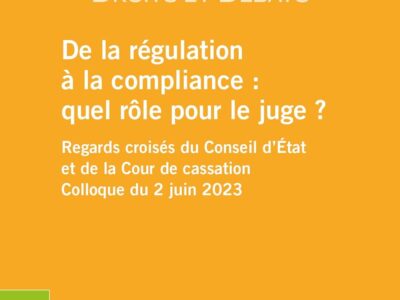
📝Le rôle du juge dans le déploiement du droit de la régulation par le droit de la compliance (The role of the Judge in the deployment of Regulatory Law through Compliance Law), synthesis in 🏛️Conseil d’État and 🏛️Cour de cassation, 📗De la régulation à la compliance : quel rôle pour le juge ?

► Full Reference: M.-A. Frison-Roche, "Le rôle du juge dans le déploiement du droit de la régulation par le droit de la compliance" ("Synthesis: The role of the Judge in the deployment of Regulatory Law through Compliance Law"), Synthesis in Conseil d'État (French Council of State) and Cour de cassation (French Court of cassation), De la régulation à la compliance : quel rôle pour le juge ? Regards croisés du Conseil d'État et de la Cour de cassation – Colloque du 2 juin 2023, La Documentation française, "Droits et Débats" Serie, 2024, pp. 173-182 - 🎥this article follows the closing speech of the biannual symposium organised by the Council of State and the Court of cassation, which in 2023 was entitled De la régulation à la compliance : quel rôle pour le juge ? (From Regulation to Compliance, what role for the judge ?) - 🚧read the bilingual Working Paper which is the basis of this article, with additional developments, technical references and hyperlinks - ► Presentation of this concluding article: It is remarkable to note the unity of conception and practice between professionals who tend to work in administrative jurisdictions and professionals who tend to work in judicial jurisdictions: they all note, in similar terms, an essential movement: what Regulatory Law is, how it has been transformed into Compliance Law, and how in one and even more so in the other the Judge is at the centre of it. Judges, as well as Regulators and European officials, explain this and use different examples to illustrate the far-reaching changes it brings to the Law and to the companies responsible for increasing the systemic effectiveness of the rules through the practice and dissemination of a Culture of Compliance. The role of the judge participating in this Ex Ante transformation is renewed, whether he/she is a judge of Public Law or a judge of Private Law, in a greater unity of the legal system. - ► English Summary of this article: The tug-of-war between 'Compliance' and 'conformity', which is exhausting us, obscures what is essential, i.e. the great novelty of a branch of law that assumes a humanist vision expressing the ambition to shape the future so that it is not catastrophic (preventing systems from collapsing), or even better (protecting human beings in these systems). The article begins by describing the emergence of Compliance Law, as an extension of Regulatory Law and going beyond it. This new branch of law takes account of our new world, brings its benefits and seeks to counter these systemic dangers so that human beings could be their beneficiaries and are not crushed by them. This branch of Ex Ante Law is therefore political, often supported by public Authorities, such as Regulatory Authorities, but today it goes beyond sectors, as shown by its cutting edge, the Obligation of Vigilance. The "Monumental Goals" in which Compliance Law is normatively anchored imply a teleological interpretation, leading to an "empowerment" of the crucial operators, not only States but also companies, responsible for the effectiveness of the many new Compliance Tools. The article goes on to show that Judges are increasingly central to Compliance Law. Lawsuits are designed to make companies more accountable. In this transformation, the role of the judge is also to remain the guardian of the Rule of Law, both in the protection of the rights of the defence and in the protection of secrets. Efficiency is not what defines Compliance, which should not be reduced to a pure and simple method of efficiency, which would lead to being an instrument of dictatorship. This is why the principle of Proportionality is essential in the judge's review of the requirements arising from this so powerful branch of Law.  The courts are thus faced with a new type of dispute, of a systemic nature, in their own area, which must not be distorted: the Area of Justice. - 📝read article (in French) - 🌐follow Marie-Anne Frison-Roche on LinkedIn 🌐follow Marie-Anne Frison-Roche on Instagram 🌐subscribe to the Newsletter MAFR Regulation, Compliance, Law