Risk

Articles in The Journal of Regulation & Compliance « JoRC »

LAMOUREUX, Marie🕴️

📝L’obligation de vigilance des opérateurs énergétiques (“The Vigilance Obligation of the Energy Operators”), in 🕴️M.-A. Frison-Roche (ed.), 📕L’obligation de Compliance (“Compliance Obligation”)e (

► Full Reference: M. Lamoureux, "L’obligation de vigilance des opérateurs énergétiques", in M.-A. Frison-Roche (dir.), L'obligation de Compliance, Journal of Regulation & Compliance (JoRC) and Dalloz, coll. "Régulations & Compliance", 2024, to be published - 📕read the general presentation of the book, L'obligation de Compliance, in which this contribution is published - ► English summary of this article de l'article (done by the Journal of Regulation & Compliance – JoRC): Firstly, the author shows, despite the diversity of energy activities (electricity by its very nature involves fewer international value chains, oil by its very nature involves more), the operators in this sector are sufficiently unique to justify their being considered globally in terms of vigilance obligation. Currently in French case law, they are directly concerned, not only because they have been summoned before the French courts in duty of vigilance cases, but also, and above all, because they are a sign of the intensity of the vigilance expected of them. The first part of the article develops the characteristics of energy operators, which influence the intensity of the obligation of vigilance. Their uniqueness stems precisely from the enterprises themselves, which are 'giants', subject to the obligation to draw up vigilance plans, firms often vertically integrated, in a sector concentrated on multinationals with very substantial resources and present throughout the value chain, whose activity involves infrastructures. The second part of the article justifies this intensity of the obligation of vigilance by the risks specifically linked to the activities of these energy operators. Indeed, even if it is true that their activity is very heterogeneous, the risks are very significant, in that on the one hand they build diverse and gigantic infrastructures, are involved in extractive activity, and on the other hand have a long-term impact on the environment. Firms are being asked to be vigilant themselves about these infrastructures and impacts. The administrative police have been doing this for a long time in this sector. But the third part of the article shows precisely that this is nothing new: the culture of risk prevention is already very present in these enterprises, not least because of the very strong presence of the State and regulations. There is a culture of 'regulatory conformity'.  In fact, climate vigilance  relies mainly on these operators. Energy operators are therefore at the centre, not only because they generate risks, but also because they hold many of the solutions for achieving the Monumental Goals targeted by the vigilance system: they are making a decisive contribution to the fight against climate change because they have the means to do so. This is one of the reasons why the major operators have all adopted a raison d'être.         -

Articles in The Journal of Regulation & Compliance « JoRC »

ROUAUD, Anne-Claire🕴️

📝L’intensité de l’obligation de vigilance selon les secteurs : le cas des opérateurs financiers (“The intensity of the obligation of vigilance depending on the sector: the case of financial operators”), in 🕴️M.-A. Frison-Roche (ed.), 📕L’Obligation de Compliance

► Full Reference: A.-C. Rouaud, "L’intensité de l’obligation de vigilance selon les secteurs : le cas des opérateurs financiers" (The intensity of the obligation of vigilance depending on the sector: the case of financial operators), in M.-A. Frison-Roche (dir.), L'Obligation de Compliance, Journal of Regulation & Compliance (JoRC) an Dalloz, coll. "Régulations & Compliance", 2025, pp. 539-550. - 📕read the general presentation of the book, L'Obligation de Compliance, in which this contribution is published - ► English summary of this contribution (done by the Journal of Regulation & Compliance – JoRC) : The author develops the case of financial operators and shows that if they are subject to very heavy obligations of vigilance, it is above all because of the systemic risks of the markets, obligations which are consubstantial with their activities, because these operators are often in charge of market infrastructures or operating services, which make them all belong to the category of regulated professions. Despite this uniqueness, the obligation of vigilance has many facets, ranging from policing and customer surveillance to warning and protection, which can be very limited, as the fight against money laundering aims to protect the system (kyc). In addition, this obligation to exercise vigilance serves different goals, which explains the diversity of sanctions, because the intensity of the obligation also varies. The fight against systemic risk is certainly a common goal, but there are also concerns about protecting specific categories, such as investors (from a more European perspective). However, the general interest is now being renewed, as market protection is coupled with a concern for Sustainability. This is reflected in the variability of sanctions, ranging from disciplinary sanctions, handled by the financial markets regulatory bodies, to the obligation to put in place compliance programmes against which breaches are sanctioned per se. Private enforcement is developing in tandem with public enforcement, with a transformation of the litigation risk for companies, which is highly sensitive to extraterritoriality and the scope of soft law.     -

Articles in a legal collective publication

article in a collective legal publication

📝100 fois remettre la Compliance sur le métier de la Stratégie (“100 times put Compliance back on the Strategy agenda”)

► Full Reference: M.-A. Frison-Roche, "100 fois remettre la Compliance sur le métier de la Stratégie" (100 times put Compliance back on the Strategy agenda), in Lettre d'information Compliance. Groupe SNCF, 100ième issue, 28 may 2025. - 📝read the article (in French) - ► English presentation of this article: This anniversary article sets out what Compliance is and should be in a large group. It expresses it in 4 points: 1. Actively master regulations by understanding their spirit 2. Improving risk detection without taking away the entrepreneurial spirit 3. Promoting convergence and managing conflict 4. Strengthen the company's identity by focusing on its strategic ambitions     - 🌐follow Marie-Anne Frison-Roche on LinkedIn 🌐follow Marie-Anne Frison-Roche on Instagram 🌐subscribe to the Newsletter MAFR Regulation, Compliance, Law 🌐subscribe to the Video Newsletter MAFR Surplomb

Conferences

introductory conference

🎥Le juriste, requis et bien placé pour le futur ((The lawyer needed and well placed for the future), in 🧮Les Eclaireurs du Droit

► Full Reference : M.-A. Frison-Roche, "Le juriste, requis et bien placé pour le futur" (The lawyer needed and well placed for the future), in Groupe Lamy Liaisons, Les Éclaireurs du Droit,  Hôtel de l’Industrie, Place Saint Germain des Près, Paris, 11 March 2025, 16h. - This speech opens a series of 4 workshops on the following themes: – The challenge of Trust – The challenge of Risk – The challenge of Transmission – The challenge of  leadership - 🧮see the full programme of this manifestation (in French) - ⬜see the slides basis made for this speech (which were not projected) (in French) - 🎥 watch the short video made after the conference (in French) - ► English Summary of this introductory conference: The 4 sessions will address the successive themes of trust, risk, transmission and leadership, which legal professionals are facing, particularly as a result of algorithms. For an introductory analysis, it is possible to make a distinction inside the Future. The future has a part of Stability: the jurist can contribute to this stability, i.e. the preservation of the past (I). The future has an part of Predictability: the lawyer must increase this part in the present itself (II). The future has a part of radical novelty (III): at this point, which may correspond to a precipice, if no one had imagined it, the lawyer can also be there. Until now, we think of lawyers more in the first 2 hypotheses, less in this one. Is it pertinent? In each of these dimensions, the algorithmic system (AI) is presented as replacing or dominating the human. In each of these 3 dimensions, Lawyers must be present, as they form a community that must remain united around the very idea of Law (algorithms do not conceive ideas, it is humans who transmit them to other humans, and the algorithmic system must remain a medium). As far as the Stability of the future is concerned, the Lawyer can and must contribute to it, in particular through Transmission, because there is less of a blank page as algorithmic 'creation' is based on past data, and training, where the human being will be all the more central as machines have to be handled. As far as the Predictability of the future is concerned, it is a question of assessing the Risks, whether specific or systemic, legal or non-legal, in order not to take them or on the contrary to take them. The more the Lawyer is involved in risk-taking, the more he or she will be in the right place, before and during the action. As far as the Radically New future is concerned, it is not easy to qualify AI as such or not, but now the possible disappearance of the Rule of Law in the United States is one of them. All Lawyer are expected. Every lawyer must have two virtues (which the algorithm cannot not have): the virtue of Justice and the virtue of Courage. It is these virtues that we must pass on and share.       - Current events have led me to devote the time available to me to focusing on a single perspective, the third, to say what is expected of Lawyers if we perceive something radically new in the near future, what everyone does. Indeed, in the United States, on the one hand there is a head of state for whom the Law does not exist and who uses the power of regulation to express his absolute indifference to other states, companies and human beings, and on the other an entrepreneur who claims that he is going to become the master of algorithmic technology, a system over which he already wields great power. Faced with this Radical Novelty, we expect the community of Lawyers, all lawyers, whatever their place, their technical mastery, their level, their nationality, to speak out and say No. As Kelsen, Cassin or Ginsberg did. Say No and help others to say No. To do this, Lawyers, as human beings who care about other human beings, must be aware of the twofold virtue expected of them: the virtue of commitment to Justice and the virtue of Courage.       - 🌐follow Marie-Anne Frison-Roche sur LinkedIn 🌐follow Marie-Anne Frison-Roche on Instagram 🌐subscribe to the Newsletter MAFR Regulation, Compliance, Law 🌐subscribe to the Video Newslette MAFR Surplomb

Conferences

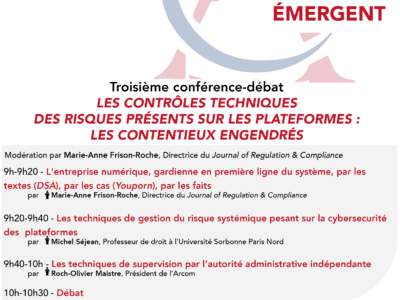
🎤Le Contentieux Systémique Emergent du fait du système numérique (“emerging systemic litigation arising from the digital system”), in 🧮Importance et spécificité du Contentieux Systémique Émergent, cycle de conférences-débats “Contentieux Systémique Émergent”

► Full Reference: M.-A. Frison-Roche, "Le Contentieux Systémique Emergent du fait du système numérique ("emerging systemic litigation arising from the digital system"), in Les contrôles techniques des risques présents sur les plateformes et les contentieux engendrés (Technical controls on the risks present on platforms and the disputes that arise), in cycle of conferences-debates "Contentieux Systémique Émergent" ("Emerging Systemic Litigation"), organised on the initiative of the Cour d'appel de Paris (Paris Cour of Appeal), with the Cour de cassation (French Court of cassation), the Cour d'appel de Versailles (Versailles Court of Appeal), the École nationale de la magistrature – ENM (French National School for the Judiciary) and the École de formation des barreaux du ressort de la Cour d'appel de Paris – EFB (Paris Bar School), under the scientific direction of Marie-Anne Frison-Roche, May 27,2024, 9h-10h30, Cour d'appel de Paris, Cassin room - 🧮see the full programme of this event - 🧮see the full programme of the entire cycle Contentieux Systémique Émergent (Emerging Systemic Litigation) - 🔲see the slides (in French), basis of this conference - 🌐read on  LinkedIn the summary of this conference les slides - 🎤read  the presentation of the second conference in this manifestation: "Un contentieux systémique in vivo : le cas dit des sites pornographiques" ("a Systemic Litigation in vivo: the case of pornographic prestations platforms") - 🧱read the general presentation of this scientific coordination of this manifestation and its various speechs - 🌐read on LinkedIn the summary of this manifestation in the Newsletter MAFR Regulation, Compliance, Law - ► Summary of this conference: This speech is a prelude to the three more specific speeches and aims to show how the digital system, by its very nature, produces and will produce "Systemic Litigation".  Systemic Litigation" is defined by "cases" (a procedural notion) brought before judges, who may be judges of first instance, or possibly emergency judges, in which the interests, or even the future, of a system are involved beyond the dispute between the parties.  This Systemic Case may be brought before a specialised judge, including the juridictional body of a Regulatory or Supervisory Authority, but also before a judge of ordinary Law, on the basis of a special text but possibly on the basis of a text of ordinary Law. This can lead to a fragmentation of litigation, even though the unity of the system remains, or even is at stake, in the present and in the future. The "digital system" is an example of the "natural" production of Systemic Litigation which arise as a result of the Digital System alone, in particular because of the systemic risks inherent in this system, and the fact that their prevention and management are internalised in the operators who have built and manage the system (Compliance Law). The issue is therefore one of Interregulation. Platforms in particular give rise to Systemic Litigation because of the specific nature of certain risks, for example disinformation, terrorism, destruction of rights (copyright being just one example), the risk of minors having access to content that is destructive for them, and so on. Digital Systemic Litigation has only just begun. It is essential that judges are prepared for this and that they face up to it together through dialogue.             - 🌐follow Marie-Anne Frison-Roche on LinkedIn 🌐follow Marie-Anne Frison-Roche on Instagram 🌐subscribe to the Newsletter MAFR Regulation, Compliance, Law

Conferences

🎤Synthèse, in 🧮Concurrence : les enjeux de la Compliance

► Full Reference: M.-A. Frison-Roche, "Synthèse" ("Synthesis"), in Concurrence : les enjeux de la Compliance​, May 24, 2024, Paris, Collège européen de Paris, Paris Panthéon-Assas University, 28 rue Saint-Guillaume - 🧮see the full programme of this event (in French):  🌐read the  la newsletter MAFR Law, Compliance, Regulation on 26 Mai 2024 about this colloquium and this synthesis (in English) - ► Summary of this concluding conference:The conference was based on the 'framework document' on conformity programmes published by the French Competition Authority, the Autorité de la concurrence, on 24 May 2022 and focused on one of the tools used, namely risk mapping. The care taken to bring together academics whose job it is to give an account of reality by classifying and naming it, which makes it easier to handle, and people who every day in enterprises find solutions to anticipate difficulties so that they can be resolved, or even prevented from arising, has borne fruit. - From all the presentations and discussions, 4 perspectives emerge, each showing what has been achieved, what may still emerge in interaction with all the other mechanisms in Compliance Law that incorporate risk mapping (for instance ,the French 2016 so-called "Sapin 2" law, the French 2017 so-called "Vigilance" law, the CS3D European directive, etc.) and the other mechanisms that are correlated with risk mapping (audit, internal investigations, evidence likely to be raised before a judge by the enterprise and/or by a stakeholder and what remains uncertain in this 2022 framework document.   - The first perspective is the basis of these recommendations, encouragement, methods, advice, etc. The second perspective is the means developed to establish and implement these compliance programmes. The third perspective is the scope of this framework document, which also depends to a large extent on the scope of the compliance programmes adopted by the firms themselves. The fourth perspective is that of the subjects of law who are obliged, or who benefit from the adoption of such  compliance programmes in Competition Law.   - During this conclusion, based solely on what each speaker had to say, I continued my reflections in each of these 4 directions. This reminded me of some of my work made in English on this subject:  M.-A. Frison-Roche (ed.), 📘Compliance Tools, ,2022   M.-A. Frison-Roche, 🚧 Support from Compliance Law for day-to-day management of Competition Law, 2021   M.-A. Frison-Roche, 🚧 Competition Law and Compliance Law, 2018   - 🌐follow Marie-Anne Frison-Roche on LinkedIn 🌐follow Marie-Anne Frison-Roche on Instagram 🌐subscribe to the Newsletter MAFR Regulation, Compliance, Law

Articles in The Journal of Regulation & Compliance « JoRC »

MERABET, Samir🕴️

📝Vigilance, being a judge and not judge, in 🕴️M.-A. Frison-Roche (ed.), 📘Compliance Jurisdictionalisation

► Full Reference: S. Merabet, "Vigilance, being a judge and not judge", in M.-A. Frison-Roche (ed.), Compliance Jurisdictionalisation, Journal of Regulation & Compliance (JoRC) and Bruylant, "Compliance & Regulation" Serie, 2024, pp. 218-228 - 📘read a general presentation of the book, Compliance Jurisdictionalisation, in which this article is published - ► Summary of the article: - 🦉This article is available in full text to those registered for Professor Marie-Anne Frison-Roche's courses -

Articles in The Journal of Regulation & Compliance « JoRC »

BRUNEAU, Alain🕴️

📝The company judges itself: the Compliance function in the bank, in 🕴️M-A Frison-Roche (ed.), 📘Compliance Jurisdictionalisation

► Full Reference: A. Bruneau, "The company judges itself: the Compliance function in the bank", in M.-A. Frison-Roche, (ed.), Compliance Jurisdictionalisation, Journal of Regulation & Compliance (JoRC) and Bruylant, coll. "Compliance & Regulation", 2024, pp. 127-145 - 📘read a general presentation of the book, Compliance Jurisdictionalisation, in which this article is published - ► Summary of the article: First, it should be remembered that the compliance function was born within finance, and that by being structured, it has evolved to support the transition from regulatory law to compliance law. Through these changes, compliance has gone from an ex-post controlling function to an ex-ante binding function. The LIBOR crisis imperfectly illustrates the primacy of this transition. The evolution of this role is illustrated by concrete examples. Firstly, the management of reputational risk is a fundamental part of the company as prosecutor and judge of itself. Reputational risk is a significant element for a financial institution, because it can have negative consequences on its capitalization, or even culminate in a systemic crisis. Avoiding a large-scale financial crisis is also part of the monumental goals of compliance. In order to avoid complex and inopportune scenarios, compliance law intervenes as early as possible and identifies issues that may impact reputation. The regulations require the implementation of certain ex ante mechanisms. The French law known as "Sapin 2" requires the implementation of tools that concern all companies (and not just banks). Indeed, beyond the risk of reputation, it is essential to consider the risk of corruption. Consideration of reputational risk may justify refusing to execute certain transactions. From this perspective, compliance must assess the potential consequences of entering into a relationship with a new client upstream, sometimes to decline the provision of services. The compliance function therefore unilaterally judges the relationship with a view to managing the company reputational risk. Secondly, the internal sanction mechanism established by compliance law is also discussed in this article, in particular the internal sanctions adopted by compliance in a financial institution. Compliance can act as a prosecutor via management committees set up within the business lines. In addition, compliance can determine and apply sanctions against employees. In this way, there is a dual role of prosecutor and judge for the compliance function within the framework of an extraordinary mechanism of ordinary law. Finally, the analysis deals with the case of the "judge-judged": following a decision by the bank, the regulator may take an even stricter position by believing that the bank is applying its guidelines incorrectly. Thus, the compliance law, which takes hold within the banking enterprise, finds itself under the judgment of its own regulator. The company finds itself judged and comes to be a prosecutor and judge of itself, but also of its clients. - 🦉This article is available in full text to those registered for Professor Marie-Anne Frison-Roche's courses -

Books

📗Les risques climatiques à l’épreuve du droit

► Full Reference:  M. Torre Schaub, A. Stevignon and B. Lormeteau (ed.), Les risques climatiques à l'épreuve du droit, Mare & Martin, coll. "Collection de l'Institut des sciences juridique et philosophique de la Sorbonne", 2023, 362 p. - ► read the table of content (in French) - ► read the backcover (in French) - ► Summary of the book (done by the publisher, in French): "Le présent ouvrage explore l’appréhension juridique d’un nouveau concept : le « risque de transition », concept découlant du changement climatique. En effet, le phénomène du changement climatique crée et amplifie des aléas qui sont à l’origine de plusieurs périls encore peu considérés par le droit (risques contentieux, financiers et réglementaires). Pour assurer la pérennité de nos sociétés, toutes les dimensions de ces dangers doivent être identifiées et traitées. Les contributions proposées ont pour objectif de dresser une typologie des risques climatiques et de présenter des pistes juridiques pour y faire face. À l’échelon global, national et territorial, se pose la question de la reformulation de la responsabilité des États, mais également des acteurs privés (entreprises, banques, sociétés d’investissement), face aux aléas non maîtrisés. De nouvelles législations et réglementations internationales, européennes et nationales émergent, tendant à aborder ces risques. Cet ouvrage en fait état, ainsi que des développements contentieux climatiques inédits que s’y rattachent.". - 📝read the article of Marie-Anne Frison-Roche : "Droit de la compliance et climat. Pour prévenir le risque et construire l'équilibre climatiques" ("Compliance Law and climate. Prevent the climate risk and build the climate balance") -

Articles in a legal collective publication

📝Droit de la compliance et climat. Pour prévenir le risque et construire l’équilibre climatiques, in 🕴️M. Torre Schaub, 🕴️A. Stevignon et 🕴️B. Lormeteau (ed.), 📗Les risques climatiques à l’épreuve du droit

► Full Reference: M.-A. Frison-Roche, "Droit de la compliance et climat. Pour prévenir le risque et construire l'équilibre climatiques" ("Compliance Law and climate. Prevent the climate risk and build the climate balance"), in M. Torre Schaub, A. Stevignon and B. Lormeteau (ed.), Les risques climatiques à l'épreuve du droit, Mare & Martin, coll. "Collection de l'Institut des sciences juridique et philosophique de la Sorbonne", 2023, pp. 73-83 - 📝read the article (in French) - 🚧read the bilingual Working Paper which is the basis of this article, with additional developments, technical references and hyperlinks - ► Summary of the article: Compliance Law is beginning to emerge in climate topic, through the expression  "Climate Compliance Law", but the climate issue itself is the most perfect example of why General Compliance Law is made for.  It is indeed a new branch of Law, a global Law claiming to provide Ex Ante solutions here and now for global issues, so that in the future systemic catastrophies will not occur, will not happen: it is these "Monumental Goals" that give meaning, coherence, and simplicity to Compliance Law. Compliance Law, linked to the Rule of Law principle, makes it possible to go beyond the choice often presented between the effectiveness of the protection of the planet and the renunciation of freedoms, in particular the freedom to do business and the freedom of individuals, especially the protection of their data. Climate is thus exemplary of the object of Monumental Goals of Compliance Law (I). The systemic risk that it now constitutes is analogous to Banking or Digital Systemic Risks and therefore calls for the application of identical legal Compliance Tools, formerly put in place for Banking Regulatory and Compliance Law, recently invented for Digital. Compliance Law, extending Regulation Law, itself from the precondition of the Sector and the Territory, is therefore the branch which makes it possible to put in place new legal solutions, either by force (judicial agreements, compliance programs, etc.), or by will (commitments, global charters, etc.). Therefore, an alliance can exist between political and public authorities, and crucial economic operators (II), that the rise in power of the "raison d'être" is the sight and whose technical challenge is the collection of information that must be put in correlation. Scientists pooling Information, this public good, provided by public and private entities. The courts are at the center of this articulation between Compliance Law and Climate, which object is the Future. - 🌐follow Marie-Anne Frison-Roche on LinkedIn 🌐follow Marie-Anne Frison-Roche on Instagram 🌐subscribe to the Newsletter MAFR Regulation, Compliance, Law

Articles in The Journal of Regulation & Compliance « JoRC »

BRUNEAU, Alain🕴️

📝L’entreprise juge d’elle-même: la fonction compliance dans la banque, in 🕴️M.-A. Frison-Roche (ed.), 📕La juridictionnalisation de la Compliance

► Full Reference: A. Bruneau, "L'entreprise juge d'elle-même : la fonction compliance dans la banque" ("The company judge of itself: the compliance function inside the bank"), in M.-A. Frison-Roche (ed.), La juridictionnalisation de la Compliance, coll. "Régulations & Compliance", Journal of Regulation & Compliance (JoRC) and Dalloz, 2023, pp. 115-131.  - 📕read a general presentation of the book, La juridictionnalisation de la Compliance, in which this article is published     - ► Summary of the article (done by the author): First of all, it should be remembered that the compliance function was born within finance, and that by being structured, it has evolved to support the transition from regulatory law to compliance law. Through these changes, compliance has gone from an ex-post controlling function to an ex-ante binding function. The LIBOR crisis imperfectly illustrates the primacy of this transition. The evolution of this role is illustrated by concrete examples Firstly, the management of reputational risk is a fundamental part of the company as prosecutor and judge of itself. Reputational risk is a significant element for a financial institution, because it can have negative consequences on its capitalization, or even culminate in a systemic crisis. Avoiding a large-scale financial crisis is also part of the monumental goals of compliance. In order to avoid complex and inopportune scenarios, compliance law intervenes as early as possible and identifies issues that may impact reputation. The regulations require the implementation of certain ex ante mechanisms. The French law known as "Sapin 2" requires the implementation of tools that concern all companies (and not just banks). Indeed, beyond the risk of reputation, it is essential to consider the risk of corruption. Consideration of reputational risk may justify refusing to execute certain transactions. From this perspective, compliance must assess the potential consequences of entering into a relationship with a new client upstream, sometimes to decline the provision of services. The compliance function therefore unilaterally judges the relationship with a view to managing the company reputational risk. Secondly, the internal sanction mechanism established by compliance law is also discussed in this article, in particular the internal sanctions adopted by compliance in a financial institution. Compliance can act as a prosecutor via management committees set up within the business lines. In addition, compliance can determine and apply sanctions against employees. In this way, there is a dual role of prosecutor and judge for the compliance function within the framework of an extraordinary mechanism of ordinary law. Finally, the analysis deals with the case of the "judge-judged": following a decision by the bank, the regulator may take an even stricter position by believing that the bank is applying its guidelines incorrectly. Thus, the compliance law, which takes hold within the banking enterprise, finds itself under the judgment of its own regulator. The company finds itself judged and comes to be a prosecutor and judge of itself, but also of its clients. -

Articles

Why do we regulate? If it is to prevent systemic risks, systemic “family offices” must be subject to it (Archegos case) (Pourquoi régule-t-on? Si c’est pour prévenir les risques systémiques, les “family offices” systémiques doivent y être soumis (cas Archegos))

Full reference: Frison-Roche, M.-A., Why do we regulate? If it is to prevent systemic risks, systemic "family offices" must be subject to it (Archegos case) (Pourquoi régule-t-on? Si c'est pour prévenir les risques systémiques, les "family offices" systémiques doivent y être soumis (cas Archegos)), Newsletter MAFR – Law, Compliance, Regulation, 30th of March 2021 Read by freely subscribing other news of the Newsletter MAFR – Law, Compliance, Regulation   Summary of the news:  Archegos was a wealth management company whose activity consisted mainly in managing funds that were not themselves from the financial markets (hence its title of "family office"). Obviously, Archegos was proving to be too fragile financially in view of the highly speculative commitments it made on the financial markets and systemic banks were particularly deeply affected by the liquidation of large amounts by Archegos to be able to respond to margin calls. As the mandate of the financial regulatory authorities is aimed almost exclusively at the protection of public savings, Archegos completely escaped the regulation and supervision of the Securities and Exchange Commission (SEC). However, Regulation Law also aims to prevent and manage systemic risks, which are often multi-sectoral and even trans-sectoral, and this in a teleological way. In view of this and the increasingly important place taken by speculative behavior in the financial markets, the financial regulatory authorities must give up the condition of using public savings in their consideration of operators which should be regulated because even an operator not handling public savings can threaten the existence of financial markets. From this perspective, "family offices", not handling public savings but having a systemic dimension, must come under the regulation and supervision of financial regulatory authorities.