Organisation of events
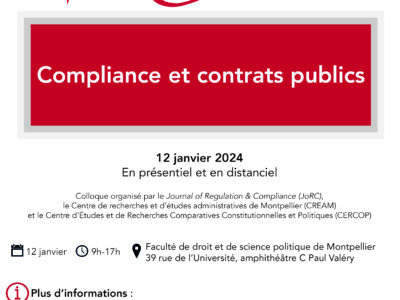
► Full Reference: M.-A. Frison-Roche, C. Gilles and A. Oumedjkane (dir.), Compliance et contrats publics (Compliance and public contracts), Journal of Regulation & Compliance (JoRC), Centre de recherches et d’études administratives de Montpellier (CREAM) and Centre d’Études et de Recherches Comparatives Constitutionnelles et Politiques (CERCOP) of the Montpellier University, Faculté de droit et de science politique de Montpellier, January 12, 2024 - consult a general presentation of this event on LinkedIn, linking to a presentation of each speech (in French) - 🏗️This symposium takes place in the cycle of symposiums organised by the Journal of Regulation & Compliance (JoRC) and its partners Universities, focusing in 2023-2024 on the general theme of the Compliance Obligation - 📚The works will then be inserted in the books: 📕Compliance et contrat, to be published in the 📚Régulations & Compliance Serie, co-published by the Journal of Regulation & Compliance (JoRC) and Dalloz, published in French. 📘Compliance & Contract, to be published on the 📚Compliance & Regulation Serie, co-published by the Journal of Regulation & Compliance (JoRC) and Dalloz, published in English. - ► General presentation of the symposium: Compliance is developing throughout the legal system, through both Public and Private Law techniques. Public Contract Law bears witness to this in two ways: through its scope, in that Compliance applies to economic relationships entered into by public bodies, and through its object, which internalises a reconciliation between their economic interests and a set of other general interest objectives, or “Monumental Goals”, a reconciliation for which public bodies have traditionally been responsible. In addition to unilateral acts, contracts have their rightful place as a practical means of achieving this reconciliation. Its flexibility allows for negotiation and adjustment of the burdens to be placed on the co-contracting parties. The aim of this symposium is to link the different manifestations of the Compliance Obligation in public contracts and thus give coherence to policies which are still too often considered in a watertight manner because they relate to very different aims and areas. Firstly, at the procurement stage, the promotion of responsible or innovative procurement, particularly from an environmental point of view, is one of the signs of Compliance’s presence. On a completely different note, the same is true of the CJEU’s challenge to the automatic application of bans on tendering, which prevent contracting authorities from ruling on a candidate’s reliability by taking into account the compliance programmes implemented by companies since their conviction. Secondly, at the litigation stage, the Conseil d’État‘s (French Council of State) recent broad recognition of the illegality of an administrative contract on the grounds of a breach of ethical obligations has tempered the drive to make contracts more secure, drawing the consequences of the major drive for transparency in public life that has been underway since 2013. The aim of the morning session will be to understand the various forms of the Compliance Obligation in public contracts. This overview will make it possible, in the afternoon, to aim to unify the Compliance Obligation in public contracts. - - ► Speakers: 🎤Ugo Assouad, PhD student at the Montpellier University, CREAM 🎤Philippe Augé, President of the Montpellier University 🎤Clémence Ballay-Petizon, PhD student at the Montpellier University, CREAM 🎤Yannisse Benrahou, PhD student at Paris-Nanterre University, CRDP 🎤Léon Boijout, PhD student at the Montpellier University, CREAM 🎤Julien Bonnet, Full Professor at the Montpellier University, CERCOP 🎤Guylain Clamour, Dean of the Montpellier Faculty of Law and Political Science 🎤Marie-Anne Frison-Roche, Professor of Regulatory and Compliance Law, Director of the Journal of Regulation & Compliance (JoRC) 🎤Pierre-Yves Gadhoun, Professor at the Montpellier University, CERCOP 🎤Pascale Idoux, Professor at the at the Montpellier University, CREAM 🎤Nedjma Kontoukas, PhD student at the Montpellier University, CREAM 🎤Valentin Lamy, Senior Lecturer at the Lorraine University, IRENEE 🎤Antoine Oumedjkane, Senior Lecturer at Lille University, ERDP 🎤Lucien Rapp, Emeritus Professor at Toulouse Capitole University 🎤Marion Ubaud-Bergeron, Full Professor at the Montpellier University, CREAM - 🧮Read a detailed presentation of the event below⤵️