Proof

Articles in The Journal of Regulation & Compliance « JoRC »

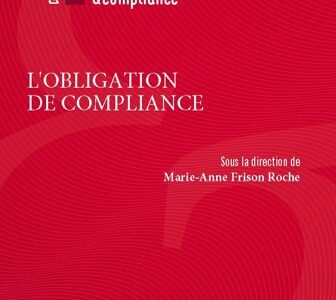
📝La preuve de la bonne exécution de la Vigilance au regard du système probatoire de Compliance (Proof that Vigilance has been properly carried out with regard to the Compliance evidence system), in 🕴️M.-A. Frison-Roche (dir.), 📕L’obligation de Compliance (“Compliance Obligation”)

► Full Reference: J.-Ch. Roda "La preuve de la bonne exécution de la Vigilance au regard du système probatoire de Compliance (Proof that Vigilance has been properly carried out with regard to the Compliance evidence system)", in M.-A. Frison-Roche (ed.), L'Obligation de Compliance, Journal of Regulation & Compliance (JoRC) and Éditions Lefebvre – Dalloz, coll. "Régulations & Compliance", 2025, pp. 679-689.   - 📕read a general presentation of the book, L'Obligation de Compliance, in which this article is published  - ► English summary of this contribution : Taking the Duty of Vigilance as an illustration, the first part of the article examines the question of who must prove about that and in what order. There are no rules in the legal dispositions specific to the Vigilance Duty duty that expressly reverse the burden of proof, to the extent of placing it on the company that should demonstrate that it has correctly fulfilled its obligation. Instead, it is needed to return to general law, which makes the burden of proof vary according to the nature of the obligations incumbent on the company as a result of its Duty of Vigilance, in particular between simplly drawing up a plan and drawing it up such that its effectiveness can be expected to give rise to an obligation on those who dispute it to demonstrate its ineffectiveness. In any event, the 2 litigant parties immediately seek to fuel the debate with elements in their favour, whatever their position in the process. This brings us to the second part of the article, devoted to the question of what constitutes proof of proper performance of the Vigilance Duty. Requiring proof of a positive fact and the constitution of a self-evidence of conformity would both be excessive and would distance the company from the Monumental Goals that are its compass. Instead, it is pertinent to distinguish between Compliance Structures, for which the proof requirements must be high, and Expected Compliance Actions, for which proof of efforts is sufficient, the obligation being only of means. In fact, companies will be wise to provide proof of their efforts as early as possible. The third part therefore deals logically with the means of proof available to the parties. Claimants act on the principle of freedom of evidence and benefit from numerous sources of information, but the most serious difficulties arise when the facts to be proven are located outside the European Union. The company can establish that the plan has been implemented using various types of evidence, but it would appear that the standard of proof is high, even if the Vigilance Plan were to be regarded as an act of management. - 🦉This article is available in full texte for people who follow  Professor Marie-Anne Frison-Roche teaching
Organisation of events

⚙️ scientific organisation of a public manifestation

🧱⚙️scientific organisation and moderation of 🧮Les techniques probatoires adéquates dans le Contentieux Systémique Émergent (Appropriate Evidentiary Techniques in Emerging Systemic Litigation), in cycle of conference-debates “Contentieux Systémique Émergent” (“Emerging Systemic Litigation”)

► Full Reference: Les techniques probatoires adéquates dans le Contentieux Systémique Émergent (Appropriate Evidentiary Techniques in Emerging Systemic Litigation), in cycle of conference-debates "Contentieux Systémique Émergent" ("Emerging Systemic Litigation"), organised on the initiative of the Cour d'appel de Paris (Paris Cour of Appeal), with the Cour de cassation (French Court of cassation), the Cour d'appel de Versailles (Versailles Court of Appeal), the École nationale de la magistrature – ENM (French National School for the Judiciary) and the École de formation des barreaux du ressort de la Cour d'appel de Paris – EFB (Paris Bar School), under the scientific direction of Marie-Anne Frison-Roche, October 14, 2024, 11am.-12.30pm., Paris Court of Appeal, Masse courtroom - ► Presentation of the conference:  - 🧮Programme of this event:  Sixth conference-debate LES TECHNIQUES PROBATOIRES ADÉQUATES DANS LE CONTENTIEUX SYSTÉMIQUE ÉMERGENT  (APPROPRIATE EVIDENTIARY TECHNIQUES IN EMERGING SYSTEMIC LITIGATION) Cour d’appel de Paris, salle Masse Presentation and moderation by 🕴️Marie-Anne Frison-Roche, Professor of Regulatory and Compliance Law, Director of the Journal of Regulation & Compliance (JoRC) 🕰️11am.-11.10am. 🎤La crédibilité (Credibility), by 🕴️Marie-Anne Frison-Roche, Professor of Regulatory and Compliance Law, Director of the Journal of Regulation & Compliance (JoRC) 🕰️11.10am.-11.30am. 🎤Ce que des entreprises font et les preuves disponibles qui en résultent (What firms are doing and evidence available as a result), by 🕴️Nathalie Fabbe-Costes, Professor of management at Aix-Marseille University  🕰️11.30am-11.50am. 🎤Les différentes techniques probatoires quand un système est impliqué dans un litige (The various evidential techniques when a system is involved in a dispute), by 🕴️Thibault Goujon-Bethan, Professor of Law at Jean-Moulin Lyon 3 University, director of the Centre patrimoine et contrats, director of the IEJ de Lyon 🕰️11.50am.-12h30pm. Debate - 🔴Registrations and information requests can be sent to: inscriptionscse@gmail.com 🔴For the attorneys, registrations have to be sent to the following address: https://evenium.events/cycle-de-conferences-contentieux-systemique-emergent/  ⚠️The conference-debates are held in person only, in the Cour d’appel de Paris (Paris Court of Appeal). -

Conferences

conference

🎤Entreprises assujetties au Droit de la Compliance : la charge de prouver la crédibilité de la trajectoire des actions entreprises à partir des structures mises en place (Companies subject to Compliance Law: the burden of proving the credibility of the course of action taken on the basis of the structures put in place), in 🧮Les techniques probatoires adéquates dans le Contentieux Systémique Émergent (Appropriate Evidentiary Techniques in Emerging Systemic Litigation), in cycle of conference-debates “Contentieux Systémique Émergent” (“Emerging Systemic Litigation”)

  🌐subscribe to the Video Newsletter MAFR Surplomb - ► Full Reference: M.-A. Frison-Roche, "Entreprises assujetties au Droit de la Compliance : la charge de prouver la crédibilité de la trajectoire des actions entreprises à partir des structures mises en place" ("Companies subject to Compliance Law: the burden of proving the credibility of the course of action taken on the basis of the structures put in place"), in Les techniques probatoires adéquates dans le Contentieux Systémique Émergent (Appropriate Evidentiary Techniques in Emerging Systemic Litigation), in cycle of conference-debates "Contentieux Systémique Émergent" ("Emerging Systemic Litigation"), organised on the initiative of the Cour d'appel de Paris (Paris Cour of Appeal), with the Cour de cassation (French Court of cassation), the Cour d'appel de Versailles (Versailles Court of Appeal), the École nationale de la magistrature – ENM (French National School for the Judiciary) and the École de formation des barreaux du ressort de la Cour d'appel de Paris – EFB (Paris Bar School), under the scientific direction of Marie-Anne Frison-Roche, October 14, 2024, 11am.-12.30pm., Paris Court of Appeal, Cassin courtroom - 🧮see the full programme of this event - ► English Summary of the conference : As developed below, the presentation shows that Systemic Litigation highlights what is incumbent on systemic companies: first and foremost, a permanent Evidential Obligation that they must satisfy with regard to stakeholders, in particular investors, partners, consumers and public opinion, whether or not there is a lawsuit. But it is essential to determine the purpose of this proof, the burden of which is permanent. It is a question of showing the efforts made on an ongoing basis by the crucial company to ensure that the system in which it operates does not collapse ("Negative Monumental Goal"), or even that it improves ("Positive Monumental Goal"). As these are inherently future factual goals, which is akin to impossible proof, it is a question of demonstrating "Credibility", i.e. showing that the structures put in place by the company and the behaviour already obtained by it, both internally and externally, generate a "trajectory" which can reasonably be expected to produce the effects expected by the Legislator which places obligations on companies. This is relevant whatever the systems involved, be they banking, financial, energy, climate, digital, etc., and whatever the monumental systemic goal targeted, be it the fight against corruption, money laundering, harmful climate change, the establishment of effective equality between human beings, respect for others, etc. It is in this new conception that the traditional notions of the object of proof, the burden of proof, presumption, means of proof, exemption from proof, and above all the judge's evidentiary role, must be adjusted to the Systemic Litigation that is emerging. - 🌐follow Marie-Anne Frison-Roche on LinkedIn 🌐follow Marie-Anne Frison-Roche on Instagram 🌐subscribe to the Newsletter MAFR Regulation, Compliance, Law

Breaking news

Dans la conférence inaugurale du 2 mars 2018 sur “L’Europe de la Compliance”, la qualité aggravante ou atténuante d’un programme de compliance en cas de manquement a été particulièrement discutée

During the discussion that followed the inaugural conference for the Cycle Pour une Europe de la Compliance (For a Europe of Compliance) that Koen Lenaerts devoted to the role of the Court of Justice of the European Union in the construction of the Europe of Compliance, and after a first discussion led by Antoine Garapon, a problem has particularly emerged. Indeed, President Koen Lenaerts has taken up the question of the influence of the adoption of a "compliance program" by a company when subsequently anticompetitive behavior is imputed to it. Competition or regulatory authorities, as well as courts, have three possibilities: either to consider that the company had done what it could to prevent this behavior, to educate the persons in its charge, that this prevention not enough but must be taken into account in its "discharge" to lighten its sanction; on the contrary, to consider that the adoption of such a compliance program by the enterprise by which it expresses its express and pro-active desire to bear the efficiency of the standard itself while at the same time it disregards it constitutes an aggravating circumstance of its responsibility; consider that the fact must remain neutral in the judge's assessment of the behavior. The Court of Justice stands by the third solution. But everyone agrees that this is an essential question for which the arguments are well-founded, the European Commission, on the other hand, leaning towards the qualification of an aggravating fact. During the discussion, it was emphasized in the opposite direction that in the perspective of Compliance as an incentive mechanism, not taking into account on the part of companies the adoption of such expensive programs is very discouraging for them. Moreover, this contradicts the definition of compliance as a "Trust pact" between the company and the public authority.   -     QWhat can be done to remain from this discussion of a very great interest? So it's a question that is still open, because the arguments are strong and we could say that "everyone is right", and companies that want to take note of their behavior, and authorities who can not be abused by what would be only a screen of behavior violating Law. The question is maybe whether the choice of "neutrality" of the Court of Justice is a solution of waiting or a decision of non-choice, because one could never know if a company is "sincere" or not when it has adopted a Compliance Program. It is probably here that a solution could be found: in probative mechanisms. Because in these matters, it is by technical processes by which the subject of law (that is to say the company) reveals that it has done everything to achieve the Compliance purpose (obligation of means strengthened). ). It is probably by formulating probative requirements of this kind that the Court of Justice could move out of its position of neutrality. While it is true that the judge must be "impartial" in relation to the facts, the attitude of giving no "relevance" to a fact as important as the compliance programs is inherently annoying. It seems difficult to associate a substantive rule, nor is it desirable to practice casuistry. But, because Economic Law lends itself to it, a probationary system that the Court would make clear would perhaps be a good solution.   -   Dans l'ouvrage qui paraîtra à la fin du cycle de conférences, un article sera inséré dans l'ouvrage sur cette question plus particulière de la portée des programmes de conformité sur l'appréciation du comportement de l'opérateur au regard des faits qui lui sont reprochés, question sur laquelle les différents régulateurs des différents systèmes juridiques divergent. In the book that will be published at the end of the conference cycle, an article will be inserted in it  on this particular question of the effects of compliance programs on the appreciation of the behavior of the enterprises with regard to the facts that are reproached, an issue on which the different regulators of the different legal systems diverge. For the moment.

Articles in a legal collective publication

📝Experts et procédure : l’amicus curiae (Experts and procedure: the amicus curiae)

► Référence complète : M.-A. Frison-Roche, "Experts et procédure : l'amicus curiae" ("Experts and procedure: the amicus curiae"), Revue de droit d'Assas, october 2012, pp. 91-94 - 📝read the article (in French) - ► English Summary of the article: A recent thesis has argued that amicus curiae is becoming a common principle of Procedural Law. This shows its importance. The fact that the mechanism, the character, is designated by a Latin formula leads us to suspect that something is being concealed that legal technique ordinarily forbids: it is the legal expert and the party's expert, which is what the amicus curiae most often is, either one or the other, or both at the same time. Therefore, removing the prudish cloak of Latin, it is these two difficulties that must be addressed. If we exclude the legal expert, it is because "jura novit curia" ("the court knows Law". But this rule, which recalls the principle that "no one is supposed to be ignorant of the law", merely indicates a sharing of the burden of evoking facts and Law between the parties and the judge (Motulsky) and not a presumption of knowledge. Consequently, the modest, and therefore self-confident, judge has no reason, either psychological or legal, to shy away from a legal expertise. As for the party's expert, or the judge's expert who is highly influenced by a party, a profession, a social group, in short, a judge's expert who is in fact an expert held by a party, this can only be a problem if the judge cannot keep his distance from this expert whose opinion is biased by the weight of the party. But first of all, any opinion is biased. Whether it is given in bad faith or good faith, it is biased, and in rhetoric we know that an opinion biased in good faith is more dangerous than a bought opinion, because the latter is known to be twisted by self-interest. In this respect, the person who listens to it, the judge, knows the difference. Indeed, the legal system that recognises the party's expert and the amicus curiae, i.e. North American Law or European Union Law, draws the necessary procedural consequence: they include the party's expert opinion in the adversarial debate. It is the principle of adversarial debate, the principle of principles in the conduct of proceedings, that makes amicus curiae acceptable and welcome, since it provides the judge with a scientific input that the latter does not have. -