Privacy

Conferences

conference

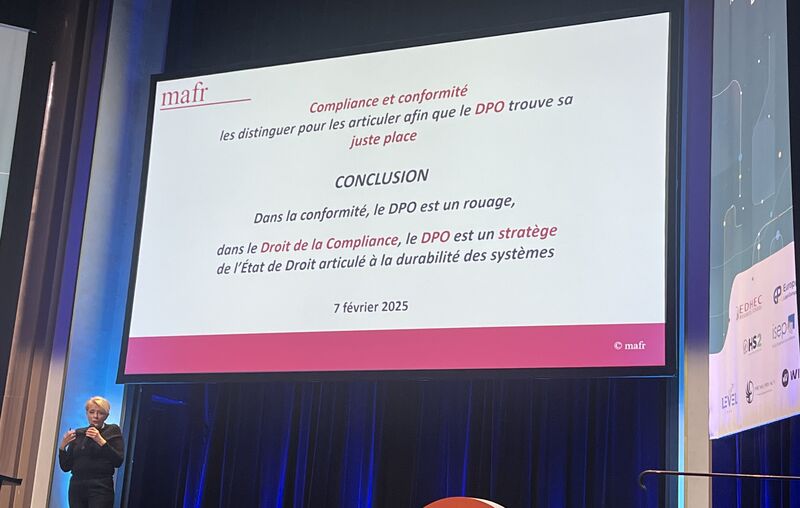
🎥”Compliance” et “conformité” : les distinguer/mieux les articuler afin que le DPO trouve sa juste place (Compliance Law” and “conformity” : distinguish between them/better articulate them so that the DPO finds their rightful place), in 🧮19ème Université AFCDP des DPO, in 🧮19ème Université AFCDP des DPO, in 🧮19ème Université AFCDP des DPO

► Full Reference: M.-A. Frison-Roche, "Compliance" et "conformité" : les distinguer/mieux les articuler afin que le DPO trouve sa juste place" ("Compliance Law" and "conformity" : distinguish between them/better articulate them so that the DPO finds their rightful place"), , in  Association française des correspondants à la protection des données à caractère personnel (AFCDP),  19ème Université AFCDP des DPO – La gouvernance des données ("Data Governance"), Maison de la Chimie, Paris, 7 February 2025 , 10h-10h45. - 🧮 see this manifestation full program (in French) - ⬜ see les slides on which this conference is done (in French)  - ► English Presentation of this conference: 'Compliance' and 'conformité' are often considered to be synonymous, notably in French in which the term "Compliance" is so often used to express only the "conformity" (conformité). This is a misunderstanding and a reduction, particularly of the role of professionals, notably DPOs. In fact, 'conformity' consists solely of ensuring that regulations are respected. Of course, an"active" conformity and "proven" conformity with these regulations, in particular the European GDPR. That and only that. If that's the case, then on the one hand this task impossible, because no one can comply with all the regulations, and it's the obsession with avoiding or reducing penalties that actually replaces the desire to do the right thing. On the other hand, algorithms are going to replace the DPO, a human being, because algorithms will identify 'non-conformity', then conformity, then write it down by "smart" contracts. But Compliance Law is more than conformity, which is only one of its tools. Compliance Law aim is to protect the human beings involved in the systems. Data protection is one of the best examples of this, and it underpins all the other areas of Compliance Law. Companies are asked to do less (obligation of means) and more: to help protect, by distinguishing between what must be revealed and what must be kept secret, sometimes to resolve conflicts between the 2 prescriptions, to educate, to make alliances. To built a real "governance". In this human and humanist mission that anchors Europe, the algorithm is flat. We are waiting for the DPO. In this human and humanist mission that anchors Europe, the algorithm is flat. We are waiting for the DPO. There is the role of guardian of the spirit of the texts, of strategic aid for the data controller, of adjuster of complementary or contradictory subjective rights, of adjustment of the texts in the European puzzle of a Regulatory Europe, which is being put in place in the humanist tradition which is its own to preserve the durability of the systems to protect the people who are forcibly or voluntarily involved in them. - 🌐suivre Marie-Anne Frison-Roche sur LinkedIn 🌐suivre Marie-Anne Frison-Roche sur Instagram 🌐s'abonner à la Newsletter MAFR Regulation, Compliance, Law 🌐s'abonner à la Newsletter en vidéo MAFR Surplomb/Overhang
Articles

💬Facebook: Quand le Droit de la Compliance démontre sa capacité à protéger les personnes (Facebook: When Compliance Law proves its ability to protect people)

Full reference: Frison-Roche, M.-A., Facebook: Quand le Droit de la Compliance démontre sa capacité à protéger les personnes (Facebook: When Compliance Law proves its ability to protect people), interview with Olivia Dufour, Actu-juridiques Lextenso, 23rd of November 2020 Read the interview (in French) Read the news of the Newsletter MAFR – Law, Compliance, Regulation about this question

Articles in a legal collective publication

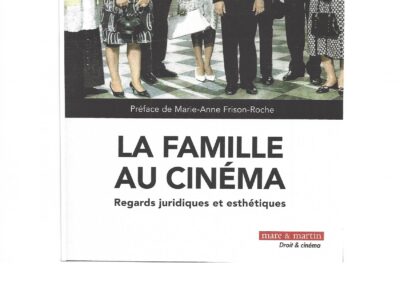
Au coeur du droit, du cinéma et de la famille : la vie (“At the heart of Law, Cinema and Family: Life”), preface of the book “La famille au cinéma. Regards juridiques et esthétiques” (“Family in Cinema. Legal and Aesthetic Perspectives”)

Full reference : Frison-Roche, M.-A., Au cœur du Droit, du cinéma et de la famille : la vie ("At the heart of Law, Cinema and Family: Life"), preface of La famille au cinéma. Regards juridiques et esthétiques ("Family in Cinema. Legal and Aesthetic Perspectives"), Florès-Longou, M. and Épinoux E. (ed.), coll. "Droit & cinéma",  Mare & Martin, 2016, pp. 21-27. Read a general presentation of the book Read the working paper from which the article was written, containing some notes and a hundred links, especially towards film extracts.  Read the article (in French) This introductive article, which constitutes the preface of the book, relies on approximatively one hundred movies to show that cinema does not stop to show legal situations and protagonists, even if "Family Law" seems to be less the darling child than the actors of the trial. We find the child, the mother and the father, the spouses and the engaged people. Often with the shape of drama, breaks and machinations and even murders, because it is like that that family appears on the screen. It is difficult to not fall asleep facing the peaceful happiness of happy families.   But why such a confluence between Cinema and Family Law?  Because both have a purpose: life.  Do not being anxious about family life, it is not understanding Family Law. And because Cinema take life itself as purpose, so when we want to learn Family Law, it is the path towards Cinema that we should take.   

Working papers

Home made Family

The family is built on one basic idea which is so powerful that legal rules are organised around it as spontanely. But if the paradigm is changing, then all the rules change with the strength of the evidence. However, in the 1970s, we changed paradigm. Previously, for millennia, the basic idea was the family as a group. Depending on the time or period, the group has varied in its contours, squares and powers granted to individual members, but the idea of group was acquired. Family was a group which was a part of the social group, kept by the State. From the 1970s, the family becomes the developed project done by a free and independent person. This project designed by a person wishing to build family that suits him or her will result in the fact that the individual meets other individuals whose family project crosses his or her. Contract becomes the perfect tool for these home-made families This desires adjustment corresponds to the market model. Concretely, market of ideal family provides services for satisfaction of various projects, all legitimate as expression of desir. The sufficient link between individuals  is affection and will, the center is the child. The market offers new perspectives, such as ideal partner and even more perfect child, becoming jewel. The idea of ​​Market has triumphed.