Platform

Articles in The Journal of Regulation & Compliance « JoRC »

📝L’intensité de l’obligation de vigilance selon les secteurs : le cas des opérateurs numériques (“The intensity of the Duty of Vigilance in different sectors: the case of digital operators”), in 🕴️M.-A. Frison-Roche (ed.), 📕L’Obligation de Compliance

► Full Reference: G. Loiseau, "L’intensité de l’obligation de vigilance selon les secteurs : le cas des opérateurs numériques" (The intensity of the Duty of Vigilance in different sectors: the case of digital operators), in M.-A. Frison-Roche (dir.), L'obligation de Compliance, Journal of Regulation & Compliance (JoRC) and Dalloz, coll. "Régulations & Compliance", 2024, forthcoming - 📕read the general presentation of the book, L'obligation de Compliance, in which the contribution is published - ► English summary of this contribution (done by the Journal of Regulation & Compliance – JoRC) : L'auteur développe le cas des opérateurs numériques. Il souligne le paradoxe d'un Droit qui est parti d'un texte qui a posé le principe de l'irresponsabilité des hébergeurs, en raison de leur neutralité technique, pour aboutir au DSA et leur imposer des diligences, mais il rappelle que cette obligation n'apparaît qu'à partir d'un signalement qui est porté auprès de l'opérateur numérique et une interdiction expresse d'une obligation générale de surveiller les informations. Moreover, there is no general duty of vigilance incumbent on digital operators, even if recent case law seems to be tightening the role imposed on hosting providers. The Monumental Goal here is to fight against illegal content, but freedom of expression must also be preserved and regulations vary according to the type of content, whereas the DSA has a more general conception, aims at a logic of accountability and prevention of systemic risks. But wanting to make platforms 'accountable' ex ante, without touching the liability regime ex post, may pose a problem. The duty of vigilance will vary depending on whether the digital operator plays a passive or active role. This may lead platforms to adopt prior measures that may constitute structural obligations, with the trusted third party taking the form of a trusted signaller. The platform is thus made responsible for its own vigilance, but despite the possibility of enhanced vigilance, this does not have to extend to investigative measures. There are, however, specific enhanced vigilance obligations for very large platforms, justified by the risks involved and the types of content (terrorism, pornography). - 🦉This contribution est available in full text for persons following Professor Marie-Anne Frison-Roche teaching -

Articles in The Journal of Regulation & Compliance « JoRC »

📝Les technologies de conformité pour satisfaire les exigences du droit de la compliance. Exemple du numérique (Conformity technologies to meet Compliance Law requirements. The digital example), in 🕴️M.-A. Frison-Roche (dir.), 📕L’obligation de Compliance

► Full Reference : E. Netter, "Les technologies de conformité pour satisfaire les exigences du droit de la compliance. Exemple du numérique" (Conformity technologies to meet the requirements of Compliance Caw. Digital example), in M.-A. Frison-Roche (dir.), L'obligation de Compliance, Journal of Regulation & Compliance (JoRC) and Dalloz, coll. "Régulations & Compliance", 2025, pp. 355-367. - 📕read the general presentation of the book, L'obligation de Compliance, in which this contribution is published. - ► English summary of this contribution (done by the Journal of Regulation & Compliance) :The author distinguishes between Compliance, which refers to Monumental Goals, and conformity, which are the concrete means that the company uses to tend towards them, through processes, check-lists in the monitoring of which the operator is accountable (art. 5.2. GRPD). Technology enables the operator to meet this requirement, as the changing nature of technology fits in well with the very general nature of the goals pursued, which leave plenty of room for businesses and public authorities to produce soft law. The contribution focuses firstly on existing technologies. Through Compliance, Law can prohibit a technology or restrict its use because it runs counter to the goal pursued, for example the technology of fully automated decisions producing legal effects on individuals. Because it is a perilous exercise to dictate by law what is good and what is bad in this area, the method is rather one of explicability, i.e. control through knowledge by others. Regulators are nevertheless developing numerous requirements stemming from the Monumental Goals of Compliance. Operators must update their technology or abandon obsolete technology in the light of new risks or to enable effective competition that does not lock users into a closed system. But technological power must not become too intrusive, as the privacy and freedom of the individuals concerned must be respected, which leads to the principles of necessity and proportionality. The author stresses that operators must comply with the regulations by using certain technologies if these technologies are available, or even to counteract them if they are contrary to the goals of the regulations, but this obligation of conformity is applied only if these technologies are available. The notion of "available technology" therefore becomes the criterion of the obligation, which means that its content varies with circumstances and time, particularly in the area of cybersecurity. In the second part of this contribution, the author examines technologies that are only potential, those that Law, and in particular the courts, might require companies to invent in order to fulfill their conformity obligation. This is quite understandable when we are talking about technologies that are in the making, but which will come to fruition, for example in the area of personal data transfer to satisfy the right to portability (GRPD), or where companies must be encouraged to develop technologies that are of less immediate benefit to them, or in the area of secure payment to ensure strong authentication (SPD 2). This is more difficult for technologies whose feasibility is not even certain, such as online age verification or the interoperability of secure messaging systems, two requirements which appear to be technologically contradictory in their terms, and which therefore still come under the heading of "imaginary technology". But Compliance is putting so much pressure on companies, particularly digital technology companies, that considerable investment is required to achieve it. The author concludes that this is the very ambition of Compliance and that the future will show how successful it will be.          - 🦉This article is available in full texte for persons following Professor Marie-Anne Frison-Roche teaching. -

Working papers

Working Paper for 📺Overhang (News)

🚧The Contract, a Compliance tool: the Obligation for a platform to control content (French Supreme Judicial Court, 15 January 2025) :

► Full Reference: M.-A. Frison-Roche, The Contract, a Compliance tool: the Obligation for a platform to control content CE, 27 January 2025, B. c/ CNIL, Working Paper, March 2025. - 🎤 This Working Paper was developed as a basis for the Overhang👁 video  on 29 March 2025 : click HERE (in French) - 🎬🎬🎬In the collection of the Overhangs👁 It falls into the News category. ►Watch the complete collection of the Overhangs👁 : click HERE - ► Summary of this Working Paper: The ruling handed down on 15 January 2025 by the Commercial, Economic and Financial Chamber of the French Judicial Supreme Court (Cour de cassation) provides a solution to the issue of content control in the digital environment. It resolves what appears to be the aporia so often emphasised, and even claimed, namely the impossibility of developing an effective controlling technology. To do this, the Court disregarded the applicable laws and referred to the electronic payment contract between the bank and the platform, which contained a clause on Vigilance against unlawful content, linked to a termination clause. It held that this clause was fully effective. This solution, so simple and so strong, can make a major contribution to regulating the digital space, if the banks so wish, because what platform can do without reliable electronic payment services?   - 🔓read the developments below⤵️ - 🌐follow Marie-Anne Frison-Roche sur LinkedIn 🌐follow Marie-Anne Frison-Roche on Instagram 🌐subscribe to the Newsletter MAFR Regulation, Compliance, Law  🌐subscribe to the Video Newsletter MAFR Surplomb

Conferences

🎤Le Contentieux Systémique Emergent du fait du système numérique (“emerging systemic litigation arising from the digital system”), in 🧮Importance et spécificité du Contentieux Systémique Émergent, cycle de conférences-débats “Contentieux Systémique Émergent”

► Full Reference: M.-A. Frison-Roche, "Le Contentieux Systémique Emergent du fait du système numérique ("emerging systemic litigation arising from the digital system"), in Les contrôles techniques des risques présents sur les plateformes et les contentieux engendrés (Technical controls on the risks present on platforms and the disputes that arise), in cycle of conferences-debates "Contentieux Systémique Émergent" ("Emerging Systemic Litigation"), organised on the initiative of the Cour d'appel de Paris (Paris Cour of Appeal), with the Cour de cassation (French Court of cassation), the Cour d'appel de Versailles (Versailles Court of Appeal), the École nationale de la magistrature – ENM (French National School for the Judiciary) and the École de formation des barreaux du ressort de la Cour d'appel de Paris – EFB (Paris Bar School), under the scientific direction of Marie-Anne Frison-Roche, May 27,2024, 9h-10h30, Cour d'appel de Paris, Cassin room - 🧮see the full programme of this event - 🧮see the full programme of the entire cycle Contentieux Systémique Émergent (Emerging Systemic Litigation) - 🔲see the slides (in French), basis of this conference - 🌐read on  LinkedIn the summary of this conference les slides - 🎤read  the presentation of the second conference in this manifestation: "Un contentieux systémique in vivo : le cas dit des sites pornographiques" ("a Systemic Litigation in vivo: the case of pornographic prestations platforms") - 🧱read the general presentation of this scientific coordination of this manifestation and its various speechs - 🌐read on LinkedIn the summary of this manifestation in the Newsletter MAFR Regulation, Compliance, Law - ► Summary of this conference: This speech is a prelude to the three more specific speeches and aims to show how the digital system, by its very nature, produces and will produce "Systemic Litigation".  Systemic Litigation" is defined by "cases" (a procedural notion) brought before judges, who may be judges of first instance, or possibly emergency judges, in which the interests, or even the future, of a system are involved beyond the dispute between the parties.  This Systemic Case may be brought before a specialised judge, including the juridictional body of a Regulatory or Supervisory Authority, but also before a judge of ordinary Law, on the basis of a special text but possibly on the basis of a text of ordinary Law. This can lead to a fragmentation of litigation, even though the unity of the system remains, or even is at stake, in the present and in the future. The "digital system" is an example of the "natural" production of Systemic Litigation which arise as a result of the Digital System alone, in particular because of the systemic risks inherent in this system, and the fact that their prevention and management are internalised in the operators who have built and manage the system (Compliance Law). The issue is therefore one of Interregulation. Platforms in particular give rise to Systemic Litigation because of the specific nature of certain risks, for example disinformation, terrorism, destruction of rights (copyright being just one example), the risk of minors having access to content that is destructive for them, and so on. Digital Systemic Litigation has only just begun. It is essential that judges are prepared for this and that they face up to it together through dialogue.             - 🌐follow Marie-Anne Frison-Roche on LinkedIn 🌐follow Marie-Anne Frison-Roche on Instagram 🌐subscribe to the Newsletter MAFR Regulation, Compliance, Law

Organisation of events

🧮Les techniques de supervision des contenus numériques disponibles sur les plateformes (Technical risks controls on platforms and disputes arising from them), in cycle de conférences-débats “Contentieux Systémique Émergent” (“Emerging Systemic Litigation”)

► Full Reference: Les contrôles techniques des risques présents sur les plateformes et les contentieux engendrés (Technical risks controls on platforms and disputes arising from them), in cycle of conference-debates "Contentieux Systémique Émergent" ("Emerging Systemic Litigation"), organised on the initiative of the Cour d'appel de Paris (Paris Cour of Appeal), with the Cour de cassation (French Court of cassation), the Cour d'appel de Versailles (Versailles Court of Appeal), the École nationale de la magistrature – ENM (French National School for the Judiciary) and the École de formation des barreaux du ressort de la Cour d'appel de Paris – EFB (Paris Bar School), under the scientific direction of Marie-Anne Frison-Roche, May 27, 2024, 9h-10h30, Cour d'appel de Paris, Cassin courtroom - 🧮see the full programme of the cycle Contentieux Systémique Émergent (Emerging Systemic Litigation) - 🌐see on LinkedIn the report of this event - 🧱read below the report of this event⤵️ - ► Presentation of the conference: The digital space is full of risks. Some are naturally associated with it, because it is an area of freedom, while others must be countered because they are associated with generally prohibited behaviour, such as money laundering. But the digital space has developed risks which, because of their scale, have been transformed in their very nature: this is particularly true of the distortion permeating certain content and the insecurity that can threaten the entire system itself. Law has therefore entrusted operators themselves with vigilance over what have become ‘cyber-risks’, such as the risk of disinformation, the risk of destruction of communication infrastructures, and the risk of data theft, a systemic prospect that can lead to the collapse of societies themselves.   New legislations has been drafted, in particular the Digital Services Act (DSA), to increase the burdens and powers of firms in this area, with digital companies in the front line, but also supervisory authorities such as the Autorité de régulation de la communication audiovisuelle et numérique – Arcom (French Regulatory Authority for Audiovisual and Digital Communication). The resulting disputes, in which firms and regulators may be allies or opponents, are systemic in nature.   The judge's handling of these "systemic cases", through the procedure and the solutions, must respond to this systemic dimension. The "pornographic websites" case, which is currently unfolding, provides an opportunity to observe in vivo the dialogue between judges when a "systemic case" imposes itself on them.   - 🧮Programme of this event:  Third conference-debate LES CONTRÔLES TECHNIQUES DES RISQUES PRÉSENTS SUR LES PLATEFORMES ET LES CONTENTIEUX ENGENDRÉS (TECHNICAL RISKS CONTROLS ON PLATFORMS AND DISPUTES ARISING FROM THEM) Paris Court of Appeal, Cassin courtroom Moderated by 🕴️Marie-Anne Frison-Roche, Professor of Regulatory and Compliance Law, Director of the Journal of Regulation & Compliance (JoRC) 🕰️9h-9h10. 🎤Le contentieux Systémique Emergent du fait du système numériqué (Systemic Litigation Emerging from the Digital System), 🕴️Marie-Anne Frison-Roche 🕰️9h10-9h30. 🎤Les techniques de gestion du risque systémique pesant sur la cybersécurité  des plateformes (The Systemic Obligation of Security on Platforms and associated Litigation), 🕴️Michel Séjean, Professor of Law at Sorbonne Paris Nord University 🕰️9h30-9h50. 🎤Un cas systémique in vivo : le cas dit des sites pornographiques (An in vivo Systemic Case: the so-called case of pornographic websites),🕴️Marie-Anne Frison-Roche 🕰️9h50-10h10. 🎤Les obligations systémiques des opérateurs numériques à travers le Règlement sur les Services Numériques (RSN/DSA) et le rôle des régulateurs (Systemic Obligations of Operators (DSA) and the role of Regulators), 🕴️Roch-Olivier Maistre, Chair of the Autorité de régulation de la communication audiovisuelle et numérique – Arcom (French Regulatory Authority for Audiovisual and Digital Communication) 🕰️10h10-10h30. Debate - 🔴Registrations and information requests can be sent to: inscriptionscse@gmail.com 🔴For the attorneys, registrations have to be sent to the following address: https://evenium.events/cycle-de-conferences-contentieux-systemique-emergent/  ⚠️The conference-debates are held in person only, in the Cour d’appel de Paris (Paris Court of Appeal). - 🧱read below a detailed presentation of this event⤵️ -

Articles in The Journal of Regulation & Compliance « JoRC »

AUGAGNEUR, Luc-Marie🕴️

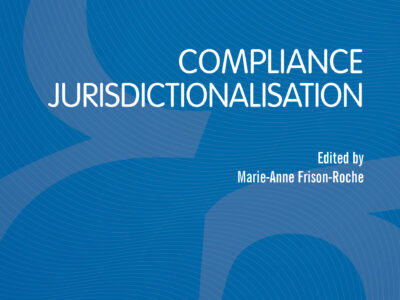
📝The jurisdictionalisation of reputation by platforms, in 🕴️M.-A. Frison-Roche (ed.), 📘Compliance Jurisdictionalisation

► Full Reference: L.-M. Augagneur, "The jurisdictionalisation of reputation by platforms", in M.-A. Frison-Roche (ed.), Compliance Jurisdictionalisation, Journal of Regulation & Compliance (JoRC) and Bruylant, coll. "Compliance & Regulation", 2024, pp. 109-125  - 📘read a general presentation of the book, Compliance Jurisdictionalisation, in which this article is published - ► Summary of the article (done by the Author): The large platforms are in the position of arbiter of the reputation economy (referencing, notoriety) in which they themselves act. Although the stakes are usually low on a unit basis, the jurisdiction of reputation represents significant aggregate stakes. Platforms are thus led to detect and assess reputation manipulations (by users: SEO, fake reviews, fake followers; or by the platforms themselves as highlighted by the Google Shopping decision issued by the European Commission in 2017) that are implemented on a large scale with algorithmic tools. The identification and treatment of manipulations is itself only possible by means of artificial intelligence tools. Google thus proceeds with an automated downgrading mechanism for sites that do not follow its guidelines, with the possibility of requesting a review through a very summary procedure entirely conducted by an algorithm. Tripadvisor, on the other hand, uses an algorithm to detect false reviews based on "fraud modeling to identify electronic patterns that cannot be detected by the human eye". It only conducts a human investigation in limited cases. This jurisdictionality of reputation has little in common with that defined by the jurisprudence of the Court of Justice (legal origin, contradictory procedure, independence, application of the Rules of Law). It is characterized, on the one hand, by the absence of transparency of the rules and even of the existence of rules stated in predicative form and applied by deductive reasoning. It is replaced by an inductive probabilistic model by the identification of abnormal behaviors in relation to centroids. This approach of course raises the issue of statistical bias. More fundamentally, it reflects a transition from Rule of Law, not so much to "Code is Law" (Laurence Lessig), but to "Data is Law", that is, to a governance of numbers (rather than "by" numbers). It also comes back to a form of collective jurisdictionality, since the sanction comes from a computational apprehension of the phenomena of the multitude and not from an individual appreciation. Finally, it appears particularly consubstantial with compliance, since it is based on a teleological approach (the search for a finality rather than the application of principles). On the other hand, this jurisdictionality is characterized by man-machine cooperation, whether in the decision-making process (which poses the problem of automaticity bias) or in the contradictory procedure (which poses, in particular, the problems of discussion with the machine and the explicability of the machine response). Until now, the supervision of these processes has been based essentially on the mechanisms of transparency, a limited adversarial requirement and the accessibility of appeal channels. The French Law Loi pour une République Numérique ("Law  for a Digital Republic"), the European Legislation Platform-to-Business Regulation and the Omnibus Directive, have thus set requirements on the ranking criteria on platforms. The Omnibus Directive also requires that professionals guarantee that reviews come from consumers through reasonable and proportionate measures. As for the European Digital Services Act, it provides for transparency on content moderation rules, procedures and algorithms. But this transparency is often a sham. In the same way and for the moment the requirements of sufficient human intervention and adversarial processes appear very limited in the draft text. The most efficient forms of this jurisdictionality ultimately emerge from the role played by third parties in a form of participatory dispute resolution. Thus, for example, FakeSpot detects false Tripadvisor reviews, Sistrix establishes a ranking index that helped establish the manipulation of Google's algorithm in the Google Shopping case by detecting artifacts based on algorithm changes. Moreover, the draft Digital Services Act envisages recognizing a specific status for trusted flaggers who identify illegal content on platforms. This singular jurisdictional configuration (judge and party platform, massive situations, algorithmic systems for handling manipulations) thus leads us to reconsider the grammar of the jurisdictional process and its characteristics. If Law is a language (Alain Sériaux), it offers a new grammatical form that would be that of the middle way (mesotès) described by Benevéniste. Between the active and the passive way, there is a way in which the subject carries out an action in which he includes himself. Now, it is the very nature of this jurisdictionality of compliance to make laws by including oneself in them (nomos tithestai). In this respect, the irruption of artificial intelligence in this jurisdictional treatment undoubtedly bears witness to the renewal of the language of Law. - 🦉This article is available in full text to those registered for Professor Marie-Anne Frison-Roche's courses -


Monographs

MORENO BELLOSO, Natahalie🕴️ & PETIT, Nicolas🕴️

📝The EU Digital Markets Act (DMA). A Competition Hand in a Regulatory Glove

► Full Reference : N. Moreno Belloso & N. Petit, "The EU Digital Markets Act (DMA). A Competition Hand in a Regulatory Glove", (2023) 48 European Law Review 391, available at SSRN: https://ssrn.com/abstract=4411743 - ► Summary of the article (made by the Authors) : "The newly enacted Digital Markets Act (DMA) finds itself at a crossroads. The DMA can develop into a specialist field of competition law for digital platforms or it can evolve into a new field of EU law, detached from competition law. The DMA’s ultimate trajectory will depend on the legal characterization given to the DMA. Is it a special competition law regime or an original instrument distinct from competition law? This paper lays the groundwork for characterizing the DMA by offering a complete descriptive analysis of the instrument. Among the elements discussed are the twin concepts of “gatekeepers” and “core platform services”, which together condition the DMA’s scope of application, as well as the legal obligations imposed on gatekeepers. The paper proposes a novel categorisation of the obligations, showing that each obligation can be associated with at least one of two conventional competition law concerns (exclusion or exploitation). The discussion shows the difficulty of pinpointing the exact nature of the DMA. We argue that this ambiguity creates challenges for the practical implementation of the DMA.". - 🦉This article is available in full text to those registered for Professor Marie-Anne Frison-Roche's courses -

Monographs

AKMAN, Pinar🕴️

📝Regulating Competition in Digital Platform Markets : A Critical Assessment of the Framework and Approach of the EU Digital Markets Act

► Full Reference: P. Akman, "Regulating Competition in Digital Platform Markets : A Critical Assessment of the Framework and Approach of the EU Digital Markets Act", (2022) 47 European Law Review 85, available at SSRN: https://ssrn.com/abstract=3978625 or http://dx.doi.org/10.2139/ssrn.3978625 - ► Summary of the article (made by the authors): "The European Union’s Digital Markets Act (DMA) initiative, which is set to introduce ex ante regulatory rules for “gatekeepers” in online platform markets, is one of the most important pieces of legislation to emanate from Brussels in recent decades. It not only has the potential to influence jurisdictions around the world in regulating digital markets, it also has the potential to change the business models of the wealthiest corporations on the planet and how they offer their products and services to their customers. Against that backdrop, this article provides an analysis of the aims of and principles underlying the DMA, the essential components of the DMA, and the core substantive framework, including the scope and structure of the main obligations and the implementation mechanisms envisaged by the DMA. Following this analysis, the article offers a critique of the central components of the DMA, such as its objectives, positioning in comparison to competition law rules, and substantive obligations. The article then provides recommendations and proposes ways in which the DMA – and other legislative initiatives around the world, which may take the DMA as an example – can be significantly improved by, inter alia, adopting a platform-driven substantive framework built upon self-executing, prescriptive obligations.". - 🦉This article is available in full text to those registered for Professor Marie-Anne Frison-Roche's courses -

Articles in a legal collective publication

AUGAGNEUR, Luc-Marie🕴️

📝La juridictionnalisation de la réputation par les plateformes, in 🕴️M.-A. Frison-Roche (ed.), 📕La Juridictionnalisation de la Compliance

► Full Reference: L.-M. Augagneur, "La juridictionnalisation de la réputation par les plateformes" ("The jurisdictionalisation of reputation by platforms"), in M.-A. Frison-Roche (ed.), La juridictionnalisation de la Compliance, coll. "Régulations & Compliance", Journal of Regulation & Compliance (JoRC) and Dalloz, 2023, pp. 97-113.  - 📕read a general presentation of the book, La juridictionnalisation de la Compliance, in which this article is published. - ► Summary of the article (done by the author): The large platforms are in the position of arbiter of the reputation economy (referencing, notoriety) in which they themselves act. Although the stakes are usually low on a unit basis, the jurisdiction of reputation represents significant aggregate stakes. Platforms are thus led to detect and assess reputation manipulations (by users: SEO, fake reviews, fake followers; or by the platforms themselves as highlighted by the Google Shopping decision issued by the European Commission in 2017) that are implemented on a large scale with algorithmic tools. The identification and treatment of manipulations is itself only possible by means of artificial intelligence tools. Google thus proceeds with an automated downgrading mechanism for sites that do not follow its guidelines, with the possibility of requesting a review through a very summary procedure entirely conducted by an algorithm. Tripadvisor, on the other hand, uses an algorithm to detect false reviews based on "fraud modeling to identify electronic patterns that cannot be detected by the human eye". It only conducts a human investigation in limited cases. This jurisdictionality of reputation has little in common with that defined by the jurisprudence of the Court of Justice (legal origin, contradictory procedure, independence, application of the Rules of Law). It is characterized, on the one hand, by the absence of transparency of the rules and even of the existence of rules stated in predicative form and applied by deductive reasoning. It is replaced by an inductive probabilistic model by the identification of abnormal behaviors in relation to centroids. This approach of course raises the issue of statistical bias. More fundamentally, it reflects a transition from Rule of Law, not so much to "Code is Law" (Laurence Lessig), but to "Data is Law", that is, to a governance of numbers (rather than "by" numbers). It also comes back to a form of collective jurisdictionality, since the sanction comes from a computational apprehension of the phenomena of the multitude and not from an individual appreciation. Finally, it appears particularly consubstantial with compliance, since it is based on a teleological approach (the search for a finality rather than the application of principles). On the other hand, this jurisdictionality is characterized by man-machine cooperation, whether in the decision-making process (which poses the problem of automaticity bias) or in the contradictory procedure (which poses, in particular, the problems of discussion with the machine and the explicability of the machine response). Until now, the supervision of these processes has been based essentially on the mechanisms of transparency, a limited adversarial requirement and the accessibility of appeal channels. The French Law Loi pour une République Numérique ("Law for a Digital Republic"), the European Legislation Platform-to-Business Regulation and the Omnibus Directive, have thus set requirements on the ranking criteria on platforms. The Omnibus Directive also requires that professionals guarantee that reviews come from consumers through reasonable and proportionate measures. As for the European Digital Services Act, it provides for transparency on content moderation rules, procedures and algorithms. But this transparency is often a sham. In the same way and for the moment the requirements of sufficient human intervention and adversarial processes appear very limited in the draft text. The most efficient forms of this jurisdictionality ultimately emerge from the role played by third parties in a form of participatory dispute resolution. Thus, for example, FakeSpot detects false Tripadvisor reviews, Sistrix establishes a ranking index that helped establish the manipulation of Google's algorithm in the Google Shopping case by detecting artifacts based on algorithm changes. Moreover, the draft Digital Services Act envisages recognizing a specific status for trusted flaggers who identify illegal content on platforms. This singular jurisdictional configuration (judge and party platform, massive situations, algorithmic systems for handling manipulations) thus leads us to reconsider the grammar of the jurisdictional process and its characteristics. If Law is a language (Alain Sériaux), it offers a new grammatical form that would be that of the middle way (mesotès) described by Benevéniste. Between the active and the passive way, there is a way in which the subject carries out an action in which he includes himself. Now, it is the very nature of this jurisdictionality of compliance to make laws by including oneself in them (nomos tithestai). In this respect, the irruption of artificial intelligence in this jurisdictional treatment undoubtedly bears witness to the renewal of the language of Law. -

Articles

💬”Let’s Use the Power of GAFAMs in the Service of General Interest!” (“Utilisons la puissance des GAFAMs au service de l’intérêt général!”)

Full reference: Frison-Roche, M.-A., "Let's Use the Power of GAFAMs in the Service of General Interest!" ("Utilisons la puissance des GAFAMs au service de l'intérêt général!"), interview done by Olivia Dufour, Actu-juridiques Lextenso, 11st of January 2021 Read the interview (in French) To read the article translated in English by us, read the working paper on which this interview is based   Summary of the interview by Olivia Dufour: Marie-Anne Frison-Roche, Professor of Regulation and Compliance Law, reported to the government in 2019 about Internet governance. For this expert, giving a disciplinary power to GAFAMs is the only effective solution. And the suppression of Donald Trump's account is not likely to call this analysis into question.   The three questions (translated in English here by ourselves) asked by Olivia Dufour are:  The deletion of Donald Trump's Twitter account arouses strong emotions on social networks, and not only among his supporters. What do you think about this ? However, this incident does raise concern. Are we not giving too much power to these private companies? This raises the question in France of the relevance of the Avia system … Should we therefore resolve by default to give our freedoms to private and opaque mastodons?   Read the answers to these three questions (in French)   To go further, especially about the logics that guide the Avia system, see: Frison-Roche, M.-A., "Hate on internet: we need to responsibilize digital operators" ("Haine sur internet: il faut responsabiliser les opérateurs numériques"), 2020 Frison-Roche, M.-A., The contribution of Compliance Law to Internet Governance, report to Government, 2019

Articles

Conditions for the legality of a platform managed by an American company hosting European health data​: French Conseil d’État decision

Full reference: Frison-Roche, M.-A., Conditions for the legality of a platform managed by an American company hosting European health data​: French Conseil d'État decision, Newsletter MAFR – Law, Compliance, Regulation, 19th of October 2020 Read by freely subscribing the other news of the Newsletter MAFR – Law, Compliance, Regulation -   News Summary: In its ordinance of 13th of October 2020, Conseil national du logiciel libre (called Health Data Hub), the Conseil d'État (French Administrative Supreme Court) has determined the legal rules governing the possibility to give the management of sensitive data on a platform to a non-europeans firm, through the specific case of the decree and of the contract by which the management of the platform centralizing health data to fight against Covid-19 has been given to the Irish subsidiary of an American firm, Microsoft.  The Conseil d'État used firstly CJEU case law, especially the decision of 16th of July 2020, called Schrems 2, in the light of which it was interpreted and French Law and the contract linking GIP and The Conseil d'État concluded that it was not possible to transfer this data to United-Sates, that the contract could be only interpreted like this and that decree and contract's modifications secured this. But it observed that the risk of obtention by American public authorities was remaining.  Because public order requires the maintenance of this platform and that it does not exist for the moment other technical solution, the Conseil d'État maintained the principle of its management by Microsoft, until a European operator is found. During this, the control by the CNIL (French Data Regulator), whose the observations has been taken into consideration, will be operated.  We can retain three lessons from this great decision: There is a perfect continuum between Ex Ante and Ex Post, because by a referred, the Conseil d'État succeed in obtaining an update of the decree, a modification of the contractual clauses by Microsoft and of the words of the Minister in order to, as soon as possible, the platform is managed by an European operator. Thus, because it is Compliance Law, the relevant time of the judge is the future.  The Conseil d'État put the protection of people at the heart of its reasoning, what is compliant to the definition of Compliance Law. It succeeded to solve the dilemma: either protecting people thanks to the person to fight against the virus, or protecting people by preventing the centralization of data and their captation by American public authorities. Through a "political" decision, that is an action for the future, the Conseil found a provisional solution to protect people against the disease and against the dispossession of their data, requiring that an European solution is found.  The Conseil d'État emphasized the Court of Justice of The European Union as the alpha and omega of Compliance Law. By interpreting the contract between a GIP (Public interest Group) and an Irish subsidy of an American group only with regards to the case law of the Court of Justice of European Union, the Conseil d'Etat shows that sovereign Europe of Data can be built. And that courts are at the heart of this.  -   Read the interview given on this Ordinance Health Data Hub   To go further about the question of Compliance Law concerning health data protection, read the news of 25th of August 2020: The always in expansion "Right to be Forgotten"​: a legitimate Oxymore in Compliance Law built on Information. Example of​ Cancer Survivors Protection   

Articles

FRISON-ROCHE, Marie-Anne

Judge between Platform and Regulator: current example of Uber case in U.K.

Full reference: Frison-Roche, M.-A., Judge between Platform and Regulator: current example of Uber case in U.K., Newsletter MAFR – Law, Compliance, Regulation, 29th of September 2020 Read by freely subscribing the other news of the Newsletter MAFR – Law, Compliance, Regulation   Summary of the news: On 22nd of September 2017, Transport of London (TFL), London Transport Regulator, refused to renew the licence, granted on 31st of May 2012 for 5 years, authorizing Uber to transport people because of criminal offenses committed by Uber's drivers. On 26th of June 2018, The Westminster Court prolonged Uber's licence for 15 months under the condition that the platform prevent the reproachable behaviors of its drivers. After these 15 months, the TFL refused once again to prolonge Uber's licence because of the persistence of aggressions against passengers. Uber, once again, contest this decision before the Westminster Court.  In a decision of 28th of September 2020, the Court observes that during the 15 months, the platform implemented many measures to prevent aggressions, that the level of maturity of these measures has improved over time and that the number of offenses was reduced over the period (passing from 55 in 2018 to 4 in 2020). The Court estimated the the implementation of this actions is sufficient to grant a new licence to Uber.  We can learn three lessons from this decision:  The Compliance obligation is not a result obligation but a mean obligation, which means that it is not reasonable to expect from a crucial operator (Uber, for instance) that it prevent every cases of agression but that it is salient to judge it on the effort it deploys to try to be closer to this ideal situation. Moreover, the crucial operator must be proactive, that is going away from the figure of passive subject of Law who apply measures enacted by the regulator in terms of fighting against aggressions to be an actor of the research of the best way to fight abusive behaviors, internalizing this "monumental goal.  The judge appreciates the violation committed by those whose the firm is responsible "in context", that is evaluates the concrete situation in a reasonable way.  It is the judge who decides in last resort and like the crucial operator, it must be reasonable.    Read to go further: Frison-Roche, M.-A., Firm, Regulator and Judge: thinking Compliance through these three characters, 2018 The report of the Assemblée nationale (French Parliament chamber) on the question 

Articles in a legal collective publication

📝 Se tenir bien dans l’espace digital (Having a good behavior in the digital space), in 📙Penser le droit de la pensée

Full reference: M.-A. Frison-Roche, Se tenir bien dans l'espace numérique, in Penser le droit de la pensée. Mélanges en l'honneur de Michel Vivant, Lexis Nexis and Dalloz, 2020, pp. 155-168. - 📝Read the article (in French) - 🚧Read the working paper, written in English, on which this article is based, with additional developments, technical references, and hyperlinks   English summary of the article: The digital space is one of the scarce spaces not framed by a specific branch of Law, Freedom also offering opportunity to its actors to not "behave well", that is to express and diffuse broadly and immediately hateful thoughts through Hate speechs, which remained before in private or limited circles. The intimacy of Law and of the legal notion of Person is broken: Digital permits to individuals or organizations to act as demultiplied and anonymous characters, digital depersonalized actors who carry behaviors that are hurtful to other's dignity.  Against that, Compliance Law offers an appropriate solution: internalizing in digital crucial operators the mission to disciplinary and substantially hold the digital space. The digital space has been structured by powerful firms able to maintain order. Because Law must not reduce digital space to be only a neutral market of digital prestations, these crucial operators, like social networks or search engines, must be forced to substantially control behaviors. It could be about an obligation of internet users to act with their face uncover, "real identity" policy controlled by firms, and to respect others' rights, privacy rights, dignity, intellectual property rights. In their Regulatory function, digital crucial firms must be supervised by public authorities.  Thus, Compliance law substantially defined is the protector of the person as "subject of law" in the digital space, by the respect that others must have, this space passing from the status of free space to the one of civilized space, in which everyone is obliged to behave well.  -   Read to go further:  Frison-Roche, M.-A., L'apport du Droit de la Compliance à la gouvernance d'Internet, 2019 Frison-Roche, M.-A. (dir.), Internet, un espace d'interrégulation, 2016 - 🌐follow Marie-Anne Frison-Roche on LinkedIn 🌐follow Marie-Anne Frison-Roche on Instagram 🌐subscribe to the Newsletter MAFR Regulation, Compliance, Law