Mother

Articles in a legal collective publication

📝Si l’heureux stratagème probatoire du Roi Salomon n’avait pas fonctionné (If King Solomon’s probationary strategy hadn’t worked), in📗Liber Amicorum, Mélanges en l’honneur de Pierre Crocq,

► Full reference: M.-A. Frison-Roche, “Si l'heureux stratagème probatoire du Roi Salomon n'avait pas fonctionné (If King Solomon's probationary strategy hadn't worked)”, in Collective Book dedicated to Professor Pierre Crocq, Liber Amicorum, Lextenso – LGDJ, 2026, pp. 713-723. - 📝Read the article (in French) - 🚧Read the bilingual working document on which this article is based - ► Introduction to the article: As renowned and significant in biblical scholarship as it is in legal culture and imagination, Solomon’s Judgement is a procedural measure, an evidential stratagem (I). But even a King cannot be certain of the success of an investigative measure that his authority allows him to impose; nothing guarantees the success of the evidential stratagem he has devised, that is to say, the discovery of the truth. The investigative measure he devised presupposes a maternal love that leads the woman – who might prefer to continue disputing – to choose instead not to keep the child and to leave him in a state of death, a mere inert prey to the claim of appropriation made by the plaintiff. It is the woman’s virtue that enables the Judge’s wisdom. The evidence stratagem might not have worked (II). This is scarcely considered, as King Solomon is always portrayed as wise and the mother as preferring the child to herself. But if we step outside the Book of Kings, where virtue reigns – that of the mother as well as that of the judge – to confront the passion of the woman who smothered her newborn in the night and now seeks the force of justice to seize the second, one might reflect, whilst wandering through the lobby of a courthouse, that it is all too often the case that adults put themselves before children. What if the second mother had put herself before the child? What would have happened if the judge’s order, already being carried out, had not been halted by the virtue of the defendant? (III). What would the King then have done to exercise his office as Judge justly, since the truth would not have been accessible to him? (IV). If one changes an element of the narrative, because justice is human, because passions drive the parties, because children are often the silent victims on both sides, is justice still possible? - 🌐Follow Marie-Anne Frison-Roche on LinkedIn 🌐follow Marie-Anne Frison-Roche on Instagram 🌐subscribe to the Newsletter MAFR Regulation, Compliance, Law 🌐Subscribe to the Video Newsletter MAFR Surplomb 🌐Subscribe to the MaFR Law & Art Newsletter

Articles in a legal collective publication

contribution in a collective legal publication

📝L’invention du “droit à l’enfant”. Les conséquences de la pratique contractuelle comme source d’engendrement de l’enfant (The invention of the “right to a child”. The consequences of the contractual practice as a source of childbearing), in 📗Nouvelles filiations (New Filiations)

► Full Reference: M.-A. Frison-Roche,  « L'invention du "droit à l'enfant". Les conséquences de la pratique contractuelle comme source d'engendrement de l'enfant (The invention of the "right to a child". The consequences of the contractual practice as a source of childbearing)", in Special Issue Nouvelles filiations (New Filiations), AJ Famille, Lefebvre Dalloz, Nov. 2025, pp. 568-571.    - 📗read the table of content of the special issue in which this article is published (in French) - 📝read this article (in French) - 🚧Read the underlying bilingual working document, which includes additional technical developments, technical references and hyperlinks. - ► English summary of this article: Every legal system is built on concepts that form its pillars. Filiation is one such concept. A cas-law solution, presented as pragmatic and casuistic, can overturn this concept. Whether one agrees with it or not, it must first be acknowledged and assessed. Through a series of rulings on surrogacy, notably a ruling by its First Civil Chamber granting exequatur to a judgment recognising the filiation established by surrogacy between a child and persons with no biological link to the child and without recourse to adoption, the French Cour de Cassation has introduced the possibility of creating parentage by contract. This not only changes the concept of filiation but also changes the very structure of the French legal system, which is based on the distinction between persons and things. One may agree or disagree with this, but it must be said. Since the judge gives force to such a contract establishing filiation, with the foreign judge simply recognising it and the French judge ensuring only that the contract is balanced, the prospect opens up of a society in which individuals will be able to contractually create institutions at their disposal, within the private normative space of the contract, with the State's only function being to give effect to their right to legal recognition of their unique "project". Parentage is only a first example. Thus constructed on what was "inconceivable", i.e. a "right to a child", thanks to the contractual power to which the State should lend its force a posteriori, the judge makes parentage resulting .the judge technically declares a parentage arising from a contract to be "admissible". Is opening a society in institutions were contractually governed.  - 🌐follow Marie-Anne Frison-Roche on LinkedIn 🌐follow Marie-Anne Frison-Roche on Instagram 🌐subscribe to the Newsletter MAFR Regulation, Compliance, Law 🌐subscribe to the Video Newsletter MAFR Surplomb 🌐subscribe to theNewsletter MaFR Droit & Art

Working papers

Working Paper serving as the basis for a contribution to a collective book dedicated to a Friend

🚧If King Solomon’s probationary strategy hadn’t worked

► Full Reference: M.-A. Frison-Roche, If King Solomon's probationary strategy hadn't worked, Working Paper, October 2025. - 📝 This Working Paper is the basis of the article published in 2026 in the collective book dedicated to Professor Pierre Crocq. - ► Summary of this Working Paper:  As renowned and significant in biblical scholarship as it is in legal culture and imagination, Solomon’s Judgement is a procedural measure, an evidential stratagem (I). But even a King cannot be certain of the success of an investigative measure that his authority allows him to impose; nothing guarantees the success of the evidential stratagem he has devised, that is to say, the discovery of the truth. The investigative measure he devised presupposes a maternal love that leads the woman – who might prefer to continue disputing – to choose instead not to keep the child and to leave him in a state of death, a mere inert prey to the claim of appropriation made by the plaintiff. It is the woman’s virtue that enables the Judge’s wisdom. The evidence stratagem might not have worked (II). This is scarcely considered, as King Solomon is always portrayed as wise and the mother as preferring the child to herself. But if we step outside the Book of Kings, where virtue reigns – that of the mother as well as that of the judge – to confront the passion of the woman who smothered her newborn in the night and now seeks the force of justice to seize the second, one might reflect, whilst wandering through the lobby of a courthouse, that it is all too often the case that adults put themselves before children. What if the second mother had put herself before the child? What would have happened if the judge’s order, already being carried out, had not been halted by the virtue of the defendant? (III). What would the King then have done to exercise his office as Judge justly, since the truth would not have been accessible to him? (IV). If one changes an element of the narrative, because justice is human, because passions drive the parties, because children are often the silent victims on both sides, is justice still possible?   - 🔓read the developments below⤵️ - 🌐follow Marie-Anne Frison-Roche on LinkedIn 🌐follow Marie-Anne Frison-Roche on Instagram 🌐subscribe to the Newsletter MAFR Regulation, Compliance, Law 🌐subscribe to the Video Newsletter MAFR Surplomb / Overhang 🌐subscribe to the Newsletter MaFR Droit & Art

Books

📙Divorce à la française

Articles in a legal collective publication

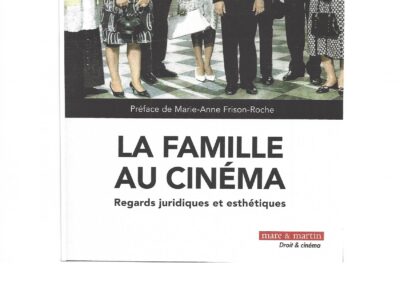
Au coeur du droit, du cinéma et de la famille : la vie (“At the heart of Law, Cinema and Family: Life”), preface of the book “La famille au cinéma. Regards juridiques et esthétiques” (“Family in Cinema. Legal and Aesthetic Perspectives”)

Full reference : Frison-Roche, M.-A., Au cœur du Droit, du cinéma et de la famille : la vie ("At the heart of Law, Cinema and Family: Life"), preface of La famille au cinéma. Regards juridiques et esthétiques ("Family in Cinema. Legal and Aesthetic Perspectives"), Florès-Longou, M. and Épinoux E. (ed.), coll. "Droit & cinéma",  Mare & Martin, 2016, pp. 21-27. Read a general presentation of the book Read the working paper from which the article was written, containing some notes and a hundred links, especially towards film extracts.  Read the article (in French) This introductive article, which constitutes the preface of the book, relies on approximatively one hundred movies to show that cinema does not stop to show legal situations and protagonists, even if "Family Law" seems to be less the darling child than the actors of the trial. We find the child, the mother and the father, the spouses and the engaged people. Often with the shape of drama, breaks and machinations and even murders, because it is like that that family appears on the screen. It is difficult to not fall asleep facing the peaceful happiness of happy families.   But why such a confluence between Cinema and Family Law?  Because both have a purpose: life.  Do not being anxious about family life, it is not understanding Family Law. And because Cinema take life itself as purpose, so when we want to learn Family Law, it is the path towards Cinema that we should take.   

Working papers

Sophistique et GPA

Monographs

Halte aux mères-fantômes !

Documents Non_aux_meres-fantomes_Le_Monde_16_juin_2015.pdf

Working papers

Home made Family

The family is built on one basic idea which is so powerful that legal rules are organised around it as spontanely. But if the paradigm is changing, then all the rules change with the strength of the evidence. However, in the 1970s, we changed paradigm. Previously, for millennia, the basic idea was the family as a group. Depending on the time or period, the group has varied in its contours, squares and powers granted to individual members, but the idea of group was acquired. Family was a group which was a part of the social group, kept by the State. From the 1970s, the family becomes the developed project done by a free and independent person. This project designed by a person wishing to build family that suits him or her will result in the fact that the individual meets other individuals whose family project crosses his or her. Contract becomes the perfect tool for these home-made families This desires adjustment corresponds to the market model. Concretely, market of ideal family provides services for satisfaction of various projects, all legitimate as expression of desir. The sufficient link between individuals  is affection and will, the center is the child. The market offers new perspectives, such as ideal partner and even more perfect child, becoming jewel. The idea of ​​Market has triumphed.