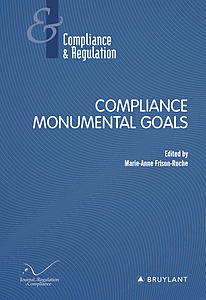
Monumental Goals

Couverture – Compliance Monumental Goals

Articles in a JoRC book

BENZONI, Laurent🕴️

📝International Trade, Competitivity and Sovereignty: Towards a Political Economy of Compliance, in 🕴️M.-A. Frison-Roche (ed.), 📘Compliance Monumental Goals

► Full Reference: L. Benzoni, "International Trade, Competitivity and Sovereignty: Towards a Political Economy of Compliance", in M.-A. Frison-Roche (ed.), Compliance Monumental Goals, coll. "Compliance & Regulation", Journal of Regulation & Compliance (JoRC) and Bruylant, 2023, pp. 447-458. - 📘read a general presentation of the book, Compliance Monumental Goals, in which this article is published. - ► Summary of the article:  -
Couverture – Compliance Monumental Goals

Articles in a JoRC book

📝Main Aspects of the Book. The Monumental Goals of Compliance Law, in 🕴️M.-A. Frison-Roche (ed.), 📘Compliance Monumental Goals

► Full reference : M.-A. Frison-Roche, « Main Aspects of the Book. The Monumental Goals of Compliance Law », in M.-A. Frison-Roche (dir.), Compliance Monumental Goals, Journal of Regulation & Compliance (JoRC) and Bruylant, coll. "Compliance & Regulation", 2023, pp. 13-31. - ► Article summary :This article constitutes the afterword of the book Compliance Monumental Goals. Its purpose is to show the consistency of the book, in that the Monumental Goals themselves, by their normativity, give Uniqueness to Compliance Law, giving it simplicity and strength. Restituting each of the contributions and articulating them all in an overall demonstration, this article highlights this consistency of the Compliance mechanisms which join the primary function of the Law: the protection of human beings, now and in the future. - 📘 Read a general presentation of the book  Compliance Monumental Goal, in which the article is published - ► Read Marie-Anne Frison-Roche's presentations of her other contributions in this book :  📝Definition of Principe of Proportionality and Definition of Compliance Law, 📝 Role and Place of Companies in the Creation and Effectiveness of Compliance Law in Crisis,  📝 Assessment of Whistleblowing and the duty of Vigilance - This article is freely accessible.  Read this article ⤵️
Couverture – Compliance Monumental Goals

Articles in a JoRC book

LE FUR, Anne-Valérie🕴️

📝Interest and “raison d’être” of the Company: How Does It Fit Together with the Compliance Monumental Goals?, in 🕴️M.-A. Frison-Roche (ed.), 📘Compliance Monumental Goals

► Full Reference: A.-V. Le Fur, "Interest and “raison d’être” of the Company: How Does It Fit Together with the Compliance Monumental Goals?", in M.-A. Frison-Roche (ed.), Compliance Monumental Goals, coll. "Compliance & Regulation", Journal of Regulation & Compliance (JoRC) and Bruylant, 2023, pp. 69-82. - 📘read a general presentation of the book, Compliance Monumental Goals, in which this article is published. - ► Summary of the article (done by the Author): Companies would have a soul. The legislator thinks so, since the French law called "loi Pacte"  of 22 May 2019 obliges managers to act in the Corporate Interest and allows companies to formulate themselves a « raison d'être ». Compliance Law does the same, relying on companies to save the world from corruption, slavery, terrorism and global warming, thus achieving Monumental goals. At first glance, the contours of Corporate Interest and « raison d’être » of the company are not far removed from the notion of Compliance Monumental Goals. This is not surprising, since the objective that presided over their introduction into the French Civil Code is the same as that underlying Compliance Law : to rethink the place of the company in the global Society, by affirming long-term values or concerns. This is a reason to use these corporate law concepts in the context of an X-ray of the concept of Monumental Goals. However, a comparative approach is disappointing. The divergences between corporate notions and compliance lead to the conclusion that company law is not intended to impose anything other than a corporate public order. Notions that are more philosophical than legal, Corporate Interest and « raison d'être » are assigned functions that limit their scope. The imperative nature of corporate rules, and this is a consequence of the above, cannot be compared with that of compliance: uncertain, it is also relative when compared with the "violence" of compliance rules. The impact of the notions of Interest and « raison d'être » remains thus mainly internal to the company. According to a second approach, it cannot be ruled out that Corporate Interest and « raison d'être » allow for a better understanding of higher and universal values by Company Law. Corporate Interest may incorporate Compliance Monumental Goals while the « raison d'être » may constitute a perspective for the realization of these goals. The stakes are high : when the interest of the company, as a legal person and autonomous economic agent, joins the Monumental Goals, the means of achieving the latter are multiplied by internalizing them in all companies, not just the largest ones. However, despite all good intentions, a company is only governable if the compass does not become an elusive and indecisive vane; in other words, if legal certainty is respected. This is why a legal ordering of the concepts is necessary, which ultimately leads to a suggestion of their domain, content and scope.  -
Couverture – Compliance Monumental Goals

Articles in a JoRC book

PETIT, Benoît🕴️

📝The Monumental Goals of (European) Labour Law: a Changing System with Balances to be Consolidated, in 🕴️M.-A. Frison-Roche (ed.), 📘Compliance Monumental Goals

► Full Reference: B. Petit, "The Monumental Goals of (European) Labour Law: a Changing System with Balances to be Consolidated", in M.-A. Frison-Roche (ed.), Compliance Monumental Goals, coll. "Compliance & Regulation", Journal of Regulation & Compliance (JoRC) and Bruylant, 2023, pp. 147-168. - 📘read a general presentation of the book, Compliance Monumental Goals, in which this article is published. - ► Summary of the article (done by the Author): Labor Law has been built on the pursuit of "monumental goals", many of which are now enshrined in international, european and national standards (social justice, the right to work, gender equality, the fight against discrimination, the fight against harassment, health and hygiene, etc.). The first step will be to shed light on the organization and articulation of these monumental goals, as reflected in positive international and european labor law. We then realize that from a "cardinal monumental goal" – the guarantee of the dignity of the person at work – there are distinct categories of "secondary monumental goals", depending on whether they develop a concern relating to the quality of work, its economic and financial sustainability, or the guarantee at work of civil and political rights recognized upstream to every person. On this diversity of monumental goals, forces emanating from the concerned actors (companies, trade unions, and States) are exerted and promote certain goals rather than others; one vision of labor relationships rather than others. We observe that the different categories of "monumental goals" thus highlighted are driven by different rationalities, sometimes contradictory to each other, which requires the establishment of permanent balances, allowed by a serious reflection on the cardinal monumental goal of guaranteeing the dignity of the person at work. Unfortunately, in practice, this essential approach escapes the normative actors of labour relations law. The result is "conflicts" of monumental goals that manifest themselves in particular during social dialogue, at the time of collective bargaining and the functioning of employee representative bodies. It will therefore be necessary, in a second step, to question the way in which these conflicts can be arbitrated, bearing in mind that international and European social law is plural (ILO, Council of Europe, European Union) and that the coordination links between the legal systems concerned are fluid. -
Couverture – Compliance Monumental Goals

Articles in a JoRC book

BÄR-BOUYSSIÈRE, Bertold🕴️

📝Proportionality and Compliance, in 🕴️M.-A. Frison-Roche (ed.), 📘Compliance Monumental Goals

► Full Reference: B. Bär-Bouyssière, "Proportionality and Compliance", in M.-A. Frison-Roche (ed.), Compliance Monumental Goals, coll. "Compliance & Regulation", Journal of Regulation & Compliance (JoRC) and Bruylant, 2023, pp. 213-220. - 📘read a general presentation of the book, Compliance Monumental Goals, in which this article is published. - ► Summary of the article (done by the Journal of Regulation & Compliance): The article is based on the undisputed assertion that Proportionality is inherent in Compliance, in particular when this takes the form of a sanction, but the author compares this assertion with its practical implementation. The author notes that in all the compliance mechanisms, in particular in Competition Compliance, companies have difficulties in practice in satisfying with their obligations in Ex Ante because the standards are very heavy, expensive and difficult to understand, as they have difficulty. in Ex Post to obtain that the authorities do not make a disproportionate use of them, and to obtain that the courts effectively protect them from that. These practical difficulties are due above all to the diversity of the standards concerned, those who create them as well as those who interpret them having to do so without excess, about what it is very difficult to obtain control. In addition, the weight of the implementation of compliance standards is not correlated with the concrete and financial ability of diverses companies to do so and the design of standards does not always integrate this correlation. Faced with this, companies then tend to do more than is necessary, in order not to incur sanctions in the doubt, and moreover because the people in charge of the effectiveness of their compliance standards have in the mind not to engage their own responsibility, which encourages them to over-apply compliance obligations, when there should be a fair and strict relationship of necessity, that is to say this desired proportionality, this additional cost being a useless excess for all. Finally, a practical difficulty is due to the violence, in itself necessary, of the sanctions, in the face of which the companies seek in Ex Post to show the disproportionate nature, but do not have very sure means of proof. This is why it is often on the ground of rhetoric and of the conviction that enterprises are placed in practice, more than on that of the mathematical calculation of proportionality. -
Couverture – Compliance Monumental Goals

Articles in a JoRC book

SEGONDS, Marc🕴️

📝Compliance, Proportionality and Sanction. A French Perspective, in 🕴️M.-A. Frison-Roche (ed.), 📘Compliance Monumental Goals

► Full Reference: M. Segonds, "Compliance, Proportionality and Sanction. A French Perspective", in M.-A. Frison-Roche (ed.), Compliance Monumental Goals, coll. "Compliance & Regulation", Journal of Regulation & Compliance (JoRC) and Bruylant, 2023, pp. 243-257. - 📘read a general presentation of the book, Compliance Monumental Goals, in which this article is published. - ► Summary of the article (done by the Journal of Regulation & Compliance): Before devoting the developments of his article to the sole perspective of sanctions imposed under "Anti-corruption Compliance", the author recalls in a more general way that, as is the sanction, Compliance is in essence proportional: Proportionality is inherent to Compliance as it conditions any sanction, including a sanction imposed under Compliance. This link between Proportionality and Compliance has been underlined by the French Anti-Corruption Agency (Agence française anticorruption – AFA) with regard to risk mapping, which must measure risks to arrive at effective and proportional measures. This same spirit of proportionality animates the recommendations of the AFA which are intended to apply according to the size of the company and its concrete organisation. It governs sanctions even more, in that punitive sanctions refer on one hand to Criminal Law, centered on the requirement of proportionality. Punitive sanctions It governs sanctions even more, in that punitive sanctions refer on the other hand to the disciplinary power of the manager who, from other sources of law, must integrate the legal requirement of proportionality when he/she applies external and internal compliance norms. -

Articles in a JoRC book

OUMEDJKANE, Antoine🕴️, TEHRANI, Adrien🕴️ and IDOUX, Pascale🕴️

📝Public Norms and Compliance in Crisis Periods: Testing Monumental Goals. A Few Thoughts, in 🕴️M.-A. Frison-Roche (ed.), Collection Compliance & Regulation Compliance Monumental Goals

► Full Reference: A. Oumedjkane, A. Tehrani and P. Idoux, "Public Norms and Compliance in Crisis Periods: Testing Monumental Goals. A Few Thoughts", in M.-A. Frison-Roche (ed.), Compliance Monumental Goals, coll. "Compliance & Regulation", Journal of Regulation & Compliance (JoRC) and Bruylant, 2023, pp. 291-313. - 📘read a general presentation of the book, Compliance Monumental Goals, in which this article is published. - ► Summary of the article (done by the Authors): In this paper, compliance refers to the fact that large private firms, through internal procedures designed to abide by public norms, participate in achieving the goals set out by public authorities, as the latter cannot reach those goals without help (proper functioning of financial markets, environment protection, fight against the corruption…). While in times outside a crisis period, the need to maintain a close link between public norms and compliance to achieve those “monumental goals” has been established, the validity of this analysis must be assessed during crisis periods. Indeed, to put an end to the turmoil as soon as possible, it is tempting to rely primarily on public authorities.  Should then be studied, in the light of the health crisis, the possibility that the link between public norms and compliance be altered in times of crisis. Not only is the normative reaction of public authorities very intense during the period, but some features of the compliance could lead one to think that compliance is in no way useful in a context of emergency and instability. This paper nevertheless suggests that to achieve monumental goals, it is necessary to maintain a close link between public norms and compliance. Such a link was maintained indeed, even at the height of the health crisis, and this should probably also be the case beyond this period, as breaking the link involves some risks which are not specific to the current health crisis. In other words, despite its shortcomings, compliance may not lose all its assets in times of crisis. -

Articles in a JoRC book

BONNET, Julien🕴️

📝The Crisis, an Opportunity to Seize Compliance as a Mode of Communication for Public Authorities, in 🕴️M.-A. Frison-Roche (ed.), Collection Compliance & Regulation Compliance Monumental Goals

► Full Reference: J. Bonnet, "The Crisis, an Opportunity to Seize Compliance as a Mode of Communication for Public Authorities", in M.-A. Frison-Roche (ed.), Compliance Monumental Goals, coll. "Compliance & Regulation", Journal of Regulation & Compliance (JoRC) and Bruylant, 2023, pp. 315-324. - 📘read a general presentation of the book, Compliance Monumental Goals, in which this article is published. - ► Summary of the article (done by the Author): This article is about the crisis, as an opportunity to seize Compliance as a mode of Communication by Public Authorities. Based on the French case of the ban on cycling during the health crisis issued by a simple ministerial tweet, the analysis aims to broaden the reflection on the consequences of the intensive and precious use of communication tools by public authorities. Because of the consequences and above all the risks for the legitimacy of the State and the law, public authorities could draw inspiration from the spirit and methods of compliance in order to produce communication and action that are both more effective, clearer, more in accordance with the law, all without renouncing the flexibility of the communicational means and incentive actions. -

Articles in a JoRC book

BISMUTH, Régis🕴️

📝The Ambiguous Relations between Corporate Compliance and Sovereignty, in 🕴️M.-A. Frison-Roche (ed.), Collection Compliance & Regulation Compliance Monumental Goals

► Full Reference: R. Bismuth, "The Ambiguous Relations between Corporate Compliance and Sovereignty", in M.-A. Frison-Roche (ed.), Compliance Monumental Goals, coll. "Compliance & Regulation", Journal of Regulation & Compliance (JoRC) and Bruylant, 2023, pp. 433-445. - 📘read a general presentation of the book, Compliance Monumental Goals, in which this article is published. - ► Summary of the article (done by the Author): At first glance, the notion of Sovereignty is difficult to combine with Compliance. Indeed, Sovereignty is part of Public International Law in a logic of essentially territorial distribution of competences, while Compliance has developed and disseminated in companies with tools and methods which largely ignore borders. A closer look reveals more fundamentally three types of ambiguous interactions between the two. Compliance can first of all be understood as a tool allowing States, by relying on companies, to circumvent the obstacles and limits posed by a Sovereignty conceived in territorial terms and therefore to extend it. Such an approach can nevertheless lead to friction or even conflicts between Compliance and Sovereignty, the norms conveyed by the first not necessarily being in line with those imposed by the second. This is particularly true when the Compliance "Monumental Goals" are not unilaterally defined or are not intended to be. Finally, by infusing companies with instruments and methods that are reminiscent of sovereign functions, compliance can also allow us to imagine an emerging movement tending to gradually establish Corporate Sovereignty beyond that of States. - -
Couverture – Compliance Monumental Goals

Articles in a JoRC book

ANDRÉ, Christophe🕴️

📝State Sovereignty, Sovereignty of the People: What Social Contract for Compliance?, in 🕴️M.-A. Frison-Roche (ed.), Collection Compliance & Regulation Compliance Monumental Goals

► Full Reference: Ch. André, "State Sovereignty, Sovereignty of the People: What Social Contract for Compliance?", in M.-A. Frison-Roche (ed.), Compliance Monumental Goals, coll. "Compliance & Regulation", Journal of Regulation & Compliance (JoRC) and Bruylant, 2023, pp. 469-486. - 📘read a general presentation of the book, Compliance Monumental Goals, in which this article is published. - ► Summary of the article (done by the Author): The “Compliance Monumental Goals” serve as vectors for “common” social values: the proposal is simple, but it seems both familiar and strange to a criminal lawyer. Familiar, because even if compliance transcends the borders of academic disciplines, it shares with criminal law a logic sanctioning attacks on social interests. Strange, because Monumental Goals convey social values by sweeping away all the learned discussions that have been going on since Beccaria about the foundations and axiological functions of punishment. Indeed, the social values promoted by Monumental Goals are “common” in every sense of the word. First, they are shared and internalized by the largest enterprises in the Western world, without the need for an international treaty on protected values. The question of sovereignty is overshadowed. Second, they are common in that they are commonplace, ordinary, approved of by most Western consumer-citizens: probity, equality, respect for the environment, who would not be in favour of respecting them? Hence it is in companies’ interest to communicate and diffuse, urbi and orbi, how they respect these Monumental Goals. The question of citizens’ consensus on values is sidestepped, as they are supposed to be derived from the obvious (even if the goals could be achieved by different means, or even contradict each other). Third, these values are common because they now enlist a multitude of communicants (the “compliance officer”, among others) who, more or less gracefully – the meticulous liturgy of compliance can put off some officiants and incite buffoonery – seek to spread the cult of these values at all levels of business. Since these values are respected, they are necessarily respectable: businesses become moralized by the multitude who respect them. Existence precedes essence, and the values conveyed contribute to the businesses’ raison d’être, beyond the pursuit of profit. The question of effectiveness vanishes, since these values are already there, regularly monitored, both internally and by public authorities. Sovereignty, citizenship, effectiveness: the logic of Compliance supplants the academic debates of criminal lawyers with practical solutions. Perhaps this is how the goals are “monumental”: vast, global, overwhelming. Compliance may not be the best of all worlds, but it is most certainly another world. -

Articles

💬Les juges vont être de plus en plus présents dans le droit de la compliance

🌐follow Marie-Anne Frison-Roche on LinkedIn 🌐subscribe to the Newsletter MAFR Regulation, Compliance, Law  - ► Full reference: M.-A. Frison-Roche, , F. Ancel, N. Roret, "Les juges vont être de plus en plus présents dans le droit de la compliance" ("Judges will be more and more involved in Compliance Law"), interview with Olivia Dufour, Actu-Juridique, 1st March 2023. - 💬read the interview (in French) - ► Presentation of the interview by the journal (in French) : "À l’instigation du professeur Marie-Anne Frison-Roche, l’École nationale de la magistrature (ENM) a proposé pour la première fois début février une formation en compliance à destination des magistrats et des avocats. François Ancel, conseiller la Cour de cassation, Nathalie Roret, avocate et directrice de l’ENM et Marie-Anne Frison-Roche plaident d’une seule voix pour le renforcement du rôle des acteurs judiciaires dans la compliance." - ► Questions asked (in French):  D’où est venue l’idée d’aborder ce droit en cours d’émergence qui semble encore très confidentiel ? En effet, on croit souvent savoir ce qu’est la compliance, en la confondant avec la conformité, pouvez-vous expliquer ce qui les distingue ?​​ On constate, en lisant le programme de la formation, que toutes les branches du droit sont concernées par la compliance depuis le droit des sociétés jusqu’au pénal en passant par les contrats et la responsabilité. Pouvez-vous nous donner des exemples ?​ Comment se redistribuent les rôles entre les avocats, les juges et les entreprises dans cette nouvelle configuration qu’est la compliance ?​ En quoi est-ce important pour les magistrats d’appréhender ce nouvel univers ?​ Ces transformations sont-elles cantonnées à la compliance ou peuvent-elles sortir de son champ ?​ Par exemple qu’en est-il de la question très controversée du rôle de l’avocat à l’égard du juge ?​ Avez-vous constaté lors de cette formation une amélioration du dialogue entre les différents acteurs ?​ Cette formation va-t-elle être instituée de manière permanente dans la formation des magistrats et des avocats ? Une autre manifestation est-elle prévue ? -

Articles

💬Les notaires, agents d’effectivité de la compliance

🌐follow Marie-Anne Frison-Roche on LinkedIn 🌐subscribe to the Newsletter MAFR Regulation, Compliance, Law  - ► Full reference: M.-A. Frison-Roche, "Les notaires "agents d'effectivité de la compliance"", interview with  Sarah Bertone, Solution Notaire Hebdo, 9 February 2023. - 💬read the interview (in French) - ► Presentation of the interview by the journal (in French): "Souvent envisagée comme un ensemble des processus visant à s’assurer du respect de certaines réglementations et/ou valeurs éthiques par les professionnels, la compliance est aujourd’hui encore mal appréhendée. Marie-Anne Frison-Roche, professeur de droit, spécialisée en droit de la régulation et de la compliance, nous explique en quoi le notariat trouve pourtant toute sa place dans cette démarche." - ► Questions asked (in French):  Quelle conception de la compliance doit-on adopter pour être efficace ?  En quoi ces organisations sont-elles clés ? Concrètement, puisque ces organisations anciennes se révèlent si adéquates, ont-elles besoin de s’adapter ? Ne faudrait-il pas que ces professions se modifient ? -
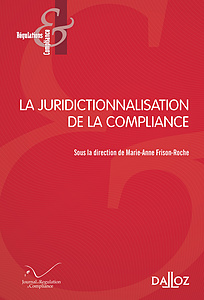
Couverture – La juridictionnalisation de la Compliance

Articles in a JoRC book

📝Le juge, l’obligation de compliance et l’entreprise. Le système probatoire de la Compliance, in🕴️M.-A. Frison-Roche (ed.), 📕La juridictionnalisation de la Complian

► Full Reference: M.-A. Frison-Roche, "Le juge, l'obligation de compliance et l'entreprise. Le système probatoire de la Compliance" ("The judge, the compliance obligation, and the company. The Compliance probationary system"), in M.-A. Frison-Roche (ed.), La juridictionnalisation de la Compliance, coll. "Régulations & Compliance", Journal of Regulation & Compliance (JoRC) and Dalloz, 2023, p 409-442. - 📝read the article (in French) - 🚧read the bilingual Working Paper which is the basis of this article, with additional developments, technical references and hyperlinks  - 📕read a general presentation of the book, La juridictionnalisation de la Compliance, in which this article is published - ► Summary of the article (done by the Journal of Regulation & Compliance): the article aims to identify the link that must be established between the company in its relationship with the compliance obligations it assumes and the judges to whom it is accountable in this respect: this link is established by evidence. The evidentiary system of proof has yet to be constructed, and it is the purpose of this long study to lay the groundwork.  To this end, the article begins with a description of what is designated here as the "probatory square" in a "probatory system" that is superimposed on the system of rules of substantive legal system. This is all the more important because Compliance seems to be in frontal collision in its very principles with the general principles of the evidentiary system, in particular because it seems that the company would have to prove the existence of the Law or that it would have to bear in a definitive way the burden of proving the absence of violation, which seems to be contrary not only to the presumption of innocence but also to the principle of the freedom of action and of undertaking. In order to re-articulate Compliance Law, the obligations of compliance which legitimately weigh on the company, it is necessary to return to the probatory system specific to Compliance, so that it remains within the Rule of Law. This presupposes the adoption of a substantial definition of Compliance, which is not only compliance with the rules, which is only a minimal dimension, but implies that Compliance Law should be defined by the Monumental Goals on which the public authorities and the companies are in substantial alliance. The evidentiary system of principle makes play between its four summits that are the burden of proof, the objects of proof this evidentiary square of principle, between the burden of proof, the means of proof and their admissibility. Compliance Law does not fall outside this evidential square, thus marking its full membership of the Rule of Law In order to lay the foundations of the evidential system specific to Compliance Law, the first part of the article identifies the objects of proof which are specific to it, by distinguishing between the structural devices, on the one hand, and the expected behaviours, on the other. The first involves proving that the structures required to achieve the Monumental Goals of Compliance have actually been put in place. The object of proof is then the effectiveness of this implementation, which presents the effectiveness of the system. As far as behavioral obligations are concerned, the object of proof is the efforts made by the company to obtain them, the principle of proportionality governing the establishment of this proof, while the systemic efficiency of the whole reinforces the evidential system. However, the wisdom of evidence lies in the fact that, even though the principle remains that of freedom of evidence, the company must establish the effectiveness, efficiency, and effectiveness of the whole, independently of the burden of proof. The second part of the article concerns those who bear the burden of proof in Compliance Law. The latter places the burden of proof on the company in principle, in view of its legal obligations. This burden comes from the legal origin of the obligations, which blocks the "round of the burden of proof". But in the interference of the different vertices of the evidentiary square, the question becomes more delicate when it comes to determining the contours of the compliance obligations that the company must perform. Moreover, the burden of proof may itself be the subject of proof, just as the company's performance of its legal obligations may also be the subject of contracts, which brings us back to the evidentiary system ordinarily applicable to contractual obligations. The situation is different when it comes to a "compliance contract" or when it comes to one or more compliance stipulations, concepts that are still not very well developed in Contract Law.  Furthermore, as all branches of Law belong to a legal system governed by the Rule of Law, other branches of law interfere and modify the methods and solutions of proof. This is the case when the fact, which is the object of proof, can give rise to a sanction, the Law of repression imposing its own solutions in the matter of the burden of proof.  In the third part of the article, the relevant means of proof in Compliance Law are examined, used in that Compliance Law is above all a branch of Law whose object is on the one hand information and on the other hand the Future. Open questions remain, such as whether companies could be forced by the Judge to build technologies to invent new means of proof. To show that they are indeed achieving the Monumental Goals they are charged with.  In the fourth part, the vital character of the pre-constitution of evidence is shown, which is the reflection of the Ex-Ante nature of Compliance Law: evidence must be pre-constituted to avoid the very prospect of having to use it, by finding all the means to establish the effectiveness, efficiency and even the effectiveness of the various Compliance Tools.  If companies do all this methodically, the Compliance evidence system will be established, in harmony with the general evidence system, Compliance Law and the Rule of Law. - 🌐 follow Marie-Anne Frison-Roche sur LinkedIn 🌐follow Marie-Anne Frison-Roche on Instagram 🌐subscribe to the Newsletter MAFR Regulation, Compliance, Law 

MAFR Chronicles Compliance Law

📝Contrat de compliance, clauses de compliance

► Full Reference: M.-A. Frison-Roche, "Contrat de compliance, clauses de compliance", Chronique of Compliance Law, D. 2022, pp. 2115-2117. - 📝reac the article (this article is written in French) - ► English summary of the article: Compliance Law is often seen only as an obligation to comply with regulations. Contract Law is masked by the study of texts and sanctions. Civil liability cases are beginning to highlight the commitments of companies, acts of will. It remains to discern the importance of contracts. First, there is a specific contract: the "compliance contract". Its purpose is to provide a third party with a service, the means for the company to "comply" with the legal systems requirements ("contract of conformity"), and/or to enable the company to achieve the monumental goals that characterize Compliance Law (contract of compliance). The interpretation and the regime of these compliance contracts must be marked by the Compliance Law that permeates it. Secondly, there are a multitude of stipulations aimed at conformity and Compliance. - 🚧read the working paper written in English: Compliance contract, Compliance stipulations - 📚read the other articles published in this chronique of Compliance Law published in the Recueil Dalloz. - 🌐 follow Marie-Anne Frison-Roche sur LinkedIn 🌐follow Marie-Anne Frison-Roche on Instagram 🌐subscribe  to the Newsletter MAFR Regulation, Compliance, Law 

Articles in a legal collective publication

📝Compliance, the new legal way for human values: towards an Ex Ante Responsibility, in 📗Evolução do Direito no século XXI. Seus princípios e valores: ESG, Liberdade, Regulação, Igualdade e Segurança Jurídica. Homenagem ao Professor Arnoldo Wald, vol. 2, Direito Privado

► Full Reference: M.-A. Frison-Roche, "Compliance, the new legal way for human values: towards an Ex Ante Responsibility", in Evolução do Direito no século XXI. Seus princípios e valores: ESG, Liberdade, Regulação, Igualdade e Segurança Jurídica. Homenagem ao Professor Arnoldo Wald, vol. 2, Direito Privado, São Paulo, Editora IASP, 2022, pp. 977-983 - ► Summary of the article:  For the first time, the future is the first question for the Humanity. The classical legal conception of Tort Law concerns the Past, the philosophical conception of Hans Jonas, a Responsability for the Future, an Ex-Ante Responsability must become a legal notion.  Traditionally, the Legislator takes decision for the Future and the Judges takes ones for the Past, but now in front of the possible disparition of human beings on this planet, global and catastrophic perspective, all legal perspectives need to be used, breaking the classical repartition, in the priority of the future.  To do something, the Responsability must be put on everyone in a legal force, not only on the classical subject of Law and because of past behaviors, but because the operators, States, firms, or individuals, are "in position" to do so.  This new "Ex-Ante Responsability" is an essential part of the Compliance Law, very new branche of Law, with an extraterritorial effect, to find immediate and active solutions for the future. Because the issue is global, international Arbitration is in position to apply the conception, because international arbitrators are the global judges. This new conception of legal Ex-Ante Responsability, declared by courts, expressed human values, such as the concerns for the others, in concordance withe the humanist tradition of European and American Law, Compliance being not at all to obey regulations but to concretise an alliance a Monumental Goal, here for the preservation of human beings in the future, and the powers and the legal duties of corporate and people to do so.  - 📝read the article - 🌐follow Marie-Anne Frison-Roche on LinkedIn 🌐follow Marie-Anne Frison-Roche on Instagram 🌐subscribe to the Newsletter MAFR Regulation, Compliance, Law
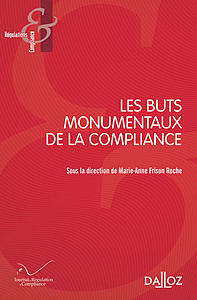
Couverture – Les Buts Monumentaux de la Compliance

Publication director

🏗️ copublishing and direction of the collection: 📚Régulations & Compliance

📚Publication of🕴️M.-A. Frison-Roche (ed.), 📕Les Buts Monumentaux de la Compliance (2022)

► Full Reference: M.-A. Frison-Roche (ed.), Les Buts Monumentaux de la Compliance (Compliance Monumental Goals), coll. “Régulations & Compliance“, Journal of Regulation & Compliance (JoRC) and Dalloz, 2022, 520 p. - 📘In parallel, the English version of this book, Compliance Monumental Goals, is published in the collection co-published by the Journal of Regulation & Compliance (JoRC) and Bruylant.  - 📅This book comes after a cycle of colloquia 2021 organised by the Journal of Regulation & Compliance (JoRC)and its Universities partners.  - This volume is the continuation of the books dedicated to Compliance in this collection. ► Read the presentations of the other books in the series: the following books: 🕴️M.-A. Frison-Roche (ed.), 📕La juridictionnalisation de la Compliance, 2023 🕴️M.-A. Frison-Roche and M. Boissavy (eds.), 📕Compliance et droits de la défense. Enquête interne – CJIP – CRPC, 2024 🕴️M.-A. Frison-Roche (ed.), 📕L’Obligation de Compliance, 2025 🕴️M.-A. Frison-Roche (ed.), 📕Compliance et Contrat, forthcoming 🕴️L. Laref (ed.), 📕Compliance et vigilance bancaire, forthcoming 🕴️M.-A. Frison-Roche, 📕Le système juridique de l’adressage de l’Internet. Une structure multi-acteurs, gage de durabilité (The Legal System of Internet Addressing. A Multi-Stakeholder Structure, the Pledge of its Sustainability), forthcoming 🕴️M.-A. Frison-Roche (ed.), 📕Le système probatoire de la Compliance, forthcoming   the previous books: 🕴️M.-A. Frison-Roche (ed.), 📕Les outils de la Compliance, 2021 🕴️M.-A. Frison-Roche (ed.), 📕Pour une Europe de la Compliance, 2019 🕴️N. Borga, J.-Cl. Marin and J.-Ch. Roda (eds.), 📕Compliance : l’entreprise, le régulateur et le juge, 2018 🕴️M.-A. Frison-Roche (ed.), 📕Régulation, Supervision, Compliance, 2017 🕴️M.-A. Frison-Roche (ed.), 📕Internet, espace d’interrégulation, 2016 📚Read the presentations of the other titles of the collection. - ► General presentation of the book: Seize Compliance by its mind: its Monumental Goals. The notion of “monumental goals” of Compliance was proposed in 2016 by Marie-Anne Frison-Roche1M.-A. Frison-Roche, "Le droit de la compliance", 2016. It has become explicit in the texts and the resolution of cases, for example to fight against climate change, make human beings effectively equal, force to be extraterritorially vigilant about suppliers.  Compliance Monumental Goals are targeted ex ante by regulations, contracts, CSR, and international treaties. Creating an alliance between business and political authorities, aiming for a new form of sovereignty. The presence in litigation of these Monumental Goals of global dimension renews the responsibilities and the Judge office. Describing and conceiving these Monumental Goals makes it possible to anticipate Compliance Law, which is more powerful every day. - 🏗️General construction of the book : The book opens with a double Introduction, the first summarizing the book (in free access) ​and the second, more substantial, proposing  the Monumental Goals as definition of Compliance Law putting them at its “beating heart”, giving this new branch of law its originality and specificity, explaining what, in the History of the United States and Europe, gave birth to this singular corpus and justifies a substantial definition of Compliance Law. The concept of Monumental Goals is explained, justifying both systemic and political nature of Compliance Law, the practical consequences of which legal specific rules are thus better identified and limited, since Compliance Law does not lead to all-obedience. We can then determine what we can expect from this Law of the Future that is Compliance Law. From there, the book unfolds in 5 titles. A first Title is devoted to the “radioscopy” of this notion, in itself and branch of Law by branch of Law. A second Title aims to measure how the Monumental Goals are questioned by a crisis, for example in a health situation, but not in that example, if they aggravate it and must be discarded, or if, on the contrary, they are exactly conceived for this hypothesis. of crisis, risks, catastrophes and that it is advisable to exploit them, in order, in this “test”, to benefit from the alliance between the political authorities, public powers and crucial operators. Once made explicit and tested, the Monumental Goals must find a sure way to be considered. Therefore a third Title aims to measure in principle and in practice how the Proportionality method can help the integration of Compliance, thus giving a new dimension to the Law without dragging it into insecurity and illegitimate grabbing of powers. But because Compliance Monumental Goals express a very great ambition, the question of a bearable, even beneficial relationship with the international competitiveness of companies, standards and systems must be opened. This is the object of the fourth Title.   Finally, because the Monumental Goals express by nature a new ambition of the Law in a world which must not give up in what could be the prospect of its abyss, the fifth Title has for object the relationship between the Monumental Goals of Compliance and Sovereignty. - ► Understand the book through the Table of Contents and the summaries of each article:   DOUBLE INTRODUCTION 🕴️M.-A. Frison-Roche, 📝Résumé de l’ouvrage Les buts monumentaux du droit de la compliance (free access : click here to read this article (in French))  🕴️M.-A. Frison-Roche, 📝Les Buts Monumentaux, cœur battant du Droit de la Compliance   I. LA NOTION DE BUTS MONUMENTAUX DE LA COMPLIANCE (“THE IDEA OF COMPLIANCE MONUMENTAL GOALS”)  🕴️R.-O. Maistre, 📝Quels buts fondamentaux pour le régulateur dans un paysage audiovisuel et numérique en pleine mutation ? 🕴️A.V. Le Fur, 📝Intérêt et raison d’être de l’entreprise : quelle articulation avec les Buts Monumentaux de la Compliance ?   🕴️A. Le Goff, 📝La part des banques dans la concrétisation des Buts Monumentaux de la Compliance 🕴️J.-F. Vaquieri,📝Les “Buts Monumentaux” perçus par l’entreprise. L’exemple d’Enedis 🕴️M. Malaurie-Vignal, 📝Les Buts Monumentaux du droit du marché. Réflexion sur la méthode 🕴️D. de La Garanderie, 📝Sur les Buts Monumentaux de la Compliance sociale  🕴️C. Peicuti & 🕴️J. Beyssade, 📝La féminisation des postes à responsabilité dans les entreprises comme But de la Compliance. Exemple du secteur bancaire 🕴️I. Gavanon, 📝Le droit des données personnelles dans l’économie numérique à l’épreuve des Buts Monumentaux 🕴️B. Petit, 📝Les Buts Monumentaux du droit (européen) des relations de travail : un système mouvant aux équilibres à consolider    🕴️G. Beaussonie, 📝Droit pénal et Compliance font-ils système ? 🕴️Ch. Huglo, 📝À quelles conditions le Droit climatique pourrait-il constituer un But Monumental prioritaire ?   II. MISE EN OEUVRE DES BUTS MONUMENTAUX DE LA COMPLIANCE EN ARTICULATION DU PRINCIPE MAJEUR DE LA PROPORTIONNALITÉ (“IMPLEMENTATION OF COMPLIANCE MONUMENTAL GOALS IN ARTICULATION OF THE MAJOR PRINCIPLE OF PROPORTIONALITY”)  🕴️L. Rapp, 📝Conformité, proportionnalité et normativité   🕴️B. Bär-Bouyssière, 📝Les obstacles pratiques à la place effective de la proportionnalité dans la Compliance 🕴️A. Mendoza-Caminade, 📝Compliance, proportionnalité et évaluation 🕴️L. Meziani, 📝Proportionnalité en Compliance, garant de l’ordre public en entreprise 🕴️M. Segonds, 📝Compliance, proportionnalité et sanction   🕴️M.-A. Frison-Roche, 📝Définition du principe de proportionnalité et définition du Droit de la Compliance     III. LES BUTS MONUMENTAUX DE LA COMPLIANCE ÉPROUVÉS PAR LES SITUATIONS DE CRISES (“THE COMPLIANCE MONUMENTAL GOALS TESTED BY CRISIS SITUATIONS”) 🕴️A. Oumedjkane, A. Tehrani et P. Idoux, 📝Normes publiques et Compliance en temps de crise : les Buts Monumentaux à l’épreuve. Éléments pour une problématique 🕴️J. Bonnet, 📝La crise, occasion de saisir la Compliance comme mode de communication des autorités publiques   🕴️N. Sudres, 📝Gel hydroalcoolique, Covid-19 et Compliance. Des insuffisances de la démarche de conformité à l’émergence d’îlots de Compliance 🕴️M.-A. Frison-Roche, 📝Place et rôle des entreprises dans la création et l’effectivité du Droit de la Compliance en cas de crise    IV. EFFECTIVITÉ DES BUTS MONUMENTAUX DE LA COMPLIANCE ET COMPÉTITIVITÉ INTERNATIONALE (“EFFECTIVENESS OF COMPLIANCE MONUMENTAL GOALS AND INTERNATIONAL COMPETITIVENESS”)  🕴️B. Deffains, 📝L’enjeu économique de compétitivité internationale de la Compliance 🕴️J.-Ch. Roda, 📝Compliance, enquêtes internes et compétitivité internationale : quels risques pour les entreprises françaises (à la lumière du droit antitrust) ? 🕴️F. Marty, 📝L’apport des programmes de conformité à la compétitivité internationale : une perspective concurrentielle 🕴️S. Lochmann, 📝Les agences de notation ESG et l’effectivité de la Compliance face à la compétitivité internationale 🕴️M.-A. Frison-Roche, 📝Appréciation du lancement d’alerte et de l’obligation de vigilance au regard de la compétitivité internationale     V. LA COMPLIANCE PORTÉE PAR LES BUTS MONUMENTAUX, NOUVELLE VOIE DE SOUVERAINETÉ (“COMPLIANCE SUPPORTED BY MONUMENTAL GOALS AND NEW WAY OF SOVEREIGNTY”)  🕴️R. Bismuth, 📝Compliance et souveraineté : relations ambigües 🕴️L. Benzoni, 📝Commerce international, compétitivité des entreprises et souveraineté : vers une économie politique de la Compliance 🕴️M.-A. Boursier, 📝Les Buts Monumentaux de la Compliance : mode d’expression des États 🕴️S. Pottier, 📝Pour une Compliance européenne, vecteur d’affirmation économique et politique 🕴️Ch. André, 📝Souveraineté étatique, souveraineté populaire : quel contrat social pour la Compliance ? 🕴️M.-A. Frison-Roche, 📝Le principe de proximité systémique active, corollaire du renouvellement du principe de souveraineté par le Droit de la Compliance - 🌐follow Marie-Anne Frison-Roche on LinkedIn 🌐follow Marie-Anne Frison-Roche on Instagram 🌐subscribe to the Newsletter MAFR Regulation, Compliance, Law  🌐s’abonner à la Newsletter MAFR Surplomb
Couverture – Les Buts Monumentaux de la Compliance

Articles in a JoRC book

ANDRÉ, Christophe🕴️

📝Souveraineté étatique, souveraineté populaire : quel contrat social pour la Compliance ?, in 🕴️M.-A. Frison-Roche (ed.), Collection Régulations & Compliance Les Buts Monumentaux de la Compliance

► Full reference: André, Ch., Souveraineté étatique, souveraineté populaire : quel contrat social pour la compliance ? (” State sovereignty, popular sovereignty: what social contract for compliance? “), in Frison-Roche, M.-A. (ed.), Les buts monumentaux de la Compliance, series “Régulations & Compliance“, Journal of Regulation & Compliance (JoRC) and Dalloz, 2022, pp. 483-500. - 🦉This article is available in full text to those registered for Professor Marie-Anne Frison-Roche’s courses - 📕read a general presentation of the book, Les Buts Monumentaux de la Compliance, in which this article is published - ► Summary of the article (done by the Author): The “Compliance Monumental Goals” serve as vectors for “common” social values: the proposal is simple, but it seems both familiar and strange to a criminal lawyer. Familiar, because even if compliance transcends the borders of academic disciplines, it shares with criminal law a logic sanctioning attacks on social interests. Strange, because Monumental Goals convey social values by sweeping away all the learned discussions that have been going on since Beccaria about the foundations and axiological functions of punishment. Indeed, the social values promoted by Monumental Goals are “common” in every sense of the word. First, they are shared and internalized by the largest enterprises in the Western world, without the need for an international treaty on protected values. The question of sovereignty is overshadowed. Second, they are common in that they are commonplace, ordinary, approved of by most Western consumer-citizens: probity, equality, respect for the environment, who would not be in favour of respecting them? Hence it is in companies’ interest to communicate and diffuse, urbi and orbi, how they respect these Monumental Goals. The question of citizens’ consensus on values is sidestepped, as they are supposed to be derived from the obvious (even if the goals could be achieved by different means, or even contradict each other). Third, these values are common because they now enlist a multitude of communicants (the “compliance officer”, among others) who, more or less gracefully – the meticulous liturgy of compliance can put off some officiants and incite buffoonery – seek to spread the cult of these values at all levels of business. Since these values are respected, they are necessarily respectable: businesses become moralized by the multitude who respect them. Existence precedes essence, and the values conveyed contribute to the businesses’ raison d’être, beyond the pursuit of profit. The question of effectiveness vanishes, since these values are already there, regularly monitored, both internally and by public authorities. Sovereignty, citizenship, effectiveness: the logic of Compliance supplants the academic debates of criminal lawyers with practical solutions. Perhaps this is how the goals are “monumental”: vast, global, overwhelming. Compliance may not be the best of all worlds, but it is most certainly another world. -
Couverture – Les Buts Monumentaux de la Compliance

Articles in a JoRC book

LE FUR, Anne-Valérie🕴️

📝Intérêt et raison d’être de l’entreprise : quelle articulation avec les Buts Monumentaux de la Compliance ?, in 🕴️M.-A. Frison-Roche (ed.), Collection Régulations & Compliance Les Buts Monumentaux de la Compliance

► Full Reference: A.-V. Le Fur, "Intérêt et raison d’être de l’entreprise : quelle articulation avec les buts monumentaux de la compliance ?" ("Interest and “raison d’être” of the company: how do they fit with the Compliance Monumental Goals?"), in M.-A. Frison-Roche (ed.), Les Buts Monumentaux de la Compliance, coll. "Régulations & Compliance", Journal of Regulation & Compliance (JoRC) and Dalloz, p. 55-67. - 📕read a general presentation of the book, Les Buts Monumentaux de la Compliance, in which this article is published - ► Summary of the article (done by the Author): Companies would have a soul. The legislator thinks so, since the French law called "loi Pacte"  of 22 May 2019 obliges managers to act in the Corporate Interest and allows companies to formulate themselves a « raison d'être ». Compliance Law does the same, relying on companies to save the world from corruption, slavery, terrorism and global warming, thus achieving Monumental goals. At first glance, the contours of Corporate Interest and « raison d’être » of the company are not far removed from the notion of Compliance Monumental Goals. This is not surprising, since the objective that presided over their introduction into the French Civil Code is the same as that underlying Compliance Law : to rethink the place of the company in the global Society, by affirming long-term values or concerns. This is a reason to use these corporate law concepts in the context of an X-ray of the concept of Monumental Goals. However, a comparative approach is disappointing. The divergences between corporate notions and compliance lead to the conclusion that company law is not intended to impose anything other than a corporate public order. Notions that are more philosophical than legal, Corporate Interest and « raison d'être » are assigned functions that limit their scope. The imperative nature of corporate rules, and this is a consequence of the above, cannot be compared with that of compliance: uncertain, it is also relative when compared with the "violence" of compliance rules. The impact of the notions of Interest and « raison d'être » remains thus mainly internal to the company. According to a second approach, it cannot be ruled out that Corporate Interest and « raison d'être » allow for a better understanding of higher and universal values by Company Law. Corporate Interest may incorporate Compliance Monumental Goals while the « raison d'être » may constitute a perspective for the realization of these goals. The stakes are high : when the interest of the company, as a legal person and autonomous economic agent, joins the Monumental Goals, the means of achieving the latter are multiplied by internalizing them in all companies, not just the largest ones. However, despite all good intentions, a company is only governable if the compass does not become an elusive and indecisive vane; in other words, if legal certainty is respected. This is why a legal ordering of the concepts is necessary, which ultimately leads to a suggestion of their domain, content and scope.  -