Market abuse

Jurisprudence

Cour d'Appel de Paris (Paris Court of Appeal)

Decision of 11th of February 2021, Veolia v. Suez

Full reference: Cour d'appel de Paris, Pole 5 – chamber 7, 11th of February 2021, Veolia/Suez, n° 20/13807

Articles in The Journal of Regulation & Compliance « JoRC »

MALAURIE, Marie👤

Monumental goals of Market Law. Reflection on the method, in Frison-Roche, M.A. (dir.), Les Buts Monumentaux de la Compliance

► Full Reference: Malaurie, M., Monumental goals of Market Law. Reflection on the method in Frison-Roche, M.-A. (ed.), Compliance Monumental Goals, series "Compliance & Regulation", Journal of Regulation & Compliance (JoRC) and Bruylant, to be published - ► Article Summary (done par the JoRC editor):  The analysis done by this article is about Competition Law, and the methodology needed to be adopted for the technical functioning of this branch of Law. Taking up the various economic and legal theories on this subject, conceptions which have succeeded and clashed, the author develops that the monumental goal of Market Law is to develop an economic environment favorable to businesses and consumers, then asks the question if it could integrate an ethical dimension and more broadly non-economic considerations, in particular humanistic ones. -   📘 see the general presentation of the book, Compliance Monumental Goals, in which this article is published -  

Videos

French Financial Markets Authority decision of 11 December 2019 sanctioning the Bloomberg press organ for disseminating false information on the financial market: here, the ethical obligation converges with Financial Law

Watch the video commenting on the decision of the Commission des sanctions of the Autorité des marchés financiers – AMF (French Financial Market Authority Sanctions Commission). Read the decision. -   In 2015, a document supposedly emanating from the Vinci company reached the Bloomberg media announcing unexpected catastrophic results. The two journalists who received it immediately published it without checking anything, the Vinci listed shares losing more than 18%. It was a rude forgery, which a basic check would have established, a check which the journalists had not done. 4 years later, the Bloomerg company is punished for the breach to "disseminate false information" on the financial market, by a decision of the Sanctions Commission of the Autorité des Marchés Financiers (French Financial Markets Authority) of December 11, 2019. The company being sued argued that it was up to journalists to be accountable and not to itself, because on the contrary the firm had implemented both detection software and a code of conduct, even though there was no legal rule constraining it. In consequence, it would not possible to pursue it. But the AMF Sanctions Commission stresses that, independently of this, it is a general rule of ethics for journalists that obliges them to verify the authenticity of the documents they publish, which they did not, whereas an elementary check would have allowed them to measure that it is a rude forgery. In addition, the Sanctions Commission refers to the European Regulation on market abuses which in its article 21 targets the special status to be reserved for press freedom and the special status of journalists, but associates this ethical obligation to verify documents . However, the Sanctions Commission notes that this obligation, which was targeted by both the journalists' ethics and the reference text of Financial Law, was completely ignored by the two journalists. It is therefore up to the press agency to be accountable and to be punished. However, the media entreprise maintained that the balance between the principle of freedom of the press and the principle of freedom of opinion on the one hand and the principle of the protection of the financial market and of investors against false information disseminated requires an interpretation of the European Union Law, which must oblige the Sanctions Commission to ask a preliminary question to the Court of Justice of the European Union. The Sanctions Commission dismisses this request because it considers that the European texts are "clear", which allows the Sanctions Commission to interpret them itself. And precisely the European Regulation on market abuse in its article 21 provides for the exception in favor of the press and journalists but compels them to respect their ethics, in particular the verification of the authenticity of documents. In this case, they did nothing. They are clearly the authors of a breach attributable to the company. - In a less clear case, one could consider that this balance between two principles, both of public interest, is delicate and that an interpretation by the Court of Justice would always be useful. Indeed and more fundamentally, does Financial Law remain an autonomous Law, putting first the objective of the preservation of the integration of the financial market and the protection of investors or is it the advanced point of an Information Law protecting everyone against the action of any "influencer" (category to which Bloomberg belongs) consisting in disseminating inaccurate information (notion of "misinformation")? And that is not so "clear" ….   -

Reports

Autorité des marchés financiers (French financial markets regulator)

La cybercriminalité boursière. Définition, cas et perspectives (Stock market cybercriminality. Définition, cases and perspectives)

Full reference: Alexandre Neyret, La cybercriminalité boursière. Définition, cas et perspectives (Stock market cybercriminality. Définition, cases and perspectives), Report to l'AMF, 10th of October 2019, 70p. Read the report (in French)

Books

🏗️ direction of the collection: 📚Droit et Économie

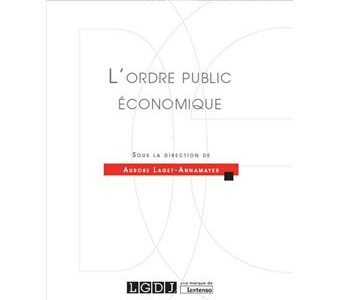
L’ordre public économique (Economic Public Order)

Full reference : Laget-Annamayer, A. (ed.), L'ordre public économique ("Economic Public Order"), coll. "Droit et Économie", Lextenso – LGDJ éditions, 2018, 397p.   This collective book is published in French.    This is the 32nd volume published in this collection.   Often launched as an all-encompassing expression, both by the doctrine and by the judge, public economic order remains a mysterious concept whose substance and contours are difficult to know, simply because it is liable to fluctuate according to its apprehension and depending on the economic and social context. Yet the expression has become widely used, almost incantatory, like a label, and there is therefore undoubtedly a gap between its invocation and its meaning in Law. It is to this discrepancy, and in an attempt to reduce the mystery, that this work is devoted. Not stopping at the only vision of public economic order in internal Public Law, he tries to seek the meanings of it in Comparative Law, in European and International Law, without omitting the historical, privatist or economic vision. It is therefore to this rich overview treated by specialists from different legal fields and beyond that this book invites. It does not aim to put an end to the debate, but on the contrary to arouse it in the context of reflections on the relationship between Law and Economics of which everyone knows the importance. Authors are : Olivier Baillet, Jacques Caillosse, Aurélien Camus, Jacques Chevallier, Dominique Custos, Pierre Delvolvé, Samuel Ferey, Sébastien Hourson, Pascale Idoux, Jean-Philippe Kovar, Aurore Laget-Annamayer, Jérémy Martinez, Francesco Martucci, Jeanne Mesmin d’Estienne, Claire Mongouachon, Eric Naim-Gesbert, Guillaume Richard, Jean-Marc Sorel, Pascal de Vareilles-Sommières.   Read the forth of cover. Read the Table of Contents.   See the whole collection in which this book is published

Jurisprudence

European Commission

Decision of 18th of July 2018, Google Android

Full reference: European Commission, 18th of July 2018, Decision relating to a proceeding under Article 102 of the Treaty on the Functioning of the European Union and Article 54 of the EEA Agreement, Google Android, Case AT.40099 Read a summary of the decision

Jurisprudence

Autorité de la concurrence (French Competition Authority)

Decision n°17-D-16 of 7th of September 2017 relating to practices implemented by the company Engie in the energy sector

Référence complète: Autorité de la concurrence (French Competition Authority), Decision relating to practices implemented by the company Engie in the energy sector, Engie vs Direct Energie, 7th of September 2017, n°17-D-16 Read the decision (in French) Read the press release

Texts

European Parliament and Council

Regulation Prospectus III of 14th of June 2017

Full reference: Regulation (EU) 2017/1129 of the European Parliament and of the Council of 14 June 2017 on the prospectus to be published when securities are offered to the public or admitted to trading on a regulated market, and repealing Directive 2003/71/EC Read the regulation 

Glossary

Market Failure

The market is normally self-regulated. It suffers from one-time failures when economic agents engage in anti-competitive behavior, mainly the abuse of dominant positions in the ordinary markets, or the abuse of markets in the financial markets, sanctioned ex post by the authorities in individual decisions. But some sectors suffer from structural failures, which prevent them, even without malicious intent of agents, from reaching this mechanism of adjustment of supply and demand. The existence of an economically natural monopoly, for example a transport network, constitutes a structural failure. Another agent will not duplicate once the first network has been built, which prevents competition. An a-competitive regulation, either by nationalization, by a state control or by a control by a regulatory authority, is needed to ensure everyone's access to an essential facility. Also constitutes a market failure asymmetry of information, theorized through the notion of agency that hinders the availability and circulation of exhaustive and reliable information on markets, especially financial markets. This market failure carries with it a systemic risk, against which regulation is definitely built and entrusted to financial regulators and central banks. In these cases, the implementation of regulations is a reaction of the State not so much by political rejection of the Market, but because the competitive economy is unfit to function. This has nothing to do with the hypothesis that the State is distancing itself from the Market, not because it is structurally flawed in relation to its own model, but because politics wants to impose higher values, expressed By the public service, whose market does not always satisfy the missions.    

Working papers

WHAT IS BASED PUNISHMENT IN FINANCIAL SYSTEM