Articles in The Journal of Regulation & Compliance « JoRC »
ANCEL, François🕴️
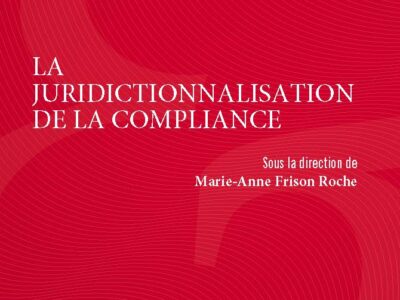
► Full Reference: F. Ancel, "Le principe processuel de compliance, un nouveau principe directeur du procès ?" (The procedural principle of compliance, a new trial leading principle?), in M.-A. Frison-Roche (ed.), La juridictionnalisation de la Compliance, coll. "Régulations & Compliance", Journal of Regulation & Compliance (JoRC) and Dalloz, 2023, pp. 225-230. - 📕read a general presentation of the book, La juridictionnalisation de la compliance, in which this article is published - ► Summary of the article (done by the Journal of Regulation & Compliance): Through this article, the author formulates a proposal: elevating the principle of compliance to the rank of leading principle of the trial. To support this, the author firstly emphasizes the convergence of the aims of compliance and the purpose of the trial. Indeed, emphasizing that Compliance Law does not oust either the State or the judge, as soon as compliance means that the person must keep their commitments and that the trial is also based on this principle that the parties must conform to the principles and to their own "speech", compliance thus becomes a trial leading principle. In a second part of the article, the author illustrates his point in a very concrete way. First, the protocols of procedure which are drawn up by the courts and the bars are commitments which should justify a form of constraint which, if it should not have the same form and nature as that of the law, must all the same even have consequences when a party fails to do so. Secondly, relying on French case law which sanctions a party which had accepted the principle of an arbitration and then systematically hinders its implementation, the author suggests that under the principle of compliance can be grouped the notions for the instant scattered of loyalty, consistency (estoppel) and efficiency. Thus, this "open practice" echoing the "open way" of a procedural principle of compliance brings out this one. -
