Litigation

Articles in The Journal of Regulation & Compliance « JoRC »

📝L’arbitre, juge, superviseur, accompagnateur ? (The arbitrator, judge, supervisor, coach?),, in 🕴️M.-A. Frison-Roche (dir.), 📕L’obligation de Compliance

► Full Reference: J.-B. Racine, "L’arbitre, juge, superviseur, accompagnateur ?" (The arbitrator, judge, supervisor, coach?), in M.-A. Frison-Roche (dir.), L'Obligation de Compliance, Journal of Regulation & Compliance (JoRC) and Dalloz, coll. "Régulations & Compliance", 2025, pp. 489-502. - 📕read the general presentation of the book, L'Obligation de Compliance, in which this article is published - ► English Summary of this article (done by the Journal of Regulation & Compliance – JoRC) : From the outset, the author sets out what is at stake in these terms:  "Quel rôle peut ou pourrait jouer l’arbitre dans les dispositifs de compliance ? Selon le rôle qu’il est amené à jouer, il peut ou pourrait venir en renfort de l’obligation de compliance. Poser cette question, c’est poser la question des pouvoirs de l’arbitre et de son office. C’est aussi, d’une certaine manière, renvoyer à la notion même d’arbitrage." (What role can or could the arbitrator play in compliance systems? Depending on the role he/she is called upon to play, he/she can or could reinforce the compliance obligation. Asking this question raises the question of the powers of the arbitrator and his/her office. In a way, it also goes back to the very notion of arbitration).  In practice, arbitrators deal with compliance issues in their office as judges. This is illustrated by disputes involving allegations of corruption, where the arbitrators' ruling obviously cannot give effect to a corrupt practice unless they violate themselves international public order. But in this, the arbitrator is only applying a legal standard, the main issue being then the question of evidence, with compliance tools often serving as indicators of the corruption itself. Leaving behind the strict legal source and coming to the standards issued by the ICC about the fight against corruption, we really enter into the "compliance obligation", in the strict sense, when a contract appears. International business practices standards are emerging, not only in the area of probity but also in the protection of human rights, for which arbitrators can now act as guarantors. Arbitrators can do this, in particular, through the emerging litigation relating to vigilance obligation, either directly when vigilance plans are at issue,, even if a legal rule gives a specific competence to a State court (as the French 2017 law does) or if we imagine that a plan itself includes a system for recourse to arbitration, which would imply a change in culture, or if we consider that soft law is in the process of emerging from the practices of international trade laying down a duty of vigilance that arbitrators could take up. In the second part of his contribution, the author takes a second, bolder approach, namely that of an arbitrator who understands Compliance Law in that he/she would be more than a Judge, i.e. he/she would do more than settle a dispute by applying the law. This would be conceivable given the tendency to consider that the arbitrator could modify contracts and if example is taken from the technique of arbitration practised for concentration disputes in merger law. To give arbitration the required regulatory dimension, this third party would have to be able to exercise a supervisory function, which the notion of "dispute" hardly lends itself to, especially as an arbitrator is only set up to be a judge, and if he/she ceases to be one it is difficult for him/her to remain an arbitrator…. However, it is conceivable that in Ex Post the arbitrator could perform the monitoring function often required in Compliance Law. The technique of disputes boards is inspiring in this respect. The two fields, Arbitration and Compliance, are thus destined to move closer together, as the two traditional limits, arbitrability and litigation, are in the process of evolving so that they no longer stand in the way of such rapprochements. The author can therefore conclude: "C’est aux différents acteurs de la compliance de penser à l’arbitrage, et à la souplesse, la plasticité et la liberté qu’il offre, pour éventuellement le configurer spécialement au service des buts de la compliance." (It is up to the various players in Compliance to think about Arbitration, and the flexibility, plasticity and freedom it offers, in order to configure it specifically to serve the goals of Compliance Law). -

Articles in The Journal of Regulation & Compliance « JoRC »

📝Les enjeux présents et à venir de l’articulation des principes de procédure civile et commerciale avec la logique de compliance (Current and future challenges for articulating civil and commercial procedural principles with Compliance Logic), in 🕴️M.-A. Frison-Roche (dir.), 📕L’Obligation de Compliance

► Full reference : Th. Goujon-Bethan, "Les enjeux présents à venir de l’articulation des principes de procédure civile et commerciale avec la logique de compliance (Current and future challenges for articulating civil and commercial procedural principles with Compliance Logic)", in  M.-A. Frison-Roche (ed.), L'Obligation de Compliance, Journal of Regulation & Compliance (JoRC) and Dalloz, coll. "Régulations & Compliance", 2025, pp. 693-719. - 📕Read a general presentation of the book, L'Obligation de Compliance, in which this article is published. - ► Summary of this article (by the Journal of Regulation & Compliance – JoRC): The author shows that the French Code of Civil Procedure, because it is exceptionally well designed and managed, can respond to the scale of transformation brought about by Compliance Law. Compliance Law is normatively anchored in its Monumental Goals: these are brought as such before the judge in 'Systemic Cases'. However, the French Code of Civil Procedure distinguishes between litigation and conflict, as demonstrated by the work of the academic authors of the Code, who were very famous legal scholars. Indeed, in a "Systemic Case" such as Compliance Law, which necessarily takes precedence (climate, protection of internet users, effective equality of human beings, sustainability of banking systems, etc.), it is the parties who are in dispute, while the conflict encompasses the systems themselves and other entities. The procedure must incorporate not only the dispute but also the conflict. This means, in particular, that we must deal not only with the dispute, but also with the conflict, which does not necessarily end with the dispute and does not find the same solutions as those sought by the dispute. It is particularly in this latter perspective, essentially in a "Systemic Compliance Case" procedure, that the techniques of mediation, amicus curiae, with a judge who takes an ex ante position, etc., are required. They are available through legal dispositions of this French Code of Civil Procedure: judges who understand what "Systemic Compliance Cases" are need only apply them. - 🦉this  article is available in full text for people who follow the professor Marie-Anne Frison-Roche's teaching  -

Articles in The Journal of Regulation & Compliance « JoRC »

ANCEL, François🕴️

📝Devoir de vigilance et litiges commerciaux : une compétence à partager ? (Duty of Vigilance and commercial disputes: a jurisdictional competence shared ?), in 🕴️M.-A. Frison-Roche (dir.), 📕L’Obligation de Compliance

► Full Reference: Fr. Ancel, "Devoir de vigilance et litiges commerciaux : une compétence à partager ?" (Duty of Vigilance  and commercial disputes: a jurisdictional competence shared ?), in M.-A. Frison-Roche (dir.), L'Obligation de Compliance, Journal of Regulation & Compliance (JoRC) and Lefebvre-Dalloz, coll. "Régulations & Compliance", 2025, 727-740. - 📕read the general presentation of the book, L'Obligation de Compliance, in which this contribution is published - ► English summary of this contribution (done by the Journal of Regulation & Compliance – JoRC) : The author considers the procedural issues raised by the duty of vigilance as the "cutting edge" of Compliance Law.  After recalling the obligations imposed by the French 2017 law  so-called "Vigilance Law" with regard to the Vigilance Plan, he emphasises the 2 types of action instituted by the law to ensure compliance with the duty of vigilance: the preventive action to put an end to the unlawful act, initiated after the formal notice has been served, and the civil liability action that can be brought under the conditions of general tort law, once the damage has occurred. It is the French 2021 law so-called "Confidence Law" that has targeted the Paris Judicial Court of First Instance, in a jurisdiction that can be described as 'special' rather than exclusive. The author looks in detail at the disputes that this law both puts an end to and yet triggers in its turn, going back over the case law of the French Cour de cassation, which referred to the very nature of the Vigilance Plan and the subject matter of the dispute. It is therefore clear that the dispute may concern only the validity of the plan, in which case the Paris Court of first instance has jurisdiction, or it may concern a dispute, for example, between the company that drew up the plan and one of its partners, in which case jurisdiction is shared. The article details all the procedural situations involving disputes in which the Vigilance Plan is more or less at the centre, which more or less implies either a lack of jurisdiction, or a stay of proceedings, or knowledge of the entire dispute by a court other than the Paris Court àf first instance, with the author proposing methods each time to develop case law so that the Duty of Vigilance does not emerge fragmented, at the same time as other jurisdictions, for example the commercial courts, will be dealing with the duty of vigilance insofar as it interferes with actions relating to commercial companies, the Plan having a direct link with the management of these companies, with the new definition of the corporate purpose of companies and with the exercise of the power of management of companies. According to the author, this "judicial syncretism", expressed in the case law of the Cour de cassation, is part of Compliance Law, which goes beyond the distinction between the traditional branches of law. To give concrete form to this general view, the author states that when the subject of the action is the legality or validity of the plan, it therefore falls within the jurisdiction specially conferred by law on the Paris Court of First Instance. However, when the plan is only mentioned in an ancillary manner, and/or the duty of vigilance is mentioned in another capacity, the natural jurisdiction of the case law remains, for example if the nullity of a contractual stipulation is alleged. It is possible that this type of dispute is more frequent and more important than actions based primarily on the illegality of the Vigilance Plan. This contractual dispute could also arise from the fact that the company contractually imposes compliance with its own Vigilance Obligation on its employees and partners as part of the "adapted actions". Judges, for example commercial judges, are then justified in interpreting and applying Vigilance  obligations in the spirit of the law, particularly with regard to the aims pursued. It will be important for a common approach to emerge.         - 🦉this article is fully available  for people enrolled in courses taught by Professor Marie-Anne Frison-Roche  -

Conferences

Conference

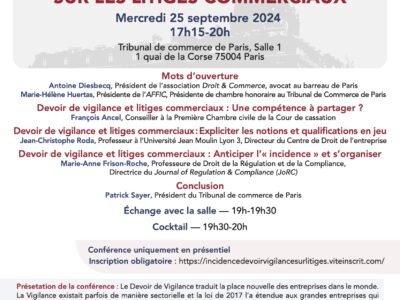
🎤Devoir de vigilance et litiges commerciaux : Anticiper l'”incidence” et s’organiser (Duty of vigilance and Commercial Litigation: Anticipating the “impact” and getting organised), in 🧮L’incidence du devoir de vigilance sur les litiges commerciaux (The Impact of the Duty of Vigilance on Commercial Litigation)

► Full Reference: M.-A. Frison-Roche, "Devoir de vigilance et litiges commerciaux : Anticiper l'"incidence" et s’organiser" ("Duty of vigilance and Commercial Litigation: Anticipating the "impact" and getting organised"), in L'incidence du devoir de vigilance sur les litiges commerciaux (The Impact of the Duty of Vigilance on Commercial Litigation), Tribunal de commerce de Paris (Paris Commercial Court), Droit & Commerce and Association Française en Faveur de l'Institution Consulaire (AFFIC), Tribunal de commerce de Paris, September 25, 2024, 17.15pm to 20pm - 🌐read the report of this speech on LinkedIn (in French) - 🧮see the full programme of this event (in French) - 🧱consult the scientific coordination sheet of this event - 🌐consult on LinkedIn a general presentation of this event (in French) - ► English Summary of the conference: After listening to the enlightening speeches of François Ancel and Jean-Christophe Roda, I had the great opportunity to emphasise, as they did, that the duty of vigilance, in the respect of French laws of 2017 and 2021, with a view to the transposition of the CS3D, does not imply, so brutally as has been said, a lack of knowledge by judges other than those of the Tribunal judiciaire de Paris (Paris First Instance Civil Court) of this new Law, which is the extension of Compliance Law, as François Ancel reminded us. Because Commercial Court judges deal with Contract Law on a daily basis, and because companies build their value chains through contracts that should be described as "regulatory contracts", the duty of vigilance has an "impact" on these disputes. These disputes may be of a "systemic" nature. This can only result not in jurisdictional trenches, but in "shared jurisdiction", along the lines drawn by François Ancel. This sharing must be built through a dialogue between judges, a necessary method on which Patrick Sayer concluded this elaborate conference on an essential and forward-looking subject. - 🌐follow Marie-Anne Frison-Roche on LinkedIn 🌐follow Marie-Anne Frison-Roche on Instagram 🌐subscribe to the Newsletter MAFR Regulation, Compliance, Law 🌐subscribe to the Video Newsletter MAFR Surplomb

Articles

📧Dans les causes systémiques : “délibérer” plutôt que “se disputer”

🌐 follow Marie-Anne Frison-Roche on LinkedIn 🌐 subscribe to the Newsletter MAFR Regulation, Compliance, Law - ► Full Reference: M.-A. Frison-Roche, "Dans les causes systémiques : "délibérer" plutôt que "se disputer"" ("In systemic causes: 'deliberate' rather than 'argue'"), Newsletter MAFR – Law, Compliance, Regulation, 17 April 2023. - 📧Read by freely subscribing other news of the Newsletter MAFR – Law, Compliance, Regulation - 🔴To deal with "systemic causes", including systemic cases of compliance, move from "argument" to "deliberation" from the start Compliance Law involves systems, for example banking, financial, digital, health, etc. When a dispute is brought before a judge, this dimension remains, whether before a judge of the Law or a judge of the merits, whether before a civil, criminal, commercial, administrative or European judge, etc. The judge's office must be adapted accordingly. And this is in the process of being done. - 📧read the article ⤵️ 

Articles in a legal collective publication

JOURDAN-MARQUES, Jérémy🕴️

📝L’arbitre, juge ex ante de la compliance ?, in 🕴️M.-A. Frison-Roche (ed.), 📕La juridictionnalisation de la Compliance

► Full Reference: J. Jourdan-Marques, "L’arbitre, juge ex ante de la compliance ?" ("The arbitrator, ex ante judge of compliance?"), in M.-A. Frison-Roche (ed.), La juridictionnalisation de la Compliance, coll. "Régulations & Compliance", Journal of Regulation & Compliance (JoRC) and Dalloz, 2023, pp. 317-334.  - 📕read a general presentation of the book, La juridictionnalisation de la Compliance, in which this article is published - ► The summary below describes an article which follows an intervention in the scientific manifestation L'entreprise instituée Juge et Procureur d'elle-même par le Droit de la Compliance ("The company instituted Judge and Prosecutor of itself by Compliance Law"), co-organized by the Journal of Regulation & Compliance (JoRC) and the  Faculty of Law Lyon 3. This colloquium was designed by Marie-Anne Frison-Roche and Jean-Christophe Roda, scientific co-directors, and took place in Lyon on June 23, 2021. Due to the very close proximity of the content of this article to a scientific manifestation that was held previously, in the same series of colloquia, manifestation on Compliance and Arbitration, designed by Marie-Anne Frison-Roche and Jean-Baptiste Racine, and which took place in Paris on March 31, 2021 in Paris, it was decided with the author and the scientific managers of the scientific events concerned to publish the article not in Title I of the book, devoted to the topic of the Company instituted Judge and Prosecutor of itself by Compliance Law, but in Title III, devoted to the topic of Compliance and International Arbitration. - ► Summary of the article (done by the Journal of Regulation & Compliance) :  The article begins with a long introduction relating to the general relationship between Compliance and Arbitration. Then the author in a first part examines the place of the Arbitration upstream of the occurrence of the dispute, aiming at the relations of the company in its organization with other companies for its economic activities, for example commercial agents. The author examines the way in which Arbitration can resolve difficulties which arise between them, including when these issues are otherwise apprehended by Compliance Law and the institutions in charge of it, in particular because of the facts of corruption are alleged and the fact is alleged by the debtor himself when payment has not yet been requested by the creditor. The legal question then becomes whether or not there is a "dispute". Being even further upstream, the author takes the hypothesis of the adoption of a compliance program in which recourse to arbitration would be inserted by the Company, insertion which could then be at the origin of exemption from criminal liability, an arbitration award being able to produce such an effect if it is recognized in the legal order.  The second part of the article considers Arbitration in the absence of multiple parties, which could correspond to the acts issued by the Oversight Board of Facebook, this kind of tribunal and judge not being seized by parties to a litigation. It might be adequate to qualify this mechanism as an arbitration, even if this qualification is difficult to retain. In any case, if we did so by admission that a unilateral request gives rise to a jurisdictional mission, there should be guarantees surrounding such institutionalization. They can go through specific bodies for Compliance cases, outside or within existing arbitration institutions, which must then become the driving force in the matter. In addition, the choice of arbitrators should undoubtedly go through the institution itself so that impartiality remains unchallenged and profiles of arbitrators would be truly varied. The procedure would also have vocation to be inflected because of the absence of real litigation, justifying the adjustment of the adversarial principle (in the narrow sense of this one, linked to the debate) in particular by the intervention of amicus curiae and to avoid the fraud through arbitration and in procedure. In the absence of an adversary, the procedural office of the arbitrator could be reconsidered: without modifying the terms of the case, it would be appropriate for the arbitrator to have more power to decide on the adequate measures to be taken to remedy the non- conformity with compliance requirements. Finally, publicity seems to the author essential so that the arbitration is not instrumentalised by the parties, publicity which could also concern the debates and the documents produced. These admittedly very high requirements would in return give great credibility to the resulting award, justifying its scope, and one could consider labeling such a result, a label that the company could claim.  The author concludes that these transformations would move away so much from Arbitration that it would denature it, in particular because of the absence of litigation, but this allows Companies to outsource the management of the more and more heavier responsibility engendered by Compliance Law, by offering Compagnies the assistance of a judicial authority, as soon as the procedural guarantees are reinforced. -