Liability

Publication director

🏗️ copublishing and direction of the collection: 📚Compliance & Regulation

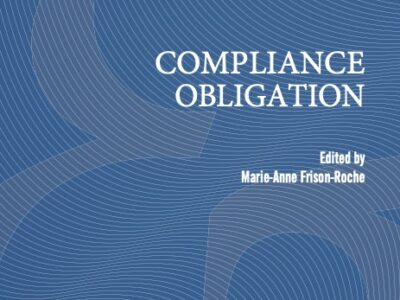
Publication of :🕴️ M.-A. Frison-Roche (ed.),📘 Compliance Obligation

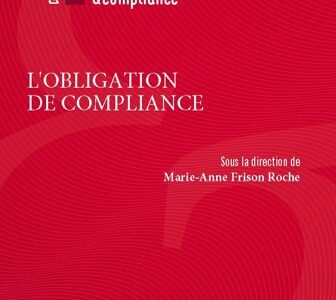
► Full Reference: M.-A. Frison-Roche (ed.), Compliance Obligation, Journal of Regulation & Compliance (JoRC) and Bruylant, "Compliance & Regulation" Serie, 2026, to be published - 📕In parallel, a book in French L'Obligation de compliance, is published in the collection "Régulations & Compliance" co-published by the Journal of Regulation & Compliance (JoRC) and Lefebvre-Dalloz.  - 📚This book is inserted in this series created by Marie-Anne Frison-Roche for developing Compliance Law.  read the presentations of the other books of this Compliance Series: further books: 🕴️M.-A. Frison-Roche (ed.), 📘Compliance Evidential System, 2027 🕴️M.-A. Frison-Roche (ed.), 📘Compliance and Contract, 2027   previous books: ​🕴️M.-A. Frison-Roche (ed), 📘Compliance Juridictionnalisation, 2023 🕴️M.-A. Frison-Roche (ed), 📘Compliance Monumental Goals, 2022 🕴️M.-A. Frison-Roche (ed.), 📘Compliance Tools, 2021 - ► go to the general presentation of this 📚Series ​Compliance & Regulation, conceived, founded et managed by Marie-Anne Frison-Roche, co-published par the Journal of Regulation & Compliance (JoRC) and Bruylant.  - 🧮the book follows the cycle of colloquia organised by the Journal of Regulation & Compliance (JoRC) and its Universities partners. - ► general presentation of the book: Compliance is sometimes presented as something that cannot be avoided, which is tantamount to seeing it as the legal obligation par excellence, Criminal Law being its most appropriate mode of expression. However, this is not so evident. Moreover, it is becoming difficult to find a unity to the set of compliance tools, encompassing what refers to a moral representation of the world, or even to the cultures specific to each company, Compliance Law only having to produce incentives or translate this ethical movement. The obligation of compliance is therefore difficult to define. This difficulty to define affecting the obligation of compliance reflects the uncertainty that still affects Compliance Law in which this obligation develops. Indeed, if we were to limit this branch of law to the obligation to "be conform" with the applicable regulations, the obligation would then be located more in these "regulations", the classical branches of Law which are Contract Law and Tort Law organising "Obligations" paradoxically remaining distant from it. In practice, however, it is on the one hand Liability actions that give life to legal requirements, while companies make themselves responsible through commitments, often unilateral, while contracts multiply, the articulation between legal requirements and corporate and contractual organisations ultimately creating a new way of "governing" not only companies but also what is external to them, so that the Monumental Goals, that Compliance Law substantially aims at, are achieved.  The various Compliance Tools illustrate this spectrum of the Compliance Obligation which varies in its intensity and takes many forms, either as an extension of the classic legal instruments, as in the field of information, or in a more novel way through specific instruments, such as whistleblowing or vigilance. The contract, in that it is by nature an Ex-Ante instrument and not very constrained by borders, can then appear as a natural instrument in the compliance system, as is the Judge who is the guarantor of the proper execution of Contract and Tort laws. The relationship between companies, stakeholders and political authorities is thus renewed. - 🏗️general construction of the book The book opens with a substantial Introduction, putting the different sort of obligations of compliance in legal categories for showing that companies must build structures of compliance (obligation of result) and act to contribute with states and stakeholders to reach Monumental Goals (obligation of means).  The first part is devoted to the definition of the Compliance Obligation.  The second part presents the articulation of Compliance obligation with the other branchs of Law, because the specific obligation is built by Compliance Law, as new substantial branch of Law but also by many other branchs of Law. The third part develops the pratical means established to obtained the Compliance Obligation to be effective, efficace and efficient. The fourth part takes the Obligation  of Vigilance as an illustration of all these considerations and the discussion about the future of this sparehead fo the Compliance Obligation .  The fifth part refers to the place and the role of the judges, natural characters for any obligation.  - TABLE OF CONTENTS    ANCHORING THE SO DIVERSE COMPLIANCE OBLIGATIONS IN THEIR NATURE, REGIMES AND FORCE TO BRING OUT THE VERY UNITY OF THE COMPLIANCE OBLIGATION, MAKING IT COMPREHENSIBLE AND PRACTICABLE    🔹 Compliance Obligation: building a compliance structure that produces credible results withe regard to the Monumentals Goals targeted by the Legislator, by 🕴️Marie-Anne Frison-Roche   TITLE I. IDENTIFYING THE COMPLIANCE OBLIGATION   CHAPTER I: NATURE OF THE COMPLIANCE OBLIGATION Section 1 🔹 Will, Heart and Calculation, the three marks surrounding the Compliance Obligation, by 🕴️Marie-Anne Frison-Roche Section 2 🔹 Debt, as the basis of the compliance obligation, by 🕴️Bruno Deffains Section 3 🔹 Compliance Obligation and Human Rights, by 🕴️Jean-Baptiste Racine Section 4 🔹 Compliance Obligation and changes in Sovereignty and Citizenship, by 🕴️René Sève Section 5 🔹 The definition of the Compliance Obligation in Cybersecurity, by 🕴️Michel Séjean   CHAPTER II: SPACES OF THE COMPLIANCE OBLIGATION Section 1 🔹 Industrial Entities and Compliance Obligation, by 🕴️Etienne Maclouf Section 2 🔹 Compliance, Value Chains and Service Economy, by 🕴️Lucien Rapp Section 3 🔹 Compliance and conflict of laws. International Law of Vigilance-Conformity, based on applications in Europe, by 🕴️Louis d'Avout    TITLE II. ARTICULATING THE COMPLIANCE OBLIGATION WITH OTHER BRANCHES OF LAW   Section 1 🔹 Tax Law and Compliance Obligation, by 🕴️Daniel Gutmann Section 2 🔹 General Procedural Law, prototype of the Compliance Obligation, by 🕴️Marie-Anne Frison-Roche Section 3 🔹 Corporate and Financial Markets Law facing the Compliance Obligation, by 🕴️Anne-Valérie Le Fur Section 4 🔹 Transformation of Governance and Vigilance Obligation, by 🕴️Véronique Magnier Section 5 🔹 The Relation between Tort Law and Compliance Obligation, by 🕴️Jean-Sébastien Borghetti Section 6 🔹 Environmental and Climate Compliance, by 🕴️Marta Torre-Schaub Section 7 🔹 Competition Law and Compliance Law, by 🕴️Jean-Christophe Roda Section 8 🔹 The Compliance Obligation in Global Law, by 🕴️Benoît Frydman & 🕴️Alice Briegleb Section 9 🔹 Environmental an Climatic Dimensions of the Compliance Obligation, by 🕴️Marta Torre-Schaub Section 10 🔹 Judge of Insolvency Law and Compliance Obligations, by 🕴️Jean-Baptiste Barbièri   TITLE III. COMPLIANCE: GIVE AND TAKE THE MEANS TO OBLIGE   CHAPTER I: COMPLIANCE OBLIGATION: THE CONVERGENCE OF SOURCES Section 1 🔹 Compliance Obligation upon Obligation works, by 🕴️Marie-Anne Frison-Roche Section 2 🔹 Conformity technologies to meet Compliance Law requirements. Some examples in Digital Law, by 🕴️Emmanuel Netter Section 3 🔹 Legal Constraint and Company Strategies in Compliance matters, by 🕴️Jean-Philippe Denis & 🕴️Nathalie Fabbe-Coste Section 4 🔹 Opposition and convergence of American and European legal systems in Compliance Rules and Systems, by 🕴️Raphaël Gauvain & 🕴️Blanche Balian Section 5 🔹 In Compliance Law, the legal consequences for Entreprises of their Commitments and Undertakings, by 🕴️Marie-Anne Frison-Roche   CHAPTER II: INTERNATIONAL ARBITRATION IN SUPPORT OF THE COMPLIANCE OBLIGATION Section 1 🔹 How International Arbitration can reinforce the Compliance Obligation, by  🕴️Laurent Aynès Section 2 🔹 Arbitration consideration of Compliance Obligation for a Sustainable Arbitration Place, by 🕴️Marie-Anne Frison-Roche Section 3 🔹 The Arbitral Tribunal's Award in Kind, in support of the Compliance Obligation, by 🕴️Eduardo Silva Romero Section 4 🔹 The use of International Arbitration to reinforce the Compliance Obligation: the example of the construction sector, by 🕴️Christophe Lapp  Section 5 🔹 The Arbitrator, Judge, Supervisor, Support, by 🕴️Jean-Baptiste Racine   TITLE IV. VIGILANCE, SPEARHEAD OF THE COMPLIANCE OBLIGATION Section 1 🔹 Vigilance Obligation, Spearheard and Total Share of the Compliance Obligation, by 🕴️Marie-Anne Frison-Roche   CHAPTER I: INTENSITIES OF THE VIGILANCE OBLIGATION, SPEARHEAD OF THE COMPLIANCE SYSTEM Section 2 🔹 Intensity of the Vigilance Obligation by Sectors: the case of Financial Operators, by 🕴️Anne-Claire Rouaud Section 3 🔹 Intensity of the Vigilance Obligation by Sectors: the case of Digital Operators, by 🕴️Grégoire Loiseau Section 4 🔹 Intensity of the Vigilance Obligation by Sectors: the case of Energy Operators, by 🕴️Marie Lamoureux   CHAPTER II: GENERAL EVOLUTION OF THE VIGILANCE OBLIGATION Section 1 🔹 Rethinking the Concept of Civil Liability in the light of the Duty of Vigilance, Spearhead of Compliance, by 🕴️Mustapha Mekki Section 2 🔹 Contracts and clauses, implementation and modalities of the Vigilance Obligation, by 🕴️Gilles J. Martin Section 3 🔹 Proof that Vigilance has been properly carried out with regard to the Compliance Evidence System, by 🕴️Jean-Christophe Roda Section 4 🔹 Compliance, Vigilance and Civil Liability: put in order and keep the Reason, by 🕴️Marie-Anne Frison-Roche   Title V. THE JUDGE AND THE COMPLIANCE OBLIGATION Section 1 🔹 Present and Future Challenges of Articulating Principles of Civil and Commercial Procedure with the Logic of Compliance, by 🕴️Thibault Goujon-Bethan Section 2 🔹 The Judge required for an Effective Compliance Obligation, by 🕴️Marie-Anne Frison-Roche - CONCLUSION THE COMPLIANCE OBLIGATION: A BURDEN BORNE BY SYSTEMIC COMPANIES GIVING LIFE TO COMPLIANCE LAW   (conclusion and key points of the books, free access) - 🌐Follow Marie-Anne Frison-Roche on LinkedIn 🌐follow Marie-Anne Frison-Roche on Instagram 🌐Subscribe to the Newsletter MAFR Regulation, Compliance, Law 🌐Subscribe to the video newsletter MAFR Overhang 🌐Subscribe to the Newsletter MaFR Law & Art
Articles in The Journal of Regulation & Compliance « JoRC »

contribution dans a collective legal publication

📝Compliance et Responsabilité civile : comprendre et raison garder (Compliance, Vigilance and Civil Liability: put in Order and keep the sense of Reason), in 🕴️M.-A. Frison-Roche (dir.), 📕L’Obligation de Compliance

► Full Reference: M.-A. Frison-Roche, "Compliance, Vigilance et Responsabilité civile : mettre en ordre et raison garder" (Compliance, Vigilance and Civil Liability: put in Order and keep the sense of Reason), in M.-A. Frison-Roche (dir.), L'Obligation de Compliance, Journal of Regulation & Compliance (JoRC) and Lefebvre-Dalloz, coll. "Régulations & Compliance", 2025, pp. 635-659. - 📝read the article (in French) - 🚧read the bilingual Working Paper on which this article is based, with additional developments, technical references and hyperlinks - 📕read the general presentation of the book, L'Obligation de Compliance, in which this article is published 📚see the general presentation of the series "Régulations & Compliance" in which this book is published - ► English summary of this article: The descriptions of the Liability incurred by large companies as a result of their compliance obligations are very diverse, even contradictory, going beyond the wishes that may be expressed as to what this liability should be. The first part of this study therefore sets out the various liabilities incurred by companies, which differ in the conditions under which they are implemented and in their scope, so as not to confuse them. Indeed, as the various laws establish specific legal compliance obligations, they give rise to liabilities of varying conditions and scope, and it is not possible to avail of the regime of one in a situation that falls within the scope of another. It is therefore necessary to review the various bodies of compliance legislation, the GDPR, the ALM-FT regulations, the French so-called Sapin 2 law, the French so-called Vigilance law , the European IA Act , the European European DGA Act, etc., to recall the inflexion that each of these bodies of legislation has made to the liability rules applied to the companies subject to them. Nevertheless, the unicity of the Compliance Obligation, overcoming this necessary diversity of situations, regulations and liability regimes,  can provide grouping lines to indicate beyond this diversity the extent of the liability incurred by companies. Once this classification has been made, the second part of the study develops the observation that none of this can create any principle of general liability on large companies in terms of compliance, and in particular not in terms of vigilance. It is not possible to deduce a general principle of specific obligations of liability or specific obligations to reparation, for example in the area of vigilance, as the texts creating specific vigilance obligation refer to the conditions of commun Tort Law (proof damage and causality), and International Public Law does not have the force to generate a general principle binding companies in this respect. The third part stresses that it is nevertheless always possible to invoke Tort Law, and companies cannot claim to escape this. This may involve contractual liability, a situation  becoming increasingly frequent as companies contractualise their legal compliance obligations, reproducing them but also modifying them, and as Vigilance duty is an obligation that goes beyond the specific situations covered by the regulations.  But it is essential, and this is the subject of the fourth part, not to make companies pure and simple guarantors of the state of the world, present and future. Indeed, if we were to transform sectoral compliances into illustrations of what would then be a new general principle, but one that applied only to them, they would consequently exercise the other side of this coin, namely power over others. - 🌐follow Marie-Anne Frison-Roche on LinkedIn 🌐follow Marie-Anne Frison-Roche on Instagram 🌐subscribe to the Newsletter MAFR Regulation, Compliance, Law 🌐subscribe to the Video Newsletter MAFR Surplomb 🌐subscribe to the Newsletter MaFR Droit & Art

Articles in The Journal of Regulation & Compliance « JoRC »

Contribution to a collective legal work

📝Obligation de Compliance : construire une structure de compliance produisant des effets crédibles au regard des Buts Monumentaux visés par le Législateur (Compliance Obligation: build a compliance structure producing credible effects in the perspective of the Monumental Goals targeted by the Legislator), in 🕴️M.-A. Frison-Roche (dir.), 📕L’obligation de Compliance

► Full Reference: M.-A. Frison-Roche, "Obligation de Compliance : construire une structure de compliance produisant des effets crédibles au regard des Buts Monumentaux visés par le Législateur" (Compliance Obligation: build a compliance structure producing credible effects in the perspective of the Monumental Goals targeted by the Legislator), in M.-A. Frison-Roche (dir.), L'Obligation de Compliance, Journal of Regulation & Compliance (JoRC) and Dalloz, coll. "Régulations & Compliance", 2025, pp. 3-44. - ► This article is the introduction to the book - 📝read the article (in French) - 🚧read the bilingual Working Paper on the basis this article has been written, with more developments, technical references and hyperlinks - 📕read the general presentation of the book, L'Obligation de Compliance, in which this article is published 📚see the general presentation of the series "Régulations & Compliance" in which this book is published - ► English Summary of this contribution: This article explains what companies' Compliance Obligation" is. Delving into the mass of compliance obligations, it uses the method of classification of those that are subject to an obligation of result and those that are subject to an obligation of means. It justifies the choice of this essential criterion, which changes the objects and the burden of proof of companies that are subject to an obligation of result when it comes to setting up "compliance structures" and are subject to an obligation of means when it comes to the effects produced by these compliance structures. Indeed, rather than getting bogged down in definitional disputes, given that Compliance Law is itself a nascent branch of Law, the idea of this contribution is to take as a starting point the different legal regimes of so many different compliance obligations to which laws and regulations subject large companies: sometimes they have to apply them to the letter and sometimes they are only sanctioned in the event of fault or negligence. This brings us back to the distinction between obligations of result and obligations of means. Although it would be risky to transpose the expression and regime of contractual obligations to legal obligations put by legislation, starting from this observation in the evidentiary system of compliance of a plurality of obligations of means and of result, depending on whether it is a question of this or that technical compliance obligation, we must first classify them. It would then appear that this plurality will not constitute a definitive obstacle to the constitution of a single definition of the Compliance Obligation. On the contrary, it makes it possible to clarify the situation, to trace the paths through what is so often described as a legal jumble, an unmanageable "mass of regulations". Indeed, insofar as the company obliged under Compliance Law participates in the achievement of the Monumental Goals on which this is normatively based, a legal obligation which may be relayed by contract or even by ethics, it can only be an obligation of means, by virtue of this very teleological nature and the scale of the goals targeted, for example the happy outcome of the climate crisis which is beginning or the desired effective equality between human beings. This established principle leaves room for the fact that the behaviour required is marked out by processes put in place by structured tools, most often legally described, for example the establishment of a vigilance plan or regularly organised training courses (effectiveness), are obligations of result, while the positive effects produced by this plan or these training courses (effaciety) are obligations of means. This is even more the case when the Goal is to transform the system as a whole, i.e. to ensure that the system is solidly based, that there is a culture of equality, and that everyone respects everyone else, all of which come under the heading of efficiency. The Compliance Obligation thus appears unified because, gradually, and whatever the various compliance obligations in question, their intensity or their sector, its structural process prerequisites are first and foremost structures to be established which the Law, through the Judge in particular, will require to be put in place but will not require anything more, whereas striving towards the achievement of the aforementioned Monumental Goals will be an obligation of means, which may seem lighter, but corresponds to an immeasurable ambition, commensurate with these Goals. In addition, because these structures (alert mechanisms, training, audits, contracts and clauses, etc.)  have real meaning if they are to produce effects and behaviours that lead to changes converging towards the Monumental Goals, it is the obligations of means that are most important and not the obligations of result. The judge must also take this into account. Finally, the Compliance Obligation, which therefore consists of this interweaving of multiple compliance obligations of result and means of using the entreprise's position, ultimately Goals at system efficiency, in Europe at system civilisation, for which companies must show not so much that they have followed the processes correctly (result) but that this has produced effects that converge with the Goals sought by the legislator (effects produced according to a credible trajectory). This is how a crucial company, responsible Ex Ante, should organise itself and behave. - 🌐follow Marie-Anne Frison-Roche on LinkedIn 🌐follow Marie-Anne Frison-Roche on Instagram 🌐subscribe to the Newsletter MAFR Regulation, Compliance, Law 🌐subscribe to the Video Newsletter MAFR Surplomb 🌐subscribe to the Newsletter MaFR Droit & Art

Articles in The Journal of Regulation & Compliance « JoRC »

RACINE, Jean-Baptiste🕴️

📝Obligation de Compliance et droits humains (Compliance Obligation and Human Rights​), in 🕴️M.-A. Frison-Roche (dir.), 📕L’obligation de Compliance

► Full Reference: J.-B. Racine, "Obligation de Compliance et droits humains" ("Compliance Obligation and Human Rights"), in M.-A. Frison-Roche (dir.), L'Obligation de Compliance, Journal of Regulation & Compliance (JoRC) and Dalloz, "Régulations & Compliance" Serie, 2025, pp. 83-95. - 📕read a general presentation of the book, L'Obligation de Compliance, in which this article is published - ► English Summary of the article (done by the Journal of Regulation & Compliance – JoRC) : The author asks whether human rights can, over and above the many compliance obligations, form the basis of the Compliance Obligation. The consideration of human rights corresponds to the fundamentalisation of Law, crossing both Private and Public Law, and are considered by some as the matrix of many legal mechanisms, including international ones. They prescribe values that can thus be disseminated. Human rights come into direct contact with Compliance Law as soon as Compliance Law is defined as "the internalisation in certain operators of the obligation to structure themselves in order to achieve goals which are not natural to them, goals which are set by public authorities responsible for the future of social groups, goals which these companies must willingly or by force aim to achieve, simply because they are in a position to achieve them". These "Monumental Goals" converge on human beings, and therefore the protection of their rights by companies.  In a globalised context, the State can either act through mandatory regulations, or do nothing, or force companies to act through Compliance Law. For this to be effective, tools are needed to enable 'crucial' operators to take responsibility ex ante, as illustrated in particular by the French law on the Vigilance Obligation of 2017. This obligation takes the form of both a "legal obligation", expression which is quite  imprecise, found for example in the duty of vigilance of the French 2017 law, and in a more technical sense through an obligation that the company establishes, in particular through contracts. Legal obligations are justified by the fact that the protection of human rights is primarily the responsibility of States, particularly in the international arena. Even if it is only a question of Soft Law, non-binding Law, this tendency can be found in the Ruggie principles, which go beyond the obligation of States not to violate human rights, to a positive obligation to protect them effectively. The question of whether this could apply not only to States but also to companies is hotly debated. If we look at the ICSID Urbaser v. Argentina award of 2016, the arbitrators accepted that a company had an obligation not to violate human rights, but rejected an obligation to protect them effectively. In European Law, the GDPR, DSA and AIA, and in France the so-called Vigilance law, use Compliance Lools, often Compliance by Design, to protect human rights ex ante. Contracts, particularly through the inclusion of multiple clauses in often international contracts, express the "privatisation" of human rights. Care should be taken to ensure that appropriate sanctions are associated with them and that they do not give rise to situations of contractual imbalance. The relationship of obligation in tort makes it necessary to articulate the Ex Ante logic and the Ex Post logic and to conceive what the judge can order. The author concludes that "la compliance oblige à remodeler les catégories classiques du droit dans l’optique de les adosser à l’objectif même de la compliance : non pas uniquement un droit tourné vers le passé, mais un droit ancré dans les enjeux du futur ; non pas un droit émanant exclusivement de la contrainte publique, mais un droit s’appuyant sur de la normativité privée ; non pas un droit strictement territorialisé, mais un droit appréhendant l’espace transnational" ("Compliance requires us to reshape the classic categories of Law with a view to bringing them into line with the very objective of Compliance: not just a Law turned towards the past, but a Law anchored in the challenges of the future; not a Law emanating exclusively from public constraint, but a Law based on private normativity; not a strictly territorialised Law, but a law apprehending the transnational space". - 🦉Cet article est accessible en texte intégral pour les personnes inscrites aux enseignements de la Professeure Marie-Anne Frison-Roche

Articles in The Journal of Regulation & Compliance « JoRC »

📝Le rapport entre le Droit de la responsabilité civile et l’Obligation de Compliance (The Relation between Tort Law and Compliance Obligation), in 🕴️M.-A. Frison-Roche (dir.), 📕L’obligation de Compliance

► Full Reference: J.-S. Borghetti, "Le rapport entre le Droit de la responsabilité civile et l'Obligation de Compliance" (The Relation between Tort Law and Compliance Obligation), in M.-A. Frison-Roche (dir.), L'obligation de Compliance, Journal of Regulation & Compliance (JoRC) and Dalloz, coll. "Régulations & Compliance", 2025, pp. 589-598. - 📕read the general presentation of the book, L'obligation de Compliance, in which this article is published - ► English Summary of this Article (done by the Journal of Regulation & Compliance – JoRC) : The Author points out that in order to establish civil liability, it is first necessary to find fault, i.e. a deviation from an obligation, which will trigger a secondary obligation, that of reparation. But it can also be argued that it is from liability that this primary obligation arises, civil liability then revealing an obligation which existed only implicitly. That establishes a two-way relationship between liability and obligation. The Compliance Obligation illustrates this, in particular through the Obligation of Vigilance conceived by the French law of 2017. The author therefore devotes the first part of his contribution to civil liability as a result of an Compliance Obligation, especially the Obligation of Vigilance. issued of the French law of 2017. After discussing whether the constraints generated by compliance should be classified as 'obligations', since there is no creditor, which therefore opens the way to liability in tort, he examines the conditions for incurring such liability, which are difficult, particularly with regard to the burden of proof and the demonstration of the causal link. The requirement concerning the latter may evolve in French law towards the admission of proportional causality, as is now accepted in certain cases in German case law. In the second part of his contribution, the author deals with the hypothesis of civil liability as an indicator of a Compliance Obligation. He points out that the claims made, particularly in the cases of TotalOuganda  (France) and Milieudefensie v. Shell (Netherlands) seek to obtain from the judge a such "revelation". The author considers that it is not possible to draw from the  French 2017 law which refers to article 1240 of the French Civil Code on the liability because this article is referred to only in order to organise the consequences of a breach of article L.225-102-4 of the French Commercial Code organising the Obligation of Vigilance (article 1240 being therefore under the secondary obligation described above) and not to feed what this article L.225-102-4 requires under the primary obligation (defined above).  -

Articles in The Journal of Regulation & Compliance « JoRC »

BORGHETTI, Jean-Sébastien🕴️

📝The Relation between Tort Law and Compliance Obligation, in 🕴️M.-A. Frison-Roche (ed.), 📘Compliance Obligation

► Full Reference: J.-S. Borghetti, "The Relation between Tort Law and Compliance Obligation", in M.-A. Frison-Roche (ed.), Compliance Obligation, Journal of Regulation & Compliance (JoRC) and Bruylant, "Compliance & Regulation" Serie, to be published - 📘read a general presentation of the book, Compliance Obligation, in which this article is published - ► Summary of the article (done by the Journal of Regulation & Compliance – JoRC): The Author points out that in order to establish civil liability, it is first necessary to find fault, i.e. a deviation from an obligation, which will trigger a secondary obligation, that of reparation. But it can also be argued that it is from liability that this primary obligation arises, civil liability then revealing an obligation which existed only implicitly. That establishes a two-way relationship between liability and obligation. The Compliance Obligation illustrates this, in particular through the Obligation of Vigilance conceived by the French law of 2017. The author therefore devotes the first part of his contribution to civil liability as a result of an Compliance Obligation, especially the Obligation of Vigilance. issued of the French law of 2017. After discussing whether the constraints generated by compliance should be classified as 'obligations', since there is no creditor, which therefore opens the way to liability in tort, he examines the conditions for incurring such liability, which are difficult, particularly with regard to the burden of proof and the demonstration of the causal link. The requirement concerning the latter may evolve in French law towards the admission of proportional causality, as is now accepted in certain cases in German case law. In the second part of his contribution, the author deals with the hypothesis of civil liability as an indicator of a Compliance Obligation. He points out that the claims made, particularly in the cases of TotalOuganda (France) and Milieudefensie v. Shell (Netherlands) seek to obtain from the judge a such "revelation". The author considers that it is not possible to draw from the  French 2017 law which refers to article 1240 of the French Civil Code on the liability because this article is referred to only in order to organise the consequences of a breach of article L.225-102-4 of the French Commercial Code organising the Obligation of Vigilance (article 1240 being therefore under the secondary obligation described above) and not to feed what this article L.225-102-4 requires under the primary obligation (defined above).  On the other hand, the Shell judgment derives directly from civil liability an obligation to act. This is understandable if one takes the perspective and the measure of the future challenges posed, in this case in the area of climate change. But the author considers that it is up to the legislator to decide on such a development in Liability Law.  - 🦉This article is available in full text to those registered for Professor Marie-Anne Frison-Roche's courses -

Articles in The Journal of Regulation & Compliance « JoRC »

RACINE, Jean-Baptiste🕴️

📝Compliance Obligation and Human Rights​, in 🕴️M.-A. Frison-Roche (ed.), 📘Compliance Obligation

► Full Reference: J.-B. Racine, "Compliance Obligation and Human Rights​", in M.-A. Frison-Roche (ed.), Compliance Obligation, Journal of Regulation & Compliance (JoRC) and Bruylant, "Compliance & Regulation" Serie, to be published - 📘read a general presentation of the book, Compliance Obligation, in which this article is published - ► Summary of the article (done by the Journal of Regulation & Compliance – JoRC): The author asks whether human rights can, over and above the many compliance obligations, form the basis of the Compliance Obligation. The consideration of human rights corresponds to the fundamentalisation of Law, crossing both Private and Public Law, and are considered by some as the matrix of many legal mechanisms, including international ones. They prescribe values that can thus be disseminated. Human rights come into direct contact with Compliance Law as soon as Compliance Law is defined as "the internalisation in certain operators of the obligation to structure themselves in order to achieve goals which are not natural to them, goals which are set by public authorities responsible for the future of social groups, goals which these companies must willingly or by force aim to achieve, simply because they are in a position to achieve them". These "Monumental Goals" converge on human beings, and therefore the protection of their rights by companies.  In a globalised context, the State can either act through mandatory regulations, or do nothing, or force companies to act through Compliance Law. For this to be effective, tools are needed to enable 'crucial' operators to take responsibility ex ante, as illustrated in particular by the French law on the Vigilance Obligation of 2017. This obligation takes the form of both a "legal obligation", expression which is quite  imprecise, found for example in the duty of vigilance of the French 2017 law, and in a more technical sense through an obligation that the company establishes, in particular through contracts. Legal obligations are justified by the fact that the protection of human rights is primarily the responsibility of States, particularly in the international arena. Even if it is only a question of Soft Law, non-binding Law, this tendency can be found in the Ruggie principles, which go beyond the obligation of States not to violate human rights, to a positive obligation to protect them effectively. The question of whether this could apply not only to States but also to companies is hotly debated. If we look at the ICSID Urbaser v. Argentina award of 2016, the arbitrators accepted that a company had an obligation not to violate human rights, but rejected an obligation to protect them effectively. In European Law, the GDPR, DSA and AIA, and in France the so-called Vigilance law, use Compliance Lools, often Compliance by Design, to protect human rights ex ante. Contracts, particularly through the inclusion of multiple clauses in often international contracts, express the "privatisation" of human rights. Care should be taken to ensure that appropriate sanctions are associated with them and that they do not give rise to situations of contractual imbalance. The relationship of obligation in tort makes it necessary to articulate the Ex Ante logic and the Ex Post logic and to conceive what the judge can order. The author concludes that "la compliance oblige à remodeler les catégories classiques du droit dans l’optique de les adosser à l’objectif même de la compliance : non pas uniquement un droit tourné vers le passé, mais un droit ancré dans les enjeux du futur ; non pas un droit émanant exclusivement de la contrainte publique, mais un droit s’appuyant sur de la normativité privée ; non pas un droit strictement territorialisé, mais un droit appréhendant l’espace transnational" ("Compliance requires us to reshape the classic categories of Law with a view to bringing them into line with the very objective of Compliance: not just a Law turned towards the past, but a Law anchored in the challenges of the future; not a Law emanating exclusively from public constraint, but a Law based on private normativity; not a strictly territorialised Law, but a law apprehending the transnational space". - 🦉This article is available in full text to those registered for Professor Marie-Anne Frison-Roche's courses -

Conferences

🎤Compliance et responsabilité civile : comprendre et raison garder (Compliance and Civil Liability: understanding and keeping our heads), in 🧮Droit de la compliance

► Full Reference: M.-A. Frison-Roche, "Compliance et Responsabilité civile : comprendre et raison garder" ("Compliance and Civil Liability: understanding and keeping our heads"), in Droit de la compliance (Compliance Law), École nationale de la magistrature – ENM (French National School for the Judiciary) in collaboration with the École de Formation professionnelle des Barreaux du ressort de la cour d'appel de Paris – EFB (Paris Bar School), Paris, February 1, 2024. - ► This conference is given in French. - 🧮see the full programme of this event (in French) - 🌐consult on LinkedIn a general presentation of this event, which links to a presentation of each speech (in French) - 🧱consult the scientific direction sheet of this event, which gives an account of the various speeches made - 🔲see the slides used to support the presentation (in French) - 📝This conference and the Working Paper on which it is based are to be linked with the article to be published in the book📘Compliance Obligation  - 🎤see a presentation of the conference "Droit de la Compliance : tour d'horizon" ("Compliance Law: overview"), given at the same symposium - ► Presentation of the conference : It is difficult, even artificial, to separate the presentation of the relationship between Compliance Law and Civil Liability from the consideration given in Compliance to Criminal Liability, sanctions and the whole contractual organisation. But, if only for reasons of time, this will be done. The chosen method consists of using decisions handed down either under Compliance Law, an emerging branch of Law of which an overview has been given before📎1🕴️M.-A. Frison-Roche, 🎤Droit de la Compliance : tour d'horizon (Compliance Law: overview), 2024., or under Special Liability Laws, such as Company Law (but here too the field of analysis is huge), or under Ordinary Civil Liability Law. The latter is often the preferred approach. It always seems that civil liability and Compliance Law are both intimate and have a difficult relationship. To understand them, before embarking on crusades in one direction or another, it is technically necessary to look at the liabilities attached to the application of "compliance regulations" imposed on economic operators, who contractualise the resulting legal obligations and whose third parties may also rely on breaches on the grounds of civil liability. This is the first stage of the analysis. Much is made of the Vigilance technique. Even if this is the advances point of Compliance, we also need to look at the GDPR, the French co-called "Sapin 2" law, Anti-Corruption, etc. However, civil liability is not the same depending on whether the obligation, legal and/or contractual, in relation to which it arises as a cause of action, gives rise, depending on the case, the text and the person, to an obligation of means or an obligation of result. If there is one principle to bear in mind, particularly in the mind of the judge, it is that, unless a text or clause provides otherwise, an obligation is an obligation of means. This essential question raises the need to better define the "Compliance Obligation", which consists of prevention and detection, with the economic operator making his "best efforts" with regard to the monumental goals to which the various regulations (thus finding their unity) are normatively anchored. The Ex Ante evidential dimension thus comes to the fore. In the second part of the analysis, which continues to be based on court decisions, we need to measure the "points of contact" between these "special compliance responsibilities" and the Ordinary Law of Civil Liability. Indeed, because this is a profound movement that runs through the entire legal system, expressing a social demand that distinguishes Western law from the rest of the world, Ordinary Liability Law has long had a preventive dimension and targets operators in a different way, not only because of their power, but also because of their "mission". This is expressly stated in the case law, and these points of contact do not justify opposing the two branches. It would only be if Compliance Law were confused with its instrument, "conformity", and if new principles were invented in an Ordinary Law, that clashes could arise. In the third stage of the analysis, which can be applied to the principles at stake today, it should be remembered that while there is no general Compliance Obligation under Ordinary Law, which implies detecting and preventing for oneself and for others any breach of any applicable regulation likely to harm others, there is a principle of freedom, as the Conseil constitutionnel (French Constitutional Council) regularly reminds us. Unless we change the legal system so that people become nothing more than subjects who obey all regulations and let it be seen that they do so, with the judge's role being limited to punishing them for not doing so. Indeed, the principle of freedom remains the foundation both of the Ordinary Civil Liability Law (and not of repression, as in Chinese Law) and of the Special Law of Compliance (and not of conformity, as in Chinese law). In conclusion, it appears that the evolution of Civil Liability, in particular due to the spirit of a Compliance Law that is articulated with it, is leading to a twofold movement: from Ex Post liability to Ex Ante responsibility📎2🕴️M.-A. Frison-Roche, 🚧Ex Ante Responsibility, 2022 ; 🕴️M.-A. Frison-Roche, 📝La responsabilité ex ante, pilier du droit de la compliance (Ex Ante Responsibility, pillar of Compliance Law), 2022, and from Liability to Accountability. To accompany this movement, alliances are being forged and must be fostered, which brings Compliance Law face to face with Competition Law, alliances often forged by contract and for which the role of the judge is being renewed, particularly through mediation techniques. - 🌐follow Marie-Anne Frison-Roche on LinkedIn 🌐follow Marie-Anne Frison-Roche on Instagram 🌐subscribe to the Newsletter MAFR Regulation, Compliance, Law

Lessons

Teaching for the École nationale de la magistrature - ENM (French National School for the Judiciary)

⚖️Droit de la compliance (Compliance Law)

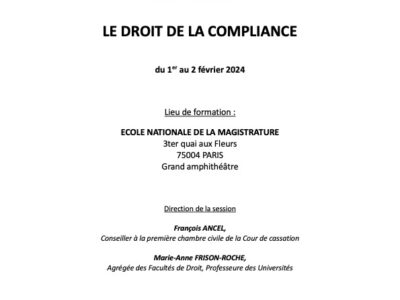
► Full Reference: F. Ancel &  M.-A. Frison-Roche, Droit de la compliance (Compliance Law), École nationale de la magistrature – ENM (French National School for the Judiciary), in collaboration with the École de Formation professionnelle des Barreaux du ressort de la cour d'appel de Paris – EFB (Paris Bar School), Paris, February 1 and 2, 2024 This teaching is given in French. - 🌐consult on LinkedIn a general présentation of this event, which links to a presentation and a report of each speech - ► Presentation of the Teaching: The aim of this two-day conference is to enable judges and lawyers to grasp the issues, objectives and methods that define Compliance Law as it is practised in companies. The speakers will illustrate the growing trend towards litigation, which is difficult to reconcile with the supranational dimension, or even indifference to territories, for example when disputes concern systemic climate or digital issues: the result is a renewal of the role of the judge and the role of lawyers. This must be set against the renewal of the role and operation of companies themselves. This is analysed from the perspective of Civil Law, in particular Contract Law and Liability Law. Company Law and Criminal Law are also addressed, as well as the way in which the legal system now integrates governance, regulation, climate and digital issues and the smooth operation of financial markets through Compliance techniques. - ► Organisation of the Teaching: This conference is divided into two parts. The first day is designed as a presentation of the major themes through which Compliance Law crosses the branches of traditional Law. The speakers will be professors of Law who will successively summarise the branches of Law and put into perspective the way in which Compliance imperatives give rise to new situations, new difficulties and new solutions. This enables the second day to focus on practical and topical issues and to debate controversial questions between people of different sensibilities. The participants tend to be judges, members of regulatory authorities, lawyers, members of associations and so on. - ► Enrolment procedure: The course is open to all judicial and consular magistrates, as well as lawyers. Registrations can be made directly with the ENM or with the EFB. - ► Speakers :   🎤François Ancel, Judge at the Première Chambre civile de la Cour de cassation (First Civil Chamber of the French Court of cassation)  🎤Thomas Baudesson, Attorney at the Paris Bar, Partner at Clifford Chance 🎤Guillaume Beaussonie, Full Professor at Toulouse 1 Capitole University 🎤Jacques Boulard, Premier Président de la Cour d’appel de Paris (First President of the Paris Court of Appeal) 🎤Marie Caffin-Moi, Full Professor at Paris Panthéon-Assas University 🎤Malik Chapuis, Judge at the Tribunal judiciaire de Paris (Paris First Instance Civil Court) 🎤Lucie Chatelain, Advocacy and Litigation Manager – Civil Liability of Parent Companies, Sherpa 🎤Jean-Benoît Devauges, Directeur Juridique, Ethique et Gouvernance des entreprises (Legal, Ethics and enterprises governance Director), MEDEF 🎤Marie-Anne Frison-Roche, Professor of Regulatory and Compliance Law, Director of the Journal of Regulation & Compliance (JoRC) 🎤Arnaud Gossement, Attorney at the Paris Bar, Partner at Gossement Avocats 🎤Thibault Goujon-Bethan, Full Professor at Jean Moulin Lyon 3 University 🎤Christophe Ingrain, Attorney at the Paris Bar, Partner at Darrois Villey Maillot Brochier 🎤Isabelle Jegouzo, Director of the Agence française anticorruption – AFA (French Anti-Corruption Agency)  🎤Anne-Valérie Le Fur, Full Professor at Versailles Saint-Quentin-en-Yvelines University 🎤Charlotte Michon, Attorney at the Paris Bar, partner at Charlotte Michon Avocat 🎤Jean-Baptiste Racine, Full Professor at Paris Panthéon-Assas University 🎤 Jean-Christophe Roda, Full Professor at Jean-Moulin Lyon 3 University 🎤Jérôme Simon, 1er Vice-Procureur Financier (First Financial Vice-Prosecutor) - 🧮read below the programme put together and organised by François Ancel and Marie-Anne Frison-Roche, as well as the reports of each presentation⤵️ - 🌐follow Marie-Anne Frison-Roche on LinkedIn 🌐follow Marie-Anne Frison-Roche on Instagram 🌐subscribe to the Newsletter MAFR Regulation, Compliance, Law

Working papers

Working Paper for an article

🚧Compliance, Vigilance and Civil Liability: put in order and keep the sense of Reason

► Full Reference : M.-A. Frison-Roche, Compliance, Vigilance and Civil Liability: put in order and keep the sense of Reason, Working Paper, June 2024 - 📝 In its French version, this Working Paper is the basis of the contribution "Compliance, Vigilance et Responsabilité civile : mettre en l'ordre et raison garder", in 📕L'Obligation de Compliance - ► Summary of this Working Paper:  The descriptions of the Liability incurred by large companies as a result of their compliance obligations are very diverse, even contradictory, going beyond the wishes that may be expressed as to what this liability should be. The first part of this study therefore sets out the various liabilities incurred by companies, which differ in the conditions under which they are implemented and in their scope, so as not to confuse them. Indeed, as the various laws establish specific legal compliance obligations, they give rise to liabilities of varying conditions and scope, and it is not possible to avail of the regime of one in a situation that falls within the scope of another. It is therefore necessary to review the various bodies of compliance legislation, the GDPR, the ALM-FT regulations, the French so-called Sapin 2 law, the French so-called Vigilance law , the European IA Act , the European European DGA Act, etc., to recall the inflexion that each of these bodies of legislation has made to the liability rules applied to the companies subject to them. Nevertheless, the unicity of the Compliance Obligation, overcoming this necessary diversity of situations, regulations and liability regimes,  can provide grouping lines to indicate beyond this diversity the extent of the liability incurred by companies. Once this classification has been made, the second part of the study develops the observation that none of this can create any principle of general liability on large companies in terms of compliance, and in particular not in terms of vigilance. It is not possible to deduce a general principle of specific obligations of liability or specific obligations to reparation, for example in the area of vigilance, as the texts creating specific vigilance obligation refer to the conditions of commun Tort Law (proof damage and causality), and International Public Law does not have the force to generate a general principle binding companies in this respect. The third part stresses that it is nevertheless always possible to invoke Tort Law, and companies cannot claim to escape this. This may involve contractual liability, a situation  becoming increasingly frequent as companies contractualise their legal compliance obligations, reproducing them but also modifying them, and as Vigilance duty is an obligation that goes beyond the specific situations covered by the regulations.  But it is essential, and this is the subject of the fourth part, not to make companies pure and simple guarantors of the state of the world, present and future. Indeed, if we were to transform sectoral compliances into illustrations of what would then be a new general principle, but one that applied only to them, they would consequently exercise the other side of this coin, namely power over others. - 🔓read the Working Paper below⤵️ - 🌐follow Marie-Anne Frison-Roche sur LinkedIn 🌐follow Marie-Anne Frison-Roche on Instagram 🌐subscribe to the Newsletter MAFR Regulation, Compliance, Law 🌐subscribe to the Video Newsletter MAFR Surplomb

Working papers

Working Paper

🚧Thinking and using Vigilance through its Compliance Monumental Goals

🌐 follow Marie-Anne Frison-Roche on LinkedIn 🌐 subscribe to the Newsletter MAFR Regulation, Compliance, Law  - ► Full reference: M.-A. Frison-Roche, Thinking and using Vigilance through its Compliance Monumental Goals, Working Paper, March 2023. - 🎤 This Working Paper has been done as basis for the  introduction of the colloquia La société vigilante ("Vigilant Company") at the Aix-Marseille University on March 24, 2023 (conference given in French)  - 📝It is also the basis of the article that introduces a special issue on La société vigilante - ► Summary of the Working Paper: The concept of "Vigilance" is difficult to define. Probably because even as it is becoming a standard, it has just entered the legal systems. And what a splash it is! To understand it, it must not be isolated. Neither in the only French law attracting all the attention, all the fears, all the hopes, the so-called Loi Vigilance ("Vigilance Law"), nor in the only technical mechanisms that make Vigilance a reality. Vigilance is itself only a part of a deeper movement, of which it is the advanced point, allowing us to anticipate the evolution of the whole: Compliance Law. In this light and for not getting lost in it, because the stakes are so high that one quickly loses the measure of things, with each party lashing out at the others, so Vigilance, the key element of Compliance, requires above all alliances,  that we can first examine the entry of Vigilance into the legal system and then understand it through the Monumental Goals which give the measure of it, i.e. both the scope and the limit, each one having to act within the margins that are theirs, States, companies, stakeholders, and judges. A Will for tomorrow can then emerge today, carried by Europe. - 🔓read the Working Paper⤵️

Articles in a legal collective publication

📝The proposal for a European Directive on the duty of vigilance: brief views on civil liability

► Full Reference: A. Danis-Fatome, "The proposal for a European Directive on the duty of vigilance: brief views on civil liability", International Business Law Journal, 5, 2022, pp. 489-497. - ► Summary of the article (done by the Journal of Regulation & Compliance):  -