Law & Economics

Articles in The Journal of Regulation & Compliance « JoRC »

DEFFAINS, Bruno🕴️

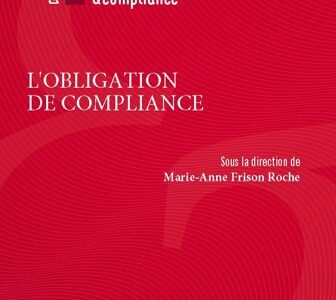
📝De la dette à l’obligation de compliance (From the Debt to the Compliance Obligation), in 🕴️M.-A. Frison-Roche (ed.), 📕L’Obligation de Compliance

► Full Reference: B. Deffains, "La dette comme fondement de l'obligation de compliance" ("From the Debt to the Compliance Obligation"), in M.-A. Frison-Roche (ed.), L'Obligation de Compliance, Journal of Regulation & Compliance (JoRC) and Dalloz, "Régulations & Compliance" Serie, 2025, pp. 67-82. - 📕read the general presentation of the book, L'Obligation de Compliance, in which this contribution is published - ► Summary of this contribution  (done by the Journal  of Regulation  & Compliance):  The contribution builds on the definition of Compliance in that it requires large companies to contribute to the achievement of Monumental Goals, including the preservation of human rights and systems, e.g. climate system.   This requirement is confronted with the notion of Debt as it results today from classic and new works available in economic science. In fact, in the primitive economy, debt refers not only to exchanges, but also to an ethical and social obligation leading back to the collective. The Economic Analysis of Law has highlighted this situation, where some of the entities involved in a situation benefit from positive externalities, or endure negative externalities on their own, thus creating a situation of debt: this generates an obligation to correct market failure through an obligation to manage risks, as expressed by Compliance Obligation. This implies that economic calculation can be used to quantify this debt, leading to new proposals for biodiversity accounting. The author then highlights the recognition of Debt as the source of an Compliance Obligation. This can be expressed through the classical notion of natural obligation, which can be traced back to the French Civil Code, or through more solidarist or political conceptions of Law, linked to moral responsibility, with the overall moral equilibrium referring to civic duty, superimposed on the accounting equilibrium. The political dimension is very much present, as shown by Grotius and Kant, then Bourgeois (solidarism), Rawls and Sen (social justice), who link the deep commitment of each individual with the group. This sheds light on the essential role played by the State and public institutions in formalising and enforcing the Compliance Obligation, not only to ensure its effectiveness, but also to make everyone aware of its fairness dimension. - 🦉This article is available in full text to those registered for Professor Marie-Anne Frison-Roche's courses -

Articles in The Journal of Regulation & Compliance « JoRC »

DEFFAINS, Bruno🕴️

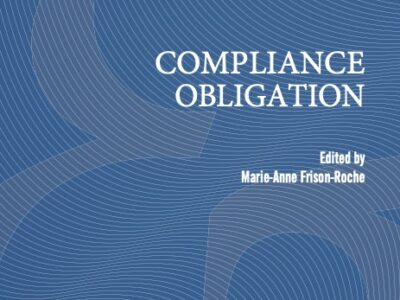
📝Debt as the basis of the Compliance Obligation, in 🕴️M.-A. Frison-Roche (ed.), 📘Compliance Obligation

► Full Reference: B. Deffains, "Debt as the basis of the Compliance Obligation", in M.-A. Frison-Roche (ed.), Compliance Obligation, Journal of Regulation & Compliance (JoRC) and Bruylant, "Compliance & Regulation" Serie, to be published - 📘read a general presentation of the book, Compliance Obligation, in which this article is published - ► Summary of the article (done by the Journal of Regulation & Compliance – JoRC): The contribution builds on the definition of Compliance in that it requires large companies to contribute to the achievement of Monumental Goals, including the preservation of human rights and systems, e.g. climate system.   This requirement is confronted with the notion of Debt as it results today from classic and new works available in economic science. In fact, in the primitive economy, debt refers not only to exchanges, but also to an ethical and social obligation leading back to the collective. The Economic Analysis of Law has highlighted this situation, where some of the entities involved in a situation benefit from positive externalities, or endure negative externalities on their own, thus creating a situation of debt: this generates an obligation to correct market failure through an obligation to manage risks, as expressed by Compliance Obligation. This implies that economic calculation can be used to quantify this debt, leading to new proposals for biodiversity accounting. The author then highlights the recognition of Debt as the source of an Compliance Obligation. This can be expressed through the classical notion of natural obligation, which can be traced back to the French Civil Code, or through more solidarist or political conceptions of Law, linked to moral responsibility, with the overall moral equilibrium referring to civic duty, superimposed on the accounting equilibrium. The political dimension is very much present, as shown by Grotius and Kant, then Bourgeois (solidarism), Rawls and Sen (social justice), who link the deep commitment of each individual with the group. This sheds light on the essential role played by the State and public institutions in formalising and enforcing the Compliance Obligation, not only to ensure its effectiveness, but also to make everyone aware of its fairness dimension. - 🦉This article is available in full text to those registered for Professor Marie-Anne Frison-Roche's courses -

Articles in The Journal of Regulation & Compliance « JoRC »

MALAURIE-VIGNAL, Marie🕴️

📝Les buts monumentaux du droit du marché. Réflexion sur la méthode, in 🕴️M.-A. Frison-Roche (ed.), 📕Les Buts Monumentaux de la Compliance

► Full Reference: M. Malaurie-Vignal, "Les buts monumentaux du droit du marché. Réflexion sur la méthode" ("The Monumental Goals of Market Law. Reflections on the method"), in M.-A. Frison-Roche (ed.), Les Buts Monumentaux de la Compliance, coll. "Régulations & Compliance", Journal of Regulation & Compliance (JoRC) and Dalloz, 2022, pp. 85-100. - 📕read a general presentation of the book, Les Buts Monumentaux de la Compliance, in which this article is published - ► Summary of the article (done by the Journal of Regulation & Compliance):  The analysis done by this article is about Competition Law, and the methodology needed to be adopted for the technical functioning of this branch of Law. Taking up the various economic and legal theories on this subject, conceptions which have succeeded and clashed, the author develops that the monumental goal of Market Law is to develop an economic environment favorable to businesses and consumers, then asks the question if it could integrate an ethical dimension and more broadly non-economic considerations, in particular humanistic ones. -

Articles in The Journal of Regulation & Compliance « JoRC »

📝Appréciation du lancement d’alerte et de l’obligation de vigilance au regard de la compétitivité internationale, in 🕴️M.-A. Frison-Roche (ed.), 📕Les Buts Monumentaux de la Compliance

► Full Reference: M.-A. Frison-Roche, "Appréciation du lancement d'alerte et de l'obligation de vigilance au regard de la compétitivité internationale" ("Assessment of whistleblowing and of the obligation of vigilance with regard to international competitiveness"), in M.-A. Frison-Roche (ed.), Les Buts Monumentaux de la Compliance, coll. "Régulations & Compliance", Journal of Regulation & Compliance (JoRC) and Dalloz, 2022, pp. 413-436. - 📝read the article (in French) - 🚧read the bilingual Working Paper which is the basis of this article, with additional developments, technical references and hyperlinks - 📕read a general presentation of the book, Les Buts Monumentaux de la Compliance, in which this article is published - ► English summary of the article (done by the Journal of Regulation & Compliance): Taking up the legal tools of Compliance and confronting them with the concern that Law must have for the Competitiveness of companies, it is necessary that these legal instruments not harm it because Compliance Law, because of its immense ambitions, can only function through an alliance between political wills with great pretensions (save the planet) and the entities which are able to achieve these goals (the crucial economic operators : the political drawing on the compagnies" power, it would be contradictory for the legal instruments put in place by Law to harm the ability of companies to face global economic competition, or worse to favor international competitors acting under legal systems which do not integrate Compliance obligations.   From this principle, it is possible to assess these two legal techniques of whistleblowing and vigilance obligation: both consist in capturing Information, which gives them a strong uniqueness and fits them into the global competition for Information. Taking the whistleblowing, its first beneficiary is the company itself since the firm discovers a weakness and can therefore remedy it. Therefore, beyond the principle of protection of the whistleblower by their access to the legal statute, for instance the one conceived by the French 2016 law known as "Sapin 2", it is questionable that all the incentives are not put in place so that the holder of such information transmits it to the manager. It is not the European solution, even after the European Directive of 2019, national legal systems continuing to require the absence of financial compensation, the "heroic figure of the whistleblower and the refusal of their remuneration depriving the company of Information and improvement. First to the manager, with external transmission taking place if the latter does nothing, the internal manager is thus encouraged to act and put an end to the dysfunction, which increases the competitiveness of the company. But the French legislation has on the contrary developed the right incentive as to the person to whom the information is transmitted because by obliging to transmit first to the manager, the external transmission intervening if the internal management does nothing, the incentive is thus made to the internal manager to act and put an end to the dysfunction, this legal solution increasing the competitiveness of the company. Even more, and even if it seems counter-intuitive, the obligation of vigilance increases the competitiveness of the obliged companies. Indeed, Law by obliging them to prevent and fight against violations of human rights and the environment has tacitly given them all the necessary powers to do so, notably the power to collect Information on third-party companies, including (and even above all) those which are not subject to transparency obligations. In this respect, companies, as far as they are personally responsible, hold supervisory power over others, a power which allows to globalize Compliance Law and which, in the process, increases the Companies' own power. Therefore, the obligation of vigilance is in many respects a boon for the companies which are subject to it. The resumption of the mechanism by the next European Directive, itself indifferent to the territory, will only strengthen this global power of vigilant companies over possibly foreign companies which become its passive subjects. - 🌐 follow Marie-Anne Frison-Roche on LinkedIn 🌐follow Marie-Anne Frison-Roche on Instagram 🌐 subscribe to the Newsletter MAFR Regulation, Compliance, Law 

Articles in The Journal of Regulation & Compliance « JoRC »

MALAURIE, Marie👤

Monumental goals of Market Law. Reflection on the method, in Frison-Roche, M.A. (dir.), Les Buts Monumentaux de la Compliance

► Full Reference: Malaurie, M., Monumental goals of Market Law. Reflection on the method in Frison-Roche, M.-A. (ed.), Compliance Monumental Goals, series "Compliance & Regulation", Journal of Regulation & Compliance (JoRC) and Bruylant, to be published - ► Article Summary (done par the JoRC editor):  The analysis done by this article is about Competition Law, and the methodology needed to be adopted for the technical functioning of this branch of Law. Taking up the various economic and legal theories on this subject, conceptions which have succeeded and clashed, the author develops that the monumental goal of Market Law is to develop an economic environment favorable to businesses and consumers, then asks the question if it could integrate an ethical dimension and more broadly non-economic considerations, in particular humanistic ones. -   📘 see the general presentation of the book, Compliance Monumental Goals, in which this article is published -  

Articles

LUGURI, Jamie and STRAHILEVITZ, Lior Jacob

Shining a Light on Dark Patterns

Full reference: Luguri, J. and Strahilevitz, L. J., Shining a Light on Dark Patterns, Journal of Legal Analysis, Vol. 13, Issue 1, 2021, 67p.  Sciences Po's students can read this article via Sciences Po's Drive in the folder MAFR – Regulation & Compliance. 

Articles

The Economic Impact of Law: a new report about it. And what about Regulation & Compliance? 3 lessons

Full reference: Frison-Roche, M.-A., The Economic Impact of Law: a new report about it. And what about Regulation & Compliance? 3 lessons, Newsletter MAFR – Law, Regulation, Compliance, 24th of September 2020 Read by freely subscribing the other news of the Newsletter MAFR – Law, Regulation, Compliance   Summary of the news:  On 18th of September 2020, the European Economic and Social Committee (EESC) published a report about the impact of Rule of Law on Economic Growth.  The EESC defines the Rule of Law as the obligation to "all public powers act within the constraints laid down by law, in accordance with the values of democracy and fundamental rights, and under the control of independent and impartial courts". According to the Committee, the Rule of Law thus defined is favorable and even necessary to a durable economic growth especially because instability of regulations, absence of guarantee of labor and property rights, discrimination or non-application of contracts poorly favors or are detrimental for investments and economic agents' productive activities. The EESC observes by the way that countries which respect the Rule of Law grow more rapidly than those which do not respect it. The Committee also insists on the destructive effect of corruption which destroys public services, public action, public institutions on the long run and confidence, increasing inequalities.  Although EESC approves the actions of European Commission to advance Rule of Law in the Union, it however invites the Commission to continue its efforts by giving a more important place to jurisdictions and by protecting better media freedom in a context of rising autocratic forces in Eastern Europe.  We can learn three lessons from this report: The common interest of European Union States to guarantee the Rule of Law. Indeed, Rule of Law is not only written in article 2 of TFEU and has been consecrated by CJEU case law, it is also a condition of economic progress.  The fight against corruption must be the object of a redoubled effort. In this perspective, Compliance Law is able to offer appropriate innovating legal tools. To a definition of Regulation and Compliance Law as a simple process of application of mechanical legal rules, it is necessary to substitute a definition of Regulation and Compliance Law based on the notion of "monumental goals" and people protection. In this perspective, these branches of Law would prove to be powerful tools in the service of the advancement of the rule of law in the European space.

Articles in a legal collective publication

Le juge, le régulateur et le Droit

Publication director

🏗️ direction of the collection: 📚Cours Dalloz – Série Droit privé

📚Publication of : 🕴️Jean-Baptiste RACINE and 🕴️Fabrice SIIRIAINEN, 📕Droit du commerce international (International Trade Law), 3rd ed.

► Full Reference : J.-B. Racine and F. Siiriainen, Droit du commerce international (International Trade Law), 1st ed. 2007 – 3rd ed., 2018, Dalloz, “Cours Dalloz-Série Droit privé” Series, 496 p. - ► General presentation of the book (written in French) : International trade law has become a fundamental discipline at a time of globalisation of the economy. It is a particular law: a law composite by nature, made up of national and international, public and private rules, which combines conflict rules and substantive rules and which knows the particular phenomenon of the lex mercatoria. Besides the sources of international trade law, fed in particular by the World Trade Organization (WTO), the book studies the operators of international trade, namely companies and States, the operations of international trade (sale, transport, distribution, subcontracting, transfer of intellectual property rights, etc.) and finally international trade litigation through its emblematic figure: arbitration. - 📕Read the back cover (in French) - 📕Read the table of contents (in French) - 📚See the entire collection in which the book is published. -

Working papers

🚧Globalization from the point of view of Law

► Full Reference: Frison-Roche, M.-A., Globalization from the point of view of Law, working paper, May 2017. - 🎤 This working paper initially served as a basis for a synthesis report made in French in the colloquium organized by the Association Henri Capitant in the International German Days on the subject of "Le Droit et la Mondialisation" (Law and Globalization). 📝 Il sert dans un second temps de base à l'article paru dans l'ouvrage La Mondialisation. 📝 it serves as a second basis for the article (written in English, with a Spanish Summary) to be published in the Brezilian journal Rarb – Revista de Arbitragem e Mediação  (Revue d`Arbitrage et Médiation). It uses the Bilingual Dictionary of the Law of Regulation and Compliance. - ► Summary of the Working: Globalization is a confusing phenomenon for the jurist. The first thing to do is to take its measure. Once it has been taken, it is essential that we allow ourselves to think of something about it, even if we have to think about it. For example, on whether the phenomenon is new or not, which allows a second assessment of what is taking place. If, in so far as the law can and must "pretend" to defend every being, a universal claim destined to face the global field of forces, the following question – but secondary – is formulated: quid facere? Nothing ? Next to nothing ? Or regulate? Or can we still claim that the Law fulfills its primary duty, which is to protect the weak, including the forces of globalization? - read the Working Paper below⤵️

Articles in The Journal of Regulation & Compliance « JoRC »

Le souci que le Régulateur doit avoir du coût de sa régulateur doit-il être contrôlé par le juge ?

The cost issue of regulation is a recurring issue. One can complain specifically, when companies are protesting about the "cost of regulation" or when the topic is taken as an object of study, through the cost / benefit calculation. A practical question of importance is whether there is a "legal question" or not. The "juridicity" of a question is defined by the fact that discussing about this question has an effect on the outcome of a case before a judge. This concrete definition, leaving the judge's power, binding nature of the rule (here the balance between cost and benefit) the effectiveness of its decision before the judge, its consideration by him in the decision he makes, has been proposed in France by Carbonnier. It is opposed to a definition of Law by the source, the author of the rule, which identifies law for example through Parliament Acts, because the text is adopted by the legislator, listed source of law. The first definition, more sociological, more flexible, giving the spotlight on judge better corresponds to a legal system which gives more room for ex post and for the judge. It is logical that we find more demonstrations of this conception in the common law systems. However, the issue of cost / benefit is being debated before the Supreme Court of the United States, about the latest environmental regulations, adopted by the Environment Protection Agency (EPA). It is a question of law. It is under the empire of the judge. For it is in this light that President Barack Obama in November 2014 asked a very costly regulation, and it was under his leadership that the Environmental Protection Agency has developed texts. Indeed, pollution of certain plants are the cause of asthma and laid in public health imperative to fight a regulation that results in a direct cost on firms. Indeed, some plants pollution is the cause of asthma and President Obama has asked public health imperative to combat by a regulation that results in a direct cost on the industry. The regulations adopted in 2012 they cost a $ 9 million, some claiming that future ones could result in billions of costs directly related to business The President emphasized by stating that the health of children was priceless. By challenging those of 2012 before the Supreme Court, in the case Michigan v. EPA, this is the other texts that conservative states and companies have in mind because it is the principle that is posed: : does A regulator have the right to take regulations very "expensive" when the advantage, however legitimate it is, is small-scale in terms of costs? The Supreme Court, having chosen to handle the case, listened to March 25, 2015, the arguments of each other and discussed the case. The question is the integration or not into the constitutional notion of "necessity of the law" of the "cost / benefit" calculation. This is a crucial point because the concept of "necessity of the law" is a common notion to the constitutions of many countries. However, not only the so-called judges "conservatives" as Justice Antonio Scalia, took position felt it was crazy not "consider" the cost of new regulations from the expected health benefits, but also Justice Stephen Breyer called "progressive," said "irrational" the environmental regulator has not taken in consideration such an imbalance between cost and benefit. It is true that Justice Breyer was formerly professor of competition law at Harvard. Judgment will be given in June.

Books

Analyse économique du droit