Irresponsability

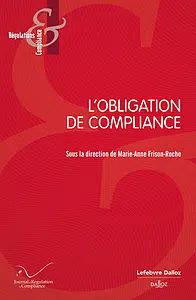
Couverture – L’Obligation de Compliance

Articles in a JoRC book

FRYDMAN, Benoît🕴️ & BRIEGLEB, Alice🕴️

📝L’obligation de compliance en Droit global (Compliance Obligation in Global Law), in 🕴️M.-A. Frison-Roche (dir.), 📕L’obligation de Compliance

► Full Reference: B. Frydman & A. Briegleb, “L’obligation de compliance en Droit global” (Compliance Obligation in Global Law), in M.-A. Frison-Roche (ed.), L’Obligation de Compliance, Journal of Regulation & Compliance (JoRC) and Lefebvre-Dalloz, coll. “Régulations & Compliance“, 2025, pp. 299-311. - read a general presentation of the book, L’Obligation de Compliance, in which this contribution is published - ► This article is written in French. English summary of this contribution (done by the Journal of Regulation & Compliance – JoRC): The authors stress that the Contracts Law and Tort Law are essential in Compliance Law, particularly in its global legal perspective, since it goes beyond the legal systems of States and develops new normativities, at the level of each company, but also allows a new expression of public power through the Monumental Goals that Compliance Law claims to achieve globally. The weaker the States, the greater the delegation to the first level is operating. In concrete terms, the authors examine a series of situations in which various organisations use compliance techniques to appropriate global power over things or people, which has the effect, and sometimes the purpose, of reducing the freedoms of people controlled in this way. Thus CSR, which was initially non-binding, is now the source of binding obligations, and the moral obligation expressed in codes of conduct can become a civil obligation, as the Supreme Court of California decided in 2002 in the Nike case. In addition, “Comply or Explain” clauses are now commonplace, allowing the person subject to the legislation not to comply if they can justify it, which is the basis of the many information reports that companies are now required to publish. Then, returning to the issue of liability, particularly in the digital environment, the article stresses the importance of ‘conditional immunity from liability’, taking the view from the European DSA that certain operators, such as hosting providers, are not liable unless they take on obligations, such as monitoring functions on contents published. Finally, with regard to the duty of vigilance, it tends for the first time to align the scope of “responsibility” with the scope of “power”, moral responsibility thus becoming legal responsibility, which would be like a new responsibility for others. The result of all this is an “obligation to regulate others”. - 🦉This article is available in full text to those registered for Professor Marie-Anne Frison-Roche’s courses
Couverture – L’Obligation de Compliance

Articles in a JoRC book

LOISEAU, Grégoire🕴️

📝L’intensité de l’obligation de vigilance selon les secteurs : le cas des opérateurs numériques (“The intensity of the Duty of Vigilance in different sectors: the case of digital operators”), in 🕴️M.-A. Frison-Roche (ed.), 📕L’Obligation de Compliance

► Full Reference: G. Loiseau, “L’intensité de l’obligation de vigilance selon les secteurs : le cas des opérateurs numériques” (The intensity of the Duty of Vigilance in different sectors: the case of digital operators), in M.-A. Frison-Roche (dir.), L’obligation de Compliance, Journal of Regulation & Compliance (JoRC) and Lefebvre-Dalloz, coll. “Régulations & Compliance“, 2025, pp. 559-569. - read the general presentation of the book, L’obligation de Compliance, in which the contribution is published - ► This article is written in French. English summary of this contribution (done by the Journal of Regulation & Compliance – JoRC): The author develops the case of digital operators. He highlights the paradox of a Law that started from a text laying down the principle that hosting providers are not liable, because of their technical neutrality, and ended up with the DSA imposing due diligence on them, but he points out that this obligation only arises once a notification has been made to the digital operator, and that there is an express prohibition of any general obligation to monitor information. Moreover, there is no general duty of vigilance incumbent on digital operators, even if recent case law seems to be tightening the role imposed on hosting providers. The Monumental Goal here is to fight against illegal content, but freedom of expression must also be preserved and regulations vary according to the type of content, whereas the DSA has a more general conception, aims at a logic of accountability and prevention of systemic risks. But wanting to make platforms “accountable” Ex Ante, without touching the liability regime Ex Post, may pose a problem. The duty of vigilance will vary depending on whether the digital operator plays a passive or active role. This may lead platforms to adopt prior measures that may constitute structural obligations, with the trusted third party taking the form of a trusted signaller. The platform is thus made responsible for its own vigilance, but despite the possibility of enhanced vigilance, this does not have to extend to investigative measures. There are, however, specific enhanced vigilance obligations for very large platforms, justified by the risks involved and the types of content (terrorism, pornography). - 🦉This article is available in full text to those registered for Professor Marie-Anne Frison-Roche’s courses -