International Arbitration

Publication director

🏗️ copublishing and direction of the collection: 📚Compliance & Regulation

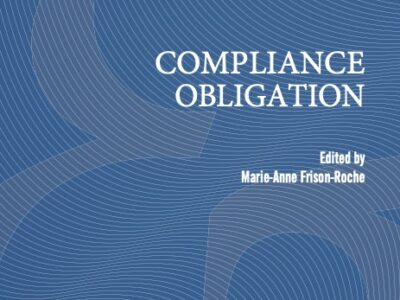
Publication of :🕴️ M.-A. Frison-Roche (ed.),📘 Compliance Obligation

► Full Reference: M.-A. Frison-Roche (ed.), Compliance Obligation, Journal of Regulation & Compliance (JoRC) and Bruylant, "Compliance & Regulation" Serie, 2026, to be published - 📕In parallel, a book in French L'Obligation de compliance, is published in the collection "Régulations & Compliance" co-published by the Journal of Regulation & Compliance (JoRC) and Lefebvre-Dalloz.  - 📚This book is inserted in this series created by Marie-Anne Frison-Roche for developing Compliance Law.  read the presentations of the other books of this Compliance Series: further books: 🕴️M.-A. Frison-Roche (ed.), 📘Compliance Evidential System, 2027 🕴️M.-A. Frison-Roche (ed.), 📘Compliance and Contract, 2027   previous books: ​🕴️M.-A. Frison-Roche (ed), 📘Compliance Juridictionnalisation, 2023 🕴️M.-A. Frison-Roche (ed), 📘Compliance Monumental Goals, 2022 🕴️M.-A. Frison-Roche (ed.), 📘Compliance Tools, 2021 - ► go to the general presentation of this 📚Series ​Compliance & Regulation, conceived, founded et managed by Marie-Anne Frison-Roche, co-published par the Journal of Regulation & Compliance (JoRC) and Bruylant.  - 🧮the book follows the cycle of colloquia organised by the Journal of Regulation & Compliance (JoRC) and its Universities partners. - ► general presentation of the book: Compliance is sometimes presented as something that cannot be avoided, which is tantamount to seeing it as the legal obligation par excellence, Criminal Law being its most appropriate mode of expression. However, this is not so evident. Moreover, it is becoming difficult to find a unity to the set of compliance tools, encompassing what refers to a moral representation of the world, or even to the cultures specific to each company, Compliance Law only having to produce incentives or translate this ethical movement. The obligation of compliance is therefore difficult to define. This difficulty to define affecting the obligation of compliance reflects the uncertainty that still affects Compliance Law in which this obligation develops. Indeed, if we were to limit this branch of law to the obligation to "be conform" with the applicable regulations, the obligation would then be located more in these "regulations", the classical branches of Law which are Contract Law and Tort Law organising "Obligations" paradoxically remaining distant from it. In practice, however, it is on the one hand Liability actions that give life to legal requirements, while companies make themselves responsible through commitments, often unilateral, while contracts multiply, the articulation between legal requirements and corporate and contractual organisations ultimately creating a new way of "governing" not only companies but also what is external to them, so that the Monumental Goals, that Compliance Law substantially aims at, are achieved.  The various Compliance Tools illustrate this spectrum of the Compliance Obligation which varies in its intensity and takes many forms, either as an extension of the classic legal instruments, as in the field of information, or in a more novel way through specific instruments, such as whistleblowing or vigilance. The contract, in that it is by nature an Ex-Ante instrument and not very constrained by borders, can then appear as a natural instrument in the compliance system, as is the Judge who is the guarantor of the proper execution of Contract and Tort laws. The relationship between companies, stakeholders and political authorities is thus renewed. - 🏗️general construction of the book The book opens with a substantial Introduction, putting the different sort of obligations of compliance in legal categories for showing that companies must build structures of compliance (obligation of result) and act to contribute with states and stakeholders to reach Monumental Goals (obligation of means).  The first part is devoted to the definition of the Compliance Obligation.  The second part presents the articulation of Compliance obligation with the other branchs of Law, because the specific obligation is built by Compliance Law, as new substantial branch of Law but also by many other branchs of Law. The third part develops the pratical means established to obtained the Compliance Obligation to be effective, efficace and efficient. The fourth part takes the Obligation  of Vigilance as an illustration of all these considerations and the discussion about the future of this sparehead fo the Compliance Obligation .  The fifth part refers to the place and the role of the judges, natural characters for any obligation.  - TABLE OF CONTENTS    ANCHORING THE SO DIVERSE COMPLIANCE OBLIGATIONS IN THEIR NATURE, REGIMES AND FORCE TO BRING OUT THE VERY UNITY OF THE COMPLIANCE OBLIGATION, MAKING IT COMPREHENSIBLE AND PRACTICABLE    🔹 Compliance Obligation: building a compliance structure that produces credible results withe regard to the Monumentals Goals targeted by the Legislator, by 🕴️Marie-Anne Frison-Roche   TITLE I. IDENTIFYING THE COMPLIANCE OBLIGATION   CHAPTER I: NATURE OF THE COMPLIANCE OBLIGATION Section 1 🔹 Will, Heart and Calculation, the three marks surrounding the Compliance Obligation, by 🕴️Marie-Anne Frison-Roche Section 2 🔹 Debt, as the basis of the compliance obligation, by 🕴️Bruno Deffains Section 3 🔹 Compliance Obligation and Human Rights, by 🕴️Jean-Baptiste Racine Section 4 🔹 Compliance Obligation and changes in Sovereignty and Citizenship, by 🕴️René Sève Section 5 🔹 The definition of the Compliance Obligation in Cybersecurity, by 🕴️Michel Séjean   CHAPTER II: SPACES OF THE COMPLIANCE OBLIGATION Section 1 🔹 Industrial Entities and Compliance Obligation, by 🕴️Etienne Maclouf Section 2 🔹 Compliance, Value Chains and Service Economy, by 🕴️Lucien Rapp Section 3 🔹 Compliance and conflict of laws. International Law of Vigilance-Conformity, based on applications in Europe, by 🕴️Louis d'Avout    TITLE II. ARTICULATING THE COMPLIANCE OBLIGATION WITH OTHER BRANCHES OF LAW   Section 1 🔹 Tax Law and Compliance Obligation, by 🕴️Daniel Gutmann Section 2 🔹 General Procedural Law, prototype of the Compliance Obligation, by 🕴️Marie-Anne Frison-Roche Section 3 🔹 Corporate and Financial Markets Law facing the Compliance Obligation, by 🕴️Anne-Valérie Le Fur Section 4 🔹 Transformation of Governance and Vigilance Obligation, by 🕴️Véronique Magnier Section 5 🔹 The Relation between Tort Law and Compliance Obligation, by 🕴️Jean-Sébastien Borghetti Section 6 🔹 Environmental and Climate Compliance, by 🕴️Marta Torre-Schaub Section 7 🔹 Competition Law and Compliance Law, by 🕴️Jean-Christophe Roda Section 8 🔹 The Compliance Obligation in Global Law, by 🕴️Benoît Frydman & 🕴️Alice Briegleb Section 9 🔹 Environmental an Climatic Dimensions of the Compliance Obligation, by 🕴️Marta Torre-Schaub Section 10 🔹 Judge of Insolvency Law and Compliance Obligations, by 🕴️Jean-Baptiste Barbièri   TITLE III. COMPLIANCE: GIVE AND TAKE THE MEANS TO OBLIGE   CHAPTER I: COMPLIANCE OBLIGATION: THE CONVERGENCE OF SOURCES Section 1 🔹 Compliance Obligation upon Obligation works, by 🕴️Marie-Anne Frison-Roche Section 2 🔹 Conformity technologies to meet Compliance Law requirements. Some examples in Digital Law, by 🕴️Emmanuel Netter Section 3 🔹 Legal Constraint and Company Strategies in Compliance matters, by 🕴️Jean-Philippe Denis & 🕴️Nathalie Fabbe-Coste Section 4 🔹 Opposition and convergence of American and European legal systems in Compliance Rules and Systems, by 🕴️Raphaël Gauvain & 🕴️Blanche Balian Section 5 🔹 In Compliance Law, the legal consequences for Entreprises of their Commitments and Undertakings, by 🕴️Marie-Anne Frison-Roche   CHAPTER II: INTERNATIONAL ARBITRATION IN SUPPORT OF THE COMPLIANCE OBLIGATION Section 1 🔹 How International Arbitration can reinforce the Compliance Obligation, by  🕴️Laurent Aynès Section 2 🔹 Arbitration consideration of Compliance Obligation for a Sustainable Arbitration Place, by 🕴️Marie-Anne Frison-Roche Section 3 🔹 The Arbitral Tribunal's Award in Kind, in support of the Compliance Obligation, by 🕴️Eduardo Silva Romero Section 4 🔹 The use of International Arbitration to reinforce the Compliance Obligation: the example of the construction sector, by 🕴️Christophe Lapp  Section 5 🔹 The Arbitrator, Judge, Supervisor, Support, by 🕴️Jean-Baptiste Racine   TITLE IV. VIGILANCE, SPEARHEAD OF THE COMPLIANCE OBLIGATION Section 1 🔹 Vigilance Obligation, Spearheard and Total Share of the Compliance Obligation, by 🕴️Marie-Anne Frison-Roche   CHAPTER I: INTENSITIES OF THE VIGILANCE OBLIGATION, SPEARHEAD OF THE COMPLIANCE SYSTEM Section 2 🔹 Intensity of the Vigilance Obligation by Sectors: the case of Financial Operators, by 🕴️Anne-Claire Rouaud Section 3 🔹 Intensity of the Vigilance Obligation by Sectors: the case of Digital Operators, by 🕴️Grégoire Loiseau Section 4 🔹 Intensity of the Vigilance Obligation by Sectors: the case of Energy Operators, by 🕴️Marie Lamoureux   CHAPTER II: GENERAL EVOLUTION OF THE VIGILANCE OBLIGATION Section 1 🔹 Rethinking the Concept of Civil Liability in the light of the Duty of Vigilance, Spearhead of Compliance, by 🕴️Mustapha Mekki Section 2 🔹 Contracts and clauses, implementation and modalities of the Vigilance Obligation, by 🕴️Gilles J. Martin Section 3 🔹 Proof that Vigilance has been properly carried out with regard to the Compliance Evidence System, by 🕴️Jean-Christophe Roda Section 4 🔹 Compliance, Vigilance and Civil Liability: put in order and keep the Reason, by 🕴️Marie-Anne Frison-Roche   Title V. THE JUDGE AND THE COMPLIANCE OBLIGATION Section 1 🔹 Present and Future Challenges of Articulating Principles of Civil and Commercial Procedure with the Logic of Compliance, by 🕴️Thibault Goujon-Bethan Section 2 🔹 The Judge required for an Effective Compliance Obligation, by 🕴️Marie-Anne Frison-Roche - CONCLUSION THE COMPLIANCE OBLIGATION: A BURDEN BORNE BY SYSTEMIC COMPANIES GIVING LIFE TO COMPLIANCE LAW   (conclusion and key points of the books, free access) - 🌐Follow Marie-Anne Frison-Roche on LinkedIn 🌐follow Marie-Anne Frison-Roche on Instagram 🌐Subscribe to the Newsletter MAFR Regulation, Compliance, Law 🌐Subscribe to the video newsletter MAFR Overhang 🌐Subscribe to the Newsletter MaFR Law & Art

Articles in The Journal of Regulation & Compliance « JoRC »

article in a legal collective book

📝Arbitration consideration of Compliance Obligation for a sustainable Arbitration Place, in 🕴️M.-A. Frison-Roche (dir.), 📘Compliance Obligation,

► Full Reference: M.-A. Frison-Roche, Arbitration consideration of Compliance Obligation for a sustainable Arbitration Place", in M.-A. Frison-Roche (ed.), Compliance Obligation, Journal of Regulation & Compliance (JoRC) and Bruylant, "Compliance & Regulation" Serie, 2026, forthcoming. - 📝read the article - 📘read a general presentation of the book, Compliance Obligation, in which this article is published - ► Summary of this article: The first part of this study assesses the evolving relationship between Arbitration Law and Compliance Law, which depends on the very definition of the Compliance Obligation (I). Indeed, these relations have been negative for as long as Compliance has been seen solely in terms of "conformity", i.e. obeying the rules or being punished. These relationships are undergoing a metamorphosis, because the Compliance Obligation refers to a positive and dynamic definition, anchored in the Monumental Goals that companies anchor in the contracts that structure their value chains. Based on this development, the second part of the study aims to establish the techniques of Arbitration and the office of the arbitrator to increase the systemic efficiency of the Compliance Obligation, thereby strengthening the attractiveness of the Place (II). First and foremost, it is a question of culture: the culture of Compliance must permeate the world of Arbitration, and vice versa. To achieve this, it is advisable to take advantage of the fact that in Compliance Law the distinction between Public and Private Law is less significant, while the concern for the long term of contractually forged structural relationships is essential. To encourage such a movement to deploy the Compliance Obligation, promoting the strengthening of a Sustainable Arbitration Place (III), the first tool is the contract. Since contracts structure value chains and enable companies to fulfill their legal Compliance Obligation but also to add their own will to it, stipulations or offers relating to Arbitration should be included in them. In addition, the adoption of non-binding texts can set out a guiding principle to ensure that concern for the Monumental Goals is appropriate in order the Compliance Obligation to be taken into account by Arbitrators. - 🌐Follow Marie-Anne Frison-Roche on LinkedIn 🌐follow Marie-Anne Frison-Roche on Instagram 🌐Subscribe to the Newsletter MAFR Regulation, Compliance, Law 🌐Subscribe to the video newsletter MAFR Overhang 🌐Subscribe to the Newsletter MaFR Law & Art
Articles

Article in a Newsletter MAFR

📝Asset freezing in the legal saga between American power and Venezuelan wealt

► Full reference: M.-A. Frison-Roche, "Asset freezing in the legal saga between American power and Venezuelan wealth", MAFR Law, Compliance, Regulation Newsletter, 23 January 2026 - 🌐read this article published on LinkedIn the 23 January 2026  - 📧Read other articles from the MAFR Newsletter – Law, Compliance, Regulation for free with a subscription. - ► Summary of this article  : It is often emphasised that the  law is merely a masquerade in the series of events we are witnessing. This is not entirely true. For three reasons. 1. Much will depend on the judge who will rule on the Madura couple's case. The energy sector has always similarly mixed regulation, public policies of states and businesses, both articulated by States and companies, both articulated by  international contracts, always organising international arbitration 3. If ExxonMobil now refuses to make the investments desired by Trump, it is also because this enterprise remembers that many years ago the freeze  of assets granted by the arbitrators was not very successful, and now the company manager believes that investment in  Venezuala's infrastructure is therefore "impossible". And given the current state of the law in the US, there is little Trump can do about it.. - 📝⤵Read the complete article below⤵ - 🌐Follow Marie-Anne Frison-Roche on LinkedIn 🌐follow Marie-Anne Frison-Roche on Instagram 🌐Subscribe to the Newsletter MAFR Regulation, Compliance, Law 🌐Subscribe to the video newsletter MAFR Overhang 🌐Subscribe to the Newsletter MaFR Law & Art

Articles in The Journal of Regulation & Compliance « JoRC »

LAPP, Christophe🕴️

📝L’usage de l’arbitrage international pour renforcer l’obligation de Compliance : l’exemple du secteur de la construction (The use of International Arbitration to strengthen Compliance oObligations: the example of the construction sector), in 🕴️M.-A. Frison-Roche (dir.), 📕L’Obligation de Compliance

► Full reference : Ch. Lapp, "L’usage de l’arbitrage international pour renforcer l’obligation de Compliance : l’exemple du secteur de la construction" (The use of International Arbitration to strengthen Compliance oObligations: the example of the construction sector)", in  M.-A. Frison-Roche (ed.), L'Obligation de Compliance, Journal of Regulation & Compliance (JoRC) and Dalloz, coll. "Regulations & Compliance", 2025, pp. 471-487. - 📕Read a general presentation of the book, L'Obligation de Compliance, in which this contribution is published. - ► English summary of this article (by the Journal of Regulation & Compliance – JoRC): The author emphasises that Arbitration is a particularly significant method of dispute resolution in the construction sector, not only because operators make extensive use of it, but also because this activity gives rise to difficulties that lend themselves to arbitration and at the same time concern compliance issues. In order to provide the necessary legal security and focusing on the Vigilance Plan especially in French and European Law, the author examines how disputes may arise in relation to it and what they may concern. In light of this, the author examines, on the one hand, the cases in which arbitration may be organised alongside the jurisdiction legally assigned to the Paris Court of Appel and, on the other hand, how Arbitrators will resolve the issues submitted to them. - 🦉This article is available in full text for those following the Professor Marie-Anne Frison-Roche's courses. -

Publication director

🏗️ direction of the collection: 📚Cours Dalloz – Série Droit privé

📚Publication of : 🕴️J.-B. RACINE, 🕴️F. SIIRIAINEN, 🕴️S. MENÉTREY, 📕Droit du commerce international (International Trade Law), 4th ed.

► Full Reference : J.-B. Racine, F. Siiriainen, S. Menétrey, Droit du commerce international (International Trade Law), 4th ed., 2025, Dalloz, “Cours Dalloz-Série Droit privé” Series, 410 p. - ► General presentation of this Course (written in French) : This Course sets out all the specific rules of international trade (sale, transport, distribution, etc.). International trade law has become a discipline at the heart of the process of globalisation of the economy. It is therefore expanding rapidly. It is not merely a branch of private international law. International trade law has a definite autonomy through its spirit, its methods and its object. The sources of this law are particular insofar as it gives pride of place to the usages of international trade, more generally referred to as the lex mercatoria. The actors of international trade are varied: companies, of course, but also States. The particularism of international trade law also lies at the level of international trade operations: sale, transport, distribution, etc. obey specific rules, most often substantive rules of international origin. Finally, the importance and originality of international trade law are shown in the use of arbitration. As private justice, arbitration has today become the ordinary means of resolving international trade disputes. The book is intended for students discovering the subject as well as for academics and practitioners. It combines theoretical knowledge and practical guidance. It opens onto a different vision of law, that is to say a law partly dissociated from the State. It also stresses the need to build a law that meets the challenges of globalisation. - 📚See the entire collection in which the book is published. - 📚Books in the collection directly related to this one : 🕴️B. Haftel, 📕Droit international privé (Private International Law) 🕴️D. Mainguy, 📕Contrats spéciaux (Specific Contracts) -

Working papers

Working Paper for📺MAFR - OverHang (Notion)

🚧Arbitration, a highly appropriate technique for deploying Compliance Law, in particular to satisfy the Vigilance Obligation

► Full Reference: M.-A. Frison-Roche, Arbitration, a highly appropriate technique for deploying Compliance Law, in particular to satisfy the Vigilance Obligation, Working Paper, March 2025. - 🎤 This Working Paper was developed as a basis for the Overhang👁 video  on …  April 2025 : click HERE  - 🎬🎬🎬In the collection of the Overhangs👁 It falls into the Notion category. ►Watch the complete collection of the Overhangs👁 : click HERE - ► Summary of this Working Paper: If Arbitration has so far not developed much in Compliance Law, it is because this new branch of Law is not well known. Indeed, if it were simply a matter of 'conformity' with mandatory regulations, then Arbitration involving rights that are freely available to the parties and Compliance would be 2 worlds that must ignore each other. But Compliance Law is defined quite differently. Its normativity lies in the Monumental Goals set by the political authorities, which oblige large companies, because these compagnies are in a position to do so, to contribute to achieving these Goals, namely the future preservation of the Systems (banking, digital, climate, energy, etc.) and human beings involved. While the Goal is constrained, the company is free to choose the means, as long as these means  are credible. Arbitration is one of them. From the arbitration clause to the appropriate award. One example is the Duty of Vigilance, the cutting edge of Compliance. In order to effectively find solutions in the value chain that the company governs, Arbitration is a suitable means of achieving the Monumental Goals of environmental protection and human rights, under the control of the Judge.       - 🔓read the developments below⤵️ - 🌐follow Marie-Anne Frison-Roche sur LinkedIn 🌐follow Marie-Anne Frison-Roche on Instagram 🌐subscribe to the Newsletter MAFR Regulation, Compliance, Law  🌐subscribe to the Video Newsletter MAFR Surplomb

Articles

Interview in a newspaper

« La compliance est avant tout une affaire humaine » (Compliance is first and foremost a human issue)

► Full Reference: M.-A. Frison-Roche,  « La compliance est avant tout une affaire humaine» (Compliance is first and foremost a human issue), interview conducted by Olivia Dufour for Actu-juridique, Lextenso, 23 January 2025.   - ► read the interview: 💬in French) - 🏛️🏛️🏛️🏛️this interview was organised following a number of official opening hearings of Parisian courts, in particular that of the Paris Judicial Court on 21 January 2025, at which the presidents of these courts explained the role now played by systemic litigation and compliance and/or vigilance law, in particular in the internal organisation of their courts. - ► presentation of this interview:  Q. (translated): At the start of the new session of the official opening hearings of Paris Court of First Instance on 21 January, President Stéphane Noël spoke at length about the creation of a 34th chamber dedicated to handling cases relating to companies' obligation of vigilance. What are the advantages of this new specialisation? MAFR Answer Summary: It corresponds to the jurisdiction given to the Paris Court of First Instance by the French 2020 so-called Confidence Act, which extends the French 2017 so-called Vigilance Act. It reflects the importance of Compliance Law, of which Vigilance is the leading edge.   Q. (translated): The court president points out that this new litigation raises questions about the role of the courts, which is to "concilier le respect des buts fondamentaux pour la protection de l’humanité avec la possibilité pour les entreprises d’apprécier la maitrise des risques et leur éventuelle responsabilité" ("reconcile respect for the monumental goals of protecting humanity with the ability of companies to assess the control of risks and their potential liability"). What do you think?   MAFR Answer Summary: the role of the judge has been renewed, as they take charge of the future of the systems and participates in the achievement of the Monumental Goals of Compliance Law. Companies are subject by law to a new compliance obligation and must demonstrate their diligence. They may be held liable under the general ordinary legal regime, as set out in the French 2017 Act on Vigilance duty, if the claimant demonstrates the existence of fault or negligence, damage and a causal link between the 2.   Q. (translated): All this comes under the heading of compliance, a concept you've been working on for 10 years and which is still not fully understood and is too often confused with conformity….   MAFR Answer Summary: The 2 aforementioned concepts ("conformity" and "compliance") were identified in the article I published in 2016 entitled Le droit de la compliance"Compliance law". This notion has taken a long time to mature because, on the one hand, it is a radically new branch of law that has an impact on the other branches. On the other hand, indeed,  there is confusion between 'compliance' and 'conformity'. Conformity is the obedience to applicable regulations; compliance is the active participation in the achievement of monumental goals to preserve or save systems in which humans are involved. Conformity is, and is only, a tool of Compliance Law.   Q. (translated):  The Nanterre Court has just created a chamber for Emerging Systemic and Regulatory Litigation. Does this confirm the interest of the courts in this fundamental development?   MAFR Answer Summary: This statement by the President of the Nanterre Court of Appeal at his hearing on 20 January 2025 illustrates the Regulation – Compliance – Vigilance continuum. He involves training for judges and dialogue between judges. Training and dialogue are being put in place.   Q. (translated):  Y a-t-il d’autres initiatives en ce sens ? MAFR Answer Summary:Le président du Tribunal de commerce Paris à son audience du 15 janvier 2025 a annoncé la création d'une chambre des contentieux complexe. Les contentieux systémiques émergents, que le Droit de la Compliance peut engendrer, ont vocation à y être présentés. Là  aussi, formation et dialogue se mettent en place.   Q. (translated):  Que manque-t-il encore ? MAFR Answer Summary: puisque le Droit de la compliance se contractualise de plus en plus, notamment dans les chaines de valeur concernées par les techniques de vigilance, l'arbitrage international est concerné. Des arbitres internationaux intégrant le droit de la compliance, et pas seulement attaché à telle et telle réglementation sectorielle, sont un enjeu d'attractivité de la Place de Paris. Cela va émerger, notamment par le dynamisme de la Cour internationale d'arbitrage, dont le siège est à Paris. - 🌐suivre Marie-Anne Frison-Roche sur LinkedIn 🌐suivre Marie-Anne Frison-Roche sur Instagram 🌐s'abonner à la Newsletter MAFR Regulation, Compliance, Law 🌐s'abonner à la Newsletter en vidéo MAFR Surplomb

Articles in a legal collective publication

💬”Les droits de la défense sont au bénéfice de tout le monde, y compris de l’entreprise elle-même” (The rights of defence benefit everyone, including the company itself)

► Full Reference: M.-A. Frison-Roche, "Les droits de la défense sont au bénéfice de tout le monde, y compris de l’entreprise elle-même" (The rights of defence benefit everyone, including the company itself), interview by Chloé Lassel, in Guide Compliance Fraudes Investigations, edition 2024, ed. Décideurs, Oct. 2024, pp. - 💬read the interview (in French) 🌐its  présentation on LinkedIn (in French) - ► Presentation of this interview by Décideurs juridiques : "Directrice du Journal of Regulation & Compliance (JoRC) et fondatrice de l’École européenne de droit de la régulation et de la compliance, Marie-Anne Frison-Roche revient sur la révolution du droit de la compliance, son articulation avec les enquêtes internes et les droits de la défense, la place que vont y prendre les contrats et l’arbitrage international." ("Marie-Anne Frison-Roche, Director of the Journal of Regulation & Compliance (JoRC) and founder of the European School of Regulatory and Compliance Law, looks back at the revolution in Compliance Law, its relationship with internal investigations and the rights of the defence, and the role that contracts and international arbitration will play in it. - ► Questions asked, Answers given:  Décideurs. Question : La compliance est au cœur des préoccupations des entreprises depuis plusieurs années. Pouvez-vous expliquer ce que c’est exactement ? (Compliance has been a key concern for companies for several years. Can you explain what it is exactly?) Marie-Anne Frison-Roche. English summary Answer: 'Compliance' should not be confused with 'Compliance', which I defined in 2016. Compliance Law is an extension of Regulatory Law, by freeing the latter from the existence of a sector as a prerequisite and a regulatory authority as an indicator. Internalised in the company, it manifests itself, for example, in Vigilance mechanisms, which are its cutting edge. Through Compliance, the political authority asks companies to help it achieve "Monumental Goals", as I have suggested, standards in which this new branch of Law is anchored (anti-money laundering, anti-corruption, sustainability, etc.).   D. Q. : Les entreprises doivent désormais être enquêtrices et juges de ce qu’il leur arrive. Voire transmettre aux autorités, lorsqu’il le faut, des informations pouvant les incriminer. Comment concilier ces obligations avec les droits de la défense ? (Companies must now be investigators and judges of what happens to them. When necessary, they can even pass on incriminating information to the authorities. How do you reconcile these obligations with the rights of the defence?) MaFR. English summary A.: In 2023, I proposed this expression of companies as "prosecutors and judges of themselves", and the place that this should give to the rights of the defence, and in 2024 I will work out the right balance between internal investigations and the rights of the defence. For the moment, this balance has not been achieved.   D. Q. : Dans l’un de vos ouvrages, François Ancel, conseiller à la première chambre civile de la Cour de cassation, écrit que la compliance renouvelle l’office du juge. Comment concilier cette idée avec l’office habituel du juge qui est celui de se prononcer sur des faits avérés et non pas futurs ? (In one of your books, François Ancel, judge in the First Civil Chamber of the French Court of Cassation, writes that Compliance is renewing the role of the judge. How do you reconcile this idea with the judge's usual role, which is to rule on proven facts rather than future ones?) MaFR. English summary A.: Indeed, In this book La juridictionnalisation de la compliance (Compliance Jurisdictionalisation), he stresses that the role of the civil and commercial courts is being profoundly renewed, in particular because they must deal with what I described in 2021 as "Systemic Litigation" and must rule on the future. From then on, the ordinary courts will take centre stage.   D. Q. : Le recours aux clauses de compliance est-il une solution pour être à la hauteur des ambitions de la compliance et de ses exigences ? (Is the use of compliance clauses a solution for living up to the ambitions and requirements of compliance?) MaFR. English summary A.: Indeed, in 2022, I developed the concepts of 'Compliance Contract' and 'Compliance clauses', by which companies implement their legal compliance obligations. This gives rise to Regulatory Contracts, particularly in business chains. This gives a great deal of leeway and power, but also Responsibility, to the companies that invent them.   D. Q. : Le recours aux arbitrages doit-il être privilégié ? (D. Q. Should recourse to arbitration be preferred?) MaFR. English summary A.: It has to be. Because there is a contract. Even though Compliance is closely bound up with the legal obligations and public order, and possibly international public order. Even if this is not yet apparent, Compliance and International Arbitration are natural allies. - 🌐follow Marie-Anne Frison-Roche on LinkedIn 🌐follow Marie-Anne Frison-Roche on Instagram 🌐subscribe to the Newsletter MAFR. Regulation, Compliance, Law 🌐subscribe to the Newsletter Surplomb, par MAFR

Articles

Interview

💬Compliance & arbitrage : les prémices d’une symbiose (💬Compliance & Arbitration: the beginnings of a symbiosis)

► Full Reference: M.-A. Frison-Roche, E. Silva Romero, G. Filhol, V. Autret, B. Sillaman et K. Hennessee, Compliance & arbitrage : les prémices d’une symbiose, propos recueillis par O. Delaunay, LJA Magazine, septembre-octobre 2024, pp. 12-20 - 💬read the collective interview (in French) - 🌐read the presentation of this interview on LinkedIn - ► Topics covered during this collective interview:  The development of Compliance in an international environment The Arbitrator and the concept of Compliance Linking Arbitration and Compliance systems - ► Summary of my interventions: Compliance Law appears to be developing in the context of international trade and Arbitration. For my part, I placed particular emphasis on the fact that the first reports were the result of "negative reports" between Compliance and Arbitration, through Criminal Law and the obligation of arbitrators to ensure that they don't give effectivity to pacts of corruption. But the future lies in a more 'positive' and fruitful relationship between this new branch of law, Compliance Law, and the solid prospect offered by Arbitration, in that the arbitrator, this natural judge of international trade, will be able to support the contractualisation of Compliance obligations, particularly about due diligences in structural chains of activities and duty of vigilance. Thus competent, the international arbitrator must respond to what the Monumental Goals in which Compliance Law is rooted expect of him/her: to provide solutions and remedies to issues that often concern an entire chain of activity or an entire sector in a more systemic perspective than in a traditional conception. This applies not only to investment arbitration, but also, for instance, to infrastructure arbitration. The concern for sustainability and the systemic perspective must be integrated into the reasoning and produce appropriate case law, a sort of new doctrine in the arbitration order, that will make more attractive the arbitration place that will most solidly link the skills of specialists in Compliance Law and Arbitration Law. - 🌐follow Marie-Anne Frison-Roche on LinkedIn 🌐follow Marie-Anne Frison-Roche on Instagram 🌐subscribe to the Newsletter MAFR. Regulation, Compliance, Law 🌐subscribe to the Newsletter Surplomb, by MAFR

Articles in The Journal of Regulation & Compliance « JoRC »

AYNÈS, Laurent🕴️

📝How International Arbitration can reinforce the Compliance Obligation, in 🕴️M.-A. Frison-Roche (dir.), 📘Compliance Obligation

► Full Reference: L. Aynès, "How International Arbitration can reinforce the Compliance Obligation", in M.-A. Frison-Roche (ed.), Compliance Obligation, Journal of Regulation & Compliance (JoRC) and Bruylant, "Compliance & Regulation" Serie, to be published - 📘read a general presentation of the book, Compliance Obligation, in which this article is published - ► Summary of the article (done by the Journal of Regulation & Compliance – JoRC): The author takes as his starting point the observation that International Arbitration and Compliance are a natural fit, since they are both a manifestation of globalisation, expressing an overcoming of borders, with arbitration being able to take on the Compliance Monumental Goals, since it has engendered a substantially global arbitral order. But the obstacle lies in the fact that the source of arbitration remains the contract, with the arbitrator exercising only a temporary jurisdiction whose mission is given by the contract. Yet the advent of the global arbitral order makes this possible, with the arbitrator drawing on norms that may include the Compliance monumental goals and corporate commitments. In so doing, the arbitrator becomes an indirect organ of this emerging compliance law. The contribution then suggests a second development, which could make the arbitrator a direct organ of compliance. For this to happen, the arbitrator must not only compel the fulfillment of an obligation to act, as is already the case with provisional measures, but also have a broader conception of the conflict for which a solution is required, or even free himself somewhat from the contractual source that surrounds it. This may well be taking shape, mirroring the profound transformation of the judge's office. - 🦉This article is available in full text to those registered for Professor Marie-Anne Frison-Roche's courses -

Videos

🕴️MaFR interviews 🕴️Eduardo Silva-Romero

🎥Compliance Law: International Arbitration and geopolitics, Interview with 🕴️Eduardo Silva Romero by🕴️Marie-Anne Frison-Roche, 🎬 Series of talks on Compliance Law, in 📺 Open windows on management

► Full reference: E. Silva-Romero, "Droit de la Compliance : Arbitrage International et géopolitique" ("Compliance Law: International Arbitration and Geopolitics"), interview conducted by M.-A. Frison-Roche as part of a series of interviews on Compliance Law, in Fenêtres ouvertes sur la gestion (Open windows on management), broadcast by J.-Ph. Denis, Xerfi Canal, recorded December 12, 2023, recorded April 27, 2024 - 🌐consult the presentation of Eduardo Silva-Romero's interview on LinkedIn - 🎥view the full interview on Xerfi Canal -   ► Starting point: In 2023, Eduardo Silva-Romero wrote a contribution:📝What place is there for compliance in investment arbitration?, in the book 📘Compliance Jurisdictionalisation 🧱read the presentation of this contribution ➡️click HERE - ► Summary of interview: Marie-Anne Frison-Roche. Question: What is the place of Compliance in international investment arbitration and, first of all, what is its specificity?   Edouardo Silva-Romero. Answer: International investment arbitration is based on a treaty, generally signed between two States, which agree to protect the investments that companies make in the host State. The resulting disputes may give rise to this specific type of arbitration.   Compliance has a special place here, because if the investment is tainted by corruption or fails to respect human rights, it will not be protected by the arbitrators, as the host state is no longer bound. - MaFR. Q.: So, through Compliance, states can assert their sovereignty?   E.S-R. A.: Yes, through the social dimension of Compliance, States can assert their social conception and impose it in investment arbitration. - MaFR. Q.: Is the attractiveness of the Paris marketplace enhanced?   E.S-R. A.: The International Court of Arbitration is headquartered in Paris, and it's clear that this presence, combined with Compliance's humanistic approach to investment arbitration, is an essential element of attractiveness. Because of the technicalities involved, it is essential for international arbitrators to master compliance law in order to participate in this new element of attractiveness, as it takes the form of rules of public order, and this is also how the Paris Court of Appeal exercises its control over awards. -

Conferences

🎤Préalable : ce qu’est un engagement (Prerequisite: the Commitment), in 🧮L’arbitrage international en renfort de l’obligation de Compliance

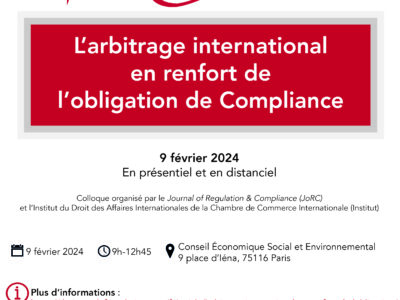
► Full Reference: M.-A. Frison-Roche, "Préalable : ce qu'est un engagement" ("Prerequisite: the Commitment"), in L. Aynès, M.-A. Frison-Roche, J.-B. Racine and E. Silva-Romero (dir.), L'arbitrage international en renfort de l'obligation de Compliance (International Arbitration in support of the Compliance Obligation), Journal of Regulation & Compliance (JoRC) and Institute of World Business Law of the ICC (Institute), Conseil Économique Social et Environnemental (CESE), Paris, February 9, 2024 - 🧮see the full programme of this event - 🌐consult on LinkedIn a general presentation of this event, which links to a presentation of each speech (in French) - 🧱consult the scientific direction sheet of this event, which gives an account of the various speeches made - 🔲see the slides used to support the presentation (in French) - 🎤see a presentation of the conference "Préalable : ce qu'est l'Obligation de Compliance" ("Prerequisite: what is the Compliance Obligation"), given at the same symposium - 🎤see a presentation of the conference "Le renforcement des engagements de Compliance par le renvoi Ex Ante à l'arbitrage international" ("Reinforcing Compliance commitments by referring Ex Ante to International Arbitration") which was finally not pronounced but will be the subject of an 📝article in the forthcoming book 📘Compliance Obligation  - ► Presentation of the conference: Having defined the Compliance Obligation in "Préalable : ce qu'est l'Obligation de Compliance" ("Prerequisite: what is the Compliance Obligation"), I set out to define what a commitment is. No one doubts that commitments, as words, constitute facts that can engage the liability of companies if there are inconsistencies or lies. The question today is whether a commitment can constitute a legal act, binding in ex ante. Companies make commitments either to fulfil their legal Compliance obligations, which is simply obeying the law, or to express their own wishes, either for themselves or for others. The cases are often confused, even though the scope is not the same. If the commitment takes the form of a contract, Compliance is concerned if the contract is used as an Ex Ante Compliance Tool📎1🕴️M.-A. Frison-Roche (ed.), 📘Compliance Tools, 2021., either if the entire contract has this purpose, or if a compliance clause is inserted, and an arbitration clause may be linked to it. The commitment, a concept that comes more from the Economics of Regulation, was conceived between a Regulatory Authority and a Company: it is the unilateral decision of the Authority that gives legal force to the commitment. Case law confirms this (Conseil d'État (French Council of State)📎2🏛️Conseil d'État (French Council of State), 21 April 2023, No. 464349, Sté Orange v. Arcep. and Conseil constitutionnel (French Constitutional Council)📎3🏛️Conseil constitutionnel (French Constitutional Council), 19 March 2021, decision No. 2021-891 QPC, Association Générations futures et autres.) and this is particularly clear in Competition Law, but it is also true of the convention judiciaire d'intérêt public – CJIP (French Judicial Public Interest Agreement). If commitment is central to Compliance, particularly Vigilance, it is because Compliance Law is an extension of Regulatory Law📎4🕴️M.-A. Frison-Roche, 🚧From Regulation Law to Compliance Law ; 🚧Compliance Law loses the ties of Regulation Law but retains its principles: consequences for companies, 2018 ; 🚧The deployment of Regulatory Law through Compliance Law in the European project, 2023.. The company is forcibly instituted by the Compliance regulator, particularly in value chains, or on digital spaces (DSA). In drawing up a plan, the company is fulfilling its legal obligation. But if we were to consider that it is a commitment, then we would also have to consider that the plan is the result of its will, that it must consult the stakeholders in its preparation, but that the source of the plan is its will: the provisions are not stipulations, are not applications of the law, but unilateral voluntary provisions. In this respect, and because its source is the will of the company (which does not prevent its co-construction), a plan could contain a "graduated offer" of arbitration. This offer could be included in commitments that are less regulated by law, such as those made in the context of CSR. - 🌐follow Marie-Anne Frison-Roche on LinkedIn 🌐follow Marie-Anne Frison-Roche on Instagram 🌐subscribe to the Newsletter MAFR Regulation, Compliance, Law

Organisation of events

🧱Co-organisation of the Symposium 🧮L’arbitrage international en renfort de l’Obligation de Compliance (International Arbitration in support of the Compliance Obligation)

► Full Reference: L. Aynès, M.-A. Frison-Roche, J.-B. Racine and E. Silva-Romero (dir.), L'arbitrage international en renfort de l'obligation de Compliance (International Arbitration in support of the Compliance Obligation), Journal of Regulation & Compliance (JoRC) and Institute of World Business Law of the ICC (Institute), Conseil Économique Social et Environnemental (CESE), Paris, February 9, 2024 - 🌐consult on LinkedIn a general présentation of this event, which links to a presentation and a report of each speech  - 🏗️This symposium takes place in the cycle of symposiums organised by the Journal of Regulation & Compliance (JoRC) and its partners Universities, focusing in 2023-2024 on the general theme of the Compliance Obligation - 📚The works will then be inserted in the books:  📕L'obligation de Compliance, to be published in the 📚Régulations & Compliance Serie, co-published by the Journal of Regulation & Compliance (JoRC) and Dalloz, published in French. 📘Compliance Obligation, to be published on the 📚Compliance & Regulation Serie, co-published by the Journal of Regulation & Compliance (JoRC) and Dalloz, published in English. - ► General presentation of the symposium: "Compliance Obligation" appears to be far from International Arbitration if Compliance Law is only understood in terms of binding regulations or even Criminal Law. Arbitration would only have contact with Compliance Obligation in a repulsive way, when a person claims to have enforced a contract before an arbitration court that disregards a compliance prohibition, e.g. corruption or money laundering. It is therefore from a negative angle that the cross-over has taken place. The fact that Arbitration Law respects the requisite of Criminal Law is nothing new.  Moreover, the power of Compliance in its detection and prevention tools, particularly in terms of evidence, no doubt increases the global efficiency. But Compliance Obligation is based on Monumental Goals, notably linked to global human rights and active ambitions about environment and climate which, particularly in the value chain economy, take the legal form of compliance clauses, or even compliance contracts, or various commitments and plans, which the parties can ask the international arbitrator to enforce. They will do so even more as arbitrators are often the only international, or even global, judges available. The use they will do of Contract Law, Quasi-Contract Law, Enforcement Law, Tort Law, reinforces Compliance Law in a global dimension. - - ► Interviennent :  🎤 Laurent Aynès, emeritus Professor at Paris 1 Panthéon-Sorbonne University, Attorney, Darrois Villey Maillot Brochier (Paris) 🎤 Marie-Anne Frison-Roche, Professor of Regulatory and Compliance Law, Director of the Journal of Regulation & Compliance (JoRC) 🎤 Jean-François Guillemin, former General Secretary of the Bouygues Group 🎤 Christophe Lapp, Attorney, Advant Altana (Paris) 🎤 Jean-Baptiste Racine, Full Professor at Paris Panthéon-Assas University (Paris 2) 🎤 Eduardo Silva-Romero, President of the Institute of World Business Law of the ICC (Institute), Attorney, Wordstone (Paris) - 🧮Read a detailed presentation of the event below⤵️ - 🌐follow Marie-Anne Frison-Roche on LinkedIn 🌐follow Marie-Anne Frison-Roche on Instagram 🌐subscribe to the Newsletter MAFR Regulation, Compliance, Law

Conferences

🎤Le renforcement des engagements de compliance par le renvoi Ex Ante à l’arbitrage international (Reinforcing Compliance commitments by referring Ex Ante to International Arbitration), in 🧮L’arbitrage international en renfort de l’obligation de Compliance

► Full Reference: M.-A. Frison-Roche, "Le renforcement des engagements de Compliance par le renvoi Ex Ante à l'arbitrage international" ("Reinforcing Compliance commitments by referring Ex Ante to International Arbitration"), in L. Aynès, M.-A. Frison-Roche, J.-B. Racine and E. Silva-Romero (dir.), L'arbitrage international en renfort de l'obligation de Compliance (International Arbitration in support of the Compliance Obligation), Journal of Regulation & Compliance (JoRC) and Institute of World Business Law of the ICC (Institute), Conseil Économique Social et Environnemental (CESE), Paris, February 9, 2024 - 🧮see the full programme of this event - 🌐consult on LinkedIn a general presentation of this event, which links to a presentation of each speech (in French) - 🧱consult the scientific direction sheet of this event, which gives an account of the various speeches made - 🔲see the slides used to support the presentation (in French) - 📝This conference and the Working Paper on which it is based are to be linked with the article to be published in the book📘Compliance Obligation  - 🎤see a presentation of the conference "Préalable : ce qu'est l'Obligation de Compliance" ("Prerequisite: what is the Compliance Obligation"), given at the same symposium - 🎤see a presentation of the conference "Préalable : ce qu'est un engagement" ("Prerequisite: the Commitment"), given at the same symposium - ► Presentation of the conference: It was initially planned that I would speak on the subject Le renforcement des engagements de Compliance par le renvoi Ex Ante à l'arbitrage international (Reinforcing Compliance commitments through the Ex Ante referral to International Arbitration), but it was agreed with the other organisers of the symposium that after defining the concept of the Compliance Obligation📎1🕴️M.-A. Frison-Roche, 🎤Préalable : ce qu'est l'obligation de Compliance (Prerequisite: the Compliance Obligation), in 🧮L'arbitrage international en renfort de l'obligation de Compliance (International Arbitration in support of the Compliance Obligation), 2024. I would refocus my second speech, mentioned above, on what a Commitment is📎2M.-A. Frison-Roche, Préalable : ce qu'est un engagement 🕴️M.-A. Frison-Roche, 🎤Préalable : ce qu'est un engagement (Prerequisite: the Commitment), in 🧮L'arbitrage international en renfort de l'obligation de Compliance (International Arbitration in support of the Compliance Obligation), 2024., an essential prerequisite for dealing with the subject of International Arbitration in support of the Compliance Obligation. Developments on Reinforcing Compliance commitments through the Ex Ante referral to International Arbitration will appear in the forthcoming books: L'obligation de Compliance (in French), Compliance Obligation (in English). Nevertheless, if I had dealt with this subject, I would have raised the following points: The inclusion of an offer of arbitration in the field of Compliance implies considering it in a contract as well as in a non-contractual commitment, and studying which category of Compliance Obligation the offer may apply to. This insertion benefits from taking the form of a "graduated offer", in a crescendo organised by the company ex ante and offered to the stakeholders: conciliation, mediation and arbitration, in "circles of trust"📎3🕴️M.-A. Frison-Roche, 🚧Compliance and Trust, 2017.. This is supported by the current French amicable settlement policy. The result was that I had to prepare a long "preliminary" discussion of what a "commitment" is, without which it seemed difficult to talk in concrete terms about the effective insertion of an offer of arbitration if we did not know whether such links or words had a constraining effect on the person issuing them in relation to the person benefiting from them. After discussions with the other speakers, it became clear that it would be more effective to give a talk devoted solely to the question of the legal definition of commitment. We therefore decided to allocate this second speaking slot to the notion of commitment. Since the written words do not have the same constraints, it will take up the initial construction, insisting on the different supports, either compliance contracts, or associations with compliance clauses, relating to different Compliance obligations, in particular on information or audit or Vigilance📎4🕴️M.-A. Frison-Roche, 🚧Compliance contract, compliance clauses, 2022., because the company must have the legal power corresponding to the mission that the State entrusts to it through Compliance📎5🕴️M.-A. Frison-Roche, 🚧Conceiving Power, 2021.. The offer must be carefully drafted to explain its purpose, and its organisation must prove the reality of this purpose: to give access to a judge to people affected by the company's activity, and not to block it. This will therefore be available in detail in the forthcoming books: M.-A. Frison-Roche (ed.), 📕L'obligation de Compliance M.-A. Frison-Roche (ed.), 📘Compliance Obligation - 🌐follow Marie-Anne Frison-Roche on LinkedIn 🌐follow Marie-Anne Frison-Roche on Instagram 🌐subscribe to the Newsletter MAFR Regulation, Compliance, Law

Conferences

🎤Préalable : ce qu’est l’obligation de Compliance (Prerequisite: the Compliance Obligation), in 🧮L’arbitrage international en renfort de l’obligation de Compliance

► Full Reference: M.-A. Frison-Roche, "Préalable : ce qu'est l'obligation de Compliance" ("Prerequisite: the Compliance Obligation"), in L. Aynès, M.-A. Frison-Roche, J.-B. Racine and E. Silva-Romero (dir.), L'arbitrage international en renfort de l'obligation de Compliance (International Arbitration in support of the Compliance Obligation), Journal of Regulation & Compliance (JoRC) and Institute of World Business Law of the ICC (Institute), Conseil Économique Social et Environnemental (CESE), Paris, February 9, 2024 - 🧮see the full programme of this event - 🌐consult on LinkedIn a general presentation of this event, which links to a presentation of each speech (in French) - 🧱consult the scientific direction sheet of this event, which gives an account of the various speeches made - 🔲see the slides used to support the presentation (in French) - 🎤see a presentation of the conference "Préalable : ce qu'est un engagement" ("Prerequisite: the Commitment"), given at the same symposium - 🎤see a presentation of the conference "Le renforcement des engagements de Compliance par le renvoi Ex Ante à l'arbitrage international" ("Reinforcing Compliance commitments by referring Ex Ante to International Arbitration") which was finally not pronounced but will be the subject of an 📝article in the forthcoming book 📘Compliance Obligation  - ► Presentation of the conference: I have first dealt with the very definition of the Compliance Obligation. After showing that the relationship between Compliance Law and International Arbitration will naturally develop, because the companies subject to it are international, because they contractualise their legal Compliance obligations and because Compliance is being jurisdictionalised📎1🕴️M.-A. Frison-Roche (ed.), 📘Compliance Jurisdictionalisation, 2024., the arbitrator being the natural judge since he is a global judge and the judge of the contract, I pointed out that Compliance Law does not simply entrust arbitration with the task of preventing evils, such as corruption pacts, but that it creates positive obligations for companies: to detect and prevent behaviour whose systemic effect is deleterious. This culture of compliance is achieved either through compliance contracts📎2🕴️M.-A. Frison-Roche, 🚧Compliance contract, compliance clauses, 2022. (which outsource the handling of audits, alerts, the drawing up of plans, etc.), or through compliance clauses📎2🕴️M.-A. Frison-Roche, 🚧Compliance contract, compliance clauses, 2022., which are inserted into distribution or supply contracts, etc.; arbitration clauses are linked to these. Thus, the alliance between Compliance and Contract is an indirect mode of alliance between Arbitration and Compliance Obligation. The obligation of Compliance which then takes concrete form consists for the company not in making effective Ex Ante all the regulations which apply to it (conception of conformity which is at once unreasonable, blind and impossible), but in making its best efforts, which it must make visible (see Compliance Evidence System📎3🕴️M.-A. Frison-Roche, 📝The Judge, the Compliance Obligation and the Company. The Compliance Evidence System, in 🕴️M.-A. Frison-Roche (ed.), 📘Compliance Jurisdictionalisation, 2024.) to achieve Monumental Goals. These Monumental Goals are systemic. The aim is to protect systems from collapse (Negative Monumental Goals) or to make them better (Positive Monumental Goals)📎4🕴️M.-A. Frison-Roche, 📝Compliance Monumental Goals, Beating Heart of Compliance Law, in🕴️M.-A. Frison-Roche (ed.), 📘Compliance Monumental Goals, 2023.. By making companies accountable, via this Ex Ante Law whose object is the future, the systemic evils of corruption, money laundering, discrimination, climate change and hatred are combated, thus finding substantial unity. The Positive Monumental Goals aim to engender sustainability, security, respect for human beings, etc. in systems, be they banking, financial, digital, climatic, etc. The role of the Judge, and therefore also that of the Arbitrator, is renewed. - 🌐follow Marie-Anne Frison-Roche on LinkedIn 🌐follow Marie-Anne Frison-Roche on Instagram 🌐subscribe to the Newsletter MAFR Regulation, Compliance, Law

Conferences

🎤Participation in the panel “Vigilance (due diligence)”, in 🧮150th Anniversary Symposium of the ILA/ADI

🌐 follow Marie-Anne Frison-Roche sur LinkedIn 🌐subscribe to the Newsletter MAFR Regulation, Compliance, Law  - ► Full Reference: M.-A. Frison-Roche, participation in the panel "Vigilance (due diligence)", in International Law Association (ILA), 150th Anniversary Symposium of the ILA/ADI, Paris, 19 June 2023. - 🧮See the full programme of this event -