Incitation

Articles in The Journal of Regulation & Compliance « JoRC »

📝Les technologies de conformité pour satisfaire les exigences du droit de la compliance. Exemple du numérique (Conformity technologies to meet Compliance Law requirements. The digital example), in 🕴️M.-A. Frison-Roche (dir.), 📕L’obligation de Compliance

► Full Reference : E. Netter, "Les technologies de conformité pour satisfaire les exigences du droit de la compliance. Exemple du numérique" (Conformity technologies to meet the requirements of Compliance Caw. Digital example), in M.-A. Frison-Roche (dir.), L'obligation de Compliance, Journal of Regulation & Compliance (JoRC) and Dalloz, coll. "Régulations & Compliance", 2025, pp. 355-367. - 📕read the general presentation of the book, L'obligation de Compliance, in which this contribution is published. - ► English summary of this contribution (done by the Journal of Regulation & Compliance) :The author distinguishes between Compliance, which refers to Monumental Goals, and conformity, which are the concrete means that the company uses to tend towards them, through processes, check-lists in the monitoring of which the operator is accountable (art. 5.2. GRPD). Technology enables the operator to meet this requirement, as the changing nature of technology fits in well with the very general nature of the goals pursued, which leave plenty of room for businesses and public authorities to produce soft law. The contribution focuses firstly on existing technologies. Through Compliance, Law can prohibit a technology or restrict its use because it runs counter to the goal pursued, for example the technology of fully automated decisions producing legal effects on individuals. Because it is a perilous exercise to dictate by law what is good and what is bad in this area, the method is rather one of explicability, i.e. control through knowledge by others. Regulators are nevertheless developing numerous requirements stemming from the Monumental Goals of Compliance. Operators must update their technology or abandon obsolete technology in the light of new risks or to enable effective competition that does not lock users into a closed system. But technological power must not become too intrusive, as the privacy and freedom of the individuals concerned must be respected, which leads to the principles of necessity and proportionality. The author stresses that operators must comply with the regulations by using certain technologies if these technologies are available, or even to counteract them if they are contrary to the goals of the regulations, but this obligation of conformity is applied only if these technologies are available. The notion of "available technology" therefore becomes the criterion of the obligation, which means that its content varies with circumstances and time, particularly in the area of cybersecurity. In the second part of this contribution, the author examines technologies that are only potential, those that Law, and in particular the courts, might require companies to invent in order to fulfill their conformity obligation. This is quite understandable when we are talking about technologies that are in the making, but which will come to fruition, for example in the area of personal data transfer to satisfy the right to portability (GRPD), or where companies must be encouraged to develop technologies that are of less immediate benefit to them, or in the area of secure payment to ensure strong authentication (SPD 2). This is more difficult for technologies whose feasibility is not even certain, such as online age verification or the interoperability of secure messaging systems, two requirements which appear to be technologically contradictory in their terms, and which therefore still come under the heading of "imaginary technology". But Compliance is putting so much pressure on companies, particularly digital technology companies, that considerable investment is required to achieve it. The author concludes that this is the very ambition of Compliance and that the future will show how successful it will be.          - 🦉This article is available in full texte for persons following Professor Marie-Anne Frison-Roche teaching. -

Articles in a legal collective publication

📝 Assessment of whistleblowing and the obligation of vigilance regarding international competitiveness, in 🕴️ M.-A. Frison-Roche (ed.), 📘Compliance Monumental Goalsnce Monumental Goals

► Full Reference: M.-A. Frison-Roche, " Assessment of whistleblowing and the obligation of vigilance regarding international competitiveness", in M.-A. Frison-Roche (ed.), Compliance Monumental Goals, series "Compliance & Regulation", Journal of Regulation & Compliance (JoRC) et Bruylant, 2023, p. - ► Article Summary: Taking up the legal tools of Compliance and confronting them with the concern that Law must have for the Competitiveness of companies, it is necessary that these legal instruments not harm it because Compliance Law, because of its immense ambitions, can only function through an alliance between political wills with great pretensions (save the planet) and the entities which are able to achieve these goals (the crucial economic operators : the political drawing on the compagnies" power, it would be contradictory for the legal instruments put in place by Law to harm the ability of companies to face global economic competition, or worse to favor international competitors acting under legal systems which do not integrate Compliance obligations.   From this principle, it is possible to assess these two legal techniques of whistleblowing and vigilance obligation: both consist in capturing Information, which gives them a strong uniqueness and fits them into the global competition for Information. Taking the whistleblowing, its first beneficiary is the company itself since the firm discovers a weakness and can therefore remedy it. Therefore, beyond the principle of protection of the whistleblower by their access to the legal statute, for instance the one conceived by the French 2016 law known as "Sapin 2", it is questionable that all the incentives are not put in place so that the holder of such information transmits it to the manager. It is not the European solution, even after the European Directive of 2019, national legal systems continuing to require the absence of financial compensation, the "heroic figure of the whistleblower and the refusal of their remuneration depriving the company of Information and improvement. First to the manager, with external transmission taking place if the latter does nothing, the internal manager is thus encouraged to act and put an end to the dysfunction, which increases the competitiveness of the company. But the French legislation has on the contrary developed the right incentive as to the person to whom the information is transmitted because by obliging to transmit first to the manager, the external transmission intervening if the internal management does nothing, the incentive is thus made to the internal manager to act and put an end to the dysfunction, this legal solution increasing the competitiveness of the company. Even more, and even if it seems counter-intuitive, the obligation of vigilance increases the competitiveness of the obliged companies. Indeed, Law by obliging them to prevent and fight against violations of human rights and the environment has tacitly given them all the necessary powers to do so, notably the power to collect Information on third-party companies, including (and even above all) those which are not subject to transparency obligations. In this respect, companies, as far as they are personally responsible, hold supervisory power over others, a power which allows to globalize Compliance Law and which, in the process, increases the Companies' own power. Therefore, the obligation of vigilance is in many respects a boon for the companies which are subject to it. The resumption of the mechanism by the next European Directive, itself indifferent to the territory, will only strengthen this global power of vigilant companies over possibly foreign companies which become its passive subjects. - 🚧 read the bilingual Working Paper, basis for this article  - 📘​ read the general presentation of the book, Compliance Monumental Goals, in which this article is published - ► read the presentations of the other Marie-Anne Frison-Roche's contributions in this book:  📝Compliance Monumental Goals, beating heart of Compliance Law,  📝Definition of Principe of Proportionality and Definition of Compliance Law, 📝 Role and Place of Companies in the Creation and Effectiveness of Compliance Law in Crisis,  -    

Articles in The Journal of Regulation & Compliance « JoRC »

RAPP, Lucien🕴️

📝Théorie des incitations et gouvernance des activités spatiales, in 🕴️M.-A. Frison-Roche (ed.), 📕Les outils de la Compliance

► Full Reference : L. Rapp, "Théorie des incitations et gouvernance des activités spatiales" ("Incentive Theory and Governance of Space Activities"), in M.-A. Frison-Roche (ed.), Les outils de la Compliance, coll. "Régulations & Compliance", Journal of Regulation & Compliance (JoRC) and Dalloz, 2021, p. 73-88. - 📕read a general presentation of the book, Les outils de la Compliance, in which this article is published - ► Summary of the article (done by the author): The article studies the conditions for an application of the theory of incentives to the problems currently posed by the governance of space activities. These activities have been enriched by the presence of numerous private operators, without the market that is being set up having yet been properly regulated. The accumulation of debris in close space highlights the difficulty of maintaining a situation where only national laws govern in the absence of a specialized international organization and in the insufficiency of the international treaties in force. This article shows the contributions of the behavioral approach in Law and economics and the interest that there would be in developing it. -

Articles in The Journal of Regulation & Compliance « JoRC »

📝Compliance et incitations : un couple à propulser, in 🕴️M.-A. Frison-Roche (ed.), 📕Les outils de la Compliance

► Full Reference: M.-A. Frison-Roche, "Compliance et incitations: un couple à propulser " ("Compliance and incentives : a promising tandem"), in M.-A. Frison-Roche (ed.), Les outils de la Compliance, coll. "Régulations & Compliance", Journal of Regulation & Compliance (JoRC) and Dalloz, 2021, pp. 123-130. - 📝read the article (in French) - 🚧read the bilingual Working Paper which is the basis of this article, with more developments, technical references and hypertext links - 📕read a general presentation of the book, Les outils de la Compliance, in which this article is published - ► Summary of the article (done by the Journal of Regulation and Compliance): The theory of incentives targets the mechanisms which do not use directly constraint (except to present sanctions themselves as incentives) but which leads nevertheless to expected behaviors. To appreciate the links which must or must not be done between incentives and Compliance, we should proceed in two times.  First, the association appears natural between incentive mechanisms and "Compliance Law" since the later is defined in a dynamic way. Indeed, if it is defined placing its legal normativity in its "monumental goals", as the end of corruption, the detection of money laundering in order to underlying criminality disappears, or as the effective protection of environment or the concrete care of human beings, then what matters is not the means in themselves but the effective tension towards these "monumental goals". In this perspective, what was related to public policies led by States, because they are definitively not able to do it, the charge is internalized in the firms which are able to tend towards this goals: "crucial operators" because they have the geographical, technological, informational and financial means.  In this perspective, the internalization of public willingness provoking a split with the concept of State linked to a territory which deprives Politics of its constraint power, incentive mechanisms appear as the most efficient mean to reach these monumental goals. They appear as this "natural" mean both negatively and positively defined. Negatively in which they do not need in Ex Ante institutional localizable sources and sanction power in Ex Post: it is enough to substitute the interest to obligation. Positively, incentives relay through operators' strategies what was the so critical and joked form of public action: the "plan". The duration is thus injected thanks to Compliance mechanisms, as we can see it through the development of it in the care for environment ("plan climat") or through the educational mechanism, which could be conceived only in duration.   However, the opposition seems radical between Compliance Law and Incentives. And this because of three convictions often developed and that we have to overcome. First, the idea that in a general way, there would be a Law only if there is a mechanism of immediate constraint which is associated to the norm. As long as the incentive is not based on obligation, then it will be nothing… Secondly, and as if that were a kind of consolation …, Compliance would not be really Law either … We so often say that it is only about a methodology, a range of processes without sense, procedures to follow without trying to understand, process that algorithms integrate in a mechanic without end and without sense or that on the contrary, Compliance would be full of sense by Ethics and Morality, which are far from Law. While incentives talk to the human spirit which calculate, Compliance would be so a process through which machines will be connected to other machines, so an extra soul, where calculation has no place… Thirdly, solutions would be to be find in Competition Law because it can do without States, submit them and approach what is a-sectorial, especially finance and digital, the world being financialized and digitalized. The violence of Competition Law which comes in Ex Ante thanks to "Compliance sanctions" applying for example to essential infrastructures Law, by continuing to deny the salience of the duration and taking care of the "market power" would be also not compatible with a marriage with incentive mechanisms which rely on duration and power of those to which it is applied, converging towards goals, which are set by what Competition Law ignores: the project. This project which pretends to build the future is the one of politics and of companies, which use their deployed power in time to concretize it. It is without any doubt there that the future of Europe is.  To overcome this triple difficulty, it is thus necessary, in a second time, to modify our conception of Law, especially thanks to Compliance Law, in which this new branch is autonomous from Competition Law, and even sometimes opposed to it, in order to the insertion of incentive mechanisms permit to unknown or against Competition Law organizations to reach "monumental goals" which are imperative to take into consideration. For example, the taking into consideration of climate challenges or the building of a sovereign identity of the data. This is expressly set by European Commission which supervises such initiatives, supervision being what is articulated with Compliance, in a couple that go beyond Regulation, and replaces in Ex Ante Competition Law, salient branch for Ex Post. All the texts which are in the process of expressing it are based on this reformed couple: Compliance and Incentive. This couple supposes that we recognize as such the existence of companies as project carriers, project which is the creation of marketed wealth circulating on a market, which could be an industrial project specific to a geographical zone both economical and political. Regulation is deployed to go away from the notion of sector and to transform itself in supervision of crucial firms in the correspondance between the project and the action, what refers to the notion of "plan". In this, banking supervision is just the advanced bastion of all thematic, energetic, climatic and health plans, or more broadly industrial and technological that could by incentive be implemented, this conception of Compliance permitting to build zones which are not reduced to immediate market exchange. The incentive corresponds to the fact that Compliance Law relies on the power of the firm to reach its own political goals, for example fighting against disinformation in the digital space or obtaining a healthy environnement. This supposes that Compliance stops to be only conceived as a model of rules effectivity, for example of Competition Law, to be recognized as a substantial branch of Law. A branch which expresses political goals. A branch which is anchored in crucial firms whose it recognizes the autonomy with regards to markets. This makes it possible, in particular through the coupling with incentive mechanisms leading to long-term collaborative operations supervised by public authorities, not to be governed by simple Competition Law, inapt to bring projects to fruition. -

Articles in a legal collective publication

The use of Intellectual Property as Regulatory and Compliance Tool (Le maniement de la propriété intellectuelle comme outil de régulation et de compliance), in “Major cases in Intellectual Property” (“Les Grands Arrêts de la propriété intellectuelle”

Référence complète : Frison-Roche, M.-A., Le maniement de la propriété intellectuelle comme outil de régulation et de compliance, in Vivant, M. (dir.), Les Grands Arrêts de la propriété intellectuelle, 3ième éd., 2019, 9-11, pp. 43-53. This contribution is written in French. Summary:  Intellectual Property, which comes from the State and is incorporated into public policy, can be designed not to reward the creator a posteriori, but to encourage others to innovate. It is then an Ex Ante regulatory tool, an alternative to the subsidy. If private copying is an exception, it is not in relation to the principle of Competition but in an insertion into a system of incentives, starting from the costs borne by the creator of the first innovation: the rights holder is then protected , not only according to a balance of interests involved but in order not to discourage innovative potentials and the sector itself. (1st decision) ; The sectoral policy then permeates Intellectual Property, used to regulate a sector, for example that of the drug. While it is true that a laboratory wishing to market a generic drug did not wait for the expiration of the patent for the original drug to do so, it is however not relevant to sanction this anticipation by a few days because the investments made by the holder of the Intellectual Property right have been made profitable by this one and because the public authorities favor the generics in a concern of public health (2nd decision). Systemic interest prevails and therefore Internet service providers have to bear the costs of blocking access while they are irresponsible because of the texts. This obligation to pay is internalized by Compliance Law because they are in the digital system best able to put an end to the violation of Intellectual Property rights which the ecosystem requires to be effective. (3rd decision).   Read the contribution (in French).   Read the Working Paper written in English having served as a basis for this contribution and endowed with additional developments, technical references and hypertext links.  -

Working papers

🚧 Compliance and Incentives: a couple to propel by the notion of “Incentive Compliance”

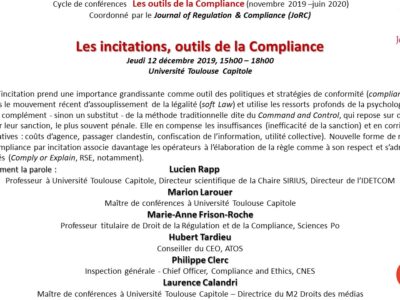
This working document serves as the basis for two conference given in the symposium made under the direction of Lucien Rapp, Les incitations, outils de la Compliance ("Incitations: Compliance Tools"). Référence : Frison-Roche, M.-A., Compliance et Incitations : un couple à propulser, in Faculté de droit de l'Université Toulouse-Capitole, et Journal of Regulation & Compliance (JoRC),Les incitations, outils de la Compliance, 12 décembre 2019, Toulouse.  This Working Paper has been the basis for two conferences in the colloquium in Toulouse (France) under the scientific direction of Lucien Rapp, about Les incitations, outils de la Compliance ("Incitations, as Compliance Tools"), on December 12, 2019, the first one about The sanction as incitation and the second one about Incitations and Compliance Law (synthesis of this colloquium). sur le thème de la sanction comme incitation, la seconde en synthèse de ce colloque sur  After it has been the basis for the article, to be published in the books Les outils de la Compliance and Compliance Tools in the Series Régulations & Compliance. Read a general presentation of this book.   - Summary of this Working Paper: Compliance and Incentives appear at first glance to be totally opposite. Not only because sanctions are at the heart of Compliance and that sanction is associated with constraint while incentive is associated with non-constrained1Voir cette question analysée d’une façon autonome, Frison-Roche, M.A., Résoudre la contradiction entre « sanction » et « incitation » sous le feu du Droit de la Compliance, 2020., but also because incentives are linked to self-regulation and that Compliance Law requires a strong presence of public authorities. Thus, one should choose: either Compliance or Incentives! Either the effectiveness of one or the effectiveness of the others; either the techniques of one, or the techniques of others; either the philosophy of one or the philosophy of the others. Resign yourself to the waste that such a necessary choice would involve. But putting the terms thus is thinking poorly about the situations and reducing the fields of the solutions which they call for. If we take a rich definition of Compliance Law, we can on the contrary articulate Compliance and Incentives. To do this, the concept of “incentive Compliance” should be developed. This concept is not only appropriate, but it is necessary in a new conception of Sovereignty. For example for the digital Europe. -   Read the developments below.