Impartiality

Videos

🎥 The Economic Attractiveness of Impartiality (“L’attractivité économique de l’impartialité”), in “”Economic Attractiveness, Judge Office and Impartiality. Thinking the judge Office” (“L’attractivité économique, l’office du juge et l’impartialité. Penser l’office du juge”)

►  Full Reference : Frison-Roche, M.-A., The Economic Attractiveness of Impartiality ("L'attractivité économique de l'impartialité"), in ""Economic Attractiveness, Judge Office and Impartiality. Thinking the judge Office" ("L'attractivité économique, l'office du juge et l'impartialité. Penser l'office du juge"),  -   🎥 watch the conference (in French with English subtitles) -   📝 read the colloquium program ( in French) 📝 see the general program of the cycle on the Judge Office. -   📝 read François Ancel's article of 14th of January 2021 in the Receuil Dalloz and which report this colloquium (in French)      📝 read the Working Paper, basis of this conference. This Working Paper is significantly different from the conference because it was conceived befor the colloquia cycle beginning. In addition, since this manifestation was a Round Table, the conference has taken more into account previous conferences and what said the other two speakers.   📊 see the slides, basis of the conference (in French) The slides could not be shown during the conference. Orally, it was appropriate to more develop the introductory remarks for emphasizing the human and unique dimension of the Judge Office, expected in economic matters. As a result, the second part of the conference was not given orally, so slides therefore remain the only media available. - ►  Summary of the conference : To fit into the ambition of this general colloquia cycle, which is to "Think the Judge Office" and in this round table which apprehends the imperative of economic attractiveness of this office, firstly emerges the seemingly contradictory relationship between this imperative and the distance that the judge must maintain. Thus it is often asserted that the judge should be internalized at this point in the "places", – an economic concept of great scope (to which the first part of the introduction is devoted, defining the "place" at the same time as a closed and porous space and as a "systemic litigant" -, that he/she should ipso facto lose his/her distance, that is to say his/her impartiality. As places are in competition, even if weighing on one hand the effectiveness of the place, and on the other hand the impartiality of a judge who is external to this place – Judge referring to the Law , Impartiality would necessarily emerge weakened. It would then be necessary on a case-by-case basis to get the judge to give the desired concessions… The conference aim is to take the opposite position and to state that the Place – in particular because they must be strongly distinguished from the Markets, of which they were the ancestors – require a Judge, who is at the same time "singular", that is to say with a personality, a face, opinions, and in distance so that his/her imagination does not surprise Place. Indeed, these require a human Justice, and a not mechanical one and singular judges, of whom the juge des référés or the arbitrator are the epigone, meets this need. But for reducing their "margins of discretion", how Economy qualifies the Impartiality of a person who can never be neutral, the singular Judge's Office must be inserted into mechanisms reducing these margins. In this way, the Place may reach a Judge who is always more impartial, and in doing so the Place becomes always more attractive. To achieve this in practice, the place expresses two legitimate expectations, as a "systemic litigant", whose satisfaction increases and the singular Judge's Impartiality and increases the Attractiveness of the Place as a space. This clearly shows that the Place's Attractiveness and the Judge's Impartiality, because judges are inserted into procedures, into institutions and into a "jurisdictional family", are not only not contradictory, but are on the contrary convergent, one fueling the other. Concretely, and judicial practice shows it, it is necessary to consolidate the particular Judge's Impartiality by inserting him/her into collective processes. As it is necessary to promote a radiance of Impartiality by strengthening the "jurisdictional family". To consolidate the singular Judge's Impartiality  by inserting him/her into collective processes, it is necessary to admit without hesitation the subjectivity of the judge, to seek it even. The reduction of the margins of discretion, definition of impartiality, being obtained by the inclusion of the judge in a procedure of which he /her alone is the master but in which he/her is not alone. This has the technical consequence that he/her is himself/herself in an adversarial debate, not only during the proceedings, but also before (in the media), inside the judgment (and the decision of the Criminal Chamber of 25 November 2020 is a model of that) and after the judgment. By that, the Judge shows that by his/her office he/she is in the future, as climate justice will show. In addition, to limit his/her margins of discretion, the singular judge must fit into a rational principle of coherence, vertical and horizontal. Vertical coherence, because he/she integrates what it is said and the technique of the "determining opinion" is to be encouraged, the singular judge having to avoid it only if he/she has "strong reasons" to do it. This is to follow  this general rule Comply or Explain (which is the very opposite of blind obedience). Horizontal coherence, because the singular judge either sticks to what he/she said, estoppel also being a rule of logic. But above all, the institution must extract as much as possible from " institutional doctrines", by all means, of which the annual reports are an example. To consolidate the singular Judge's Impartiality by strengthening the notion and reality of the "Jurisdictional Family", it is necessary to have of it a broader conception, which could lead to "guidelines" common to various jurisdictions, and a stronger one, by integrating those surrounding the judge to lead to judgment. In this, the procedure before the Court of Justice of the European Union, working on a common file, is a model. If this community were even stronger, the Judge Office would be even more useful than it is already in the digital space. Thus, Judges who are always human, always diverse, always singular, who listen, consider and adjust to the situation, who within a Jurisdictional Family fit into an Institutional Doctrine which transcends and supports them but which they transform if there is a strong reason to do so, a reason always expressed said: this is the embodied Impartiality that makes an economic and financial Place attractive.   -      
Books

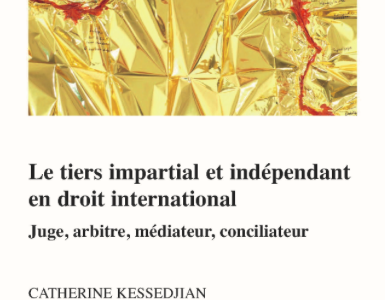
KESSEDJIAN, Catherine

Le tiers impartial et indépendant en droit international. Juge, arbitre, médiateur, conciliateur

Full reference: Kessedjian, C., Le tiers impartial et indépendant en droit international. Juge, arbitre, médiateur, conciliateur, Académie de Droit international de La Haye, 2020, 769p.   Read the forth of cover (in French) Read the table of content (in French)

Articles

Regulators’​ Impartiality and contents control: “Les infidèles”​ case

Full reference: Frison-Roche, M.-A., Regulators'​ Impartiality and contents control: "Les infidèles"​ case, Newsletter MAFR – Law, Compliance, Regulation, 19th of August 2020 Read by freely subscribing the other news of the Newsletter MAFR – Law, Compliance, Regulation To go further, read the chapter of the book Compliance Tools: "The geographical pregnancy ​of Compliance tools" opened by an introductive chapter written by Jean-Baptiste Racine   Summary of the news Impartiality of the regulator is one of the most important principles of Regulation and Compliance Law. However, this impartiality can be difficult to implement when the regulation object has a strong moral dimension.  In August 2020, various religious associations sized the Conseil National de Régulation de l'Audiovisuel sénégalais (Senegalese audiovisual regulatory authority) to ask the interdiction of broadcasting on television of the film "Les infidèles" telling the story of a married woman with multiple lovers.  First, the regulator distinguishes the sequences likely to be detrimental to cultural and religious identities and shocking sequences or likely to attack the dignity of the person. Then, it asks the deletion of indecent and obscene scenes and of scenes likely to be detrimental to cultural and religious identities, bans the broadcasting of the film in the television before 10.30 pm, asks an update of the trailer and requires the introduction of a pictogram "forbidden to children under 16" during the broadcasting. The CNRA judges itself able to regulate the content of telefilms in order to protect cultural identities with regards to the law of 4th of January setting its mission.  In 2012, a similar controversy surrounded, in France, the broadcasting of a different film with the same name. However, the purpose and the context were very different because the film was broadcasted at cinema, because it presented adultery men, because it was comic, because the competent regulator was not an administrative body but a professional body and because the broadcasting country was not the same. Here, only the poster was modified.  Thus, an impartial regulation must however taking into consideration "local cultural identities".  

Breaking news

The “Conseil d’État” (French Council of State) transmits July 23, 2014 a “Question prioritaire de constitutionnalité – QPC” on any non-compliance with the Constitution of concurrent sanctions under the Non bis in idem principle, about the French Court of budgetary and financial discipline

In its judgment of 23 July 2014, MM. B., A. et C., the Conseil d'État (French Council of State) shall transmit a  Question prioritaire de constitutionnalité – QPC (Priority Question of Constitutionality) to the Conseil constitutionnel  (French Constitutional Council) about the compliance of the procedural organization of the Cour de discipline budgétaire et financière – CDBF (French Court of fiscal and financial discipline) in terms of constitutional principle impartiality. Indeed, the jurisprudence of the Constitutional Council has incorporated in the constitutional corpus the principle of impartiality, objectively designed   as judicial jurisprudence and the jurisprudence of the European Court of Human Rights have done and have imposed the organs exercising power sanction must give to see their impartiality (definition of the "objective impartiality") to third parties who must have confidence in this body which has power to impose sanctions.

Breaking news

In France, a decree of 1st August 2014 finally reorganizes the sanction procedure before the French telecommunication Regulator (ARCEP), after the condemnation by the French Constitutional Council for partiality

Political power has often difficulties, or takes a long time to admit the principles of law, such as express the judges. So it was quite certain that the penalty proceedings held before the Autorité de Régulation des Communications Electroniques et de la Poste -ARCEP  (French Regulatory Authority for Electronic Communications and Post, as the investigation body and the judgment body were not sufficiently distinct crumpled the constitutional principle of impartiality. It was acquired about 15 years. Yet the organization has continued. It has been enough that an operator has been sanctioned. He used the procedure of Question Prioritairre de Constitutionnalité -Q.P.C.  Priority Question of Constitutionality) and Numéricable July 5, 2013 decision by the Constitutional Council came to declare that any sanction proceedings before ARCEP unconstitutional, because of objective procedural partialité, thus causing difficulty to the regulator. It took until the 0rdonnance of March 12, 2014 and finally the decree of 1st August 2014 to organize an efficient sanctions procedure, making this time an intern wall within the ARCEP between the services responsible for the instruction and those which are responsible for judging. The great judge Pierre Drai used to say: "Ne pas respecter le droit coûte cher (Do not respect the law is expensive)". We see here that this is true also for the Government which writes laws and regulations. So, for months, the regulator has been without power, to the delight of the operators, who often are tacticians or turbulent.

Texts

Decree of 1 August 2014 Décret du 1er août 2014 relatif à la procédure de sanction de l’Autorité de régulation des communications électroniques et des postes (ARCEP) -on the procedure for sanction of the Regulatory Authority for Electronic Communications and Posts (ARCEP)

To read the decree, in French . To read the modifications of the Code des postes et des communications électroniques.[ French […]

Jurisprudence

French Council of State (“Conseil d’État”)

Read the Conseil d'État decision. The ruling sends the Conseil constitutionnel  (French Constitutional Council) the question of whether the proceedings […]

Jurisprudence

European Court of Human Rights

To read the decision

I-2.0: Is there a compelling need for neutral action in regulated economic sectors ? ?

TRANSLATED SUMMARIES ENGLISH “Acting in a neutral way” is an oxymoron. “Companies often require however that States use their powers in a neutral way (eg tax neutrality). In regulated sectors, some are right or even duty , of not being neutral. Firstly, it is the State, which requires the market for other purposes, other temporalities and other values​​. Secondly, they are also the “crucial operators”, which are sort of regulators of second degree, such as transmission system operators or companies capital markets firms. The difficulty increases when the systeme requires neutrality of regulators and judges, when first build economic policy and the second create jurisprudence. Their consistency, impartiality and rationality can create an objectifiable neutralitys FRENCH «Agir de façon neutre» est un oxymoron. «Les entreprises ont souvent besoin, cependant, que les États utilisent leurs pouvoirs de manière neutre (neutralité fiscale par exemple). Dans les secteurs réglementés, certains ont le droit ou même le devoir de ne pas être neutre. Tout d’abord, c’est l’État, qui insère le marché à d’autres fins, d’autres temporalités et d’autres valeurs. En second lieu, ils sont aussi les «opérateurs crucial», qui sont des sortes de régulateurs du second degré : par exemple les opérateurs de réseaux de transport ou de entreprises de marchés financiers. La difficulté augmente lorsque le systeme économique et politique exige la neutralité des autorités de régulation et des juges, alors que les premiers construisent la politique économique et les seconds construisent la jurisprudence. Le respect qu’ils doivent avoir de l’impartialité et d’une rationalité suffisamment objectivables pourra permettre cette objectivité requise.

I-2.5: Neutralization using impact surveys before the adoption of Acts and Regulation

Translated Summaries In The Journal of Regulation the summaries’ translation are done by the Editors and not by the authors ENGLISH: Nowadays, it’s necessary to define, initially, the framework of an impact survey. An impact survey is an analysis estimating the economic consequences of a bill (in Europe or in the US) in order to limit, reduce or compensate for negative impacts. It requires the prior adoption of the text. ITALIAN Nei giorni nostri, è necessario definire, inizialmente, la struttura di una valutazione d’impatto. Una valutazione d’impatto è uno studio che cerca di fare una stima delle conseguenze economiche dell’adozione di una legge (in Europa o negli Stati Uniti) in modo tale da limitare, ridurre o compensare le sue conseguenze negative. Tuttavia questo richiede l’adozione preliminare del testo. ………………… Other translations forthcoming.

I-2.2: Regulation and Neutrality: The Case of Financial Markets

At first glance, associating the terms regulation and neutrality seems to be an oxymoron, to cite Marie-Anne Frison-Roche’s expression*. Before […]

I-2.1: What does it mean to be neutral ? Socrates in the land of regulators

Translated Summaries In The Journal of Regulation the summaries’ translation are done by the Editors and not by the authors ENGLISH Article: What does it mean to be neutral ? Socrates in the land of regulators Should regulatory agencies, as we define them in today’s economic and cultural world, be obligated to be neutral in accomplishing their regulatory activities? What would the meaning of such an obligation be? ITALIAN Articolo: Cosa vuol dire essere neutrale? Socrate nella terra dei regolatori Le autorità di regolazione, come sono denominate oggigiorno nel mondo economico e culturale, dovrebbero essere obbligate ad essere neutrali quando compiono le loro attività di regolazione? Quale sarebbe il significato di un tale obbligo? ………………… Other translations forthcoming.