In a positivist conception of law or in in how it is taught , we tend to think that the history of law is an "auxiliary science". But if it happens that past events remain in the current law, so it is ignoring the current law to know nothing of the history of law. If we take the example of the French Revolution, a major divide in the French history, is there still something in the French law? If not, then let the knowledge of the Revolution to historians. If so, then the practical handling of the current French law requires knowledge and understanding of the French Revolution and its ideas, which are still working through today's law, for example through then texts still preserved in its letter and in its spirit.
Read more
historyArticle 16 of the Declaration of Human RightsFrench RevolutionSavignyFreedom of associationBrotherhoodSolidarity
It is therefore necessary to take the statement for granted: the law expresses "the spirit of a people." We want to believe, since Savigny stated it Following the great author does not avoid explaining the meaning of such a statement. Expressing the historical conception of law means that all legal events are the result of a culture of a "people", which has been built over the centuries. Thus, because a French "people" are, there is a French law that reflects this. If this is true, then the implications of this fact are considerable. First, in order for a law to be effective, coherent and applied, it must correspond to the "spirit" of the people to whom it applies. The legislature and the courts must make it part of their art, not to rush a historical movement, do not ignore it,but to adopt the pace. Therefore, foreign legal techniques cannot be welcome. The most important sources of law are the most spontaneous, that is to say, those in which people forge through the centuries of usage and customs. The law written on a white sheet of paper is a mistake, unless it is itself covered by a long period after. The legislator and the judge should have taken to the method of knowing the spirit of their society in which they move: the sociology and history cease to be ancillary to become positive law. In this, the common law rooted in its "stare decisis" better expresses this conception than does the system of Civil Law. But more importantly, there has to be a "people" whose mind law would collect. As rightly pointed out by the German Constitutional Court in 2009, there is no "European people". So how can we build Europe? While the French, British, German, Italian, Spanish, peoples etc. have such a different mind, and that expansion now brings us to the Slavic soul?
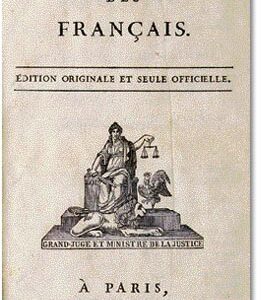
The "pinnacle" means the culmination of a successful issue. Here, the Code civil (French Civil Code) would be the point of perfection of French law. For many this qualification is required with evidence before this masterpiece of concision, practice and use of language. This implies a critique of the current French law, including a legislator that would had fallen very low. But the question nevertheless arises. Since before the Civil Code, there was a law that was not as unworthy. Moreover, after some general principles, all the civil law takes place into the Civil Code, family law, contract law, tort law, and so on. But the criminal law or public law aren't inserted in the book. Thus, it is rather the form, the art of writing the law that can be given to this term apogee Civil Code, not the substance that can bring so much praise to the Code civil because he never embraced the french law in its entirety. In addition, it is true that the form is the pinnacle of French law, but a French law that put the law should only be expressed through writing through codification rather than practices or casebased rules. We must therefore bow to bin assumptions before proclaiming that the Civil Code is the pinnacle of French law. Admitting it is rather the culmination of a certain conception of the law, a non indiscutable conception, he was a perfect and sublime event.
One of the reasons why the law has a bad reputation is that it would be "arbitrary". It would be composed of rules, imposing to do this or not to to do that, without strong reasons. Ultimately, what we do does not matter, as long as we all behave in a similar way. No matter the substance in the legal rule which is adopted, the law, is primarily question of order. And a frequent example is the rule to drive on the left or to drive on the right on the roads.. Because it is a legal rule. It is often said that the law is "like that" and it is made just for the sole purpose of ensuring that everyone does the same, so there is no accident . But is that such an arbitrary rule ? Do the British, driving on the left, have no more reason to do so that French who drive on the right ? If we can show that British legal rule has a more rational basis, then we must end up suspecting that no rule of law is established "without reason."
Translated SummariesENGLISH The subject of neutrality brings to my mind a certain number of preliminary ideas and reminiscences. First of all, the image of Buddha comes to mind, because it alone expresses the extent to which neutrality is an endless subject, since by thinking about the fact that he isn’t thinking about anything, Buddha is still thinking about something. It also makes me think of contemporary music’s constant attempts to attain a form of neutrality: yet this goal remains unattainable, because it is evident that the search for the neutral, in a sound or a timbre, can probably never be found. FRENCH Tout d’abord, la figure du Bouddha, qui exprime à elle seule combien la question de la neutralité est un thème sans fin, car en pensant qu’il ne pense à rien, le Bouddha pense malgré tout à quelque chose. Il me fait penser aussi à la musique contemporaine, à son souci constant d’atteindre une forme de neutralité ; préoccupation à jamais déçue lorsqu’elle reconnaît ultimement que le neutre, en ayant toujours une qualité – un son, un timbre – est probablement introuvable. SPANISHEl principio de los estándares de la neutralidad (el ejemplo de estándares de contabilidad) El tema de la neutralidad trae a luz un cierto número de ideas preliminares. Para comenzar, la figura de Buda viene a mente, porque él sólo expresa la naturaleza interminable que es el tema de la neutralidad, ya que al pensar en el hecho de que él no piensa en absolutamente nada, Buda aún así piensa en algo. También me hace pensar el intento constante de la música contemporánea de alcanzar una forma de neutralidad: pero este objetivo permanece inalcanzable, porque es evidente que la búsqueda de lo neutral, en un sonido o un timbre, probablemente nunca se podrá encontrar. ………………… Other translations forthcoming.
Judicial policyTrialDoctrinehistorySociologyStateJurisprudenceCodificationCourt of CassationConseil d'État (French Council of State)Prudential regulatory La