Governance

Articles in The Journal of Regulation & Compliance « JoRC »

article in a legal collective book

📝In Compliance Law, the legal consequences for Entreprises of their commitments and undertakings, in 🕴️M.-A. Frison-Roche (dir.), 📘Compliance Obligation,

► Full Reference: M.-A. Frison-Roche, "In Compliance Law, the legal consequences for Entreprises of their commitments and undertakingsn", in M.-A. Frison-Roche (ed.), Compliance Obligation, Journal of Regulation & Compliance (JoRC) and Bruylant, "Compliance & Regulation" Serie, 2026, forthcoming. - 📝read the article - 🚧read the bilingual Working Paper on the basis this article has been written, with more developments, technical references and hyperlinks - 📘read a general presentation of the book, Compliance Obligation, in which this article is published - ► Summary of this article: The innocents might believe, taking the Law and its words literally, that "commitments" are binding on those who make them. Shouldn't they be afraid of falling into the trap of the 'false friend', which is what the Law wants to protect them from (as stated in the prolegomena)? Indeed, the innocent persons think that those who make commitments ask what they must do and say what they will do. Yet, strangely enough, the 'commitments' that are so frequent and common in compliance behaviours are often considered by those who adopt them to have no binding value! Doubtless because they come under disciplines other than Law, such as the art of Management or Ethics. It is both very important and sometimes difficult to distinguish between these different Orders – Management, Moral Norms and Law – because they are intertwined, but because their respective standards do not have the same scope, it is important to untangle this tangle. This potentially creates a great deal of insecurity for companies (I). The legal certainty comes back when commitments take the form of contracts (II), which is becoming more common as companies contractualise their legal Compliance Obligations, thereby changing the nature of the resulting liability, with the contract retaining the imprint of the legal order or not having the same scope if this prerequisite is not present. But the contours and distinctions are not so uncontested. In fact, the qualification of unilateral undertaking of will is proposed to apprehend the various documents issued by the companies, with the consequences which are attached to that, in particular the transformation of the company into a 'debtor', which would change the position of the stakeholders with regard to it (III). It remains that the undertakings expressed by companies on so many important subjects cannot be ignored: they are facts (IV). It is as such that they must be legally considered. In this case, Civil Liability will have to deal with them if the company, in implementing what it says, what it writes and in the way it behaves, commits a fault or negligence that causes damage, not only the sole existence of an undertaking.  -   - 🌐Follow Marie-Anne Frison-Roche on LinkedIn 🌐follow Marie-Anne Frison-Roche on Instagram 🌐Subscribe to the Newsletter MAFR Regulation, Compliance, Law 🌐Subscribe to the video newsletter MAFR Overhang 🌐Subscribe to the Newsletter MaFR Law & Art
Publication director

🏗️ copublishing and direction of the collection: 📚Compliance & Regulation

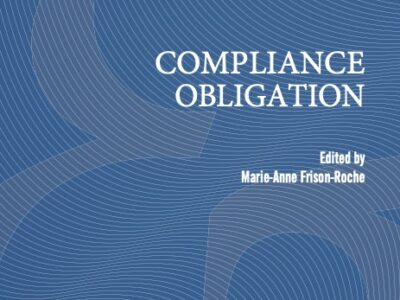
Publication of :🕴️ M.-A. Frison-Roche (ed.),📘 Compliance Obligation

► Full Reference: M.-A. Frison-Roche (ed.), Compliance Obligation, Journal of Regulation & Compliance (JoRC) and Bruylant, "Compliance & Regulation" Serie, 2026, to be published - 📕In parallel, a book in French L'Obligation de compliance, is published in the collection "Régulations & Compliance" co-published by the Journal of Regulation & Compliance (JoRC) and Lefebvre-Dalloz.  - 📚This book is inserted in this series created by Marie-Anne Frison-Roche for developing Compliance Law.  read the presentations of the other books of this Compliance Series: further books: 🕴️M.-A. Frison-Roche (ed.), 📘Compliance Evidential System, 2027 🕴️M.-A. Frison-Roche (ed.), 📘Compliance and Contract, 2027   previous books: ​🕴️M.-A. Frison-Roche (ed), 📘Compliance Juridictionnalisation, 2023 🕴️M.-A. Frison-Roche (ed), 📘Compliance Monumental Goals, 2022 🕴️M.-A. Frison-Roche (ed.), 📘Compliance Tools, 2021 - ► go to the general presentation of this 📚Series ​Compliance & Regulation, conceived, founded et managed by Marie-Anne Frison-Roche, co-published par the Journal of Regulation & Compliance (JoRC) and Bruylant.  - 🧮the book follows the cycle of colloquia organised by the Journal of Regulation & Compliance (JoRC) and its Universities partners. - ► general presentation of the book: Compliance is sometimes presented as something that cannot be avoided, which is tantamount to seeing it as the legal obligation par excellence, Criminal Law being its most appropriate mode of expression. However, this is not so evident. Moreover, it is becoming difficult to find a unity to the set of compliance tools, encompassing what refers to a moral representation of the world, or even to the cultures specific to each company, Compliance Law only having to produce incentives or translate this ethical movement. The obligation of compliance is therefore difficult to define. This difficulty to define affecting the obligation of compliance reflects the uncertainty that still affects Compliance Law in which this obligation develops. Indeed, if we were to limit this branch of law to the obligation to "be conform" with the applicable regulations, the obligation would then be located more in these "regulations", the classical branches of Law which are Contract Law and Tort Law organising "Obligations" paradoxically remaining distant from it. In practice, however, it is on the one hand Liability actions that give life to legal requirements, while companies make themselves responsible through commitments, often unilateral, while contracts multiply, the articulation between legal requirements and corporate and contractual organisations ultimately creating a new way of "governing" not only companies but also what is external to them, so that the Monumental Goals, that Compliance Law substantially aims at, are achieved.  The various Compliance Tools illustrate this spectrum of the Compliance Obligation which varies in its intensity and takes many forms, either as an extension of the classic legal instruments, as in the field of information, or in a more novel way through specific instruments, such as whistleblowing or vigilance. The contract, in that it is by nature an Ex-Ante instrument and not very constrained by borders, can then appear as a natural instrument in the compliance system, as is the Judge who is the guarantor of the proper execution of Contract and Tort laws. The relationship between companies, stakeholders and political authorities is thus renewed. - 🏗️general construction of the book The book opens with a substantial Introduction, putting the different sort of obligations of compliance in legal categories for showing that companies must build structures of compliance (obligation of result) and act to contribute with states and stakeholders to reach Monumental Goals (obligation of means).  The first part is devoted to the definition of the Compliance Obligation.  The second part presents the articulation of Compliance obligation with the other branchs of Law, because the specific obligation is built by Compliance Law, as new substantial branch of Law but also by many other branchs of Law. The third part develops the pratical means established to obtained the Compliance Obligation to be effective, efficace and efficient. The fourth part takes the Obligation  of Vigilance as an illustration of all these considerations and the discussion about the future of this sparehead fo the Compliance Obligation .  The fifth part refers to the place and the role of the judges, natural characters for any obligation.  - TABLE OF CONTENTS    ANCHORING THE SO DIVERSE COMPLIANCE OBLIGATIONS IN THEIR NATURE, REGIMES AND FORCE TO BRING OUT THE VERY UNITY OF THE COMPLIANCE OBLIGATION, MAKING IT COMPREHENSIBLE AND PRACTICABLE    🔹 Compliance Obligation: building a compliance structure that produces credible results withe regard to the Monumentals Goals targeted by the Legislator, by 🕴️Marie-Anne Frison-Roche   TITLE I. IDENTIFYING THE COMPLIANCE OBLIGATION   CHAPTER I: NATURE OF THE COMPLIANCE OBLIGATION Section 1 🔹 Will, Heart and Calculation, the three marks surrounding the Compliance Obligation, by 🕴️Marie-Anne Frison-Roche Section 2 🔹 Debt, as the basis of the compliance obligation, by 🕴️Bruno Deffains Section 3 🔹 Compliance Obligation and Human Rights, by 🕴️Jean-Baptiste Racine Section 4 🔹 Compliance Obligation and changes in Sovereignty and Citizenship, by 🕴️René Sève Section 5 🔹 The definition of the Compliance Obligation in Cybersecurity, by 🕴️Michel Séjean   CHAPTER II: SPACES OF THE COMPLIANCE OBLIGATION Section 1 🔹 Industrial Entities and Compliance Obligation, by 🕴️Etienne Maclouf Section 2 🔹 Compliance, Value Chains and Service Economy, by 🕴️Lucien Rapp Section 3 🔹 Compliance and conflict of laws. International Law of Vigilance-Conformity, based on applications in Europe, by 🕴️Louis d'Avout    TITLE II. ARTICULATING THE COMPLIANCE OBLIGATION WITH OTHER BRANCHES OF LAW   Section 1 🔹 Tax Law and Compliance Obligation, by 🕴️Daniel Gutmann Section 2 🔹 General Procedural Law, prototype of the Compliance Obligation, by 🕴️Marie-Anne Frison-Roche Section 3 🔹 Corporate and Financial Markets Law facing the Compliance Obligation, by 🕴️Anne-Valérie Le Fur Section 4 🔹 Transformation of Governance and Vigilance Obligation, by 🕴️Véronique Magnier Section 5 🔹 The Relation between Tort Law and Compliance Obligation, by 🕴️Jean-Sébastien Borghetti Section 6 🔹 Environmental and Climate Compliance, by 🕴️Marta Torre-Schaub Section 7 🔹 Competition Law and Compliance Law, by 🕴️Jean-Christophe Roda Section 8 🔹 The Compliance Obligation in Global Law, by 🕴️Benoît Frydman & 🕴️Alice Briegleb Section 9 🔹 Environmental an Climatic Dimensions of the Compliance Obligation, by 🕴️Marta Torre-Schaub Section 10 🔹 Judge of Insolvency Law and Compliance Obligations, by 🕴️Jean-Baptiste Barbièri   TITLE III. COMPLIANCE: GIVE AND TAKE THE MEANS TO OBLIGE   CHAPTER I: COMPLIANCE OBLIGATION: THE CONVERGENCE OF SOURCES Section 1 🔹 Compliance Obligation upon Obligation works, by 🕴️Marie-Anne Frison-Roche Section 2 🔹 Conformity technologies to meet Compliance Law requirements. Some examples in Digital Law, by 🕴️Emmanuel Netter Section 3 🔹 Legal Constraint and Company Strategies in Compliance matters, by 🕴️Jean-Philippe Denis & 🕴️Nathalie Fabbe-Coste Section 4 🔹 Opposition and convergence of American and European legal systems in Compliance Rules and Systems, by 🕴️Raphaël Gauvain & 🕴️Blanche Balian Section 5 🔹 In Compliance Law, the legal consequences for Entreprises of their Commitments and Undertakings, by 🕴️Marie-Anne Frison-Roche   CHAPTER II: INTERNATIONAL ARBITRATION IN SUPPORT OF THE COMPLIANCE OBLIGATION Section 1 🔹 How International Arbitration can reinforce the Compliance Obligation, by  🕴️Laurent Aynès Section 2 🔹 Arbitration consideration of Compliance Obligation for a Sustainable Arbitration Place, by 🕴️Marie-Anne Frison-Roche Section 3 🔹 The Arbitral Tribunal's Award in Kind, in support of the Compliance Obligation, by 🕴️Eduardo Silva Romero Section 4 🔹 The use of International Arbitration to reinforce the Compliance Obligation: the example of the construction sector, by 🕴️Christophe Lapp  Section 5 🔹 The Arbitrator, Judge, Supervisor, Support, by 🕴️Jean-Baptiste Racine   TITLE IV. VIGILANCE, SPEARHEAD OF THE COMPLIANCE OBLIGATION Section 1 🔹 Vigilance Obligation, Spearheard and Total Share of the Compliance Obligation, by 🕴️Marie-Anne Frison-Roche   CHAPTER I: INTENSITIES OF THE VIGILANCE OBLIGATION, SPEARHEAD OF THE COMPLIANCE SYSTEM Section 2 🔹 Intensity of the Vigilance Obligation by Sectors: the case of Financial Operators, by 🕴️Anne-Claire Rouaud Section 3 🔹 Intensity of the Vigilance Obligation by Sectors: the case of Digital Operators, by 🕴️Grégoire Loiseau Section 4 🔹 Intensity of the Vigilance Obligation by Sectors: the case of Energy Operators, by 🕴️Marie Lamoureux   CHAPTER II: GENERAL EVOLUTION OF THE VIGILANCE OBLIGATION Section 1 🔹 Rethinking the Concept of Civil Liability in the light of the Duty of Vigilance, Spearhead of Compliance, by 🕴️Mustapha Mekki Section 2 🔹 Contracts and clauses, implementation and modalities of the Vigilance Obligation, by 🕴️Gilles J. Martin Section 3 🔹 Proof that Vigilance has been properly carried out with regard to the Compliance Evidence System, by 🕴️Jean-Christophe Roda Section 4 🔹 Compliance, Vigilance and Civil Liability: put in order and keep the Reason, by 🕴️Marie-Anne Frison-Roche   Title V. THE JUDGE AND THE COMPLIANCE OBLIGATION Section 1 🔹 Present and Future Challenges of Articulating Principles of Civil and Commercial Procedure with the Logic of Compliance, by 🕴️Thibault Goujon-Bethan Section 2 🔹 The Judge required for an Effective Compliance Obligation, by 🕴️Marie-Anne Frison-Roche - CONCLUSION THE COMPLIANCE OBLIGATION: A BURDEN BORNE BY SYSTEMIC COMPANIES GIVING LIFE TO COMPLIANCE LAW   (conclusion and key points of the books, free access) - 🌐Follow Marie-Anne Frison-Roche on LinkedIn 🌐follow Marie-Anne Frison-Roche on Instagram 🌐Subscribe to the Newsletter MAFR Regulation, Compliance, Law 🌐Subscribe to the video newsletter MAFR Overhang 🌐Subscribe to the Newsletter MaFR Law & Art

Conferences

keynote address at a conference

🎥Obligation de compliance et gouvernance bancaire (Compliance obligations and banking governance), in 🧮Compliance et vigilance bancaire : la participation des acteurs du secteur bancaire et financier à la LCB/FT (Compliance and Banking Vigilance: the Participation of Banking and Financial Sector Players in AML/CFT)

► Full reference : M.-A. Frison-Roche, "Obligation de compliance et gouvernance bancaire (Compliance obligations and banking governance)", in Chair in Business Ethics: Compliance, ESG and Sustainability Reporting & National Association of Bank Lawyers (ANJB), Compliance et vigilance bancaire : la participation des acteurs du secteur bancaire et financier à la LCB/FT (Compliance and Banking Vigilance: the Participation of Banking and Financial Sector Players in AML/CFT) , Faculty of Law, Catholic University of Lille, Lille, 12 March 2026. - 🧮view the full programme for the event (in French) - 📶view the slides (in French) - 🌐read the summary of this conference and the colloquium on LinkedIn - 📝This lecture will form the basis of a contribution to a forthcoming book in the 📚Régulations & Compliance series, co-published by the Journal of Regulation & Compliance (JoRC) and Lefebvre-Dalloz.   - ► English presentation of this introductory lecture of the symposium : Based on a specific method, three perspectives will be taken. In method, to shed light on the round tables making up the day's meetings without addressing the subject in their place or pretending to answer in advance the questions they will raise, or seeking to conclude in advance without having listened to anything, which is sometimes the flaw of introductions, which are so often a kind of disguised closing statement, with just a few question marks to give the impression of change, I have adopted the old, old method of the "triple funnel" introduction. This involves starting from a point other than the subject of the conference itself, Compliance and banking vigilance: the participation of banking and financial sector players in AML/CFT, in order to approach the subject from an external perspective and in a preliminary manner, nbsp;then moving on to a second external point, and doing so a third time, so that after this three-part presentation, the subject has been explored in sufficient depth to allow the following speakers to focus on the specific topic at hand. This is all the easier given that the chosen theme itself focuses on three points: a specific ambition (the "fight against money laundering and terrorist financing"), a specific sector (the "banking sector") and a specific activity carried out by individuals; three specific terms: one ambition (the "fighting agains AML/CFT""activity"). – one sectors (the "banking sector") and one active department (the "participation of stakeholders"). - My first starting point is to define what Compliance Law is in order to link Compliance Law to the subject it covers: the banking sector. Because if it were simply a matter of "being conform with applicable regulations", it is difficult to understand why the banking sector is so concerned, so constrained, so exposed to "compliance", which is simply the British way of saying "conformity". There must be more to it than simply obeying every rule and standards for preventing breaches for it, to be obliged to be so structuring and for the banking sector to be at the forefront. It therefore appears that Compliance Law is not simply mechanical obedience to a body of regulations, but rather the contribution made by systemic operators to the realisation of political ambitions that are essential for the future (the "Monumental Goals", both negative and positive). It is in this capacity that the banking sector, because it is composed of "crucial operators", is the natural subject of Compliance Law. Its power should not be criticised; it is indispensable. In an emerging branch of law that is systemic, that is Ex Ante, that is above all a Law of action whose object is the future. Techniques of conformity is only one tool. ⛏️Go further  : 🕴🏻M.-A. Frison-Roche, 📝Compliance Law, 2016 🕴🏻M.-A. Frison-Roche, 📝 Monumental goals, the beating heart of compliance law, in  🕴🏻M.-A. Frison-Roche, 📕The monumental goals of compliance, 2022 🕴🏻M.-A. Frison-Roche, 📝The Birth of a New Branch of Law: Compliance Law, 2024 🕴🏻M.-A. Frison-Roche, 📝Compliance and conformity: distinguishing between them in order to articulate them, 2024 - My second starting point is to start with the "Monumental Goals", this normative foundation of Compliance Law, and link it to this present specific case, privileged ambition of combating money laundering and terrorist financing. Certain things are surprising. Indeed, if we refuse at the introductory stage to delve into the technicalities of the texts and the litigation surrounding them, we may wonder why these two subjects (money laundering and terrorist financing) are linked in this way. We can see the correlation between banking activitird and money laundering. Notaries, auctioneers, and, in short, anyone who handles money are also involved in the fight against it. Moreover, if we see the ratio legis, the idea remains that the one who is merely the conduit (to use the familiar basis distinction in the regulatory rule of essential network infrastructure) could also be the one who organises the content: the image remains of the money laundering banker. Even if the ex ante compliance diligence whitewashes in advance, this suspicion that remains of an ex post sanction. We pay dearly for this representation, which permeates the repressive, even Criminal, Law of banking supervision, particularly in matters of secrecy, transparency, information and risk-taking. But why extend it to terrorist financing? Because the suspicion of terrorist bankers no longer exists. The case becomes clear-cut again. It is a matter of internalising within banks the sovereign responsibility to intervene before it is too late, before people are killed. Financing is the weak and visible point of systemic evil. This is understandable. It has moved from ex post (financial processing after the crime) to ex ante (financial processing before the crime). It is of a different nature. But if this is of a different nature, there is no reason to stop this Ex Ante surveillance, because money movements provide so much information about collective and individual projects. For example, in the digital space. We must be careful about this, in light of the principle of freedom, of which the principle of non-interference is only one aspect. ⛏️Go further  : 🕴🏻M.-A. Frison-Roche, 📝The Ex Ante – Ex Post Couple, Justification of a Specific Regulatory Law, in 🕴🏻M. -A. Frison-Roche, 📕Les engagements dans les systèmes de régulation, 2006 🕴🏻M.-A. Frison-Roche, 📝Ex Ante Responsability, a pillar of Compliance Law, 2022 🕴🏻M.-A. Frison-Roche, 📝Compliance, Vigilance and Civil Liability: Understanding and Keeping a Level Head, in  🕴🏻M.-A. Frison-Roche, 📕The obligation of compliance, 2025 - My third starting point is "Governance", a rather mysterious term, as it relates more to the political art of mobilising human beings than to Law. Why is it necessary for "actors" to participate, when legal norms are binding and, in most cases, take the form of Criminal Law? The combination of the most violent norms, the application of financial penalties, and even deprivation of liberty, being often claimed as a victory for financial and banking regulatory and supervisatory bodies , even as procedural principles are being rolled back, could be a source of incomprehension. Moreover, in a legal system that would be challenged by this "Governance", it is up to the State to dictate and the banks to obey. But if banks take charge of everything, it becomes difficult to maintain this system, and it is undoubtedly no longer tenable if the Monumental Goal expands to dimensions that exceed those of the State but correspond to those of the banks. The risk then is to move from one governing body to another, which is a growing social and political risk. In practical terms, banking operators can achieve this reversal in two ways. Firstly, by effectively involving the human beings who make up their organisations, both internally and externally, their partners and stakeholders. This can be called "Governance" in an alliance based on explicitcommon  goals, with contributions that are not taken at face value but are provided by "compliance structures", "credible behaviour" and "plausible trajectories". In this respect, mutual banks are in a better position than others. Training mechanisms, which are central to Compliance Law, play an essential role here. Secondly, alliances with public authorities and regional roots, with concrete assessments, are decisive. The contract then becomes not only the mandatory means by which the regulated bank fulfils its regulatory obligation, but also the most traditional legal tool by which it exercises its freedom to contribute, in its own way, to the achievement of Monumental Goals for the future of the social group, which is currently under threat. We are far beyond "conformity": this is called Compliance Law. ⛏️Find out more  : 🕴🏻M.-A. Frison-Roche, 📝A substantive Compliance Law, based on the European humanist tradition,in 🕴🏻M. -A. Frison-Roche, 📕Towards a Europe of Compliance, 2019 🕴🏻M.-A. Frison-Roche, 📝Training: content and context of Compliance Law, in 🕴🏻M. -A. Frison-Roche, 📕Compliance tools, 2020 🕴🏻M.-A. Frison-Roche, 📝Compliance Contract, compliance clauses, 2022 🕴🏻M.-A. Frison-Roche, ⚙️Compliance and Contracts, 2026 🕴🏻M.-A. Frison-Roche, 🏛️Official Mission given by the French Minister of Justice, Compliance Law, Work in progress, 2025 – 2026. - 🌐Follow Marie-Anne Frison-Roche on LinkedIn 🌐follow Marie-Anne Frison-Roche on Instagram 🌐Subscribe to the Newsletter MAFR Regulation, Compliance, Law 🌐Subscribe to the video newsletter MAFR Overhang 🌐Subscribe to the Newsletter MaFR Law & Art
Organisation of events

🧱⚙️Scientific coordination and co-hosting of the colloquia series 🧮Compliance and Contract

► Full reference : M.-A. Frison-Roche, Scientific coprdination and co-hosting of the colloquia series Compliance and Contract, organised on the initiative of the Journal of Regulation & Compliance (JoRC) and its academic partners - - ► The Symposium Series in a nutshell : As a direct continuation of the previous symposium series co-organised by the Journal of Regulation & Compliance and its partner universities on "Compliance Obligation", which served as the basis for the publication of the book 📘Compliance Obligation,  The series, some elements of which began in 2024 and others are already present in this book, explored in depth the specific theme of the links between compliance law and contracts. Indeed, compliance law is often analysed as the construction of laws and regulations to achieve "📘 Monumental Goals " of a political nature desired by States and public authorities, to the achievement of which systemic economic operations contribute through 📘Compliance Tools that are now well documented. Contracts are still relatively little studied, or even developed, in compliance systems that are often perceived through the orders issued, the technologies put in place and the 📘sanctions to be avoided or endured. On the contrary, the future of compliance law, particularly in its European conception, which places human beings at the centre of concerns for the sustainability of systems and the use of contracts, is the new conception that we must adopt. Contracts then appear to be both the means by which the subject company fulfils its legal obligations, forges relationships with other actors and deploys the necessary innovations. Contract law is both used and renewed as a result. The series of symposiums will examine various aspects of this general issue. It will result in the publication of a 📘book Compliance and Contrat. - ► Presentation of symposiums in development :  29 May 2026🧮THE JUDGE CONFRONTED WITH CONTRACTS OF COMPLIANCE AND COMPLIANCE CLAUSES: read the presentation   12 June 2026🧮THE "CONTRACT OF COMPLIANCE" : read the presentation   25  Septembre 2026🧮COMPLIANCE: CLAUSE BY CLAUSE: read the presentation   2 October 2026🧮COMPLIANCE AND COMMON CONTRACT LAW : read the presentation   September 2026🧮COMPLIANCE, VALUE CHAINS AND CONTRACT: read the presentation   2 November 2026 🧮COMPLIANCE AND THE STRATEGIC CONTRACTUAL ORGANISATION OF CHAINS VALUE BY ENTERPRISES: read the presentation  -

Articles in The Journal of Regulation & Compliance « JoRC »

📝Transformation de la gouvernance et obligation de vigilance (The transformation of governance and due diligence), in 🕴️M.-A. Frison-Roche (dir.), 📕L’obligation de Compliance

► Full Reference: V. Magnier, "Transformation de la gouvernance et obligation de vigilance" (The transformation of governance and due diligence), in M.-A. Frison-Roche (dir.), L'Obligation de Compliance, Journal of Regulation & Compliance (JoRC) and Dalloz, coll. "Régulations & Compliance", 2025, pp. 259-269. - 📕read the general presentation of the book, L'Obligation de Compliance, in which this contribution is published - ► English summary of this contribution (done by the Journal of Regulation & Compliance – JoRC) : The author develops the tensions caused by Compliance Law and the Duty of Vigilance on corporate governance. The French "Sapin 2" law targets corruption, while the French "Vigilance" law has a broader scope in terms of risks and the entire value chain. It is logical that this should create tensions in terms of governance, given the monumental goals involved. Companies need to take ownership of the powers delegated to them, which means rethinking their governance and the way in which they exercise their corporate mandates, with the corporate interest, the judge's compass, having to be combined with the adoption of new standards of behaviour formalised voluntarily by ethical charters in line with international standards. On this voluntary and supervised basis, the company must adapt its structure and then contractualise these norms. This ethical approach has an impact on the role of corporate organs, not only in terms of transparency and risk prioritisation, but also proactively in terms of the adoption of commitments whose sincerity will be verified, as reflected, for example, in corporate governance codes (cf.in France the AFEP-MEDEF Code), the setting up of ad hoc committees and the presence of stakeholders, who will be consulted when the vigilance plan is drawn up. She stresses that this creates tensions, that dialogue is difficult, that business secrecy must be preserved, but that stakeholders must become Vigilance watchdogs, a role that should not be left to the public authorities alone. - 🦉this article is available in full text pour the persons following the Professor Marie-Anne Frison-Roche teaching -

Thesis defence

🪑🪑🪑member of the jury for Annika Bauch’s thesis: 📓Le droit de l’entreprise à l’épreuve de la compliance (Company Law put to the test of Compliance)

► Full Reference: M.-A. Frison-Roche, member of the jury for Annika Bauch's thesis, Le droit de l'entreprise à l'épreuve de la compliance (Company Law put to the test of Compliance), University of Toulouse, 5 June 2025, 2-5pm.  - 🪑🪑🪑Other members of the jury :   🕴🏻Lukas Rass-Masson, Professor at Toulouse-Capitole University, thesis supervisor 🕴🏻Sandrine Tisseyre,  Professor at Toulouse-Capitole University,  🕴🏻Marc-Philippe Weller,  Professor at the University of Heidelberg, Germany 🕴🏻Caroline Coupet, Professor at the Université Panthéon-Assas (Paris II) - ► Presentation of the thesis: The thesis is based on French, American and German research. It is based on two perspectives. The first part of the thesis describes the way in which Business Law  feeds into Compliance, since it is within Business Law (and more particularly Company Law and the legal rules governing corporate bodies) that Compliance, which the author presented  to have originated in the United States, has transformed the way in which companies must be managed, having to take into account the extra-financial dimension of their activity, which modifies the very notion of social interest and leads to the integration of stakeholders into the corporate functioning. The second part of the thesis looks at the way in which Compliance has transformed Corporate Law, bringing with it new requirements, such as consideration of risks, regulatory mechanisms and ethical concerns, with the company itself becoming a vehicle for Compliance. This is achieved in particular by inserting compliance clauses into contracts, which is an appropriate but nevertheless limited tool for this compliance goal. - At the end of her defence, the candidate was awarded the degree of Doctor of Law and was informally congratulated by her jury on the quality of her work. - 📗The thesis was subsequently published by Larcier. - 📝It features a foreword by Marie-Anne Frison-Roche - 🌐follow Marie-Anne Frison-Roche on LinkedIn 🌐follow Marie-Anne Frison-Roche on Instagram 🌐subscribe to the Newsletter MAFR Regulation, Compliance, Law 🌐subscribe to the Video Newsletter MAFR Surplomb 🌐subscribe to the Newsletter MaFR Droit & Art

Organisation of events

⚙️Co-organisation of the symposium 🧮Durabilité de l’Internet : le rôle des opérateurs du système des noms de domaine. Compliance et Régulation de l’espace numérique (Sustainability of the Internet: the role of the operators of the domain name system. Compliance and regulation of the digital space)

  - ► Full Reference: M.-A. Frison-Roche & G. Loiseau (dir.), Durabilité de l'Internet : le rôle des opérateurs du système des noms de domaine. Compliance et régulation de l'espace numérique (Sustainability of the Internet: the role of the operators of the domain name system. Compliance and regulation of the digital space), Journal of Regulation & Compliance (JoRC) and Institut de Recherche Juridique de la Sorbonne (André Tunc – IRJS), Paris 1 Panthéon-Sorbonne University, 21 Fabruary 2025 - ► General presentation of this symposium: The digital space has been built on and as a system. Its primary interest is of a negative nature: it consists of to be preserved against the prospect of systemic failure, of not collapsing. Like all other systems, this 'Monumental Goal' specific to the digital system justifies resources that incorporate this concern for the future. As with all systems, it integrates and relies on the specific technical nature of this system. The digital space is largely based on the invention, technology and architecture of domain names. Domain names, as an addressing system, enable users to enter the digital space and find other Internet users. The uniqueness and solidity of the domain name system, entrusted to a single root and decentralisation, makes this community possible for those who use the digital space and ensures the technical durability required, without which the digital space would be compromised. The architecture, operation, operators and what they do under the control of legislators, regulators, judges and legal subjects are therefore examined from a dual technical and legal perspective, in the light of the imperative of sustainability. This allows to progress in 4 stages. Firstly, to examine the permanence in time and space of the domain name system, insofar as it is the foundation of the Internet and the digital system. This technical construction gives rise to legal qualifications, not only for the present but also for the future, since the Web3 offers new technical solutions. Secondly, this technical sustainability is an imperative that is built into the operators of the domain names themselves, which are inter-linked not only at national level but also at global level, this cross-linking being necessary for the security of the system. The State is present through public law techniques that enable surveillance, control and possible recovery. Thirdly, it imposes constraints on the operators subject to them in order to serve this monumental goal of technical sustainability, and these constraints themselves generate as many powers as they need to usefully achieve this mission. This proportionality must be at the heart of the method and the requirements. The relationship between constraints and powers also stems from it. Fourthly, this imperative of technical sustainability, which is global in nature, gives way to imperatives of societal sustainability, more localised in space and time, when domain name operators are called upon by the legitimate authors of binding standards, legislators in the first instance, to express concerns such as the protection of people involved in the digital space and whose rights are compromised or who are in danger. This second type of sustainability, which is more localised and less inherent in the architecture of the Internet, is justified by the available power of the operators concerned and their adherence to social imperatives. The resulting constraints and powers are therefore not the same. The 2 sustainabilities must then be articulated in a conception that is both teleological and pragmatic. - - ► Speakers (they will speak in French, but the book to be published will be in English):  🎤Pierre Bonis, Chief Executive Officer of the Association française pour le nommage Internet en coopération (Afnic) 🎤Lucien Castex, Adviser of the Afnic Chief Executive Officer for Research internet and society and Internet governance 🎤Marie-Anne Frison-Roche, Full Professor of Regulatory and Compliance Law, Director of the Journal of Regulation & Compliance (JoRC) 🎤Claire Leveneur, Senior Lecturer at Paris-Est Créteil University 🎤Grégoire Loiseau, Full Professor at Paris 1 Panthéon-Sorbonne University 🎤Samir Merabet, Full Professor at the University of West Indies 🎤Antoine Oumedjkane, Senior Lecturer at Lille University 🎤Frédéric Sardain, attorney at law, Jeantet law firm - read below a detailed presentation of this event⤵️ - 🌐follow Marie-Anne Frison-Roche on LinkedIn 🌐follow Marie-Anne Frison-Roche on Instagram 🌐subscribe to the Newsletter MAFR. Regulation, Compliance, Law 🌐subscribe to the Newsletter Surplomb, par MAFR

Articles in The Journal of Regulation & Compliance « JoRC »

MAGNIER, Véronique🕴️

📝The transformation of governance and due diligence, in 🕴️M.-A. Frison-Roche (ed.), 📘Compliance Obligation

► Full Reference: V. Magnier, "The transformation of governance and due diligence", in M.-A. Frison-Roche (ed.), Compliance Obligation, Journal of Regulation & Compliance (JoRC) and Bruylant, "Compliance & Regulation" Serie, to be published - 📘read a general presentation of the book, Compliance Obligation, in which this article is published - ► Summary of the article (done by the Journal of Regulation & Compliance – JoRC): The author develops the tensions caused by Compliance Law and the Duty of Vigilance on corporate governance. The French "Sapin 2" law targets corruption, while the French "Vigilance" law has a broader scope in terms of risks and the entire value chain. It is logical that this should create tensions in terms of governance, given the monumental goals involved. Companies need to take ownership of the powers delegated to them, which means rethinking their governance and the way in which they exercise their corporate mandates, with the corporate interest, the judge's compass, having to be combined with the adoption of new standards of behaviour formalised voluntarily by ethical charters in line with international standards. On this voluntary and supervised basis, the company must adapt its structure and then contractualise these norms. This ethical approach has an impact on the role of corporate organs, not only in terms of transparency and risk prioritisation, but also proactively in terms of the adoption of commitments whose sincerity will be verified, as reflected, for example, in corporate governance codes (cf.in France the AFEP-MEDEF Code), the setting up of ad hoc committees and the presence of stakeholders, who will be consulted when the vigilance plan is drawn up. She stresses that this creates tensions, that dialogue is difficult, that business secrecy must be preserved, but that stakeholders must become Vigilance watchdogs, a role that should not be left to the public authorities alone. - 🦉This article is available in full text to those registered for Professor Marie-Anne Frison-Roche's courses -

Conferences

conference

🎤Participation au panel “Une Gouvernance responsable : vers un mieux vivre ensemble ?” (“Responsible corporate governance: towards a better way of living together”), in 🧮Grenelle du Droit 5

► Full Reference: M.-A. Frison-Roche, Participation in the panel "Une Gouvernance responsable : vers un mieux vivre ensemble ?" ("Responsible governance: towards a better way of living together"), in Grenelle du Droit 5. L'avenir de la filière juridique, Association française des juristes d'entreprise ("The future of the legal profession"), AFJE), Cercle Montesquieu and Paris Panthéon-Sorbonne University, Campus Port-Royal Université Paris 1 Panthéon-Sorbonne, 1 rue de la Glacière, 75013 Paris, June 12, 2024 - 🧮See the full programme of this event (in French) - 🎥watch the interview made just after this round-table discussion (in French) - 🪑🪑🪑🪑🪑 will also be taking part in this round-table discussion: 🕴️Yves Garagnon, Chairman of Dilitrust, 🕴️Pierrick Le Goff, lawyer, partner at De Gaulle Fleurance, 🕴️Sabine Lochmann, Chairman of Ascend, 🕴️Vincent Vigneau, President of the Commercial, Economic and Financial Chamber of the Cour de cassation (French Judicial Supreme Court) - ► English presentation of my intervention in this event's opening plenary  round-table: In this plenary round table which opens the event, devoted to the theme of 'responsible corporate governance', for my interventions based on my work I will have the opportunity to address more particularly these different perspectives: How the new Compliance Law, which gives concrete expression to the responsibility of enterprises in a new relationship with States and with civil society, constitutes a 'legal revolution 💡for the record, mafr,📝Compliance Law, 2016 ; (ed.) 📘Compliance Monumental Goals, 2022   how the judgment handed down by the Tribunal judiciaire de Paris (Paris First Instance Civil Court) on 28 February 2023 (Total Ouganda case) is remarkable and already constitutes a turning point in case law 💡for the record, mafr, 🎤audition as amica curiae, hearing of 26 October 2022 before the first instance Paris Court; (ed)📘Compliance Jurisdictionalisation, 2024   how the relationship between States and enterprises is being renewed by this profound legal movement expressed by Compliance Law 💡for the record, mafr et M. Boissavy (ed.), 📕Compliance et droits de la défense – Enquêtes internes, CJIP, CRPC, mafr (dir.), 📘 Compliance Obligation, 2025   how internal lawyers have a decisive and central role to play in this movement, particularly in the mechanism of vigilance / corporate sustainability due diligence, the "cutting edge" of Compliance Law, 💡for the record, mafr, 📝Contract of Compliance, Compliance stipulations, 2023 ; (ed.), 📘Compliance and Contract, 2025   what is meant by the "Ex Ante responsibility" of enterprises, which does not necessarily entail their Ex Post liability, a distinction which lawyers are the guardians of 💡for the record, mafr, 📝La responsabilité Ex Ante, pilier du Droit de la Compliance ("Ex-Ante Responsability, Compliance Law Pillar"), 2021   how European Compliance Law is profoundly humanist, an identity that distinguishes European Compliance from American Compliance and, above all, from Chinese Compliance. 💡for the record, mafr (ed.), 📕Pour une Europe de la Compliance ("For the Europe of the Compliance"), 2017 - read the  article about this round table written by Delphine Bauer in Actu-Juridique (in French) - 🌐follow Marie-Anne Frison-Roche on LinkedIn 🌐follow Marie-Anne Frison-Roche on Instagram 🌐subscribe to the Newsletter MAFR Regulation, Compliance, Law

Conferences

🕴️MaFR interviews 🕴️Jacques Beyssade

🎥Compliance and governance (example of a banking group), interview with 🕴️Jacques Beyssade by Marie-Anne Frison-Roche, 🎬 Series of talks on Compliance Law, in 📺 Open windows on management

► Full reference: J. Beyssade, "Compliance et gouvernance (exemple d'un groupe bancaire)" (Compliance and governance (example of a banking group)), interview conducted by M.-A. Frison-Roche on the occasion of a series of interviews on Compliance Law, in Fenêtres ouvertes sur la gestion (Open windows on management), broadcast by J.-Ph. Denis, Xerfi Canal, recorded December 12, 2023, recorded February 24, 2024 - 🌐consult the presentation of Jacques Beyssade's interview on LinkedIn - 🎥view the full interview on Xerfi Canal - ► Starting point: In 2022, Jacques Beyssade wrote a contribution on 📝Feminisation of positions of responsibility in the workplace as a goal of Compliance, in 📘Compliance Monumental Goals 🧱read the presentation of this contribution ➡️click HERE - ► Summary of interview:  Marie-Anne Frison-Roche. Question: Compliance and governance are often linked. Can you explain how, in the strategy of a banking group like BPCE, this link between compliance and governance is articulated? Jacques Beyssade. Answer. Compliance is not just a matter of obeying the rules, but also, and perhaps even more so, of respecting customers, suppliers, stakeholders and members. For a mutualist structure, customers and member-policyholders are closer, they are the same social body, and so it's a matter of governance. - MaFR. Q.: Let's take a concrete example, where Compliance and governance serve a specific purpose: effective equality between men and women, for example. How does this work in your Group? J.B. R.: This objective is in the genes of BPCE, and in particular of the savings banks. The Copé-Zimmermann law requires it. We go beyond this constraint, at the level of governance. The management board, or executive committee, is egalitarian, and this also works as an example. Compliance takes up the baton, for example, by identifying talent, particularly female talent, and correcting any anomalies.  - MaFR. Q.: In the future, can we hope that this alliance between new governance and the power of Compliance, with the same Monumental Goals, will transform our societies? J.B. R.: Changes in society come from the behavior of individuals and companies, as demonstrated by the opening of savings accounts to women in the 19th century. Both can do a great deal, within the framework of regulations, by going beyond them. Through governance, for example in a mutual bank like BPCE, it's the members who set the rules, reflecting social movements because they themselves are representative of society as a whole. In this way, through the alliance of governance and compliance, they can act to give concrete expression to the fundamental social movements they themselves represent, through the broad representation of the social body that the member-policyholders constitute. -

Videos

🎤Compliance Law in Entreprise: theory and practices, in 📅Notarial engineering

🌐 follow Marie-Anne Frison-Roche on LinkedIn 🌐subscribe to the Newsletter MAFR Regulation, Compliance, Law  - ► Full Reference: Frison-Roche, M.A., La compliance en entreprise : aspects théoriques et pratiques, in 118ième Congrès des Notaires, L'ingénierie notariale, Marseilles, October 12, 2022.  This Masterclass is given in French. - ► English Presentation of this Masterclass: This two-hour Masterclass aims to introduce, regarding the role of the Notary in companies and vis-à-vis them, Compliance Law.  This discover of Compliance Law is built on a description of the new Compliance techniques of which companies are the object or the source (I) then, faced with such a mass of new standards, because this is incomprehensible and uncontrollable if these so many regulations are not "conceived", explain what can give meaning to this Compliance Law, namely the "Monumental Goals" which animate it and give it meaning (II). Like the Regulation Law that Compliance prolongs, Compliance Law is a teleological branch of law that requires that the application and interpretation of norms be done by these Monumental Goals. -   This Masterclass is given in French: see some technical references in English ⤵️

Articles in The Journal of Regulation & Compliance « JoRC »

LE FUR, Anne-Valérie🕴️

📝Intérêt et raison d’être de l’entreprise : quelle articulation avec les Buts Monumentaux de la Compliance ?, in 🕴️M.-A. Frison-Roche (ed.), 📕Les Buts Monumentaux de la Compliance

► Full Reference: A.-V. Le Fur, "Intérêt et raison d’être de l’entreprise : quelle articulation avec les buts monumentaux de la compliance ?" ("Interest and “raison d’être” of the company: how do they fit with the Compliance Monumental Goals?"), in M.-A. Frison-Roche (ed.), Les Buts Monumentaux de la Compliance, coll. "Régulations & Compliance", Journal of Regulation & Compliance (JoRC) and Dalloz, p. 55-67. - 📕read a general presentation of the book, Les Buts Monumentaux de la Compliance, in which this article is published - ► Summary of the article (done by the Author): Companies would have a soul. The legislator thinks so, since the French law called "loi Pacte"  of 22 May 2019 obliges managers to act in the Corporate Interest and allows companies to formulate themselves a « raison d'être ». Compliance Law does the same, relying on companies to save the world from corruption, slavery, terrorism and global warming, thus achieving Monumental goals. At first glance, the contours of Corporate Interest and « raison d’être » of the company are not far removed from the notion of Compliance Monumental Goals. This is not surprising, since the objective that presided over their introduction into the French Civil Code is the same as that underlying Compliance Law : to rethink the place of the company in the global Society, by affirming long-term values or concerns. This is a reason to use these corporate law concepts in the context of an X-ray of the concept of Monumental Goals. However, a comparative approach is disappointing. The divergences between corporate notions and compliance lead to the conclusion that company law is not intended to impose anything other than a corporate public order. Notions that are more philosophical than legal, Corporate Interest and « raison d'être » are assigned functions that limit their scope. The imperative nature of corporate rules, and this is a consequence of the above, cannot be compared with that of compliance: uncertain, it is also relative when compared with the "violence" of compliance rules. The impact of the notions of Interest and « raison d'être » remains thus mainly internal to the company. According to a second approach, it cannot be ruled out that Corporate Interest and « raison d'être » allow for a better understanding of higher and universal values by Company Law. Corporate Interest may incorporate Compliance Monumental Goals while the « raison d'être » may constitute a perspective for the realization of these goals. The stakes are high : when the interest of the company, as a legal person and autonomous economic agent, joins the Monumental Goals, the means of achieving the latter are multiplied by internalizing them in all companies, not just the largest ones. However, despite all good intentions, a company is only governable if the compass does not become an elusive and indecisive vane; in other words, if legal certainty is respected. This is why a legal ordering of the concepts is necessary, which ultimately leads to a suggestion of their domain, content and scope.  -

Analyses

💬 “Faire du Droit pour qu’à l’avenir le monde soit moins injuste” – à propos du projet de directive européenne sur le devoir de vigilance. (“Making Compliance Law for a world less unfair in the future” – about the draft European directive on the corporate sustainability due diligence)

► Full Reference: Frison-Roche, M.A.,, "Faire du Droit pour qu'à l'avenir le monde soit moins injuste" – à propos du projet de directive européenne sur le devoir de vigilance ("Making Compliance Law for a world less unfair in the future" – about the draft European directive on the corporate sustainability due diligence), interview with Olivia Dufour, Actu-Juridique,  March 24, 2022.  - 💬 read the interview (in French)  - ► Interview English Summary: This interview comments on the draft directive presented by the European Commission aimed at unifying European Union Law about Corporate Sustainability Due diligence in global supply chains to protect environnement and human rights effectively, putting companies under same legal rules. including non-European companies. The interview emphasizes that this text and reinforces Compliance Law perspective in that the legal instruments are Ex Ante, aim at the functioning of groups, constitute incentives, and seek effectiveness to prevent violations of human rights and the environment, 80% of which taking place outside the European Union. The goal is both ethical, for example to fight against child labor and the endangerment of people, and systemic: the promoting of a sustainable economy, through the help of companies which have some power in value chains which are global.  This future directive clearly shows the difference between simple "conformity" (just obeying all applicable regulations…) and "compliance", illustrated here: aiming to achieve "monumental goals", here fighting against attacks on the climate balance and protect people, to obtain in the future these damages do not occur or are reduced.  -   

Books

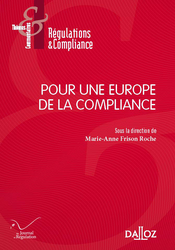
📕Pour une Europe de la Compliance (For the Europe of the Compliance)

🌐 follow Marie-Anne Frison-Roche on LinkedIn 🌐 subscribe to the Newsletter MAFR Regulation, Compliance, Law - ► Full Reference: M.-A. Frison-Roche (ed.), Pour une Europe de la Compliance (For the Europe of the Compliance), series "Régulations & Compliance", Dalloz, 2019, 124 p.  - This volume is the continuation of the books dedicated to Compliance in this collection. 📚Read the other books' presentations of the collection about Compliance: 🕴️M.-A. Frison-Roche (ed.), 📕La juridictionnalisation de la Compliance, 2023 🕴️M.-A. Frison-Roche (ed.), 📕Les Buts Monumentaux de la Compliance, 2022 🕴️M.-A. Frison-Roche (ed.), 📕Les outils de la Compliance, 2021 🕴️N. Borga, 🕴️J.-Cl. Marin &🕴️J.-Ch. Roda (ed.), 📕Compliance : l'Entreprise, le Régulateur et le Juge, 2018 🕴️M.-A. Frison-Roche (ed.), 📕Régulation, Supervision, Compliance, 2017 🕴️M.-A. Frison-Roche (ed.),📕 Internet, espace d'interrégulation, 2016   📚Read the presentations of the other titles of the collection. - ► General presentation of the book: This book is written in French. The topic is : "For the Europe of the Compliance". See below its general presentation in English.  The political dimension is intrinsic to the Compliance Law. Indeed, compliance mechanisms consist of internalizing in certains companies the obligation to implement goals of general interest set by Public Authorities. These public bodies control the Ex Ante reorganization that implies for these companies and punish Ex Post the possible structural inadequacy of these compagnies, becoming transparent for this purpose.  This new mode of governance establishes a continuum between Regulation, Supervision, Compliance (book published in 2017) and renew the links between Companies, Regulators and Judges1Frison-Roche, M.-A., Compliance, see.  This political dimension must be increased: the Compliance Law of Compliance must today be used to build Europe. One can observe not only the construction of the  European Compliance Law, object-by-object, sector-by-sector, purpose-by-purpose, but also the construction of the European Compliance Law that transcends and unifies them. Becoming independent of American Law and ceasing to be in reaction, even on the defensive, the Compliance Law contributes to the European project, offering it a higher ambition, that Europe can carry and, by this way, can carry the Europe itself, not only to preserve the European economy from corruption or money laundering, but by claiming the protection of nature and human beings. This is why the book describes the "reasons and objectives" of the Europe of the Compliance, which makes it possible to describe, detect and even predict the ways and means. - ► Understand the book through the Table of Contents and the summaries of each article:  🕴️M.-A. Frison-Roche, 📝Avant propos  🕴️K. Lenaerts, 📝Le juge de l'Union européenne dans une Europe de la compliance 🕴️M.-A. Frison-Roche, 📝Un droit substantiel de la compliance, appuyé sur la tradition européenne humaniste   I. LES RAISONS ET LES OBJECTIFS D'UNE EUROPE DE LA COMPLIANCE (THE REASONS AND OBJECTIVES OF THE EUROPE OF THE COMPLIANCE)  🕴️X. Musca, 📝Construire une Europe de la compliance en donnant une meilleure place aux entreprises 🕴️P. Vimont, 📝La place de la diplomatie dans l'avancée d'une Europe de la compliance 🕴️P. Sellal, 📝Les vertus de la compliance : une réponse possible aux faiblesses de l'Union européenne ? 🕴️J.-J. Daigre, 📝Compliance, entreprise et Europe   II. LES VOIES ET MOYENS D'UNE EUROPE DE LA COMPLIANCE  (THE WAYS AND MEANS OF THE EUROPE OF THE COMPLIANCE) 🕴️J.-Cl. Marin, 📝Quels outils pour la construction du droit de la compliance en Europe ? 🕴️M. Canto-Sperber, 📝La compliance et les définitions traditionnelles de la vertu 🕴️T. Bonneau, 📝Compliance et secteur bancaire et financier en Europe 🕴️C. Duchaine, 📝L'Agence française anticorruption, à l'appui de l'Europe de la compliance 🕴️D. Martin, 📝Les contraintes et les vertus de la compliance 🕴️A. de La Cotardière, 📝Construire une Europe de la compliance lisible pour les entreprises -