Future

Articles in a legal collective publication

📝Compliance, the new legal way for human values: towards an Ex Ante Responsibility, in 📗Evolução do Direito no século XXI. Seus princípios e valores: ESG, Liberdade, Regulação, Igualdade e Segurança Jurídica. Homenagem ao Professor Arnoldo Wald, vol. 2, Direito Privado

► Full Reference: M.-A. Frison-Roche, "Compliance, the new legal way for human values: towards an Ex Ante Responsibility", in Evolução do Direito no século XXI. Seus princípios e valores: ESG, Liberdade, Regulação, Igualdade e Segurança Jurídica. Homenagem ao Professor Arnoldo Wald, vol. 2, Direito Privado, São Paulo, Editora IASP, 2022, pp. 977-983 - ► Summary of the article:  For the first time, the future is the first question for the Humanity. The classical legal conception of Tort Law concerns the Past, the philosophical conception of Hans Jonas, a Responsability for the Future, an Ex-Ante Responsability must become a legal notion.  Traditionally, the Legislator takes decision for the Future and the Judges takes ones for the Past, but now in front of the possible disparition of human beings on this planet, global and catastrophic perspective, all legal perspectives need to be used, breaking the classical repartition, in the priority of the future.  To do something, the Responsability must be put on everyone in a legal force, not only on the classical subject of Law and because of past behaviors, but because the operators, States, firms, or individuals, are "in position" to do so.  This new "Ex-Ante Responsability" is an essential part of the Compliance Law, very new branche of Law, with an extraterritorial effect, to find immediate and active solutions for the future. Because the issue is global, international Arbitration is in position to apply the conception, because international arbitrators are the global judges. This new conception of legal Ex-Ante Responsability, declared by courts, expressed human values, such as the concerns for the others, in concordance withe the humanist tradition of European and American Law, Compliance being not at all to obey regulations but to concretise an alliance a Monumental Goal, here for the preservation of human beings in the future, and the powers and the legal duties of corporate and people to do so.  - 📝read the article - 🌐follow Marie-Anne Frison-Roche on LinkedIn 🌐follow Marie-Anne Frison-Roche on Instagram 🌐subscribe to the Newsletter MAFR Regulation, Compliance, Law

Articles in The Journal of Regulation & Compliance « JoRC »

📝Place et rôle des entreprises dans la création et l’effectivité du Droit de la Compliance en cas de crise, in 🕴️M.-A. Frison-Roche (ed.), 📕Les Buts Monumentaux de la Compliance

🌐 follow Marie-Anne Frison-Roche on LinkedIn 🌐 subscribe to the Newsletter MAFR Regulation, Compliance, Law  - ► Full Reference: M.-A. Frison-Roche, "Place et rôle des entreprises dans la création et l'effectivité du Droit de la Compliance en cas de crise" ("Place and rôle of Companies in the Creation and Effectiveness of Compliance Law in Crisis"), in M.-A. Frison-Roche (ed.), Les Buts Monumentaux de la Compliance, coll. "Régulations & Compliance", Journal of Regulation & Compliance (JoRC) and Dalloz, 2022, pp. 339-352. - 📝read the article (in French)    - 🚧read the bilingual Working Paper which is the basis of this article, with additional developments, technical references, and hyperlinks - 📕read a general presentation of the book, Les Buts Monumentaux de la Compliance, in which this article is published - ► Summary of the article (done by the Journal of Regulation & Compliance): This article has a very topic: the place of private Companies, regarding the chapter's issue: "the ordeal of a crisis". The crisis constitutes a "test" it brings evidence. Let us take it as such. Indeed, during the health crisis, Companies have helped the Public Authorities to resist the shock, to endure and to get out of the Crisis. They did so by force, but they also took initiatives in this direction. From this too, we must learn lessons for the next crisis that will come. It is possible that this has already started in the form of another global and systemic crisis: the environmental crisis. In view of what we have been able to observe and the evolution of the Law, of the standards adopted by the Authorities but also by the new case law, what can we expect from Companies in the face of this next Crisis, willingly and strength? -

Working papers

🚧 Regulatory and Compliance Law, expression of the missions of a professional Order

🌐 follow Marie-Anne Frison-Roche on LinkedIn 🌐 subscribe to the Newsletter MAFR Regulation, Compliance, Law  - ► Full reference: M.-A. Frison-Roche, Regulatory and Compliance Law, expression of the missions of a professional Order, Working Paper, July 2022. - 🎤 This Working Paper has been done as basis for an intervention in the Annual Congress of the French Professional Order of the Géomètres-Experts, September 15, 2022 (conference given in French)  - 🎥watch the short presentation of this speech (in French)  - 🎥watch the full speech given on 15 September 2022, based on this working paper - ► Summary of the Working Paper: Professional orders should not present themselves as exceptions, however legitimate they may be, in relation to a principle, which would be the competitive system, but as the expression of a principle. This principle is expressed by two branches of Law whose importance is constantly growing in European Law, liberal branches which are based on the conception of economic life and the definition of company, turned towards the future: the Regulatory Law and Compliance Law, two branches of Law at the same time related and distinct. Indeed, and this is the topic of the first part, Competition Law conceives professional orders as exceptions since these "corporations" constitute structural agreements. French domestic legal system both consolidates the professional orders by backing them up to the State, which would sub-delegate its powers to them, but involves them in the questioning by the European Union of the States and their tools. Most often the temptation is then to recall with a kind of nostalgia the times when the professional orders were the principle but, except to ask for a restoration, the time would be no more. A more dynamic approach is possible, in accordance with the more general evolution of Economic Law. Indeed, the Professional Order is the expression of a profession, a little-exploited concept in Economic Law, over which the Order exercises the function of "Second-level Regulator", the public authorities exercising the function of "First-level Regulator". The Banking and Financial Regulatory Law is built in this way and operates thank to that, at national, European, and global level. This is what should be linked. The Professional Orders therefore have the primary function of spreading a "Culture of Compliance" among the professionals they supervise and beyond them (clients and stakeholders). This culture of Compliance is developed regarding the missions which are concretized by the professionals themselves. Therefore, the second part of the Working Paper deals with the legal evolution of the notion of "Mission" which has become central in Economic and General Law, through the technique of the mission-based company. However, there are multiple points of contact between the raison d'être, the company with a mission and Compliance Law as soon as the latter is defined by the concrete and overly ambitious goals that it pursues. : the Monumental Goals. Each structure, for example the French Ordre des Géomètres-Experts, is legitimate to set the Monumental Goal that it pursues and that it inculcates, in particular the conception of territory and the living environment, joining what unites all the Monumental Goals of Compliance: concern for others. The French Ordre des Géomètres-Experts, is adequate because it has a more flexible relationship, both tighter and broader, with the territory than the State itself. By instilling this in professionals, the Professional Order develops in the practitioner an "ex ante responsibility", which is a pillar of Compliance Law, constituting both a charge and a power that the practitioner exercises, and of which the Professional Order must be the supervisor. - 🔓read the Working Paper⤵️

MAFR Chronicles Compliance Law

📝 La responsabilité ex ante, pilier du droit de la compliance (“Ex-Ante Responsibility, Compliance Law Pillar”)

🌐 follow Marie-Anne Frison-Roche on LinkedIn 🌐 subscribe to the Newsletter MAFR Regulation, Compliance, Law  - ► Full Reference: FM.-A. Frison-Roche, La responsabilité ex ante, pilier du droit de la compliance ("Ex-Ante Responsibility, Compliance Law Pillar"), D. 2022, chronique MAFR – Droit de la Compliance, Recueil Dalloz, March 31, 2022. - ► Article English Summary: The Law must help to face the future, which can be totally catastrophic in terms of climate and digital issues. Courts are s best placed for this, without “governing”, only relying on the commitments made by companies, governments, and legislators.  On the ordinary Tort Law, court decisions oblige these different entities to be consistent in the commitments they have made, obliging them to act in the future, formal “compliance” with the regulations cannot be sufficient. This ex-ante responsibility, founding the powers, thus constitutes a pillar of a substantial Compliance Law, showing the part that CSR and the companies with a raison d'être play in it. -   📝 read the article. (written in French) - 📚go to the presentation of the other articles published in this Chronique Droit de la Compliance made in the Recueil Dalloz.  -

Articles in The Journal of Regulation & Compliance « JoRC »

📝Dresser des cartographies des risques comme obligation et le paradoxe des “risques de conformité”, in 🕴️M.-A. Frison-Roche (ed.), 📕Les outils de la Compliance

► Full Reference: M.-A. Frison-Roche, "Dresser des cartographies des risques comme obligation et le paradoxe des "risques de conformité"" ("Drawing up risk maps as an obligation and the paradoxe of the "compliance risks""), in M.-A. Frison-Roche (ed.), Les outils de la Compliance, coll. "Régulations & Compliance", Journal of Regulation & Compliance (JoRC) and Dalloz, 2021, pp. 53-62. - 📝read the article (in French) - 🚧read the bilingual Working Paper which is the basis of this article, with additional developments, technical references and hyperlinks - 📕read a general presentation of the book, Les outils de la Compliance, in which this article is published - ► Summary of the article (done by the Journal of Regulation & Compliance): There are few synthetic or theoretical studies on Risk Mapping even though it is in fact the Compliance central tool, perhaps because it is more a management tool than a legal one. Risk Mapping is often described but does not receive any other legal qualifications than being a "modality", suffering in this respect from an evil which affects the whole of Compliance, still little understood by Law, attention often so focused on the Ex Post (sanctions) while Compliance is by nature in the Ex Ante. Going from disarray to incomprehension, everyone can note the existence of "compliance risks" among the mapped risks, because if as so many affirm that it would be necessary to speak only of simple conformity as obedience, demonstrated in Ex Ante, to Law, how a sub-set of a tool would therefore have the same object as the set of Law that this tool serves … This aporia can only be resolved if Compliance Law is defined substantially by its "monumental goals" which exceed obedience to regulations. Consequently, Law taking up Risk Mapping, this mechanism may first appear as an ancillary obligation to the main obligation consisting in achieving "monumental goals". The ancillary obligation to draw up the maps is an obligation of result, while the main obligation to achieve the monumental goals is an obligation of means. These cartographies being very diverse and being only occasionally targeted by specific laws, it can also constitute only a legal fact or, through the play of various charters, a unilateral legal commitment. But it isnbecoming the basis of an autonomous legal obligation incumbent on enterprises in position to know certain risks, obligation referring to the existence of a subjective right tof knowing and measuring them ("right to be worried") which the third parties who are going to run them would hold, thus allowing them to choose to run them, or not.   -

Videos

🎤 The Potential of Compliance Law (Les potentialités du Droit de la Compliance)

Full reference : Frison-Roche, M.-A., The Potential of Compliance Law (Les potentialités du Droit de la Compliance), conference given to Muriel Fabre-Magnan's students, Paris I, 17th of March 2021. -   This conference has been designed for Paris I's students following a Law cursus, specialized in Law of obligations and especially in Tort Law.  It therefore aims to show the technical content of Compliance Law and what it can become.  It has been followed by a debate with students.  Summary: Compliance Law is a branch of Law in the process of being born. We can be sure of its existence in the French positive Law, through the technical examination of laws called "Sapin 2" (2016) and "Vigilance" (2017). It appears at radically new. It is the reason why it is perceived as an attack, especially from United-States and we rather use legal knowledge to counter it. But if we study the historical reasons of its adoption in the United-States and the "monumental goals", whether they are negative (what should not appear in the future) or positive (what should appear in the future), we can measure that this Law, which is essentially Ex Ante could be the means through which scattered but legitimate public authorities and powerful but illegitimate big firms could ally. Therefore potentially Compliance Law could be the worst, simple tool of obedience (mechanical "conformité") or the best: what through which we could do something face to global problems, like global warming, or what we would accept to look in the face: the care for others.  Read the slides on which this conference was based (in French)

Working papers

🚧The dreamed Compliance Law

🌐follow Marie-Anne Frison-Roche on LinkedIn 🌐subscribe to the Newsletter MAFR Regulation, Compliance, Law  - ► Full Reference: M.-A. Frison-Roche, The dreamed Compliance Law, Working Paper, June 2020.  - This Working Paper, "The Dreamed Compliance Law", is the basis for an article, written in French, "La compliance" (Compliance), inserted in the collective work to be published under the direction of Jean-Baptiste Racine, Le Droit économique du XXIème siècle (The XXIe century Economic Law , in the Serie Droit & Economie,   Lextenso – LGDJ, 2020. -   No one can know what the Law of the 21st century will be. Pretending to know it is just not to realize its ignorance. Why then writing about it, since the future is always surprising? One can only write about the unknown part of the Law of tomorrow. If the future is then modeled on what was written, so much the better for the prophet, a tribute that can, for example, be paid to Pierre Godé1Mélanges Pierre Godé, off-trade book, 2019.  who described in 1999 what was going to be 10 years later "Law of the future" constituted by Environmental Law2Godé, P., Le Droit de l'avenir (Un Droit en devenir), 1999. . If the future denies the author or if its contours in no way follow the lines of the written word, this is not serious since the writing of the Law, even if it has the specificity of being partly prescriptive in that it has the power to write the future, a normative pen that rounds up letters3It is in particular the idea of the movement of analysis of Law & Literature which poses that by telling the past in one way or another, by thus inventing it, Law, and in particular the Judge, invents the future and being written, creates it. On this movement which was powerful in the United States, v. Cabrillac, R. et Frison-Roche, M.-A., Droit et Littérature, à paraître. , it participates in all writing: above all to be that of a dream. Lévi-Strauss argued that teaching is defined as dreaming out loud. Teaching and describing the Law of a century that we will never know gives even more freedom to dream about it. This freedom increases when the object is a branch of Law in the process of being born, state of the stammering "Compliance Law" of which some still maintain, as it was made for Regulation Law, that there is not existing. The hand can then, as it pleases, trace its beautiful or hideous features: what face will Compliance Law have, as soon as we assume that it will exist? It may as well be a nightmare (I) as a happy dream (II). It is up to us to choose in which category this branch of Law will flourish. Because what we can be sure of is this fulfillment. It is certainly already taking sides to presuppose the very existence of Compliance Law. Not only to consider it possibility with hostility because to be an enemy of something or someone is already to recognize their existence. Before that, two objections radically block the very existence of Compliance Law and their shadow remains in the future of it4See infra I. Compliance Law as nightmarish octopus. . Firstly, it is said that Compliance does not come under Law, but for example only ethics since it would consist in keeping well in companies which care about the interest of others or the planet, for example by spontaneous care of the environment; Compliance being a crystallization of social responsibility, the one for which we have our conscience, we express our "raison d'être" and we are not accountable5On the fact that "social responsibility" makes it possible not to be legally responsible, cf. Supiot, A., Du nouveau au self-service normatif: la responsabilité sociale des entreprises, 2004; this is not the subject of this article and this question will not be developed here.. Or it would consist in technologically putting in place tools for capturing technical information using data storage and processing methods. Compliance is then a sub-category of "Data Regulation"!6See, for instance, ..., Replace Regulation by norm by Regulation by Data, 2020. , a mechanical concept in which Law is no more present. In these two perspectives, Compliance Law cannot exist, no more tomorrow than it would exist today. These two radical conceptions, completely entrusting Compliance mechanisms to everyone except lawyers, do not make sense because it suffices to note the development of judgments and laws to measure the legal phenomenon already present7See, for instance, Frison-Roche, M.-A., Compliance Law (monography), 2016 ; Compliance Law, 2020. . Second, there would be many Compliance mechanisms but insufficient to constitute a branch of Law. Indeed we would find Compliance in Company Law, Labor Law, Financial Law, Banking Law, Criminal Law, Administrative Law, European Law, International Law, etc. These classic branches, which have been formed for so long, depending on the point of view adopted, would gain in modernity or be threatened with decay by this kind of extension which will be Compliance. There would thus be as many "little legal sectoral rules" as there are branches of law. These new internal developments would be like a new bud, on which care should be taken – if the tree regains its strength – or a weed to be eradicated – if the French garden loses its perspective. Thus the matter being scattered as many as specialist lawyers, often criminalists or specialists in banking and Financial Law, then tomorrow all specialists in all branches of Law, this could constitute the most radical obstacle to the constitution of Compliance Law. Indeed, we would come back to confuse Compliance and the "modernization" of Law itself as a whole, since it would only be a question of perfecting each of the classic branches of the legal system. If we keep in this half-sleep that is any projection in the future the hope of a constituted branch of Law, we must discard these two perspectives of annihilation, either in the total absence of Law or in recovery by all Law. To dismiss the sorrowful spirits who see no future in Compliance and keep only its enemies in the space of this article, let us assume that Compliance Law will exist in the 21st century. In what form and by what means, in the palm of which institutions, in the shadow of which legal system? Since it is a question of projecting ourselves onto the black screen of our nights of dreamy lawyers, let us take the current state only as a trailer. Like the one developed by the genius who by the contempt not only brought down into the flames of hell the cinema which has become a consumer industry with which producers force-feed us but offered us the vision of its future. What is what we see today the trailer? We let our imagination run wild since the trailer films are autonomous works compared to the film which follows them. We have no idea what will happen and what we are watching from the brief and violent current images of Compliance Law, the cinema of which rather makes a hero of the whistleblower8On what the cinema does with the whistleblower, with the availability of trailers and extracts from the films, see Frison-Roche, M.-A., introduction of the article The impossible unicity of the legal category of whistleblowers, 2019.  and a character of the narrow and ridiculous importance of the compliance officer9Frison-Roche, M.-A., ... (retrouver sur LinkedIn). , does little to help us. But if we force the features of the present lineaments, the alternative of this Law in childhood is therefore that of a nightmare (I) or an idyllic solution for difficulties that will increase (II). Everything will depend on the concept that we will retain of Compliance Law. Because the script is not written, because Compliance Law is a Law with a political dimension, that it is defined by the ambitions that we can claim to have by setting monumental goals that we are going to achieve, a claim that will make it one major branch of the Law of tomorrow, or we can abandon any claim, lower our heads and arms, and reject any claim. It is then that the power of Compliance Law, which will be no less great, will turn against us, human beings, as in a nightmare.  

Working papers

Compliance Law, Health crisis and Future

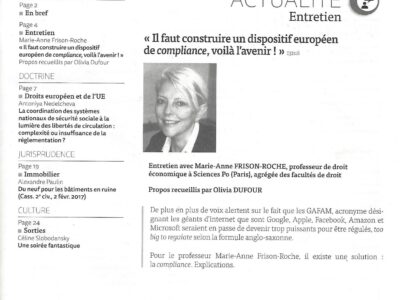
This interview was conducted in French with Olivia Dufour, for an article published in French in the digital publication Actualité Juridique. Its subject is  the confrontation between the current health crisis situation and the Compliance Law.    Summary. After defining Compliance Law, distinguishing the procedural and poor definition and the substantial and rich definition, the starting point is to admit the aporia: the type of health crisis caused by Covid-19 will be renewed and it is imperative to prevent it, even to manage it, then to organize the crisis exit. Public Authorities are legitimate to do so, but because this type of crisis being global and the State being consubstantially linked to borders, States are hardly powerful. Their traditional International Law shows their  limits in this current crisis and one cannot hope that this configulration will improve radically. In contrast, some companies and markets, notably the financial markets, are global. But the markets are not legitimate to carry out such missions and counting on the generosity of certain large companies is far too fragile in front of the "monumental goal" that is the prevention of the next health crisis, crisis which must never happen. How to get out of this aporia? By Compliance Law, basis of, in a literal and strong sense, the "Law of the Future".  We need to be inspired by the Banking and Financial Compliance Law. Designed in the United States after the 1929 crisis to tend towards the "monumental goal" of the absence of a new devastating crisis in the country and the world,  this set of new legal mechanisms gave duty and power of supervision, regulation and compliance to market authorities and central bankers. These are independent of governments but in constant contact with them. Today, they claim to have as first priority the fight against climate change. Now and for the future, they must also be given the responsibility and the powers to prevent a global health disaster, similar to a global ecological disaster, similar to a global financial disaster. This does not require a modification of the texts because their mandate consists in fighting instability. Stability must become a primary legal principle, of which the fight against monetary instability was only a first example. By the new use that central banks must make of it by preventing and managing health crises, Compliance Law will ensure that the future will be not catastrophic.

Books

Réformes et transformations

Analyses

Hayao Miyazaki explains that the drawings of video games made by machines are “insults to life”

Through the Open Culture website, it is possible to listen to Hayao Miyazaki who, in March 2017, claimed that video games whose drawings are made on Artificial Intelligence basis are "insults to life". Read below the history, the words that the Master has held, his conception of what is creation and "truly human" work, which is echoed by the definitions given by Alain Supiot, who also reflected on what robots do. This brings us back to the very notion of "creation" and creative work.   - Read below

I-2.0: Is there a compelling need for neutral action in regulated economic sectors ? ?

TRANSLATED SUMMARIES ENGLISH “Acting in a neutral way” is an oxymoron. “Companies often require however that States use their powers in a neutral way (eg tax neutrality). In regulated sectors, some are right or even duty , of not being neutral. Firstly, it is the State, which requires the market for other purposes, other temporalities and other values​​. Secondly, they are also the “crucial operators”, which are sort of regulators of second degree, such as transmission system operators or companies capital markets firms. The difficulty increases when the systeme requires neutrality of regulators and judges, when first build economic policy and the second create jurisprudence. Their consistency, impartiality and rationality can create an objectifiable neutralitys FRENCH «Agir de façon neutre» est un oxymoron. «Les entreprises ont souvent besoin, cependant, que les États utilisent leurs pouvoirs de manière neutre (neutralité fiscale par exemple). Dans les secteurs réglementés, certains ont le droit ou même le devoir de ne pas être neutre. Tout d’abord, c’est l’État, qui insère le marché à d’autres fins, d’autres temporalités et d’autres valeurs. En second lieu, ils sont aussi les «opérateurs crucial», qui sont des sortes de régulateurs du second degré : par exemple les opérateurs de réseaux de transport ou de entreprises de marchés financiers. La difficulté augmente lorsque le systeme économique et politique exige la neutralité des autorités de régulation et des juges, alors que les premiers construisent la politique économique et les seconds construisent la jurisprudence. Le respect qu’ils doivent avoir de l’impartialité et d’une rationalité suffisamment objectivables pourra permettre cette objectivité requise.

Articles

BON-MICHEL, Béatrice

La cartographie des risques : de la rationalisation du futur à l’apprentissage du risque (Risks Mapping: from Rationalization of the Future to Risk Learning)

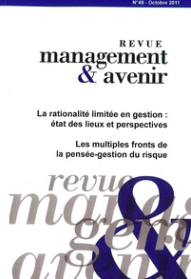
Full reference: Bon-Michel, B., La cartographie des risques : de la rationalisation du futur à l'apprentissage du risque. Cas de l'identification du risque opérationnel au sein d'un établissement de crédit (Risks Mapping: from Rationalization of the Future to Risk Learning. Case of the Identification of the Operational Risk in a Credit Establishment), Management & Avenir, vol. 48, no. 8, 2011, pp. 326-341. Sciences Po's students can read this article in the Sciences Po Drive in the folder MAFR – Regulation & Compliance 

I-1.32: Innovation and Regulation serving the digital Revolution

ENGLISH In the most developed nations, as in emerging countries, the economy and society are currently being entirely transformed by an industrial revolution originating in information and communication technologies. Anti-competitive Behaviour Audacity – Autorité de Régulation des Communications Electroniques et des Postes (ARCEP – French Electronic Communications and Posts Regulator) – Communication – Competition – Confidence – Cooperation – Darwin – Digital revolution – Discrimination – European Commission – Ex ante / Ex post – Fiber optic – Future – impredictibility – Information – Infostructure – Infrastructure – Innovation – Internet – Lamarck – Napoleon – Network – Overregulation – Risk – Uncertainty – Underregulation * * In The Journal of Regulation, these keywords are done by the Editor and not by the Author. ITALIAN Articolo: Innovazione e regolazione al servizio della rivoluzione digitale Nelle nazioni le più sviluppate, nonché negli stati in via di sviluppo, l’economia e la società sono completamente trasformati da un rivoluzione industriale che trova le sue origini nelle teconologie d’informazione e di comunicazione. Autorité de Régulation des Communications Electroniques et des Postes (ARCEP – Autorità francese di regolazione dei servizi postali e di telecomunicazione) – Commissione Europea – Comportamento anticoncorrenziale – Comunicazione – Concorrenza – Cooperazione – Darwin – Deregolamentazione – Discriminazione – Ex ante / Ex post – Fibra ottica – Imprevisibilità – Incertezza – Inflazione normativa – Informazione – Infostruttura – Infrastruttura – Innovazione – Internet – Lamarck – Napoleone – Rete – Rischio – Rivoluzione digitale * * In The Journal of Regulation, le parole chiave sono responsabilità dell’Editore e non dall’Autore.   PORTUGUESE Artigo: Inovação e Renovação a serviço da Revolução digital. Nos países mais desenvolvidos, bem como nos em desenvolvimento, a economia e a sociedade vem sendo, atualmente, completamente transformados por uma revolução industrial baseada em tecnologias da informação e da comunicação. Comportamento anti-concurrencial – Autoridade de regulação das comunicações eletrônicas e dos correios (ARCEP – Regulador francês de Comunicações e dos Correios) – Comunicação – Concorrência – Confiança – Cooperação – Darwin – Revolução digital – Discriminação – Comissão Europeia – Ex ante / Ex post – Fibra ótica – Futuro – Imprevisibilidade – Informação – Info-estrutura – Infra-estrutura – Inovação – Internet – Lamarck – Napoleão – Rede – Sobre-regulação – Risco – Incerteza – Sub-regulação.*  * No Journal of Regulation, as palavras-chave são fornecidas pelo Diretor, e não pelo Autor. SPANISH Artículo: Innovación y regulación sirviendo la revolución digital En las naciones más desarrolladas, tal como en los países emergentes, la economía y la sociedad están actualmente siendo transformadas por una revolución industrial provenientes de las tecnologías informáticas y de telecomunicaciones.     Other translations forthcoming.