Future generations

Articles in The Journal of Regulation & Compliance « JoRC »

SÈVE, René🕴️

📝Les mutations de la souveraineté et l’Obligation de Compliance (Compliance Obligation and changes in Sovereignty and Citizenship), in 🕴️M.-A. Frison-Roche (dir.), 📕L’obligation de Compliance

► Full Reference: R. Sève, "L'Obligation de Compliance et les mutations de la souveraineté et de la citoyenneté" ("Compliance Obligation and changes in Sovereignty and Citizenship"), in M.-A. Frison-Roche (ed.), L'obligation de Compliance, Journal of Regulation & Compliance (JoRC) and Dalloz, coll. "Régulations & Compliance", 2025, pp. 97-107.   - 📕read the general presentation of the book, L'obligation de Compliance, in which this article is published. - ► English Summary of this article (done by the Journal of Regulation & Compliance – JoRC) : The contribution describes "les changements de philosophie du droit que la notion de compliance peut impliquer par rapport à la représentation moderne de l’Etat assurant l’effectivité des lois issues de la volonté générale, dans le respect des libertés fondamentales qui constituent l’essence du sujet de droit." ("the changes in legal philosophy that the notion of Compliance may imply in relation to the modern representation of the State ensuring the effectiveness of laws resulting from the general will, while respecting the fundamental freedoms that constitute the essence of the subject of law"). The contributor believes that the definition of Compliance is due to authors who « jouer un rôle d’éclairage et de structuration d’un vaste ensemble d’idées et de phénomènes précédemment envisagés de manière disjointe.  Pour ce qui nous occupe, c’est sûrement le cas de la théorie de la compliance, développée en France par Marie-Anne Frison-Roche dans la lignée de grands économistes (Jean-Jacques Laffont, Jean Tirole) et dont la première forme résidait dans les travaux bien connus de la Professeure sur le droit de la régulation. » ( "play a role in illuminating and structuring a vast set of ideas and phenomena previously considered in a disjointed manner.  For our purposes, this is certainly the case with the theory of Compliance, developed in France by Marie-Anne Frison-Roche in the tradition of great economists (Jean-Jacques Laffont, Jean Tirole) and whose first form was in her well-known work on Regulatory Law"). Drawing on the Principles of the Law of the American Law Institute, which considers compliance to be a "set of rules, principles, controls, authorities, offices and practices designed to ensure that an organisation conforms to external and internal norms", he stresses that Compliance thus appears to be a neutral mechanism aimed at efficiency through a move towards Ex Ante. But he stresses that the novelty lies in the fact that it is aimed 'only' at future events, by 'refounding' and 'monumentalising' the matter through the notion of 'monumental goals' conceived by Marie-Anne Frison-Roche, giving rise to a new jus comune. Thus, "la compliance c’est l’idée permanente du droit appliquée à de nouveaux contextes et défis." ("Compliance is the permanent idea of Law applied to new contexts and challenges").  So it's not a question of making budget savings, but rather of continuing to apply the philosophy of the Social Contract to complex issues, particularly environmental issues.  This renews the place occupied by the Citizen, who appears not only as an individual, as in the classical Greek concept and that of Rousseau, but also through entities such as NGOs, while large companies, because they alone have the means to pursue the Compliance Monumental Goals, would be like "super-citizens", something that the digital space is beginning to experience, at the risk of the individuals themselves disappearing as a result of "surveillance capitalism". But in the same way that thinking about the Social Contract is linked to thinking about capitalism, Compliance is part of a logical historical extension, without any fundamental break: "C’est le développement et la complexité du capitalisme qui forcent à introduire dans les entités privées des mécanismes procéduraux d’essence bureaucratique, pour discipliner les salariés, contenir les critiques internes et externes, soutenir les managers en place" ("It is the development and complexity of capitalism that forces us to introduce procedural mechanisms of a bureaucratic nature into private entities, in order to discipline employees, contain internal and external criticism, and support the managers in place") by forcing them to justify remuneration, benefits, and so on. Furthermore, in the words of the author, "Avec les buts monumentaux, – la prise en compte des effets lointains, diffus, agrégés par delà les frontières, de l’intérêt des générations futures, de tous les êtres vivants – ,  on passe, pour ainsi dire, à une dimension industrielle de l’éthique, que seuls de vastes systèmes de traitement de l’information permettent d’envisager effectivement." ("With the Monumental Goals – taking into account the distant, diffuse effects, aggregated across borders, the interests of future generations, of all living beings – we move, so to speak, to an industrial dimension of ethics, which only vast information processing systems can effectively envisage"). This is how we can find a division between artificial intelligence and human beings in organisations, particularly companies, or in decision-making processes. In the same way, individual freedom does not disappear with Compliance, because it is precisely one of its monumental goals to enable individuals to make choices in a complex environment, particularly in the digital space where the democratic system is now at stake, while technical mechanisms such as early warning will revive the right to civil disobedience, invalidating the complaint of "surveillance capitalism". The author concludes that the stakes are so high that Compliance, which has already overcome the distinctions between Private and Public Law and between national and international law, must also overcome the distinction between Information and secrecy, particularly in view of cyber-risks, which requires the State to develop and implement non-public Compliance strategies to safeguard the future. - 🦉Cet article est accessible en texte intégral pour les personnes inscrites aux enseignements de la Professeure Marie-Anne Frison-Roche

Organisation of events

🧱⚙️Coordination of the conference 🧮Dans l’espace de justice, les pratiques juridictionnelles au service du futur (In the Space of Justice, Jurisdictional Practices at the Service of the Future)

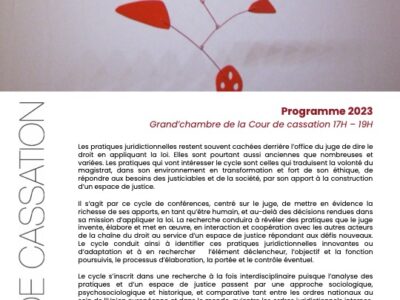
► Full Reference: M.-A. Frison-Roche, coordination of the conference Dans l’espace de justice, les pratiques juridictionnelles au service du futur (In the Space of Justice, Jurisdictional Practices at the Service of the Future), in Cour de cassation, cycle of conferences "Penser les pratiques juridictionnelles au service d’un espace de justice" ("Thinking jurisdictional practices in the service of a Space of Justice"), 21 November 2023, 4pm.-6.30pm. - ► General presentation of the conference: The conception of the conference takes account of the fact that the event comes almost last in the cycle. Previous themes have been ‘jurisdictional practices’ insofar as they are ‘at the service of a European area of justice’ (February 2023), ‘enlightened’ (March 2023), ‘attractive’ (June 2023), ‘interactive’ (September 2023) and ‘peacemaking’ (December 2023). The conference's problematic stems from an observation: today, judges are facing claims that relate directly to the future. Of course, in their traditional office judges deal with the future of disputed situations, but today it is the future of systems in their entirety that is sometimes submitted to them through a dispute or a request, and a solution is sought. The possible presence of future generations is just one sign of this. The space of justice may seem unsuitable for such gigantic trials, both in terms of their subject matter and their impact. No doubt a distinction must be made between judges, and some judges may seem more familiar than others with the systemic issues that the future brings with it. Perhaps the judge's prudence should lead him not to use his power over the future, for example in the handling of sanctions, forgetting that the future by its very nature contains an element of the unknown, a fundamental prudence which the principle of the legality of offences and penalties expresses. But the future is not a blank page either and the judge, without inventing it, can check the coherence of those who write the law, if he is a constitutional judge, those who write contracts and commitments, if he is a civil or commercial judge. In order to fulfil their office, which the stakeholders are demanding, judges need to think about and deal with this new systemic object before them: the future. To understand it, judges draw on available jurisdictional practices, adjust others, and link them together using new methods. - 🧮read the programme of the cycle of conférences in 2023 (in French) -

Conferences

conference

🎥Synthèse (Synthesis), in 🧮Les pratiques juridictionnelles au service d’un espace juridique pour le futur (In the Space of Justice, Jurisdictional Practices at the Service of the Future)

► Full Reference: M.-A. Frison-Roche, "Synthèse" ("Synthesis"), in M.-A. Frison-Roche (dir.), Dans l’espace de justice, les pratiques juridictionnelles au service du futur (In the Space of Justice, Jurisdictional Practices at the Service of the Future), in Cour de cassation, cycle of conferences "Penser les pratiques juridictionnelles au service d’un espace de justice" ("Thinking about jurisdictional practices in the service of an area of justice"), 21 November 2024, 4pm.-6pm. - 🧮see the program of this manifestation (in French) - ► English summary of this conference:  The topic covered takes account of the fact that this scientific event comes almost last in this cycle of conferences Penser les pratiques juridictionnelles au service d’un espace de justice ("Thinking about jurisdictional practices in the service of an area of justice"). Indeed, 'jurisdictional practices' have previously been addressed insofar as they are 'at the service of a European area of justice' (February 2023), enlightened (March 2023), attractive (June 2023), interactive (September 2023), peacemaking (December 2023). The approach here is different and complementary. The conference's starting point is the observation that, today, many new claims are made before Judges that relate directly to the Future. Admittedly, in their traditional role, Judges deal with the Future of disputed situations, but today it is the Future of Systems in their entirety that is sometimes submitted to them through a dispute or a claim. Moreover, they may be asked to find a systemic solution. The possible presence of future generations is just one sign of this change. The courtroom may seem unsuitable for trials of such gigantic proportions, both in terms of their subject matter and their impact. No doubt a distinction must be drawn between judges, some of whom may appear more familiar than others with the systemic issues that the Future brings with itself. Perhaps the judge's prudence should guide him/her in the use they make of their powers when they relate to the future, for example in the handling of sanctions, because the future by its very nature contains an element of the unknown, a fundamental prudence that the principle of the legality of offences and penalties expresses. But the future is not a blank page and Judges, without inventing it, can, indeed must, monitor the coherence of those who write the legal rules, if they are constitutional judges, and of those who write contracts and commitments, if they are civil and commercial judges. In order to fulfill their role, particularly with regard to the demands of stakeholders, judges need to think about and deal with this new systemic object before them: the future. To understand it, Judges draw on available jurisdictional practices, adjust others and combine them, using new methods. - 🧮see below the complete programme of this manifestation⤵️ - 🌐follow Marie-Anne Frison-Roche on LinkedIn 🌐follow Marie-Anne Frison-Roche on Instagram 🌐subscribe to the Newsletter MAFR Regulation, Compliance, Law

Articles in The Journal of Regulation & Compliance « JoRC »

SÈVE, René🕴️

📝Compliance Obligation and changes in Sovereignty and Citizenship, in 🕴️M.-A. Frison-Roche (dir.), 📘Compliance Obligation

► Full Reference: R. Sève, "Compliance Obligation and changes in Sovereignty and Citizenship", in M.-A. Frison-Roche (ed.), Compliance Obligation, Journal of Regulation & Compliance (JoRC) and Bruylant, "Compliance & Regulation" Serie, to be published - 📘read a general presentation of the book, Compliance Obligation, in which this article is published - ► Summary of the article (done by the Journal of Regulation & Compliance – JoRC):  The contribution describes "les changements de philosophie du droit que la notion de compliance peut impliquer par rapport à la représentation moderne de l’Etat assurant l’effectivité des lois issues de la volonté générale, dans le respect des libertés fondamentales qui constituent l’essence du sujet de droit." ("the changes in legal philosophy that the notion of Compliance may imply in relation to the modern representation of the State ensuring the effectiveness of laws resulting from the general will, while respecting the fundamental freedoms that constitute the essence of the subject of law"). The contributor believes that the definition of Compliance is due to authors who « jouer un rôle d’éclairage et de structuration d’un vaste ensemble d’idées et de phénomènes précédemment envisagés de manière disjointe.  Pour ce qui nous occupe, c’est sûrement le cas de la théorie de la compliance, développée en France par Marie-Anne Frison-Roche dans la lignée de grands économistes (Jean-Jacques Laffont, Jean Tirole) et dont la première forme résidait dans les travaux bien connus de la Professeure sur le droit de la régulation. » ( "play a role in illuminating and structuring a vast set of ideas and phenomena previously considered in a disjointed manner.  For our purposes, this is certainly the case with the theory of Compliance, developed in France by Marie-Anne Frison-Roche in the tradition of great economists (Jean-Jacques Laffont, Jean Tirole) and whose first form was in her well-known work on Regulatory Law"). Drawing on the Principles of the Law of the American Law Institute, which considers compliance to be a "set of rules, principles, controls, authorities, offices and practices designed to ensure that an organisation conforms to external and internal norms", he stresses that Compliance thus appears to be a neutral mechanism aimed at efficiency through a move towards Ex Ante. But he stresses that the novelty lies in the fact that it is aimed 'only' at future events, by 'refounding' and 'monumentalising' the matter through the notion of 'monumental goals' conceived by Marie-Anne Frison-Roche, giving rise to a new jus comune. Thus, "la compliance c’est l’idée permanente du droit appliquée à de nouveaux contextes et défis." ("Compliance is the permanent idea of Law applied to new contexts and challenges").  So it's not a question of making budget savings, but rather of continuing to apply the philosophy of the Social Contract to complex issues, particularly environmental issues.  This renews the place occupied by the Citizen, who appears not only as an individual, as in the classical Greek concept and that of Rousseau, but also through entities such as NGOs, while large companies, because they alone have the means to pursue the Compliance Monumental Goals, would be like "super-citizens", something that the digital space is beginning to experience, at the risk of the individuals themselves disappearing as a result of "surveillance capitalism". But in the same way that thinking about the Social Contract is linked to thinking about capitalism, Compliance is part of a logical historical extension, without any fundamental break: "C’est le développement et la complexité du capitalisme qui forcent à introduire dans les entités privées des mécanismes procéduraux d’essence bureaucratique, pour discipliner les salariés, contenir les critiques internes et externes, soutenir les managers en place" ("It is the development and complexity of capitalism that forces us to introduce procedural mechanisms of a bureaucratic nature into private entities, in order to discipline employees, contain internal and external criticism, and support the managers in place") by forcing them to justify remuneration, benefits, and so on. Furthermore, in the words of the author, "Avec les buts monumentaux, – la prise en compte des effets lointains, diffus, agrégés par delà les frontières, de l’intérêt des générations futures, de tous les êtres vivants – ,  on passe, pour ainsi dire, à une dimension industrielle de l’éthique, que seuls de vastes systèmes de traitement de l’information permettent d’envisager effectivement." ("With the Monumental Goals – taking into account the distant, diffuse effects, aggregated across borders, the interests of future generations, of all living beings – we move, so to speak, to an industrial dimension of ethics, which only vast information processing systems can effectively envisage"). This is how we can find a division between artificial intelligence and human beings in organisations, particularly companies, or in decision-making processes. In the same way, individual freedom does not disappear with Compliance, because it is precisely one of its monumental goals to enable individuals to make choices in a complex environment, particularly in the digital space where the democratic system is now at stake, while technical mechanisms such as early warning will revive the right to civil disobedience, invalidating the complaint of "surveillance capitalism". The author concludes that the stakes are so high that Compliance, which has already overcome the distinctions between Private and Public Law and between national and international law, must also overcome the distinction between Information and secrecy, particularly in view of cyber-risks, which requires the State to develop and implement non-public Compliance strategies to safeguard the future. - 🦉This article is available in full text to those registered for Professor Marie-Anne Frison-Roche's courses -