French law “Vigilance” (2017)

Publication director

🏗️ copublishing and direction of the collection: 📚Compliance & Regulation

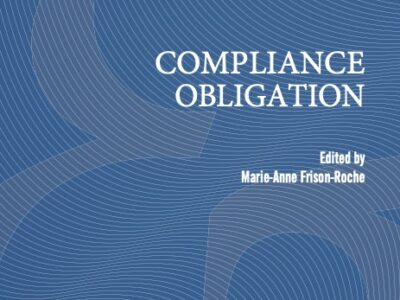
Publication of :🕴️ M.-A. Frison-Roche (ed.),📘 Compliance Obligation

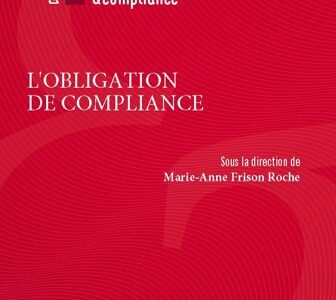
► Full Reference: M.-A. Frison-Roche (ed.), Compliance Obligation, Journal of Regulation & Compliance (JoRC) and Bruylant, "Compliance & Regulation" Serie, 2026, to be published - 📕In parallel, a book in French L'Obligation de compliance, is published in the collection "Régulations & Compliance" co-published by the Journal of Regulation & Compliance (JoRC) and Lefebvre-Dalloz.  - 📚This book is inserted in this series created by Marie-Anne Frison-Roche for developing Compliance Law.  read the presentations of the other books of this Compliance Series: further books: 🕴️M.-A. Frison-Roche (ed.), 📘Compliance Evidential System, 2027 🕴️M.-A. Frison-Roche (ed.), 📘Compliance and Contract, 2027   previous books: ​🕴️M.-A. Frison-Roche (ed), 📘Compliance Juridictionnalisation, 2023 🕴️M.-A. Frison-Roche (ed), 📘Compliance Monumental Goals, 2022 🕴️M.-A. Frison-Roche (ed.), 📘Compliance Tools, 2021 - ► go to the general presentation of this 📚Series ​Compliance & Regulation, conceived, founded et managed by Marie-Anne Frison-Roche, co-published par the Journal of Regulation & Compliance (JoRC) and Bruylant.  - 🧮the book follows the cycle of colloquia organised by the Journal of Regulation & Compliance (JoRC) and its Universities partners. - ► general presentation of the book: Compliance is sometimes presented as something that cannot be avoided, which is tantamount to seeing it as the legal obligation par excellence, Criminal Law being its most appropriate mode of expression. However, this is not so evident. Moreover, it is becoming difficult to find a unity to the set of compliance tools, encompassing what refers to a moral representation of the world, or even to the cultures specific to each company, Compliance Law only having to produce incentives or translate this ethical movement. The obligation of compliance is therefore difficult to define. This difficulty to define affecting the obligation of compliance reflects the uncertainty that still affects Compliance Law in which this obligation develops. Indeed, if we were to limit this branch of law to the obligation to "be conform" with the applicable regulations, the obligation would then be located more in these "regulations", the classical branches of Law which are Contract Law and Tort Law organising "Obligations" paradoxically remaining distant from it. In practice, however, it is on the one hand Liability actions that give life to legal requirements, while companies make themselves responsible through commitments, often unilateral, while contracts multiply, the articulation between legal requirements and corporate and contractual organisations ultimately creating a new way of "governing" not only companies but also what is external to them, so that the Monumental Goals, that Compliance Law substantially aims at, are achieved.  The various Compliance Tools illustrate this spectrum of the Compliance Obligation which varies in its intensity and takes many forms, either as an extension of the classic legal instruments, as in the field of information, or in a more novel way through specific instruments, such as whistleblowing or vigilance. The contract, in that it is by nature an Ex-Ante instrument and not very constrained by borders, can then appear as a natural instrument in the compliance system, as is the Judge who is the guarantor of the proper execution of Contract and Tort laws. The relationship between companies, stakeholders and political authorities is thus renewed. - 🏗️general construction of the book The book opens with a substantial Introduction, putting the different sort of obligations of compliance in legal categories for showing that companies must build structures of compliance (obligation of result) and act to contribute with states and stakeholders to reach Monumental Goals (obligation of means).  The first part is devoted to the definition of the Compliance Obligation.  The second part presents the articulation of Compliance obligation with the other branchs of Law, because the specific obligation is built by Compliance Law, as new substantial branch of Law but also by many other branchs of Law. The third part develops the pratical means established to obtained the Compliance Obligation to be effective, efficace and efficient. The fourth part takes the Obligation  of Vigilance as an illustration of all these considerations and the discussion about the future of this sparehead fo the Compliance Obligation .  The fifth part refers to the place and the role of the judges, natural characters for any obligation.  - TABLE OF CONTENTS    ANCHORING THE SO DIVERSE COMPLIANCE OBLIGATIONS IN THEIR NATURE, REGIMES AND FORCE TO BRING OUT THE VERY UNITY OF THE COMPLIANCE OBLIGATION, MAKING IT COMPREHENSIBLE AND PRACTICABLE    🔹 Compliance Obligation: building a compliance structure that produces credible results withe regard to the Monumentals Goals targeted by the Legislator, by 🕴️Marie-Anne Frison-Roche   TITLE I. IDENTIFYING THE COMPLIANCE OBLIGATION   CHAPTER I: NATURE OF THE COMPLIANCE OBLIGATION Section 1 🔹 Will, Heart and Calculation, the three marks surrounding the Compliance Obligation, by 🕴️Marie-Anne Frison-Roche Section 2 🔹 Debt, as the basis of the compliance obligation, by 🕴️Bruno Deffains Section 3 🔹 Compliance Obligation and Human Rights, by 🕴️Jean-Baptiste Racine Section 4 🔹 Compliance Obligation and changes in Sovereignty and Citizenship, by 🕴️René Sève Section 5 🔹 The definition of the Compliance Obligation in Cybersecurity, by 🕴️Michel Séjean   CHAPTER II: SPACES OF THE COMPLIANCE OBLIGATION Section 1 🔹 Industrial Entities and Compliance Obligation, by 🕴️Etienne Maclouf Section 2 🔹 Compliance, Value Chains and Service Economy, by 🕴️Lucien Rapp Section 3 🔹 Compliance and conflict of laws. International Law of Vigilance-Conformity, based on applications in Europe, by 🕴️Louis d'Avout    TITLE II. ARTICULATING THE COMPLIANCE OBLIGATION WITH OTHER BRANCHES OF LAW   Section 1 🔹 Tax Law and Compliance Obligation, by 🕴️Daniel Gutmann Section 2 🔹 General Procedural Law, prototype of the Compliance Obligation, by 🕴️Marie-Anne Frison-Roche Section 3 🔹 Corporate and Financial Markets Law facing the Compliance Obligation, by 🕴️Anne-Valérie Le Fur Section 4 🔹 Transformation of Governance and Vigilance Obligation, by 🕴️Véronique Magnier Section 5 🔹 The Relation between Tort Law and Compliance Obligation, by 🕴️Jean-Sébastien Borghetti Section 6 🔹 Environmental and Climate Compliance, by 🕴️Marta Torre-Schaub Section 7 🔹 Competition Law and Compliance Law, by 🕴️Jean-Christophe Roda Section 8 🔹 The Compliance Obligation in Global Law, by 🕴️Benoît Frydman & 🕴️Alice Briegleb Section 9 🔹 Environmental an Climatic Dimensions of the Compliance Obligation, by 🕴️Marta Torre-Schaub Section 10 🔹 Judge of Insolvency Law and Compliance Obligations, by 🕴️Jean-Baptiste Barbièri   TITLE III. COMPLIANCE: GIVE AND TAKE THE MEANS TO OBLIGE   CHAPTER I: COMPLIANCE OBLIGATION: THE CONVERGENCE OF SOURCES Section 1 🔹 Compliance Obligation upon Obligation works, by 🕴️Marie-Anne Frison-Roche Section 2 🔹 Conformity technologies to meet Compliance Law requirements. Some examples in Digital Law, by 🕴️Emmanuel Netter Section 3 🔹 Legal Constraint and Company Strategies in Compliance matters, by 🕴️Jean-Philippe Denis & 🕴️Nathalie Fabbe-Coste Section 4 🔹 Opposition and convergence of American and European legal systems in Compliance Rules and Systems, by 🕴️Raphaël Gauvain & 🕴️Blanche Balian Section 5 🔹 In Compliance Law, the legal consequences for Entreprises of their Commitments and Undertakings, by 🕴️Marie-Anne Frison-Roche   CHAPTER II: INTERNATIONAL ARBITRATION IN SUPPORT OF THE COMPLIANCE OBLIGATION Section 1 🔹 How International Arbitration can reinforce the Compliance Obligation, by  🕴️Laurent Aynès Section 2 🔹 Arbitration consideration of Compliance Obligation for a Sustainable Arbitration Place, by 🕴️Marie-Anne Frison-Roche Section 3 🔹 The Arbitral Tribunal's Award in Kind, in support of the Compliance Obligation, by 🕴️Eduardo Silva Romero Section 4 🔹 The use of International Arbitration to reinforce the Compliance Obligation: the example of the construction sector, by 🕴️Christophe Lapp  Section 5 🔹 The Arbitrator, Judge, Supervisor, Support, by 🕴️Jean-Baptiste Racine   TITLE IV. VIGILANCE, SPEARHEAD OF THE COMPLIANCE OBLIGATION Section 1 🔹 Vigilance Obligation, Spearheard and Total Share of the Compliance Obligation, by 🕴️Marie-Anne Frison-Roche   CHAPTER I: INTENSITIES OF THE VIGILANCE OBLIGATION, SPEARHEAD OF THE COMPLIANCE SYSTEM Section 2 🔹 Intensity of the Vigilance Obligation by Sectors: the case of Financial Operators, by 🕴️Anne-Claire Rouaud Section 3 🔹 Intensity of the Vigilance Obligation by Sectors: the case of Digital Operators, by 🕴️Grégoire Loiseau Section 4 🔹 Intensity of the Vigilance Obligation by Sectors: the case of Energy Operators, by 🕴️Marie Lamoureux   CHAPTER II: GENERAL EVOLUTION OF THE VIGILANCE OBLIGATION Section 1 🔹 Rethinking the Concept of Civil Liability in the light of the Duty of Vigilance, Spearhead of Compliance, by 🕴️Mustapha Mekki Section 2 🔹 Contracts and clauses, implementation and modalities of the Vigilance Obligation, by 🕴️Gilles J. Martin Section 3 🔹 Proof that Vigilance has been properly carried out with regard to the Compliance Evidence System, by 🕴️Jean-Christophe Roda Section 4 🔹 Compliance, Vigilance and Civil Liability: put in order and keep the Reason, by 🕴️Marie-Anne Frison-Roche   Title V. THE JUDGE AND THE COMPLIANCE OBLIGATION Section 1 🔹 Present and Future Challenges of Articulating Principles of Civil and Commercial Procedure with the Logic of Compliance, by 🕴️Thibault Goujon-Bethan Section 2 🔹 The Judge required for an Effective Compliance Obligation, by 🕴️Marie-Anne Frison-Roche - CONCLUSION THE COMPLIANCE OBLIGATION: A BURDEN BORNE BY SYSTEMIC COMPANIES GIVING LIFE TO COMPLIANCE LAW   (conclusion and key points of the books, free access) - 🌐Follow Marie-Anne Frison-Roche on LinkedIn 🌐follow Marie-Anne Frison-Roche on Instagram 🌐Subscribe to the Newsletter MAFR Regulation, Compliance, Law 🌐Subscribe to the video newsletter MAFR Overhang 🌐Subscribe to the Newsletter MaFR Law & Art
Articles in The Journal of Regulation & Compliance « JoRC »

📝Le rapport entre le Droit de la responsabilité civile et l’Obligation de Compliance (The Relation between Tort Law and Compliance Obligation), in 🕴️M.-A. Frison-Roche (dir.), 📕L’obligation de Compliance

► Full Reference: J.-S. Borghetti, "Le rapport entre le Droit de la responsabilité civile et l'Obligation de Compliance" (The Relation between Tort Law and Compliance Obligation), in M.-A. Frison-Roche (dir.), L'obligation de Compliance, Journal of Regulation & Compliance (JoRC) and Dalloz, coll. "Régulations & Compliance", 2025, pp. 589-598. - 📕read the general presentation of the book, L'obligation de Compliance, in which this article is published - ► English Summary of this Article (done by the Journal of Regulation & Compliance – JoRC) : The Author points out that in order to establish civil liability, it is first necessary to find fault, i.e. a deviation from an obligation, which will trigger a secondary obligation, that of reparation. But it can also be argued that it is from liability that this primary obligation arises, civil liability then revealing an obligation which existed only implicitly. That establishes a two-way relationship between liability and obligation. The Compliance Obligation illustrates this, in particular through the Obligation of Vigilance conceived by the French law of 2017. The author therefore devotes the first part of his contribution to civil liability as a result of an Compliance Obligation, especially the Obligation of Vigilance. issued of the French law of 2017. After discussing whether the constraints generated by compliance should be classified as 'obligations', since there is no creditor, which therefore opens the way to liability in tort, he examines the conditions for incurring such liability, which are difficult, particularly with regard to the burden of proof and the demonstration of the causal link. The requirement concerning the latter may evolve in French law towards the admission of proportional causality, as is now accepted in certain cases in German case law. In the second part of his contribution, the author deals with the hypothesis of civil liability as an indicator of a Compliance Obligation. He points out that the claims made, particularly in the cases of TotalOuganda  (France) and Milieudefensie v. Shell (Netherlands) seek to obtain from the judge a such "revelation". The author considers that it is not possible to draw from the  French 2017 law which refers to article 1240 of the French Civil Code on the liability because this article is referred to only in order to organise the consequences of a breach of article L.225-102-4 of the French Commercial Code organising the Obligation of Vigilance (article 1240 being therefore under the secondary obligation described above) and not to feed what this article L.225-102-4 requires under the primary obligation (defined above).  -

Articles in The Journal of Regulation & Compliance « JoRC »

RACINE, Jean-Baptiste🕴️

📝Obligation de Compliance et droits humains (Compliance Obligation and Human Rights​), in 🕴️M.-A. Frison-Roche (dir.), 📕L’obligation de Compliance

► Full Reference: J.-B. Racine, "Obligation de Compliance et droits humains" ("Compliance Obligation and Human Rights"), in M.-A. Frison-Roche (dir.), L'Obligation de Compliance, Journal of Regulation & Compliance (JoRC) and Dalloz, "Régulations & Compliance" Serie, 2025, pp. 83-95. - 📕read a general presentation of the book, L'Obligation de Compliance, in which this article is published - ► English Summary of the article (done by the Journal of Regulation & Compliance – JoRC) : The author asks whether human rights can, over and above the many compliance obligations, form the basis of the Compliance Obligation. The consideration of human rights corresponds to the fundamentalisation of Law, crossing both Private and Public Law, and are considered by some as the matrix of many legal mechanisms, including international ones. They prescribe values that can thus be disseminated. Human rights come into direct contact with Compliance Law as soon as Compliance Law is defined as "the internalisation in certain operators of the obligation to structure themselves in order to achieve goals which are not natural to them, goals which are set by public authorities responsible for the future of social groups, goals which these companies must willingly or by force aim to achieve, simply because they are in a position to achieve them". These "Monumental Goals" converge on human beings, and therefore the protection of their rights by companies.  In a globalised context, the State can either act through mandatory regulations, or do nothing, or force companies to act through Compliance Law. For this to be effective, tools are needed to enable 'crucial' operators to take responsibility ex ante, as illustrated in particular by the French law on the Vigilance Obligation of 2017. This obligation takes the form of both a "legal obligation", expression which is quite  imprecise, found for example in the duty of vigilance of the French 2017 law, and in a more technical sense through an obligation that the company establishes, in particular through contracts. Legal obligations are justified by the fact that the protection of human rights is primarily the responsibility of States, particularly in the international arena. Even if it is only a question of Soft Law, non-binding Law, this tendency can be found in the Ruggie principles, which go beyond the obligation of States not to violate human rights, to a positive obligation to protect them effectively. The question of whether this could apply not only to States but also to companies is hotly debated. If we look at the ICSID Urbaser v. Argentina award of 2016, the arbitrators accepted that a company had an obligation not to violate human rights, but rejected an obligation to protect them effectively. In European Law, the GDPR, DSA and AIA, and in France the so-called Vigilance law, use Compliance Lools, often Compliance by Design, to protect human rights ex ante. Contracts, particularly through the inclusion of multiple clauses in often international contracts, express the "privatisation" of human rights. Care should be taken to ensure that appropriate sanctions are associated with them and that they do not give rise to situations of contractual imbalance. The relationship of obligation in tort makes it necessary to articulate the Ex Ante logic and the Ex Post logic and to conceive what the judge can order. The author concludes that "la compliance oblige à remodeler les catégories classiques du droit dans l’optique de les adosser à l’objectif même de la compliance : non pas uniquement un droit tourné vers le passé, mais un droit ancré dans les enjeux du futur ; non pas un droit émanant exclusivement de la contrainte publique, mais un droit s’appuyant sur de la normativité privée ; non pas un droit strictement territorialisé, mais un droit appréhendant l’espace transnational" ("Compliance requires us to reshape the classic categories of Law with a view to bringing them into line with the very objective of Compliance: not just a Law turned towards the past, but a Law anchored in the challenges of the future; not a Law emanating exclusively from public constraint, but a Law based on private normativity; not a strictly territorialised Law, but a law apprehending the transnational space". - 🦉Cet article est accessible en texte intégral pour les personnes inscrites aux enseignements de la Professeure Marie-Anne Frison-Roche

Conferences

Conference

🎤Les spécificités à concevoir dans l’audience publique des contentieux systémiques de vigilance (The Specific Features of Public Hearings to conceive on Vigilance Systemic Litigation), in 🧮Le Droit processuel de la Vigilance (Vigilance General Procedural Law)

► Full Reference: M.-A. Frison-Roche, "Les spécificités à concevoir dans l'audience publique des contentieux systémiques de vigilance" ("The Specific Features of Public Hearings to conceive on Vigilance Systemic Litigation"), in Le Droit processuel de la Vigilance (Vigilance General Procedural Law), in cycle of conference-debates "Contentieux Systémique Émergent" ("Emerging Systemic Litigation"), organised on the initiative of the Cour d'appel de Paris (Paris Cour of Appeal), with the Cour de cassation (French Court of cassation), the Cour d'appel de Versailles (Versailles Court of Appeal), the École nationale de la magistrature – ENM (French National School for the Judiciary) and the École de formation des barreaux du ressort de la Cour d'appel de Paris – EFB (Paris Bar School), under the scientific direction of Marie-Anne Frison-Roche, November 18, 2024, 11h-12h30, Cour d'appel de Paris, Cassin courtroom - 🕴️An other speaker to this conference is Natalie Fricero, Emeritus Professor at Côte d'Azur University 🧮see the full programme of this event - ⚙️This event was conceived as part of the "Emerging Systemic Litigation" cycle of conference-debates, organized by the Paris Court of appeal, in conjunction with the French Court of cassation, the Versailles Court of appeal, the French National School for the Judiciary and the Paris Bar School, under the scientific direction of Marie-Anne Frison-Roche. - ► English Summary of the conference:  - 🌐follow Marie-Anne Frison-Roche on LinkedIn 🌐follow Marie-Anne Frison-Roche on Instagram 🌐subscribe to the Newsletter MAFR Regulation, Compliance, Law 🌐subscribe to the Newsletter Surplomb, par MAFR

Articles in a legal collective publication

Article in a collective legal publication

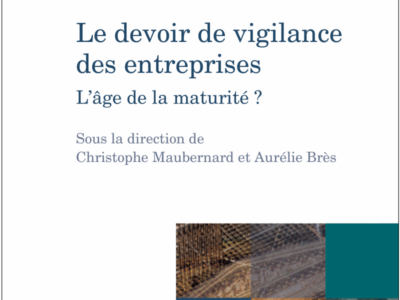
📝Devoir de vigilance : progresser (“Duty of Vigilance: the Way Forward), in 🕴️Ch. Maubernard & 🕴️A. Brès (eds.), 📗Le devoir de vigilance des entreprises. L’âge de la maturité ?

► Full Reference: M.-A. Frison-Roche, "Devoir de vigilance : progresser" ("Duty of Vigilance: the Way Forward"), in Ch. Maubernard & A. Brès (eds.), Le devoir de vigilance des entreprises. L'âge de la maturité ? (The duty of vigilance. The age of maturity?), Bruylant, "Droit & Economie" Serie, 2024, pp. 221-251 - 📝read the article (in French)  - 🚧 read the bilingual Working Paper which is the basis of this article, with additional developments, technical references and hyperlinks - ► English Summary of the article: In 2017 in France the so-called Vigilance law expressed great ambition. So did the draft directive. But in 2024 the European institutions moderated this ambition by refusing to increase either the type of companies subject and the constraints to which the duty of vigilance is associated. The directive has essentially halted what was for some the "march of progress". Does the ambition no longer exist? Does the future lie in an extension of the philosophy of the duty of vigilance, i.e. companies that should always be more concerned about others? This would undoubtedly be reaching the "age of maturity", where others see the age of madness, because it would be a contradiction in terms to ask a company to be concerned about anything other than its own development. It is therefore appropriate to consider this very hypothesis of an "age of maturity" as being an ambition maintained despite a European directive which, in its adopted version, is weakened and while the oppositions are intact (I). First of all, it must be admitted that the notion of "maturity" most often conceals a value judgment when applied to a legal concept (I.A.) and that this is blatantly obvious with regard to the duty of vigilance, which is considered by some and by nature by some as a good and by others as an evil (I.B). In order not to remain in what appears to be trench warfare, we must not get too bogged down in the reference French legislation of 2017 and what appears to be a European stutter in 2024, arguing so loudly that we can hear them reasoning in print, by paying attention to less visible and now more promising avenues of progress (II). In fact, the duty of vigilance can progress simply by the passage of time (II.A), by a better definition of the vocabulary (II.B), by the consolidation of the principles of Responsibility and Dialogue (II.C), by the uniqueness of the jurisdictional route (II.D). This last perspective of the progress that will be made possible in France by the uniqueness of the judicial route leads to a final avenue of progress. By their very nature, laws are jolts, all the more violent for being disputed. At the moment, if we want to make progress, these two other sources – the contract and the judge – must be favoured (III). The European directive is rightly concerned with access to the courts and takes a measured view of the effectiveness of contracts as a means of making the duty of vigilance effective, with the courts having to ensure that the contract does not destroy the spirit of the system. This is what the law already organises about the relationship between the contract, the judge and the duty of compliance (III.A). What is new in Europe in 2024 is the introduction of a Supervisor (III.B). Here again, vigilance is the "cutting edge" of Compliance Law, as it is an extension of Regulatory Law.  The result is that, through interpretation and the handling of principles, and to formulate a more general conclusion, it is the judge who holds and will hold the balance of the duty of vigilance. - 🌐follow Marie-Anne Frison-Roche on LinkedIn 🌐follow Marie-Anne Frison-Roche on Instagram 🌐subscribe to the Newsletter MAFR. Regulation, Compliance, Law 🌐s'abonner à la Newsletter Surplomb, par MAFR

Articles in The Journal of Regulation & Compliance « JoRC »

BORGHETTI, Jean-Sébastien🕴️

📝The Relation between Tort Law and Compliance Obligation, in 🕴️M.-A. Frison-Roche (ed.), 📘Compliance Obligation

► Full Reference: J.-S. Borghetti, "The Relation between Tort Law and Compliance Obligation", in M.-A. Frison-Roche (ed.), Compliance Obligation, Journal of Regulation & Compliance (JoRC) and Bruylant, "Compliance & Regulation" Serie, to be published - 📘read a general presentation of the book, Compliance Obligation, in which this article is published - ► Summary of the article (done by the Journal of Regulation & Compliance – JoRC): The Author points out that in order to establish civil liability, it is first necessary to find fault, i.e. a deviation from an obligation, which will trigger a secondary obligation, that of reparation. But it can also be argued that it is from liability that this primary obligation arises, civil liability then revealing an obligation which existed only implicitly. That establishes a two-way relationship between liability and obligation. The Compliance Obligation illustrates this, in particular through the Obligation of Vigilance conceived by the French law of 2017. The author therefore devotes the first part of his contribution to civil liability as a result of an Compliance Obligation, especially the Obligation of Vigilance. issued of the French law of 2017. After discussing whether the constraints generated by compliance should be classified as 'obligations', since there is no creditor, which therefore opens the way to liability in tort, he examines the conditions for incurring such liability, which are difficult, particularly with regard to the burden of proof and the demonstration of the causal link. The requirement concerning the latter may evolve in French law towards the admission of proportional causality, as is now accepted in certain cases in German case law. In the second part of his contribution, the author deals with the hypothesis of civil liability as an indicator of a Compliance Obligation. He points out that the claims made, particularly in the cases of TotalOuganda (France) and Milieudefensie v. Shell (Netherlands) seek to obtain from the judge a such "revelation". The author considers that it is not possible to draw from the  French 2017 law which refers to article 1240 of the French Civil Code on the liability because this article is referred to only in order to organise the consequences of a breach of article L.225-102-4 of the French Commercial Code organising the Obligation of Vigilance (article 1240 being therefore under the secondary obligation described above) and not to feed what this article L.225-102-4 requires under the primary obligation (defined above).  On the other hand, the Shell judgment derives directly from civil liability an obligation to act. This is understandable if one takes the perspective and the measure of the future challenges posed, in this case in the area of climate change. But the author considers that it is up to the legislator to decide on such a development in Liability Law.  - 🦉This article is available in full text to those registered for Professor Marie-Anne Frison-Roche's courses -

Articles in The Journal of Regulation & Compliance « JoRC »

RACINE, Jean-Baptiste🕴️

📝Compliance Obligation and Human Rights​, in 🕴️M.-A. Frison-Roche (ed.), 📘Compliance Obligation

► Full Reference: J.-B. Racine, "Compliance Obligation and Human Rights​", in M.-A. Frison-Roche (ed.), Compliance Obligation, Journal of Regulation & Compliance (JoRC) and Bruylant, "Compliance & Regulation" Serie, to be published - 📘read a general presentation of the book, Compliance Obligation, in which this article is published - ► Summary of the article (done by the Journal of Regulation & Compliance – JoRC): The author asks whether human rights can, over and above the many compliance obligations, form the basis of the Compliance Obligation. The consideration of human rights corresponds to the fundamentalisation of Law, crossing both Private and Public Law, and are considered by some as the matrix of many legal mechanisms, including international ones. They prescribe values that can thus be disseminated. Human rights come into direct contact with Compliance Law as soon as Compliance Law is defined as "the internalisation in certain operators of the obligation to structure themselves in order to achieve goals which are not natural to them, goals which are set by public authorities responsible for the future of social groups, goals which these companies must willingly or by force aim to achieve, simply because they are in a position to achieve them". These "Monumental Goals" converge on human beings, and therefore the protection of their rights by companies.  In a globalised context, the State can either act through mandatory regulations, or do nothing, or force companies to act through Compliance Law. For this to be effective, tools are needed to enable 'crucial' operators to take responsibility ex ante, as illustrated in particular by the French law on the Vigilance Obligation of 2017. This obligation takes the form of both a "legal obligation", expression which is quite  imprecise, found for example in the duty of vigilance of the French 2017 law, and in a more technical sense through an obligation that the company establishes, in particular through contracts. Legal obligations are justified by the fact that the protection of human rights is primarily the responsibility of States, particularly in the international arena. Even if it is only a question of Soft Law, non-binding Law, this tendency can be found in the Ruggie principles, which go beyond the obligation of States not to violate human rights, to a positive obligation to protect them effectively. The question of whether this could apply not only to States but also to companies is hotly debated. If we look at the ICSID Urbaser v. Argentina award of 2016, the arbitrators accepted that a company had an obligation not to violate human rights, but rejected an obligation to protect them effectively. In European Law, the GDPR, DSA and AIA, and in France the so-called Vigilance law, use Compliance Lools, often Compliance by Design, to protect human rights ex ante. Contracts, particularly through the inclusion of multiple clauses in often international contracts, express the "privatisation" of human rights. Care should be taken to ensure that appropriate sanctions are associated with them and that they do not give rise to situations of contractual imbalance. The relationship of obligation in tort makes it necessary to articulate the Ex Ante logic and the Ex Post logic and to conceive what the judge can order. The author concludes that "la compliance oblige à remodeler les catégories classiques du droit dans l’optique de les adosser à l’objectif même de la compliance : non pas uniquement un droit tourné vers le passé, mais un droit ancré dans les enjeux du futur ; non pas un droit émanant exclusivement de la contrainte publique, mais un droit s’appuyant sur de la normativité privée ; non pas un droit strictement territorialisé, mais un droit appréhendant l’espace transnational" ("Compliance requires us to reshape the classic categories of Law with a view to bringing them into line with the very objective of Compliance: not just a Law turned towards the past, but a Law anchored in the challenges of the future; not a Law emanating exclusively from public constraint, but a Law based on private normativity; not a strictly territorialised Law, but a law apprehending the transnational space". - 🦉This article is available in full text to those registered for Professor Marie-Anne Frison-Roche's courses -