Freedom of expression

Articles in The Journal of Regulation & Compliance « JoRC »

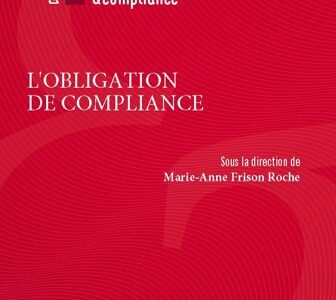
📝L’intensité de l’obligation de vigilance selon les secteurs : le cas des opérateurs numériques (“The intensity of the Duty of Vigilance in different sectors: the case of digital operators”), in 🕴️M.-A. Frison-Roche (ed.), 📕L’Obligation de Compliance

► Full Reference: G. Loiseau, "L’intensité de l’obligation de vigilance selon les secteurs : le cas des opérateurs numériques" (The intensity of the Duty of Vigilance in different sectors: the case of digital operators), in M.-A. Frison-Roche (dir.), L'obligation de Compliance, Journal of Regulation & Compliance (JoRC) and Dalloz, coll. "Régulations & Compliance", 2024, forthcoming - 📕read the general presentation of the book, L'obligation de Compliance, in which the contribution is published - ► English summary of this contribution (done by the Journal of Regulation & Compliance – JoRC) : L'auteur développe le cas des opérateurs numériques. Il souligne le paradoxe d'un Droit qui est parti d'un texte qui a posé le principe de l'irresponsabilité des hébergeurs, en raison de leur neutralité technique, pour aboutir au DSA et leur imposer des diligences, mais il rappelle que cette obligation n'apparaît qu'à partir d'un signalement qui est porté auprès de l'opérateur numérique et une interdiction expresse d'une obligation générale de surveiller les informations. Moreover, there is no general duty of vigilance incumbent on digital operators, even if recent case law seems to be tightening the role imposed on hosting providers. The Monumental Goal here is to fight against illegal content, but freedom of expression must also be preserved and regulations vary according to the type of content, whereas the DSA has a more general conception, aims at a logic of accountability and prevention of systemic risks. But wanting to make platforms 'accountable' ex ante, without touching the liability regime ex post, may pose a problem. The duty of vigilance will vary depending on whether the digital operator plays a passive or active role. This may lead platforms to adopt prior measures that may constitute structural obligations, with the trusted third party taking the form of a trusted signaller. The platform is thus made responsible for its own vigilance, but despite the possibility of enhanced vigilance, this does not have to extend to investigative measures. There are, however, specific enhanced vigilance obligations for very large platforms, justified by the risks involved and the types of content (terrorism, pornography). - 🦉This contribution est available in full text for persons following Professor Marie-Anne Frison-Roche teaching -
Videos

French Financial Markets Authority decision of 11 December 2019 sanctioning the Bloomberg press organ for disseminating false information on the financial market: here, the ethical obligation converges with Financial Law

Watch the video commenting on the decision of the Commission des sanctions of the Autorité des marchés financiers – AMF (French Financial Market Authority Sanctions Commission). Read the decision. -   In 2015, a document supposedly emanating from the Vinci company reached the Bloomberg media announcing unexpected catastrophic results. The two journalists who received it immediately published it without checking anything, the Vinci listed shares losing more than 18%. It was a rude forgery, which a basic check would have established, a check which the journalists had not done. 4 years later, the Bloomerg company is punished for the breach to "disseminate false information" on the financial market, by a decision of the Sanctions Commission of the Autorité des Marchés Financiers (French Financial Markets Authority) of December 11, 2019. The company being sued argued that it was up to journalists to be accountable and not to itself, because on the contrary the firm had implemented both detection software and a code of conduct, even though there was no legal rule constraining it. In consequence, it would not possible to pursue it. But the AMF Sanctions Commission stresses that, independently of this, it is a general rule of ethics for journalists that obliges them to verify the authenticity of the documents they publish, which they did not, whereas an elementary check would have allowed them to measure that it is a rude forgery. In addition, the Sanctions Commission refers to the European Regulation on market abuses which in its article 21 targets the special status to be reserved for press freedom and the special status of journalists, but associates this ethical obligation to verify documents . However, the Sanctions Commission notes that this obligation, which was targeted by both the journalists' ethics and the reference text of Financial Law, was completely ignored by the two journalists. It is therefore up to the press agency to be accountable and to be punished. However, the media entreprise maintained that the balance between the principle of freedom of the press and the principle of freedom of opinion on the one hand and the principle of the protection of the financial market and of investors against false information disseminated requires an interpretation of the European Union Law, which must oblige the Sanctions Commission to ask a preliminary question to the Court of Justice of the European Union. The Sanctions Commission dismisses this request because it considers that the European texts are "clear", which allows the Sanctions Commission to interpret them itself. And precisely the European Regulation on market abuse in its article 21 provides for the exception in favor of the press and journalists but compels them to respect their ethics, in particular the verification of the authenticity of documents. In this case, they did nothing. They are clearly the authors of a breach attributable to the company. - In a less clear case, one could consider that this balance between two principles, both of public interest, is delicate and that an interpretation by the Court of Justice would always be useful. Indeed and more fundamentally, does Financial Law remain an autonomous Law, putting first the objective of the preservation of the integration of the financial market and the protection of investors or is it the advanced point of an Information Law protecting everyone against the action of any "influencer" (category to which Bloomberg belongs) consisting in disseminating inaccurate information (notion of "misinformation")? And that is not so "clear" ….   -

Articles

Bertrand Cantat revendique son “droit à la réinsertion” et le fait qu’il “a payé la dette à laquelle la justice l’a condamné” : en Droit, la justice pénale n’est pas une simple “facture” et c’est en terme de “libertés” et non de “droits” que les questions se posent

Articles

Le marché des idées

I-2.6: Does a legal principle regarding net neutrality exist?

Translated Summaries In The Journal of Regulation the summaries’ translation are done by the Editors and not by the authors ENGLISH The debate on Net Neutrality faces a major difficulty, namely that of its legal status: does there exist a “legal principle”—meaning a rule somewhere within the entire body of law—with mandatory force that could be used to counter infrastructure operators’ discriminatory practices?   FRENCH Le débat sur la neutralité du Net fait face à une difficulté majeure, à savoir son statut juridique: existe-t-il un «principe juridique», qui exprime une règle dans l’ensemble du système juridique – avec une force obligatoire qui pourrait être utilisée pour contrer les pratiques discriminatoires des opérateurs d’ infrastructure ? SPANISH El debate sobre la Neutralidad de la Red se enfrenta a una gran dificultad, primordialmente en cuanto a su estatus legal: ¿realmente existe un “principio legal” – es decir, una regla que se encuentra dentro de la disciplina del derecho – con fuerza mandataria que podría ser usado para enfrentar a las prácticas discriminatorios que practican los operadores de infraestructura? ITALIAN Il dibattito sulla neutralità della rete si trova di fronte ad una difficoltà rilevante dal punto di vista del suo fondamento giuridico: esiste una norma giuridica obbligatoria – intesa come una norma legale – che possa essere utilizzata contro le pratiche discriminatorie degli operatori? ……………….. Other translations forthcoming.