Financial law

Articles

Interregulation: way of “cooperation protocol”​ between Regulatory Bodies.Example between French Financial Markets Authority and Anticorruption Agency

Full reference: Frison-Roche, M.-A., Interregulation: way of "cooperation protocol"​ between Regulatory Bodies. Example between French Financial Markets Authority and Anticorruption Agency, Newsletter MAFR – Law, Compliance, Regulation, 22nd of September 2020 Read by freely subscribing other news of the Newsletter MAFR – Law, Compliance, Regulation   Summary of the news:  Although Regulation Law was born from the notion "sector", constant interferences between sectors and frequent interactions between some sectors and more general questions common to different sectors, make interregulation necessary. Compliance Law being the extension of Regulation Law, this interregulation mechanism is also necessary in Compliance Law.  This interregulation can take many legal paths like letters exchanges between regulators, the creation of a network of regulators and supervisors at the world level or about some specific question or the adoption of a "cooperation protocol" as the AMF (French Financial Market Regulator) and the AFA (French Anticorruption Agency) did on 16th of September 2020 to reinforce their respective fight against corruption, against market abuses and for the protection of investors.  This cooperation protocol between the AFA and the AMF has the following subjects: A more efficient methodology concerning the research and the analysis of corruption and market abuses. A more efficient prevention of corruption and market abuses. A better capacity to give recommendations of new regulations to the Legislator. A more rigorous monitoring of international works on the topic.  A more coherent information for the public. Are regulators the new teachers? 

Articles in a legal collective publication

📝The impossible legal unicity of the category of “whistleblowers” (“L’impossible unicité juridique de la catégorie des “lanceurs d’alertes” “)

Full reference: Frison-Roche, M.-A., L'impossible unicité juridique de la catégorie des "lanceurs d'alertes" ("The impossible legal unicity of the category of "whistleblowers""), in Chacornac, J. (dir.), Lanceurs d'alertes, regards comparatistes, ("Whistleblowers, comparative perspectives"), Publications of the Centre français de droit comparé ("French Comparative Law Center"), May 2020, Volume 21, pp. 13-31.    Read the article (in French).    Read the general presentation of the collective book in which this article is published Read the bilingual working paper which had served of basis for this article.  Read the presentation of the conference "Les lanceurs d'alertes: glose" (Whistleblowers: glose") and especially the slides elabored for the colloquium organized by the Centre français de droit comparé ("French Comparative Law Center") on 23th of November 2018 under the direction of Jérôme Chacornac - Introduction of the article "Whistleblowers". This is a new expression. Which is a great success. Barely heard once, we hear it everywhere … A topic not of course or knowledge test, but rather a topic of daily conversation. Because it is spoken to us every day, in more or less gracious terms. For example President Donald Trump on October 1, 2019 declared to the press "want to question" the whistleblower who would have illegally denounced him and would not, according to him, have the right to conceal his identity, proof in this according to him of the lying character of his assertions against him, while his lawyer indicates on October 6, 2019 that he is not speaking on behalf of a single whistleblower thus taken to task but of a plurality of people who gave information against the President of the United States. Even the most imaginative screenwriters would not have written such brutal and rapid twists and turns. Spectators, we are waiting for the next episode, secretly hoping for the escalation. And precisely if we go to the cinema, it is still a whistleblower whose dedication and success, we are told about, even the drama, for the benefit of global society, and in particular democracy, since the secrets are fought for the benefit of the truth. The Secret Man designates Mark Felt as the first whistleblower. Returning to what we often present as being a more "serious" media1On the more general fact that cinema is undoubtedly the medium which most seriously restores the state of the Law, c. Frison-Roche, M.-A., Au coeur du Droit, du cinéma et de la famille : la vie, 2016., we listen to France-Culture and here is another story told by a historian who worked as an archivist on events that political power would have liked to keep hidden by possibly destroying their traces but which its trade led to preserve: here it is expressly presented to the studious listeners like a "whistleblower" …. While the same radio tries to find the one who could well be, as in a kind of contest the "first whistleblower"2L'histoire du premier lanceur d'alerte, France Culture, septembre 2019. ? …. This rewriting of History can be defended because ultimately what did other Voltaire do for Calas, or Zola for Dreyfus? It is also a subject of legislative discussion since in the United States the Dodd-Frank law of 2010 inserted in the law of 1934 which established the Securities & Exchanges Commission a complete device of remuneration and remuneration of the whistleblowers, whereas after having developed flexible but guiding lines in this regard in 20123European Commission, Guidelines on Whistleblowing, 6 of December 2012, SEC(2012) 679 final, updated on 23 of April 2018. , the European Commission published on November 20, 2018 the text of what will become a Directive intended to give a unified European status to the character, in the system gradually developed to protect the one who was presented in 2018 as that "cannot be punished for having done what is right". In Europe, the Directive first approved by a Resolution of the European Parliament on April 16, 2019 on the protection of persons denouncing breaches of Union Law and then adopted on October 7, 2019 (Directive of the European Parliament and of the Council of European Union on the Protection of Persons who Report Violations of European Union Law, different title, it should be noted, will have to be transposed into the laws of the Member States within the next two years. , since only "violations of Union Law" are targeted, but the character of the "whistleblower" is more generally targeted: he is "whole"4However, precisely the so common use of plurality ("whistleblowers") raises doubts about the uniqueness of the character. On this question, see. all the first part of the developments of this study, which leads to the conclusion rather than beyond the multitude of particular cases, there are rather two kinds of whistleblowers. V. infra I.. In short, the whistleblower is a star5The director of the film La fille de Brest says that she considers the whistleblower at the origin of the case of the Pick as a "movie character".. A sort of historical figure, covered in blows and glory, going from Voltaire to Snowden, both of whom find themselves embodied on the screens6Thus, the adventures of Snowden were brought to the screen by Oliver Stone in 2016, Snowden. On the question of knowing whether this film "faithfully reproduces" or not the case, Schetizer, P., Le film Snowden est-il à la hauteur de la réalité?, 2017. This article is favorable to the whistleblower, and to the film which tells us with emotion his case, in particular because (sic), it is easier than to read the Washington Post. …., Consecrated by law, which associates with it a legal regime of protection to such an extent that, like a Nessus tunic, it is this legal regime which will define the character and not the reverse. When we read the law of December 9, 2016 relating to transparency in the fight against corruption and the modernization of economic life, known as "Sapin 2", we notice that the Legislator makes much of this character, since 'he dedicates its chapter II to him7Underlined by us.: "From the protection of whistleblowers", and that it is by his very protection that he formally opens the door of Right to him. But why a plural? Admittedly when we read the recitals of the Community Directive of October 7, 2019 on the protection of whistleblowers8About this directive, v. the developments infra, it is only a list of all the subjects on which it is a good idea to protect them, which therefore prompts us to see in this plural only the index of this non-exhaustive list of subjects which it is good to tell us, a sign of the lack of definition of who should alert us. Reading the French law known as "Sapin 2" makes it less severe but more perplexing. Indeed, this plurality referred to by the title of the chapter devoted to "whistleblowers", there is no longer any question in the rest of the law, in the very definition which follows, article 6 which opens this chapter devoted to "whistleblowers" offering the reader immediately a singular since it begins as follows: "A9Underlined by us. whistleblower is a person …". No mention of diversity. The art of legislative writing would however have required that the qualifying article not only be singular but that it should not yet be undefined. Stendhal if he had still deigned to have the law for bedside book would have wanted to find at the beginning of chapter a sentence like: "The10Underlined by us. whistleblower is a person …". Thus seem to contradict themselves within the law "Sapin 2 the very title which presents the character, in that it uses a defined plural (the) while the defining article which presents it is in the undefined singular (one). … Here is a first reason not to advance any more but in a very careful way, in this "step by step" that constitutes a reading word for word: a gloss. This consists of taking the expression itself literally. The second reason for this technical choice is that the gloss is well suited to the introduction of a collective work, thus allowing more targeted developments to take place in other contributions, on the techniques, the difficulties and the limits of this protection, or on its history, or the reasons for the arrival in French law of these whistleblowers and the way they develop, or not, elsewhere. I am therefore going to content myself with taking this already legal expression to the letter: The (I) whistle (III). blowers (II).       

Books

Patrick BOLTON - Morgan DESPRES - Luiz Awazu PEREIRA DA SILVA Frédéric SAMAMA - Romain SVARTZMAN, The Green Swan

The Green Swan

Reference: Patrick BOLTON – Morgan DESPRES – Luiz Awazu PEREIRA DA SILVA – Frédéric SAMAMA – Romain SVARTZMAN, The green swan: central banking and financial stability in the age of climate change, Banque des Règlements Internationaux, Janvier 2020 Accede to article

Videos

French Financial Markets Authority decision of 11 December 2019 sanctioning the Bloomberg press organ for disseminating false information on the financial market: here, the ethical obligation converges with Financial Law

Watch the video commenting on the decision of the Commission des sanctions of the Autorité des marchés financiers – AMF (French Financial Market Authority Sanctions Commission). Read the decision. -   In 2015, a document supposedly emanating from the Vinci company reached the Bloomberg media announcing unexpected catastrophic results. The two journalists who received it immediately published it without checking anything, the Vinci listed shares losing more than 18%. It was a rude forgery, which a basic check would have established, a check which the journalists had not done. 4 years later, the Bloomerg company is punished for the breach to "disseminate false information" on the financial market, by a decision of the Sanctions Commission of the Autorité des Marchés Financiers (French Financial Markets Authority) of December 11, 2019. The company being sued argued that it was up to journalists to be accountable and not to itself, because on the contrary the firm had implemented both detection software and a code of conduct, even though there was no legal rule constraining it. In consequence, it would not possible to pursue it. But the AMF Sanctions Commission stresses that, independently of this, it is a general rule of ethics for journalists that obliges them to verify the authenticity of the documents they publish, which they did not, whereas an elementary check would have allowed them to measure that it is a rude forgery. In addition, the Sanctions Commission refers to the European Regulation on market abuses which in its article 21 targets the special status to be reserved for press freedom and the special status of journalists, but associates this ethical obligation to verify documents . However, the Sanctions Commission notes that this obligation, which was targeted by both the journalists' ethics and the reference text of Financial Law, was completely ignored by the two journalists. It is therefore up to the press agency to be accountable and to be punished. However, the media entreprise maintained that the balance between the principle of freedom of the press and the principle of freedom of opinion on the one hand and the principle of the protection of the financial market and of investors against false information disseminated requires an interpretation of the European Union Law, which must oblige the Sanctions Commission to ask a preliminary question to the Court of Justice of the European Union. The Sanctions Commission dismisses this request because it considers that the European texts are "clear", which allows the Sanctions Commission to interpret them itself. And precisely the European Regulation on market abuse in its article 21 provides for the exception in favor of the press and journalists but compels them to respect their ethics, in particular the verification of the authenticity of documents. In this case, they did nothing. They are clearly the authors of a breach attributable to the company. - In a less clear case, one could consider that this balance between two principles, both of public interest, is delicate and that an interpretation by the Court of Justice would always be useful. Indeed and more fundamentally, does Financial Law remain an autonomous Law, putting first the objective of the preservation of the integration of the financial market and the protection of investors or is it the advanced point of an Information Law protecting everyone against the action of any "influencer" (category to which Bloomberg belongs) consisting in disseminating inaccurate information (notion of "misinformation")? And that is not so "clear" ….   -

Articles in The Journal of Regulation & Compliance « JoRC »

JUVIGNY, Benoît de🕴️

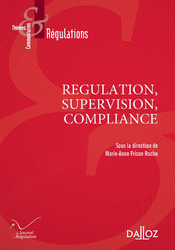
📝La compliance, bras armé de la régulation financière, in 🕴️M.-A. Frison-Roche (ed), 📕Régulation, Supervision, Compliance

► Full Reference: B. de Juvigny, "La compliance, bras armé de la régulation financière" ("Compliance, the arm of financial regulation"), in M.-A. Frison-Roche (ed.), Régulation, Supervision, Compliance, Dalloz, coll. "Thèmes & Commentaires", "Régulations" Serie, 2017, pp. 17-28 - 📕read a general presentation of the book, Régulation, Supervision, Compliance, in which this article is published - ► English summary of the article (done by the Journal of Regulation & Compliance – JoRC):  - 🦉This article is available in full text to those registered for Professor Marie-Anne Frison-Roche's courses -

Jurisprudence

Cour de Cassation (French Judicial Supreme Court)

Decision of 22nd of November 2016, BLCM

Full reference: Cour de cassation, civile, Chambre commerciale, 22nd of November 2016, BLCM, 15-11.063   Read the decision (in French)

Working papers

Compliance law

This article provides a basis for an article published  in the Recueil Dalloz  in French : "Le droit de la compliance". ‘Compliance’ issues have been increasingly discussed in recent years. Articles, handbooks, soft law, decisions or definition have been written. But nothing really converges. The term ‘conformity’ [conformité in French] is used in parallel, or even instead of the usual concept of compliance. There are as many definitions of what compliance is as there are authors writing on the matter. And yet it is used in manifold ways, from Competition law to International Finance law, from the hardest law (enforced with the help of the most stringent sanctions) to business ethics, according to which behaving should be enough to be compliant. At a time when compliance invades law, it should be first noted that we are too shortsighted to grasp the mechanism (I), whereas it is necessary to build a comprehensive Compliance law (II). Read developments below.

Working papers

🚧Globalization from the point of view of Law

► Full Reference: Frison-Roche, M.-A., Globalization from the point of view of Law, working paper, May 2017. - 🎤 This working paper initially served as a basis for a synthesis report made in French in the colloquium organized by the Association Henri Capitant in the International German Days on the subject of "Le Droit et la Mondialisation" (Law and Globalization). 📝 Il sert dans un second temps de base à l'article paru dans l'ouvrage La Mondialisation. 📝 it serves as a second basis for the article (written in English, with a Spanish Summary) to be published in the Brezilian journal Rarb – Revista de Arbitragem e Mediação  (Revue d`Arbitrage et Médiation). It uses the Bilingual Dictionary of the Law of Regulation and Compliance. - ► Summary of the Working: Globalization is a confusing phenomenon for the jurist. The first thing to do is to take its measure. Once it has been taken, it is essential that we allow ourselves to think of something about it, even if we have to think about it. For example, on whether the phenomenon is new or not, which allows a second assessment of what is taking place. If, in so far as the law can and must "pretend" to defend every being, a universal claim destined to face the global field of forces, the following question – but secondary – is formulated: quid facere? Nothing ? Next to nothing ? Or regulate? Or can we still claim that the Law fulfills its primary duty, which is to protect the weak, including the forces of globalization? - read the Working Paper below⤵️

Jurisprudence

French Council of State (“Conseil d’État”)

Read the Conseil d'État decision. The ruling sends the Conseil constitutionnel  (French Constitutional Council) the question of whether the proceedings […]