Family

Books

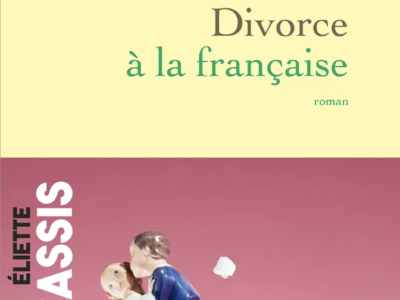
📙Divorce à la française

Publication director

🏗️ direction of the collection: 📚Cours Dalloz – Série Droit privé

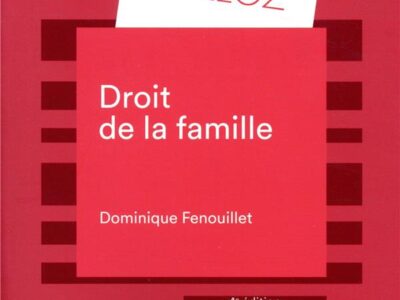
📚Publication of : 🕴️Dominique FENOUILLET, 📕Droit de la famille (Family Law), 5th ed.

► Full Reference : D. Fenouillet, Droit de la famille (Family Law), 1st ed. 1997 – 5th ed., 2022, Dalloz, “Cours Dalloz-Série Droit privé” Series, 673 p. - ► General presentation of the book (written in French) : This textbook, up to date with the latest texts, is intended for all law students and all practitioners updating their knowledge of family law. Its first part deals with « couples » (married, divorced, unmarried), its second part being devoted to « the child » (filiation and status). Finally, a last part develops « the family beyond » (name, maintenance obligations and family property). - 📚See the entire collection in which the book is published. -

Publication director

🏗️ direction of the collection: 📚Cours Dalloz – Série Droit privé

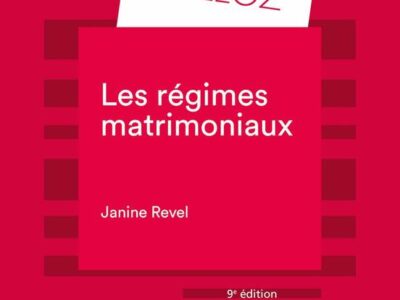
📚Publication of : 🕴️Janine REVEL, 📕Les régimes matrimoniaux (Matrimonial Property Regimes), 10th ed.

► Full Reference : J. Revel, Les régimes matrimoniaux (Matrimonial Property Regimes), 10th ed., 2020, Dalloz, “Cours Dalloz-Série Droit privé” Series, 410 p. - ► General presentation of the book (written in French) : Janine Revel opens her book with these words: « Marriage is a union of persons and of economic interests ». This explains why the Law of matrimonial property regimes draws as much on the law of persons as on the techniques of property law. This textbook explains clearly and progressively the matrimonial status, the choice and functioning of the matrimonial regime, including the prospect of its liquidation, as well as the property relations that develop between spouses. The rules vary according to the regimes, from separation of property to universal community, but the primary regime binds all couples together around rules to which French law remains attached, while this model is replicated for recognised stable couples who have not married. - 📕Read the back cover (in French) - 📕Read the table of contents (in French) - 📚See the entire collection in which the book is published. -

Books

Droit civil. La famille

Books

FLORES-LONGOU, Magalie and ÉPINOUX, Estelle

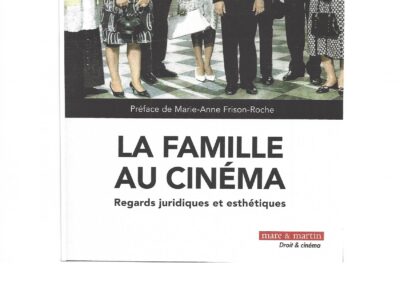
La famille au cinéma. Regards juridiques et esthétiques (“Family in Cinema. Legal and Aesthetic Perspectives”)

Full reference: Florès-Longou, M. and Épinoux E. (ed.), La famille au cinéma. Regards juridiques et esthétiques ("Family in Cinema. Legal and Aesthetic Perspectives"), coll. "Droit & cinéma", Mare & Martin, 2016. Read the forth of cover (in French) Read the table of contents (in French) Read the introduction of the book (in French) Read the Marie-Anne Frison-Roche preface: Au coeur du droit, du cinéma et de la famille: la vie ("At the heart of Law, Cinema and Family: life") (in French). 

Articles in a legal collective publication

Au coeur du droit, du cinéma et de la famille : la vie (“At the heart of Law, Cinema and Family: Life”), preface of the book “La famille au cinéma. Regards juridiques et esthétiques” (“Family in Cinema. Legal and Aesthetic Perspectives”)

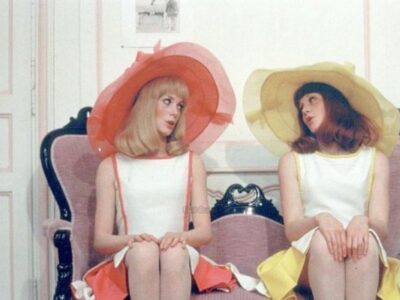
Full reference : Frison-Roche, M.-A., Au cœur du Droit, du cinéma et de la famille : la vie ("At the heart of Law, Cinema and Family: Life"), preface of La famille au cinéma. Regards juridiques et esthétiques ("Family in Cinema. Legal and Aesthetic Perspectives"), Florès-Longou, M. and Épinoux E. (ed.), coll. "Droit & cinéma",  Mare & Martin, 2016, pp. 21-27. Read a general presentation of the book Read the working paper from which the article was written, containing some notes and a hundred links, especially towards film extracts.  Read the article (in French) This introductive article, which constitutes the preface of the book, relies on approximatively one hundred movies to show that cinema does not stop to show legal situations and protagonists, even if "Family Law" seems to be less the darling child than the actors of the trial. We find the child, the mother and the father, the spouses and the engaged people. Often with the shape of drama, breaks and machinations and even murders, because it is like that that family appears on the screen. It is difficult to not fall asleep facing the peaceful happiness of happy families.   But why such a confluence between Cinema and Family Law?  Because both have a purpose: life.  Do not being anxious about family life, it is not understanding Family Law. And because Cinema take life itself as purpose, so when we want to learn Family Law, it is the path towards Cinema that we should take.   
Working papers

Au coeur du droit, du cinéma et de la famille : la vie (“At the heart of Law, Cinema and Family: Life”)

This working paper served as a basis for the preface of the book: Magalie Flores-Lonjou and Estelle Épinoux (ed.),  La famille au cinéma. Regards juridiques et esthétiques ("Family in Cinema. Legal and Aesthetic Perspectives"), pref. Marie-Anne Frison-Roche, coll. "Droit et Cinéma", Éditions Mare et Martin, 2016. Since the transmission of the text, this working paper has been updated many times.  It contains links towards approximatively 90 movies which appears relevant to me for this topic. 

Working papers

Home made Family

The family is built on one basic idea which is so powerful that legal rules are organised around it as spontanely. But if the paradigm is changing, then all the rules change with the strength of the evidence. However, in the 1970s, we changed paradigm. Previously, for millennia, the basic idea was the family as a group. Depending on the time or period, the group has varied in its contours, squares and powers granted to individual members, but the idea of group was acquired. Family was a group which was a part of the social group, kept by the State. From the 1970s, the family becomes the developed project done by a free and independent person. This project designed by a person wishing to build family that suits him or her will result in the fact that the individual meets other individuals whose family project crosses his or her. Contract becomes the perfect tool for these home-made families This desires adjustment corresponds to the market model. Concretely, market of ideal family provides services for satisfaction of various projects, all legitimate as expression of desir. The sufficient link between individuals  is affection and will, the center is the child. The market offers new perspectives, such as ideal partner and even more perfect child, becoming jewel. The idea of ​​Market has triumphed.

Books

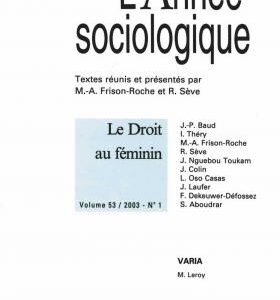
📕Le Droit au féminin (Law in the feminine)

► Full Reference: M.-A. Frison-Roche & R. Sève (ed.), Le Droit au féminin (Law in the feminine), L'Année Sociologique, vol. 53, 2003, No. 1, 256 p. - ► read the backcover (in French) - ► read the table of content (in French) - 📕read the general presentation by Marie-Anne Frison-Roche and René Sève - 📝read the article of Marie-Anne Frison-Roche : "L'art législatif et la personne située dans la législation française relative aux femmes" ("Legislative art and the situated person in French legislation relating to women") -