Expertise

Working papers

Working Paper for 📺Overhang

🚧Dans le silence des textes, vers qui se tourner en cas de manquement à une disposition du Droit de la Compliance ?

► Full Reference: M.-A. Frison-Roche, Who is responsible for making the Compliance provision effective? Is it the company or the public authority? Example of data: CE, 27 January 2025, B. c/ CNIL, Working Paper, February 2025.   - 🎤 This Working Paper was developed as a basis for the Overhang👁 video  on 8 February 2025 : click HERE (in French) - 🎬🎬🎬In the collection of the Overhangs👁 It falls into the News category. ►Watch the complete collection of the Overhangs👁 : click HERE - ► Summary of this Working Paper: In its decision of 27 January 2025, B. v CNIL, the French Administrative Supreme Court (Conseil d'État ) had to provide a solution to a case that the Compliance rules applicable to data had not expressly provided for. Can a person who believes that another person has failed to fulfill their obligations under the GDPR refer the matter to the French Data Protection Regulator (CNIL) and not the data controller? The Conseil d'État considers that the question is clear and that there is no point in referring a preliminary question to the ECJ. Indeed, the texts require the person alleging that his or her right has been infringed to first contact the data controller to have the information deleted before subsequently referring the matter to the CNIL. Furthermore, this case involved personal information inserted by doctors in an expert report submitted to a court. The Conseil d'État agreed with the CNIL that it was not required to review and assess the evidence, which is the role of the court. This shows that, while the right to alert can be used to refer cases directly to the administrative authorities, here the specific takes precedence over the general, with the spirit of the Law entrusting the direct preservation of rights to the data controller, with the CNIL's supervisory and sanctioning role coming only at a later stage. This illustrates the more general nature of Compliance Law, which relies primarily on the operators themselves. Furthermore, as a melting pot of various subjective rights, in this case the right to erasure but also the right to contribute to the debates, the Conseil d'État stresses that it is the role of the judicial judge to ensure the fairness of the debates. - 🔓read the developments below⤵️

Organisation of events

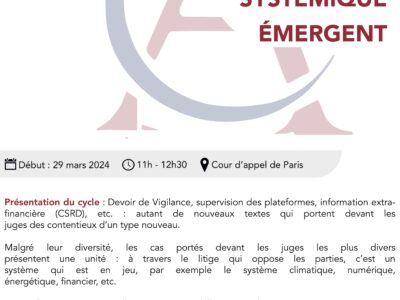
🧱⚙️Coordination of the cycle of conference-debates 🧮Contentieux Systémique Émergent – CSE (Emerging Systemic Litigation – ESL)

► Full Reference: M.-A. Frison-Roche, Coordination of the cycle of conference-debates Contentieux Systémique Émergent (Emerging Systemic Litigation), organised on the initiative of the Cour d'appel de Paris (Paris Cour of Appeal), with the Cour de cassation (French Court of cassation), the Cour d'appel de Versailles (Versailles Court of Appeal), the École nationale de la magistrature – ENM (French National School for the Judiciary) and the École de formation des barreaux du ressort de la Cour d'appel de Paris – EFB (Paris Bar School), under the scientific direction of Marie-Anne Frison-Roche - ► This Cycle in few words: Duty of vigilance, supervision of platforms, non-financial information (CSRD), etc.: as many new texts that bring new types of disputes before the courts. Despite their diversity, the cases brought before the most diverse judges present a unity: through the dispute that pits the parties against each other, it is a system that is at stake, for example the climate system, digital system, energy system, financial system, etc. New regulations are just the illustration of this "Emerging Systemic Litigation"; the conference-debates aiming at showing the new fields, new techniques, new standards, etc., in relation to the scale and diversity of stakeholders' expectations. This cycle is designed to encourage cross-fertilisation, so as to provide judges with food for thought ahead of the litigation they will be called upon to deal with. Les réglementations nouvelles ne sont que l’illustration de ce « contentieux systémique émergent » dont la formation a pour objet de montrer les nouveaux champs, les nouvelles techniques, les nouvelles normes, etc., en lien avec l’ampleur et la diversité des attentes des parties prenantes. Le cycle vise à favoriser les échanges croisés, afin d’alimenter la réflexion des magistrats en amont des litiges qui leurs seront soumis. - 🔴Registrations and information requests can be sent to: inscriptionscse@gmail.com 🔴For the attorneys, registrations have to be sent to the following address: https://evenium.events/cycle-de-conferences-contentieux-systemique-emergent/  ⚠️The conference-debates are held in person only, in the Cour d’appel de Paris (Paris Court of Appeal). - ► General Presentation of the Cycle: In 2024, the Cour d’appel de Paris (Paris Court of Appeal) created a new specialised chamber: chamber 5-12 Contentieux émergent – Devoir de vigilance et responsabilité écologique (Emerging litigation – Duty of vigilance and environmental liability). Vigilance litigation is an example of what is emerging more generally: Systemic Litigation, often linked to technologies. This calls for a new way of judging, organising procedures and relations between professionals. A series of conference-debates on Emerging Systemic Litigation (ESL) is being organised jointly by the Paris Court of Appeal, the Versailles Court of Appeal, the Cour de cassation (French Court of cassation), the École nationale de la magistrature – ENM (French National School for the Judiciary) and the École de formation des barreaux du ressort de la Cour d'appel de Paris – EFB (Paris Bar School), under the scientific responsibility of Professor Marie-Anne Frison-Roche. In this context, a series of conference-debates involving professionals from a wide range of backgrounds is being proposed on the following themes: 🧮the very notion of "Emerging Systemic Litigation" and the role of the judiciary in it (29 March 2024): read the report of this event   🧮vigilance, insofar as it gives rise to Systemic Litigation, notably because it takes legal form in numerous contracts, for example in employment relationships (26 April 2024): read the report of this event   🧮the inclusion in Emerging Systemic Litigation of information reliability techniques, particularly with regard to content available on platforms (27 May 2024): read the report of this event   🧮the way in which artificial intelligence is generating Systemic Litigation and the influence of new specific texts (24 June 2024): read the report of this event   🧮sustainability, a principle of systems found in reports and transitively in disputes concerning their development, their standards and even their control (9 September 2024): read the programme of this event   🧮new evidentiary techniques required by Emerging Systemic Litigation, to account for systemic needs, e.g. climate and digital systems, and how firms respond to them (14 October 2024): read the programme of this event   🧮Vigilance General Procedural Law, in that it incorporates the Systemic dimension of Vigilance Litigation (18 November 2024): read the programme of this event   🧮institutional and case law feedback from courts on Emerging Systemic Litigation (16 December 2024): read the programme of this event - 🧮read below the full programme of this cycle of conference-debates⤵️

Articles

For regulating or supervising, technical competence is required: example of the French creation of the “Pôle d’expertise de la régulation numérique “​

Full reference: Frison-Roche, M.-A., For regulating or supervising, technical competence is required: example of the French creation of the "Pôle d'expertise de la régulation numérique"​, Newsletter MAFR – Law, Regulation, Compliance, 2nd of September 2020 Lire par abonnement gratuit d'autres news de la Newsletter MAFR – Law, Regulation, Compliance   Summary of the news Through a decree of 31st of August 2020, the government created a national service, the "Pôle d'expertise de la régulation numérique" (digital regulation expertise pole). It has to furnish to State services a technical expertise in computer science, data science and algorithm processes in order to assist them in their role of control, investigation and study. The aim is to favor information sharing between researchers and State services in charge of regulating digital space.  As its acronym indicates, this pole of expertise aims to represents constance in a changing world. Moreover, more than being a national service, this organism must adopt a transversal dimension, its creation decree being signed by the Prime Minister, Minister of Economy, Minister of Culture and Minister of Digital Transition. The creation of such a pole shows the awareness of the government of the importance of technical competency in the regulation of digital space and of the necessity to centralize these expertises in one organ.  However, as the decree indicates, this pole of expertise could be consulted only by "State services", that excludes regulators which are independent from the State and which could put the pole in conflict of interest, and courts even if they are supposed to play a central role in the regulation of digital space and even if they are allowed to ask the advice of the regulator about some cases. But if regulators cannot size the pole, to whom does it benefit except the legislator and a few officials?  It would therefore have been better for this pole of expertise to be placed under the direction of regulatory and supervisory bodies, which would have enabled it to be able to be consulted both by regulators and by judges, both of whom are key players in digital regulation.

Articles in a legal collective publication

📝Experts et procédure : l’amicus curiae (Experts and procedure: the amicus curiae)

► Référence complète : M.-A. Frison-Roche, "Experts et procédure : l'amicus curiae" ("Experts and procedure: the amicus curiae"), Revue de droit d'Assas, october 2012, pp. 91-94 - 📝read the article (in French) - ► English Summary of the article: A recent thesis has argued that amicus curiae is becoming a common principle of Procedural Law. This shows its importance. The fact that the mechanism, the character, is designated by a Latin formula leads us to suspect that something is being concealed that legal technique ordinarily forbids: it is the legal expert and the party's expert, which is what the amicus curiae most often is, either one or the other, or both at the same time. Therefore, removing the prudish cloak of Latin, it is these two difficulties that must be addressed. If we exclude the legal expert, it is because "jura novit curia" ("the court knows Law". But this rule, which recalls the principle that "no one is supposed to be ignorant of the law", merely indicates a sharing of the burden of evoking facts and Law between the parties and the judge (Motulsky) and not a presumption of knowledge. Consequently, the modest, and therefore self-confident, judge has no reason, either psychological or legal, to shy away from a legal expertise. As for the party's expert, or the judge's expert who is highly influenced by a party, a profession, a social group, in short, a judge's expert who is in fact an expert held by a party, this can only be a problem if the judge cannot keep his distance from this expert whose opinion is biased by the weight of the party. But first of all, any opinion is biased. Whether it is given in bad faith or good faith, it is biased, and in rhetoric we know that an opinion biased in good faith is more dangerous than a bought opinion, because the latter is known to be twisted by self-interest. In this respect, the person who listens to it, the judge, knows the difference. Indeed, the legal system that recognises the party's expert and the amicus curiae, i.e. North American Law or European Union Law, draws the necessary procedural consequence: they include the party's expert opinion in the adversarial debate. It is the principle of adversarial debate, the principle of principles in the conduct of proceedings, that makes amicus curiae acceptable and welcome, since it provides the judge with a scientific input that the latter does not have. -

I-2.4: The principle of the neutrality of standards (the example of accounting standards)

Translated Summaries ENGLISH The subject of neutrality brings to my mind a certain number of preliminary ideas and reminiscences. First of all, the image of Buddha comes to mind, because it alone expresses the extent to which neutrality is an endless subject, since by thinking about the fact that he isn’t thinking about anything, Buddha is still thinking about something. It also makes me think of contemporary music’s constant attempts to attain a form of neutrality: yet this goal remains unattainable, because it is evident that the search for the neutral, in a sound or a timbre, can probably never be found.   FRENCH Tout d’abord, la figure du Bouddha, qui exprime à elle seule combien la question de la neutralité est un thème sans fin, car en pensant qu’il ne pense à rien, le Bouddha pense malgré tout à quelque chose. Il me fait penser aussi à la musique contemporaine, à son souci constant d’atteindre une forme de neutralité ; préoccupation à jamais déçue lorsqu’elle reconnaît ultimement que le neutre, en ayant toujours une qualité – un son, un timbre – est probablement introuvable.   SPANISH El principio de los estándares de la neutralidad (el ejemplo de estándares de contabilidad) El tema de la neutralidad trae a luz un cierto número de ideas preliminares. Para comenzar, la figura de Buda viene a mente, porque él sólo expresa la naturaleza interminable que es el tema de la neutralidad, ya que al pensar en el hecho de que él no piensa en absolutamente nada, Buda aún así piensa en algo. También me hace pensar el intento constante de la música contemporánea de alcanzar una forma de neutralidad: pero este objetivo permanece inalcanzable, porque es evidente que la búsqueda de lo neutral, en un sonido o un timbre, probablemente nunca se podrá encontrar. ………………… Other translations forthcoming.