European Directive

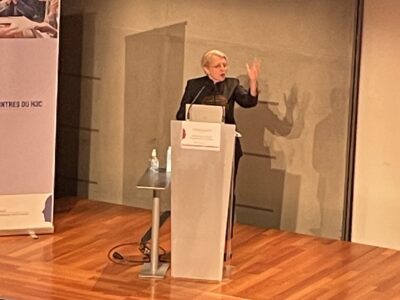
Marie-Anne Frison-Roche intervenant aux Rencontres de la Haute Autorité de l’Audit (H2A), 2 juillet 2025

Conferences

🎥L’enjeu de la crédibilité des rapports de durabilité. Temps long, Simplicité et Stratégie (The credibility of sustainability reports. Time, Simplicity and Strategy), in 🧮Mise en œuvre de la directive CSRD. Premiers constats et perspectives (Implementation of the CSRD directive. Initial findings and outlook)

► Full Reference: M.-A. Frison-Roche, "L'enjeu de la crédibilité des rapports de durabilité. Temps long, Simplicité et Stratégie" (The credibility of sustainability reports. Time, Simplicity and Strategy), concluding speech, in Rencontres de la Haute Autorité de l'Audit (H2A), 2025,  Mise en œuvre de la directive CSRD. Premiers constats et perspectives (Annual Manifestation of the French Audit Regulatory Body Haute Autorité de l'Audit – H2A, Implementation of the CSRD directive. Initial findings and outlook),, 2 July 2025, La Défense, 1pm-6pm - This manifestation, which takes place face-to-face with simultaneous translation, begins with a presentation by Florence Peybernès, President of the French High Audit Authority ( Haute Autorité de l'Audit -H2A). It is followed by 3 round-table discussions: 🪑🪑🪑 Round table 1: Feedback on the first appointments 🪑🪑🪑 Round table 2: Cross-perspectives between preparers, verifiers and stakeholders 🪑🪑🪑 Round table 3: Perspectives for CSRD   It is following on from this that the more legal, more judicial perspective, in an articulation between Ex Ante and Ex Post, will take shape. - ► English summary of the speech, as prepared : n view of the information available at the time of preparation for this event, the considerable interest aroused by the CSRD, and also its contestation, which led to its modification, is it counter-intuitive in view of the technicality of the remarks, the flood of criticism and the number of pages one reads, the impression of the weight, constraints and uselessness of the thing which would deprive companies of their freedom, but what emerges rather is Simplicity. Why: because the sustainability report is only a tool and it is the goal it serves that needs to be considered (more generally that's how the judge looks at it), a tool that serves a European strategy (Green Deal, sustainable finance). It is this strategy that needs to be identified, and the company has a free hand in it. What we are looking at the company in its contribution to this goal that is simple, a contribution which it can, in information that is admittedly standardised, draw the outlines of Long-term and Strategy: Investors and stakeholders are not hostile to this approach: the key is the credibility of the information made available. Because Long-Term Thinking puts the future at the centre, and we don't know what that future will be. This essential element, which the courts have recalled in relation to Vigilance Obligation, must also be borne in mind, because it is first and foremost a question of providing information about the future. To express the Information they want to give on this subject, companies need to understand the Goal of the European Plan (where Simplicity lies), to adjust their own plan to it (under the more familiar term of "Strategy") the councils and lawyers need to help them with this; to blend their strategies with the European strategy, to rely on the authorities and the auditors so that what they say is credible. Credibility is at the heart of it, which is why auditors are at the heart of it. Because the only obligation they have is to say. Not to do. The CSRD should not be interpreted as imposing obligations on the companies subject to it to do things (such as the obligation of vigilance generates); the CSRD only imposes an obligation on them to say things. The CSRD imposes on them only an obligation to inform. While this may be onerous, standardised and certified, there is no obligation to do or disclose anything. Moreover, that is part of the company's own strategy, a strategy over which the company retains full control. In this respect, although standardised, the information is free and it is the credibility of the information that is crucial, but not participation in a plan whose terms would be written by the Authorities or the stakeholders. Therefore, after learning from each other, it seems that there are three fairly simple things that are sometimes buried under the complication of the details accumulated and the violence of the arguments exchanged around the European Omnibus package. These three points will be developed at the end of the round-tables.   The first is the simplicity of the breadcrumb trail of credible, accessible information imposed by the European Union to put the Green Deal into practice. This breadcrumb trail is held in particular by the various regulators. The second is the existence of a single, simple obligation on the part of the company: to say what it has done, is doing and plans to do, without being obliged to do anything in the European Action Plan (the CRSD does not forcibly enroll companies in the European action plan). This limitation to an obligation to say is essential. Its articulation with obligations to act, arising in particular from texts on Vigilance, or even identical terms, must not lead to confusion in qualifications. The third is the benefit that the company derives from the articulation of a double "singular strategy": that of the European Union, which wants to build its future, a strategy of the Union to which it is free to contribute or not to contribute, and that of its own strategy which is articulated with the first and in which green gives way to many other colours according to the will of the company.   ► English Summary of speech, as made with regard to what effectively was said during the 2 round tables:  During the event itself, I preferred to place myself rather in the direct continuation of what had been said.  In the fifteen minutes allotted, this was the reason for not proceeding in this way, but rather to highlight the fact that what has emerged, all these efforts, uncertainty, trial and error and goodwill to elaborate that went into drawing up the first sustainability reports, runs the risk of being erased because in retrospect, in 2 or 5 years' time, particularly if a lawsuit were be brought, we will have the impression that everything was self-evident, that we knew everything, that everything was clear and decided. And it's that future, which will be the future of the judge who will be called upon by a stakeholder, a regulator, a prosecutor, who always takes the past for granted, that we have to think about. We need to think in terms of evidence. Evidence of uncertainty. And always remember that the sustainability report is also a piece of evidence. Which will fuel liability claims, disputes over information, and so on. Plus encore, parce que le report de durabilité n'est qu'un outil, pour une stratégie, qui est une stratégie d'ensemble, où la CSRD n'est qu'un élément du puzzle, des éléments du rapport de durabilité peuvent être pris pour être utilisés plus tard pour alimenter d'autres documents et rapports, et d'autres litiges. Cela est notamment le cas du plan de vigilance, puisque la cartographie des risques est souvent commune au rapport de durabilité et au plan de vigilance, ce qui est logique puisque la CSRD et la CS3D se font miroir dans le grand plan d'action de l'Union que constitue le Pacte vert. Mais cela est amplifié par les entreprises, qui parfois confondent l'un et l'autre, dans la présentation même au sein du rapport de gestion. Il est pourtant essentielle de distinguer nettement l'obligation de dire (rapport de durabilité) et l'obligation de faire (plan de vigilance). L'ambiguïté des "engagements" accroît cela. Il est essentiel de veiller à un travail ex ante entre expert de la gestion, de la finance, de l'audit et du droit pour éviter que les points de contact ne se transforment en confusions, maintenant et /ou plus tard, confusions qui pourraient être préjudiciables à tous. - 🌐follow Marie-Anne Frison-Roche on LinkedIn 🌐follow Marie-Anne Frison-Roche on Instagram 🌐subscribe to the Newsletter MAFR Regulation, Compliance, Law 🌐subscribe to the Video Newsletter MAFR Surplomb 🌐subscribe to the Newsletter MaFR Droit & Art

Articles in a non-legal collective publication

article in a non-legal collective publication

📝Le Droit de la compliance, voie royale pour réguler l’espace numérique (Compliance Law as a Royal Road for regulating the Digital Space​), in📚Enjeux numérique,📗Régulation et Compliance

► Full Reference: M.-A. Frison-Roche, "Le Droit de la compliance, voie royale pour réguler l'espace numérique" (Compliance Law as a Royal Road for regulating the Digital Space), in P. Bonis et L. Castex (dir.), Compliance et nouvelles régulation, Annales des Mines, coll. "Enjeux numériques", juin 2025, pp. 69-77. - 📝 read the article (in French)  - 🚧This article is underpinned by a English Working Paper in English, with additional technical developments and hypertext links. : Compliance Law as a Royal Road for regulating the Digital Space - ► English Summary of this article:  In order to describe the role of Compliance Law in regulating the digital space and to conclude that this new branch of Law is the 'royal road' to this end, this study proceeds in 6 stages.  Firstly, at first sight and conceptually, there is a gap between the political idea of Regulating and the ideas (freedom and technology as 'law') on which the digital space has been built and is unfolding.  Secondly, in practice, there is such a huge gap between the ordinary methods of Regulatory Law, which are backed by a State, and the organisation of the Digital Space by these economic operators, that are both American and global.  Thirdly, the political claim to civilise the Digital Space remains and is growing, relying on the very strength of the entities capable of realising this ambition, these entities being the crucial digital operators themselves, seized as Ex Ante.  Fourthly, it corresponds to the conception and practice of a new branch of Law, Compliance Law, which should not be confused with "conformity" and which is normatively anchored in its "Monumental Goals".  Fifthly, Compliance Law internalises Monumental Goals in the digital operators which disseminate them through structures and behaviours in the digital space.  Sixthly, through the interweaving of legislation, court rulings and corporate behaviour, the Monumental Goals are given concrete expression, willingly or by force, in ways that can civilise the digital space without undermining the primacy of freedom. - 🌐follow Marie-Anne Frison-Roche on LinkedIn 🌐follow Marie-Anne Frison-Roche on Instagram 🌐subscribe to the Newsletter MAFR Regulation, Compliance, Law 🌐subscribe to the Video Newsletter MAFR Surplomb 🌐subscribe to the Newsletter MaFR Droit & Art

Texts

🏛️Directive (EU) of 13 June 2024 on corporate sustainability due diligence (CS3D)

► Full Reference: Directive (EU) 2024/1760 of the European Parliament and of the Council of 13 June 2024 on corporate sustainability due diligence and amending Directive (EU) 2019/1937 and Regulation (EU) 2023/2859 (CS3D) - ► read the text of the directive - 📧see on LinkedIn the article published by Marie-Anne Frison-Roche in the Newsletter MAFR. Regulation, Compliance, Law, on the occasion of the publication of this directive in the Official Journal of the European Union -

Texts

Directive (EU) 2024/1640 of 31 May 2024 on the mechanisms to be put in place by Member States for the prevention of the use of the financial system for the purposes of money laundering or terrorist financing

► Référence complète : Directive (EU) 2024/1640 of the European Parliament and of the Council of 31 May 2024 on the mechanisms to be put in place by Member States for the prevention of the use of the financial system for the purposes of money laundering or terrorist financing, amending Directive(EU) 2019/1937, and amending and repealing Directive (EU) 2015/849 - ► read the text -

Breaking news

💬GPA : “Il faut cesser de passer la femme par pertes et profits” (Surrogacy: “We have to stop writing off women”)

► Full Reference: M.-A. Frison-Roche, "GPA : "Il faut cesser de passer la femme par pertes et profits"" ("Surrogacy: "We have to stop writing off women""), interview with Olivia Dufour, Actu-Juridique, April 30, 2024 - 💬read the interview (in French) - ► Presentation of the interview by the journal: "Le 23 avril 2024, les députés européens ont adopté une loi élargissant le champ d’application des mesures actuelles pour combattre et prévenir la traite des êtres humains et mieux soutenir ses victimes, par 563 voix pour, 7 contre et 17 abstentions. La maternité de substitution, ou GPA, entre désormais dans le champ de la traite des êtres humains. Mais depuis quelques jours, la polémique fait rage. Le nouveau texte réprime-t-il uniquement la GPA contrainte organisée par une association criminelle, ou toute forme de GPA ? Nous avons demandé au professeur Marie-Anne Frison-Roche, auteur d’un ouvrage intitulé « GPA : dire Oui ou dire Non » publié chez Dalloz en 2018, de nous éclairer sur les enjeux attachés à cette question et sur la position de l’Europe.". (Free translation: "On April 23, 2024, Members of the European Parliament adopted a law extending the scope of existing measures to combat and prevent human trafficking and provide better support for its victims, by 563 votes to 7 with 17 abstentions. Surrogacy (gestation pour autrui – GPA in French), now falls within the scope of human trafficking. But in recent days, controversy has been raging. Does the new text punish only forced surrogate motherhood organised by a criminal association, or all forms of surrogacy? We asked Professor Marie-Anne Frison-Roche, author of a book entitled "GPA: dire Oui ou dire Non" ("Surrogacy: say Yes or say No") published by Dalloz in 2018, to shed some light on the issues surrounding this question and on Europe's position".) - 🕴️M.-A. Frison-Roche, 📕GPA : dire Oui ou dire Non (Surrogacy: say Yes or say No), 2018 - ► Questions asked, answers given: Actu Juridique. Question : La GPA est une pratique ancienne même si elle est longtemps restée marginale, qu’est-ce qui a changé et nécessite aujourd’hui l’attention des pouvoirs publics et du législateur ?   Surrogacy is a long-standing practice, even if it was marginal for a long time. What has changed that now requires the attention of public authorities and legislators?   Marie-Anne Frison-Roche. Answer. : Two things have changed this practice. The first is the possibility of introducing a man's gametes and a woman's oocyte into a woman's body, thus reducing her to being a "carrier" and providing this service, which is very much in demand. The second is the transformation of the desire for a child, an eternal desire shared by many, into a "right to a child". This right to a child would need to be put into practice by any means, for the benefit of any holder who is unable or unwilling to suffer the inconvenience of pregnancy. This is how the practice developed. The legislator intervened, following case law, by declaring, as the Cour de cassation (French Court of cassation) had done, that this practice was contrary to the dignity of the human being, punishable under both the Code civil (French Civil Code) and the Code pénal (French Criminal Code).     A.J. Q. : Autrement dit, les innovations techniques couplées à l’émergence d’un sentiment de droit à l’enfant ont fait exploser la demande de maternité de substitution… In other words, technical innovations coupled with the emergence of a sense of entitlement to a right to a child have led to an explosion in demand for surrogacy… MaFR. A. : Yes, but this demand has to be matched by an offer. There are few fertile women prepared to bear children for others. The desire to have children is not matched by a desire to bear them for others without compensation. And the few women who are willing to do so are in countries far removed from the people who want them. The practice has only developed because of the very prosperous agencies on which everything depends. Without this intermediation, towards Ukraine for example, the practice could not have spread.   A.J. Q. : L’Europe avait-elle déjà pris position sur la GPA et si oui, par quels textes et dans quel sens ? Has Europe already taken a position on surrogacy and, if so, in what texts and in what direction?   MaFR. A. : In Europe, it was the case law of the ECHR which in 2014 (Mennesson judgments) broke with French jurisprudence to impose that the filiation of a child born as a result of a surrogacy carried out abroad in a country where surrogacy is lawful can be established with regard to the father whose gametes had been used. All that remained was for the child to be adopted by the father's spouse. This did not change domestic legislation, but the way civil status works means that the prohibition can be rendered ineffective. But this meant saying Yes and No at the same time… The challenge was therefore to amend the texts, either to exclude surrogacy more strongly, or to admit it more openly.     A.J. Q. : Dans ce contexte, quelle nouveauté apporte le texte adopté par le Parlement européen le 23 avril dernier ? Against this backdrop, what is new about the text adopted by the European Parliament on 23 April? MaFR. A. : It depends on how you interpret it. When the text of the directive was being discussed, no one disputed that its adoption would result in the effective prohibition of surrogacy throughout the European Union and the strengthening of the basis of this prohibition in that surrogacy constitutes trafficking in human beings, the woman who carries the child and who legally remains the mother since she gives birth to the child, and that child. But once voted, the text gives rise to another interpretation, supported by some. It is argued that trafficking in human beings is not the "legal category" into which surrogacy falls, but the "condition" under which surrogacy is punishable; So, if surrogacy is practised without "trade" (trafficking is a trade), if there is no money involved, if there is only altruism and concern for the other person, then not only is surrogacy not punished, but what is more, this so-called "altruistic" surrogacy becomes legitimate by the very fact of this directive! The scope is therefore quite simply the opposite… This could give rise to litigation.   A.J. Q. : Dans l’ouvrage que vous avez consacré à la GPA en 2018 chez Lefebvre-Dalloz préfacé par Éliette Abécassis, vous montrez qu’on peut dire Oui ou Non à la GPA, mais qu’il faut répondre et surtout vous mettez en lumière les implications de ces choix. Pourquoi faut-il forcément répondre à cette question ? In your book on GPA published by Lefebvre-Dalloz in 2018, with a preface by Éliette Abécassis, you show that we can say Yes or No to surrogacy, but that we must answer, and above all you highlight the implications of these choices. Why do we have to answer this question? MaFR. A. : The question of whether or not to allow surrogacy must be answered (say Yes or say No), because it is a question of society. Not to answer it, to say neither yes nor no, to say yes and no at the same time, is not to choose the society in which we want to live.   A.J. Q. : Imaginons que l’on choisisse le Oui. Qu’implique-t-il sur les valeurs de la société et l’état du droit ? What does this mean for the values of society and the Rule of Law? MaFR. A. : If we accept that surrogacy is legal, then it is the will of the people involved that gives birth to the child. The agreement between the person or persons planning to have a child and the woman who agrees to carry the child, with the agent acting as intermediary. It is the society of the contract, because the State is nothing, it is only the scribe who copies the stipulations onto the civil status register. Parentage ceases to be the institution guarded by the State through which the individual is anchored in the social group. Parentage becomes a private matter. This contract-based society is in fact a market society.    A.J. Q. : Et si l’on dit Non à la GPA, on le fait sur quel fondement et pourquoi ? And if we say No to GPA, on what grounds and why? MaFR. A. : If we maintain the prohibition of surrogacy and seek to make it effective, in particular by taking action against agencies, we are referring to a society where the State, through public order, watches over human beings and where the law controls power and protects women. - 🌐follow Marie-Anne Frison-Roche on LinkedIn 🌐follow Marie-Anne Frison-Roche on Instagram 🌐subscribe to the Newsletter MAFR Regulation, Compliance, Law

Conferences

🎤Les voies d’innovations juridiques face aux nouveaux “défis climatiques” (“Innovative legal solutions to the new “climate challenges””), in 🧮Nouveaux défis – Regards croisés : Droit, Économie et Finance. Quel Droit face au Changement Climatique ? (“New challenges – Crossed perspectives : Law, Economics and Finance. What Law in the Face of Climate Change?”)

► Full Reference: M.-A. Frison-Roche, "Les voies d'innovations juridiques face aux nouveaux "défis climatiques" ("Innovative legal solutions to the new "climate challenges""), in C. Arnaud, O. de Bandt et B. Deffains (dir.), Nouveaux défis – Regards croisés : Droit, Économie et Finance. Quel Droit face au Changement Climatique ? (("New challenges – Crossed perspectives : Law, Economics and Finance. What Law in the Face of Climate Change?"), Banque de France (French Central Bank) and CRED/Paris Panthéon-Assas University, Paris, Centre de Conférence de la Banque de France, April 2, 2024 - 🧮See the full programme of this event - 🔲see the slides, basis of this conference (in French) - ► Summary of this conference: In response to the question of how the Law can produce 'innovations' to meet the 'climate challenges', the process is based on the three traditional sources of Law, which are, firstly, laws and regulations, secondly, the commitments of individuals, mainly contracts, and thirdly, court rulings. At first sight, the Law in its traditional conception and practice is weak in the face of climate change. This weakness is inherent in the nature of climate change, which is at once future, global and systemic, in the face of these three sources of Law, which do not address all three dimensions at once. The scale of the legal innovation required to ensure that one or more articulated sources can grasp the future, the global and the systemic is therefore clear. And yet this is what is happening. As far as laws and regulations are concerned, they do not seem very appropriate because they are, by their very nature, a territorial limit, and international treaties are very difficult to negotiate. The interweaving of European regulations, for example the CSRD and the CS3D, which mirror each other, may be more effective. As far as 'commitments' are concerned, a concept which in Law is not very precise outside of contracts and liability cases📎1🕴️M.-A. Frison-Roche, 📝What a commitment is, in 🕴️M.-A. Frison-Roche (ed.), 📘Compliance Obligation, 2024., contracts are above all a means for companies to fulfill their legal obligations, and a contract always implies a judge. At first sight, however, the judge is the least well placed to respond to 'climate challenges', particularly in France where he is said or wished to be powerless, where he rules on the past and where, especially the civil judge, he settles a one-off dispute between two singular parties. But a major change has occurred with the emergence of a new branch of law: the Compliance Law, a teleological branch of Law whose legal normativity is lodged in the Monumental Goals📎2🕴️M.-A. Frison-Roche, 📝Compliance Monumental Goals, beating heart of Compliance Law, in 🕴️M.-A. Frison-Roche (ed.), 📘Compliance Monumental Goals, 2023. that it pursues, namely the preservation of systems, for example the climate system. In France, the so-called "Sapin 2" law in 2016, followed by the so-called "Vigilance" law in 2017, illustrate this. And the Judge is at the centre of it all. In this global, systemic, extraterritorial perspective, the object of which is the future – Compliance Law is, moreover, rejected by many legal experts – the legislative innovation is major. Indeed, the law of 23 March 2017, known as "Vigilance" designated large companies, because they are "powerful", because they are "in a position to act" to "detect and prevent" breaches of the environment and human rights. The 2017 law copied the "compliance tools"📎3🕴️M.-A. Frison-Roche (ed.), 📘Compliance Tools, 2021. put in place by the Sapin 2 anti-corruption law: risk mapping, plans, alerts, audits, internal investigations, and so on.  Only large companies are subject to the Compliance Law, notably the Vigilance Law, since they are the only ones in a position to act, in this case "parent companies or principals", and borders are no longer limits since the obligation, creating personal liability for the company📎4🏛️Conseil constitutionnel (French Constitutional Council), March 23, 2017, decision No. 2017-750 DC, Loi relative au devoir de vigilance des sociétés mères et des entreprises donneuses d’ordre., extends throughout the "value chain". The notion and fact of "systemic dispute" is emerging before the courts. In France, the Paris Court of First Instance has exclusive jurisdiction. European legislation is proving more difficult to draw up, because although it is compulsory to provide information on these "extra-financial" subjects (CSRD), the directive on the duty of vigilance, which has just been adopted, does not go any further than the French law of 2017. On the second point, that of commitments, we are only at the beginning. Judges do not transform ethical statements into "unilateral legal commitments", and vigilance does not transform company law into co-management. But contracts do form a global network through which companies adjust their various legal obligations. This is why arbitrators, the only "global judges", will soon be involved in this systemic litigation📎5🕴️M.-A. Frison-Roche (ed.), 📘Compliance Obligation, 2024, of which a chapter is dedicated to "International Arbitration in support of the Compliance Obligation"., and more general case law is to come on "compliance contracts and clauses"📎6🕴️M.-A. Frison-Roche, 🚧Compliance contract, compliance clauses, 2022 ; 🕴️M.-A. Frison-Roche (ed.), 📘Contrat and Contract, 2024.. But the most innovative aspect undoubtedly comes from the courts. Perhaps and notably in France because it is from where we least expect it, the civil courts, that the imagination comes, but also the guarding of the great principles of the Rule of Law, because for the moment the case law is reasonable. This innovation has not come about proprio motu: the judges are not taking action, it is the NGOs that are conducting a kind of litigation policy, systematically giving formal notice to the major energy companies, but also to the major banks and insurers on climate issues, alleging non-compliance with their vigilance plans. The interim relief judge at the Paris Court of First Instance must then provide answers in systemic disputes, of which the so-called "Total Uganda"📎7🏛️Tribunal judiciaire de Paris (Paris First Instance Civil Court), summary rulings, February 28, 2023, No. RG 22/53943 and 22/53942, Total Ouganda. case is an example. The courts are demonstrating a great deal of innovation. The Court of First Instance's interim relief judge has appointed amici curiae📎8🕴️N. Cayrol, 📝L'amicus curiae, mesure d'instruction ordinaire, 2022., the Paris Court of Appeal has set up a specialised chamber📎9On the creation on the new 5-12 Chamber, Contentieux émergent – Devoir de vigilance et responsabilité écologique see 🕴️J. Boulard, 💬Contentieux systémique : "Il est important, pour les magistrats, de rester au plus près des réalités" (Systemic litigation: "It is important for judges to remain as close as possible to reality"), March 28, 2024., and training conferences have been set up on this "Emerging Systemic Litigation"📎10🕴️M.-A. Frison-Roche, 💬"Nous voyons émerger aujourd’hui le contentieux systémique" ("We are now seeing the emergence of the Systemic Litigation"), March 28, 2024 ; 🕴️M.-A. Frison-Roche, Coordination and animation of cycle of conference-debates 🧮Contentieux Systémique Émergent (Emerging Systemic Litigation). . In conclusion, Law is in the process of being rebuilt through a new branch of Law, Compliance Law, whose the very purpose, as an extension of and going beyond Regulatory Law📎11🏛️Conseil d'État (French Council of State) and 🏛️Cour de cassation (French Court of cassation), 📗De la régulation à la compliance : quel rôle pour le juge ? (From Regulation to Compliance: what role for the Judge?), 2024; 🕴️M.-A. Frison-Roche, 🚧The deployment of Regulatory Law through Compliance Law in the European project, 2023 ; 🚧Compliance Law loses the ties of Regulation Law but retains its principles : consequences for companies, 2018 ; 🚧From Regulation Law to Compliance Law, 2017., is to preserve systems, in particular the climate system, in a profoundly renewed role for judges📎12🕴️M.-A. Frison-Roche, 📝Le rôle du juge dans le déploiement du droit de la régulation par le droit de la compliance et ;🕴️Fr. Ancel, 📝Quel rôle pour le juge aujourd’hui dans la compliance ? Quel office processuel du juge dans la compliance ?, in 🏛️Conseil d'État et 🏛️Cour de cassation, 📗De la régulation à la compliance : quel rôle pour le juge ?, 2024 ; 🕴️Fr. Ancel, 📝Le principe processuel de compliance, un nouveau principe directeur du procès ?, in M.-A. Frison-Roche (dir.), 📕La juridictionnalisation de la Compliance, 2023 ; 🕴️M.-A. Frison-Roche, 📝Le Juge requis pour une Obligation de Compliance effective, in 🕴️M.-A. Frison-Roche (dir.), 📕L'Obligation de Compliance, 2024.. - 🌐follow Marie-Anne Frison-Roche on LinkedIn 🌐follow Marie-Anne Frison-Roche on Instagram 🌐subscribe to the Newsletter MAFR Regulation, Compliance, Law

Conferences

🎤Conclusion, in 🧮L’eau : entre protection de la ressource et conflits d’usage

🌐follow Marie-Anne Frison-Roche on LinkedIn 🌐subscribe to the Newsletter MAFR Regulation, Compliance, Law - ► Full Reference: M.-A. Frison-Roche, "Conclusion", in Club des avocats environnementalistes, L’eau : entre protection de la ressource et conflits d’usage, Maison des Avocats, Auditorium, September 28, 2023. - 🧮see the full programme of this event -

Conferences

🎥L’esprit des Lois en matière de vigilance (“Spirit of Law in Vigilance (Due Diligences) matters”), in 🧮Réalités et défis de la CSRD – Perspectives du devoir de vigilance

► Full Reference: M.-A. Frison-Roche, "L'esprit des Lois en matière de vigilance" ("Spirit of Law in Vigilance (Due Diligences) matters"), in Haut Conseil du Commissariat aux Comptes (H3C), Réalités et défis de la CSRD – Perspectives du devoir de vigilance, Paris, 14 June 2023. - 🎥watch the video of a part of the speech (in French) - 🧱read the description of the speeches of other speakers of this panel (in French) -   The speech took place during the third-round table devoted to the Perspectives du devoir de vigilance (Perspectives of the duty of vigilance), the first round table having been devoted to the lessons that the DPEF can provide for the CSRD, and the second to the transposition work of the CSRD. 🧮See the full programme of this annual event (in French) - ► English summary of the speech: In consideration of and in addition to what has been said, explained and even affirmed by other speakers, I have emphasised that 'vigilance" laws is not a 'regulation' like any other, but the leading edge of a very vast movement, Compliance Law, in which the 2017 French law is the driving force. For its application, the Judge, who is at the centre because of the will of the Legislator, is already taking into consideration the CS3D, the twin text of the CSRD. The texts must not be seen in isolation. If we isolate them from each other, they become almost incomprehensible, their meaning appearing uncertain, even threatening: we need to understand the spirit of these texts, which are indeed new, because they aim to provide answers to the new world we have entered. We must all rejoice in this political ambition, which is taking a legal form, and work to make it efficient: Legislators, companies, auditors, Regulators and Judges. If we do not stop at the letter, which would be to reduce Compliance to conformity, whereas Compliance Law, particularly Vigilance, is the extension of Regulation, finds its meaning in the Goals, we see that the French law of 2017, known as the "Vigilance law", which copies all the techniques of the French law known as "Sapin 2", gives goals simple to understand to the companies subject to the Legislator's will: detect and prevent environmental and human rights abuses in the value chains. The logic is therefore Ex-Ante. This Ex-Ante logic is retained by the CS3D directive. The Judge is central to it. But the responsibility which the NGOs will ask him to trigger is itself an "Ex Ante responsibility", the Compliance trials being like "accountability" trials, to ensure that companies act in accordance with the Goals set by the Legislator. This is transforming the role of the Judge, who must find effective solutions for the future. The discussion and the adversarial principle will become more important. Mediation will be encouraged. Stakeholders and the company will have to work together, and this method, which was intended by the Legislator for drawing up the vigilance plan, will be continued in the supporting legal proceedings. This will also transform the company, and the role played by those who accredit the information on the company's actions and long-term strategies: auditors therefore have a central role to play. - 🌐follow Marie-Anne Frison-Roche on LinkedIn 🌐follow Marie-Anne Frison-Roche on Instagram 🌐subscribe to the Newsletter MAFR Regulation, Compliance, Law

Conferences

conference

🎤Conclusions, in 🧮le devoir de vigilance des entreprises : l’âge de la maturité ?

🌐 flollow Marie-Anne Frison-Roche on LinkedIn 🌐subscribe to the Newsletter MAFR Regulation, Compliance, Law  - ► Full Reference: M.-A. Frison-Roche, "Conclusions", in Ch. Maubernard et A. Brès (dir.), Institut de droit européen des droits de l'homme et Centre de droit de l'entreprise, Université de Montpellier, Le devoir de vigilance des entreprises : l'âge de la maturité?("The Entreprises duty of vigilance: the maturity age?") , Montpellier, May 25, 2023. The conference is held in French. - 🧮see the manifestation programme (in French) - 🌐 read the report done on LinkedIn (in French) - ► English summary of this final speech of the manifestation: It is rather difficult to draw a conclusion after listening so many contributions. For three reasons: firstly, because of their richness and extreme diversity; secondly, because of the fact that we do not know whether the duty of vigilance is under the French law of 2017 (known as the Vigilance Law) or in other national, European and international texts or beyond or below the legal rules; thirdly, because we do not know what is meant by the "maturity" of a legal concept. But in the end, since the question posed by the title itself of the colloquium is Duty of Vigilance: the age of maturity? the answer is clearly: no. But this is regrettable. It is therefore essential to explore the ways in which the duty of vigilance can mature.  If we find merit in this duty which has now entered the legal system, there are eight intersecting avenues, which must be exploited. The first path is progression through the passage of time, rediscovering what in the past was already vigilance and what in the future will be its deployment. The second way is to progress by fixing the vocabulary, because we are witnessing a great battle of words, overtly or covertly, in French or English. The third path is progression through the emergence of principles, or even a principle, rediscovered or invented. The fourth path is progression through coherence brought to the legal system(s), which at present suffer from gaps and inconsistencies, which could be remedied by methods such as centralising litigation or, more radically, ignoring borders. The fifth path is progression through the fact that it works, because vigilance techniques are those of Compliance, of which vigilance is the leading edge, and the challenge is to find solutions. The sixth path is progression through using power of the legal system not only to create new areas of relevance – starting with the notion of vigilance, but also that of the value chain – but also to impose new indifferences, namely indifference to the figure of the market (to which laws prefer the company and the value chain) and indifference to borders. The seventh path is progression through bringing perspectives closer together, in order to find solutions even when interests are opposed. This is where the two techniques of contract and mediation are very welcome. The eighth path is progression through culture, because the culture of vigilance, like the culture of compliance, must be developed within companies and supply chains, and must become common to them and their stakeholders. - 🚧read the Working Paper written just after this oral conclusion in preparation for the article to be published. -  

Reports

📓Report of the Committee on Legal affairs of the European Parliament on the proposal for a directive of the European Parliament and of the Council on Corporate Sustainability Due Diligence and amending Directive (EU) 2019/1937

► Full Reference: Committee on Legal Affairs of the European Parliament, Report on the proposal for a directive of the European Parliament and of the Council on Corporate Sustainability Due Diligence and amending Directive (EU) 2019/1937, 8 May 2023. - 📓read the report -

Texts

🏛️Directive (EU) 2022/2464, of 14 december 2022, amending Regulation (EU) n° 537/2014, Directive 2004/109/EC, Directive 2006/43/EC and Directive 2013/34/EU, as regards corporate sustainability reporting

► Full reference: Directive (EU) 2022/2464 of the European Parliament and of the Council, of 14 december 2022, amending Regulation (EU) n° 537/2014, Directive 2004/109/EC, Directive 2006/43/EC and Directive 2013/34/EU, as regards corporate sustainability reporting (called "CSRD" (Corporate Sustainability Reporting Directive)). - ► Read the text  -

Articles in a legal collective publication

📝The proposal for a European Directive on the duty of vigilance: brief views on civil liability

► Full Reference: A. Danis-Fatome, "The proposal for a European Directive on the duty of vigilance: brief views on civil liability", International Business Law Journal, 5, 2022, pp. 489-497. - ► Summary of the article (done by the Journal of Regulation & Compliance):  -

Texts

European Parliament and European Council

Directive 2020/1818 on representative actions for the protection of the collective interests of consumers

Full reference: Directive (EU) 2020/1828 of the European Parliament and of the Council of 25 November 2020 on representative actions for the protection of the collective interests of consumers and repealing Directive 2009/22/EC Read the directive

Articles in a legal collective publication

📝The impossible legal unicity of the category of “whistleblowers” (“L’impossible unicité juridique de la catégorie des “lanceurs d’alertes” “)

Full reference: Frison-Roche, M.-A., L'impossible unicité juridique de la catégorie des "lanceurs d'alertes" ("The impossible legal unicity of the category of "whistleblowers""), in Chacornac, J. (dir.), Lanceurs d'alertes, regards comparatistes, ("Whistleblowers, comparative perspectives"), Publications of the Centre français de droit comparé ("French Comparative Law Center"), May 2020, Volume 21, pp. 13-31.    Read the article (in French).    Read the general presentation of the collective book in which this article is published Read the bilingual working paper which had served of basis for this article.  Read the presentation of the conference "Les lanceurs d'alertes: glose" (Whistleblowers: glose") and especially the slides elabored for the colloquium organized by the Centre français de droit comparé ("French Comparative Law Center") on 23th of November 2018 under the direction of Jérôme Chacornac - Introduction of the article "Whistleblowers". This is a new expression. Which is a great success. Barely heard once, we hear it everywhere … A topic not of course or knowledge test, but rather a topic of daily conversation. Because it is spoken to us every day, in more or less gracious terms. For example President Donald Trump on October 1, 2019 declared to the press "want to question" the whistleblower who would have illegally denounced him and would not, according to him, have the right to conceal his identity, proof in this according to him of the lying character of his assertions against him, while his lawyer indicates on October 6, 2019 that he is not speaking on behalf of a single whistleblower thus taken to task but of a plurality of people who gave information against the President of the United States. Even the most imaginative screenwriters would not have written such brutal and rapid twists and turns. Spectators, we are waiting for the next episode, secretly hoping for the escalation. And precisely if we go to the cinema, it is still a whistleblower whose dedication and success, we are told about, even the drama, for the benefit of global society, and in particular democracy, since the secrets are fought for the benefit of the truth. The Secret Man designates Mark Felt as the first whistleblower. Returning to what we often present as being a more "serious" media1On the more general fact that cinema is undoubtedly the medium which most seriously restores the state of the Law, c. Frison-Roche, M.-A., Au coeur du Droit, du cinéma et de la famille : la vie, 2016., we listen to France-Culture and here is another story told by a historian who worked as an archivist on events that political power would have liked to keep hidden by possibly destroying their traces but which its trade led to preserve: here it is expressly presented to the studious listeners like a "whistleblower" …. While the same radio tries to find the one who could well be, as in a kind of contest the "first whistleblower"2L'histoire du premier lanceur d'alerte, France Culture, septembre 2019. ? …. This rewriting of History can be defended because ultimately what did other Voltaire do for Calas, or Zola for Dreyfus? It is also a subject of legislative discussion since in the United States the Dodd-Frank law of 2010 inserted in the law of 1934 which established the Securities & Exchanges Commission a complete device of remuneration and remuneration of the whistleblowers, whereas after having developed flexible but guiding lines in this regard in 20123European Commission, Guidelines on Whistleblowing, 6 of December 2012, SEC(2012) 679 final, updated on 23 of April 2018. , the European Commission published on November 20, 2018 the text of what will become a Directive intended to give a unified European status to the character, in the system gradually developed to protect the one who was presented in 2018 as that "cannot be punished for having done what is right". In Europe, the Directive first approved by a Resolution of the European Parliament on April 16, 2019 on the protection of persons denouncing breaches of Union Law and then adopted on October 7, 2019 (Directive of the European Parliament and of the Council of European Union on the Protection of Persons who Report Violations of European Union Law, different title, it should be noted, will have to be transposed into the laws of the Member States within the next two years. , since only "violations of Union Law" are targeted, but the character of the "whistleblower" is more generally targeted: he is "whole"4However, precisely the so common use of plurality ("whistleblowers") raises doubts about the uniqueness of the character. On this question, see. all the first part of the developments of this study, which leads to the conclusion rather than beyond the multitude of particular cases, there are rather two kinds of whistleblowers. V. infra I.. In short, the whistleblower is a star5The director of the film La fille de Brest says that she considers the whistleblower at the origin of the case of the Pick as a "movie character".. A sort of historical figure, covered in blows and glory, going from Voltaire to Snowden, both of whom find themselves embodied on the screens6Thus, the adventures of Snowden were brought to the screen by Oliver Stone in 2016, Snowden. On the question of knowing whether this film "faithfully reproduces" or not the case, Schetizer, P., Le film Snowden est-il à la hauteur de la réalité?, 2017. This article is favorable to the whistleblower, and to the film which tells us with emotion his case, in particular because (sic), it is easier than to read the Washington Post. …., Consecrated by law, which associates with it a legal regime of protection to such an extent that, like a Nessus tunic, it is this legal regime which will define the character and not the reverse. When we read the law of December 9, 2016 relating to transparency in the fight against corruption and the modernization of economic life, known as "Sapin 2", we notice that the Legislator makes much of this character, since 'he dedicates its chapter II to him7Underlined by us.: "From the protection of whistleblowers", and that it is by his very protection that he formally opens the door of Right to him. But why a plural? Admittedly when we read the recitals of the Community Directive of October 7, 2019 on the protection of whistleblowers8About this directive, v. the developments infra, it is only a list of all the subjects on which it is a good idea to protect them, which therefore prompts us to see in this plural only the index of this non-exhaustive list of subjects which it is good to tell us, a sign of the lack of definition of who should alert us. Reading the French law known as "Sapin 2" makes it less severe but more perplexing. Indeed, this plurality referred to by the title of the chapter devoted to "whistleblowers", there is no longer any question in the rest of the law, in the very definition which follows, article 6 which opens this chapter devoted to "whistleblowers" offering the reader immediately a singular since it begins as follows: "A9Underlined by us. whistleblower is a person …". No mention of diversity. The art of legislative writing would however have required that the qualifying article not only be singular but that it should not yet be undefined. Stendhal if he had still deigned to have the law for bedside book would have wanted to find at the beginning of chapter a sentence like: "The10Underlined by us. whistleblower is a person …". Thus seem to contradict themselves within the law "Sapin 2 the very title which presents the character, in that it uses a defined plural (the) while the defining article which presents it is in the undefined singular (one). … Here is a first reason not to advance any more but in a very careful way, in this "step by step" that constitutes a reading word for word: a gloss. This consists of taking the expression itself literally. The second reason for this technical choice is that the gloss is well suited to the introduction of a collective work, thus allowing more targeted developments to take place in other contributions, on the techniques, the difficulties and the limits of this protection, or on its history, or the reasons for the arrival in French law of these whistleblowers and the way they develop, or not, elsewhere. I am therefore going to content myself with taking this already legal expression to the letter: The (I) whistle (III). blowers (II).       

Working papers

🚧 THE IMPOSSIBLE UNICITY OF THE LEGAL CATEGORY OF WHISTLEBLOWERS

This working paper served as a basis for a conference done in French for the Centre de droit comparé (Center for Comparative Law) in Paris on 23 November 2018. Updated, it has served as a basis for an article published in French in a book of the Société de Législation comparé (Society of Comparative Legislation).   -   "The whistleblowers". This is a new expression. Which wins a full success. Barely heard once, we hear it everywhere … A theme not only of academic teaching, but rather a topic of daily conversation. Because it is every day that we speak about it, in terms more or less graceful. For example President Donald Trump on October 1, 2019 told the press he "wants to interrogate" the whistleblower who would have unlawfully denounced him and would not have, according to him, the right to conceal his own identity, evidence in this according Donald Trump of the false character of his assertions against him, while his lawyer indicates on October 6, 2019 that he does not speak on behalf of a single whistleblower thus taken apart but of a plurality people who gave information against the President of the United States. Even the most imaginative scriptwriters would not have written twists as abruptly or so fast. Spectators, we wait for the next episode, secretly hoping for climbs and slashs. Precisely if we go to the cinema, it is still a whistleblower whose dedication and success, or even drama, we are told, for the benefit of the global society, and especially of Democracy, since the secrets are fought for the benefit of the truth. Thus, the movie The Secret Man designates Mark Felt as the first whistleblower. Returning to what is often presented as a more "serious" media, for example in France the radio "France Culture" we can learn the story of a historian who worked as an archivist on events that the political power would have wanted to keep hidden by possibly destroying their traces but that his profession led to preserve1On the more general fact that cinema is undoubtedly the medium which most seriously restores the state of the Law, c. Frison-Roche, M.-A., Au coeur du Droit, du cinéma et de la famille : la vie, 2016.: here it is expressly presented to the studious listeners as a "whistleblower" … While the same radio is trying to find the one that could be, as in a kind of contest, the "first whistleblowers"2L'histoire du premier lanceur d'alerte, France Culture, septembre 2019. ?. This rewriting of History can be made because finally Voltaire for Calas, or Zola for Dreyfus did they anything else?  It is also a topic of legislative debate since in the United States the Dodd-Frank Act of 2010 inserted in the 1934 law that established the Securities & Exchanges Commission (SEC) a complete system for retribution and remuneration of whistleblowers, while after elaborating guidelines about about in 20123European Commission, Guidelines on Whistleblowing, 6 of December 2012, SEC(2012) 679 final, updated on 23 of April 2018. , the European Commission has published the text on November 20, 2018 in order to give the character a unified European status, in the device gradually developed to protect the one that was presented in 2018 as who  like that : ""The new whistleblowers' protection rules will be a game changer. In the globalised world where the temptation to maximise profit sometimes at the expense of the law is real we need to support people who are ready to take the risk to uncover serious violations of EU law. We owe it to the honest people of Europe.". Step for the Directive of October 7, 2019.  In Europe, the Directive first approved by a Resolution of the European Parliament on 16 April 2019 on protection of persons reporting breaches of Union law and then adopted on 7 October 2019 (Directive 2019/78 (EU) of the European Parliament European Union and the Council of the European Union on the Protection of Persons Reporting Breaches of Union law, will have to be transposed in the next two years to the legal systems of the Member States. is not general, since only "violations of European Union Law" are targeted but the character of the "whistleblower" is more generally referred to: it is "whole"4However, precisely the so common use of plurality ("whistleblowers") raises doubts about the uniqueness of the character. On this question, see. all the first part of the developments of this study, which leads to the conclusion rather than beyond the multitude of particular cases, there are rather two kinds of whistleblowers. V. infra I.. In short, the whistleblower is a star 5The director of the film La fille de Brest says that she considers the whistleblower at the origin of the case of the Pick as a "movie character".. A kind of historical character, covered with blows and glory, going from Voltaire to Snowden, one as the other being incarnated on the screens6Thus, the adventures of Snowden were brought to the screen by Oliver Stone in 2016, Snowden. On the question of knowing whether this film "faithfully reproduces" or not the case, Schetizer, P., Le film Snowden est-il à la hauteur de la réalité?, 2017. This article is favorable to the whistleblower, and to the film which tells us with emotion his case, in particular because (sic), it is easier than to read the Washington Post. …. Recognized by national legislations, which associate to him a legal regime of protection to such a point that, like a tunic of Nessus, it is this legal regime which will define his character and not the opposite. When we read the French law of December 9, 2016 relative à la transparence à la lutte contre la corruption et à la modernisation de la vie économique (on transparency in the fight against corruption and the modernization of economic life), usually known as "Sapin 2 Act", we note that the lawmaker makes much of this character, because he devotes to him the chapter II: "De la protection des7Underlined by us. lanceurs d'alerte" ("The protection of7Underlined by us. whistle-blowers") and that it is by his very protection that the French Parliament formally opens the door of Law to him and throws it openly. But why a plural? Certainly when we read the recitals of the European Directive of 7 October 2019 on the protection of whistleblowers8About this directive, v. the developments infra, this is only an enumeration of all the subjects about which it is a good idea to to protect them, which encourages us to see in this plural only the index of this non-exhaustive list of topics about which it is good that we are alerted, sign of the lack of definition … Reading the French law known as "Sapin 2" makes us less severe but more perplex. Indeed, from this plurality covered by the title of the chapter devoted to Les lanceurs d'alerte ("The whistleblowers"), there is no longer any question in the rest of the law, in the very definition that follows, Article 6 which opens this chapter devoted the "whistleblowers" offering the player immediately a singular since it begins as follows:  "Un9Underlined by us. lanceur d'alerte est une personne …" (A! footnote-1684 whistleblower is a person …"). No more mention of diversity. The art of legislative writing would have even required that the qualifying article should not be singular but not yet indefinite.  Thus seem to contradict in this law "Sapin 2" itself the very title which presents the character, in that it uses a definite plural ("the whistleblowers") while the article of definition which presents the topic does it by using the singular indefinite : "a whistleblower….". This is a first reason to move forward only in a very cautious way, in this "step by step" that constitutes a word-by-word reading: a gloss. This method consists in taking literally the expression itself. The second reason for this technical choice is that the gloss is well suited to an introduction of a collective work, allowing more specific developments to take place in other contributions, for example on the techniques, the difficulties and the limits of this protection, or the history of it, or the reasons for the arrival in French law of these American or Brithish whistleblowers and the way they develop, or not, in other legal systems or other countries. I will therefore content myself with taking again literally this already legal expression: The (I) launchers (II) of alert (III). See below developments.