Europe

Texts

European Parliament and European Council

Directive 2020/1818 on representative actions for the protection of the collective interests of consumers

Full reference: Directive (EU) 2020/1828 of the European Parliament and of the Council of 25 November 2020 on representative actions for the protection of the collective interests of consumers and repealing Directive 2009/22/EC Read the directive

Articles

💬Facebook: Quand le Droit de la Compliance démontre sa capacité à protéger les personnes (Facebook: When Compliance Law proves its ability to protect people)

Full reference: Frison-Roche, M.-A., Facebook: Quand le Droit de la Compliance démontre sa capacité à protéger les personnes (Facebook: When Compliance Law proves its ability to protect people), interview with Olivia Dufour, Actu-juridiques Lextenso, 23rd of November 2020 Read the interview (in French) Read the news of the Newsletter MAFR – Law, Compliance, Regulation about this question

Videos

🎥Compliance Law, an adequate legal framework for GAIA-X, in 🧮GaiaX Summit2020, The World with GAIA-X

► Full Reference: M.-A. Frison-Roche, "Compliance Law, an adequate legal framework for GAIA-X", in Pan-European GAIA – X Summit, The World with GAIA-X, November18, 2020. - 🧮See the general presentation of the Summit - 📈​See the slides, basis of this intervention. - ► Summary of the intervention: Europe may offer an adequate legal framework for the GAIA-X project through Compliance Law. Compliance Law is a new form for Regulatory Law, driven by "Monumental Goals", negative Monumental Goals, for instance prevention of systemic failures, and positive Monumental Goals, for instance innovation or stability. This very new branch of Law works on these Monumental Goals, which must be explicit and internalized in Crucial Enterprises. These Crucial Enterprises concretize these Goals, supervised by public Authorities.  European Compliance Law already works, for instance about Personal Data protection (case law and GDPR) or prevention banking systemic failures (Banking Union), Compliance Tools being in balance with Competition principle. European Union Law is moving from the Ex-Post Competition Law to the Ex-Ante Compliance Law, internalizing Monumental Goals in Crucial Enterprises.  There is a perfect adequacy between European Compliance Law and GAIA-X. This project built by Crucial Enterprises must be supervised by public authority, maybe a specific or the European Commission. The governance of GAIA-X must be transparent and accountable. This private organization must use it powers in respect of the proportionality principle, controlled by the public supervisory body. The legal framework is required but it is sufficient.  - 📈see the slides, basis of this intervention. - 🎥watch the video of this intervention.  -    

Articles

Due process and Personal Data Compliance Law: same rules, one Goal (GCEU, October 29, 2020 Order, Facebook Ireland Ltd v/ E.C.)

Full reference: Frison-Roche, M.-A., Due process and Personal Data Compliance Law: same rules, one Goal (CJEU, Order, October 29, 2020, Facebook Ireland Ltd v/ E.C.), Newsletter MAFR – Law, Compliance, Regulation, 1st of November 2020 Read by freely subscribing other news of the Newsletter MAFR – Law, Compliance, Regulation Read Marie-Anne Frison-Roche's interview in Actu-juridiques about this decision (in French)   Summary of the news:  As part of a procedure initiated for anti-competitive behaviors, the European Commission has three times requested, between the 13th of March and the 11th of November 2019, from Facebook the communication of information, reitarated in a decision in May 2020.   Facebook contests it alleging that the requested documents would contain sensitive personal information that a transmission to the Commission would make accessible to a too broad number of observers, while "the documents requested under the contested decision were identified on the basis of wideranging search terms, (…) there is strong likelihood that many of those documents will not be necessary for the purposes of the Commission’s investigation".  The contestation therefore evokes the violation of the principles of necessity and proportionality but also of due process because these probatory elements are collected without any protection and used afterwards. Moreover, Facebook invokes what would be the violation of a right to the respect of personal data of its employees whose the emails are transferred.  The court reminds that the office of the judge is here constraint by the condition of emergency to adopt a temporary measure, acceptable by the way only if there is an imminent and irreversible damage. It underlines that public authorities benefit of a presumption of legality when they act and can obtain and use personal data since this is necessary to their function of public interest. Many allegations of Facebook are rejected as being hypothetical.  But the Court analyzes the integrality of the evoked principles with regards with the very concrete case. But, crossing these principles and rights in question, the Court estimates that the European Commission did not respect the principle of necessity and proportionality concerning employees' very sensitive data, these demands broadening the circle of information without necessity and in a disproportionate way, since the information is very sensitive (like employees' health, political opinions of third parties, etc.).  It is therefore appropriate to distinguish among the mass of required documents, for which the same guarantee must be given in a technique of communication than in a technic of inspection, those which are transferable without additional precaution and those which must be subject to an "alternative procedure" because of their nature of very sensitive personal data.  This "alternative procedure" will take the shape of an examination of documents considered by Facebook as very sensitive and that it will communicate on a separate electronic support, by European Commission's agents, that we cannot a priori suspect to hijack law. This examination will take place in a "virtual data room" with Facebook's attorneys. In case of disagreement between Facebook and the investigators, the dispute could be solved by the director of information, communication and medias of the Directorate-General for Competition of the European Commission.  - We can draw three lessons from this ordinance:  This decision shows that Procedural Law and Compliance Law are not opposed. Some often say that Compliance guarantees the efficacy and that Procedure guarantees fundamental rights, the protection of the one must result in the diminution of the guarantee of the other. It is false. As this decision shows it, through the key notion of sensitive personal data protection (heart of Compliance Law) and the care for procedure (equivalence between communication and inspection procedures; contradictory organization of the examination of sensitive personal data), we see once again that two branches of Law express the same care, have the same objective: protecting people.  The judge is able to immediately find an operational solution, proposing "an alternative procedure" axed around the principle of contradictory and conciliating Commision's and Facebook's interests has shown that it was able to bring alternative solutions to the one it suspends the execution, appropriate solution to the situation and which equilibrate the interest of both parties.  The best Ex Ante is the one which anticipate the Ex Post by the pre-constitution of evidence. Thus the firm must be able to prove later the concern that it had for human rights, here of employees, to not being exposed to sanctioning pubic authorities. This Ex Ante probatory culture is required not only from firms but also from public authorities which also have to give justification of their action.    -    

Articles

Conditions for the legality of a platform managed by an American company hosting European health data​: French Conseil d’État decision

Full reference: Frison-Roche, M.-A., Conditions for the legality of a platform managed by an American company hosting European health data​: French Conseil d'État decision, Newsletter MAFR – Law, Compliance, Regulation, 19th of October 2020 Read by freely subscribing the other news of the Newsletter MAFR – Law, Compliance, Regulation -   News Summary: In its ordinance of 13th of October 2020, Conseil national du logiciel libre (called Health Data Hub), the Conseil d'État (French Administrative Supreme Court) has determined the legal rules governing the possibility to give the management of sensitive data on a platform to a non-europeans firm, through the specific case of the decree and of the contract by which the management of the platform centralizing health data to fight against Covid-19 has been given to the Irish subsidiary of an American firm, Microsoft.  The Conseil d'État used firstly CJEU case law, especially the decision of 16th of July 2020, called Schrems 2, in the light of which it was interpreted and French Law and the contract linking GIP and The Conseil d'État concluded that it was not possible to transfer this data to United-Sates, that the contract could be only interpreted like this and that decree and contract's modifications secured this. But it observed that the risk of obtention by American public authorities was remaining.  Because public order requires the maintenance of this platform and that it does not exist for the moment other technical solution, the Conseil d'État maintained the principle of its management by Microsoft, until a European operator is found. During this, the control by the CNIL (French Data Regulator), whose the observations has been taken into consideration, will be operated.  We can retain three lessons from this great decision: There is a perfect continuum between Ex Ante and Ex Post, because by a referred, the Conseil d'État succeed in obtaining an update of the decree, a modification of the contractual clauses by Microsoft and of the words of the Minister in order to, as soon as possible, the platform is managed by an European operator. Thus, because it is Compliance Law, the relevant time of the judge is the future.  The Conseil d'État put the protection of people at the heart of its reasoning, what is compliant to the definition of Compliance Law. It succeeded to solve the dilemma: either protecting people thanks to the person to fight against the virus, or protecting people by preventing the centralization of data and their captation by American public authorities. Through a "political" decision, that is an action for the future, the Conseil found a provisional solution to protect people against the disease and against the dispossession of their data, requiring that an European solution is found.  The Conseil d'État emphasized the Court of Justice of The European Union as the alpha and omega of Compliance Law. By interpreting the contract between a GIP (Public interest Group) and an Irish subsidy of an American group only with regards to the case law of the Court of Justice of European Union, the Conseil d'Etat shows that sovereign Europe of Data can be built. And that courts are at the heart of this.  -   Read the interview given on this Ordinance Health Data Hub   To go further about the question of Compliance Law concerning health data protection, read the news of 25th of August 2020: The always in expansion "Right to be Forgotten"​: a legitimate Oxymore in Compliance Law built on Information. Example of​ Cancer Survivors Protection   

Articles

Attorney’s Professional Secret & Filter mechanism in balance with fighting Money Laundering: constitutional analysis in favor of Attorney’s Secret

Full Reference : Frison-Roche, M.-A.,Attorney's Professional Secret & Filter mechanism in balance with fighting Money Laundering: constitutional analysis in favor of Attorney's Secret, Newsletter MAFR – Law, Compliance, Regulation, October 9, 2020.   Summary: By its judgment of September 24, 2020, the Constitutional Court of Belgium released an essential judgment which considers: – Compliance Law which imposes obligations on entities to fight against money laundering and the financing of terrorism is legal requirements which must be analyzed on the basis of these goals – the national transposition law is "broader" than the transposed European texts since it is anchored in the Constitution – the provisions of the law imposing the declaration of suspicion on an employee of the Attorney or on a Compliance Officer concerning information covered by the professional secrecy of the Attorney, the basis of Democracy, must therefore be canceled. This reasoning is remarkable and very solid. It is not unique to Belgium.   Lire par abonnement gratuit les autres News dans la Newsletter MAFR – Law, Compliance, Regulation

Jurisprudence

Court of Justice of the European Union

Judgment C-623/17 of 6th of October 2020 concerning the processing of personal data in the electronic communications sector

Full reference: CJEU, Grand Chamber, 6th of October 2020, Privacy International c/ Secretary of State for Foreign and Commonwealth Affairs, C-623/17. Read the judgment  Read the summary of the judgment (in French) Read the opinion of the Advocate General  Read the reference for a preliminary ruling from the Investigatory Powers Tribunal – London (United Kingdom)

Reports, Reports

GIULIANI-VIALLARD, Amélie

The Europe of Compliance, at the heart of tomorrow’s world

Full reference: Giuliani-Viallard, A., The Europe of Compliance, at the heart of tomorrow's world. For a transformation of our European businesses and the upturn in their international competitiveness, European Issue, n°572, policy paper from the Robert Schuman Foundation, 28th of September 2020, 3 p. Read the policy paper

Articles

Freedom&Media:when Italian Media Regulation’s real “goal”​ is not Pluralism Protection, Freedom of Establishment prevails (CJEU, 3 Sept.2020,Vivendi)

Full reference: Frison-Roche, M.-A., Freedom&Media: when Italian Media Regulation's real "goal"​ is not Pluralism Protection, Freedom of Establishment prevails (CJEU, 3 Sept.2020,Vivendi), Newsletter MAFR – Law, Regulation, Compliance, 9th of September 2020 Read by freely subscribing other news of the Newsletter MAFR – Law, Regulation, Compliance   Summary of the news The media sector is organized on an equilibrium between the principle of competition and other concerns like information pluralism. Generally, competition Law by making market accessible to many competitors ensures information pluralism. But, this is not the case if an operator get an excessive market power, running risk not only for competition but also for information pluralism. It is the reason why the Italian legal system forbids the constitution of an operator gathering more than 40% of the total income generated by the media sector or more than 10% of the total income generated by the Italian communication sector.  In 2016, Vivendi, a French media group, got more than 28% of the Mediaset Group's actions and around 30% of its voting right. The Italian communication regulation authority sized by Mediaset demands in 2017 to Vivendi to ends its participations in the group Mediaset. Vivendi contested this decision before the regional administrative court which referred to the Court of Justice of the European Union in order to know if freedom of establishment can legitimately be discarded in favor of information pluralism in this concrete case. The Court of Justice answered, in a decision of 3rd of September 2020, that the restriction of the freedom of establishment can in principle be justified by a general interest objective such as information pluralism protection but that in this concrete case, this is not justified because the fact that a firm is committed in the transmission of contents does not necessarily give it the power to control the production of such contents. We can learn three lessons form this case: The Court precises that even if the principle is the freedom of establishment, it is possible to discard it to protect information pluralism protection under the condition that the concerned member State do not use this legitimate power to create a political monopoly, the burden of proof falling on the person attacking national legislation and not on the Member State. The Court distinguishes transmission of contents and production of contents and explains that if the State rejects this decision, the burden falling to it to prove the concrete links between these two activities. This case shows that the power to share the respective places of the "principle" and of the "exception" always comes back to the judges. 

Articles

Conflict of interests & “revolving doors”​:what the European Ombudsman said in May 2020, the European Banking Authority agreed in August.Three lessons

Full reference: Frison-Roche, M.-A., Conflict of interests & "revolving doors"​: what the European Ombudsman said in May 2020, the European Banking Authority agreed in August.Three lessons, Newsletter MAFR – Law, Compliance, Regulation, 7th of September 2020 Read by freely subscribing other news of the Newsletter MAFR – Law, Compliance, Regulation   Summary of the news:  Supervision and regulation authorities' impartiality and independence are conditioned to the fact that their members do not have any conflict of interest with the sector that they supervise or regulate. Such an absence of conflict of interest is necessary to guarantee a climate of trust between the authority and operators. This supposes that regulation and supervision authority members do not cumulate functions of operator and of regulator/supervision during but also after their mandate in the regulation/supervision authority because the anticipation of a future hiring can influence present decisions.  On 2nd of August 2019, the executive director of the European Banking Authority (EBA) informed the authority of its willingness to become PDG of the Association des marchés financiers en Europe, lobby of the financial sector. EBA approved this perspective. However, "Change Finance", a civil coalition, sized the European Mediator explaining that such a professional reorientation created an inevitable conflict of interest. The European Mediator reacted on 7th of May 2020 through a recommendation saying that although EBA took preventive measures, theses measures are not sufficient with regard to the risks. In this recommendation, the European Mediator also made some general propositions to manage future conflicts of interest: The interdiction for senior managers to have positions able to create a conflict of interest for two years. The information of senior managers and candidates to senior managers positions of the actual rules. The implementation of internal procedures blocking access to confidential information to the member who notified its willingness to occupy later a position able to constitute a conflict of interest with its current position.  In a letter of 28th of August 2020, the president of EBA told to the European Mediator that he accepts these remarks and propositions.  In this particular case, we can draw three lessons: The difficult articulation between independence/impartiality (necessary for trust) and regulator/supervisor expertise. The European Mediator and the ABE are agree that the interdiction to get some positions must be limited in time. The necessity that everyone can anticipate rules correctly. The necessity to preserve legal security. 

Articles

SUPIOT, Alain

“La refondation de l’Europe ne pourra se faire sans sortir des traités actuels” (“The refoundation of Europe cannot be done without leaving the current treaties”)

Full reference: Support, A., "La refondation de l'Europe ne pourra se faire sans sortir des traités actuels" ("The refoundation of Europe cannot be done without leaving the current treaties"), column in Le Figaro, 22nd of May 2020 Read Alain Supiot's column (in French)   In this column, Alain Supiot underlines the opportunity offered by the judgment of the Court of Karlsruhe of May 5, 2020 concerning the proportionality of the unconventional monetary measures adopted by the ECB.

Reports

Council of the European Union

INFORMATION NOTE FROM THE EUROPEAN COMMISSION TO THE PERMANENT REPRESENTATIVES COMMITTEE ABOUT THE PROGRESS ON COMBATTING HATE SPEECH ONLINE THROUGH THE EU CODE OF CONDUCT

Full reference: Information Note From the European Commission to the Permanent Representatives Committee About the Progress on Combatting Hate Speech Online Through the EU Code of Conduct, Council of the European Union, 27th of September 2019, 7p. Read the note
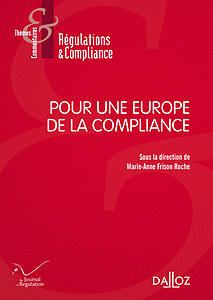
Couverture – Pour une Europe de la Compliance

Forewords, prefaces

📝Avant-propos, in 🕴️M.-A. Frison-Roche (ed.), Collection Régulations & Compliance Pour une Europe de la Compliance

► Full Reference: M.-A. Frison-Roche, "Avant-propos" ("Foreword"), in M.-A. Frison-Roche (ed.), Pour une Europe de la Compliance (For the Europe of Compliance), series "Régulations & Compliance", 2019, pp. VII-VIII.  - read a general presentation of the book, Pour une Europe de la Compliance, in which this foreword is published. - ► The Foreword: It is sometimes said the construction of Europe is blocked, or even is in decline. But this construction can only advance because it is not only community to be rediscovered by the effect of a common culture or the result of an agreement between States or the benefit of commercial exchanges: it is also a legal Order. And Law is moving forward, sometimes like a goat through rulings of lightning justice, sometimes through legislation whose development have certainly the step of the turtle but also the strength of this military figure.   For this, any legal mechanism is good to take, so foreign, even aggressive, it may seem at first. Compliance, on which everyone questions the definition, in which we sometimes see the enemy to fight, about which we often doubt that it is really a legal mechanism, could well be useful. So, let's seize the opportunity. It is not so common that a branch of law appears. The framework is still young, it is appropriate to take advantage of what is sometimes presented as defects, for example the uncertainty of definitions, but which are only defects of youth, or what is perceived as archaisms, in particular the violence of the compliance mechanisms, in their scale, their procedure and their territorial scope. But isn't a means of reconstituting the regalian at the moment when the states are struggling to recover from a report given to the cause to the territory ? Allowing them to pursue goals in the pretension that they must be satisfied (for example the fight against corruption or the sale of human beings)? Compliance Law allows the states to claim again and with a stronger voice their prerogatives. Moreover, let us take advantage of this still malleable idea of ​​the Compliance Law to obtain that Europe imbues the compliance mechanism with its legal Order. Compliance Law is undoubtedly the Law of tomorrow, the law without frontiers by which the legitimate public authorities set the Law, by fixing Ex ante goals and internalizing them in the crucial operators who carry them out in ways they build, public supervisors continuously monitoring the results achieved the goals set by the authorities. The Compliance Law allows that the powerful worldwird companies are not our masters because is the master who sets the goals and not the one who reaches them. This is where Europe brings to the Compliance Law, where Europe can be exemplary of the Law of tomorrow. Indeed, where long-established systems, as American Law did, have developed Cmpliance techniques to prevent systemic risks, Europe can put back to the center its primary concern: the Person, a notion that Europe invented in order to protect by rights and obligations human beings against the only game of powers. A Europe strengthened by Compliance Law; a Compliance Law transfigured by the European tradition: how not to be For a Europe of Compliance? This is what the authors of this book demonstrate to us. -
Couverture – Pour une Europe de la Compliance

Articles in a JoRC book

LENAERTS, Koen🕴️

📝Le juge de l’Union européenne dans une Europe de la Compliance, in 🕴️M.-A. Frison-Roche (ed.), Collection Régulations & Compliance Pour une Europe de la Compliance

► Full Reference : K. Lenaerts, "Le juge de l'Union européenne dans une Europe de la Compliance" ("The Judge of the European Union in the Europe of the Compliance"), in M.-A. Frison-Roche (ed.), Pour une Europe de la Compliance, series "Régulations & Compliance", Dalloz, 2019, pp. 1-12. - read a general presentation of the book, Pour une Europe de la Compliance, in which this article is published - ► Summary of the article (done by the Journal of Regulation & Compliance):  - 🦉This article is available in full text to those registered for Professor Marie-Anne Frison-Roche's courses -
Couverture – Pour une Europe de la Compliance

Articles in a JoRC book

MUSCA, Xavier🕴️

📝Construire une Europe de la compliance en donnant une meilleure place aux entreprises, in 🕴️M.-A. Frison-Roche (ed.), Collection Régulations & Compliance Pour une Europe de la Compliance

► Full Reference: X. Musca, "Construire une Europe de la compliance en donnant une meilleure place aux entreprises" ("Building the Europe of the Compliance by giving companies a greater role to play"), in M.-A. Frison-Roche (ed.), Pour une Europe de la Compliance, series "Régulations & Compliance", Dalloz, 2019, pp. 39-47. - read a general presentation of the book, Pour une Europe de la Compliance, in which this article is published - ► Summary of the article (done by the Journal of Regulation & Compliance):    🦉This article is available in full text to those registered for Professor Marie-Anne Frison-Roche's courses -
Couverture – Pour une Europe de la Compliance

Articles in a JoRC book

VIMONT, Pierre🕴️

📝La place de la diplomatie dans l’avancée d’une Europe de la compliance, in 🕴️M.-A. Frison-Roche (ed.), Collection Régulations & Compliance Pour une Europe de la Compliance

► Full Reference: P. Vimont, "La place de la diplomatie dans l'avancée d'une Europe de la compliance" ("The role of diplomacy in advancing the Europe of the Compliance"), in M.-A. Frison-Roche (ed.), Pour une Europe de la Compliance, series "Régulations & Compliance", Dalloz, 2019, pp. 49-52. - read a general presentation of the book, Pour une Europe de la Compliance, in which this article is published - ► Summary of the article (done by the Journal of Regulation & Compliance):  - 🦉This article is available in full text to those registered for Professor Marie-Anne Frison-Roche's courses -