Energy

Articles

Article in a Newsletter MAFR

📝Asset freezing in the legal saga between American power and Venezuelan wealt

► Full reference: M.-A. Frison-Roche, "Asset freezing in the legal saga between American power and Venezuelan wealth", MAFR Law, Compliance, Regulation Newsletter, 23 January 2026 - 🌐read this article published on LinkedIn the 23 January 2026  - 📧Read other articles from the MAFR Newsletter – Law, Compliance, Regulation for free with a subscription. - ► Summary of this article  : It is often emphasised that the  law is merely a masquerade in the series of events we are witnessing. This is not entirely true. For three reasons. 1. Much will depend on the judge who will rule on the Madura couple's case. The energy sector has always similarly mixed regulation, public policies of states and businesses, both articulated by States and companies, both articulated by  international contracts, always organising international arbitration 3. If ExxonMobil now refuses to make the investments desired by Trump, it is also because this enterprise remembers that many years ago the freeze  of assets granted by the arbitrators was not very successful, and now the company manager believes that investment in  Venezuala's infrastructure is therefore "impossible". And given the current state of the law in the US, there is little Trump can do about it.. - 📝⤵Read the complete article below⤵ - 🌐Follow Marie-Anne Frison-Roche on LinkedIn 🌐follow Marie-Anne Frison-Roche on Instagram 🌐Subscribe to the Newsletter MAFR Regulation, Compliance, Law 🌐Subscribe to the video newsletter MAFR Overhang 🌐Subscribe to the Newsletter MaFR Law & Art
Working papers

Working Paper for 📺Overhang

🚧The French Judicial Public Interest Agreement and the time saved: the Areva and Orano CJIP of 2 December 2024

► Full Reference: M.-A. Frison-Roche, The French Judicial Public Interest Agreement and the time saved: the Areva and Orano CJIP of 2 December 2024, Working Paper, January 2025. - 🎤 This Working Paper was developed as a basis for the Overhang👁 video  on 25 January 2025 : click HERE (in French) - 🎬🎬🎬In the collection of the Overhangs👁 It falls into the News category. ►Watch the complete collection of the Overhangs👁 : click HERE - ► Summary of this Working Paper: On 2 December 2024, Areva/Orano signed a Public Interest Judicial Agreement (CJIP) with the French National Financial Prosecutor's Office, validated by the order of 9 December 2024 of the President of the Paris Judicial Court. The case concerns the bribery of a foreign public official in Mongolia through the use of an intermediary. This perfectly illustrates the primary advantage of this Compliance Tool, which consists of closing a situation that could deprive a company of the means to act in the future. Even if neither the CJIP nor the validation order constitutes an admission of guilt or a conviction, the acts of bribery of a foreign public official can no longer give rise to prosecution. However, the future has been taken care of, because as soon as Tracfin passed the first information to the Public Prosecutor's Office, the company cooperated and set up a programme to actively fight corruption ("compliance programme"). The CJIP extends this by a compliance programme supervised by the French Anticorruption Agency. One month after the CJIP, the Mongolian government and the company, in the presence of the French government, announced on 17 January 2025 the signing of a contract to operate a uranium mine, the same industrial coopération that had given rise to these reprehensible acts. The CJIP made it possible to move forward in time.       - 🔓read the developments below⤵️ - 🌐follow Marie-Anne Frison-Roche sur LinkedIn 🌐follow Marie-Anne Frison-Roche on Instagram 🌐subscribe to the Newsletter MAFR Regulation, Compliance, Law  🌐subscribe to the Video Newsletter MAFR Surplomb

Articles in a legal collective publication

VAQUIERI, Jean-François🕴️

📝Les “Buts Monumentaux” perçus par l’entreprise. L’exemple d’Enedis, in 🕴️M.-A. Frison-Roche (dir.), 📕Les Buts Monumentaux de la Compliance

► Full Reference: J.-F. Vaquieri, "Les "Buts Monumentaux" perçus par l'entreprise. L'exemple d'Enedis" ("The "Monumental Goals" perceived by the company. The example of Enedis"), in M.-A. Frison-Roche (ed.), Les Buts Monumentaux de la Compliance, coll. "Régulations & Compliance", Journal of Regulation & Compliance (JoRC) and Dalloz, 2022, pp. 77-84. - 📕read a general presentation of the book, Les Buts Monumentaux de la Compliance, in which this article is published - ► Summary of the article (done by the Journal of Regulation & Compliance):  The article aims to show how a particular company in that it is charged by the State to effectively distribute electricity to everyone in France participates in the Monumental Goals, makes them concrete and integrates them into its functioning itself. The firm Enedis, a French monopolistic State company, operator of the distribution network participates directly in these Goals under the express application of the French Energy Code.  Under the control of the Regulator, the company is responsible for the continuity of the electricity supply and responds to the challenges of energy transition, Enedis ensuring equal treatment at national and local level, Compliance thus extending Regulatory system to which this firm responds and which it internalizes. The management of personal data, energy being at the heart of the digital revolution, implies a particularly strong internal framework of Compliance. This articulation between this new Compliance in terms of personal information and this classic Compliance as a continuation of the Regulation to serve the citizen, both converging for the benefit of people, explains that Enedis has put Compliance at the heart of its commitments, particularly expressed in its code of conduct, its industrial and human project (Projet industriel et humain – PIH) and its environmental actions. The Compliance which is specific to Enedis is disseminated by it to various entities, in particular via concession contracts, giving these an original framework. This importance of Compliance for Enedis leads the company through the "Monumental Goals" which unite it to design and maintain balances between the diversity of these so that the values carried by the companies continue to decline, especially locally. -

Articles in a legal collective publication

VAQUIERI, Jean-François👤

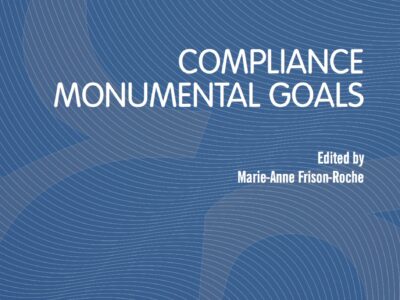
The “Monumental Goals” perceived by the company. The example of Enedis, in Frison-Roche, M.-A. (ed.), 📘Compliance Monumental Goals

► Full Reference: Vaquieri, J.-F.,  The "Monumental Goals" perceived by the company. The example of Enedis, in Frison-Roche, M.-A. (ed.),Compliance Monumental Goals, series "Compliance & Regulation", Journal of Regulation & Compliance (JoRC) and Bruylant, to be published. - ► Article Summary: The article aims to show how a particular company in that it is charged by the State to effectively distribute electricity to everyone in France participates in the Monumental Goals, makes them concrete and integrates them into its functioning itself. The firm Enedis, a French monopolistic State company, operator of the distribution network participates directly in these Goals under the express application of the French Energy Code.  Under the control of the Regulator, the company is responsible for the continuity of the electricity supply and responds to the challenges of energy transition, Enedis ensuring equal treatment at national and local level, Compliance thus extending Regulatory system to which this firm responds and which it internalizes. The management of personal data, energy being at the heart of the digital revolution, implies a particularly strong internal framework of Compliance. This articulation between this new Compliance in terms of personal information and this classic Compliance as a continuation of the Regulation to serve the citizen, both converging for the benefit of people, explains that Enedis has put Compliance at the heart of its commitments, particularly expressed in its code of conduct, its industrial and human project (Projet industriel et humain – PIH) and its environmental actions. The Compliance which is specific to Enedis is disseminated by it to various entities, in particular via concession contracts, giving these an original framework. This importance of Compliance for Enedis leads the company through the "Monumental Goals" which unite it to design and maintain balances between the diversity of these so that the values carried by the companies continue to decline, especially locally. -     📝 see the general presentation of the book, Compliance Monumental Goals, in which this article is published -    

Reports

BAYROU, François

Électricité: le devoir de lucidité (Electricity: the duty of lucidity)

Full reference: Bayrou, F., Electricité: le devoir de lucidité (Electricity: the duty of lucidity), note n°4 from the Haut-Commissariat au Plan (French government planification agency), 23rd of March 2021, 37 p.   Read the note (in French) Read the summary of the note done by the Haut-Commissariat au Plan on is official website (in French)

Articles

The control by regulator of the essential infrastructure manager’s investment plan: example of electric network and the notion of “doctrine”

Full reference: Frison-Roche, M.-A., The control by regulator of the essential infrastructure manager's investment plan: example of electric network and the notion of "doctrine", Newsletter MAFR – Law, Compliance, Regulation, 24th of August 2020 Read by freely subscribing other news of the Newsletter MAFR – Law, Compliance, Regulation   Summary of the news On 31st of July 2020, the Commission de Régulation de l'Energie (CRE and French energy regulator) has examined the investment plan of the French electric network manager (RTE) as it does every year. This investment plan is an economic document but it also contains societal purposes, especially the adaptation of the electric network in order to integrate renewable energies.  The control by the CRE is not a financial control. The crucial operator (RTE) is free to decide the way it wants to manage its budget. The CRE just advices on the financial side by recommending for exemple to be more flexible in its financial strategies. The true CRE's control is about the investment plan's general orientations, the methodology of needs analysis and crucial operator's investment choices which must be aligned with those of the regulator. Such a control leads to the emergence of an "investment doctrine" from the side of the crucial operator, mixing its own choices and the regulator's guidelines. Beyond this, the elaboration of the investment plan is the result of a true co-writing between the regulator and the firm which discuss together, exchanges points of view and methods. Such a method, expressing a kind of coregulation, could be used in other sectors. 

Jurisprudence

Autorité de la concurrence (French Competition Authority)

Decision n°17-D-16 of 7th of September 2017 relating to practices implemented by the company Engie in the energy sector

Référence complète: Autorité de la concurrence (French Competition Authority), Decision relating to practices implemented by the company Engie in the energy sector, Engie vs Direct Energie, 7th of September 2017, n°17-D-16 Read the decision (in French) Read the press release

Working papers

Working Paper.

The “crucial companies” and their regulation

The expression "regulated company" may appear as an oxymoron : the State  regulates areas (markets, networks, etc.) because of their structural failures, but the State doesn't enter a company that develops its activities autonomously. But on reflection, it is sometimes necessary to "regulate a company" and this necessity is increasingly imposed. This is imperative if a company absorbs the entire area, because it is a monopoly or because it wants to become the heart of a crucial area, such as Google which has the project to become the future global brain. In a more general way, it is a necessity to  locate businesses which are "crucial", banks are only one example, and organize, beyond supervision, providing direct regulation of such firms. This regulatory power on critical firms must take the form of attendance of public power and policy within the company itself, so that the state interfere in decisions which social group suffers the consequences. The control can go beyond this "public presence" to take the form of "public authority", the state ruling as operator. Under such conditions of "cruciality", the neutralization of "public enterprise" by the competition law must cease, the public company must be better recognized as a regulatory instrument in distance with the simple game of competition.