Banking law

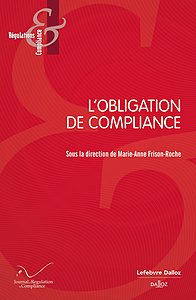
Couverture – L’Obligation de Compliance

Articles in a JoRC book

FRANÇON, Mathieu🕴️

📝L’intensité du devoir de vigilance dans le secteur bancaire (The Intensity of the Duty of Vigilance in the Banking Sector), in 🕴️M.-A. Frison-Roche (dir.), 📕L’Obligation de Compliance

► Full Reference: M. Françon, “L’intensité du devoir de vigilance dans le secteur bancaire” (The Intensity of the Duty of Vigilance in the Banking Sector), in M.-A. Frison-Roche (dir.), L’Obligation de Compliance, Journal of Regulation & Compliance (JoRC) and Lefebvre-Dalloz, coll. “Régulations & Compliance”, 2025, pp. 551-557. - read the general presentation of the book, L’Obligation de Compliance, in which the contribution is published - ► This article is written in French. English summary of this contribution (done by the Journal of Regulation & Compliance – JoRC): The author develops the case of banking and insurance operators. He emphasises that, in banking and insurance matters, Vigilance consists of an obligation to process information, collected beforehand where necessary, in order to prevent a systemic risk from materialising. Identifying and preventing risk is an enhanced obligation of means which, in this context, varies in intensity. The obligation is long-standing, whereas the Duty of Vigilance is recent. This time lag is explained by the fact that the required Vigilance is consubstantial with the very activity of the banker and the insurer, and by the systemic nature that the sector has always had, which produces an interweaving of hard and soft law. The variations in the intensity of the obligation of Vigilance stem from the fact that there are two types of obligations: those imposed in the interest of the activity and of the client, and those imposed in the interest of the stability of the system. The latter are much stronger than the former. They weigh on the banker as well as on the client. Thus, anti-money laundering obligations have the general interest as their sole purpose, the client being unable to rely on the bank’s failures (Cour de cassation (French Court of cassation), Chambre commerciale (Commercial Chamber), 28 April 2004). Moreover, in matters of asset freezing, the obligation of Vigilance becomes an obligation of result. Within the general interest itself, intensity varies according to the goals pursued, giving rise to “standard, simplified, enhanced” Vigilance, depending on the underlying risk. In addition, interfering rights cause the obligation to vary, notably the right to the protection of personal data, or the right to non-interference by the banker. Finally, the obligations of Vigilance weighing on third parties, including those located outside Europe, also interfere. - 🦉This article is available in full text to those registered for Professor Marie-Anne Frison-Roche’s courses -

Publication director

🏗️ direction of the collection: 📚Cours Dalloz – Série Droit privé

📚Publication of : 🕴️Philippe NEAU-LEDUC & 🕴️Ariane PÉRIN-DUREAU, 📕Droit bancaire (Banking Law), 7th ed.

► Full Reference : Ph. Neau-Leduc & A. Périn-Dureau, Droit bancaire (Banking Law), 7th ed., 2024, Dalloz, “Cours Dalloz-Série Droit privé” Series, 350 p. - ► General presentation of the book (written in French) : This new edition of Droit bancaire, of which Philippe Neau-Leduc was the author, is intended for all Master 1 law students but also for practitioners wishing to update their knowledge of banking law. In a first part it develops « the banking system » (the banking sector and banking status), and in a second part « the banking service » (banking and ancillary operations). - 📕Read the back cover (in French) - 📕Read the table of contents (in French) - 📚See the entire collection in which the book is published. - 📚Books in the collection directly related to this one : 🕴️S. Piédelièvre, 📕Instruments de crédit et de paiement (Credit and Payment Instruments) -
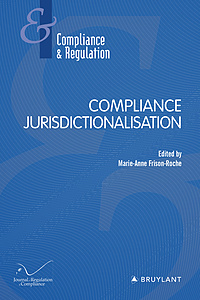
Couverture – Compliance Jurisdictionalisation

Articles in a JoRC book

BRUNEAU, Alain🕴️

📝The company judges itself: the Compliance function in the bank, in 🕴️M-A Frison-Roche (ed.), Collection Compliance & Regulation Compliance Jurisdictionalisation

► Full Reference: A. Bruneau, “The company judges itself: the Compliance function in the bank”, in M.-A. Frison-Roche, (ed.), Compliance Jurisdictionalisation, Journal of Regulation & Compliance (JoRC) and Bruylant, coll. “Compliance & Regulation“, 2024, pp. 127-145 - read a general presentation of the book, Compliance Jurisdictionalisation, in which this article is published - ► Summary of the article: First, it should be remembered that the compliance function was born within finance, and that by being structured, it has evolved to support the transition from regulatory law to compliance law. Through these changes, compliance has gone from an ex-post controlling function to an ex-ante binding function. The LIBOR crisis imperfectly illustrates the primacy of this transition. The evolution of this role is illustrated by concrete examples. Firstly, the management of reputational risk is a fundamental part of the company as prosecutor and judge of itself. Reputational risk is a significant element for a financial institution, because it can have negative consequences on its capitalization, or even culminate in a systemic crisis. Avoiding a large-scale financial crisis is also part of the monumental goals of compliance. In order to avoid complex and inopportune scenarios, compliance law intervenes as early as possible and identifies issues that may impact reputation. The regulations require the implementation of certain ex ante mechanisms. The French law known as “Sapin 2” requires the implementation of tools that concern all companies (and not just banks). Indeed, beyond the risk of reputation, it is essential to consider the risk of corruption. Consideration of reputational risk may justify refusing to execute certain transactions. From this perspective, compliance must assess the potential consequences of entering into a relationship with a new client upstream, sometimes to decline the provision of services. The compliance function therefore unilaterally judges the relationship with a view to managing the company reputational risk. Secondly, the internal sanction mechanism established by compliance law is also discussed in this article, in particular the internal sanctions adopted by compliance in a financial institution. Compliance can act as a prosecutor via management committees set up within the business lines. In addition, compliance can determine and apply sanctions against employees. In this way, there is a dual role of prosecutor and judge for the compliance function within the framework of an extraordinary mechanism of ordinary law. Finally, the analysis deals with the case of the “judge-judged”: following a decision by the bank, the regulator may take an even stricter position by believing that the bank is applying its guidelines incorrectly. Thus, the compliance law, which takes hold within the banking enterprise, finds itself under the judgment of its own regulator. The company finds itself judged and comes to be a prosecutor and judge of itself, but also of its clients. - 🦉This article is available in full text to those registered for Professor Marie-Anne Frison-Roche’s courses -

Books

Droit bancaire