Dialogue between judges

Conferences

🖥️Traduire dans l’institution judiciaire l’articulation entre l’international et le systémique, in🧮Le contentieux systémique émergent, un contentieux international justifiant la création de juridictions spécialisées ?

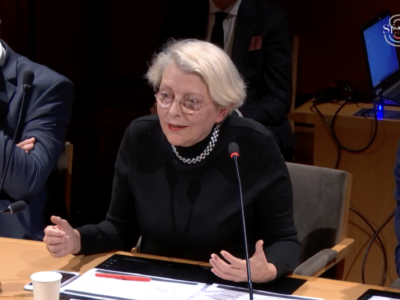
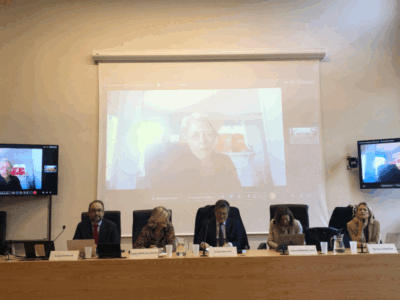
  - ► Référence complète : M.-A. Frison-Roche, "Traduire dans l'institution judiciaire l'articulation entre l'international et le systémique" in CREDIP, Faculté de Droit de l'Université Jean Moulin – Lyon 3, Le contentieux systémique émergent, un contentieux international justifiant la création de juridictions spécialisées, cycle de conférences sur Le contentieux international et la spécialisation des juges, Lyon , 18 avril 2025, 10h-12h. - 🪑🪑🪑Participent aussi à cette manifestation : 🪑Jacques Boulard, Premier président de la Cour d'appel de Paris 🪑Brigitte Brun-Lallemand, Première présidente de chambre de la Cour d'appel de Paris (Pôle économique) 🪑Jérémy Heymann, professeur de droit à l'Université Jean Moulin – Lyon 3 🪑Sabine Abravanel-Jolly, Professeure de droit au sein de l'Equipe Louis Josserand 🪑Marylou Françoise, maîtresse de conférences à l'Université Jean Moulin – Lyon 3 - 🧮consulter le programme complet de cette manifestation - ► Résumé de l'intervention : cette intervention ayant eu lieu après les présentations du Premier Président Jacques Boulard et Madame la Première Présidente Brigitte Brun-Lallemand, elle s'articule sur ces deux interventions.   I. Contentieux systémique et Contentieux international. On peut ainsi se demander si la nature d'un "contentieux systémique" se prête à ce qu'est un "contentieux international" ? A première vue, non. L'on pourrait poser que, d'une part, si le "contentieux systémique émergent" était "nécessairement international", alors l'on ne comprendrait pas pourquoi la Chambre spéciale internationale de la Cour d'appel de Paris ne suffisait pas et d'autre part, l'on ne comprendrait pas comment deux jugements ont été rendus sur le Devoir de Vigilance, dont on ne conteste pas qu'il appartient au Contentieux Systémique Emergent, alors qu'ils ne portent pas sur une chaine internationale de valeur : jugement TJ Paris 5 décembre 2023 dit La Poste, cas systémique actuellement devant la chambre spécialisée de la Cour d'appel de Paris ; TJ Paris 13 février 2025, dit SNCF, cas systémique, n'ayant pas fait l'objet d'appel.   II. Deux chambres spécialisées en miroir Dès lors, l'on pourrait dire que le contentieux systémique est de fait international mais pas par nature. Parce que cela n'est pas une subdivision du contentieux international, cela explique certes que la chambre 5-12 soit autonome par rapport à la chambre 5-16 (chambre internationale), mais parce que la perspective est de fait souvent transnationale, ces 2 chambres ont vocation à fonctionner en miroir. Car le système est un fait global. Et c'est plus en terme de fait global qu'il convient de le traiter, ce qui est plus facile dans des systèmes qui ne sont pas construit sur cette summa divisio du fait et du droit, qui convient mal au contentieux systémique.   III. Par nature, un contentieux dans lequel un système est "impliqué". Cela nous amène donc vers la définition du "Contentieux Systémique Emergent". Elle est simple : c'est un Cause dans laquelle un système est impliqué, dans lequel les intérêts de celui-ci sont en jeu, le premier de ses intérêts étant sa survie. C'est pourquoi la durabilité est une notion-clé, que l'on retrouve quelque soit le système impliqué. C'est pourquoi l'avenir est présent dans le contentieux systémique. C'est pourquoi l'office du juge est renouvelé car il s'agit d'un office Ex Ante, renouvellement à la fois procédural et substantiel qui conduit en pratique à un Droit processuel. Le fait systémique mène donc de droit à une dialogue des juges qui se spécialisent sur des faits globaux et les obligent, sauf à méconnaître ceux-ci, à se prendre en considération. Cela donne un nouveau statut au "droit comparé".   IV. Un contentieux émergent par le fait de systèmes nouveaux, globaux, saisis par des opérateurs locaux qui en fixent la stratégie.  Les systèmes ont déjà donné lieu à des contentieux : c'est la juridictionnalisation du Droit de la Régulation. Mais la Régulation a quitté ce prérequis des systèmes pour entrer à l'intérieur des opérateurs économiques dont le pouvoir de stratégie est situé localement. Le Droit de la Compliance internalise les besoins systémiques. Le Droit de la Compliance dont on affirma, parce qu'Ex Ante, qu'il allait dispenser du Juge, s'est lui-même juridictionnalisé. L'obligation de vigilance étant elle-même la pointe avancée de la Compliance, ne pouvait que donner une large place au Juge. Tandis que le système est l'enjeu du procès et de sa bonne solution, la partie au litige est l'opérateur cruciale : non seulement les entreprises régulées (comme les banques) mais encore les entreprises maîtresses des chaines de valeur (ce qui fait sortir le Droit de la Régulation des secteurs régulés). Or, les chaines de valeur sont un espace global contractuellement structuré transnational rattachées à un juge local qui est confronté à un office renouvelé avec le DIP.    V. Une culture juridictionnelle propre à des zones distinctes. Le Droit de la Vigilance, de la Compliance et de la Régulation tel qu'on le voit manier par les juges dépasse nos distinctions entre droit public et droit privé, entre les systèmes juridique, mais les décisions que l'on lit expriment trois cultures, procédurales et substantielles, différentes : l'Asie, les Etats-Unis et l'Europe. Cette culture de place porteuse d'une identité européenne de Vigilance, de Compliance et de Régulation repose notamment sur une culture juridictionnelle propre à cette zone-là. - 🌐suivre Marie-Anne Frison-Roche sur LinkedIn 🌐suivre Marie-Anne Frison-Roche sur Instagram 🌐s'abonner à la Newsletter MAFR Regulation, Compliance, Law 🌐s'abonner à la Newsletter en vidéo MAFR Surplomb 🌐s'abonner à la Newsletter MaFR Droit & Art
Organisation of events

🧱⚙️scientific organisation of 🧮L’expérience des juridictions dans le Contentieux Systémique Émergent (Courts Experience in Emerging Systemic Litigation), in cycle of conference-debates “Contentieux Systémique Émergent” (“Emerging Systemic Litigation”)

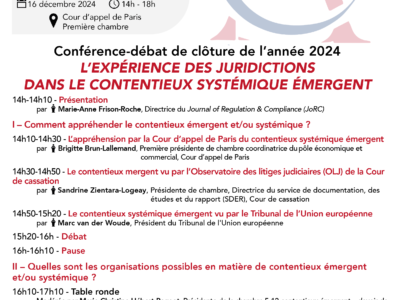
► Full Reference: L’expérience des juridictions dans le Contentieux Systémique Émergent (Courts Experience in Emerging Systemic Litigation), in cycle of conference-debates "Contentieux Systémique Émergent" ("Emerging Systemic Litigation"), organised on the initiative of the Cour d'appel de Paris (Paris Cour of Appeal), with the Cour de cassation (French Court of cassation), the Cour d'appel de Versailles (Versailles Court of Appeal), the École nationale de la magistrature – ENM (French National School for the Judiciary) and the École de formation des barreaux du ressort de la Cour d'appel de Paris – EFB (Paris Bar School), under the scientific direction of Marie-Anne Frison-Roche, 16 December 2024, 2pm.-6pm., Cour d'appel de Paris, Première Chambre (First Chamber) - ► Presentation of the conference:  - 🧮Programme of this event:  Closing conference-debate of 2024 L'EXPÉRIENCE DES JURIDICTIONS DANS LE CONTENTIEUX SYSTÉMIQUE ÉMERGENT  (COURTS EXPERIENCE IN EMERGING SYSTEMIC LITIGATION) Paris Court of Appeal, First Chamber   🕰️2pm.-2.10pm. Présentation (Introduction), by 🕴️Marie-Anne Frison-Roche, Professor of Regulatory Law and  Compliance Law, Director of the Journal of Regulation & Compliance (JoRC), Scientific Director of the Cycle of conferences-debates on the Emerging Systemic Litigation – ESL)   I – Comment appréhender le contentieux émergent et/ou systémique ?  (I – How to deal with Emerging and/or Systemic Litigation?) 🕰️2.10pm.-2.30pm. 🎤L’appréhension par la Cour d’appel de Paris du Contentieux Systémique Émergent (The Paris Court of Appeal's approach to Emerging Systemic Litigation), by 🕴️Brigitte Brun-Lallemand, Première présidente de chambre coordinatrice du pôle économique et commercial, Cour d’appel de Paris (First President of Chamber, Coordinator of the Economic and Commercial Division, Paris Court of Appeal) 🕰️2.30pm.-2.50pm. 🎤Le contentieux émergent vu par l’Observatoire des litiges judiciaires (OLJ) de la Cour de cassation, par 🕴️Sandrine Zientara-Logeay, Présidente de chambre, Directrice du service de documentation, des études et du rapport – SDER, Cour de cassation (President of Chamber, Director of the Department of Documentation, Studies and Reports – SDER, French Court of cassation)  🕰️2.50pm.-3.20pm. 🎤Le contentieux systémique Eémergent vu par le Tribunal de l’Union européenne (Emerging Systemic Litigation as seen by the General Court of the European Union), par 🕴️Marc van der Woude, President of the General Court of the European Union  🕰️3.20pm.-4pm. Debate 🕰️4pm.-4.20pm. Break   II – Quelles sont les organisations possibles en matière de contentieux émergent et/ou systémique ?  (II – How to organise with Emerging and/or Systemic Litigation?) 🕰️4.10pm.-5.10pm. 🎤Table ronde (Round Table) Moderated by 🕴️Marie-Christine Hébert-Pageot, Présidente de la chambre 5-12 contentieux émergent – devoir de vigilance et responsabilité écologique, Cour d‘appel de Paris (President of the 5-12 Chamber emerging litigation – duty of vigilance and ecological liability, Paris Court of Appeal) Speakers: 🕴️Stéphane Noël, Président du Tribunal judiciaire de Paris (President of the Paris First Instance Civil Court) 🕴️Patrick Sayer, Président du Tribunal de commerce de Paris (President of the Paris First Instance Commercial Court) 🕴️Jean-François Beynel, Premier président de la Cour d’appel de Versailles (First President of the Versailles Court of Appeal) and 🕴️Benjamin Deparis, Président du Tribunal judiciaire de Nanterre (President of the Nanterre First Instance Civil Court) 🕰️5.10pm.-5.40pm. Debate   🕰️5.40pm.-6pm. 🎤Conclusion. Le Contentieux Systémique Émergent : dialogues (Conclusion. Emerging Systemic Litigation: Dialogues), by 🕴️Jacques Boulard, Premier Président de la Cour d’appel de Paris (First President of the Paris Court of Appeal) - 🔴Registrations and information requests can be sent to: inscriptionscse@gmail.com 🔴For the attorneys, registrations have to be sent to the following address: https://evenium.events/cycle-de-conferences-contentieux-systemique-emergent/  ⚠️The conference-debates are held in person only, in the Cour d’appel de Paris (Paris Court of Appeal). -

Organisation of events

🧱⚙️scientific organisation of 🧮L’incidence du devoir de vigilance sur les litiges commerciaux (The impact of the duty of vigilance on commercial litigation)

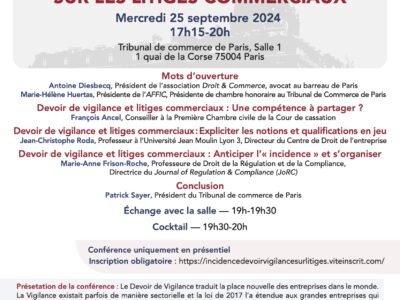
► Full Reference: M.-A. Frison-Roche, coordination of the conference L'incidence du devoir de vigilance sur les litiges commerciaux (The impact of the duty of vigilance on commercial litigation), Tribunal de commerce de Paris (Paris Commercial Court), Droit & Commerce and Association Française en Faveur de l'Institution Consulaire (AFFIC), Tribunal de commerce de Paris, 25 September 2024, 5.15p.m. to 8p.m. - 🧮see the full programme of this event - 🌐consult on LinkedIn a general présentation of this event (in French) - ► General presentation of the conference: The Duty of Vigilance reflects the new role of firms in the world. Vigilance sometimes existed on a sectoral basis, but the 2017 French law extended it to large companies that control value chains. The French so-called "confiance" law gave the Tribunal judiciaire de Paris (Paris First Instance Civil Court) jurisdiction to hear "actions relatives" ("actions relating") to this duty. This does not mean, however, that the commercial courts will no longer have jurisdiction. Firstly, vigilance may go beyond the scope of the 2017 French law. Secondly, vigilance may concern not only the plan drawn up by the firm, but also Commercial Contract Law or Liability Law, special Distribution Law, etc. Commercial courts will have to develop a doctrine for dividing up and coordinating disputes, in particular by staying proceedings within certain disputes. To build a unified or at least non-contradictory case law on vigilance, we need to imagine a dialogue between judges and new procedures. - 🧮Programme of this event:  L'INCIDENCE DU DEVOIR DE VIGILANCE SUR LES LITIGES COMMERCIAUX (THE IMPACT OF THE DUTY OF VIGILANCE ON COMMERCIAL LITIGATION) Paris First Instance Commercial Court, room 1 🕰️5.15pm.-5.30pm. Welcome 🕰️5.30pm.-5.40pm. 🎤Mots d'ouverture (Opening words), by 🕴️Antoine Diesbecq, President of Droit & Commerce, attorney at the Paris Bar and 🕴️Marie-Hélène Huertas, President of AFFIC, Honorary President of Chamber of the Paris First Instance Commercial Court 🕰️5.40pm.-6pm. 🎤Devoir de vigilance et litiges commerciaux : Une compétence à partager ? (Duty of Vigilance and Commercial Litigation: A jurisdiction to share?), by 🕴️François Ancel, Judge at the Première Chambre civile de la Cour de cassation (First Civil Chamber of the French Court of cassation) 🕰️6pm.-6.20pm. 🎤Devoir de vigilance et litiges commerciaux : Expliciter les notions et qualifications en jeu (Duty of Vigilance and Commercial Litigation: Explain the concepts and qualifications involved?), by 🕴️Jean-Christophe Roda, Full Professor at Jean Moulin Lyon 3 University, Director of the Centre de Droit de l’entreprise 🕰️6.20pm.-6.40pm. 🎤Devoir de vigilance et litiges commerciaux : Anticiper l''incidence" et s’organiser (Duty of Vigilance and Commercial Litigation: Anticipating the "impact" and getting organised), by 🕴️Marie-Anne Frison-Roche, Professor of Regulatory Law and Compliance Law, Director of the Journal of Regulation & Compliance (JoRC) 🕰️6.40pm.-7pm. 🎤Conclusion (Conclusion), by 🕴️Patrick Sayer, President of the Tribunal de commerce de Paris (Paris First Instance Commercial Court) 🕰️7pm.-7.30pm. Discussion with the audience 🕰️7.30pm.-8pm. Cocktail - 🌐follow Marie-Anne Frison-Roche on LinkedIn 🌐follow Marie-Anne Frison-Roche on Instagram 🌐subscribe to the Newsletter MAFR Regulation, Compliance, Law

Conferences

Conference

🎤Devoir de vigilance et litiges commerciaux : Anticiper l'”incidence” et s’organiser (Duty of vigilance and Commercial Litigation: Anticipating the “impact” and getting organised), in 🧮L’incidence du devoir de vigilance sur les litiges commerciaux (The Impact of the Duty of Vigilance on Commercial Litigation)

► Full Reference: M.-A. Frison-Roche, "Devoir de vigilance et litiges commerciaux : Anticiper l'"incidence" et s’organiser" ("Duty of vigilance and Commercial Litigation: Anticipating the "impact" and getting organised"), in L'incidence du devoir de vigilance sur les litiges commerciaux (The Impact of the Duty of Vigilance on Commercial Litigation), Tribunal de commerce de Paris (Paris Commercial Court), Droit & Commerce and Association Française en Faveur de l'Institution Consulaire (AFFIC), Tribunal de commerce de Paris, September 25, 2024, 17.15pm to 20pm - 🌐read the report of this speech on LinkedIn (in French) - 🧮see the full programme of this event (in French) - 🧱consult the scientific coordination sheet of this event - 🌐consult on LinkedIn a general presentation of this event (in French) - ► English Summary of the conference: After listening to the enlightening speeches of François Ancel and Jean-Christophe Roda, I had the great opportunity to emphasise, as they did, that the duty of vigilance, in the respect of French laws of 2017 and 2021, with a view to the transposition of the CS3D, does not imply, so brutally as has been said, a lack of knowledge by judges other than those of the Tribunal judiciaire de Paris (Paris First Instance Civil Court) of this new Law, which is the extension of Compliance Law, as François Ancel reminded us. Because Commercial Court judges deal with Contract Law on a daily basis, and because companies build their value chains through contracts that should be described as "regulatory contracts", the duty of vigilance has an "impact" on these disputes. These disputes may be of a "systemic" nature. This can only result not in jurisdictional trenches, but in "shared jurisdiction", along the lines drawn by François Ancel. This sharing must be built through a dialogue between judges, a necessary method on which Patrick Sayer concluded this elaborate conference on an essential and forward-looking subject. - 🌐follow Marie-Anne Frison-Roche on LinkedIn 🌐follow Marie-Anne Frison-Roche on Instagram 🌐subscribe to the Newsletter MAFR Regulation, Compliance, Law 🌐subscribe to the Video Newsletter MAFR Surplomb

Books

Conseil d'État🏛️ & Cour de cassation🏛️

📗De la régulation à la compliance : quel rôle pour le Juge ?. Regards croisés du Conseil d’État et de la Cour de cassation (From Regulatory Law to Compliance Law: what role for the Judge?. Viewpoints of the Conseil d’État (French Administrative Supreme Court) and Cour de Cassation (French Judiciairy Supreme Court)

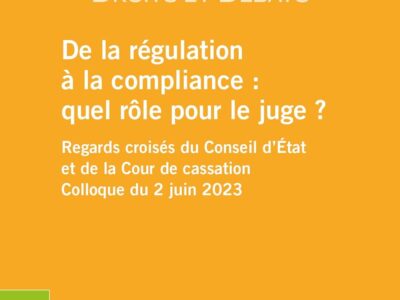
► Full Reference: Conseil d'État (French Administrative Supreme Court) & Cour de cassation (French Judiciary Supreme Court), De la régulation à la compliance : quel rôle pour le juge ? Regards croisés du Conseil d'État et de la Cour de cassation, ("From Regulatory Law to Compliance Law: what role for the Judge?"), La Documentation française, coll. "Droits et Débats", 2024, 241 p. - 📗read the  coverback (in French) - 📗read the table of content (in French) - ► Summary of this book : "Compliance, sometimes translated in French by the word "conformité" ("conformity"), is an extension of Regulatory Law and represents from it a new and decisive step forward. Compliance brings together all the mechanisms implemented within an organisation to achieve general interest goals (security, sustainability), thereby countering systemic risks. By relying on the rules, legal and ethical standards that embody these values, which are imposed on them and internalised by them, enterprises can both prevent the risk of sanctions and participate in this alliance between public authorities, economic operators and stakeholders to detect and prevent future systemic disasters.  Organisé par le Conseil d’État et la Cour de cassation, le colloque du 2 juin 2023 analyse ce changement de paradigme créé par cette nouvelle branche du droit.".  Organised by the Conseil d'État (French Administrative Supreme Court) and the Cour de cassation (French Judiciary Supreme Court), the conference on 2 June 2023, basis of this book, has analysed this paradigm shift created by this new branch of law: Compliance Law.  - 📝read the presentation in English of the concluding contribution of  Marie-Anne Frison-Roche : "Le rôle du juge dans le déploiement du droit de la régulation par le droit de la compliance" - 📝read the presentation in English of the contribution of François Ancel : "Quel rôle pour le juge aujourd’hui dans la compliance ? Quel office processuel du juge dans la compliance ?" -

Articles

💬You Porn : La CJUE face au défi de la protection des mineurs

► Full Reference: M.-A. Frison-Roche, "You Porn : La CJUE face au défi de la protection des mineurs" ("You Porn: The CJEU faces the challenge of protecting minors"), interview with Olivia Dufour, Actu-Juridique, March 11, 2024 - 💬read the interview (in French) - ► Presentation of the interview by the journal (in French): "Depuis bientôt deux ans, l’Arcom tente de contraindre les sites pornographiques à mettre en place des procédés techniques sérieux de contrôle d’âge des internautes qui accèdent à leurs sites, afin que la protection des mineurs organisée par le droit pénal soit effective. Il y a à la fois une procédure civile en cours, basée notamment sur le décret qui met en œuvre ce dispositif, et un recours administratif, contestant la légalité du décret sur lequel s’appuie le régulateur pour mettre en demeure les sites d’adopter ces dispositifs techniques. Dans ce dernier contentieux, le Conseil d’État a, par sa décision du 6 mars 2024, adressé plusieurs questions préjudicielles à la CJUE pour déterminer quelle était la marge de manœuvre des États membres à l’encontre des sites qui ne respectent pas leur législation. Nous avons demandé au professeur Marie-Anne Frison-Roche, spécialiste de droit de la compliance, de nous éclairer sur les enjeux de ce contentieux hors normes.". - ► Questions asked (in French):  Pouvez-vous nous rappeler brièvement la genèse de ce cas manifestement complexe ? C’est la première fois qu’apparaît dans une décision de justice la notion de « cause systémique » dont vous êtes l’auteure. De quoi s’agit-il exactement ? Sur ces entrefaites, une décision de la CJUE est venue bouleverser la donne… Revenons au recours devant le Conseil d’État contre le décret, il semble que le Conseil d’État avait donc le choix entre deux solutions : suivre la CJUE et donc renoncer à protéger les enfants de la pornographie en France ou bien s’émanciper de cette jurisprudence européenne au risque de se le voir reprocher. Qu’a-t-il décidé finalement ? - 🌐follow Marie-Anne Frison-Roche on LinkedIn 🌐follow Marie-Anne Frison-Roche on Instagram 🌐subscribe to the Newsletter MAFR Regulation, Compliance, Law

Articles in The Journal of Regulation & Compliance « JoRC »

WENNERSTRÖM, Erik🕴️

📝Quelques réflexions sur la Compliance et la Cour européenne des droits de l’homme, in 🕴️M.-A. Frison-Roche (ed.), 📕La juridictionnalisation de la Compliance

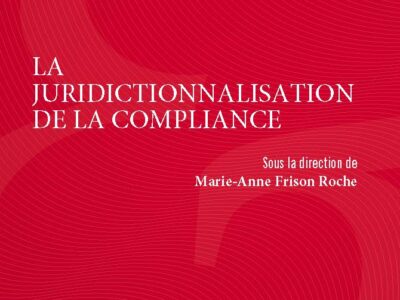
► Full Reference: E. Wennerström, "Quelques réflexions sur la Compliance et la Cour européenne des droits de l'homme" ("Some Reflections on Compliance and the European Court of Human Rights"), in M.-A. Frison-Roche (ed.), La juridictionnalisation de la Compliance, coll. "Régulations & Compliance", Journal of Regulation & Compliance (JoRC) and Dalloz, 2023, pp. 479-489. - 📕read a general presentation of the book, La juridictionnalisation de la Compliance, in which this article is published - ► Summary of the article (done by the Journal of Regulation & Compliance): The development of the European Court of Human Rights case law, contributing to European integration, has incorporated the substantial concept of ​​"compliance" which goes beyond the idea of ​​legality with respect to which companies remain passive, and promotes legal orders as systems in interaction with another.  The author develops the spirit and scope of Protocol 15 by which both the principle of subsidiarity and the margins of appreciation the signatory States are organized, mechanisms governed by the principle of proportionality. Subsidiarity means that the States are in the best position to design the most adequate application of the Convention, the close links between the States allowing its effective application. In addition, the new opinion procedure which allows a national court to have during a case the non-binding opinion of the ECHR ensures better compliance with the objectives of the Convention. The case-law of the Court takes up this substantial requirement through its doctrine, in particular identified in the Bosphorus case, by stressing that the accession of a State to the European Union presumes its compliance when implementing EU law with the obligations arising from the ECHR, even if this presumption can be refuted if the protection is manifestly lacking, which was admitted in several cases, in particular concerning the right to an impartial tribunal in matters of economic regulation. The different legal orders are thus articulated.  The author concludes that the European Court of Human Rights, like the Court of Justice of the Union, contributes to the construction of Compliance Law in Europe, from an Ex Ante perspective favoring opinions rather than Ex Post sanctions and creating, in particular through the Bosphorus doctrine, elements of security and confidence for European integration around common values. -

Articles in The Journal of Regulation & Compliance « JoRC »

WENNERSTRÖM, Erik🕴️

📝Some Reflections on Compliance and the European Court of Human Rights, in 🕴️M.-A. Frison-Roche (ed.), 📘Compliance Jurisdictionalisation

► Full Reference: E. Wennerström, "Some Reflections on Compliance and the European Court of Human Rights", in M.-A. Frison-Roche (ed.), Compliance Jurisdictionalisation, Journal of Regulation & Compliance (JoRC) and Bruylant, coll. "Compliance & Regulation", to be published.  - 📘read a general presentation of the book, Compliance Jurisdictionalisation, in which this article is published   - ► Summary of the article (done by the Journal of Regulation & Compliance): The development of the European Court of Human Rights case law, contributing to European integration, has incorporated the substantial concept of ​​"compliance" which goes beyond the idea of ​​legality with respect to which companies remain passive, and promotes legal orders as systems in interaction with one another. The author develops the spirit and scope of Protocol 15 by which both the principle of subsidiarity and the margins of appreciation the signatory States are organized, mechanisms governed by the principle of proportionality. Subsidiarity means that the States are in the best position to design the most adequate application of the Convention, the close links between the States allowing its effective application. In addition, the new opinion procedure which allows a national court to have during a case the non-binding opinion of the ECHR ensures better compliance with the objectives of the Convention. The case-law of the Court takes up this substantial requirement through its doctrine, in particular identified in the Bosphorus case, by stressing that the accession of a State to the European Union presumes its compliance when implementing EU law with the obligations arising from the ECHR, even if this presumption can be refuted if the protection is manifestly lacking, which was admitted in several cases, in particular concerning the right to an impartial tribunal in matters of economic regulation. The different legal orders are thus articulated.  The author concludes that the European Court of Human Rights, like the Court of Justice of the Union, contributes to the construction of Compliance Law in Europe, from an Ex Ante perspective favoring opinions rather than Ex Post sanctions and creating, in particular through the Bosphorus doctrine, elements of security and confidence for European integration around common values. -   🦉This article is available in full text to those registered for Professor Marie-Anne Frison-Roche's courses -