Crucial firm

Reports

🧱⚙️Mission confiée par le garde des Sceaux, 🏛 Droit de la compliance, souveraineté juridique et attractivité économique (Mission entrusted by the French Minister of Justice: Compliance Law, Legal Sovereignty and Economic Attractiveness)

► Full reference: M.-A. Frison-Roche, Mission entrusted by the French Minister of Justice, Droit de la compliance, souveraineté juridique et attractivité économique (Compliance Law, Legal Sovereignty and Economic Attractiveness), 2025-2026. - 📜read the engagement letter of 5 September 2025 by which the French Minister of Justice entrusted Marie-Anne Frison-Roche with this mission (in French) - 📑The report of the mission, Déployer le Droit de la Compliance pour renforcer la souveraineté et accroître l’attractivité de la France avec l’Europe (Deploying Compliance Law to Strengthen France’s Sovereignty and Increase its Attractiveness with Europe), will be submitted to the French Minister of Justice in a French version and in an English version. - 🌐follow Marie-Anne Frison-Roche on LinkedIn 🌐follow Marie-Anne Frison-Roche on Instagram 🌐subscribe to the Newsletter MAFR Regulation, Compliance, Law 🌐subscribe to the Video Newsletter MAFR Surplomb 🌐subscribe to the Newsletter MaFR Droit & Art

Videos

concluding lecture

🖥️L’avenir de la compliance (The future of Compliance), in 🧮La compliance (Compliance)

► Full reference : M.-A. Frison-Roche, "The Future of Compliance", series Compliance, Centre Perelman, Brussels, 23 February 2026. - 🧮view the full programme for the series Compliance (in French) - ► English presentation of this concluding conference in the series Compliance : The future of Compliance: who knows what it holds? Anyone who practises and studies the texts, litigation, structures and behaviours will have to admit that they do not know what will become of what has emerged as a new branch of law. It is not easily recognised, probably for three reasons. Firstly, because the birth of a new branch of law is an unusual phenomenon, whose disruptive and regenerative waves are felt in all branches of law and other regulatory systems, accompanying and reflecting the new world we have already entered, whether we like it or not. Secondly, because it is unpleasant (especially if you are a professor…) to begin and conclude with the fact that you do not know. Thirdly, because it is not very marketable, and in today's large and growing "compliance market", it is not very smart, if you want to sell compliance products (whether they be algorithms, new services to be linked to the highest level of companies, specialities in law firms, new chairs in various schools), to say that you don't know. So the experts say they know. For my part, I meet many people who are "experts" and who are "knowledgeable". What is surprising is the diversity of their discourse, which casts doubt on the solidity of the projection, particularly on the meaning of words: for example, not only words that could be described as "new" (which we then try to anchor in old words) such as "compliance/conformity" and "governance", but also words that we are undoubtedly more familiar with, such as "commitment" and "responsibility" or "sanction", i.e. the very pillars of the matter. Why is this a cause for concern, apart from the fact that it is always better to know what we are talking about, rather than everyone talking in their own corner, for their own compliance corpus, for their like-minded friends, with the subject matter becoming increasingly siloed? Because the object of Compliance Law is the future. So, the future of this branch of law which its object is the future is by nature very uncertain.   It will therefore be assumed in advance that not knowing the future is a major difficulty when it comes to Compliance Law, in that this branch of law is unified in that it is ex ante and its object is the future. The difficulty is neither of the same nature nor of the same magnitude when it comes to the legislator, the "regulator", the regulated company (calculating or political), or the judge faced with systemic compliance litigation. That said, in a first part, one can imagine the future possibilities for Compliance (because that is what it boils down to, given the number of candidates eager to seize the instruments of power that are the " Compliance tools"). It is not a foregone conclusion that this future will be governed by Law. The consequences could take care of that. Or the order given by the leader (Trump, for instance), and that would go down all the better as he states that he certainly does not care about human beings but that he wields the power of Compliance to restore the climate balance (through Chinese regulations): except to say that there is no unified Compliance Law. That there would be one for the climate and another for human rights. So what about the future consistency of European Law, which links the two in the CSRD and the CS3D? Particularly in value chains. The question then is: what will be the uniqueness of Compliance Law in the future? -   In a second part, since we do not know how things will turn out, from omnibus to omnibus, from a government hostile to the Law to a government appealing to the Due Process, from case law to case law, from special law to common law, we must weigh up the advantages and disadvantages of the various perspectives. There is never one perspective where everything is good and another where everything is bad, because in that case there would be no choice and no policy: it would be enough to have information, to be "rational" and to go for the right solution rather than the wrong one. Beyond general statements that a combination of compliance and ethics is welcome, which is not in doubt in the superb statements made in this regard, it is necessary to look at the advantages and disadvantages of the direction we may take. Firstly, there is the disappearance of Compliance Law, with the advantage of reducing the regulatory burden on those subject to it and the disadvantage of abandoning altruistic and global ambitions (these two Monumental Goals may overlap). Secundly, it could involve the creation of a global empire, with the advantage of a simplified American empire, whether extraterritorialised by the state or by companies and their governance or technology, with the advantage of a Western model and the disadvantage of the crushing of "mondialisation" by globalisation and the disappearance of the specific ambitions of States. Thirdly, it may be a contribution to a war between powers, particularly through the European DSA and the data war, with the advantage of European maturity in Compliance Law as an extension of Regulatory Law and the disadvantage that we could move from a war in the metaphorical sense (never use metaphors in Law) to a war. Quaterly, it could be a new rule of Law in which systemic companies participate in an alliance to achieve Monumental political Goals decided by States and political authorities, preserving systems for the future ("sustainability") so that human beings are not crushed by them but benefit from them. The disadvantage is that we have to relearn the Law, because although it has nothing to do with conformity, which is only an instrument, Compliance Law changes all branches of Law and requires the integration of other techniques, particularly political and technological ones. -   In third part, in practice, we must strive in advance to reduce the disadvantages associated with the shortcomings of possible future developments in Compliance Law, just as we must strive in advance to increase the advantages associated with the qualities of possible future developments in Compliance Law. The disadvantage lies in the very nature of Compliance Law, namely its great power, because unlike Competition Law, it calls for and increases power. We must therefore counteract the prospect of compliance techniques, particularly those related to Information, being monopolised by those who only want to use them to consolidate or extend their power, laughing at Ethics and Monumental Goals. This means that supervision techniques on the one hand and a renewed role for judges on the other must be considered. The quality attached to possible futures stems from the fact that we could uphold a "Global Law" (reference to the work of Benoît Frydman, among others) and that, faced with the possible disappearance of Public International Law and the imperative preservation of value chains, particularly in the context of possible war, the alliance between supervised systemic companies and the political authorities in charge of the future of the social group that legitimises them may appear to be a legitimate, effective, efficiate and efficient system. -   ⛏️Go further  : 🕴🏻M.-A. Frison-Roche, 📝Compliance Law, 2016 🕴🏻M.-A. Frison-Roche, 📝Conceiving Power, 2021 🕴🏻M.-A. Frison-Roche, 📕Compliance Monumental Goals, 2022  🕴🏻M.-A. Frison-Roche, 📝The Birth of a New Branch of Law: Compliance Law, 2024 🕴🏻M.-A. Frison-Roche, 📝Compliance Law and conformity: distinguishing between them to better articulate them, 2024 🕴🏻M.-A. Frison-Roche, 📕Complianceo Obligation, 2025 🕴🏻M.-A. Frison-Roche, 📝Compliance Law and Systemic Litigation, 2025 - 🌐Follow Marie-Anne Frison-Roche on LinkedIn 🌐follow Marie-Anne Frison-Roche on Instagram 🌐Subscribe to the Newsletter MAFR Regulation, Compliance, Law 🌐Subscribe to the video newsletter MAFR Overhang 🌐Subscribe to the Newsletter MaFR Law & Art

Articles in a legal collective publication

article in a collective book

📝Compliance, in 🕴️J.-Fr. Kerléo & 🕴️E. Lemaire (dir.), 📗Dictionnaire de l’éthique publique

► Full Reference:: M.-A. Frison-Roche, "Compliance", in J.-Fr. Kerléo & E. Lemaire (dir.), Dictionnaire de l'éthique publique, LexisNexis, 2025, pp.  - 📗 read the general presentation of the Dictionary. - 📝read the article (in French). - ► English Summary of the article defining what is Compliance: The article explains Compliance in 7 points. Firstly, it states that Compliance oscillates between a weak and a strong definition. It can be defined weakly as the demonstration of obedience to all applicable regulations, or it can be defined strongly as active participation in the achievement of 'monumental' ambitions for the future of the social group. Positive legal rules and case law are increasingly revealing the relevance of the strong definition, with the weak definition referring only to conformity to the Law. Secondly, this understanding of the new branch of Law known as Compliance Law will enable us to master the regulations specifically relating to compliance (RGPD, French laws such as Sapin 2 Act and Vigilance Act, AML/FT, European AI Act, etc.), which are both more specific and more restrictive than the general obligation to comply with the applicable legal rules. Thirdly, everyone can see the move from "extraterritoriality" to another thing which is the indifference to territoryd: Compliance is the right instrument for the digital space and for chains of activities. Fourthly, this is due to the very nature of Compliance, which consists in internalising in companies in a position to be active the “Monumental Negative Goal” of preventing the collapse of systems (energy, climate, digital, banking, financial, algorithmic, etc.). Fifthly, this internalisation is carried out by States and public authorities in entities in a position to act, i.e. in concrete terms in companies in a position to be active to reach the “Monumental Goals” by contributing to the improvement of systems so that these systems benefit in the present and the future the people who are de jure and de facto involved in them. Sixthly, these goals become positive when it comes to educating people about probity and effective equality between human beings, notably through training policies. In this respect, Vigilance is the “cutting edge” of Compliance. Seventhly, an “ex ante responsibility” of Crucial Operators subject to Compliance is emerging, and is articulated by Systemic Litigation which aims to balance and maintain systems, carried by States and these crucial companies. - 📝read the preentation of the other article written by Marie-Anne Frison-Roche for this Dictionary: "Régulation" - 🌐follow Marie-Anne Frison-Roche on LinkedIn 🌐follow Marie-Anne Frison-Roche on Instagram 🌐subscribe to the Newsletter MAFR Regulation, Compliance, Law 🌐subscribe to the Video Newsletter MAFR Surplomb 🌐subscribe to the Newsletter MaFR Droit & Art

Articles in a non-legal collective publication

article in a non-legal collective publication

📝Le Droit de la compliance, voie royale pour réguler l’espace numérique (Compliance Law as a Royal Road for regulating the Digital Space​), in📚Enjeux numérique,📗Régulation et Compliance

► Full Reference: M.-A. Frison-Roche, "Le Droit de la compliance, voie royale pour réguler l'espace numérique" (Compliance Law as a Royal Road for regulating the Digital Space), in P. Bonis et L. Castex (dir.), Compliance et nouvelles régulation, Annales des Mines, coll. "Enjeux numériques", juin 2025, pp. 69-77. - 📝 read the article (in French)  - 🚧This article is underpinned by a English Working Paper in English, with additional technical developments and hypertext links. : Compliance Law as a Royal Road for regulating the Digital Space - ► English Summary of this article:  In order to describe the role of Compliance Law in regulating the digital space and to conclude that this new branch of Law is the 'royal road' to this end, this study proceeds in 6 stages.  Firstly, at first sight and conceptually, there is a gap between the political idea of Regulating and the ideas (freedom and technology as 'law') on which the digital space has been built and is unfolding.  Secondly, in practice, there is such a huge gap between the ordinary methods of Regulatory Law, which are backed by a State, and the organisation of the Digital Space by these economic operators, that are both American and global.  Thirdly, the political claim to civilise the Digital Space remains and is growing, relying on the very strength of the entities capable of realising this ambition, these entities being the crucial digital operators themselves, seized as Ex Ante.  Fourthly, it corresponds to the conception and practice of a new branch of Law, Compliance Law, which should not be confused with "conformity" and which is normatively anchored in its "Monumental Goals".  Fifthly, Compliance Law internalises Monumental Goals in the digital operators which disseminate them through structures and behaviours in the digital space.  Sixthly, through the interweaving of legislation, court rulings and corporate behaviour, the Monumental Goals are given concrete expression, willingly or by force, in ways that can civilise the digital space without undermining the primacy of freedom. - 🌐follow Marie-Anne Frison-Roche on LinkedIn 🌐follow Marie-Anne Frison-Roche on Instagram 🌐subscribe to the Newsletter MAFR Regulation, Compliance, Law 🌐subscribe to the Video Newsletter MAFR Surplomb 🌐subscribe to the Newsletter MaFR Droit & Art

Conferences

conference

🎤Participation au panel “Une Gouvernance responsable : vers un mieux vivre ensemble ?” (“Responsible corporate governance: towards a better way of living together”), in 🧮Grenelle du Droit 5

► Full Reference: M.-A. Frison-Roche, Participation in the panel "Une Gouvernance responsable : vers un mieux vivre ensemble ?" ("Responsible governance: towards a better way of living together"), in Grenelle du Droit 5. L'avenir de la filière juridique, Association française des juristes d'entreprise ("The future of the legal profession"), AFJE), Cercle Montesquieu and Paris Panthéon-Sorbonne University, Campus Port-Royal Université Paris 1 Panthéon-Sorbonne, 1 rue de la Glacière, 75013 Paris, June 12, 2024 - 🧮See the full programme of this event (in French) - 🎥watch the interview made just after this round-table discussion (in French) - 🪑🪑🪑🪑🪑 will also be taking part in this round-table discussion: 🕴️Yves Garagnon, Chairman of Dilitrust, 🕴️Pierrick Le Goff, lawyer, partner at De Gaulle Fleurance, 🕴️Sabine Lochmann, Chairman of Ascend, 🕴️Vincent Vigneau, President of the Commercial, Economic and Financial Chamber of the Cour de cassation (French Judicial Supreme Court) - ► English presentation of my intervention in this event's opening plenary  round-table: In this plenary round table which opens the event, devoted to the theme of 'responsible corporate governance', for my interventions based on my work I will have the opportunity to address more particularly these different perspectives: How the new Compliance Law, which gives concrete expression to the responsibility of enterprises in a new relationship with States and with civil society, constitutes a 'legal revolution 💡for the record, mafr,📝Compliance Law, 2016 ; (ed.) 📘Compliance Monumental Goals, 2022   how the judgment handed down by the Tribunal judiciaire de Paris (Paris First Instance Civil Court) on 28 February 2023 (Total Ouganda case) is remarkable and already constitutes a turning point in case law 💡for the record, mafr, 🎤audition as amica curiae, hearing of 26 October 2022 before the first instance Paris Court; (ed)📘Compliance Jurisdictionalisation, 2024   how the relationship between States and enterprises is being renewed by this profound legal movement expressed by Compliance Law 💡for the record, mafr et M. Boissavy (ed.), 📕Compliance et droits de la défense – Enquêtes internes, CJIP, CRPC, mafr (dir.), 📘 Compliance Obligation, 2025   how internal lawyers have a decisive and central role to play in this movement, particularly in the mechanism of vigilance / corporate sustainability due diligence, the "cutting edge" of Compliance Law, 💡for the record, mafr, 📝Contract of Compliance, Compliance stipulations, 2023 ; (ed.), 📘Compliance and Contract, 2025   what is meant by the "Ex Ante responsibility" of enterprises, which does not necessarily entail their Ex Post liability, a distinction which lawyers are the guardians of 💡for the record, mafr, 📝La responsabilité Ex Ante, pilier du Droit de la Compliance ("Ex-Ante Responsability, Compliance Law Pillar"), 2021   how European Compliance Law is profoundly humanist, an identity that distinguishes European Compliance from American Compliance and, above all, from Chinese Compliance. 💡for the record, mafr (ed.), 📕Pour une Europe de la Compliance ("For the Europe of the Compliance"), 2017 - read the  article about this round table written by Delphine Bauer in Actu-Juridique (in French) - 🌐follow Marie-Anne Frison-Roche on LinkedIn 🌐follow Marie-Anne Frison-Roche on Instagram 🌐subscribe to the Newsletter MAFR Regulation, Compliance, Law

Articles in a legal collective publication

📝L’usage des puissances privées par le droit de la compliance pour servir les droits de l’homme (Use of private companies by Compliance Law to serve Human Rights), in 🕴️J. Andriantsimbazovina (dir.), 📗Puissances privées et droits de l’Homme. Essai d’analyse juridique

► Full reference: M.-A. Frison-Roche, "L’usage des puissances privées par le droit de la compliance pour servir les droits de l’homme" (Use of private companies by Compliance Law to serve Human Rights) , in J. Andriantsimbazovina (dir.), Puissances privées et droits de l'Homme. Essai d'analyse juridique, Mare & Martin,  coll. "Horizons européens", 2024, pp. 279-295 - 🚧read the  Bilingual Working Paper on which this article is based, with more technical developments, references and hypertext links - ► English Summary of this article: Following the legal tradition, Law creates a link between power with a legitimate source, the State, public power being its prerogative, while private companies exercise their power only in the shadow of this public power exercised ex ante.  The triviality of Economic Law, of which Competition Law is at the heart, consisting of the activity of companies that use their power on markets, relegates the action of the State to the rank of an exception, admissible if the State, which claims to exercise this contrary power, justifies it.  The distribution of roles is thus reversed, in that the places are exchanged, but the model of opposition is shared. This model of opposition exhausts the forces of the organisations, which are relegated to being the exception. However, if we want to achieve great ambitions, for example to give concrete reality to human rights beyond the legal system within which the public authorities exercise their normative powers, we must rely on a new branch of Law, remarkable for its pragmatism and the scope of the ambitions, including humanist ambitions, that it embodies: Compliance Law. Compliance Law is thus the branch of Law which makes the concern for others, concretised by human rights, borne by the entities in a position to satisfy it, that is to say the systemic entities, of which the large companies are the direct subjects of law (I). The result is a new division between Public Authorities, legitimate to formulate the Monumental Goal of protecting human beings, and private organisations, which adjust to this according to the type of human rights and the means put in place to preserve them. Corporations are sought after because they are powerful, in that they are in a position to make human rights a reality, in their indifference to territory, in the centralisation of Information, technologies and economic, human, and financial means. This alliance is essential to ensure that the system does not lead to a transfer of political choices from Public Authorities to private companies; this alliance leads to systemic efficiency. The result is a new definition of sovereignty as we see it taking shape in the digital space, which is not a particular sector since it is the world that has been digitalised, the climate issue justifying the same new distribution of roles (II).  - 📝read the article (in French) - 🌐follow Marie-Anne Frison-Roche on LinkedIn 🌐follow Marie-Anne Frison-Roche on Instagram 🌐subscribe to the Newsletter MAFR Regulation, Compliance, Law 🌐subscribe to the Video Newsletter MAFR Surplomb

Articles in a legal collective publication

article in a collective publication

📝The deployment of Regulatory Law through Compliance Law in the European project

► Full Reference: M.-A. Frison-Roche, "The deployment of Regulatory Law through Compliance Law in the European project", in G. Hardy & F. Picod, Compliance Regulation from a European Perspective, Law and European Affairs (L.E.A.), 2023/2, pp. 345-352. - 🚧read the bilingual Working Paper which is the basis of this article, with additional developments, technical references and hyperlinks  - ► English Summary of the article: Compliance Law is neither a method of obeying regulations, nor a simple neutral method of ensuring the effectiveness of norms, nor a means of enforcement displaced from Ex Post to Ex Ante. It is an extension of Regulatory Law and goes beyond it. Like it, it aims to build spaces according to a political project specific to an area, such as Europe. Branch of Law looking to the future as Regulatory Law does, it constructs and maintains, in a systemic way, sustainable, albeit unstable, balances to achieve the ‘Monumental Goals’ in which its normativity resides: security, sustainability, probity, truth, and dignity. By internalising these Monumental Goals in the companies that are in a position to achieve them, the “crucial companies”, Compliance Law preserves the logic of Regulatory Law, offering it a prodigious expansion since it frees it from the condi- tion of a sector and territorial borders, which seemed tautological, by associating private powers and public will, which remains primary. In this way, Compliance can regulate the digital space and climate issue through political choices made by a sovereign Europe. - 🌐follow Marie-Anne Frison-Roche on LinkedIn 🌐follow Marie-Anne Frison-Roche on Instagram 🌐subscribe to the Newsletter MAFR Regulation, Compliance, Law

Articles in a legal collective publication

PEICUTI, Cristina🕴️ and BEYSSADE, Jacques🕴️

📝 Feminisation of positions of responsibility in the workplace as a goal of Compliance, in Frison-Roche, M.-A. (ed.), 📘Compliance Monumental Goals

► Full Reference: Peicuti, C. et Beyssade, J., Feminisation of positions of responsibility in the workplace as a goal of Compliance, in Frison-Roche, M.-A. (ed.), Compliance Monumental Goals, series "Compliance & Regulation", Journal of Regulation & Compliance (JoRC) and Bruylant, 2023,pp. 117-135. - ► Article Summary:  If the Compliance techniques are conceived as taking their meaning by their Goal, the latter being in particular the protection and the effective promotion of human beings, to be reinforced in the future thanks to Compliance Law tools, the example of the effective promotion of efficient equality between women and men in the banking sector to exercise responsible functions is clear. strongly feminized, the image of banking sector remains masculine and in fact too few women exercise positions of responsibility, although no text is opposed to it and all rights have been allocated for this. To move from this situation to a future where equality will be effective, it is therefore in terms of regulatory mechanisms that we should think of the necessary transformation and even more of "transition" so that one day a de facto equality will be established. and appears natural to all. The bank must then structurally integrate this Goal, which corresponds to the definition of Compliance. To do this, the banking company is part of a long-term voluntary Compliance process, relying in particular on human resources and on the public authorities of the European Banking Union which, by further implementing the concept of sustainable economy, facilitated this long-term action. In this transition, each action and result must be considered in relation to this sought-after goal of effective equality: each progress must be valued not so much in relation to the past but in relation to the future. This Ex Ante perspective justifies these self-binding Compliance techniques, such as plans, commitments, quotas, stakeholder implications, and more flexible techniques such as examples given by managers, internal training and joint affirmations with the public authorities, are all used by the company to achieve this Monumental Goal of effective equality between human beings. The banking sector is all the more exemplary for this because the banking authorities themselves deploy incentives in this direction, the definition of Compliance Law as an alliance between the Authorities and the Companies therefore corresponding to such an action clearly in progress, structurally in the BPCE group. -     📝 see the general presentation of the book 📘Compliance Monumental Goals in which this article is published -

Articles in The Journal of Regulation & Compliance « JoRC »

POTTIER, Stanislas🕴️

📝Pour une compliance européenne, vecteur d’affirmation économique et politique, in 🕴️M.-A. Frison-Roche (ed.), 📕Les Buts Monumentaux de la Compliance

► Full Reference: S. Pottier, "Pour une compliance européenne, vecteur d’affirmation économique et politique" ("For European compliance, a vector of economic and political affirmation"), in M.-A. Frison-Roche (ed.), Les Buts Monumentaux de la Compliance, coll. "Régulations & Compliance", Journal of Regulation & Compliance (JoRC) and Dalloz, 2022, pp. 475-482. - 📕read a general presentation of the book, Les Buts Monumentaux de la Compliance, in which this article is published - ► Summary of the article (donne by the Journal of Regulation & Compliance): Today's monumental goals, particularly environmental and climatic ones, are of a financial magnitude that we had not imagined but the essential stake is rather in the way of using these funds, that is to determine the rules which, to be effective and fair, should be global. The challenge is therefore to design these rules and organize the necessary alliance between States and companies. It is no longer disputed today that the concern for these monumental goals and the concern for profitability of investments go hand in hand, the most conservative financiers admitting, moreover, that concern for others and for the future must be taken into account, the ESG rating and the "green bonds" expressing it. Companies are increasingly made more responsible, in particular by the reputational pressure exerted by the request made to actively participate in the achievement of these goals, this insertion in the very heart of the management of the company showing the link between compliance and the trust of which companies need, CSR also being based on this relationship, the whole placing the company upstream, to prevent criticism, even if they are unjustified. All governance is therefore impacted by compliance requirements, in particular transparency. Despite the global nature of the topic and the techniques, Europe has a great specificity, where its sovereignty is at stake and which Europe must defend and develop, as a tool for risk management and the development of its industry. Less mechanical than the tick the box, Europe makes the spirit of Compliance prevail, where the competitiveness of companies is deployed in a link with States to achieve substantial goals. For this, it is imperative to strengthen the European conception of compliance standards and to use the model. The European model of compliance arouses a lot of interest. The duty of vigilance is a very good example. It is of primary interest to explain it, develop it and promote it beyond Europe. -

Articles in The Journal of Regulation & Compliance « JoRC »

PEICUTI, Cristina🕴️ et BEYSSADE, Jacques🕴️

📝La féminisation des postes à responsabilité dans les entreprises comme But de la Compliance. Exemple du secteur bancaire, in 🕴️M.-A. Frison-Roche (ed.), 📕Les Buts Monumentaux de la Compliance

► Full Reference: C. Peicuti et J. Beyssade, "La féminisation des postes à responsabilité dans les entreprises comme but de la compliance. Exemple du secteur bancaire" ("The feminization of responsibility positions in companies as a Compliance Goal. Example of the banking sector"), in M.-A. Frison-Roche (ed.), Les Buts Monumentaux de la Compliance, coll. "Régulations & Compliance", Journal of Regulation & Compliance (JoRC) and Dalloz, 2022, 109-124. - 📕read a general presentation of the book, Les Buts Monumentaux de la Compliance, in which this article is published - ► Summary of the article (done by the Journal of Regulation & Compliance): If the Compliance techniques are conceived as taking their meaning by their Goal, the latter being in particular the protection and the effective promotion of human beings, to be reinforced in the future thanks to Compliance Law tools, the example of the effective promotion of efficient equality between women and men in the banking sector to exercise responsible functions is clear. strongly feminized, the image of banking sector remains masculine and in fact too few women exercise positions of responsibility, although no text is opposed to it and all rights have been allocated for this. To move from this situation to a future where equality will be effective, it is therefore in terms of regulatory mechanisms that we should think of the necessary transformation and even more of "transition" so that one day a de facto equality will be established. and appears natural to all. The bank must then structurally integrate this Goal, which corresponds to the definition of Compliance. To do this, the banking company is part of a long-term voluntary Compliance process, relying in particular on human resources and on the public authorities of the European Banking Union which, by further implementing the concept of sustainable economy, facilitated this long-term action. In this transition, each action and result must be considered in relation to this sought-after goal of effective equality: each progress must be valued not so much in relation to the past but in relation to the future. This Ex Ante perspective justifies these self-binding Compliance techniques, such as plans, commitments, quotas, stakeholder implications, and more flexible techniques such as examples given by managers, internal training and joint affirmations with the public authorities, are all used by the company to achieve this Monumental Goal of effective equality between human beings. The banking sector is all the more exemplary for this because the banking authorities themselves deploy incentives in this direction, the definition of Compliance Law as an alliance between the Authorities and the Companies therefore corresponding to such an action clearly in progress, structurally in the BPCE group. -

Articles in The Journal of Regulation & Compliance « JoRC »

📝Place et rôle des entreprises dans la création et l’effectivité du Droit de la Compliance en cas de crise, in 🕴️M.-A. Frison-Roche (ed.), 📕Les Buts Monumentaux de la Compliance

🌐 follow Marie-Anne Frison-Roche on LinkedIn 🌐 subscribe to the Newsletter MAFR Regulation, Compliance, Law  - ► Full Reference: M.-A. Frison-Roche, "Place et rôle des entreprises dans la création et l'effectivité du Droit de la Compliance en cas de crise" ("Place and rôle of Companies in the Creation and Effectiveness of Compliance Law in Crisis"), in M.-A. Frison-Roche (ed.), Les Buts Monumentaux de la Compliance, coll. "Régulations & Compliance", Journal of Regulation & Compliance (JoRC) and Dalloz, 2022, pp. 339-352. - 📝read the article (in French)    - 🚧read the bilingual Working Paper which is the basis of this article, with additional developments, technical references, and hyperlinks - 📕read a general presentation of the book, Les Buts Monumentaux de la Compliance, in which this article is published - ► Summary of the article (done by the Journal of Regulation & Compliance): This article has a very topic: the place of private Companies, regarding the chapter's issue: "the ordeal of a crisis". The crisis constitutes a "test" it brings evidence. Let us take it as such. Indeed, during the health crisis, Companies have helped the Public Authorities to resist the shock, to endure and to get out of the Crisis. They did so by force, but they also took initiatives in this direction. From this too, we must learn lessons for the next crisis that will come. It is possible that this has already started in the form of another global and systemic crisis: the environmental crisis. In view of what we have been able to observe and the evolution of the Law, of the standards adopted by the Authorities but also by the new case law, what can we expect from Companies in the face of this next Crisis, willingly and strength? -

Conferences

🎥La place de l’Intelligence artificielle dans le respect de la Compliance dans l’entreprise : la juste mesure (“Compliance, Artificial Intelligence and Business Management: the right measure”), in M. Mekki (coord.), 🧮L’intelligence artificielle et la gestion des entreprises (“Artificial Intelligence and Business Management”)

🌐follow Marie-Anne Frison-Roche on LinkedIn 🌐subscribe to the  Newsletter MAFR Regulation, Compliance, Law - ► Full Reference: M.-A. Frison-Roche, "Compliance, Artificial Intelligence and Business Management: the right measure" ("Compliance, Intelligence artificielle et gestion des entreprises : la juste mesure"), participation to the Conference coordinated by Mustapha Mekki, L'intelligence artificielle et la gestion des entreprises. July 1st, 2022.  - 🎥 see the conference (in French) -  consult the slides having been used as brief notes for deliver the lecture (inf French) - 🚧read the bilingual Working Paper having been used as basis for this conference - 📝This work will be the basis for an article. - ► Summary of the Lecture: Of the next European Regulation on artificial intelligence, the European Commission has a quite neutral conception of AI for obtaining a consensus between the Member States, while the Regulators and certain States have a more substantial conception of technology, wanting its power to be used to protect people, firstly from these new tools themselves, secondly from what is an amplification of the evils of the classic world, such as hate or misinformation. This is the reflection of two conceptions of Compliance. Firstly, Compliance can be defined as neutral processes that increase the effectiveness of what would be the obligation for companies or their desire for efficient risk management (in particular the consideration of "legal risks") to prove being "conform" to all regulations that are applicable to itself and all persons to whom the firm is accountable. This is often referred to as the "compliance obligation" or "obligation of conformity". This conception implies considerable practical consequences for the company which, in order to succeed in this "total exploit", would then have to resort to artificial intelligence tools constituting a "total and infallible solution", which mechanically generate for it the obligation to "know " all the "regulatory mass", to detect all "non-compliances", to conceive its relationship to the Law in terms of "risk of non-compliance", fully supported by Compliance by Design which could, without human intervention , eliminate legal risk and ensure "compliance total efficiency" in Ex Ante. The "legal price" of this technological dream is extremely high because all the "regulatory" requirements will then be transformed into obligations of result, any failure generating liability. The Compliance probationary system will become overwhelming for the company, both in terms of burden of proof, means of proof, and transfers, without exemption from proof. Objective responsibilities for others will multiply. The "law of conformity" will multiply Ex Ante systemic penalties, the border with criminal law being less and less preserved. It is essential to avoid this, both for businesses and for the Rule of Law. For this, we must use Artificial Intelligence to its proper extent: it may constitute a "massive aid", without ever claiming to be a total and infallible solution, because it is the human who must be at the center of the compliance system functioning thank to the firms and not the machinery. For this, it is necessary to adopt a substantial conception of Compliance Law (and not a sort of Conformity Law or Obedience Law). It does not at all cover all the applicable regulations and it is not at all "neutral", being in no way a series of processes. This new branch of Law is substantially built on Monumental Goals. These are either of a negative nature (preventing a systemic crisis from happening, in many but specific perspectives: banking, financial, health, climate, etc.), or of a positive nature (building a better balance, in particular between human beings, in the company and beyond). In this conception which appears more and more strongly, artificial intelligence finds its place, more modest. As Compliance Law is based on information, Artificial Intelligence is essential to capture it and make first connections, first stages for successive analyses, done by human beings, making what is essential: the commitment of the company, both by the leaders and by all those who are "embarked" by a "culture of Compliance" which is at both built and common. This restores the required seal between Criminal Law and what can be asked of the mechanical use of Artificial Intelligence; this puts the obligation of means back as a principle. This restores the principal place to the lawyer and the compliance officer, so that the culture of compliance is articulated with the specificities of a sector and the identity of the company itself. Indeed, the culture of compliance being inseparable from a culture of values, Compliance by design requires a dual technique, both mathematical and legal culture. It is why European Compliance Law, because it is rooted in the European humanist tradition, is a model. - For further: 📘Frison-Roche, M.-A. (ed.), Compliance Monumental Goals, 2022 📘Frison-Roche, M.-A. (ed.), Compliance Jurisdictionalisation, 2022 📘Frison-Roche, M.-A. (ed.), Compliance Tools, 2021 📓Frison-Roche, M.-A., L'apport du Droit de la Compliance à la Gouvernance d'Internet, 2019  📕Frison-Roche, M.-A. (ed.), Pour une Europe de la Compliance, 2019 📕Frison-Roche, M.-A. (ed.), Régulation, Supervision, Compliance, 2017 📕 Frison-Roche, M.-A. (ed.), Internet, espace d'interrégulation, 2016 📝 Frison-Roche, M.-A., Compliance Monumental Goals, beating heart of Compliance law,  2022, 📝 Frison-Roche, M.-A., Role and Place of Companies in the Creation and Effectiveness of Compliance Law in Crisis, 2022 📝 Frison-Roche, M.-A., Assessment of Whistleblowing, and the duty of Vigilance, 2022 📝Frison-Roche, M.-A., Drawing up Risk Maps as an obligation and the paradox of he "compliance risks", 2021 -

Working papers

🚧Compliance, Artificial Intelligence and Business Management: the right measure

🌐 follow Marie-Anne Frison-Roche on LinkedIn 🌐subscribe to the Newsletter MAFR Regulation, Compliance, Law  - ► Full Reference: Frison-Roche, M.-A. Compliance, Artificial Intelligence and Business Management: the right measure, Working Paper, June 2022.  - ► Summary of the Working Paper: Of the next European Regulation on artificial intelligence, the European Commission has a quite neutral conception of AI for obtaining a consensus between the Member States, while the Regulators and certain States have a more substantial conception of technology, wanting its power to be used to protect people, firstly from these new tools themselves, secondly from what is an amplification of the evils of the classic world, such as hate or misinformation. This is the reflection of two conceptions of Compliance. Firstly, Compliance can be defined as neutral processes that increase the effectiveness of what would be the obligation for companies or their desire for efficient risk management (in particular the consideration of "legal risks") to prove being "conform" to all regulations that are applicable to itself and all persons to whom the firm is accountable. This is often referred to as the "compliance obligation" or "obligation of conformity". This conception implies considerable practical consequences for the company which, in order to succeed in this "total exploit", would then have to resort to artificial intelligence tools constituting a "total and infallible solution", which mechanically generate for it the obligation to "know " all the "regulatory mass", to detect all "non-compliances", to conceive its relationship to the Law in terms of "risk of non-compliance", fully supported by Compliance by Design which could, without human intervention , eliminate legal risk and ensure "compliance total efficiency" in Ex Ante. The "legal price" of this technological dream is extremely high because all the "regulatory" requirements will then be transformed into obligations of result, any failure generating liability. The Compliance probationary system will become overwhelming for the company, both in terms of burden of proof, means of proof, and transfers, without exemption from proof. Objective responsibilities for others will multiply. The "law of conformity" will multiply Ex Ante systemic penalties, the border with criminal law being less and less preserved. It is essential to avoid this, both for businesses and for the Rule of Law. For this, we must use Artificial Intelligence to its proper extent: it may constitute a "massive aid", without ever claiming to be a total and infallible solution, because it is the human who must be at the center of the compliance system functioning thank to the firms and not the machinery. For this, it is necessary to adopt a substantial conception of Compliance Law (and not a sort of Conformity Law or Obedience Law). It does not at all cover all the applicable regulations and it is not at all "neutral", being in no way a series of processes. This new branch of Law is substantially built on Monumental Goals. These are either of a negative nature (preventing a systemic crisis from happening, in many but specific perspectives: banking, financial, health, climate, etc.), or of a positive nature (building a better balance, in particular between human beings, in the company and beyond). In this conception which appears increasingly strongly, artificial intelligence finds its place, more modest. As Compliance Law is based on information, Artificial Intelligence is essential to capture it and make first connections, first stages for successive analyses, done by human beings, making what is essential: the commitment of the company, both by the leaders and by all those who are "embarked" by a "culture of Compliance" which is at both built and common. This restores the required seal between Criminal Law and what can be asked of the mechanical use of Artificial Intelligence; this puts the obligation of means back as a principle. This restores the principal place to the lawyer and the compliance officer, so that the culture of compliance is articulated with the specificities of a sector and the identity of the company itself. Indeed, the culture of compliance being inseparable from a culture of values, Compliance by design requires a dual technique, both mathematical and legal culture. It is why European Compliance Law, because it is rooted in the European humanist tradition, is a model. -

Videos

🎥Compliance Law, an adequate legal framework for GAIA-X, in 🧮GaiaX Summit2020, The World with GAIA-X

► Full Reference: M.-A. Frison-Roche, "Compliance Law, an adequate legal framework for GAIA-X", in Pan-European GAIA – X Summit, The World with GAIA-X, November18, 2020. - 🧮See the general presentation of the Summit - 📈​See the slides, basis of this intervention. - ► Summary of the intervention: Europe may offer an adequate legal framework for the GAIA-X project through Compliance Law. Compliance Law is a new form for Regulatory Law, driven by "Monumental Goals", negative Monumental Goals, for instance prevention of systemic failures, and positive Monumental Goals, for instance innovation or stability. This very new branch of Law works on these Monumental Goals, which must be explicit and internalized in Crucial Enterprises. These Crucial Enterprises concretize these Goals, supervised by public Authorities.  European Compliance Law already works, for instance about Personal Data protection (case law and GDPR) or prevention banking systemic failures (Banking Union), Compliance Tools being in balance with Competition principle. European Union Law is moving from the Ex-Post Competition Law to the Ex-Ante Compliance Law, internalizing Monumental Goals in Crucial Enterprises.  There is a perfect adequacy between European Compliance Law and GAIA-X. This project built by Crucial Enterprises must be supervised by public authority, maybe a specific or the European Commission. The governance of GAIA-X must be transparent and accountable. This private organization must use it powers in respect of the proportionality principle, controlled by the public supervisory body. The legal framework is required but it is sufficient.  - 📈see the slides, basis of this intervention. - 🎥watch the video of this intervention.  -    

Working papers

Compliance Law, Health crisis and Future

This interview was conducted in French with Olivia Dufour, for an article published in French in the digital publication Actualité Juridique. Its subject is  the confrontation between the current health crisis situation and the Compliance Law.    Summary. After defining Compliance Law, distinguishing the procedural and poor definition and the substantial and rich definition, the starting point is to admit the aporia: the type of health crisis caused by Covid-19 will be renewed and it is imperative to prevent it, even to manage it, then to organize the crisis exit. Public Authorities are legitimate to do so, but because this type of crisis being global and the State being consubstantially linked to borders, States are hardly powerful. Their traditional International Law shows their  limits in this current crisis and one cannot hope that this configulration will improve radically. In contrast, some companies and markets, notably the financial markets, are global. But the markets are not legitimate to carry out such missions and counting on the generosity of certain large companies is far too fragile in front of the "monumental goal" that is the prevention of the next health crisis, crisis which must never happen. How to get out of this aporia? By Compliance Law, basis of, in a literal and strong sense, the "Law of the Future".  We need to be inspired by the Banking and Financial Compliance Law. Designed in the United States after the 1929 crisis to tend towards the "monumental goal" of the absence of a new devastating crisis in the country and the world,  this set of new legal mechanisms gave duty and power of supervision, regulation and compliance to market authorities and central bankers. These are independent of governments but in constant contact with them. Today, they claim to have as first priority the fight against climate change. Now and for the future, they must also be given the responsibility and the powers to prevent a global health disaster, similar to a global ecological disaster, similar to a global financial disaster. This does not require a modification of the texts because their mandate consists in fighting instability. Stability must become a primary legal principle, of which the fight against monetary instability was only a first example. By the new use that central banks must make of it by preventing and managing health crises, Compliance Law will ensure that the future will be not catastrophic.

Books

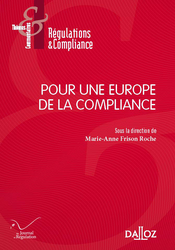
📕Pour une Europe de la Compliance (For the Europe of the Compliance)

🌐 follow Marie-Anne Frison-Roche on LinkedIn 🌐 subscribe to the Newsletter MAFR Regulation, Compliance, Law - ► Full Reference: M.-A. Frison-Roche (ed.), Pour une Europe de la Compliance (For the Europe of the Compliance), series "Régulations & Compliance", Dalloz, 2019, 124 p.  - This volume is the continuation of the books dedicated to Compliance in this collection. 📚Read the other books' presentations of the collection about Compliance: 🕴️M.-A. Frison-Roche (ed.), 📕La juridictionnalisation de la Compliance, 2023 🕴️M.-A. Frison-Roche (ed.), 📕Les Buts Monumentaux de la Compliance, 2022 🕴️M.-A. Frison-Roche (ed.), 📕Les outils de la Compliance, 2021 🕴️N. Borga, 🕴️J.-Cl. Marin &🕴️J.-Ch. Roda (ed.), 📕Compliance : l'Entreprise, le Régulateur et le Juge, 2018 🕴️M.-A. Frison-Roche (ed.), 📕Régulation, Supervision, Compliance, 2017 🕴️M.-A. Frison-Roche (ed.),📕 Internet, espace d'interrégulation, 2016   📚Read the presentations of the other titles of the collection. - ► General presentation of the book: This book is written in French. The topic is : "For the Europe of the Compliance". See below its general presentation in English.  The political dimension is intrinsic to the Compliance Law. Indeed, compliance mechanisms consist of internalizing in certains companies the obligation to implement goals of general interest set by Public Authorities. These public bodies control the Ex Ante reorganization that implies for these companies and punish Ex Post the possible structural inadequacy of these compagnies, becoming transparent for this purpose.  This new mode of governance establishes a continuum between Regulation, Supervision, Compliance (book published in 2017) and renew the links between Companies, Regulators and Judges1Frison-Roche, M.-A., Compliance, see.  This political dimension must be increased: the Compliance Law of Compliance must today be used to build Europe. One can observe not only the construction of the  European Compliance Law, object-by-object, sector-by-sector, purpose-by-purpose, but also the construction of the European Compliance Law that transcends and unifies them. Becoming independent of American Law and ceasing to be in reaction, even on the defensive, the Compliance Law contributes to the European project, offering it a higher ambition, that Europe can carry and, by this way, can carry the Europe itself, not only to preserve the European economy from corruption or money laundering, but by claiming the protection of nature and human beings. This is why the book describes the "reasons and objectives" of the Europe of the Compliance, which makes it possible to describe, detect and even predict the ways and means. - ► Understand the book through the Table of Contents and the summaries of each article:  🕴️M.-A. Frison-Roche, 📝Avant propos  🕴️K. Lenaerts, 📝Le juge de l'Union européenne dans une Europe de la compliance 🕴️M.-A. Frison-Roche, 📝Un droit substantiel de la compliance, appuyé sur la tradition européenne humaniste   I. LES RAISONS ET LES OBJECTIFS D'UNE EUROPE DE LA COMPLIANCE (THE REASONS AND OBJECTIVES OF THE EUROPE OF THE COMPLIANCE)  🕴️X. Musca, 📝Construire une Europe de la compliance en donnant une meilleure place aux entreprises 🕴️P. Vimont, 📝La place de la diplomatie dans l'avancée d'une Europe de la compliance 🕴️P. Sellal, 📝Les vertus de la compliance : une réponse possible aux faiblesses de l'Union européenne ? 🕴️J.-J. Daigre, 📝Compliance, entreprise et Europe   II. LES VOIES ET MOYENS D'UNE EUROPE DE LA COMPLIANCE  (THE WAYS AND MEANS OF THE EUROPE OF THE COMPLIANCE) 🕴️J.-Cl. Marin, 📝Quels outils pour la construction du droit de la compliance en Europe ? 🕴️M. Canto-Sperber, 📝La compliance et les définitions traditionnelles de la vertu 🕴️T. Bonneau, 📝Compliance et secteur bancaire et financier en Europe 🕴️C. Duchaine, 📝L'Agence française anticorruption, à l'appui de l'Europe de la compliance 🕴️D. Martin, 📝Les contraintes et les vertus de la compliance 🕴️A. de La Cotardière, 📝Construire une Europe de la compliance lisible pour les entreprises -

Working papers

Enterprise, Regulator, Judge: Thinking Compliance by these three characters

This working paper has served  as a basis for an article written in French in the book Compliance : Entreprise, Régulateur, Juge ("Compliance: Enterprise, Regulator, Judge"), published in May 2018 in the Regulations Series of Dalloz editions (Paris). See the other books published in this collection (presentation in French), directed by Marie-Anne Frison-Roche (presentation in English). ABSTRACT: The Company, the Regulator and the Judge are three key figures for the construction of an emerging Compliance Law. An important risk lies in a confusion of their respective roles, the company becoming a regulator, the regulator becoming a board of a place that goes to the conquest of others, the judge standing back. It is appropriate that each plays his role and that their respective function is not distorted. If this confusion is avoided, then the points of contact can multiply and one observes it. But as soon as everyone remains in its place, we can go further than these points of contact and if they agreed, the three characters can reach common goals. This is all the more legitimate since Compliance Law, as Regulation Law, is teleological in nature, which makes these branches of law profoundly political. These common goals are technical, such as risk prevention. They can be more political and higher, if there is a shared will, without ever one of the characters being captured by another: it is then to concern by the human being. The designation of this common goal to the Company, the Regulator and the Judge can be expressed in one word: Europe.