Contract

MONTEILLET, Vanessa🕴🏻

📝Le contrat, outil de mise en œuvre des obligations de vigilance entre les partenaires de la chaîne de valeur, in 📗Engagements et contrats à l’aune des mutations environnementales

► Full reference: V. Monteillet, « Le contrat, outil de mise en œuvre des obligations de vigilance entre les partenaires de la chaîne de valeur », in M. Hautereau-Boutonnet, J. Rochfeld and B. Parance (eds.), Engagements et contrats à l’aune des mutations environnementales, Dalloz, “Thèmes & commentaires – Actes” series, 2025, pp. 15-24, in French. - ► Summary: the author starts from the observation that the French Act no. 2017-399 of 27 March 2017 on the duty of vigilance of parent companies and ordering companies sets a goal – establishing a culture of social and environmental risk management throughout the value chain – without predetermining the means. After seven years of application of the Act and the adoption of Directive (EU) 2024/1760 of 13 June 2024, she shows that the contract formalising exchanges between ordering companies, their subcontractors and their suppliers is one of the operational instruments of Vigilance, wanted by public authorities but criticised by non-governmental organisations, since the Rana Plaza building had been audited a few days before its collapse. A first part deals with the drafting of the contractual content, which enables partners in the value chain to anticipate risks. The first requirement is to master contractual technique: the purpose of vigilance clauses and the “cascading contractualisation” of the contractual assurances required by the Directive, and the subject matter of these clauses, which refer to the company’s charters and codes of conduct, to international instruments and, increasingly, to technical standards. The second is to ensure contractual balance: monitoring and auditing of business partners, allocation of the cost of these controls, cooperation with partners and support for SMEs, with a view to the model contractual clauses that the Commission must adopt by 26 January 2027. A second part addresses the modulation of contractual effects and the fair allocation of risks between partners. The contractual relationship is regulated by the ordering company: enhanced prevention action plan, suspension or termination of the business relationship, sanction clauses subject to review for significant imbalance, consultation of stakeholders, which recalls the theory of contractual solidarism. Lastly, the contractual chain is made accountable in light of Article 29 of the Directive: the ordering company’s failure of vigilance may cover the harmful act of the subcontractor, and joint and several liability towards the victim may be shifted, at the stage of contribution to the debt, onto the business partner through the clauses (French Civil Code, Art. 1313 and 1317). - 🦉 The article is available in full text to those registered in Professor Marie-Anne Frison-Roche’s courses.
Logo-partage-JoRC-Paris1-IRJS

Conferences

🎤Autonomie de la volonté, engagements et Compliance (Autonomy of will, commitments and Compliance), in 🧮Compliance et Droit commun des contrats (Compliance and General Contract Law)

► Full reference: M.-A. Frison-Roche, “Autonomie de la volonté, engagements et Compliance” (Autonomy of will, commitments and Compliance), in Journal of Regulation & Compliance (JoRC) and Université Paris 1 Panthéon-Sorbonne, Institut de recherche juridique de la Sorbonne (IRJS), Compliance et Droit commun des contrats (Compliance and General Contract Law), Paris, 7 October 2026. see on Instagram the carousel devoted to the conference (in French) see on Instagram the image announcing this lecture (in French) see on Instagram the carousel devoted to this lecture (in French) - 🧮read the full programme of the event 🏗️This colloquium is part of the 2026 cycle of colloquia Compliance and Contract. - 🖥️read the slides supporting this conference (in French) - 🎤See the presentation of the other intervention made in this colloquium: Synthèse (Synthesis). - 📝This conference will give rise to an article, “Autonomie de la volonté, engagements et Compliance”, to be published in the book 📕Compliance et Contrat (Compliance and Contract), in the series 📚Régulations & Compliance, co-published by the Journal of Regulation & Compliance (JoRC) and Lefebvre-Dalloz. - ► Presentation of this conference: Contract law, in its common rules expressed by the “general theory of contracts”, seems at first sight to be given little consideration when it comes to Compliance. Yet the “commitments” that punctuate the techniques and behaviours making up the “compliance culture” hold a central place in Compliance Law, without their place, let alone their equivalence with Contract, being settled. If one stops perceiving Compliance Law only through the prism of repression, the compliance obligation can be thought of as also having contract as a legitimate source, a contract whose source, in general law, is the autonomy of will and all its consequences. It is on the basis of this founding principle that this conference opens the colloquium. At the heart of Contract Law as of Compliance Law lies the will. But whose will? If the will of the Legislator shapes the obligation that companies implement, and if the Monumental Goals stem from the will of the Political power, companies would enter into them only as executors, and the contract would merely be a path taken by the law to apply more effectively: an arranged marriage. The conference proposes to link the compliance contract, or the compliance clause, not to the external will of a Legislator, but to the primary source of the contract: the autonomous wills of the contracting parties who exchange their consents, thus restoring to the autonomy of will its place as the source of the contractual Compliance Obligation. It first measures the concrete stake of designating this source, distinguishing three conceptions: the contract as the mouthpiece of the regulator, the contracting parties as the regulator’s “good soldiers”, and autonomous and convergent wills, which choose the ways and means of taking their part in the legal ambitions — Compliance chosen rather than Compliance endured. It then proposes to put an end to the current confusion between the force of regulation, the binding force of wills and the impetus of commitments, and finally to occupy the contractual sphere freely in order to develop a contractual Compliance system specific to each company.

Articles in a legal collective publication

contribution in a collective legal publication

📝L’invention du “droit à l’enfant”. Les conséquences de la pratique contractuelle comme source d’engendrement de l’enfant (The invention of the “right to a child”. The consequences of the contractual practice as a source of childbearing), in 📗Nouvelles filiations (New Filiations)

► Full Reference: M.-A. Frison-Roche,  « L'invention du "droit à l'enfant". Les conséquences de la pratique contractuelle comme source d'engendrement de l'enfant (The invention of the "right to a child". The consequences of the contractual practice as a source of childbearing)", in Special Issue Nouvelles filiations (New Filiations), AJ Famille, Lefebvre Dalloz, Nov. 2025, pp. 568-571.    - 📗read the table of content of the special issue in which this article is published (in French) - 📝read this article (in French) - 🚧Read the underlying bilingual working document, which includes additional technical developments, technical references and hyperlinks. - ► English summary of this article: Every legal system is built on concepts that form its pillars. Filiation is one such concept. A cas-law solution, presented as pragmatic and casuistic, can overturn this concept. Whether one agrees with it or not, it must first be acknowledged and assessed. Through a series of rulings on surrogacy, notably a ruling by its First Civil Chamber granting exequatur to a judgment recognising the filiation established by surrogacy between a child and persons with no biological link to the child and without recourse to adoption, the French Cour de Cassation has introduced the possibility of creating parentage by contract. This not only changes the concept of filiation but also changes the very structure of the French legal system, which is based on the distinction between persons and things. One may agree or disagree with this, but it must be said. Since the judge gives force to such a contract establishing filiation, with the foreign judge simply recognising it and the French judge ensuring only that the contract is balanced, the prospect opens up of a society in which individuals will be able to contractually create institutions at their disposal, within the private normative space of the contract, with the State's only function being to give effect to their right to legal recognition of their unique "project". Parentage is only a first example. Thus constructed on what was "inconceivable", i.e. a "right to a child", thanks to the contractual power to which the State should lend its force a posteriori, the judge makes parentage resulting .the judge technically declares a parentage arising from a contract to be "admissible". Is opening a society in institutions were contractually governed. 
Couverture – L’Obligation de Compliance

Articles in a JoRC book

Contribution to a collective legal work

📝Obligation de Compliance : construire une structure de compliance produisant des effets crédibles au regard des Buts Monumentaux visés par le Législateur (Compliance Obligation: build a compliance structure producing credible effects in the perspective of the Monumental Goals targeted by the Legislator), in 🕴️M.-A. Frison-Roche (dir.), 📕L’obligation de Compliance

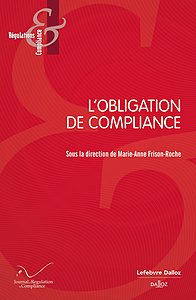
► Full Reference: M.-A. Frison-Roche, “Obligation de Compliance : construire une structure de compliance produisant des effets crédibles au regard des Buts Monumentaux visés par le Législateur” (Compliance Obligation: build a compliance structure producing credible effects in the perspective of the Monumental Goals targeted by the Legislator), in M.-A. Frison-Roche (dir.), L’Obligation de Compliance, Journal of Regulation & Compliance (JoRC) and Lefebvre-Dalloz, coll. “Régulations & Compliance“, 2025, pp. 3-44. - ► This article is the introduction to the book - 📝read the article (in French) - 🚧read the bilingual Working Paper on the basis this article has been written, with more developments, technical references and hyperlinks - 📕read the general presentation of the book, L’Obligation de Compliance, in which this article is published 📚see the general presentation of the series “Régulations & Compliance” in which this book is published - ► This article is written in French. English summary of this contribution (done by the Journal of Regulation & Compliance – JoRC): This article explains what companies’ Compliance Obligation” is. Delving into the mass of compliance obligations, it uses the method of classification of those that are subject to an obligation of result and those that are subject to an obligation of means. It justifies the choice of this essential criterion, which changes the objects and the burden of proof of companies that are subject to an obligation of result when it comes to setting up “compliance structures” and are subject to an obligation of means when it comes to the effects produced by these compliance structures. Indeed, rather than getting bogged down in definitional disputes, given that Compliance Law is itself a nascent branch of Law, the idea of this contribution is to take as a starting point the different legal regimes of so many different compliance obligations to which laws and regulations subject large companies: sometimes they have to apply them to the letter and sometimes they are only sanctioned in the event of fault or negligence. This brings us back to the distinction between obligations of result and obligations of means. Although it would be risky to transpose the expression and regime of contractual obligations to legal obligations put by legislation, starting from this observation in the evidentiary system of compliance of a plurality of obligations of means and of result, depending on whether it is a question of this or that technical compliance obligation, we must first classify them. It would then appear that this plurality will not constitute a definitive obstacle to the constitution of a single definition of the Compliance Obligation. On the contrary, it makes it possible to clarify the situation, to trace the paths through what is so often described as a legal jumble, an unmanageable “mass of regulations”. Indeed, insofar as the company obliged under Compliance Law participates in the achievement of the Monumental Goals on which this is normatively based, a legal obligation which may be relayed by contract or even by ethics, it can only be an obligation of means, by virtue of this very teleological nature and the scale of the goals targeted, for example the happy outcome of the climate crisis which is beginning or the desired effective equality between human beings. This established principle leaves room for the fact that the behaviour required is marked out by processes put in place by structured tools, most often legally described, for example the establishment of a vigilance plan or regularly organised training courses (effectiveness), are obligations of result, while the positive effects produced by this plan or these training courses (effaciety) are obligations of means. This is even more the case when the Goal is to transform the system as a whole, i.e. to ensure that the system is solidly based, that there is a culture of equality, and that everyone respects everyone else, all of which come under the heading of efficiency. The Compliance Obligation thus appears unified because, gradually, and whatever the various compliance obligations in question, their intensity or their sector, its structural process prerequisites are first and foremost structures to be established which the Law, through the Judge in particular, will require to be put in place but will not require anything more, whereas striving towards the achievement of the aforementioned Monumental Goals will be an obligation of means, which may seem lighter, but corresponds to an immeasurable ambition, commensurate with these Goals. In addition, because these structures (alert mechanisms, training, audits, contracts and clauses, etc.) have real meaning if they are to produce effects and behaviours that lead to changes converging towards the Monumental Goals, it is the obligations of means that are most important and not the obligations of result. The judge must also take this into account. Finally, the Compliance Obligation, which therefore consists of this interweaving of multiple compliance obligations of result and means of using the entreprise’s position, ultimately Goals at system efficiency, in Europe at system civilisation, for which companies must show not so much that they have followed the processes correctly (result) but that this has produced effects that converge with the Goals sought by the legislator (effects produced according to a credible trajectory). This is how a crucial company, responsible Ex Ante, should organise itself and behave.
Couverture – L’Obligation de Compliance

Articles in a JoRC book

📝Concevoir l’Obligation de Compliance : faire usage de sa position pour participer à la réalisation des Buts Monumentaux de la Compliance (Conceiving the Compliance Obligation: Using its Position to take part in achieving the Compliance Monumental Goals), in 🕴️M.-A. Frison-Roche (ed.), 📕L’Obligation de Compliance

► Full Reference: M.-A. Frison-Roche, "Concevoir l'Obligation de Compliance : faire usage de sa position pour participer à la réalisation des Buts Monumentaux de la Compliance" ("Conceiving the Compliance Obligation: Using its Position to take part in achieving the Compliance Monumental Goals"), in M.-A. Frison-Roche (ed.), L'Obligation de Compliance, Journal of Regulation & Compliance (JoRC) and Dalloz, "Régulations & Compliance" Serie, 2025, pp. 3-44. - 📝read the article (in French) - 🚧read the bilingual Working Paper on the basis this contribution has been built, with  more developments, technical references and hyperlinks.  - 📕read a general presentation of the book, L'Obligation de Compliance, in which this article is published  - ► English summary of this contribution: Rather than getting bogged down in definitional disputes, given that Compliance Law is itself a incipient branch of Law, the idea of this contribution is to take as a starting point the different regimes of so many different compliance obligations to which laws and regulations subject large companies: sometimes they must apply them to the letter and sometimes they are only penalised in the event of fault or negligence. This brings us back to the distinction between obligations of result and obligations of means. Although it might be risky to transpose the expression and regime of contractual obligations to legal obligations, starting from this observation in the Compliance Evidentiary System of a plurality of obligations of means and of result, depending on whether we are dealing with this or that technical compliance obligation, we must first classify them. It would appear that this plurality does not constitute a definitive obstacle to the creation of a single definition of the Compliance Obligation. On the contrary, it makes it possible to clarify the situation, to trace the paths through what is so often described as a legal jumble, an unmanageable mass of regulations. Indeed, insofar as the company obliged under Compliance Law participates in the achievement of the Monumental Goals on which this branch of Law is normatively based, a legal obligation which may be relayed by contract or even by ethics, it can only be an obligation of means, by virtue of this very teleological nature and the scale of the goals targeted, for example the happy outcome of the climate crisis which is beginning or the desired effective equality between human beings. This established principle leaves room for the fact that the behaviour required is marked out by processes put in place by structured tools, most often legally described, for example the establishment of a vigilance plan or regularly organised training courses (effectiveness), are obligations of result, while the positive effects produced by this plan or these training courses (efficacy) are obligations of means. This is even more the case when the aim is to transform the system as a whole, i.e. to ensure that the system is solidly based, that there is a culture of equality, and that everyone respects everyone else – all of which come under the heading of efficiency. The Compliance Obligation thus appears unified because, gradually, and whatever the various compliance obligations in question, their intensity or their sector, its structural process prerequisites are first and foremost structures to be established which the Law, through the Judge in particular, will require to be put in place but will not require anything more, whereas striving towards the achievement of the aforementioned Monumental Goals will be an obligation of means, which may seem lighter, but corresponds to an immeasurable ambition, linked with these Goals. Moreover, because these structures (warning platforms, training, audits, contracts and clauses, etc.) only have meaning in order to produce effects and behaviour leading to changes converging towards the Monumental Goals, it is the obligations of means that are most important and not the obligations of result. The judge must also take this into account. Finally, the Compliance Obligation, which therefore consists of this interweaving of multiple compliance obligations of result and means of using the Entreprise's position, ultimately aims at system efficiency, in Europe at system civilisation, for which companies must show not so much that they have followed the processes correctly (result) but that this has produced effects that converge with the Goals sought by the legislator (effects produced according to a credible trajectory). This is how a crucial economic operator, responsible Ex Ante, should organise itself and behave.

Working papers

🚧The invention of the ‘right to a child’. The consequences of contractual practice as a source of childbearing

► Full reference : M.-A. Frison-Roche, The invention of the 'right to a child'. The consequences of contractual practice as a source of filiation, working document, Sept. 2024 – Oct. 2025. - 🎤This working document forms the basis of a presentation entitled, "Le "droit à l'enfant" est-il concevable, pourquoi et avec quelles conséquences" (Is the 'right to a child' conceivable, why and with what consequences", in Les nouvelles filiations. Diifférentes perspectives (New parentage. Different perspectives." held at the Paris Court of Appeal on 12 September 2024. - 📝Revised, this working document forms the basis of the article published in the dossier "Les nouvelles filiations. Regards croisés" (New parentage. Different perspectives), Act. jur. Dalloz Droit de la famille (in French). - ► Summary of this working document  :  Every legal system is built on concepts that form its pillars. Filiation is one such concept. A cas-law solution, presented as pragmatic and casuistic, can overturn this concept. Whether one agrees with it or not, it must first be acknowledged and assessed. Through a series of rulings on surrogacy, notably a ruling by its First Civil Chamber granting exequatur to a judgment recognising the filiation established by surrogacy between a child and persons with no biological link to the child and without recourse to adoption, the French Cour de Cassation has introduced the possibility of creating parentage by contract. This not only changes the concept of filiation but also changes the very structure of the French legal system, which is based on the distinction between persons and things. One may agree or disagree with this, but it must be said. Since the judge gives force to such a contract establishing filiation, with the foreign judge simply recognising it and the French judge ensuring only that the contract is balanced, the prospect opens up of a society in which individuals will be able to contractually create institutions at their disposal, within the private normative space of the contract, with the State's only function being to give effect to their right to legal recognition of their unique "project". Parentage is only a first example. Thus constructed on what was "inconceivable", i.e. a "right to a child", thanks to the contractual power to which the State should lend its force a posteriori, the judge makes parentage resulting from a contract technically "admissible" and opens up a contractually governed society. - 🔓read the working document below⤵️

Organisation of events

Second conference-debate of the cycle "Contentieux Systémique Émergent" ("Emerging Systemic Litigation")

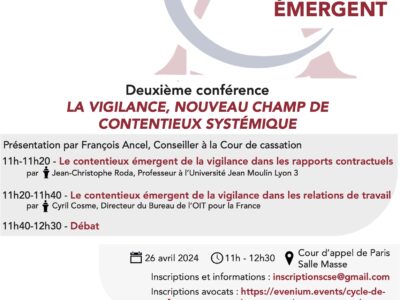
🧮La vigilance, nouveau champ de contentieux systémique (Vigilance, new field of Systemic Litigation), in cycle of conference-debates “Contentieux Systémique Émergent” (Emerging Systemic Litigation)

► Full Reference: La vigilance, nouveau champ de contentieux systémique (Vigilance, new field of Systemic Ligation), in cycle of conference-debates "Contentieux Systémique Émergent" ("Emerging Systemic Litigation"), organised on the initiative of the Cour d'appel de Paris (Paris Cour of Appeal), with the Cour de cassation (French Court of cassation), the Cour d'appel de Versailles (Versailles Court of Appeal), the École nationale de la magistrature – ENM (French National School for the Judiciary) and the École de formation des barreaux du ressort de la Cour d'appel de Paris – EFB (Paris Bar School), under the scientific direction of Marie-Anne Frison-Roche, 26 April 2024, 11am.-12.30am., Cour d'appel de Paris, Massé courtroom - 🧮see the full programme of the cycle Contentieux Systémique Émergent (Emerging Systemic Litigation) - see on LinkedIn the report of this event - 🧱read below the report of this event⤵️ - ► Presentation of the conference: The duty of vigilance imposed by the 2017 French law is being contractualised, either by ad hoc contracts or by stipulations that reproduce the legal provisions, adjust them or go beyond them. This adoption by the Contract and Tort Law is valuable but not without risk. The systemic scope of the underlying law on the one hand and of economic structures on the other, the firm or the value chain, will permeate litigation. The example of labour relations is instructive in this respect. - 🧮Programme of this event:  Second conference-debate LA VIGILANCE, NOUVEAU CHAMP DE CONTENTIEUX SYSTÉMIQUE (VIGILANCE, NEW FIELD OF SYSTEMIC LITIGATION)   Paris Court of Appeal, Massé courtroom General presentation of the topic and moderation by 🕴️François Ancel, Judge at the Première Chambre civile de la Cour de cassation (First Civil Chamber of the French Court of cassation) 🕰️11am.-11.20am. 🎤Le contentieux émergent de la Vigilance dans les rapports contractuels (Emerging Vigilance Litigation in Contractual Relationships), by 🕴️Jean-Christophe Roda, Full Professor at Jean-Moulin Lyon 3 University 🕰️11.20am.-11.40am. 🎤Le contentieux émergent de la Vigilance dans les relations de travail (Emerging Vigilance Litigation in Employment Relationships), by 🕴️Cyril Cosme, Director of the French Office of the International Labour Organization (ILO) 🕰️11.40am.-12.30am. Debate - 🔴Registrations and information requests can be sent to: inscriptionscse@gmail.com 🔴For the attorneys, registrations have to be sent to the following address: https://evenium.events/cycle-de-conferences-contentieux-systemique-emergent/  ⚠️The conference-debates are held in person only, in the Cour d’appel de Paris (Paris Court of Appeal). - 🧱read below a detailed presentation of this event⤵️ -

Conferences

🎤Le renforcement des engagements de compliance par le renvoi Ex Ante à l’arbitrage international (Reinforcing Compliance commitments by referring Ex Ante to International Arbitration), in 🧮L’arbitrage international en renfort de l’obligation de Compliance

► Full Reference: M.-A. Frison-Roche, “Le renforcement des engagements de Compliance par le renvoi Ex Ante à l’arbitrage international” (“Reinforcing Compliance commitments by referring Ex Ante to International Arbitration”) (planned but not delivered), in L. Aynès, M.-A. Frison-Roche, J.-B. Racine and E. Silva-Romero (dir.), L’arbitrage international en renfort de l’obligation de Compliance (International Arbitration in support of the Compliance Obligation), Journal of Regulation & Compliance (JoRC) and Institute of World Business Law of the ICC (Institute), Conseil Économique Social et Environnemental (CESE), Paris, February 9, 2024 - 🧮see the full programme of this event - consult on LinkedIn a general presentation of this event, which links to a presentation of each speech (in French) - 🧱consult the scientific direction sheet of this event, which gives an account of the various speeches made - 🔲see the slides that were to support the presentation (in French) - 📝This conference, which was to be delivered, and the Working Paper on which it is based are to be linked with the article to be published in the book📘Compliance Obligation  - 🎤see a presentation of the conference “Préalable : ce qu’est l’Obligation de Compliance” (“Prerequisite: what is the Compliance Obligation”), given at the same symposium - 🎤see a presentation of the conference “Préalable : ce qu’est un engagement” (“Prerequisite: the Commitment”), given at the same symposium - ► Presentation of the conference: It was initially planned that I would speak on the subject Le renforcement des engagements de Compliance par le renvoi Ex Ante à l’arbitrage international (Reinforcing Compliance commitments through the Ex Ante referral to International Arbitration), but it was agreed with the other organisers of the symposium that after defining the concept of the Compliance Obligation📎1🕴️M.-A. Frison-Roche, 🎤Préalable : ce qu'est l'obligation de Compliance (Prerequisite: the Compliance Obligation), in 🧮L'arbitrage international en renfort de l'obligation de Compliance (International Arbitration in support of the Compliance Obligation), 2024. I would refocus my second speech, mentioned above, on what a Commitment is📎2M.-A. Frison-Roche, Préalable : ce qu'est un engagement 🕴️M.-A. Frison-Roche, 🎤Préalable : ce qu'est un engagement (Prerequisite: the Commitment), in 🧮L'arbitrage international en renfort de l'obligation de Compliance (International Arbitration in support of the Compliance Obligation), 2024., an essential prerequisite for dealing with the subject of International Arbitration in support of the Compliance Obligation. Developments on Reinforcing Compliance commitments through the Ex Ante referral to International Arbitration will appear in the forthcoming books: L’obligation de Compliance (in French), Compliance Obligation (in English). Nevertheless, if I had dealt with this subject, I would have raised the following points: I would have shown that the inclusion of an offer of arbitration in the field of Compliance implies considering it in a contract as well as in a non-contractual commitment, and studying which category of Compliance Obligation the offer may apply to. I would have added that this insertion benefits from taking the form of a “graduated offer”, in a crescendo organised by the company ex ante and offered to the stakeholders: conciliation, mediation and arbitration, in “circles of trust”📎3🕴️M.-A. Frison-Roche, 🚧Compliance and Trust, 2017.. This is supported by the current French amicable settlement policy. The result was that I had to prepare a long “preliminary” discussion of what a “commitment” is, without which it seemed difficult to talk in concrete terms about the effective insertion of an offer of arbitration if we did not know whether such links or words had a constraining effect on the person issuing them in relation to the person benefiting from them. After discussions with the other speakers, it became clear that it would be more effective to give a talk devoted solely to the question of the legal definition of commitment. We therefore decided to allocate this second speaking slot to the notion of commitment. Since the written words do not have the same constraints, it will take up the initial construction, insisting on the different supports, either compliance contracts, or associations with compliance clauses, relating to different Compliance obligations, in particular on information or audit or Vigilance📎4🕴️M.-A. Frison-Roche, 🚧Compliance contract, compliance clauses, 2022., because the company must have the legal power corresponding to the mission that the State entrusts to it through Compliance📎5🕴️M.-A. Frison-Roche, 🚧Conceiving Power, 2021.. The offer must be carefully drafted to explain its purpose, and its organisation must prove the reality of this purpose: to give access to a judge to people affected by the company’s activity, and not to block it. This will therefore be available in detail in the forthcoming books: M.-A. Frison-Roche (ed.), 📕L’obligation de Compliance M.-A. Frison-Roche (ed.), 📘Compliance Obligation

Publication director

🏗️ copublishing and direction of the collection: 📚Compliance & Regulation

📚Publication of:🕴️M.-A. Frison-Roche (ed.), 📘Compliance and Contract

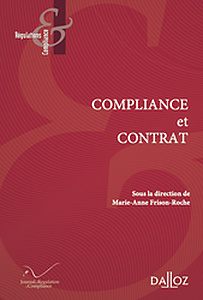
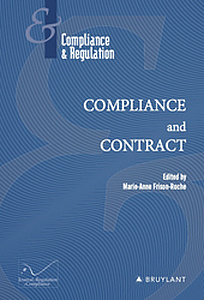
► Full Reference: M.-A. Frison-Roche (ed.), Compliance and Contract, Journal of Regulation & Compliance (JoRC) and Bruylant, “Compliance & Regulation” Serie, to be published - 📘In parallel, the French version of this book, Compliance et contrat, is published in the Serie co-published by the Journal of Regulation & Compliance (JoRC) and Dalloz - 🧮This book comes after a cycle of symposiums organised in 2023-2024 by the Journal of Regulation & Compliance (JoRC) and its Academic Partners - ► General presentation of the book: - 📚This volume is one of a series of books devoted to Compliance in this series. ► read presentations of the other books of this Serie dealing with Compliance : further books: 🕴️M.-A. Frison-Roche (ed.), 📘Compliance Evidence System, 2025 previous books: 🕴️M.-A. Frison-Roche (ed.), 📘Compliance Obligation, 2024 🕴️M.-A. Frison-Roche (ed.), 📘Compliance Jurisdictionalisation, 2024 🕴️M.-A. Frison-Roche (ed.), 📘Compliance Monumental Goals, 2023 🕴️M.-A. Frison-Roche (ed.), 📘Compliance Tools, 2021 📚see the global presentation of all the books of the Serie. - 🏗️General construction of the book: ► General presentation of this book: The book, published in 2025 in the same series “Regulations & Compliance” series, demonstrates that the Obligation of Compliance—which falls upon crucial operators and those concerned with the future of systems and the present and future individuals involved in them—derives from laws and regulations, and is upheld by these operators themselves, regulators and judges. The role played by contracts has already been discussed therein, since contracts are both a means by which operators perform their legal compliance obligation and an autonomous source of obligation (which places the question of liability at the heart of the subject). This book specifically examines the role that contracts play and will play in the conception, development and implementation of Compliance Law. This aspect is underestimated because Compliance Law is often analysed through the prism of laws and regulations designed to achieve Monumental Goals set by states and public authorities, to the realisation of which systemic economic operations contribute through compliance tools, rather than through the actors themselves. When they do act, this is referred to outside the realm of Law, generally to Ethics. However, the Contract, the binding Ex Ante legal instrument par excellence, will play an increasingly significant role within global and interconnected compliance systems. In the European construction of Compliance Law, which places human beings at the heart of efforts to ensure the sustainability of systems, the Contract serves not only as the means by which the entity fulfils its legal obligations, forges relationships with stakeholders and implements the necessary innovations, but also as the means by which it exercises its autonomy to contribute to the realisation of the systemic ambitions in question, may go beyond public ambitions, enrich them, anchor them territorially, and identify them with its own activity and its overall corporate strategy, etc. To describe and anticipate the practice and rules that link Compliance Law and Contracts, the book first examines how this new branch of Law, insofar as it draws on the political ideas of the Social Contract, renews Contract Law by embedding it within the strategy of economic operators, a task made all the easier for them as they have built value chains through contracts. These are ‘regulatory contracts’. This demonstrates that Public Law Contracts exemplify the incorporation by General Contract Law of the overarching perspective of compliance, normatively anchored in the Monumental Goals (Title I). That explained, the book examines how General Contract Law interfaces with the techniques and objectives of Compliance Law. Whether through mandatory requirements, incentives or support, Compliance Law plays a role in contracts, helping to shape them in part, whether they relate to regulated or unregulated activities, with the points of contact with the principle of liberalism – and the limits to it – being determined by the courts. Conversely, however, General Contract Law contributes to Compliance Law and will do so increasingly. This applies equally to the stages of formation, execution, and sanctions, which may take the form of consolidations (Title II). In practical terms, the Contract itself serves as a Compliance Tool. As such, the company may choose to outsource the compliance function, which it is free to do provided it remains accountable for its performance to the legislator and the persons concerned: this is the concept of the ‘Compliance Contract’, which appears as a specific contract. Furthermore, compliance can be incorporated into multiple contracts—contractual arrangements through which the contracting parties establish one or more obligations that will facilitate or enhance their legal obligations. In doing so, legal entities exercise their freedom, as permitted by general law, as can be seen in practice “clause by clause”, and this is also recognised by the Regulator, Supervisor and/or Judge in light of the normative Monumental Goals of Compliance Law (Title III). Precisely, a new field of ‘contractual compliance litigation’ is emerging. The primary topic here is to examine contractual judicial disputes in which an element of Compliance Law features in the proceedings. Indeed, a dispute concerning a claim for mandatory execution, termination or contractual liability may involve, in the claim itself or in an procedural exception or defence raised, an element of compliance law, ranging from an allegation of lack of jurisdiction to a request for the court to take into account a systemic teleological norm that the contract judge should consider. Secondly, in certain emerging systemic compliance litigation, because the role of the judge is transformed and the procedure must be adapted, the contract appears as a particularly suitable tool, either as a ‘procedural framework’ through the contractualisation of the whole, or as a technique used in the strict sense, its ex ante nature allowing, in disputes concerning the future, the development of new adequate techniques (Title IV). - ► First presentation of the provisional Table of Contents  : - PROVISIONAL TABLE OF CONTENTS REPORTING ON CONTRACTUAL PRACTICES WITHIN THE COMPLIANCE SYSTEM AND ENHANCING ITS EFFECTIVENESS AND HUMANITY ♦️ The Marriage between Compliance and Contract, by 🕴️Marie-Anne Frison-Roche TITLE I. SOCIAL CONTRACT, COMPLIANCE LAW AND THE STRATEGY OF ECONOMIC OPERATORS CHAPTER I: SOCIAL CONTRACT AND COMPLIANCE LAW Section 1 ♦️ The Monumental Goals of Compliance, a guide to action for economic operators serving global policies, by 🕴️Marie-Anne Frison-Roche Section 2 ♦️ Compliance and the Social Contract, by 🕴️René Sève CHAPTER II: POLITICAL AMBITIONS AND CORPORATE STRATEGIES IN THE CONTRACTUAL ORGANISATION OF VALUE CHAINS Section 1 ♦️ sss Section 2 ♦️ sss, by CHAPTER III: PUBLIC CONTRACTS, PARAGONS OF THE INCORPORATION OF POLITICAL AMBITIONS INTO STRATEGIES AND OF THE ALLIANCE OF INSTITUTIONS Section 1 ♦️ Contractual instruments facilitating the insertion of the compliance obligation, by 🕴️Marion Ubaud-Bergeron Section 2 ♦️ Third-party assessment obligations in public contracts, by 🕴️Valentin Lamy Section 3 ♦️ Exemplarity in public contracts, by 🕴️Ugo Assouad and 🕴️Léon Boijout Section 4 ♦️ Is the duty of vigilance soluble in the law of administrative contracts?, by 🕴️Antoine Oumedjkane TITLE II. GENERAL CONTRACT LAW FACED WITH COMPLIANCE LAW CHAPTER I: DISTINGUISHING WHAT IS CONTRACTUAL FROM WHAT RESEMBLES IT IN THE COMPLIANCE SYSTEM Section 1 ♦️ Commitments, Contractualisation and Compliance, by 🕴️Marie-Anne Frison-Roche Section 2 ♦️ The functional contract, the contribution of general contract law to compliance requirements, by 🕴️Laurent Aynès CHAPTER II: WHERE GENERAL CONTRACT LAW CONTRIBUTES TO COMPLIANCE Section 1 ♦️ Regulatory contracts generated by compliance, by 🕴️Jean-Baptiste Barbieri Section 2 ♦️ Third parties to contracts that include a compliance dimension, by 🕴️Philippe Stoffel-Munck TITLE III. COMPLIANCE CONTRACT, COMPLIANCE CLAUSES CHAPTER I: THE “COMPLIANCE CONTRACT” Sub-chapter 1: THE EMERGENCE OF THE “COMPLIANCE CONTRACT” AND OF THE COMPLIANCE MARKET Section 1 ♦️ The industrialisation and outsourcing by the company of an essential function through the “compliance contract”, by 🕴️Étienne Maclouf and 🕴️Bruno Deffains Section 2 ♦️ Legal definition of the “compliance contract”, by 🕴️Marie-Anne Frison-Roche Sub-chapter 2: EXAMPLES OF “COMPLIANCE CONTRACTS” Section 3 ♦️ Internal investigation contracts, by 🕴️Dominique de la Garanderie Section 4 ♦️ Contracts concluded with audit firms, by 🕴️Antoinette Gutierrez-Crespin Sub-chapter 3: THE LAW’S RESPONSE TO THE INDUSTRIALISATION AND STANDARDISATION OF THE “COMPLIANCE CONTRACT” Section 5 ♦️ How competition law grasps the standardisation and industrialisation of the “compliance contract” in order to regulate, by 🕴️Jean-Christophe Roda Section 6 ♦️ The international aspects of the “compliance contract”, by 🕴️Jean-Baptiste Racine CHAPTER II: COMPLIANCE CLAUSES Section 1 ♦️ Uniqueness and Diversity of Compliance Clauses, by 🕴️Marie-Anne Frison-Roche Section 2 ♦️ Compared usefulness of conformity clauses and Compliance clauses, by 🕴️Jean-Christophe Roda Sub-chapter 1: COMPLIANCE CLAUSES CONCERNING INFORMATION Section 3 ♦️ Compliance clauses relating to the transmission of information, by 🕴️Thibault Duchesne Section 4 ♦️ Compliance clauses relating to confidentiality and the non-transmission of information, by 🕴️Jean-Christophe Roda Section 5 ♦️ Compliance clauses relating to audit, by 🕴️Marie-Anne Frison-Roche Sub-chapter 2: COMPLIANCE CLAUSES CONCERNING THE PERFORMANCE OF THE CONTRACT Section 6 ♦️ Compliance clauses relating to changes in circumstances, by 🕴️Julia Heinich Section 7 ♦️ Compliance clauses aimed at obtaining appropriate behaviour (the example of labour relations), by 🕴️Joseph-Antoine Morin Section 8 ♦️ Compliance clauses aimed at ensuring the effectiveness of risk management plans, by 🕴️Grégoire Leray Section 9 ♦️ Robustness clauses, by 🕴️Ludovic Pailler Sub-chapter 3: COMPLIANCE CLAUSES CONCERNING THE PREVENTION AND ANTICIPATED MANAGEMENT OF DISPUTES Section 10 ♦️ Compliance clauses relating to sanctions, by 🕴️Laura Sautonie-Laguionie Section 11 ♦️ Compliance clauses relating to remediation, by 🕴️Morgane Tirel Section 12 ♦️ Compliance clauses relating to procedure, expert evidence and pre-trial case management, by 🕴️Thibault Goujon-Béthan TITLE IV. CONTRACTUAL LITIGATION INVOLVING COMPLIANCE LAW CHAPTER I: IDENTIFYING CONTRACTUAL LITIGATION INVOLVING COMPLIANCE Section 1 ♦️ The emergence of contractual litigation involving Compliance through the convergence of fields, by 🕴️Marie-Anne Frison-Roche Section 2 ♦️ The singularity of contractual litigation involving Compliance, by 🕴️Thibault Goujon-Béthan CHAPTER II: COURTS SEISED AND NATURAL JUDGES OF CONTRACTUAL LITIGATION INVOLVING COMPLIANCE Section 1 ♦️ Ordinary courts and specialised courts in contractual litigation involving Compliance, by 🕴️Romain Raine Section 2 ♦️ From the criminal court to the civil court in contractual litigation involving Compliance, by 🕴️Alex Nicollet Section 3 ♦️ The supporting judge in contractual litigation involving Compliance, by 🕴️Fabrice Vert Section 4 ♦️ The arbitrator in contractual litigation involving Compliance, by 🕴️Cyril Nourissat CHAPTER III: THE PARTIES TO CONTRACTUAL LITIGATION INVOLVING COMPLIANCE Section 1 ♦️ Original and intervening parties, necessary parties, stakeholders: who are the legitimate parties?, by 🕴️Liza Veyre CHAPTER IV: THE PROCEDURAL HANDLING OF CONTRACTUAL LITIGATION INVOLVING COMPLIANCE Section 1 ♦️ Handling time in contractual litigation involving Compliance: from urgency to the long term, by 🕴️Marie-Anne Frison-Roche Section 2 ♦️ Contractualising pre-trial case management, a natural tool of contractual litigation involving Compliance, by 🕴️Thibault Goujon-Béthan Section 3 ♦️ Contractualising evidence in contractual litigation involving Compliance, by 🕴️Nicolas Ida Section 4 ♦️ The hearing in contractual litigation involving Compliance, by 🕴️Anaïs Danet CHAPTER V: THE JUDGMENT IN CONTRACTUAL LITIGATION INVOLVING COMPLIANCE Section 1 ♦️ The appropriate judgment in contractual litigation involving Compliance and its effective enforcement, by 🕴️Marie-Anne Frison-Roche and 🕴️Thibault Goujon-Béthan

Lessons

Teaching for the École nationale de la magistrature - ENM (French National School for the Judiciary)

⚖️Droit de la compliance (Compliance Law)

► Full Reference: F. Ancel &  M.-A. Frison-Roche, Droit de la compliance (Compliance Law), École nationale de la magistrature – ENM (French National School for the Judiciary), in collaboration with the École de Formation professionnelle des Barreaux du ressort de la cour d'appel de Paris – EFB (Paris Bar School), Paris, February 1 and 2, 2024 This teaching is given in French. - consult on LinkedIn a general présentation of this event, which links to a presentation and a report of each speech - ► Presentation of the Teaching: The aim of this two-day conference is to enable judges and lawyers to grasp the issues, objectives and methods that define Compliance Law as it is practised in companies. The speakers will illustrate the growing trend towards litigation, which is difficult to reconcile with the supranational dimension, or even indifference to territories, for example when disputes concern systemic climate or digital issues: the result is a renewal of the role of the judge and the role of lawyers. This must be set against the renewal of the role and operation of companies themselves. This is analysed from the perspective of Civil Law, in particular Contract Law and Liability Law. Company Law and Criminal Law are also addressed, as well as the way in which the legal system now integrates governance, regulation, climate and digital issues and the smooth operation of financial markets through Compliance techniques. - ► Organisation of the Teaching: This conference is divided into two parts. The first day is designed as a presentation of the major themes through which Compliance Law crosses the branches of traditional Law. The speakers will be professors of Law who will successively summarise the branches of Law and put into perspective the way in which Compliance imperatives give rise to new situations, new difficulties and new solutions. This enables the second day to focus on practical and topical issues and to debate controversial questions between people of different sensibilities. The participants tend to be judges, members of regulatory authorities, lawyers, members of associations and so on. - ► Enrolment procedure: The course is open to all judicial and consular magistrates, as well as lawyers. Registrations can be made directly with the ENM or with the EFB. - ► Speakers :   🎤François Ancel, Judge at the Première Chambre civile de la Cour de cassation (First Civil Chamber of the French Court of cassation)  🎤Thomas Baudesson, Attorney at the Paris Bar, Partner at Clifford Chance 🎤Guillaume Beaussonie, Full Professor at Toulouse 1 Capitole University 🎤Jacques Boulard, Premier Président de la Cour d’appel de Paris (First President of the Paris Court of Appeal) 🎤Marie Caffin-Moi, Full Professor at Paris Panthéon-Assas University 🎤Malik Chapuis, Judge at the Tribunal judiciaire de Paris (Paris First Instance Civil Court) 🎤Lucie Chatelain, Advocacy and Litigation Manager – Civil Liability of Parent Companies, Sherpa 🎤Jean-Benoît Devauges, Directeur Juridique, Ethique et Gouvernance des entreprises (Legal, Ethics and enterprises governance Director), MEDEF 🎤Marie-Anne Frison-Roche, Professor of Regulatory and Compliance Law, Director of the Journal of Regulation & Compliance (JoRC) 🎤Arnaud Gossement, Attorney at the Paris Bar, Partner at Gossement Avocats 🎤Thibault Goujon-Bethan, Full Professor at Jean Moulin Lyon 3 University 🎤Christophe Ingrain, Attorney at the Paris Bar, Partner at Darrois Villey Maillot Brochier 🎤Isabelle Jegouzo, Director of the Agence française anticorruption – AFA (French Anti-Corruption Agency)  🎤Anne-Valérie Le Fur, Full Professor at Versailles Saint-Quentin-en-Yvelines University 🎤Charlotte Michon, Attorney at the Paris Bar, partner at Charlotte Michon Avocat 🎤Jean-Baptiste Racine, Full Professor at Paris Panthéon-Assas University 🎤 Jean-Christophe Roda, Full Professor at Jean-Moulin Lyon 3 University 🎤Jérôme Simon, 1er Vice-Procureur Financier (First Financial Vice-Prosecutor) - 🧮read below the programme put together and organised by François Ancel and Marie-Anne Frison-Roche, as well as the reports of each presentation⤵️

Organisation of events

🧱Co-organisation of the Symposium 🧮Compliance et contrats publics (Compliance and public contracts)

► Full Reference: M.-A. Frison-Roche, C. Gilles and A. Oumedjkane (dir.), Compliance et contrats publics (Compliance and public contracts), Journal of Regulation & Compliance (JoRC), Centre de recherches et d’études administratives de Montpellier (CREAM) and Centre d’Études et de Recherches Comparatives Constitutionnelles et Politiques (CERCOP) of the Montpellier University, Faculté de droit et de science politique de Montpellier, January 12, 2024 - consult a general presentation of this event on LinkedIn, linking to a presentation of each speech (in French) - 🏗️This symposium takes place in the cycle of symposiums organised by the Journal of Regulation & Compliance (JoRC) and its partners Universities, focusing in 2023-2024 on the general theme of the Compliance Obligation - 📚The works will then be inserted in the books: 📕Compliance et contrat, to be published in the 📚Régulations & Compliance Serie, co-published by the Journal of Regulation & Compliance (JoRC) and Dalloz, published in French. 📘Compliance & Contract, to be published on the 📚Compliance & Regulation Serie, co-published by the Journal of Regulation & Compliance (JoRC) and Dalloz, published in English. - ► General presentation of the symposium: Compliance is developing throughout the legal system, through both Public and Private Law techniques. Public Contract Law bears witness to this in two ways: through its scope, in that Compliance applies to economic relationships entered into by public bodies, and through its object, which internalises a reconciliation between their economic interests and a set of other general interest objectives, or “Monumental Goals”, a reconciliation for which public bodies have traditionally been responsible. In addition to unilateral acts, contracts have their rightful place as a practical means of achieving this reconciliation. Its flexibility allows for negotiation and adjustment of the burdens to be placed on the co-contracting parties. The aim of this symposium is to link the different manifestations of the Compliance Obligation in public contracts and thus give coherence to policies which are still too often considered in a watertight manner because they relate to very different aims and areas. Firstly, at the procurement stage, the promotion of responsible or innovative procurement, particularly from an environmental point of view, is one of the signs of Compliance’s presence. On a completely different note, the same is true of the CJEU’s challenge to the automatic application of bans on tendering, which prevent contracting authorities from ruling on a candidate’s reliability by taking into account the compliance programmes implemented by companies since their conviction. Secondly, at the litigation stage, the Conseil d’État‘s (French Council of State) recent broad recognition of the illegality of an administrative contract on the grounds of a breach of ethical obligations has tempered the drive to make contracts more secure, drawing the consequences of the major drive for transparency in public life that has been underway since 2013. The aim of the morning session will be to understand the various forms of the Compliance Obligation in public contracts. This overview will make it possible, in the afternoon, to aim to unify the Compliance Obligation in public contracts. - - ► Speakers: 🎤Ugo Assouad, PhD student at the Montpellier University, CREAM 🎤Philippe Augé, President of the Montpellier University 🎤Clémence Ballay-Petizon, PhD student at the Montpellier University, CREAM  🎤Yannisse Benrahou, PhD student at Paris-Nanterre University, CRDP 🎤Léon Boijout, PhD student at the Montpellier University, CREAM 🎤Julien Bonnet, Full Professor at the Montpellier University, CERCOP 🎤Guylain Clamour, Dean of the Montpellier Faculty of Law and Political Science 🎤Marie-Anne Frison-Roche, Professor of Regulatory and Compliance Law, Director of the Journal of Regulation & Compliance (JoRC) 🎤Pierre-Yves Gadhoun, Professor at the Montpellier University, CERCOP 🎤Pascale Idoux, Professor at the at the Montpellier University, CREAM 🎤Nedjma Kontoukas, PhD student at the Montpellier University, CREAM 🎤Valentin Lamy, Senior Lecturer at the Lorraine University, IRENEE 🎤Antoine Oumedjkane, Senior Lecturer at Lille University, ERDP 🎤Lucien Rapp, Emeritus Professor at Toulouse Capitole University 🎤Marion Ubaud-Bergeron, Full Professor at the Montpellier University, CREAM  - 🧮Read a detailed presentation of the event below⤵️

Articles

LUGURI, Jamie and STRAHILEVITZ, Lior Jacob

Shining a Light on Dark Patterns

Full reference: Luguri, J. and Strahilevitz, L. J., Shining a Light on Dark Patterns, Journal of Legal Analysis, Vol. 13, Issue 1, 2021, 67p.  - 🦉This article is available in full text to those registered for Professor Marie-Anne Frison-Roche’s courses -

Articles in a legal collective publication

FABRE-MAGNAN, Muriel

Les fausses promesses des entreprises: RSE et droit commun des contrats

► Full Reference: M. Fabre-Magnan, “Les fausses promesses des entreprises : RSE et droit commun des contrats” (“Companies’ False Promises: CSR and General Contract Law”), in Études en la mémoire de Philippe Neau-Leduc. Le juriste dans la cité, “Mélanges” series, Lextenso – LGDJ, 2018, pp. 451-458 - 🦉This article is available in full text to those registered for Professor Marie-Anne Frison-Roche’s courses -