Confidentiality

Videos

🏛️Audition by a commission or public body

🏛️Audition by the French National Assembly’s Law Commission on the confidentiality of legal advice (the “Legal Privilege à la française”)

► Full reference: M.-A. Frison-Roche, Audition by the French National Assembly's Law Commission on the confidentiality of legal advice  (the "Legal Privilege à la française"), 8 April 2024. - I had expressed my opinion on the need for French legal system to better ensure the confidentiality of legal opinions drawn up by internal lawyers in companies, in an article published in 2023 in the French academic journal Recueil Dalloz: "La compliance, socle de la confidentialité nécessaire des avis juridiques élaborés en entreprise (Compliance Law, the cornerstone of the necessary confidentiality of legal opinions drawn up by companies". Compliance, the cornerstone of the necessary confidentiality of legal opinions drawn up by companies).  Following on from this article, and as a specialist in Regulatory and Compliance Law, I was invited by the French National Assembly's Law Commission to give my opinion on the proposed law n°2022 on the confidentiality of consultations by in-house lawyers ( Proposition de loi n°2022 relative à la confidentialité des consultations des juristes d'entreprises), often named in French Legal privilege à la française. -     ► Summary of this presentation: I have shown that we must start not from the person (external lawyer / in-house lawyer, for instance) and not even centrally from the information in question (branch of Law by branch of Law), but from the Goals pursued, i.e. from Compliance Law. In this respect, we must not be misled. We could do so by confusing mechanical "conformity" with this new branch of Law: Compliance Law. Conformity is merely a tool of Compliance Law. Out of concern for the correct use of the French language, as "Compliance" appears to many to be an American term, the proposed law uses the term "conformité" but refers to Compliance Law. Conformity" is merely the mechanical obligation to obey the applicable rules, which is the fate of any subject of law, subject to the mandatory rules, a passive position common to everyone in a State governed by the Rule of Law. Compliance Law is quite different, with conformity being just one of its tools. On the one hand, Compliance Law imposes an active obligation, and on the other, it targets only certain legal subjects: companies.  For them, it is a matter of ensuring that certain goals set by the legislator are actually achieved, which becomes effectively and efficiently possible thanks to the power of companies (financial power, organizational power, management power, information power, location power, information power). These "Monumental Goals" are either negative (preventing systems from collapsing) or positive (ensuring that systems improve). For companies to play this role – a role that is not required of other "ordinary" people, as they are not "in a position" to take on such a burden, particularly in terms of finance and organization – those in charge of organizing themselves and taking action, i.e. companies, must "detect and prevent" system failures (as required by laws such as US FCPA, French so-called Sapin 2 and Vigilance laws, European CSRD and CS3D, etc.). To "detect and prevent", which is an order from the Legislator, companies need to know the weaknesses of their organization and of the people they answer to, in order to remedy them: "remediation" is a "remedy" to ensure the "sustainability" of "systems". This set of key concepts lies at the heart of Compliance Law, the branch of law That focuses on the future. It is the legal opinions, for example, and in particular the report resulting from internal investigations, that enable those who decide and control this organization (the managers) to fulfill the role entrusted to them by the State. If these opinions are not confidential, the result is not the remediation and preservation of global systems (competitive, climatic, digital, energy, banking, financial systems, etc.): the effective managerial solution in Ex-Ante then consists not in seeking information but, conversely, in not seeking this information, since obtaining it will lead to the weakening of the company through the sanction that the information produces, for lack of confidentiality. The interests of the system, the State and the company are disjointed, because Compliance Law implies their alliance, which is what the confidentiality of legal opinions produces. This is why Compliance Law must, by its very nature, ensure the confidentiality of legal advice. -   When asked about the actual text of the proposal, I felt that the explanatory memorandum was particularly relevant, since the link between Compliance Law (admittedly called "conformité" in the proposed bill by a rather too mechanical respect for the French legal language, from which the French legislator has so far been unable to dispense….) is clear, that this confidentiality is attached to the document, that the company can waive it, and that it is clearly distinct from professional secrecy, all three of which should be approved. For my part, I've suggested a change to the procedure, which must be open to the confidentiality process. Indeed, public authorities, such as Competition and Regulatory Authorities, are rather hostile to this confidentiality. Having contributed a great deal to the development of Regulatory Law, and continuing to do so, I believe that Competition and Regulatory Authorities have a logic that needs to be understood. It is as follows: Regulatory Authorities are Ex-Ante (this was less true for the Competition Authorities, but it too is increasingly so) and are in a situation of information asymmetry. Their first concern is to combat this asymmetry. If we translate this into legal terms, it means that in order to carry out their mission of general interest, they must seek out all available information. However, legal opinions, and in particular the internal investigation report, are what I have described as "evidence treasure". In their logic, the Competition and Regulatory Authorities want to seize it. There is therefore a conflict between two general interest logics: the general interest of the Monumental Goals of Compliance Law actively served by companies, at the behest of the Legislation, which requires the confidentiality of legal opinions, and the general interest of the action of Regulators who fight against information asymmetry and seek to seize the evidential treasures of legal opinions. For the reasons given above, I believe that the Monumental Goals of Compliance must prevail. All the more so as the rights of the defence converge to this end. Ultimately, however, it is up to the Judge, in the event of open conflict, to balance these two claims, which are based on the service of the general interest.  However, reading the proposition, it seems to me that the rather complicated procedure entrusts this to a multiplicity of judges… But since it is indeed Compliance Law which is the best basis for "legal privilege à la française", Compliance Law, which is the extension of Regulatory Law and whose advanced point is the Vigilance duty, it would be more appropriate and logical to entrust this litigation to the exclusive jurisdiction of the Paris Judicial Court. This court has already the exclusive competence for litigation about Vigilance. This would have another fortunate effect: on appeal, the dispute would be brought before the Paris Court of Appeal, which has exclusive jurisdiction (barring exceptions) over disputes concerning decisions on French Competition and Regulatory Authorities. The judges of the "Pôle 5" (12 chambers specializing in economic law) of the very specific court are seasoned and would be well-suited to strike the necessary balance between the two general interests involved. I think a procedural amendment to the proposed text along these lines would be welcome. -   ► See in my work those that may be of interest with regard to this hearing (all with English summary, many with bilingual working paper) ⤵️   🕴️M.-A. Frison-Roche, 📝Le rôle du juge dans le déploiement du Droit de la Régulation par le Droit de la Compliance, in 📗Conseil d'État et Cour de cassation, De la Régulation à la Compliance : quel rôle pour le Juge ?, 2024.   🕴️M.-A. Frison-Roche, 📝Compliance et conformité : les distinguer pour mieux les articuler, 2024. 🕴️M.-A. Frison-Roche (dir.),📕L'obligation de compliance, 2024. 🕴️M.-A. Frison-Roche et M. Boissavy (dir.), 📕Compliance et droits de la défense, 2024. 🕴️M.-A. Frison-Roche (dir.), 📕Compliance et droits de la défense, Les Buts Monumentaux de la compliance,  2022. 🕴️M.-A. Frison-Roche, 📝Contrat de compliance, clauses de compliance, 2022. 🕴️M.-A. Frison-Roche, 📝Le Droit de la compliance, 2016. - 🌐 follow Marie-Anne Frison-Roche on LinkedIn 🌐follow Marie-Anne Frison-Roche on Instagram 🌐subscribe to the Newsletter MAFR Regulation, Compliance, Law 🌐subscribe to the Video Newsletter MAFR Surplomb

Conferences

📝L’enjeu de la confidentialité des avis juridiques internes au regard des « Buts Monumentaux » de la Compliance

► Full Reference: M.-A. Frison-Roche, "L’enjeu de la confidentialité des avis juridiques internes au regard des « Buts Monumentaux » de la Compliance" ("The issue of confidentiality of in-house legal opinions with regard to the "Monumental Goals" of Compliance"), in L’instauration d’un Legal Privilege à la française. Le temps de l’action au service de la souveraineté et de la compétitivité de nos entreprises, Association française des juristes d'entreprise (AFJE), Association nationale des juristes de banque (ANJB) et Cercle Montesquieu, March 7, 2024, Maison de la Chimie, 28 rue Saint Dominique Paris - 📝On the same topic, read the article of Marie-Anne Frison-Roche "La compliance, socle de la confidentialité nécessaire des avis juridiques élaborés en entreprise" ("Compliance, the cornerstone of the confidentiality required for in-house legal opinions") - 🌐follow Marie-Anne Frison-Roche on LinkedIn 🌐follow Marie-Anne Frison-Roche on Instagram 🌐subscribe to the Newsletter MAFR Regulation, Compliance, Law

Articles in The Journal of Regulation & Compliance « JoRC »

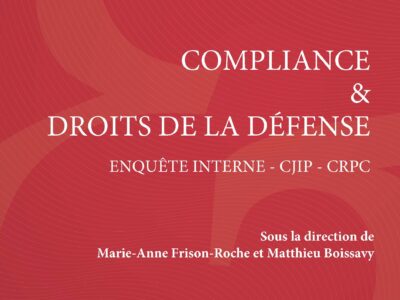
📝Circuler dans le temps pour l’efficience des droits de la défense dans les systèmes de compliance (“Moving through Time to align Compliance with the rights of the defence”), in 🕴️M.-A. Frison-Roche et 🕴️M. Boissavy (dir.), 📕Compliance et droits de la défense. Enquête interne – CJIP – CRPC

► Full Reference: M.-A. Frison-Roche "Circuler dans le temps pour mettre en phase Compliance et droits de la défense ("Moving through Time to align Compliance with the rights of the defence")", in M.-A. Frison-Roche et M. Boissavy (dir.), Compliance et droits de la défense. Enquête interne – CJIP – CRPC, Journal of Regulation & Compliance (JoRC) and Dalloz, coll. "Régulations & Compliance",  2024, pp. 33-58. - 📝read the article (in French) - 🚧read the bilingual Working Paper on which this article is based, with additional developments, technical references and hyperlinks - 📕read the general presentation of the book, Compliance et droits de la défense. Enquête interne – CJIP – CRPC, in which this article is published (in French) - 📝read also the presentation of the other article published par Marie-Anne Frison-Roche in this book : "Connaitre les pratiques pour redessiner les frontières et accroître les points de contact entre Compliance et droits de la défense dans l’enquête interne, la CJIP et la CRPC" (Understanding practices to redraw the boundaries and increase the points of contact between Compliance and the rights of the defense in Internal Investigation, Judicial Public Interest Agreement and French guilty plea procedure) - ► English Summary of this article: the subject of Compliance & rights of the defence is difficult to pin down because it often gives rise to totally opposing presentations, which express the initial confrontation between Compliance and rights of the defence, which seems irreducible. This initial confrontation must be acknowledged, and this is even more necessary to prevent it from becoming definitive(I) But in a society governed by the Rule of Law, the rights of the defence are central, and the hierarchy of norms dictates that they remain the privilege of all those who risk being punished in the future. Admittedly, if we look at the course of events in a linear way, the Compliance mechanisms come in Ex Ante, whereas the rights of the defence would only be activated when the repressive procedures would later come to bear on the moral or natural person. The question would therefore not even arise, or not in a central way. But this reasoning creates a false compatibility between Compliance and the rights of the defence (II. Indeed, it is the perspective of punishment in the future that forms the basis for the attribution of rights of the defence in the present. This consideration of the future not only allows but obliges the Law to "move in time", to always think in advance about what might happen tomorrow: this is how we must think about the Compliance methods of Internal Investigation, the DPA (or in the French legal system the Convention judiciaire d'intérêt public and the French Guilty plea procedure (CRPC) (III). As soon as these Compliance Tools are being used in practice, at the time they are being used, we must already think about how their results will be used, results which they have often been used for, because the Internal Investigation is a formidable piece of Evidence for obtaining a conviction and/or a DPA, etc. : therefore, the rights of the defence must shift over time, from the future to the present of the Information collect. Two ambiguities that affect Compliance Law itself, ambiguities which the rights of the defence help to clarify, now appear more clearly.  The first concerns the place occupied by the consent of the person who could have been protected by the rights of defence but //who exercises his/her will to renounce them (IV). Consent, in relation to the will of which it is the expression, is also linked with the future and allows Compliance once again to take precedence over the prerogatives of the individual who chooses not to benefit from it. The omnipresence of 'consent' in Compliance is enlightening here… The second ambiguity concerns the place of secrecy (V). Secrecy seems to be the prerogative of the rights of the defence. But it can also be an effective Compliance Tool when Confidentiality enables the company to detect and prevent breaches. It may even constitute the very Monumental Goal of Compliance Law. This happens when the Goal of Compliance Law, in which legal normativity is placed, becomes the protection of the individual, as is the case for personal information. That guides the European Judge, in line with the humanism that underpins European Compliance Law, in finding the right balance, this protection and effectiveness, depending on whether the information must be given or must be not. - 🌐follow Marie-Anne Frison-Roche on LinkedIn 🌐follow Marie-Anne Frison-Roche on Instagram 🌐subscribe to the Newsletter MAFR Regulation, Compliance, Law 

Conferences

final speech of a scientific manifestation

🎥 5 leçons en conclusions ouvertes (5 Lessons in Open Conclusions), in 🧮Compliance, vigilance et médiation

► Full Reference: M.-A. Frison-Roche, "Conclusion", in M. Boissavy, H. Dehghani-Azar, and M.-A. Frison-Roche (dir.), Journal of Regulation & Compliance (JoRC) and Conseil national des Barreaux (CNB), Compliance, vigilance et médiation (Compliance, Vigilance and Mediation), Amphitheatre of the Conseil national des Barreaux, November 30, 2023. - 🧮see the full programme of this event - 🌐follow Marie-Anne Frison-Roche on LinkedIn 🌐follow Marie-Anne Frison-Roche on Instagram 🌐subscribe to the Newsletter MAFR Regulation, Compliance, Law

Monographs

📝La compliance, socle de la confidentialité nécessaire des avis juridiques élaborés en entreprise

► Full Reference: M.-A. Frison-Roche, "La compliance, socle de la confidentialité nécessaire des avis juridiques élaborés en entreprise" ("Compliance, the cornerstone of the confidentiality required for in-house legal opinions"), D. 2023, p. - 📝read the article (in French) - ► English Summary of the article: The French Law about the Ministry of Justice's 2023-2027 Orientation and Programming  ("loi d'orientation et de programmation du ministère de la justice 2023-2027") had introduced into the French legal system the confidentiality of in-house lawyers' opinions (before the  French Constitutional Council, on a question of parliamentary procedure, annulled this disposition, thus leaving the question still open).  This development is necessary in order to respond to the injunction for companies to comply more and more with the regulations, which is itself only one of the tools of a wider movement: Compliance Law. This branch of the law, notably through the French so-called Sapin 2 Act of 2016, the French Vigilance Act of 2017 and the European Digital Services Act (DSA), requires companies to implement the necessary means to satisfy the Monumental Goals contained in the laws or regulations. This presupposes, firstly, that companies have information (via alerts, risk mapping, vigilance, sustainability reports, etc.), enabling them to identify their conformity and non-conformity, so that they can, secondly, take effective action to put an end to current breaches, prevent future breaches and achieve the goals set by the Legislator. This Compliance System requires that the information made available to managers is reliable and honest. However, if non-conformity is not analysed and communicated in a way that is protected by confidentiality, the company will prefer not to know about it and will therefore be unable to take appropriate action, which will deprive the social community of its power to act in the future. This is why the confidentiality of in-house lawyers' opinions is based on the very definition of Compliance Law itself. - 🌐follow Marie-Anne Frison-Roche on LinkedIn 🌐follow Marie-Anne Frison-Roche on Instagram 🌐subscribe to the Newsletter MAFR Regulation, Compliance, Law