Competition law

Monographs

📝 Droit de la Concurrence et Droit de la Compliance (“Competition Law and Compliance Law”

► Full Reference : Frison-Roche, M.-A., Droit de la concurrence et droit de la compliance ("Competition Law and Compliance Law), November 2018,  in Revue Concurrences n° 4-2018, Art. n° 88053, pp. 1-4.  -   ► Summary: Compliance Law is a new branch of Law, still under construction. One can have a “narrow definition” of seeing it as the obligation of businesses to show that they are constantly and actively complying with the law. One can have a richer definition, of a substantive nature, defining it as the obligation or the own will of certain companies to achieve “monumental goals” that go beyond economic and financial performance. Competition Law partly integrates its two conceptions of Compliance: Precursor, Competition Law concretizes dynamically the first conception of Compliance Law. It is with more difficulties but also much more future that Competition Law can express in dialectic the second conception of Compliance Law as internationalization of these “monumental goals”, especially in the digital space. -   📝 read the article (in French) - 🚧read the Working Paper on which this Article is based, with footnotes, technical references and hypertext links.     -

Working papers

🚧 Competition Law & Compliance Law

► Full Reference: Frison-Roche, M.-A., Competition Law & Compliance Law , Working Paper, October 2018. -   ► this Working Paper has served as basis for an Article published later in French in the Review Concurrences  ; read the presentation in English of this Article.  -   ► Summary and introduction : Compliance Law is a new branch of Law, still under construction. One can have a "narrow definition" of seeing it as the obligation of businesses to show that they are constantly and actively complying with the law. One can have a richer definition, of a substantive nature, defining it as the obligation or the own will of certain companies to achieve "monumental goals" that go beyond economic and financial performance.The Competition Law partly integrates its two conceptions of Compliance: Precursor, the Competition Law concretizes dynamically the first conception of the Compliance Law (I) It is with more difficulties but also much more future that the Competition Law can express in dialectic the second conception of the Compliance Law as internationalization of these "monumental goals", especially in the digital space (II).

Jurisprudence

European Commission

Decision of 18th of July 2018, Google Android

Full reference: European Commission, 18th of July 2018, Decision relating to a proceeding under Article 102 of the Treaty on the Functioning of the European Union and Article 54 of the EEA Agreement, Google Android, Case AT.40099 Read a summary of the decision

Breaking news

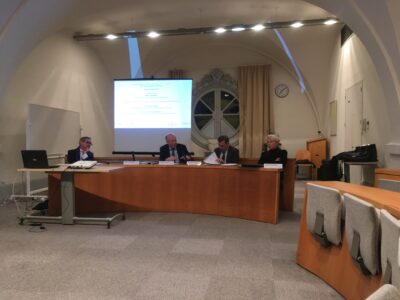
In the inaugural conference of March 2, 2018, Koen Lenaerts brings the “Europe of Compliance” to life

Among all the things that were important to remember, one of the things that struck me most in the extraordinary conference of the President of the Court of Justice of the European Union Koen Lenaerts on "Europe of the Compliance "held on March 2, 2018 was his ability to make" live Europe ". Not only to make it understand but also to make it "live". Here is the challenge: that compliance is not an accumulation of processes without reason and without flesh, but a living whole taking its meaning into consideration of the human being, a person whose judge is concerned. On 2 March 2018, Koen Lenaerts therefore came to an amphitheater at the University Panthéon-Assas (Paris 2) to inaugurate the series of conferences organized by the Journal of Regulation & Compliance (JoRC), a cycle that has the general title: Pour une Europe de la Compliance (For the Europe of Compliance). The School of Public Affairs of Sciences Po, the Department of Economics of Sciences Po, the Ecole doctorale de droit privé  (Doctoral School of Private Law) at the Université Panthéon-Assas- Paris 2 (Panthéon-Assas University – Paris 2) and the School of Law of the University Panthéon-Sorbonne (Paris I), are associated with this cycle. Many personalities will take the floor. Presented by Professor Thierry Bonneau, the conference made by President Koen Lenaerts was extremely rich and solid, perfectly constructed. Everyone had known the quality of the conference to be delivered by the President of the CJEU. The content of his demonstration will be found in the article he will give for the book that will be published in the Régulations & Compliance Series edited by Marie-Anne Frison-Roche at Éditions Dalloz. And the reader will find all the strength of this demonstration. This is necessary to venture into this area of "Compliance" : Koen Lenaerts recalled that we were still looking for the definition and a French term that would do justice to a satisfactory definition1Frison-Roche, M.-A., Compliance Law, 2016.. This question was echoed by Antoine Garapon in his discussion. Embodying the firmness that must be shown when words are uncertain, President Koen Lenaerts emphasized that the European Union is based on "Rule of Law". This means that the behaviors must respect Law. For that, – and that is why it is necessary to take in the literal sense the English expression "to comply with", the enterprise must not be passive but to make sure that its behavior is actually respectful of legal prescriptions. In this, there is a general paradigm shift, which inverses the relation betwenn the operator and the rules, from the Ex Post to the Ex Ante2On this passage, which internalises the "Regulatory Law" in the company, c. not. Frison-Roche, M.-A., From Regulation Law to Compliance Law, 2017, and the book, Régulation, Supervision, Compliance (Regulation, Supervision, Compliance), 2017.  as the entreprise has to be itself active to secure the effectiveness of the rule of Law. This internalization of the rule by the company develops both a procedural culture and a behavioral culture, in which companies can express an ethical dimension and build a "Trust Pact" 3About this notion, s. Frison-Roche, M.-A., Compliance and Trust, 2017 ; Drawing the Circles of Compliance Law, 2017. with states and public authorities. This change has been brought about by globalization, since states no longer have the means to impose ethical norms of behavior on businesses through the Ex Post intervention of their jurisdiction, but States like companies are gaining the benefit of this internalisation of rules in compagnies because the Compliance is inseparable from the accountability by which the company is compelled to justify that it actually tends to achieve the overall goals assigned by the public authority. Thus, after exposing the general movement by which Europe opened up to this upheaval, President Koen Lenaerts took on three technical dimensions crossed by this new conception. The first is the Financial Markets Law. The second is Competition Law, about which the President has notably developed the Court's reflections on whether the adoption of a compliance program by an enterprise found to have violated Competition Law, in particular by "negligence" is neutral, or constitutes a mitigating circumstance or constitutes an aggravating circumstance. This question was taken up after the presentation in the discussion with the room. The third is that of personal data. Taking again as in a waltz with three times his remarks, the president of the Court of Justice found that the compliance, whereas it consists in transforming the Ex Post into Ex Ante becomes juridicalised and in this the Court of justice holds its not only in Europe but also in relation to the world, without however ever forgetting that it is the States that are drawing up the rules that are the foundation of Europe. We will find in the article that will be published all these precious elements and no doubt that the elegance of the pen will be equal to that of speech. But, written exercise requires, the reader will not find what we had the chance to attend: the story of two cases by the one I would prefer to name the "Professor Koen Lenaerts". Two famous cases, which we teachers, comment and remind in our courses, that students learn and recite, quote in their copies. But never that way. The first case is the Schrerms case, where the court said that Facebook could not transfer this person's personal data to the United States since he was opposed to it. To make it clear, the President revived it through the litigant, who was a student and for this reason he spoke directly to the students present in the amphitheater. He pointed out that the plaintiff at the origin of the case was a law student, like them. He detailed his situation in Austria, making some quotes in perfect German, pointing out that this student was now at the doctoral stage, inviting students to be brave, as he was. At each episode of the story, the speaker told the students, making some detours on his own student life because finally we were all in family … Alma Mater. But his hands were telling the story even more: they were thrown themselves into the story, they brewed the space, it seemed as if they themselves were no more grandiloquent than the speaker but found their place exactly , in a magisterial position. Yes, here is a president in front of which companies have a hard time hiding the truth, a president with such firm hands and whose torso does not move but turns to the left and right to talk to everyone. The second story was even more beautiful. The Google Spain case, I know it. I even know it by heart. I read it, commented on it, cited it a lot of times … But all of a sudden that's what happened to a small Spanish merchant: President Koen Lenaerts told us his story, and I rediscovered the case. A small Spanish shopkeeper, whose name the speaker uttered in perfect Spanish, obtained from the Court of Justice that his "right to be forgotten" was recognized. President underlined the apparent paradox of his  insistence for the appearance of his surname in the judgment by which this person had thus obtained the erasing of his surname! Yes, I did not notice … Why did he ask for the mention of his name in the right to have his name deleted? Because it's a matter of honor. This is what the speaker insisted: do not joke with honor. And if you do, even Google will lose. The merchant had been subject to a forced property sale procedure because of financial difficulty, which spanish newspapers had echoed. His honor was been trampled. Then, by a happy return of fortune, he had recovered his property, his prosperity, his reputation. But from that, the press had not talked about it. Some lines in a newspaper of legal announcements, but that it is nothing for the human soul. That's why he wanted these mechanical digital links to disappear, which always and for all end up with articles presenting him as a wretch without ever ending up with articles presenting him as a prosperous merchant (because of the non-existence of these second articles). The speaker emphasized this dimension very much. And we know that the General Regulations that will come into force in May 2018 on personal data, which intrigues so much the Americans, draws in the judgment Google Spain its main solution in the matter: this "right to be forgotten" , subjective right so strange. He emphasized this dimension very much. And we know that the General Regulations that will come into force in May 2018 on personal data, which intrigues so much the Americans, draws in the judgment Google Spain its main solution in the matter: this "right to be forgotten" , subjective right so strange. Listening to President Koen Lenaerts, how not to think of Carbonnier? to  his articles of it, especially on sociological rule : "small causes, great effects"? From this conference, it will remain a great article, but as in the theater, where the ephemeral is part of the beauty of this art, what were these two stories, told by the one who knew how to listen when it was necessary to decide the two cases, stories told with the two firm hands that danced inviting students to enter this round, even as the President of the Court of Justice had to leave immediately to Luxembourg to hold such heavy obligations, yes it was simply beautiful .    
Jurisprudence

Autorité de la concurrence (French Competition Authority)

Decision n°17-D-16 of 7th of September 2017 relating to practices implemented by the company Engie in the energy sector

Référence complète: Autorité de la concurrence (French Competition Authority), Decision relating to practices implemented by the company Engie in the energy sector, Engie vs Direct Energie, 7th of September 2017, n°17-D-16 Read the decision (in French) Read the press release

Jurisprudence

Autorité de la concurrence (French Competition Authority)

Decision n°17-D-06 of 21st of March 2017 relating to practices implemented in natural gas, electricity and energy services supply sector

Full reference: Autorité de la concurrence (French Competition Authority), Decision relating to practices implemented in natural gas, electricity and energy services supply sector, Engie vs Direct Energie/UFC que choisir, 21st of March 2017, n°17-D-06 Read the decision (in French) Read the press release Read the press release of the decision of 9th of September 2014 on which this decision is based    

Glossary

Competition

Competition is the law of the market. It allows the emergence of the exact price, which is often referred to as "fair price". It means and requires that agents on the market are both mobile, that is to say free to exercise their will, and atomized, that is to say, not grouped together. This is true for those who offer a good or service, the offerers, as well as for those seeking to acquire them, the applicants: the bidders seek to attract the applicants so that they buy them the goods and services that they propose.  Bidders are in competition with each other. In the competitive market, buyers are indulging in their natural infidelity: even if they have previously bought a product from an A supplier, they will be able to turn away from him in favor of a B supplier if the latter offers them a product more attractive in terms of quality or price. Price is the main signal and information provided by the suppliers on the market to excite this competitive mobility of the offerers. Thus, free competition accelerates market liquidity, the circulation of goods and services, raises the quality of products and services and lowers prices. It is therefore a moral and virtuous system, as Adam Smith wanted, a system which is the fruits of individual vices. That is why everything that will inject "viscosity" into the system will be countered by Competition Law as "non-virtuous": not only frontal coordination on prices but for example, exclusivity clauses, agreements by which companies delay their entry on the market or intellectual property rights which confer on the patentee a monopoly. Admittedly, Competition Law can not be reduced to a presentation of such simplicity, since it admits economic organizations which deviate from this basic model, for example distribution networks or patent mechanisms on which, inter alia, is built the pharmaceutical sector. But the impact is probative: in the sphere of Competition Law, if one is in a pattern that is not part of the fundamental figure of the free confrontation of supply and demand, he has to demonstrate the legitimacy and efficiency of its organization, which is a heavy burden on the firm or the State concerned. Thus, in the field of Regulation, if regulatory mechanis were to be regarded as an exception to competition, an exception admitted by the competition authorities, but which should be constantly demonstrated before them by its legitimacy and effectiveness in the light of the "competitive order", then public organizations and operators in regulated sectors would always face a heavy burden of proof. This is what the competition authorities consider. But if we consider that regulated sectors have a completely different logic from competitive logic, both from an economic and a legal point of view, the Law of Regulation refers in particular to the notion of public service and having its own institutions, which are the regulatory authorities, then certain behaviors, in particular monopolies, are not illegitimate in themselves and do not have to justify themselves in relation to the competitive model, for they are not the exception ( Such as the public education or health service).

Texts

European Parliament and Council of the European Union

Regulation of 25 November 2015 laying down measures concerning open internet access

Full reference: Regulation (EU) 2015/2120 of the European Parliament and of the Council of 25 November 2015 laying down measures concerning open internet access and amending Directive 2002/22/EC on universal service and users’ rights relating to electronic communications networks and services and Regulation (EU) No 531/2012 on roaming on public mobile communications networks within the Union Read the regulation 

Texts

European Parliament and European Council

Regulation of 16th of April 2014 about market abuses

Full reference: European Parliament and European Council, Regulation (EU) No 596/2014 of 16 April 2014 on market abuse (market abuse regulation) and repealing Directive 2003/6/EC of the European Parliament and of the Council and Commission Directives 2003/124/EC, 2003/125/EC and 2004/72/EC Read the regulation

I-2.0: Is there a compelling need for neutral action in regulated economic sectors ? ?

TRANSLATED SUMMARIES ENGLISH “Acting in a neutral way” is an oxymoron. “Companies often require however that States use their powers in a neutral way (eg tax neutrality). In regulated sectors, some are right or even duty , of not being neutral. Firstly, it is the State, which requires the market for other purposes, other temporalities and other values​​. Secondly, they are also the “crucial operators”, which are sort of regulators of second degree, such as transmission system operators or companies capital markets firms. The difficulty increases when the systeme requires neutrality of regulators and judges, when first build economic policy and the second create jurisprudence. Their consistency, impartiality and rationality can create an objectifiable neutralitys FRENCH «Agir de façon neutre» est un oxymoron. «Les entreprises ont souvent besoin, cependant, que les États utilisent leurs pouvoirs de manière neutre (neutralité fiscale par exemple). Dans les secteurs réglementés, certains ont le droit ou même le devoir de ne pas être neutre. Tout d’abord, c’est l’État, qui insère le marché à d’autres fins, d’autres temporalités et d’autres valeurs. En second lieu, ils sont aussi les «opérateurs crucial», qui sont des sortes de régulateurs du second degré : par exemple les opérateurs de réseaux de transport ou de entreprises de marchés financiers. La difficulté augmente lorsque le systeme économique et politique exige la neutralité des autorités de régulation et des juges, alors que les premiers construisent la politique économique et les seconds construisent la jurisprudence. Le respect qu’ils doivent avoir de l’impartialité et d’une rationalité suffisamment objectivables pourra permettre cette objectivité requise.

I-2.6: Does a legal principle regarding net neutrality exist?

Translated Summaries In The Journal of Regulation the summaries’ translation are done by the Editors and not by the authors ENGLISH The debate on Net Neutrality faces a major difficulty, namely that of its legal status: does there exist a “legal principle”—meaning a rule somewhere within the entire body of law—with mandatory force that could be used to counter infrastructure operators’ discriminatory practices?   FRENCH Le débat sur la neutralité du Net fait face à une difficulté majeure, à savoir son statut juridique: existe-t-il un «principe juridique», qui exprime une règle dans l’ensemble du système juridique – avec une force obligatoire qui pourrait être utilisée pour contrer les pratiques discriminatoires des opérateurs d’ infrastructure ? SPANISH El debate sobre la Neutralidad de la Red se enfrenta a una gran dificultad, primordialmente en cuanto a su estatus legal: ¿realmente existe un “principio legal” – es decir, una regla que se encuentra dentro de la disciplina del derecho – con fuerza mandataria que podría ser usado para enfrentar a las prácticas discriminatorios que practican los operadores de infraestructura? ITALIAN Il dibattito sulla neutralità della rete si trova di fronte ad una difficoltà rilevante dal punto di vista del suo fondamento giuridico: esiste una norma giuridica obbligatoria – intesa come una norma legale – che possa essere utilizzata contro le pratiche discriminatorie degli operatori? ……………….. Other translations forthcoming.

I-2.3: Neutralization in economically regulated industries using procedural law techniques

Translated Summaries ENGLISH Article: Neutralization in economically regulated industries using procedural law techniques In itself, regulation does not necessary require judicial review of regulators’ acts, whether the regulator is a ministry or an independent authority. In short, regulators could have the “last word” in all circumstances. However, because of an equal concern for democratic legitimacy and care to respect its international commitments, the French Parliament is convinced that judicial review over regulators’ actions is necessary. - FRENCH Article : La neutralisation dans les secteurs économiques régulés par les techniques procédurales En soi, la régulation n’appelle pas nécessairement un contrôle juridictionnel du régulateur, qu’il soit une administration ou une autorité indépendante. Ce régulateur, sommes toutes, pourrait avoir en toutes circonstances « le dernier mot ». Pourtant, moitié par conviction démocratique, moitié par prudence en raison de ses engagements internationaux, le législateur français s’est convaincu qu’un tel contrôle était indispensable. - SPANISH Artículo: Neutralización en industrias económicamente reguladas usando técnicas del derecho procesal. En sí mismo, la regulación no requiere de revisión judicial de las acciones del regulador, ya sea que el regulador es un ministerio o una autoridad independiente. Para resumir, los reguladores podrían tener la “última palabra” en todas las circunstancias. No obstante, una preocupación por la legitimidad democrática y deseo de respetar sus compromisos internacionales, el Parlamente francés está convencido que una revisión judicial sobre las acciones de los reguladores es necesaria. -   ………………… Other translations forthcoming.