Branch of Law

Articles in The Journal of Regulation & Compliance « JoRC »

BARBIÈRI, Jean-Baptiste🕴️

📝Les juges du droit des entreprises en difficulté et les obligations de compliance (Judges of Insolvency Law and Compliance Obligations), in 🕴️M.-A. Frison-Roche (ed.), 📕L’Obligation de Compliance

► Full Reference: , J.-B. Barbièri, "Les juges du droit des entreprises en difficulté et les obligations de compliance (Judges of Insolvency Law and Compliance Obligations), in M.-A. Frison-Roche (ed.), L'Obligation de Compliance, Journal of Regulation & Compliance (JoRC) and Éditions Lefebvre – Dalloz, coll. "Régulations & Compliance", 2025, pp. 313-323. - 📕read a general presentation of the book, L'Obligation de Compliance, in which this contribution is published  - ► English summary of this contribution (done by the Journal of Regulation & Compliance – JoRC): Describing at first sight the intersection of Compliance and Insolvency procedures as the "marriage of the carp and the rabbit", the Author shows that the logic is in many ways the same, particularly in terms of the role played by the Judge, since it is always a question of the State delegating Monumental Goals, with Insolvency procedures giving concrete expression to the desire to save a company, jobs, an industry, a region, etc., in what is always a "public interest".  In his/her office, the insolvency judge is confronted with compliance clauses, relating to commitments, or information, or organising monitoring. The author begins by examining the cases in which the insolvency judge is confronted with the principle of primacy of the insolvency proceedings over this compliance contractual organisation, either under current contracts, which may contain compliance obligations, in particular because audits and controls will have been strengthened or automatic termination will be provided for (which would then be deactivated?), or because the nullity of the suspect period comes into play, because the compliance clauses are often unbalanced. The second part examines the hypothesis that compliance techniques will support insolvency proceedings themselves and the purpose they serve. Indeed, because they are preventive in nature, contractual compliance mechanisms can also prevent failures, by means of audit and monitoring clauses and the introduction of reporting, if necessary under the supervision of the Judge, associated with conciliation mechanisms. What is more, they should be used to restructure companies in difficulty. The plan, which can be imposed on creditors, must open up the range of instruments, and could perhaps be articulated at this class of parties, which would only be made up of creditors benefiting from compliance clauses, if we consider that they constitute a "sufficient community of economic interest". They could then also be delegated the task of monitoring the survival of the company, which is the main goal served by the plan. In the case of a disposal plan, an offer including compliance undertakings should not be favoured, since the law expressly states that the sole purpose of such a plan is to ensure the maintenance of activities and to clear the past. But time will tell whether the judge will go beyond this. - 🦉This article is available for people who follow the Professor Marie-Anne Frison-Roche teaching

Articles in The Journal of Regulation & Compliance « JoRC »

ROUAUD, Anne-Claire🕴️

📝L’intensité de l’obligation de vigilance selon les secteurs : le cas des opérateurs financiers (“The intensity of the obligation of vigilance depending on the sector: the case of financial operators”), in 🕴️M.-A. Frison-Roche (ed.), 📕L’Obligation de Compliance

► Full Reference: A.-C. Rouaud, "L’intensité de l’obligation de vigilance selon les secteurs : le cas des opérateurs financiers" (The intensity of the obligation of vigilance depending on the sector: the case of financial operators), in M.-A. Frison-Roche (dir.), L'Obligation de Compliance, Journal of Regulation & Compliance (JoRC) an Dalloz, coll. "Régulations & Compliance", 2025, pp. 539-550. - 📕read the general presentation of the book, L'Obligation de Compliance, in which this contribution is published - ► English summary of this contribution (done by the Journal of Regulation & Compliance – JoRC) : The author develops the case of financial operators and shows that if they are subject to very heavy obligations of vigilance, it is above all because of the systemic risks of the markets, obligations which are consubstantial with their activities, because these operators are often in charge of market infrastructures or operating services, which make them all belong to the category of regulated professions. Despite this uniqueness, the obligation of vigilance has many facets, ranging from policing and customer surveillance to warning and protection, which can be very limited, as the fight against money laundering aims to protect the system (kyc). In addition, this obligation to exercise vigilance serves different goals, which explains the diversity of sanctions, because the intensity of the obligation also varies. The fight against systemic risk is certainly a common goal, but there are also concerns about protecting specific categories, such as investors (from a more European perspective). However, the general interest is now being renewed, as market protection is coupled with a concern for Sustainability. This is reflected in the variability of sanctions, ranging from disciplinary sanctions, handled by the financial markets regulatory bodies, to the obligation to put in place compliance programmes against which breaches are sanctioned per se. Private enforcement is developing in tandem with public enforcement, with a transformation of the litigation risk for companies, which is highly sensitive to extraterritoriality and the scope of soft law.     -

Publication director

🏗️ copublishing and direction of the collection: 📚Régulations & Compliance

📚Publication of🕴️M.-A. Frison-Roche (ed.), 📕L’Obligation de Compliance

  - ► Full Reference: M.-A. Frison-Roche (dir.), L’Obligation de Compliance, coll.”Régulations & Compliance“, Journal of Regulation & Compliance (JoRC) and Dalloz, 2025. - 📘 At the same time, a book in English, Compliance Obligation, is published in the collection copublished by the Journal of Regulation & Compliance (JoRC) and the Éditions Bruylant. - 🧮the book follows the cycle of colloquia organised by the Journal of Regulation & Compliance (JoRC) and its Universities partners in 2023 and 2024. - 📚this volume is one of a series of books devoted to Compliance in this collection. ► Read the presentations of the other books in the series: the following books: 🕴️M.-A. Frison-Roche (ed.), 📕Compliance et Contrat, forthcoming 🕴️L. Laref (ed.), 📕Compliance et vigilance bancaire, forthcoming 🕴️M.-A. Frison-Roche, 📕Le système juridique de l’adressage de l’Internet. Une structure multi-acteurs, gage de durabilité (The Legal System of Internet Addressing. A Multi-Stakeholder Structure, the Pledge of its Sustainability), forthcoming 🕴️M.-A. Frison-Roche (ed.), 📕Le système probatoire de la Compliance, forthcoming   the previous books: 🕴️M.-A. Frison-Roche and M. Boissavy (eds.), 📕Compliance et droits de la défense. Enquête interne – CJIP – CRPC, 2024 🕴️M.-A. Frison-Roche (ed.), 📕La juridictionnalisation de la Compliance, 2023 🕴️M.-A. Frison-Roche (ed.), 📕Les Buts Monumentaux de la Compliance, 2022 🕴️M.-A. Frison-Roche (ed.), 📕Les outils de la Compliance, 2021 🕴️M.-A. Frison-Roche (ed.), 📕Pour une Europe de la Compliance, 2019 🕴️N. Borga, J.-Cl. Marin and J.-Ch. Roda (eds.), 📕Compliance : l’entreprise, le régulateur et le juge, 2018 🕴️M.-A. Frison-Roche (ed.), 📕Régulation, Supervision, Compliance, 2017 🕴️M.-A. Frison-Roche (ed.), 📕Internet, espace d’interrégulation, 2016 📚see the global presentation of all the books of the collection. - ► General presentation of this book: Compliance is sometimes presented as something that cannot be avoided, which is tantamount to seeing it as the legal obligation par excellence, Criminal Law being its most appropriate mode of expression. It is sometimes presented as something that the company does out of ethical concern, self-regulation which is the opposite of legal obligation. For the moment, therefore, there is no single vision of the Compliance Obligation. This is all the less the case because of the multitude of texts, themselves constantly evolving and changing, which inject such a wide range of compliance obligations that we give up trying to establish any unity, thinking that, on a case-by-case basis, we will define a regime and a legal constraint of greater or lesser strength, aimed at one subject or debtor or another, for the benefit of one or other. This lack of unity, due to the absence of a definition of the Compliance Obligation, makes the application of the texts difficult to foresee and therefore makes the Judge fearful, even though he/she is going to take on more and more importance. This book asks the practical questions: What is Compliance obliging? Who is obliged to comply? and How far are we obliged to comply? and provides answers, Compliance practices, constraints and innovations will be better mastered and anticipated by all those they affect: companies, stakeholders, technicians, lawyers, consultants, institutions and courts. - 🏗️general construction of this Book: The book opens with a double Introduction.  The first, which is freely accessible, consists of a summary of the book, while the second, which is substantial, deals with the unified conception that we can, and indeed should, have, of the “Compliance Obligation”, without losing the concrete and active character that characterises this branch of law. The first Part of the book aims to define the Compliance Obligation. To this end, Chapter I deals with the Nature of this obligation. Chapter II deals with the Spaces of the Compliance Obligation. The Part II aims to articulate the Compliance Obligation with other branches of Law.  The Part III of the book looks at the way in which the possibility of obliging and the means of obliging are provided.  To this end, Chapter I deals with the Convergence of the Sources of the Compliance Obligation. Chapter II considers International Arbitration as a reinforcement of the Compliance Obligation. To this end, Chapter I deals with the Convergence of the Sources of the Compliance Obligation. Chapter II considers International Arbitration as a reinforcement of the Compliance Obligation.  The last Part of the book is devoted to Vigilance, the leading edge of the Compliance Obligation. Chapter I is devoted to a study of the various sectors, and analyses the Intensities of the Vigilance Obligation. Chapter II deals with the Variations in Tension generated by the Vigilance Obligation. Finally, Chapter III deals with the New Modalities of the Compliance Obligation, highlighted by the Vigilance Imperative. - TABLE OF CONTENTS    ANCRER LES OBLIGATIONS DE COMPLIANCE SI DIVERSES    DANS LEUR NATURE, LEURS REGIMES ET LEUR FORCE  POUR DEGAGER  L’UNITE DE L’OBLIGATION DE COMPLIANCE LA RENDANT COMPREHENSIBLE ET PRATIQUABLE  (ANCHOR COMPLIANCE OBLIGATIONS, SO DIVERSE  IN THEIR NATURE, THEIR REGIMES AND THEIR FORCE, TO BRING OUT THE UNITY OF THE COMPLIANCE OBLIGATION MAKING IT COMPREHENSIBLE AND PRACTICABLE) ♦️ Obligation de Compliance : construire une structure de compliance produisant des effets crédibles au regard des Buts Monumentaux visés par le Législateur (Compliance Obligation: building a compliance structure that produces credible results with regard to the Monumental Goals targeted by the Legislator), by 🕴️Marie-Anne Frison-Roche   TITRE I. CERNER L’OBLIGATION DE COMPLIANCE  (IDENTIFYING THE COMPLIANCE OBLIGATION)   CHAPITRE I : LA NATURE DE L’OBLIGATION DE COMPLIANCE (THE NATURE OF THE COMPLIANCE OBLIGATION) Section 1 ♦️ La volonté, le cœur et le calcul, les trois traits cernant l’Obligation de Compliance  (Will, Heart and Calculation, the three traits encercling the Compliance Obligation), by 🕴️Marie-Anne Frison-Roche Section 2 ♦️ De la dette à l’obligation de compliance (From the Debt to the Compliance Obligation), by 🕴️Bruno Deffains Section 3 ♦️ Obligation de Compliance et droits humains (Compliance Obligation and Human Rights), by 🕴️Jean-Baptiste Racine Section 4 ♦️ L’Obligation de Compliance et les mutations de la souveraineté et de la citoyenneté (Compliance Obligation and changes in Sovereignty and Citizenship), by 🕴️René Sève Section 5 ♦️ La définition de l”obligation de compliance confrontée au droit de la cybersécurité (The definition of the Compliance Obligation in Cybersecurity Law) by🕴️Michel Séjean   CHAPITRE II : LES ESPACES DE L’OBLIGATION DE COMPLIANCE (SPACES OF THE COMPLIANCE OBLIGATION) Section 1 ♦️ Entités industrielles et Obligation de compliance (Industrial entities and Compliance Obligation), by 🕴️Etienne Maclouf Section 2 ♦️ L’Obligation de Compliance dans les chaînes de valeur (The Compliance Obligation in Value Chains), by 🕴️Lucien Rapp Section 3 ♦️ Compliance et conflits de lois. Le droit international de la vigilance-conformité à partir de quelques applications récentes sur le continent européen (Compliance and conflict of laws. International Law of Vigilance-Conformity, based on recent applications in Europe), by 🕴️Louis d’Avout    TITRE II. ARTICULER L’OBLIGATION DE COMPLIANCE AVEC DES BRANCHES DU DROIT (ARTICULATING THE COMPLIANCE OBLIGATION WITH BRANCHES OF LAW)   Section 2 ♦️ Droit fiscal et obligation de compliance (Tax Law and Compliance Obligation), by 🕴️Daniel Gutmann Section 3 ♦️ Le droit processuel, prototype de l’Obligation de Compliance (General Procedural Law, prototype of the Compliance Obligation), by 🕴️Marie-Anne Frison-Roche Section 4 ♦️ Le droit des sociétés et des marchés financiers face à l’Obligation de Compliance (Corporate and Financial Markets Law facing the Compliance Obligation), by 🕴️Anne-Valérie Le Fur Section 4 ♦️ Transformation de la gouvernance et obligation de vigilance, by 🕴️Véronique Magnier Section 5 ♦️ Le rapport entre le Droit de la responsabilité civile et l’Obligation de Compliance (The link between Tort Law and Compliance Obligation), by 🕴️Jean-Sébastien Borghetti Section 6 ♦️ Dimensions environnementales et climatiques de l’Obligation de Compliance (Environmental and Climatic Dimensions of the Compliance Obligation), by 🕴️Marta Torre-Schaub Section 7 ♦️ Droit de la concurrence et Droit de la Compliance (Competition Law and Compliance Law), by 🕴️Jean-Christophe Roda Section 8 ♦️ L’Obligation de Compliance en Droit global (The Compliance Obligation in Global Law), by 🕴️Benoît Frydman & 🕴️Alice Briegleb Section 9 ♦️ Les juges du droit des entreprises en difficulté et les obligations de compliance (Judges of Insolvency Law and Compliance Obligations), by 🕴️Jean-Baptiste Barbièri   TITRE III. COMPLIANCE : DONNER ET SE DONNER LES MOYENS D’OBLIGER (COMPLIANCE : GIVE AND TAKE THE MEANS TO OBLIGE)   CHAPITRE I : LA CONVERGENCE DES SOURCES (CONVERGENCE OF SOURCES) Section 1 ♦️ Obligation sur obligation vaut (Compliance Obligation on Obligation works), by 🕴️Marie-Anne Frison-Roche Section 2 ♦️ Les technologies disponibles, prescrites ou proscrites pour satisfaire Compliance et Vigilance (Technologies available, prescribed or prohibited to meet Compliance and Vigilance requirements), by 🕴️Emmanuel Netter Section 3 ♦️ Contrainte légale et stratégie des entreprises en matière de Compliance (Legal Constraint and Company Strategies in Compliance matters), by 🕴️Jean-Philippe Denis & Nathalie Fabbe-Costes Section 4 ♦️ La loi, source de l’Obligation de Compliance (The Law, source of the Compliance Obligation), by 🕴️Jean-Baptiste Blanc Section 5 ♦️ Opposition et convergence des systèmes juridiques américains et européens dans les règles et cultures de compliance (Opposition and Convergence of American and European Legal Systems in Compliance Rules and Cultures), by 🕴️Raphaël Gauvain & 🕴️Blanche Balian Section 6 ♦️ Ce à quoi les engagements engagent qu’est un engagement (What a ), by 🕴️Marie-Anne Frison-Roche   CHAPITRE II : L’ARBITRAGE INTERNATIONAL EN RENFORT DE L’OBLIGATION DE COMPLIANCE (INTERNATIONAL ARBITRATION IN SUPPORT OF THE COMPLIANCE OBLIGATION) Section 1 ♦️ Comment l’arbitrage international peut être un renfort de l’Obligation de Compliance (How International Arbitration can reinforce the Compliance Obligation), by 🕴️Laurent Aynès Section 2 ♦️ La considération par l’Arbitrage de l’Obligation de Compliance pour une place d’arbitrage durable (Arbitration’ consideration of Compliance Obligation for a Sustainable Arbitration Place),  by 🕴️Marie-Anne Frison-Roche  Section 3 ♦️ L’usage de l’arbitrage international pour renforcer l’obligation de Compliance : l’exemple du secteur de la construction (The use of International Arbitration to reinforce the Compliance Obligation: the example of the construction sector), by 🕴️Christophe Lapp Section 4 ♦️ L’arbitre, juge, superviseur, accompagnateur  ? (The Arbitrator, Judge, Supervisor, Support) , by 🕴️Jean-Baptiste Racine   TITRE IV. LA VIGILANCE, POINTE AVANCÉE DE L’OBLIGATION DE COMPLIANCE (VIGILANCE, SPEARHEAD OF THE COMPLIANCE OBLIGATION) Section 1 ♦️ La Vigilance, pointe avancée et part totale de l’Obligation de Compliance (….), by 🕴️Marie-Anne Frison-Roche CHAPITRE I : LES INTENSITÉS DE L’OBLIGATION DE VIGILANCE, POINTE AVANCÉE DU SYSTÈME DE COMPLIANCE (INTENSITIES OF THE VIGILANCE OBLIGATION, SPEARHEAD OF THE COMPLIANCE SYSTEM) Section 2 ♦️ L’intensité de l’Obligation de Vigilance selon les secteurs : le cas des opérateurs financiers (Intensity of the Vigilance Obligation by Sectors: the case of Financial Operators), by 🕴️Anne-Claire Rouaud Section 3 ♦️ L’intensité de l’Obligation de Vigilance selon les secteurs : le cas des opérateurs bancaires et d’assurance (Intensity of the Vigilance Obligation by Sectors: the case of Banking and Insurance Operators), by 🕴️Mathieu Françon Section 4 ♦️ L’intensité de l’obligation de vigilance selon les secteurs : le cas des opérateurs numériques (Intensity of the Vigilance Obligation by Sectors: the case of Digital Operators), by 🕴️Grégoire Loiseau Section 5 ♦️ L’Obligation de vigilance des opérateurs énergétiques (The Vigilance obligation of Energy Operators), by 🕴️Marie Lamoureux   CHAPITRE II : LES DISPUTES AUTOUR DE L’OBLIGATION DE VIGILANCE, POINTE AVANCÉE DU SYSTÈME DE COMPLIANCE, DANS SON RAPPORT AVEC LA RESPONSABILITÉ Section 1 ♦️ Le rapport entre le droit de la responsabilité civile et l’obligation de compliance, by 🕴️Jean-Sébastien Borghetti Section 2 ♦️ Repenser le concept de responsabilité civile à l’aune du devoir de vigilance, pointe avancée de la compliance (Rethinking the Concept of Civil Liability in the light of the Duty of Vigilance, Spearhead of Compliance), by 🕴️Mustapha Mekki Section 3 ♦️ Tensions et contradictions entre les instruments relatifs à la vigilance raisonnable des entreprises, by 🕴️Laurence Dubin Section 4 ♦️ Compliance, Vigilance et Responsabilité civile : mettre en ordre et raison garde (Compliance, Vigilance  and Civil Liability: put in order and keep the Reason), by 🕴️Marie-Anne Frison-Roche   CHAPITRE III : LES MODALITÉS NOUVELLES DE L’OBLIGATION DE COMPLIANCE, MISES EN LUMIÈRE PAR L’IMPÉRATIF DE VIGILANCE (NEW MODALITIES OF THE COMPLIANCE OBLIGATION, HIGHLIGHTED BY THE VIGILANCE IMPERATIVE) Section 1 ♦️ Clauses et contrats, modalités de l’obligation de vigilance (Clauses and Contracts, terms and conditions of implementation of the Vigilance Obligation), by 🕴️Gilles J. Martin Section 2 ♦️ La preuve de la bonne exécution de la Vigilance au regard du système probatoire de Compliance (Proof that Vigilance has been properly carried out with regard to the Compliance Evidence System), by 🕴️Jean-Christophe Roda   TITRE V. LE JUGE ET L’OBLIGATION DE COMPLIANCE (THE JUDGE AND THE COMPLIANCE OBLIGATION) Section 1 Section 1 ♦️ Devoir de vigilance et litiges commerciaux : une compétence à partager ?, par 🕴️François Ancel Section 2 ♦️ Les enjeux présents à venir de l’articulation des principes de procédure civile et commerciale avec la logique de compliance (Present and Future Challenges of Articulating Principles of Civil and Commercial Procedure with the Logic of Compliance), by 🕴️Thibault Goujon-Bethan Section 3 ♦️ Le juge de l’amiable et la compliance (The amicable settlement judge and compliance), by 🕴️Malik Chapuis Section 4 ♦️ Le juge adéquat pour l'effectivité de l'Obligation de Compliance (The Adequate Judge for the Effectiveness of the Compliance Obligation), by 🕴️Marie-Anne Frison-Roche     L’OBLIGATION DE COMPLIANCE : VISION D’ENSEMBLE (COMPLIANCE OBLIGATION : OVERVIEW) ♦️ L’obligation de compliance, charge portée par les entreprises systémiques donnant vie au Droit de la Compliance. – lignes de force de l’ouvrage (The Compliance Obligation, a burden borne by Systemic Companies giving life to Compliance Law –  key points of the book (free access) by 🕴️Marie-Anne Frison-Roche - 🌐follow Marie-Anne Frison-Roche on LinkedIn 🌐follow Marie-Anne Frison-Roche on Instagram 🌐subscribe to the Newsletter MAFR Regulation, Compliance, Law 🌐subscribe to the VideoNews  MAFR Surplomb 🌐subscribe to the Newsletter MaFR Law & Art

Articles in The Journal of Regulation & Compliance « JoRC »

📝Le rapport entre le Droit de la responsabilité civile et l’Obligation de Compliance (The Relation between Tort Law and Compliance Obligation), in 🕴️M.-A. Frison-Roche (dir.), 📕L’obligation de Compliance

► Full Reference: J.-S. Borghetti, "Le rapport entre le Droit de la responsabilité civile et l'Obligation de Compliance" (The Relation between Tort Law and Compliance Obligation), in M.-A. Frison-Roche (dir.), L'obligation de Compliance, Journal of Regulation & Compliance (JoRC) and Dalloz, coll. "Régulations & Compliance", 2025, pp. 589-598. - 📕read the general presentation of the book, L'obligation de Compliance, in which this article is published - ► English Summary of this Article (done by the Journal of Regulation & Compliance – JoRC) : The Author points out that in order to establish civil liability, it is first necessary to find fault, i.e. a deviation from an obligation, which will trigger a secondary obligation, that of reparation. But it can also be argued that it is from liability that this primary obligation arises, civil liability then revealing an obligation which existed only implicitly. That establishes a two-way relationship between liability and obligation. The Compliance Obligation illustrates this, in particular through the Obligation of Vigilance conceived by the French law of 2017. The author therefore devotes the first part of his contribution to civil liability as a result of an Compliance Obligation, especially the Obligation of Vigilance. issued of the French law of 2017. After discussing whether the constraints generated by compliance should be classified as 'obligations', since there is no creditor, which therefore opens the way to liability in tort, he examines the conditions for incurring such liability, which are difficult, particularly with regard to the burden of proof and the demonstration of the causal link. The requirement concerning the latter may evolve in French law towards the admission of proportional causality, as is now accepted in certain cases in German case law. In the second part of his contribution, the author deals with the hypothesis of civil liability as an indicator of a Compliance Obligation. He points out that the claims made, particularly in the cases of TotalOuganda  (France) and Milieudefensie v. Shell (Netherlands) seek to obtain from the judge a such "revelation". The author considers that it is not possible to draw from the  French 2017 law which refers to article 1240 of the French Civil Code on the liability because this article is referred to only in order to organise the consequences of a breach of article L.225-102-4 of the French Commercial Code organising the Obligation of Vigilance (article 1240 being therefore under the secondary obligation described above) and not to feed what this article L.225-102-4 requires under the primary obligation (defined above).  -

Working papers

Working Paper, basis for an article (in French)

🚧Compliance Law and Systemic Litigation

► Full Reference: M.-A. Frison-Roche, Compliance Law and Systemic Litigation, Working Paper, August 2025. - 📝 This bilingual Working Paper is the basis of the article published in French "Droit de la compliance et contentieux systémique" - ► Summary of this Working Paper: Legal systems have changed, and Compliance Law, in its uniqueness, reflects this change and plays a powerful role in it. New sets of compliance rules, particularly at European Union level, covering data protection (GDPR), anti-money laundering (AMLA), climate balance protection (CS3D) and banking and financial system sustainability (Banking Union), have been developed and imposed on large companies, which must implement them: alerts, mapping, assessment, sanctions, etc. These new regulatory frameworks only make sense in relation to their ‘Monumental Goals’: to detect systemic risks ex ante and prevent crises so that the systems in question do not collapse, but ‘last’. All the legal instruments in the corpus are normatively rooted in these monumental goals, which are the core that unifies Compliance Law (I). The judge is the guardian of this new and highly ambitious regulatory framework, which relies on the practical ability of companies to implement it (II). Courts ensure that the legal technical provisions are applied in a teleological manner in each of these compliance blocks and that the regulations support each other, because all compliance regulations serve the same systemic goal: to ensure that the systems (banking, financial, climate, digital, energy, etc.) do not collapse, but sustains, and that present and future human beings are not crushed by them, but rather benefit from them. This unity is still little perceived because so meticulous regulations pulverise this profound unity of Compliance Law into a myriad of changing provisions. Entrusting the ‘regulatory mass’ to algorithms increases this fragmentation, making the whole even more incomprehensible and therefore impossible to handle. On the contrary, recognising the judge's place, i.e. at the centre, makes it possible to master this new branch of law. But the judge's sole function is not to restore clarity to a body of law covered by the dust of its own technicality. There is a transfer to Litigation of the systemic object of Compliance Law. Indeed, the litigation that emerges from the new Compliance Law is itself fundamentally new, by transitivity. Indeed, the purpose of Compliance Law is to make systems sustainable (or resilient, or robust, depending on the terminology used). This results in litigation that is itself ‘Systemic Litigation’ (III), most often brought by an organisation against a systemic operator. The place and role of each party are transformed (IV). - 🔓read the developments below⤵️ - 🌐follow Marie-Anne Frison-Roche on LinkedIn 🌐follow Marie-Anne Frison-Roche on Instagram 🌐subscribe to the Newsletter MAFR Regulation, Compliance, Law 🌐subscribe to the Video Newsletter MAFR Surplomb 🌐subscribe to the Newsletter MaFR Droit & Art

Working papers

Working Paper for 📺Overlook

🚧The puzzle of Institutional Compliance Law and Substantive Compliance Law: the example of the European Regulations of 31 May 2024 on AMLA and enterprises compliance obligations

► Full Reference: M.-A. Frison-Roche, The puzzle of Institutional Compliance Law and Substantive Compliance Law: the example of the European Regulations of 31 May 2024 on AMLA and enterprises compliance obligations​, Working Paper, January 2025.   - 🎤 This Working Paper was developed as a basis for the Overhang👁 video  on 11 January 2024 :   - 🎬🎬🎬In the collection of the Overhangs👁 It falls into the News category. ►Watch the complete collection of the Overhangs👁 : click HERE - ► Summary of this Working Paper: Compliance Law is built on 2 legs, Institutions on the one hand and substantive rules on the other. For example in the United States, the 1934 Act established at the same time the prohibition and prevention of financial market abuse and the SEC. In Europe, in 2013, the Banking Union established institutions to build this Union and increased the obligations on banks. This is perfectly illustrated by the 2 European Regulations of 31 May 2024, one creating the AMLA and the other reinforcing the compliance obligations of crucial economic operators, one text referring to the other. Indeed, Institutional Compliance Law and Substantive Compliance Law are like 2 articulated legs. You have to know both and make them work together. This is part of the "European puzzle", a positive expression which implies that, when assessing and interpreting a text, we should always bear in mind that it is only one element of a general picture, which is coloured by its Monumental Goal: in this case to obtain a European area where money laundering is efficiently prevented thanks to the action of the companies themselves under the supervision and support of a Supervisory Authority which coordinates the actions of the States. If we consider only one element, we find everything 'complicated', whereas the overall picture is simple, because the Goal is simple and in Compliance Law, a branch of Teleological Law, everything is in the Monumental Goal.   - 🔓read the developments below ⤵️ - 🌐suivre Marie-Anne Frison-Roche sur LinkedIn 🌐suivre Marie-Anne Frison-Roche sur Instagram 🌐s'abonner à la Newsletter MAFR Regulation, Compliance, Law  🌐s'abonner à la Newsletter en vidéo MAFR Surplomb

Articles in a legal collective publication

Article in a collective book dedicated to an Amicorum

📝Naissance d’une branche du Droit : le Droit de la Compliance (Births of a branch of Law: Compliance Law), in 📗Mélanges en l’honneur de Louis Vogel

► Full Reference: M.-A. Frison-Roche, "Naissance d'une branche du Droit : le Droit de la Compliance" ("Birth of a branch of Law: Compliance Law"), in Mélanges offerts à Louis Vogel. La vie du droit, LexisNexis – Dalloz – LawLex – LGDJ, 2024, pp. 177-188. - 📝read the article (in French) - 🚧read the bilingual Working Paper which is the basis of this article, with additional developments, technical references and hyperlinks - ► English Summary of the article:  The study focuses on the various movements that have given rise to Compliance Law, with particular emphasis on Competition Law. After a preliminary reflection on the construction of the legal system into branches of Law, their classification in relation to each other, the difficulty encountered in this respect by Economic Law, and the various movements that give rise to one of them, the diversity of which the branch subsequently keeps track of, the study is constructed in 4 parts. To find out what gave rise to Compliance Law, the first part invites everyone to reject the narrow perspective of a definition that is content to define it by the fact of "complying" with the applicable regulations in the sens to obey them automatically. This has the effect of increasing the effectiveness of the regulations, but it does not produce a branch of Law, being only an efficiency tool like any other. The second part of the study aims to shed light on what appears to be an "enigma", because it is often claimed that this is the result of a flexible method through the "soft law", or of an American regulation (for instance FCPA), or of as many regulations as there are occasions to make. Instead, it appears that in the United States, in the aftermath of the 1929 crisis, it was a question of establishing an authority and rules to prevent another atrocious collapse of the system, while in Europe, in 1978, in memory of the use of files about Jews, it was a question of establishing an authority and rules to prevent an atrocious attack on human rights. A common element that aims for the future ("never again"), but not the same object of preventive rejection. This difference between the two births explains the uniqueness and diversity of the two Compliance Law, the tensions that can exist between the two, and the impossibility of obtaining a global Compliance Law. The third part analyses the way in which Competition Law has given rise to conformity mechanisms: they had only constituted a secondary branch which is a guarantee of conformity with competition regulations. Developed in particular through the soft law issued by the competition authorities, the result is a kind of "soft obedience", a well-understood collaboration of a procedural type through which the company educates, monitors and even sanctions, without going outside Competition Law, of which compliance  (in the sens of conformity) is the appendix. The distance between a conformity culture and Compliance Law can be measured here. The fourth part aims to show that Competition Law and Compliance Law are two autonomous and articulated branches of Law. Since Compliance Law is a autonomous and strong branch of Law built around Monumental Goals, in particular the sustainability of systems and the preservation of the human beings involved so that they are not crushed by these systems  but benefit from them : the current challenge of European integration is to build the pillar of Compliance Law alongside the competitive pillar. Jurisdictions are in the process of doing this and articulating them. - 🌐follow Marie-Anne Frison-Roche on LinkedIn 🌐follow Marie-Anne Frison-Roche on Instagram 🌐subscribe to the Newsletter MAFR Regulation, Compliance, Law

Articles in The Journal of Regulation & Compliance « JoRC »

BORGHETTI, Jean-Sébastien🕴️

📝The Relation between Tort Law and Compliance Obligation, in 🕴️M.-A. Frison-Roche (ed.), 📘Compliance Obligation

► Full Reference: J.-S. Borghetti, "The Relation between Tort Law and Compliance Obligation", in M.-A. Frison-Roche (ed.), Compliance Obligation, Journal of Regulation & Compliance (JoRC) and Bruylant, "Compliance & Regulation" Serie, to be published - 📘read a general presentation of the book, Compliance Obligation, in which this article is published - ► Summary of the article (done by the Journal of Regulation & Compliance – JoRC): The Author points out that in order to establish civil liability, it is first necessary to find fault, i.e. a deviation from an obligation, which will trigger a secondary obligation, that of reparation. But it can also be argued that it is from liability that this primary obligation arises, civil liability then revealing an obligation which existed only implicitly. That establishes a two-way relationship between liability and obligation. The Compliance Obligation illustrates this, in particular through the Obligation of Vigilance conceived by the French law of 2017. The author therefore devotes the first part of his contribution to civil liability as a result of an Compliance Obligation, especially the Obligation of Vigilance. issued of the French law of 2017. After discussing whether the constraints generated by compliance should be classified as 'obligations', since there is no creditor, which therefore opens the way to liability in tort, he examines the conditions for incurring such liability, which are difficult, particularly with regard to the burden of proof and the demonstration of the causal link. The requirement concerning the latter may evolve in French law towards the admission of proportional causality, as is now accepted in certain cases in German case law. In the second part of his contribution, the author deals with the hypothesis of civil liability as an indicator of a Compliance Obligation. He points out that the claims made, particularly in the cases of TotalOuganda (France) and Milieudefensie v. Shell (Netherlands) seek to obtain from the judge a such "revelation". The author considers that it is not possible to draw from the  French 2017 law which refers to article 1240 of the French Civil Code on the liability because this article is referred to only in order to organise the consequences of a breach of article L.225-102-4 of the French Commercial Code organising the Obligation of Vigilance (article 1240 being therefore under the secondary obligation described above) and not to feed what this article L.225-102-4 requires under the primary obligation (defined above).  On the other hand, the Shell judgment derives directly from civil liability an obligation to act. This is understandable if one takes the perspective and the measure of the future challenges posed, in this case in the area of climate change. But the author considers that it is up to the legislator to decide on such a development in Liability Law.  - 🦉This article is available in full text to those registered for Professor Marie-Anne Frison-Roche's courses -

MAFR Chronicles Compliance Law

🔄Chronique MAFR Compliance Law

📝Compliance et conformité : les distinguer pour les articuler (Compliance and conformity: distinguish them in order to articulate them)

► Full Reference: M.-A. Frison-Roche, "Compliance et conformité : les distinguer pour les articuler" ("Compliance and conformity: distinguish them in order to articulate them"), D. 2024, chron., pp. 497-499 - 📝read the article (in French) - 🚧read the bilingual Working Paper which is the basis of this article, with additional developments, technical references and hyperlinks - ► English Summary of the article: "Compliance" and "conformité" ("conformity") are sometimes presented as synonyms, with "conformité" simply being the translation of "compliance". On the contrary, they are two opposing concepts. "Conformity" refers to the obligation to obey all applicable regulations, regardless of their content. A godsend for the regulator… Compliance Law is quite different! Political and public authorities set systemic 'Monumental Goals' to ensure that systems do not collapse tomorrow, or even improve, and then entrust large companies with the task of activating the means to achieve these goals. Conformity then resumes its place in Compliance Law: being one of its tools. - 📚read the other articles published in this chronique of Compliance Law published in the Recueil Dalloz   - 🌐follow Marie-Anne Frison-Roche on LinkedIn 🌐follow Marie-Anne Frison-Roche on Instagram 🌐subscribe to the Newsletter MAFR Regulation, Compliance, Law

Conferences

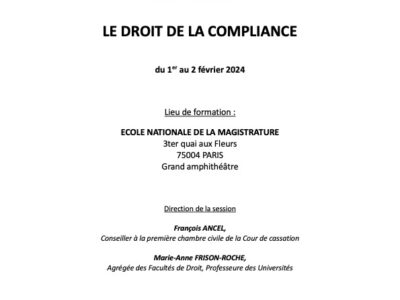
🎤Droit de la compliance : tour d’horizon (Compliance Law: Overview), in 🧮Droit de la compliance (Compliance Law)

► Full Reference: M.-A. Frison-Roche, "Droit de la compliance : tour d'horizon" ("Compliance Law: Overview"), in Droit de la compliance (Compliance Law), École nationale de la magistrature – ENM (French National School for the Judiciary) in collaboration with the École de Formation professionnelle des Barreaux du ressort de la cour d'appel de Paris – EFB (Paris Bar School), Paris, February 1, 2024. - ► This conference is given in French - 🧮see the full programme of this event (in French) - 🌐consult on LinkedIn a general presentation of this event, which links to a presentation of each speech (in French) - 🧱consult the scientific direction sheet of this event, which gives an account of the various speeches made - 🔲see the slides used to support the presentation (in French) - 🎤see a presentation of the other speech about "Compliance et Responsabilité civile : comprendre et raison garder" ("Compliance and Civil Liability: understanding and keeping our heads"), given at the same symposium - ► Presentation of the conference: Compliance Law is mysterious in itself, because it is still in creation1🕴️M.-A. Frison-Roche, 📝Naissance d'une branche du Droit : le Droit de la Compliance (Birth of a branch of Law : Compliance Law), to be published., because its presence and power are felt, but it is difficult to grasp it. It is necessary, however, because it deals with the most important, even the most dramatic, facts and carries with it the greatest ambitions. Magistrates must also "make the effort" to participate in the "adventure of Compliance Law", because it affects, and even overturns, all subjects, and because the Prosecutor and the Judge play an increasing role in it2🕴️M.-A. Frison-Roche (ed.), 📘Compliance Jurisdictionalisation, 2023.. Because the purpose of this conference is to introduce the two days of a training course designed for magistrates and open to lawyers, it only provides an "overview" of, so that we do not get lost in the sprawling regulations, the global mechanisms and the political ambitions that permeate them. Therefore, without going into any of the subjects, it is about opening up four ways of entering what is a branch of Law that is being born before our eyes: 1. Understanding Compliance Law through "regulations" 2. Understanding Compliance Law through "tools"3🕴️M.-A. Frison-Roche (ed.), 📘Compliance Tools, 2020. 3. Understanding Compliance Law through "methods" 4. Understanding Compliance Law through "goals"4🕴️M.-A. Frison-Roche (ed.), 📘Compliance Monumental Goals, 2023. The four approches are legitimate because the four dimensions are articulated in the legal system, notably case law. But the more positive Law is consolidated, the more its normativity through the goals that give normativity, or even a simplicity without which the whole is not humanly controllable. These Goals are Monumental and Europe bears them more and better than other areas of the world5🕴️M.-A. Frison-Roche (ed.), 📕Pour une Europe de la Compliance (For the Europe of the Compliance), 2019.. - 🌐follow Marie-Anne Frison-Roche on LinkedIn 🌐follow Marie-Anne Frison-Roche on Instagram 🌐subscribe to the Newsletter MAFR Regulation, Compliance, Law

Conferences

🎤Compliance et responsabilité civile : comprendre et raison garder (Compliance and Civil Liability: understanding and keeping our heads), in 🧮Droit de la compliance

► Full Reference: M.-A. Frison-Roche, "Compliance et Responsabilité civile : comprendre et raison garder" ("Compliance and Civil Liability: understanding and keeping our heads"), in Droit de la compliance (Compliance Law), École nationale de la magistrature – ENM (French National School for the Judiciary) in collaboration with the École de Formation professionnelle des Barreaux du ressort de la cour d'appel de Paris – EFB (Paris Bar School), Paris, February 1, 2024. - ► This conference is given in French. - 🧮see the full programme of this event (in French) - 🌐consult on LinkedIn a general presentation of this event, which links to a presentation of each speech (in French) - 🧱consult the scientific direction sheet of this event, which gives an account of the various speeches made - 🔲see the slides used to support the presentation (in French) - 📝This conference and the Working Paper on which it is based are to be linked with the article to be published in the book📘Compliance Obligation  - 🎤see a presentation of the conference "Droit de la Compliance : tour d'horizon" ("Compliance Law: overview"), given at the same symposium - ► Presentation of the conference : It is difficult, even artificial, to separate the presentation of the relationship between Compliance Law and Civil Liability from the consideration given in Compliance to Criminal Liability, sanctions and the whole contractual organisation. But, if only for reasons of time, this will be done. The chosen method consists of using decisions handed down either under Compliance Law, an emerging branch of Law of which an overview has been given before📎1🕴️M.-A. Frison-Roche, 🎤Droit de la Compliance : tour d'horizon (Compliance Law: overview), 2024., or under Special Liability Laws, such as Company Law (but here too the field of analysis is huge), or under Ordinary Civil Liability Law. The latter is often the preferred approach. It always seems that civil liability and Compliance Law are both intimate and have a difficult relationship. To understand them, before embarking on crusades in one direction or another, it is technically necessary to look at the liabilities attached to the application of "compliance regulations" imposed on economic operators, who contractualise the resulting legal obligations and whose third parties may also rely on breaches on the grounds of civil liability. This is the first stage of the analysis. Much is made of the Vigilance technique. Even if this is the advances point of Compliance, we also need to look at the GDPR, the French co-called "Sapin 2" law, Anti-Corruption, etc. However, civil liability is not the same depending on whether the obligation, legal and/or contractual, in relation to which it arises as a cause of action, gives rise, depending on the case, the text and the person, to an obligation of means or an obligation of result. If there is one principle to bear in mind, particularly in the mind of the judge, it is that, unless a text or clause provides otherwise, an obligation is an obligation of means. This essential question raises the need to better define the "Compliance Obligation", which consists of prevention and detection, with the economic operator making his "best efforts" with regard to the monumental goals to which the various regulations (thus finding their unity) are normatively anchored. The Ex Ante evidential dimension thus comes to the fore. In the second part of the analysis, which continues to be based on court decisions, we need to measure the "points of contact" between these "special compliance responsibilities" and the Ordinary Law of Civil Liability. Indeed, because this is a profound movement that runs through the entire legal system, expressing a social demand that distinguishes Western law from the rest of the world, Ordinary Liability Law has long had a preventive dimension and targets operators in a different way, not only because of their power, but also because of their "mission". This is expressly stated in the case law, and these points of contact do not justify opposing the two branches. It would only be if Compliance Law were confused with its instrument, "conformity", and if new principles were invented in an Ordinary Law, that clashes could arise. In the third stage of the analysis, which can be applied to the principles at stake today, it should be remembered that while there is no general Compliance Obligation under Ordinary Law, which implies detecting and preventing for oneself and for others any breach of any applicable regulation likely to harm others, there is a principle of freedom, as the Conseil constitutionnel (French Constitutional Council) regularly reminds us. Unless we change the legal system so that people become nothing more than subjects who obey all regulations and let it be seen that they do so, with the judge's role being limited to punishing them for not doing so. Indeed, the principle of freedom remains the foundation both of the Ordinary Civil Liability Law (and not of repression, as in Chinese Law) and of the Special Law of Compliance (and not of conformity, as in Chinese law). In conclusion, it appears that the evolution of Civil Liability, in particular due to the spirit of a Compliance Law that is articulated with it, is leading to a twofold movement: from Ex Post liability to Ex Ante responsibility📎2🕴️M.-A. Frison-Roche, 🚧Ex Ante Responsibility, 2022 ; 🕴️M.-A. Frison-Roche, 📝La responsabilité ex ante, pilier du droit de la compliance (Ex Ante Responsibility, pillar of Compliance Law), 2022, and from Liability to Accountability. To accompany this movement, alliances are being forged and must be fostered, which brings Compliance Law face to face with Competition Law, alliances often forged by contract and for which the role of the judge is being renewed, particularly through mediation techniques. - 🌐follow Marie-Anne Frison-Roche on LinkedIn 🌐follow Marie-Anne Frison-Roche on Instagram 🌐subscribe to the Newsletter MAFR Regulation, Compliance, Law

Working papers

Working Paper basis for an article

🚧Births of a new branch of Law: Compliance Law

► Full Reference: M.-A. Frison-Roche, Births of a branch of Law: Compliance Law, Working Paper, November 2023. - 📕This Working Paper was drawn up as a basis for a contribution to the collective book given to Professor Louis Vogel, published in 2024 - ► Summary of this Working Paper: The study looks at the various movements that have given birth to Compliance Law, with particular emphasis on Competition Law. After a preliminary reflection on the construction of the legal system into branches of Law, their classification in relation to each other, the difficulty encountered in this respect by Economic Law, and the various movements that give birth to one of them, the diversity of which the branch subsequently keeps track of, the study is constructed in 4 parts. To find out what gave rise to Compliance Law, the first part invites us to reject the narrow perspective of a definition that is content to define it by the fact of "being conform" with all the applicable regulations. This has the effect of increasing the efficacy of the regulations, but it does not produce a branch of Law, being just a set of tools like others. The second part of the study aims to shed some light on what appears to be an "enigma", as it is often claimed that this is the result of a soft method, or of an American political decision, or of as many regulations as there are occasions to make. Instead, it appears that in the United States, in the aftermath of the 1929 crisis, it was a decision of establishing an authority and rules to prevent another atrocious collapse of the system, while in Europe in 1978, in memory of the use of files of personal and racial information, it was a question of establishing an authority and rules to prevent an atrocious attack on human rights. A common element that aims for the future ("never again") but not the same object of preventive rejection. This difference between the two births explains the uniqueness and diversity of the two Compliance Laws, the tensions that can exist between the two, and the impossibility of obtaining a global Law. The third part analyses the way in which Competition Law has given rise to conformity: a secondary branch which is a guarantee of conformity with competition rules. Developed in particular through the soft law issued by the competition authorities, the result is a kind of soft obedience, a well-understood collaboration of the procedural type through which the firm educates, monitors and even sanctions, without leaving  the cercle of Competition Law, of which conformity is an appendix. The distance between a culture of conformity and the substantial Compliance Law can be measured here. The fourth part aims to show that Competition Law and Compliance Law are two autonomous and articulated branches of Law. Since Compliance Law is a branch of Law built on Monumental Goals, in particular the sustainability of systems and the preservation of the human beings involved so that they are not crushed by them but benefit from them, the current challenge of European integration is to build the pillar of Compliance Law alongside the competitive pillar. Jurisdictions are in the process of doing this and of linking the two.   - 🔓read the Working Paper below⤵️ - 🌐follow Marie-Anne Frison-Roche on LinkedIn 🌐follow Marie-Anne Frison-Roche on Instagram 🌐subscribe to the Newsletter MAFR Regulation, Compliance, Law  🌐subscribe to the Video Newsletter MAFR Surplomb

Breaking news

📧Message personnel

Videos

🎤 The Potential of Compliance Law (Les potentialités du Droit de la Compliance)

Full reference : Frison-Roche, M.-A., The Potential of Compliance Law (Les potentialités du Droit de la Compliance), conference given to Muriel Fabre-Magnan's students, Paris I, 17th of March 2021. -   This conference has been designed for Paris I's students following a Law cursus, specialized in Law of obligations and especially in Tort Law.  It therefore aims to show the technical content of Compliance Law and what it can become.  It has been followed by a debate with students.  Summary: Compliance Law is a branch of Law in the process of being born. We can be sure of its existence in the French positive Law, through the technical examination of laws called "Sapin 2" (2016) and "Vigilance" (2017). It appears at radically new. It is the reason why it is perceived as an attack, especially from United-States and we rather use legal knowledge to counter it. But if we study the historical reasons of its adoption in the United-States and the "monumental goals", whether they are negative (what should not appear in the future) or positive (what should appear in the future), we can measure that this Law, which is essentially Ex Ante could be the means through which scattered but legitimate public authorities and powerful but illegitimate big firms could ally. Therefore potentially Compliance Law could be the worst, simple tool of obedience (mechanical "conformité") or the best: what through which we could do something face to global problems, like global warming, or what we would accept to look in the face: the care for others.  Read the slides on which this conference was based (in French)

Working papers

🚧The dreamed Compliance Law

🌐follow Marie-Anne Frison-Roche on LinkedIn 🌐subscribe to the Newsletter MAFR Regulation, Compliance, Law  - ► Full Reference: M.-A. Frison-Roche, The dreamed Compliance Law, Working Paper, June 2020.  - This Working Paper, "The Dreamed Compliance Law", is the basis for an article, written in French, "La compliance" (Compliance), inserted in the collective work to be published under the direction of Jean-Baptiste Racine, Le Droit économique du XXIème siècle (The XXIe century Economic Law , in the Serie Droit & Economie,   Lextenso – LGDJ, 2020. -   No one can know what the Law of the 21st century will be. Pretending to know it is just not to realize its ignorance. Why then writing about it, since the future is always surprising? One can only write about the unknown part of the Law of tomorrow. If the future is then modeled on what was written, so much the better for the prophet, a tribute that can, for example, be paid to Pierre Godé1Mélanges Pierre Godé, off-trade book, 2019.  who described in 1999 what was going to be 10 years later "Law of the future" constituted by Environmental Law2Godé, P., Le Droit de l'avenir (Un Droit en devenir), 1999. . If the future denies the author or if its contours in no way follow the lines of the written word, this is not serious since the writing of the Law, even if it has the specificity of being partly prescriptive in that it has the power to write the future, a normative pen that rounds up letters3It is in particular the idea of the movement of analysis of Law & Literature which poses that by telling the past in one way or another, by thus inventing it, Law, and in particular the Judge, invents the future and being written, creates it. On this movement which was powerful in the United States, v. Cabrillac, R. et Frison-Roche, M.-A., Droit et Littérature, à paraître. , it participates in all writing: above all to be that of a dream. Lévi-Strauss argued that teaching is defined as dreaming out loud. Teaching and describing the Law of a century that we will never know gives even more freedom to dream about it. This freedom increases when the object is a branch of Law in the process of being born, state of the stammering "Compliance Law" of which some still maintain, as it was made for Regulation Law, that there is not existing. The hand can then, as it pleases, trace its beautiful or hideous features: what face will Compliance Law have, as soon as we assume that it will exist? It may as well be a nightmare (I) as a happy dream (II). It is up to us to choose in which category this branch of Law will flourish. Because what we can be sure of is this fulfillment. It is certainly already taking sides to presuppose the very existence of Compliance Law. Not only to consider it possibility with hostility because to be an enemy of something or someone is already to recognize their existence. Before that, two objections radically block the very existence of Compliance Law and their shadow remains in the future of it4See infra I. Compliance Law as nightmarish octopus. . Firstly, it is said that Compliance does not come under Law, but for example only ethics since it would consist in keeping well in companies which care about the interest of others or the planet, for example by spontaneous care of the environment; Compliance being a crystallization of social responsibility, the one for which we have our conscience, we express our "raison d'être" and we are not accountable5On the fact that "social responsibility" makes it possible not to be legally responsible, cf. Supiot, A., Du nouveau au self-service normatif: la responsabilité sociale des entreprises, 2004; this is not the subject of this article and this question will not be developed here.. Or it would consist in technologically putting in place tools for capturing technical information using data storage and processing methods. Compliance is then a sub-category of "Data Regulation"!6See, for instance, ..., Replace Regulation by norm by Regulation by Data, 2020. , a mechanical concept in which Law is no more present. In these two perspectives, Compliance Law cannot exist, no more tomorrow than it would exist today. These two radical conceptions, completely entrusting Compliance mechanisms to everyone except lawyers, do not make sense because it suffices to note the development of judgments and laws to measure the legal phenomenon already present7See, for instance, Frison-Roche, M.-A., Compliance Law (monography), 2016 ; Compliance Law, 2020. . Second, there would be many Compliance mechanisms but insufficient to constitute a branch of Law. Indeed we would find Compliance in Company Law, Labor Law, Financial Law, Banking Law, Criminal Law, Administrative Law, European Law, International Law, etc. These classic branches, which have been formed for so long, depending on the point of view adopted, would gain in modernity or be threatened with decay by this kind of extension which will be Compliance. There would thus be as many "little legal sectoral rules" as there are branches of law. These new internal developments would be like a new bud, on which care should be taken – if the tree regains its strength – or a weed to be eradicated – if the French garden loses its perspective. Thus the matter being scattered as many as specialist lawyers, often criminalists or specialists in banking and Financial Law, then tomorrow all specialists in all branches of Law, this could constitute the most radical obstacle to the constitution of Compliance Law. Indeed, we would come back to confuse Compliance and the "modernization" of Law itself as a whole, since it would only be a question of perfecting each of the classic branches of the legal system. If we keep in this half-sleep that is any projection in the future the hope of a constituted branch of Law, we must discard these two perspectives of annihilation, either in the total absence of Law or in recovery by all Law. To dismiss the sorrowful spirits who see no future in Compliance and keep only its enemies in the space of this article, let us assume that Compliance Law will exist in the 21st century. In what form and by what means, in the palm of which institutions, in the shadow of which legal system? Since it is a question of projecting ourselves onto the black screen of our nights of dreamy lawyers, let us take the current state only as a trailer. Like the one developed by the genius who by the contempt not only brought down into the flames of hell the cinema which has become a consumer industry with which producers force-feed us but offered us the vision of its future. What is what we see today the trailer? We let our imagination run wild since the trailer films are autonomous works compared to the film which follows them. We have no idea what will happen and what we are watching from the brief and violent current images of Compliance Law, the cinema of which rather makes a hero of the whistleblower8On what the cinema does with the whistleblower, with the availability of trailers and extracts from the films, see Frison-Roche, M.-A., introduction of the article The impossible unicity of the legal category of whistleblowers, 2019.  and a character of the narrow and ridiculous importance of the compliance officer9Frison-Roche, M.-A., ... (retrouver sur LinkedIn). , does little to help us. But if we force the features of the present lineaments, the alternative of this Law in childhood is therefore that of a nightmare (I) or an idyllic solution for difficulties that will increase (II). Everything will depend on the concept that we will retain of Compliance Law. Because the script is not written, because Compliance Law is a Law with a political dimension, that it is defined by the ambitions that we can claim to have by setting monumental goals that we are going to achieve, a claim that will make it one major branch of the Law of tomorrow, or we can abandon any claim, lower our heads and arms, and reject any claim. It is then that the power of Compliance Law, which will be no less great, will turn against us, human beings, as in a nightmare.