Binding

Articles in The Journal of Regulation & Compliance « JoRC »

WENNERSTRÖM, Erik🕴️

📝Quelques réflexions sur la Compliance et la Cour européenne des droits de l’homme, in 🕴️M.-A. Frison-Roche (ed.), 📕La juridictionnalisation de la Compliance

► Full Reference: E. Wennerström, "Quelques réflexions sur la Compliance et la Cour européenne des droits de l'homme" ("Some Reflections on Compliance and the European Court of Human Rights"), in M.-A. Frison-Roche (ed.), La juridictionnalisation de la Compliance, coll. "Régulations & Compliance", Journal of Regulation & Compliance (JoRC) and Dalloz, 2023, pp. 479-489. - 📕read a general presentation of the book, La juridictionnalisation de la Compliance, in which this article is published - ► Summary of the article (done by the Journal of Regulation & Compliance): The development of the European Court of Human Rights case law, contributing to European integration, has incorporated the substantial concept of ​​"compliance" which goes beyond the idea of ​​legality with respect to which companies remain passive, and promotes legal orders as systems in interaction with another.  The author develops the spirit and scope of Protocol 15 by which both the principle of subsidiarity and the margins of appreciation the signatory States are organized, mechanisms governed by the principle of proportionality. Subsidiarity means that the States are in the best position to design the most adequate application of the Convention, the close links between the States allowing its effective application. In addition, the new opinion procedure which allows a national court to have during a case the non-binding opinion of the ECHR ensures better compliance with the objectives of the Convention. The case-law of the Court takes up this substantial requirement through its doctrine, in particular identified in the Bosphorus case, by stressing that the accession of a State to the European Union presumes its compliance when implementing EU law with the obligations arising from the ECHR, even if this presumption can be refuted if the protection is manifestly lacking, which was admitted in several cases, in particular concerning the right to an impartial tribunal in matters of economic regulation. The different legal orders are thus articulated.  The author concludes that the European Court of Human Rights, like the Court of Justice of the Union, contributes to the construction of Compliance Law in Europe, from an Ex Ante perspective favoring opinions rather than Ex Post sanctions and creating, in particular through the Bosphorus doctrine, elements of security and confidence for European integration around common values. -

Articles in The Journal of Regulation & Compliance « JoRC »

WENNERSTRÖM, Erik🕴️

📝Some Reflections on Compliance and the European Court of Human Rights, in 🕴️M.-A. Frison-Roche (ed.), 📘Compliance Jurisdictionalisation

► Full Reference: E. Wennerström, "Some Reflections on Compliance and the European Court of Human Rights", in M.-A. Frison-Roche (ed.), Compliance Jurisdictionalisation, Journal of Regulation & Compliance (JoRC) and Bruylant, coll. "Compliance & Regulation", to be published.  - 📘read a general presentation of the book, Compliance Jurisdictionalisation, in which this article is published   - ► Summary of the article (done by the Journal of Regulation & Compliance): The development of the European Court of Human Rights case law, contributing to European integration, has incorporated the substantial concept of ​​"compliance" which goes beyond the idea of ​​legality with respect to which companies remain passive, and promotes legal orders as systems in interaction with one another. The author develops the spirit and scope of Protocol 15 by which both the principle of subsidiarity and the margins of appreciation the signatory States are organized, mechanisms governed by the principle of proportionality. Subsidiarity means that the States are in the best position to design the most adequate application of the Convention, the close links between the States allowing its effective application. In addition, the new opinion procedure which allows a national court to have during a case the non-binding opinion of the ECHR ensures better compliance with the objectives of the Convention. The case-law of the Court takes up this substantial requirement through its doctrine, in particular identified in the Bosphorus case, by stressing that the accession of a State to the European Union presumes its compliance when implementing EU law with the obligations arising from the ECHR, even if this presumption can be refuted if the protection is manifestly lacking, which was admitted in several cases, in particular concerning the right to an impartial tribunal in matters of economic regulation. The different legal orders are thus articulated.  The author concludes that the European Court of Human Rights, like the Court of Justice of the Union, contributes to the construction of Compliance Law in Europe, from an Ex Ante perspective favoring opinions rather than Ex Post sanctions and creating, in particular through the Bosphorus doctrine, elements of security and confidence for European integration around common values. -   🦉This article is available in full text to those registered for Professor Marie-Anne Frison-Roche's courses -

Articles in a legal collective publication

📝 Assessment of whistleblowing and the obligation of vigilance regarding international competitiveness, in 🕴️ M.-A. Frison-Roche (ed.), 📘Compliance Monumental Goalsnce Monumental Goals

► Full Reference: M.-A. Frison-Roche, " Assessment of whistleblowing and the obligation of vigilance regarding international competitiveness", in M.-A. Frison-Roche (ed.), Compliance Monumental Goals, series "Compliance & Regulation", Journal of Regulation & Compliance (JoRC) et Bruylant, 2023, p. - ► Article Summary: Taking up the legal tools of Compliance and confronting them with the concern that Law must have for the Competitiveness of companies, it is necessary that these legal instruments not harm it because Compliance Law, because of its immense ambitions, can only function through an alliance between political wills with great pretensions (save the planet) and the entities which are able to achieve these goals (the crucial economic operators : the political drawing on the compagnies" power, it would be contradictory for the legal instruments put in place by Law to harm the ability of companies to face global economic competition, or worse to favor international competitors acting under legal systems which do not integrate Compliance obligations.   From this principle, it is possible to assess these two legal techniques of whistleblowing and vigilance obligation: both consist in capturing Information, which gives them a strong uniqueness and fits them into the global competition for Information. Taking the whistleblowing, its first beneficiary is the company itself since the firm discovers a weakness and can therefore remedy it. Therefore, beyond the principle of protection of the whistleblower by their access to the legal statute, for instance the one conceived by the French 2016 law known as "Sapin 2", it is questionable that all the incentives are not put in place so that the holder of such information transmits it to the manager. It is not the European solution, even after the European Directive of 2019, national legal systems continuing to require the absence of financial compensation, the "heroic figure of the whistleblower and the refusal of their remuneration depriving the company of Information and improvement. First to the manager, with external transmission taking place if the latter does nothing, the internal manager is thus encouraged to act and put an end to the dysfunction, which increases the competitiveness of the company. But the French legislation has on the contrary developed the right incentive as to the person to whom the information is transmitted because by obliging to transmit first to the manager, the external transmission intervening if the internal management does nothing, the incentive is thus made to the internal manager to act and put an end to the dysfunction, this legal solution increasing the competitiveness of the company. Even more, and even if it seems counter-intuitive, the obligation of vigilance increases the competitiveness of the obliged companies. Indeed, Law by obliging them to prevent and fight against violations of human rights and the environment has tacitly given them all the necessary powers to do so, notably the power to collect Information on third-party companies, including (and even above all) those which are not subject to transparency obligations. In this respect, companies, as far as they are personally responsible, hold supervisory power over others, a power which allows to globalize Compliance Law and which, in the process, increases the Companies' own power. Therefore, the obligation of vigilance is in many respects a boon for the companies which are subject to it. The resumption of the mechanism by the next European Directive, itself indifferent to the territory, will only strengthen this global power of vigilant companies over possibly foreign companies which become its passive subjects. - 🚧 read the bilingual Working Paper, basis for this article  - 📘​ read the general presentation of the book, Compliance Monumental Goals, in which this article is published - ► read the presentations of the other Marie-Anne Frison-Roche's contributions in this book:  📝Compliance Monumental Goals, beating heart of Compliance Law,  📝Definition of Principe of Proportionality and Definition of Compliance Law, 📝 Role and Place of Companies in the Creation and Effectiveness of Compliance Law in Crisis,  -    

Conferences

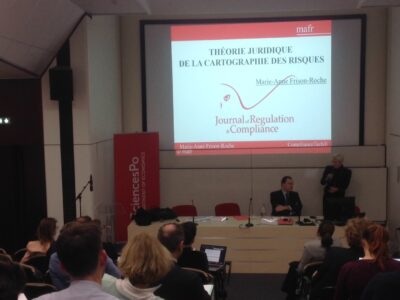
Legal theory of Risk Mapping, in “Risk Mapping, as Compliance Tool” (conference made in French)

Reference : Frison-Roche, M.-A., General presentation of the cycle of conferences on Les outils de la Compliance  (Compliance Tools) and  "Théorie générale de la cartographie des risques" (Legal Theory of Risk Mapping), conference made in French, in Département d'Economie de Sciences Po & Journal of Regulation & Compliance (JoRC),  La cartographie des risques, outil de la Compliance (Risk Mapping, as Compliance Tool), November 28th, 2019, Sciences Po, Paris.    Read the  General Presentation ot the cycle of conferences about the Compliance Tools   Read the General Presentation of the book written in English to be published   Read the General Presentation of the serie Régulations & Compliance in which the book will be published   Summary of the conference Risk mapping is both central to the obligations or practices of companies and little apprehended by the legal systems. It is not expressly referred to by the French legal system, except for the special national laws known as "Sapin 2" and "Vigilance". But if we are out of this field, because there is only a description and not a legal definition, even less a legal notion, we do not know what legal regime to apply to the action of mapping risks. It is therefore useful, indeed compelling, to define the legal concept of risk mapping. Starting from what is still the safest ground, namely these two special laws, to go towards less secure legal grounds, such as the doctrine of the authorities or the commitments of the companies, even the ISO certifications obtained in this matter. Through a few judicial decisions and legal reasoning, a legal notion of the action of mapping risks emerges. It is advisable to proceed in 5 steps (the working document follows another approach). The first, based directly on the two available laws, apprehends the action of mapping when it comes into execution of a special legal obligation. The decision rendered in 2019 by the French Commission des sanctions of the Agence Française Anticorruption (French Corruption Agency's Sanctions Commission) draws probate games as to the demonstration of the execution of the obligation and the probationary system can be extended. In the same way the decision of the French Conseil constitutionnel (Constitutional Council) in 2017 on the "Vigilance Act" shows that a mechanism referred to as a "modality" is legitimate with regard to the goal, which is, concerning this tool, the establishment of a responsibility for others. It is therefore the concern for the situation of others that can be targeted by the Law thanks to Compliance Tool, especially Risk Mapping. The second theme aims to map risks as a fact of good management for a company, while the enterprise is not constrained by a legal obligation. This fact is a paradox because the Regulatory Authority and the Judge may, where the conduct that was to be prevented occurs, for example a market abuse or an anti-competitive behavior, either qualify as an aggravating circumstance or as an attenuating circumstance. Consideration of the theory of incentives should lead to the adoption of the American solution, that is to say the qualification of an effective cartography as a mitigating fact. European case law is not yet fixed, especially in terms of Competition Law's compliance. The third theme is the mapping action carried out by an entity which, in doing so, exercises power over a third party. Because cartography is as much an obligation as a power, possibly on a third party. The Conseil d'État (French Council of State) in 2017 qualified risk mapping as an act of grievance, but doing so legitimately, since it was to prevent forest fires efficiently. This solution based on the teleology attached to Compliance Law can be transposed to other areas. Going further, one may consider transforming this action from de facto status to legal status on the part of the company, if it thus identifies risks for third parties. It would thus give third-party creditors the right to be in a position to measure the risks that weigh on them. Risk mapping would thus be part of a broader unilateral commitment by powerful companies, recognizing the existence of risks for third parties to enable them to know their nature and extent. If this responsibility Ex Ante (characteristic of Compliance Law) is fulfilled, then the Ex Post liability of the company could no longer be retained. This is the ongoing issue of the Johnson & Johnson trial (2019 American judgment), in terms of medical compliance. Because if one can argue that there exists through this kind of risk mapping that the posology a "subjective right to be worried about the risks related to the taking of the drug", the patient remains free in the use of it. The question of whether third-party education is included in the mapping, since the alert is already included in it, is an open question. For now, the answer is negative. Indeed and in a fifth time, appears the liberal definition of Compliance Law through the apprehension that the Law must make of the cartography of the risks. Beyond the rational act that any person has to control their risks for their own interest, by preventing the damaging effects of that from the crystallization of risk has in fact proved, it is a question of preserving an external interest for the preservation of which the Law must intervene because the subject of law, in particular the company will be less likely to be concerned. By the imprint of the law, risk mapping expresses the concern for an external interest, either of a system or of a third party. But this support in Ex Ante implies force (Sapin 2, Vigilance, financial market information obligation) or will (social responsibility, ethical commitment, adoption of non-financial standards) relates only to information, its constitution, its intelligibility and its hierarchy. Then it is the actors exposed to the risks, able to understand in Ex Ante the extent as far as they are concerned, either the entity itself, or the thirds, to choose to run them to no.     Consult the two sets of slides as basis of the conference:    Slides served as basis for the General Presentation of the cycle of conference on the Compliance Tools (in French)  Slides served as basis for the specific contribution "Théorie générale de la cartographie des risques / Legal Theory of Risk Mapping" (in French).   Read the working paper served as basis for the conference -

Books

Le droit des contrats