Adversarial principle

Organisation of events

🧱⚙️scientifi organisation and moderation of 🧮Le Droit processuel de la Vigilance (Vigilance General Procedural Law), in cycle de conférences-débats “Contentieux Systémique Émergent”

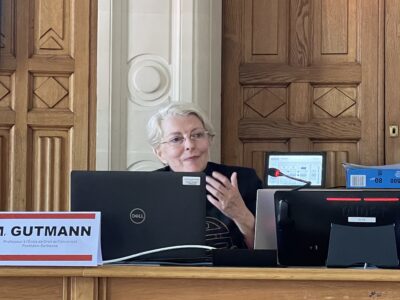
► Full Reference: Le Droit processuel de la Vigilance (Vigilance General Procedural Law), in cycle of conference-debates "Contentieux Systémique Émergent" ("Emerging Systemic Litigation"), organised on the initiative of the Cour d'appel de Paris (Paris Cour of Appeal), with the Cour de cassation (French Court of cassation), the Cour d'appel de Versailles (Versailles Court of Appeal), the École nationale de la magistrature – ENM (French National School for the Judiciary) and the École de formation des barreaux du ressort de la Cour d'appel de Paris – EFB (Paris Bar School), under the scientific direction of Marie-Anne Frison-Roche, November 18, 2024, 11h-12h30, Cour d'appel de Paris, Cassin courtroom - ► Presentation of the conférence:  - 🧮Programme of this event:  Seventh conference-debate LE DROIT PROCESSUEL DE LA VIGILANCE (VIGILANCE GENERAL PROCEDURAL LAW) Paris Court of Appeal, Cassin courtroom Presentation and moderation par Marie-Anne Frison-Roche, Professor of Regulatory and Compliance Law, Director ot the Journal of Regulation & Compliance (JoRC) 🕰️11h-11h20. 🎤, by 🕴️Marie-Anne Frison-Roche, Professor of Regulatory and Compliance Law, Director ot the Journal of Regulation & Compliance (JoRC) 🕰️11h20-11h40. 🎤, by 🕴️Natalie Fricero, Emeritus Professor of Law at Côte d'Azur University 🕰️11h40-12h30. Debate - 🔴Registrations and information requests can be sent to: inscriptionscse@gmail.com 🔴For the attorneys, registrations have to be sent to the following address: https://evenium.events/cycle-de-conferences-contentieux-systemique-emergent/  ⚠️The conference-debates are held in person only, in the Cour d’appel de Paris (Paris Court of Appeal). -

Conferences

Conference

🎤Les spécificités à concevoir dans l’audience publique des contentieux systémiques de vigilance (The Specific Features of Public Hearings to conceive on Vigilance Systemic Litigation), in 🧮Le Droit processuel de la Vigilance (Vigilance General Procedural Law)

► Full Reference: M.-A. Frison-Roche, "Les spécificités à concevoir dans l'audience publique des contentieux systémiques de vigilance" ("The Specific Features of Public Hearings to conceive on Vigilance Systemic Litigation"), in Le Droit processuel de la Vigilance (Vigilance General Procedural Law), in cycle of conference-debates "Contentieux Systémique Émergent" ("Emerging Systemic Litigation"), organised on the initiative of the Cour d'appel de Paris (Paris Cour of Appeal), with the Cour de cassation (French Court of cassation), the Cour d'appel de Versailles (Versailles Court of Appeal), the École nationale de la magistrature – ENM (French National School for the Judiciary) and the École de formation des barreaux du ressort de la Cour d'appel de Paris – EFB (Paris Bar School), under the scientific direction of Marie-Anne Frison-Roche, November 18, 2024, 11h-12h30, Cour d'appel de Paris, Cassin courtroom - 🕴️An other speaker to this conference is Natalie Fricero, Emeritus Professor at Côte d'Azur University 🧮see the full programme of this event - ⚙️This event was conceived as part of the "Emerging Systemic Litigation" cycle of conference-debates, organized by the Paris Court of appeal, in conjunction with the French Court of cassation, the Versailles Court of appeal, the French National School for the Judiciary and the Paris Bar School, under the scientific direction of Marie-Anne Frison-Roche. - ► English Summary of the conference:  - 🌐follow Marie-Anne Frison-Roche on LinkedIn 🌐follow Marie-Anne Frison-Roche on Instagram 🌐subscribe to the Newsletter MAFR Regulation, Compliance, Law 🌐subscribe to the Newsletter Surplomb, par MAFR

Surplomb - Notion

🎬Procedural Law of Regulation and Compliance

Articles in The Journal of Regulation & Compliance « JoRC »

📝Adjusting General Procedural Law to Compliance Law by the nature of things, in🕴️M.-A. Frison-Roche (ed.), 📘Compliance Jurisdictionalisation

► Full Reference: M.-A. Frison-Roche, "Adjusting General Procedural Law to Compliance Law by the Nature of things", in M.-A. Frison-Roche (ed.), Compliance Jurisdictionalisation, Journal of Regulation & Compliance (JoRC) and Bruylant, "Compliance & Regulation" Serie, 2024, pp. 273-28.  - 📝read the article - 🚧read the bilingual Working Paper which is the basis of this article, with additional developments, technical references and hyperlinks - 📘read a general presentation of the book, Compliance Jurisdictionalisation, in which this article is published - The principal elements of this articles had been presented during the scientific manifestation held on September 23, 2021, at Dauphine University in Paris, coorganised by the Journal of Regulation & Compliance (JoRC) and the Institute Droit Dauphine.  In the book this article is placed in the chapter II about the General Procedural Law in the Compliance Law.   - ► Summary of the article (done by the Journal of regulation & Compliance – JoRC): General Procedural Law is an invention, essentially due to Professor Motulsky, going well beyond the gain that one always has in comparing types of procedures with each other. As he asserted, there is Natural Law in General Procedural Law, in that as soon as there is the Rule of Law Principle there cannot be, whatever the "procedure", even the "process", such and such way of doing things: for example, to decide, to seize the one who decides, to listen before deciding, to contest the one who has decided. General Procedural Law therefore depends on the nature of things. However, Compliance Law organizes things in a new way. Therefore, both the simple and iron principles of General Procedural Law creep in where we do not expect them at first sight, because there is no judge, this character around whom ordinary procedures fit together. The principles of General Procedural Law are essential in companies. Even if the regulations do not breathe a word about it, it is up to the Judges, in particular the Supreme Courts, to recognize this nature of things because on this effect of nature that  General Procedural Law is built: when compliance mechanisms oblige companies to strike, General Procedural law must oblige, even in the silence of the texts, to arm those who can be hit, even stand up against devices that would set aside too much these defenses that are easily considered contrary to efficiency (I). But because it is a question of making room for this nature of the things of which the Rule of Law Principle entrusts the custody to the Judge and the Lawyer, the General Procedural Law must also adjust itself to what the extraordinary new branch of Law Compliance Law is. Indeed, Compliance Law is extraordinary in that it expresses the political pretention to act now so that the future will not be catastrophic, by detecting and preventing the realization of systemic risks, or even that it is better, by building effective equality or real concern for others. Because it is the Monumental Goals that defines this new branch of Law, a disputed systemic issue, possibly disputed by several parties before a judge, the procedural principles used by the court must be broadened considerably: they must then include civil society and the future (II). General Procedural Law thus naturally acquires an even more place than in the classic branches of Law since on the one hand it imposes itself outside of trials, particularly in companies and on the other before the courts it involves people who had hardly any place to speak and thinks themselves, especially the systems entering the "causes" of Compliance now debated before the Judge. - 🌐follow Marie-Anne Frison-Roche on LinkedIn 🌐follow Marie-Anne Frison-Roche on Instagram 🌐subscribe to the Newsletter MAFR Regulation, Compliance, Law

Conferences

🎤Compliance et droit processuel (Compliance and Procedural Law), in🧮Compliance : Obligation, devoir, pouvoir, culture

🌐follow Marie-Anne Frison-Roche on LinkedIn 🌐subscribe to the Newsletter MAFR Regulation, Compliance, Law - ► Full Reference: M.-A. Frison-Roche, "Compliance et droit processuel" ("Compliance and Procedural Law"), in B. Deffains, M.-A. Frison-Roche and J.-B. Racine (dir.), Journal of Regulation & Compliance (JoRC) and University Panthéon-Assas (Paris II), Compliance : Obligation, devoir, pouvoir, culture (Compliance : obligation, duty, power, culture), University Panthéon-Assas, Salle des Conseils, 14 June 2023. - 🧮See the full programme of this event - 🎤see the other speech made during the first day of this symposium : "L'obligation de compliance, entre volonté et consentement : obligation sur obligation vaut" ("Compliance Obligation, between will and consent: obligation on obligation works")   - ► Summary of the conference: After referring to the chapter in the book Compliance Jurisdictionalisation, which deals more specifically with Procedural Law1See the articles that are part of the Second chapter of the book 🕴️M.-A. Frison-Roche (ed.), 📘Compliance jurisdictionalisation, 2023 : 🕴️N. Cayrol, 📝General Procedural Law in Compliance Law,, the conference is built around 5 developments, each of which represents a progression. The first development relates to the fact that the relationship between Compliance Law and Procedural Law is very difficult because it is often said that they simply have nothing to do with each other, or that they have everything to dislike each other. This is because Compliance is often reduced to processes, and to the mechanical place that algorithms could take in it, in taking care of everything. Compliance would even have the purpose and effect of ensuring that the company and its managers never come into contact with a judge, the public prosecutor being their best ally in this respect. Secondly, I recalled the very common idea that Procedural Law is a kind of 'tribute' that the rule of Law demands, which certainly weighs down companies when compared with companies living in systems in which there's not not such a price. But many stress that Procedural Law could become a model. This can be justified and technically anticipated because it has already happened in Regulation Law, and Compliance Law is the deployment of it2🕴️M.-A. Frison-Roche, 🚧From Regulation Law to Compliance Law, 2017. 🕴️M.-A. Frison-Roche, 🎤Le rôle du Juge dans le déploiement du Droit de la Régulation en Droit de la Compliance (The role of the Judge in the deployment of Regulatory Law in Compliance Law), in 🧮De la Régulation à la Compliance : quel rôle pour le Juge ?, 2023.. In the third stage, I worked on the alliance between the two, with the procedure (rather than the process) modifying compliance and thereby reinforcing it, evoking the way in which this can manifest itself technically3Notably in this perspective, 🕴️M.-A. Frison-Roche and 🕴️M. Boissavy, 📕Compliance et droits de la défense. Enquête interne - CJIP - CRPC (Compliance and Due Process. Internal Investigation - DPA), 2024.. In the fourth step, I looked for what would be the "naturally appropriate procedure" for Compliance: one that takes into account the duration and the development of "solutions", to which the notion of "sustainability", which is central in the substantive Law of Compliance, refers. In a fifth stage, and devoting more time to this, I have pointed out where innovation should be the strongest: the proof, the probatory obligation being the "part totale" ("total part") of the compliance obligation. This major issue will be the subject of a series of symposiums held in 2024. -

Articles in The Journal of Regulation & Compliance « JoRC »

SCEMLA, Sophie🕴️ et PAILLOT, Diane🕴️

📝The difficulty for Compliance Enforcement Authorities to comprehend the Rights of the Defence in compliance matters, in 🕴️M.-A. Frison-Roche (ed.), 📘Compliance Jurisdictionalisation

► Full Reference: S. Scemla & D. Paillot, "The difficulty for Compliance Enforcement Authorities to comprehend the Rights of the Defence in compliance matters", in M.-A. Frison-Roche (ed.),  Compliance Jurisdictionalisation, Journal of Regulation & Compliance (JoRC) and Bruylant, coll. "Compliance & Regulation", to be published. - 📘read a general presentation of the book, Compliance Jurisdictionalisation, in which this article is published   - ► Summary of the article (done by the Authors): Since 2016, French companies subject to the provisions of the so-called “Sapin 2” Law must implement eight stringent anti-corruption measures, such as a risk mapping, a whistleblowing procedure or a third-party due diligence procedure. To ensure their compliance with these obligations, the Sapin 2 law created the Agence française anticorruption – AFA (French Anti-Corruption Agency), which had been assigned three missions: firstly, to help any person prevent and detect corruption; secondly, to control the quality and effectiveness of the anti-corruption programs deployed by the companies; and thirdly, to sanction any breaches, through its Sanctions Committee. As pointed out by the French Conseil d’État, the powers devolved to the administrations have multiplied and became stratified. While the Conseil d'État suggests to improve both the conduct and the effectiveness of administrative controls by harmonising their practices and simplifying their prerogatives, it is urgent to remedy the numerous procedural failures that undermine the rights of defence. In fact, the AFA exercises various powers when undertaking its controls. Some of these powers are not provided for by the Law, and most of them infringe fundamental rights and freedoms among which the adversarial principle and the freedom not to self-incriminate. For instance, the AFA does not necessarily draft minutes of the interviews it conducts, thus depriving the interviewee of the possibility to challenge the statements reported by the AFA to the Sanctions Committee. From a more structural point of view, the scope of the AFA's mission is extremely broad. The Law allows the AFA to request the communication of "any professional document or any useful information", without defining the notion of usefulness. Also, the AFA considers that the entity cannot benefit from the legal privilege that would cover their documents, and considers that an entity who voluntarily hands over a document, without expressing any reserves, waives its right to the benefit of its legal privilege. Apart from the severe consequences that could arise if another proceedings was to be initiated by a foreign authority, the concept of "voluntary handover" does not faithfully reflect the reality. Indeed, the controlled entities only cooperate under the threat of being prosecuted on the basis of an obstruction to the control, which compels them to communicate documents even when facing the risk of contributing to their own incrimination. These many procedural deficiencies encountered during AFA controls must therefore be reformed, as recommended by the Conseil d’État, so as to require the authorities to take into account the rights of the defence. - 🦉This article is available in full text to those registered for Professor Marie-Anne Frison-Roche's courses -

Videos

🎥 The Economic Attractiveness of Impartiality (“L’attractivité économique de l’impartialité”), in “”Economic Attractiveness, Judge Office and Impartiality. Thinking the judge Office” (“L’attractivité économique, l’office du juge et l’impartialité. Penser l’office du juge”)

►  Full Reference : Frison-Roche, M.-A., The Economic Attractiveness of Impartiality ("L'attractivité économique de l'impartialité"), in ""Economic Attractiveness, Judge Office and Impartiality. Thinking the judge Office" ("L'attractivité économique, l'office du juge et l'impartialité. Penser l'office du juge"),  -   🎥 watch the conference (in French with English subtitles) -   📝 read the colloquium program ( in French) 📝 see the general program of the cycle on the Judge Office. -   📝 read François Ancel's article of 14th of January 2021 in the Receuil Dalloz and which report this colloquium (in French)      📝 read the Working Paper, basis of this conference. This Working Paper is significantly different from the conference because it was conceived befor the colloquia cycle beginning. In addition, since this manifestation was a Round Table, the conference has taken more into account previous conferences and what said the other two speakers.   📊 see the slides, basis of the conference (in French) The slides could not be shown during the conference. Orally, it was appropriate to more develop the introductory remarks for emphasizing the human and unique dimension of the Judge Office, expected in economic matters. As a result, the second part of the conference was not given orally, so slides therefore remain the only media available. - ►  Summary of the conference : To fit into the ambition of this general colloquia cycle, which is to "Think the Judge Office" and in this round table which apprehends the imperative of economic attractiveness of this office, firstly emerges the seemingly contradictory relationship between this imperative and the distance that the judge must maintain. Thus it is often asserted that the judge should be internalized at this point in the "places", – an economic concept of great scope (to which the first part of the introduction is devoted, defining the "place" at the same time as a closed and porous space and as a "systemic litigant" -, that he/she should ipso facto lose his/her distance, that is to say his/her impartiality. As places are in competition, even if weighing on one hand the effectiveness of the place, and on the other hand the impartiality of a judge who is external to this place – Judge referring to the Law , Impartiality would necessarily emerge weakened. It would then be necessary on a case-by-case basis to get the judge to give the desired concessions… The conference aim is to take the opposite position and to state that the Place – in particular because they must be strongly distinguished from the Markets, of which they were the ancestors – require a Judge, who is at the same time "singular", that is to say with a personality, a face, opinions, and in distance so that his/her imagination does not surprise Place. Indeed, these require a human Justice, and a not mechanical one and singular judges, of whom the juge des référés or the arbitrator are the epigone, meets this need. But for reducing their "margins of discretion", how Economy qualifies the Impartiality of a person who can never be neutral, the singular Judge's Office must be inserted into mechanisms reducing these margins. In this way, the Place may reach a Judge who is always more impartial, and in doing so the Place becomes always more attractive. To achieve this in practice, the place expresses two legitimate expectations, as a "systemic litigant", whose satisfaction increases and the singular Judge's Impartiality and increases the Attractiveness of the Place as a space. This clearly shows that the Place's Attractiveness and the Judge's Impartiality, because judges are inserted into procedures, into institutions and into a "jurisdictional family", are not only not contradictory, but are on the contrary convergent, one fueling the other. Concretely, and judicial practice shows it, it is necessary to consolidate the particular Judge's Impartiality by inserting him/her into collective processes. As it is necessary to promote a radiance of Impartiality by strengthening the "jurisdictional family". To consolidate the singular Judge's Impartiality  by inserting him/her into collective processes, it is necessary to admit without hesitation the subjectivity of the judge, to seek it even. The reduction of the margins of discretion, definition of impartiality, being obtained by the inclusion of the judge in a procedure of which he /her alone is the master but in which he/her is not alone. This has the technical consequence that he/her is himself/herself in an adversarial debate, not only during the proceedings, but also before (in the media), inside the judgment (and the decision of the Criminal Chamber of 25 November 2020 is a model of that) and after the judgment. By that, the Judge shows that by his/her office he/she is in the future, as climate justice will show. In addition, to limit his/her margins of discretion, the singular judge must fit into a rational principle of coherence, vertical and horizontal. Vertical coherence, because he/she integrates what it is said and the technique of the "determining opinion" is to be encouraged, the singular judge having to avoid it only if he/she has "strong reasons" to do it. This is to follow  this general rule Comply or Explain (which is the very opposite of blind obedience). Horizontal coherence, because the singular judge either sticks to what he/she said, estoppel also being a rule of logic. But above all, the institution must extract as much as possible from " institutional doctrines", by all means, of which the annual reports are an example. To consolidate the singular Judge's Impartiality by strengthening the notion and reality of the "Jurisdictional Family", it is necessary to have of it a broader conception, which could lead to "guidelines" common to various jurisdictions, and a stronger one, by integrating those surrounding the judge to lead to judgment. In this, the procedure before the Court of Justice of the European Union, working on a common file, is a model. If this community were even stronger, the Judge Office would be even more useful than it is already in the digital space. Thus, Judges who are always human, always diverse, always singular, who listen, consider and adjust to the situation, who within a Jurisdictional Family fit into an Institutional Doctrine which transcends and supports them but which they transform if there is a strong reason to do so, a reason always expressed said: this is the embodied Impartiality that makes an economic and financial Place attractive.   -      

Working papers

The attorney, vector of conviction in the new Compliance system

This Working Paper written in English is the basis for an article published in French in the French journal Dalloz Avocat , in March 2020.       Summary of the working Paper. If we perceive Compliance Law as an aggression of the private company and a binding set of mechanisms that have no meaning and added value for it, then the attorney has a utility: defending the business. It can do so not only during the sanctions phase, but also to prevent it. But this function is not central. It becomes so if we understand Compliance Law as a body of substantial rules, pursuing a "monumental goal": the protection of the person, goal injected by political bodies and taken up by the operator. From this, the company must convince everyone to take it back, inside the company and outside. In a general and contradictory debate, the attorney carries this conviction, because he and she is always convincing those who at the end judge (market, public opinion, etc.) that is their raison d'être.   (In this short document, the pop-ups refer to the different works that develop each of the points)

Books

📕Généralités sur le principe du contradictoire. Étude de droit processuel (Generalities about the principle of contradictory. Study of procedural Law)

Full reference: Frison-Roche, M.A., Généralités sur le principe du contradictoire. Étude de droit processuel, coll. "Anthologie du Droit", Lextenso – LGDJ éditions, 2014, 221 p. - Republished from Généralités sur le principe du contradictoire », Étude de droit processuel, Th. Paris II, 1988.  This book is the publication of a thèse d'Etat (French official thesis) written under the direction of Jean Foyer and defended in the Panthéon-Assas University (Paris II) face to a jury made up among others of François Terré, René Chapus, Gérard Cornu, Geneviève Viney.  The main idea is to defend that the principle of contradictory is a simple and fundamental principle, without which there is no Law. It is the reason it is obvious to study it as in civil procedure as in criminal, administrative or arbitrary procedures, to take back a "Procedural Law" perspective conceived by Motulsky. Indeed, without a judge listening without having already decided the facts and Law versions that presents who's the situation will be affected by the decision that the judge will make, there is no rule of Law.  The main beneficiary of the principle of contradictory, it is not really the person, and it is in this that the contradictory is detached from the rights of the defense, it is the judge. Indeed, emphasizing contradictory versions of Law and facts which collide in front of him or her, the judge perceives more exactly and more fairly the world and the use of Law that he or she should favor. Thus, Law is better used. In this, we can consider that the principle of contradictory is consubstantial to Law. Read the summary (in French) Read the introduction (in French) Read the table of contents (in French)

Articles in a legal collective publication

📝Experts et procédure : l’amicus curiae (Experts and procedure: the amicus curiae)

► Référence complète : M.-A. Frison-Roche, "Experts et procédure : l'amicus curiae" ("Experts and procedure: the amicus curiae"), Revue de droit d'Assas, october 2012, pp. 91-94 - 📝read the article (in French) - ► English Summary of the article: A recent thesis has argued that amicus curiae is becoming a common principle of Procedural Law. This shows its importance. The fact that the mechanism, the character, is designated by a Latin formula leads us to suspect that something is being concealed that legal technique ordinarily forbids: it is the legal expert and the party's expert, which is what the amicus curiae most often is, either one or the other, or both at the same time. Therefore, removing the prudish cloak of Latin, it is these two difficulties that must be addressed. If we exclude the legal expert, it is because "jura novit curia" ("the court knows Law". But this rule, which recalls the principle that "no one is supposed to be ignorant of the law", merely indicates a sharing of the burden of evoking facts and Law between the parties and the judge (Motulsky) and not a presumption of knowledge. Consequently, the modest, and therefore self-confident, judge has no reason, either psychological or legal, to shy away from a legal expertise. As for the party's expert, or the judge's expert who is highly influenced by a party, a profession, a social group, in short, a judge's expert who is in fact an expert held by a party, this can only be a problem if the judge cannot keep his distance from this expert whose opinion is biased by the weight of the party. But first of all, any opinion is biased. Whether it is given in bad faith or good faith, it is biased, and in rhetoric we know that an opinion biased in good faith is more dangerous than a bought opinion, because the latter is known to be twisted by self-interest. In this respect, the person who listens to it, the judge, knows the difference. Indeed, the legal system that recognises the party's expert and the amicus curiae, i.e. North American Law or European Union Law, draws the necessary procedural consequence: they include the party's expert opinion in the adversarial debate. It is the principle of adversarial debate, the principle of principles in the conduct of proceedings, that makes amicus curiae acceptable and welcome, since it provides the judge with a scientific input that the latter does not have. -