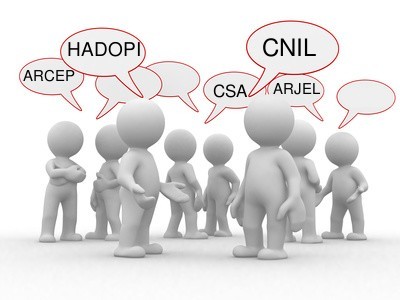
The Regulator, which generally takes the form of an [lien a="autorite-administrative-independante-aai"]independent administrative authority (IAA[/lien]), is the person or body that monitors and [lien a="controle"]controls [/lien]the [lien a="secteur"]sector [/lien]in order to maintain a [lien a="equilibre"]balance [/lien]between the principle of [lien a="concurrence"]competition[/lien] and another principle. For example, the [lien a="telecommunications"]telecommunications[/lien] regulator will ensure the licensing of mobile telephony; or the [lien a="energie"]energy [/lien]regulator will monitor the [lien a="access"]access [/lien]conditions of competitors to the electricity transmission grid ; or the financial regulator will monitor the reliability of the financial [lien a="information"]information [/lien]it will make available to investors.
The regulator must either build [lien a="concurrence"]competition [/lien]to achieve the [lien a="liberalisation"]liberalization[/lien] of a [lien a="secteur"]sector[/lien] or preserve it of the systemic [lien a="risque"]risks [/lien]that threaten it. For this it must have very large powers both [lien a="ex-ante-ex-post"]in ex ante and ex post[/lien]. Thus, in most cases, it has an ex ante regulatory power, for example through a general power to adopt texts, such has the French Financial Markets Authority ([lien a="autorite-des-marches-financiers-amf"]Autorité des Marchés Financiers - AMF[/lien]). Ex post, it has also an [lien a="droit-administratif-repressif"]administrative power to sanction[/lien] and [lien a="reglement-des-differents"]settle the disputes[/lien].
The diversity of objectives, their heterogeneity, and even their contradiction, makes it difficult to satisfy everyone, but also - and it is another issue - offers the regulatory authority a large margin of discretion since it can easily justify its use of his powers by aiming one objective or another. The theoretical and practical question of the "discretion of the regulator" is a major political problem, especially for those who claim that the regulator would only be an expert and not exercise political power, that is to say do not make discretionary choices for the social group. All these powers are nonetheless exercised in compliance with fundamental procedural safeguards, since the persons concerned may challenge the acts before the [lien a="juge"]courts[/lien].
Finally, according to Hannah Arendt's model, beyond the law, the Regulator must first of all have "authority" (gravitas), that is, sufficiently impress and the sector and the government to be respected, and its prescriptions taken in consideration. For this, the regulatory body must have the [lien a="information"]information[/lien], belong itself to the same private circles of its interlocutors and widely communicate with its foreign counterparts. In this, the Regulator sometimes appears as a sort of minister, who would hold its power of the sector itself, but must always remain [lien a="neutralite"]neutral[/lien]. The issue of its [lien a="independance"]independence [/lien]and its absence of [lien a="capture-du-regulateur"]capture [/lien]is all the more crucial.