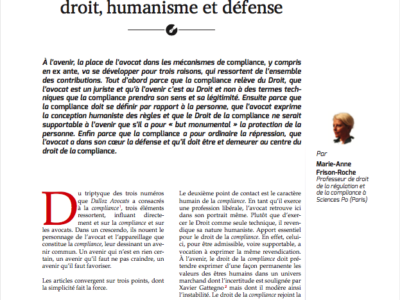
Full reference : Frison-Roche, M.-A., Avocat et Compliance – L'avenir du personnage et de son outil : Droit, Humanisme et Défense ("Attorney and Compliance – the future of the character and his tool: Law, Humanism and Defense),article of synthesis fo the collective publication "Compliance", Dalloz Avocat, March 2020, April 2020, June 2020, Dalloz Avocat, June 2020, pp. 321-324 Read the synthesis article (in French). Read the editorial of the March 2020 Issue, presenting the problematic : "The Attorney, Vector of Conviction in the New Compliance System". - Summary of the article: In the future, the place of lawyers in compliance mechanisms, including in Ex Ante, will develop for three reasons, which emerge from all of the contributions. First of all because Compliance is a matter of Law, a lawyer is a lawyer and in the future it is a matter of Law and not on technical terms that Compliance demands its meaning and legitimacy. Then because Conformity must be defined in relation to the person, the lawyer expresses the humanist conception of the rules and Compliance Law will only be tolerable in the future if it is for "monumental goal" of protection of the person. Finally, because Compliance with ordinary repression, that the lawyer in his heart defends and must be and remain at the center of Compliance Law. -
This interview was conducted in French with Olivia Dufour, for an article published in French in the digital publication Actualité Juridique. Its subject is the confrontation between the current health crisis situation and the Compliance Law. Summary. After defining Compliance Law, distinguishing the procedural and poor definition and the substantial and rich definition, the starting point is to admit the aporia: the type of health crisis caused by Covid-19 will be renewed and it is imperative to prevent it, even to manage it, then to organize the crisis exit. Public Authorities are legitimate to do so, but because this type of crisis being global and the State being consubstantially linked to borders, States are hardly powerful. Their traditional International Law shows their limits in this current crisis and one cannot hope that this configulration will improve radically. In contrast, some companies and markets, notably the financial markets, are global. But the markets are not legitimate to carry out such missions and counting on the generosity of certain large companies is far too fragile in front of the "monumental goal" that is the prevention of the next health crisis, crisis which must never happen. How to get out of this aporia? By Compliance Law, basis of, in a literal and strong sense, the "Law of the Future". We need to be inspired by the Banking and Financial Compliance Law. Designed in the United States after the 1929 crisis to tend towards the "monumental goal" of the absence of a new devastating crisis in the country and the world, this set of new legal mechanisms gave duty and power of supervision, regulation and compliance to market authorities and central bankers. These are independent of governments but in constant contact with them. Today, they claim to have as first priority the fight against climate change. Now and for the future, they must also be given the responsibility and the powers to prevent a global health disaster, similar to a global ecological disaster, similar to a global financial disaster. This does not require a modification of the texts because their mandate consists in fighting instability. Stability must become a primary legal principle, of which the fight against monetary instability was only a first example. By the new use that central banks must make of it by preventing and managing health crises, Compliance Law will ensure that the future will be not catastrophic.
Read more
CrisisMarketAdministrative authoritiesex anteFinancial marketStateUncertaintyPublic International LawBorderGlobalizationCrucial firmFinancial CrisisAltruismComplianceFutureGlobal LawStabilityCoronavirusHealth crisis
Without any request, on his or her newsfeed, those who surfs on the social network built by Facebook, has found on 23 of March 2020, in the morning, the following message : « X (prénom de l'internaute), agissez maintenant pour ralentir la propagation du coronavirus (COVID-19) Retrouvez les actualités des autorités sanitaires et institutions publiques, des conseils pour ralentir la propagation du coronavirus et des ressources pour vous et vos proches dans le Centre d’information sur le coronavirus (COVID-19)" ("X (user's name), act now to slow down the spread of the Coronavirus (COVID-19). Find the health authorities and public institutions' news, advices to slow down the spread of the Coronavirus for you and your entourage in the Information Center about Coronavirus (COVID-19) »). This corresponds to the more general declaration done the same day by Kang-Xing Jin, director of Health at Facebook, who declares : "In response to the coronavirus outbreak, Facebook is supporting the global public health community’s work to keep people safe and informed. Since the World Health Organization declared the coronavirus a public health emergency in January, we’ve taken steps to make sure everyone has access to accurate information, stop misinformation and harmful content, and support global health experts, local governments, businesses and communities.". Thanks, Facebook to indicate how to do ; by the way, thanks to having invited me to do it. By the way, is it really an « invitation » ? Since the expression is « act now ». Just miss the exclamation point, and the pointed finger of Uncle Sam for « war effort ». If in Law, we can consider « invitation », it would be not to the "invitation" that in the past Bank of France did to shareholders banks to refinance a bank which risks to be soon into difficulties that we could consider, invitation from which the invited cannot really escape. No, obviously no, it is just the same message that you and me can write on our Facebook pages to tell similar things about the same purpose ! But, Facebook would be, like you and me, editor of contents ? Questions and difficulties which encourage to proceed to the legal analysis to know under which title Facebook posted such a message. The first hypothesis is that this firm has acted spontaneously, following its « Corporate Social Responsibility » (I) If it is the right qualification, with regards to the content of the message, legal consequences are important because this firm, without generalizing to others, by the expression of its care of common good, shows, by transitivity, that it is an editor. The second hypothesis starts from the observation that Facebook is a « crucial digital operator ». In this perspective, the firm is constraint to Compliance Law (II). It is the reason why, it is constraint by specific obligations, that excludes the spontaneous message emission qualification. If it is the right qualification, with regards to the content of the message, legal consequences are also important and of a totally different nature. Indeed, the qualification leads to develop the relation between the obligation to fight against fake news and malicious websites towards those of redirecting towards public websites, benefiting for the operator of a reliability presumption. Read the developments below.
Read more
Crucial operatorConstraintFaceBookCorporate Social Responsabilitydigital
This working paper is the basis for an article in the French Law Journal Le Clunet. When we compare the terms "Compliance" and "Extraterritoriality", it is often with dissatisfaction, even anger and indignation. On the momentum, after having expressed a principle of disapproval of such a merger, attention is focused on how we can fight against it, to break the link between Compliance and Extraterritoriality. But do we have to go so fast? Is this negative initial assessment correct? Indeed, thus gone, it is frequently explained that the binding mechanisms of Compliance are suffered, that they come from abroad, that they apply with efficiency but in an illegitimate way, without agreement of the one who must submit to it, whose resistance is therefore certainly ineffective but nevertheless justified. In the same spirit, when we start to shell the cases, like so many scars, sort of rosary, even crown of thorns, BNPP case, Astom case, etc., the wounds not yet closed turn into reproaches made against the rules, public authorities, even reproaches made against named people. We are leaving this kind of complaint against X, which targets what would be this appalling "Compliance", this Law which would be both hostile and mechanical which would not have been able to stay within the limits of borders, Compliance being thus placed in contrast to sovereignty and protection, which presuppose staying within its limits and being able to protect companies from abroad. More concretely, this presentation targets more directly the United States, which uses "the legal weapon", slipped under what is then designated as "the artifice of the Law" with extraterritorial scope. But this effect would in reality be the very object of the whole: their hegemonic will to better organize at least a global racket, notably through the Foreign Corrupt Practices Act (FCPA) and at best a world government through notably the embargoes.Those who believed otherwise would be naive or foolish. This silences the opponents because who likes this costume? So the world would be put in a ruled cut; what the mafia could not have done, Compliance Law would have obtained, offering the whole world to the United States thanks to the extraterritoriality of its national Law. Compliance Law would thus become the very negation of Law, since it has the effect, even the purpose (barely concealed by strategic, powerful and shameless States), of counting borders for nothing, whereas Public International Law, in that it is built between the sovereign subjects of law that are the States presupposes the primary respect for borders to better exceed them while Private International Law takes the same postulate to better welcome foreign Law in situations presenting a foreign element. Jurists believed in the force of Law; by Compliance, we would return to the sad reality that only the powerful, here the United States, dominate and – ironically – it is under the pretext of Law that they do it. It would be necessary to be well duped, or accomplice, to see there still legal where there is only the balance of powers. When one is more intelligent or skilful than that, one understands that the "small" can only be "subject" to the Compliance Law, one would have to be powerful to be the normative source and its enforcement agent. It is then towards this mis-named Department of Justice (DoJ) that the fearful, hateful and resigned glances turn. If you see it that way, what should you do then? The answer is obvious: react! It is necessary to save the sovereignty, France, companies, the Law itself. If that is how the question is posed, how can we disagree? It is therefore necessary to destroy the Compliance Law and the extra-territoriality of American Law which had found this "Trojan horse", an expression so frequently used. This is the basis for the administrative reports available, for example the Berger-Lellouche parliamentary reports and the Gauvainfootnote-1720 report. Both of them broadly develop the two preceding claims, namely that the extra-priority of compliance mechanisms is illegitimate and harmful, since it is a mechanism invented by the Americans and harming the Europeans, or even invented by the Americans to harm Europeans, the description being made in much more violent terms than those used here. The description seems acquired, the reflections therefore relate to the remedies. The reaction is most often to "block" the Compliance Law in its extraterritorial effect. But without discussing the effectiveness of the remedies proposed downstream, it is necessary to return to this description so widely shared made upstream. Because many elements on the contrary lead to affirm that ComplianceLaw first of all and by nature can only be extraterritorial and that it must be. Whether or not the State in which it was created has malicious intentions. The description which is made to us most often describes particular cases from which we draw generalities, but we cannot reduce Compliance Law to the already cooled cases, as BNPP case, or to the always hot case of the American embargo on Iran. Furthermore, one cannot take the issue of embargoes and draw conclusions, legitimate for it, but which would apply to the whole of Compliance Law. The fact that theCompliance Law is a branch of Law at the stage still of emergence can lead to this confusion which consists in taking the part for the whole, but it is very regrettable because what is justified for the embargoes does not is in no way relevant for all Compliance Law, of which precisely the Law of embargoes is only a small part, even an abusive use. This overlapping is not often perceived, because the definition of Compliance Law and its criterion are not clearly enough defined, namely the existence of a "monumental goal", which does not exist in an embargo decided unilaterally by an order decreed by the President of the United States, but which exists in all other cases and fully justifies extraterritoriality, extraterritoriality which is even consubstantial with Compliance Law (I). Once we have distinguished the embargoes, as an atypical, sometimes even illegitimate part, of Compliance Law, we should continue this work of distinction by emphasizing that the United States has certainly invented Compliance Law but only developed a mechanical concept for the prevention and management of systemic risks. Europe has taken up this systemic conception of the protection of systems, for example financial or banking, but superimposed another conception, drawing on its deep humanist tradition, whose protection of personal data is only an example and whose monumental goal is the protection of the human being. This primary concern then justifies the European use of Compliance mechanisms to interfere with global objects regardless of their location, especially the environment, and to block the entry onto the ground of objects that enter, which is contrary to Competition Law but builds a legitimate barrier under this Compliance Law, in the indifference of an extraterritorial origin (II). Indeed, this branch of the new Law which is Compliance Law is not reducible to Competition Law, any more than it is not reducible to a method. It is a substantial, extraterritorial Law because the "monumental goals" which give it substantial unity are extraterritorial. This can directly contribute to the future of a Europe which on the one hand will be able to pursue, in an extraterritorial manner, monumental humanist goals, in the field of the environment or the protection of personal information or access to the Law (in particular by the technique of compliance programs) and which, on the other hand, by the techniques of traceability of products, will have the means not to bring in products manufactured in an indecent manner, except in countries which do not grant value than in Competition Law to enter the WTO. Read the developments below.
Read more
Competition lawMarketDecent WorkEnvironmental LawPublic International LawTerritoryHuman rightsBNPMonumental GoalGlobal LawExtraterritoriality
Référence générale : Frison-Roche, M.-A., L'avocat, porteur de conviction dans le nouveau système de Compliance, Dalloz Avocat, mars 2020. This editorial opens a thematic collective publication about Compliance. A synthetic article on all the contributions, published in May 2020, mirrors it: "Attorney and Compliance – The future of the character and his tool: Law, Humanism and Defense" - English Summary of the article (written in French) : If we perceive Compliance Law as an aggression of the private company and a binding set of mechanisms that have no meaning and added value for it, then the attorney has a utility: to defend the business. It can do so not only during the sanctions phase, but also to prevent it. But this function is not central. He and she becomes so if we understand Compliance Law as being a body of substantial rules, pursuing a "monumental goal": the protection of the person, goal injected by political bodies and taken up by the operator. From this, the company must convince everyone to take it back, inside the company and outside. In a general and contradictory debate, the attorney carries this conviction, because he and shed is always convincing those who in the end judge (market, public opinion, etc.) that is their raison d'être. Read the article - Read the Working Paper underlying this article, with the technical references and all the articles serving as the basis for all the assertions in this article
This Working Paper written in English is the basis for an article published in French in the French journal Dalloz Avocat , in March 2020. Summary of the working Paper. If we perceive Compliance Law as an aggression of the private company and a binding set of mechanisms that have no meaning and added value for it, then the attorney has a utility: defending the business. It can do so not only during the sanctions phase, but also to prevent it. But this function is not central. It becomes so if we understand Compliance Law as a body of substantial rules, pursuing a "monumental goal": the protection of the person, goal injected by political bodies and taken up by the operator. From this, the company must convince everyone to take it back, inside the company and outside. In a general and contradictory debate, the attorney carries this conviction, because he and she is always convincing those who at the end judge (market, public opinion, etc.) that is their raison d'être. (In this short document, the pop-ups refer to the different works that develop each of the points)
► Full Reference : M.-A. Frison-Roche, "Théorie juridique de la cartographie des risques, centre du Droit de la Compliance (Legal Theory of Risk Mapping, center of Compliance Law)", D. 2019, chronique Compliance, p. - ► English Summary of this article : The act of mapping risks is not currently defined by Law. It is only described in special laws. While risks mapping is central to preventing in Ex Ante the occurrence of crises or behaviors from which the occurrence is excluded, no legal regime is available, due to the lack of a legal definition available. This legal definition is proposed here in 5 stages, starting from special laws and specific cases to go towards a general conception. Risk mapping then appears as a concern for others taken care of willingly or by force by crucial operators, through a new subjective right: the “right to be alarmed”, the map being the structural counterpart of the character of the whistleblower. Two articulated systems of Compliance Law. - Read the article, published in French. Read its translation in English. Read the English Working Paper on which this article is based, working paper with additional developpments, technical references and hypertext links. -
Référence complète : Frison-Roche, M.-A., Le maniement de la propriété intellectuelle comme outil de régulation et de compliance, in Vivant, M. (dir.), Les Grands Arrêts de la propriété intellectuelle, 3ième éd., 2019, 9-11, pp. 43-53. This contribution is written in French. Summary: Intellectual Property, which comes from the State and is incorporated into public policy, can be designed not to reward the creator a posteriori, but to encourage others to innovate. It is then an Ex Ante regulatory tool, an alternative to the subsidy. If private copying is an exception, it is not in relation to the principle of Competition but in an insertion into a system of incentives, starting from the costs borne by the creator of the first innovation: the rights holder is then protected , not only according to a balance of interests involved but in order not to discourage innovative potentials and the sector itself. (1st decision) ; The sectoral policy then permeates Intellectual Property, used to regulate a sector, for example that of the drug. While it is true that a laboratory wishing to market a generic drug did not wait for the expiration of the patent for the original drug to do so, it is however not relevant to sanction this anticipation by a few days because the investments made by the holder of the Intellectual Property right have been made profitable by this one and because the public authorities favor the generics in a concern of public health (2nd decision). Systemic interest prevails and therefore Internet service providers have to bear the costs of blocking access while they are irresponsible because of the texts. This obligation to pay is internalized by Compliance Law because they are in the digital system best able to put an end to the violation of Intellectual Property rights which the ecosystem requires to be effective. (3rd decision). Read the contribution (in French). Read the Working Paper written in English having served as a basis for this contribution and endowed with additional developments, technical references and hypertext links. -
Read more
EffectivenessPatentIntellectual propertyEconomic and financial regulation authorityIncitationJurisprudenceNetwork ManagerRegulatory lawTelecommunications RegulatoryGoalaccessbut
This working document serves as the basis for two conference given in the symposium made under the direction of Lucien Rapp, Les incitations, outils de la Compliance ("Incitations: Compliance Tools"). Référence : Frison-Roche, M.-A., Compliance et Incitations : un couple à propulser, in Faculté de droit de l'Université Toulouse-Capitole, et Journal of Regulation & Compliance (JoRC),Les incitations, outils de la Compliance, 12 décembre 2019, Toulouse. This Working Paper has been the basis for two conferences in the colloquium in Toulouse (France) under the scientific direction of Lucien Rapp, about Les incitations, outils de la Compliance ("Incitations, as Compliance Tools"), on December 12, 2019, the first one about The sanction as incitation and the second one about Incitations and Compliance Law (synthesis of this colloquium). sur le thème de la sanction comme incitation, la seconde en synthèse de ce colloque sur After it has been the basis for the article, to be published in the books Les outils de la Complianceand Compliance Tools in the Series Régulations & Compliance.Read a general presentation of this book. - Summary of this Working Paper: Compliance and Incentives appear at first glance to be totally opposite. Not only because sanctions are at the heart of Compliance and that sanction is associated with constraint while incentive is associated with non-constrained1Voir cette question analysée d’une façon autonome, Frison-Roche, M.A., Résoudre la contradiction entre « sanction » et « incitation » sous le feu du Droit de la Compliance, 2020., but also because incentives are linked to self-regulation and that Compliance Law requires a strong presence of public authorities. Thus, one should choose: either Compliance or Incentives! Either the effectiveness of one or the effectiveness of the others; either the techniques of one, or the techniques of others; either the philosophy of one or the philosophy of the others. Resign yourself to the waste that such a necessary choice would involve. But putting the terms thus is thinking poorly about the situations and reducing the fields of the solutions which they call for. If we take a rich definition of Compliance Law, we can on the contrary articulate Compliance and Incentives. To do this, the concept of “incentive Compliance” should be developed. This concept is not only appropriate, but it is necessary in a new conception of Sovereignty. For example for the digital Europe. - Read the developments below.
This Working Paper served as the basis for an intervention in the conference organized in the conference cycle organized by the Journal of Regulation & Compliance (JoRC) on the theme: Compliance Tools, in collaboration with many university partners: this first conference is organized in collaboration with the Sciences po Economics Department and is held on November 28, 2019 at Sciences po and deals with the more specific theme of Risk mapping. It also serves as the basis for the book edited by Marie-Anne Frison-Roche, Compliance Tools, which will be released in the Regulations & Compliance collection. - Is the consideration by Law of the Risk Mapping mechanism so new? At first glance yes, and one might even be surprised at this novelty, since this rational anticipation of risks should have been recognized for a long time. But this is perhaps due to the more general fact that Risk itself has only recently become an autonomous legal object in Economic Law, in particular because Risk does not have at all the same position in Competition Law and in Regulation Law (I) .. Its position is even opposed in the both, Risk becoming central in Regulation Law. Compliance Law being the extension of Regulatory Law, it is also built on the "concern" of Risk and the internalization of this consideration in enterprises therefore takes the form of mapping. A closer look maybe not,even before the specific French laws, called "Sapin 2" and "Vigilance" and beyond them, case law decisions giving a general scope to maps drawn up by operators, or increasing the obligation that 'they have to do it (II). In this, general and precise technical Law offers points of support for Compliance Law, strengthening it in its tools.
Read more
Criminal LawCorporate LawUnited StatesLaw of ObligationsExtraterritorialityrisk mapping
The Finance Bill has proposed to the Parliament to vote an article 57 whose title is: Possibilité pour les administrations fiscales et douanières de collecter et exploiter les données rendues publiques sur les sites internet des réseaux sociaux et des opérateurs de plateformes (translation: Possibility for the tax and customs administrations to collect and exploit the data made public on the websites of social networks and platform operators). Its content is as is in the text voted on in the National Assembly as follows: "(1) I. – On an experimental basis and for a period of three years, for the purposes of investigating the offenses mentioned in b and c of 1 of article 1728, in articles 1729, 1791, 1791 ter, in 3 °, 8 ° and 10 ° of article 1810 of the general tax code, as well as articles 411, 412, 414, 414-2 and 415 of the customs code, the tax administration and the customs administration and indirect rights may, each as far as it is concerned, collect and exploit by means of computerized and automated processing using no facial recognition system, freely accessible content published on the internet by the users of the online platform operators mentioned in 2 ° of I of article L. 111-7 of the consumer code.(2) The processing operations mentioned in the first paragraph are carried out by agents specially authorized for this purpose by the tax and customs authorities.(3) When they are likely to contribute to the detection of the offenses mentioned in the first paragraph, the data collected are kept for a maximum period of one year from their collection and are destroyed at the end of this period. However, when used within the framework of criminal, tax or customs proceedings, this data may be kept until the end of the proceedings.(4) The other data are destroyed within a maximum period of thirty days from their collection.(5) The right of access to the information collected is exercised with the assignment service of the agents authorized to carry out the processing mentioned in the second paragraph under the conditions provided for by article 42 of law n ° 78-17 of January 6, 1978 relating to data processing, the files and freedoms.(6) The right to object, provided for in article 38 of the same law, does not apply to the processing operations mentioned in the second paragraph.(7) The terms of application of this I are set by decree of the Council of State.(8) II. – The experiment provided for in I is the subject of an evaluation, the results of which are forwarded to Parliament as well as to the National Commission for Data Protection at the latest six months before its end. " This initiative provoked many comments, rather reserved, even after the explanations given by the Minister of Budget to the National Assembly. What to think of it legally? Because the situation is quite simple, that is why it is difficult: on the one hand, the State will collect personal information without the authorization of the persons concerned, which is contrary to the very object of the law of 1978 , which results in full disapproval; on the other hand, the administration obtains the information to prosecute tax and customs offenses, which materializes the general interest itself. So what about it? Read below.
Read more
EffectivenessA SUPPRIMER : Efficacité (tag anglais vidé)Rule of LawInternetLegality of evidencePersonal DataFraudPlatformEfficiencydigital