Philosophy, theory and sociology of law

Conferences

MasterClass

🎤Saisir les principes du Droit de la Compliance à travers l’actualité (Understanding the principles of compliance law through current current legal cases and events)

► Full reference : M.-A. Frison-Roche, Saisir les principes du Droit de la Compliance à travers l'actualité (Understanding the principles of compliance law through current current legal cases and events), Jean Moulin  – Lyon 3 University Law Faculty, 10 December 2025. - ► Methodological presentation of this 4-hour MasterClass : It is difficult to teach a branch of law that is still being developed, to find a way to open its doors, because if by explaining its principles ex abrupto, the risk exists of remaining at the door, even though the aim is to open it. This door is all the more blocked by the accumulation of multiple regulatory corpus, which are now perceived as being linked to Compliance Law: GDPR, Sapin 2, Vigilance, Nis2, Dora, FCPA, etc.; These are highly technical and complicated, and tend to be studied in silos, with little connection between them and little articulation with the traditional branches of Law. Therefore, the principles that form the backbone of Compliance Law as an autonomous branch of Law are all the less apparent, even though they would make these "compliance blocks" more intelligible and manageable. However, setting out these principles, which shed light not only on the current positive law but also on how it will evolve, seems "theoretical". In order to open the door to this new branch of Law, which already occupies a significant place in practice and is set to expand, so that it can be handled by lawyers who understand its spirit and is not entirely dominated by those from other disciplines who will master its tools (risk mapping, assessment, internal investigation, etc.), most often through algorithms and platforms (compliance by design), it is relevant to start with a few cases, a few decisions, a few texts, and a few comments, to gauge what they reveal. Because the principles are already there. They are gradually emerging. The challenge is that they often emerge quickly, in a manner that is sufficiently consistent with other branches of Law, and that the legal aspect takes precedence. That is what is at stake today. Each hour is devoted to a different case, based on a document of a different legal genre. - 🌐read a post on LinkedIn (in French) - - ⛏️Find out more  : 🕴🏻M.-A. Frison-Roche, 📝Compliance Law, 2016 🕴🏻M.-A. Frison-Roche, 📝Monumental Goals, the beating heart of Compliance Law, 2023 🕴🏻M.-A. Frison-Roche, 📝In Compliance Law, the legal consequences for Entreprises of their commitments and undertakings, 2025 🕴🏻M.-A. Frison-Roche, 📝Compliance Law and Systemic Litigation, 2025   - 🌐Follow Marie-Anne Frison-Roche on LinkedIn 🌐follow Marie-Anne Frison-Roche on Instagram 🌐Subscribe to the Newsletter MAFR Regulation, Compliance, Law 🌐Subscribe to the video newsletter MAFR Overhang 🌐Subscribe to the Newsletter MaFR Law & Art

Conferences

introductory conference

🎥Le juriste, requis et bien placé pour le futur ((The lawyer needed and well placed for the future), in 🧮Les Eclaireurs du Droit

► Full Reference : M.-A. Frison-Roche, "Le juriste, requis et bien placé pour le futur" (The lawyer needed and well placed for the future), in Groupe Lamy Liaisons, Les Éclaireurs du Droit,  Hôtel de l’Industrie, Place Saint Germain des Près, Paris, 11 March 2025, 16h. - This speech opens a series of 4 workshops on the following themes: – The challenge of Trust – The challenge of Risk – The challenge of Transmission – The challenge of  leadership - 🧮see the full programme of this manifestation (in French) - ⬜see the slides basis made for this speech (which were not projected) (in French) - 🎥 watch the short video made after the conference (in French) - ► English Summary of this introductory conference: The 4 sessions will address the successive themes of trust, risk, transmission and leadership, which legal professionals are facing, particularly as a result of algorithms. For an introductory analysis, it is possible to make a distinction inside the Future. The future has a part of Stability: the jurist can contribute to this stability, i.e. the preservation of the past (I). The future has an part of Predictability: the lawyer must increase this part in the present itself (II). The future has a part of radical novelty (III): at this point, which may correspond to a precipice, if no one had imagined it, the lawyer can also be there. Until now, we think of lawyers more in the first 2 hypotheses, less in this one. Is it pertinent? In each of these dimensions, the algorithmic system (AI) is presented as replacing or dominating the human. In each of these 3 dimensions, Lawyers must be present, as they form a community that must remain united around the very idea of Law (algorithms do not conceive ideas, it is humans who transmit them to other humans, and the algorithmic system must remain a medium). As far as the Stability of the future is concerned, the Lawyer can and must contribute to it, in particular through Transmission, because there is less of a blank page as algorithmic 'creation' is based on past data, and training, where the human being will be all the more central as machines have to be handled. As far as the Predictability of the future is concerned, it is a question of assessing the Risks, whether specific or systemic, legal or non-legal, in order not to take them or on the contrary to take them. The more the Lawyer is involved in risk-taking, the more he or she will be in the right place, before and during the action. As far as the Radically New future is concerned, it is not easy to qualify AI as such or not, but now the possible disappearance of the Rule of Law in the United States is one of them. All Lawyer are expected. Every lawyer must have two virtues (which the algorithm cannot not have): the virtue of Justice and the virtue of Courage. It is these virtues that we must pass on and share.       - Current events have led me to devote the time available to me to focusing on a single perspective, the third, to say what is expected of Lawyers if we perceive something radically new in the near future, what everyone does. Indeed, in the United States, on the one hand there is a head of state for whom the Law does not exist and who uses the power of regulation to express his absolute indifference to other states, companies and human beings, and on the other an entrepreneur who claims that he is going to become the master of algorithmic technology, a system over which he already wields great power. Faced with this Radical Novelty, we expect the community of Lawyers, all lawyers, whatever their place, their technical mastery, their level, their nationality, to speak out and say No. As Kelsen, Cassin or Ginsberg did. Say No and help others to say No. To do this, Lawyers, as human beings who care about other human beings, must be aware of the twofold virtue expected of them: the virtue of commitment to Justice and the virtue of Courage.       - 🌐follow Marie-Anne Frison-Roche sur LinkedIn 🌐follow Marie-Anne Frison-Roche on Instagram 🌐subscribe to the Newsletter MAFR Regulation, Compliance, Law 🌐subscribe to the Video Newslette MAFR Surplomb

Conferences

🎤participation à la table ronde “Le droit à l’enfant : réalité ou faux concept ?”, in 🧮Regards croisés sur les nouvelles filiations

► Full Reference: M.-A. Frison-Roche, participation to the round table "Le droit à l'enfant : réalité ou faux concept ?" ("The right to a child: reality or false concept?"), in Regards croisés sur les nouvelles filiations, Cour d'appel de Paris (Paris Court of Appeal), September 12, 2024 - 🧮see the full programme of this event - ► Summary of the conference:  -   🌐follow Marie-Anne Frison-Roche on LinkedIn 🌐follow Marie-Anne Frison-Roche on Instagram 🌐subscribe to the Newsletter MAFR Regulation, Compliance, Law

Conferences

🎤Discussion, in 🧮Regards sur la justice, 10ième séance

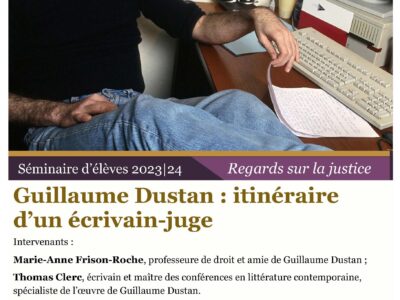
► Full Reference: M.-A. Frison-Roche, "Discussion" ("Discussion"), in E. Renaud & L. Turcat (dir.), Regards sur la justice, 10ième séance, École normale supérieure (ENS), Paris, Salle Dussane, 45 rue d’Ulm, 75005 Paris, April 24, 2024 - 🧮See the full programme of this event - ► Presentation of the conférence:  - 🌐follow Marie-Anne Frison-Roche on LinkedIn 🌐follow Marie-Anne Frison-Roche on Instagram 🌐subscribe to the Newsletter MAFR Regulation, Compliance, Law

Conferences

🎤Favoriser ou pas la « contractualisation » du Droit (“To favour or not the “contractualisation” of the Law”), in 🧮La contractualisation du droit. Acte II

🌐follow Marie-Anne Frison-Roche on LinkedIn 🌐subscribe to the Newsletter MAFR Regulation, Compliance, Law  - ► Full Reference: M.-A. Frison-Roche, "Favoriser ou pas la « contractualisation » du Droit" ("To favour or not the "contractualisation" of the Law"), final speech in Société de législation comparée (SLC) and Procuradoria Geral do Estado do Rio de Janeiro (PGE-RJ), La contractualisation du droit. Acte II, Paris, 21 June 2023. - 🧮See the full programme of this event (in French). The conference is held in French -

Conferences

🎤 Conclusion in 📅Compliance Monumental Goals: radioscopy of a notion “(“Rapport de synthèse in “Les buts monumentaux: radioscopie d’une notion” “)

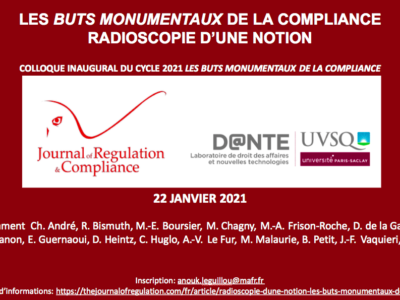
Full reference: Frison-Roche, M.-A., Rapport de synthèse (Conclusion) in André C., Frison-Roche, M.-A., Malaurie, M. and Petit, B., Les Buts monumentaux de la Compliance (Compliance Monumental Goals), Colloquium co-organised by the Journal of Regulation & Compliance (JoRC) and the Laboratoire Dante of Paris-Saclay University, -     📅  September 16, 2021. 🧭 Maison du Barreau, 12 place Dauphine 75004 Paris - ► Conclusions' Summary: Based on the multiple contributions of the day, the first part of this synthesis focuses on the practical interest of having Monumental Goals attached to compliance techniques.Conceptually defining these Monumental Goals as normative legal rules of Compliance Law has the first practical advantage of making clear this scattered and almost incomprehensible material, allowing us to better understand it.  The second practical advantage is to bring together the various branches of law in that they all contain compliance mechanisms, the points of contact thus discerned leading to a unification of technical legal rules.  The third practical advantage is to provide the various sources of law concerned with a means of applying and interpreting the law. The fourth practical advantage is to give meaning to all these technical provisions. In the second part of this synthesis, it appeared that these practical considerations therefore justify undertaking the "conceptual adventure". This one can take three pillars, in this "cathedral" that Dominique de la Garanderie designed, this "monument" corresponding well to the adjective Monumental which is better suited to these Goals than does the adjective "Fundamental", because it is a question of building, of building for a future which is not fatal. The first conceptual pillar consists in conceptualizing the Monumental Goals so that the Compliance Law finding a substantial meaning thus gives in a normative way a meaning to all the technical provisions which serve it in an instrumental way. The second conceptual pillar consists of giving everyone their place, that of public authority, that of the company and that of the population, each concerned and each not having to take the place of the other in the determination of the monumental goals, the company being in particular free in the design of the means while the political authority being in charge of drawing the Goals, the company being able to copy them on its own account. This conception does not depend on legal systems but on goals and legitimacy, in particular on the definition chosen for what is a company. The third conceptual pillar derives precisely from the humanist conception that one can claim to have of the Compliance Monumental Goal, risk management being only a means to achieve it. Humanism effectively carried by Compliance, taken on their own account by the companies alone capable of making them concrete, is what makes it possible to distinguish texts that are nevertheless technically similar, depending on whether they apply in  Rule of Law systems or in systems which are note governed by the Rule of Law Principle. This is why the technical future of Compliance Law lies in this conceptual adventure that it is necessary to lead. -   📝 read the program of this colloquium  🎥 see Marie-Anne Frison-Roche's conclusion in video (in French, with English subtitles) ✏️ read the notes translated in English on which this conclusion is based  - 📅 This colloquium is part of the Cycle of colloquium 2021 organized by the Journal of Regulation & Compliance (JoRC) and its partners around Compliance Monumental Goals.   📘 This manifestation is in French but the interventions will be part of an English collective book directed by Marie-Anne Frison-Roche, Compliance Monumental Goals, co-edited by the JoRC and Bruylant. 📕 An equivalent book in French, Les Buts Monumentaux de la Compliance, directed by Marie-Anne Frison-Roche, will be co-published by the JoRC and Dalloz. 

Conferences

🎤 The judge-judged / Articulate words and things face to the stressful conflict of interests, in “The Firm established as Prosecutor and Judge of itself by Compliance Law

Full reference: Frison-Roche, M.-A., The judge-judged: Articulate words and things face to the difficult conflicts of interest, in L'entreprise instituée Procureur et Juge d'elle-même par le Droit de la Compliance, colloquium co-organized by the Journal of Regulation & Compliance (JoRC) and Lyon 3 Law School, 23rd of June 2021. -   This conference was in French ; the Working Paper on which this conference was based is in French and in English: The judge-judged: Articulate words and things face to the stressful conflicts of interest  📅  June 23, 2021, 9h30 – 18h30  🧭 Lyon,  Lyon 3 Law School, "Salle de la Rotonde" and online -   📊 Read the slides on which this conference is based (in French) 🎥 See the video of this conference.    📝 Read the general program of this colloquium (in French) 📝 Read the working paper on which this conference is based  (in English) - 📅 This colloquium is part of the cycle of colloquia in 2021 organized by the Journal of Regulation & Compliance (JoRC) and its partners about Compliance Juridictionnalization.  📕 📘 The conference is the first basis for the writing of an article, forthcoming in a book whose the French version is La juridictionnalisation de la Compliance,  co-published by the Journal of Regulation & Compliance (JoRC and Dalloz, and whose the English version Compliance Juridictionnalisation, is co-published by the Journal of Regulation & Compliance (JoRC) and Bruylant.     The book in French will be published in the collection "Régulation & Compliance " while the book in English will be published in the same collection "Compliance & Regulation".  - 🔻 Summary of the conference: read below.

Conferences

🎤 Note taken during the colloquium “Compliance and Arbitration” for doing its conclusion: a backing (Conclusion, in “Compliance and Arbitration))

Full reference: Frison-Roche, M.-A., Compliance et arbitrage. Rapport de synthèse: un adossement (Compliance and Arbitration: a Backing. Conclusion), in Frison-Roche, M.-A. & Racine, J.-B., Compliance et Arbitrage (Compliance and Arbitration), Colloquium co-organised by the Journal of Regulation & Compliance (JoRC) and the Centre de recherches sur la Justice et le Règlement des Conflits (CRJ) of Panthéon-Assas University (Paris II), with the support avec the International Court of Arbitration, Paris, 31st of March 2021 -   Read the program of this colloquium See Marie-Anne Frison-Roche's conclusion in video (in French, with English subtitles) These notes of the conclusion have been written as the colloquium took place.  See the video of the entire colloquium (in French, with English subtitles) - This colloquium is part of the Cycle of colloquium 2021 organized by the Journal of Regulation & Compliance (JoRC) and its partners around the topic Compliance Juridictionnalization.   This manifestation is in French but the interventions will be the basis for a specific chapter of the English collective book directed by Marie-Anne Frison-Roche, Compliance Juridictionnalization, co-published by the JoRC and Bruylant. An equivalent book in French, La Juridictionnalisation de la Compliance, directed by Marie-Anne Frison-Roche, will be co-published by the JoRC and Dalloz.    Read the notes established for the conclusion below ⤵️