Justice and procedure

Articles in a legal collective publication

📝Compliance, the new legal way for human values: towards an Ex Ante Responsibility, in 📗Evolução do Direito no século XXI. Seus princípios e valores: ESG, Liberdade, Regulação, Igualdade e Segurança Jurídica. Homenagem ao Professor Arnoldo Wald, vol. 2, Direito Privado

► Full Reference: M.-A. Frison-Roche, "Compliance, the new legal way for human values: towards an Ex Ante Responsibility", in Evolução do Direito no século XXI. Seus princípios e valores: ESG, Liberdade, Regulação, Igualdade e Segurança Jurídica. Homenagem ao Professor Arnoldo Wald, vol. 2, Direito Privado, São Paulo, Editora IASP, 2022, pp. 977-983 - ► Summary of the article:  For the first time, the future is the first question for the Humanity. The classical legal conception of Tort Law concerns the Past, the philosophical conception of Hans Jonas, a Responsability for the Future, an Ex-Ante Responsability must become a legal notion.  Traditionally, the Legislator takes decision for the Future and the Judges takes ones for the Past, but now in front of the possible disparition of human beings on this planet, global and catastrophic perspective, all legal perspectives need to be used, breaking the classical repartition, in the priority of the future.  To do something, the Responsability must be put on everyone in a legal force, not only on the classical subject of Law and because of past behaviors, but because the operators, States, firms, or individuals, are "in position" to do so.  This new "Ex-Ante Responsability" is an essential part of the Compliance Law, very new branche of Law, with an extraterritorial effect, to find immediate and active solutions for the future. Because the issue is global, international Arbitration is in position to apply the conception, because international arbitrators are the global judges. This new conception of legal Ex-Ante Responsability, declared by courts, expressed human values, such as the concerns for the others, in concordance withe the humanist tradition of European and American Law, Compliance being not at all to obey regulations but to concretise an alliance a Monumental Goal, here for the preservation of human beings in the future, and the powers and the legal duties of corporate and people to do so.  - 📝read the article - 🌐follow Marie-Anne Frison-Roche on LinkedIn 🌐follow Marie-Anne Frison-Roche on Instagram 🌐subscribe to the Newsletter MAFR Regulation, Compliance, Law

Conferences

🎥 Regulatory Law and Compliance, expression of the Professional Order missions, in🧮Une profession face aux défis de la société

  ► Full Reference: Frison-Roche, M.A., Régulation et Compliance, expression des missions d'un Ordre, in📅 Ordre des Géomètres-experts, Une profession face aux défis de la société, Le Havre, September 15, 2022.  - 📅 read the general of the manifestation de la manifestation (in French) - 🎥watch the one-minute video summarizing the twenty-minutes intervention (in French) - 🚧 read English Presentation of the Working Paper which has been the basis of this conference   ► English Summary of this intervention: Professional orders should not present themselves as exceptions, however legitimate they may be, in relation to a principle, which would be the competitive system, but as the expression of a principle. This principle is expressed by two branches of Law whose importance is constantly growing in European Law, liberal branches which are based on the conception of economic life and the definition of company, turned towards the future: the Regulatory Law and Compliance Law, two branches of Law both related and distinct. Indeed, and this is the topic of the first part, Competition Law conceives professional orders as exceptions since these "corporations" constitute structural agreements. French domestic legal system both consolidates the professional orders by backing them up to the State, which would sub-delegate its powers to them, but involves them in the questioning by the European Union of the States and their tools. Most often the temptation is then to recall with a kind of nostalgia the times when the professional orders were the principle but, except to ask for a restoration, the time would be no more. A more dynamic approach is possible, in accordance with the more general evolution of Economic Law. Indeed, the Professional Order is the expression of a profession, a little-exploited concept in Economic Law, over which the Order exercises the function of "Second-level Regulator", the public authorities exercising the function of "First-level Regulator". The Banking and Financial Regulatory Law is built in this way and operates thank to that, at national, European, and global level. This is what should be linked. The Professional Orders therefore have the primary function of spreading a "Culture of Compliance" among the professionals they supervise and beyond them (clients and stakeholders). This culture of Compliance is developed regarding the missions which are concretized by the professionals themselves. Therefore, the second part of the Working Paper deals with the legal evolution of the notion of "Mission" which has become central in Economic and General Law, through the technique of the mission-based company. However, there are multiple points of contact between the raison d'être, the company with a mission and Compliance Law as soon as the latter is defined by the concrete and overly ambitious goals that it pursues. : the Monumental Goals. Each structure, for example the French Ordre des Géomètres-Experts, is legitimate to set the Monumental Goal that it pursues and that it inculcates, in particular the conception of territory and the living environment, joining what unites all the Monumental Goals of Compliance: concern for others. The French Ordre des Géomètres-Experts, is adequate because it has a more flexible relationship, both tighter and broader, with the territory than the State itself. By instilling this in professionals, the Professional Order develops in the practitioner an "ex ante responsibility", which is a pillar of Compliance Law, constituting both a charge and a power that the practitioner exercises, and of which the Professional Order must be the supervisor. - ► to go further ⤵️  Frison-Roche, M.-A., Compliance Monumental Goals, 2021 Frison-Roche, M.-A., 💻Appliquer la notion de "Raison d'être" à la profession du Notariat, 2021 -
Couverture – Les Buts Monumentaux de la Compliance

Books

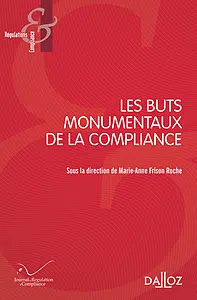
Collection Régulations & Compliance Les Buts Monumentaux de la Compliance

🌐follow Marie-Anne Frison-Roche on LinkedIn 🌐subscribe to the Newsletter MAFR Regulation, Compliance, Law  - ► Full Reference: M.-A. Frison-Roche (ed.), Les Buts Monumentaux de la Compliance (Compliance Monumental Goals), coll. “Régulations & Compliance“, Journal of Regulation & Compliance (JoRC) and Dalloz, 2022, 520 p. - In parallel, the English version of this book, Compliance Monumental Goals, is published in the collection co-published by the Journal of Regulation & Compliance (JoRC) and Bruylant. - 📅This book comes after a cycle of colloquia 2021 organised by the Journal of Regulation & Compliance (JoRC)and its Universities partners. - This volume is one of the books dedicated to Compliance in the collection Régulations & Compliance: read the presentations of the other titles of this collection. - ► General presentation of the book: Seize Compliance by its mind: its Monumental Goals. The notion of “monumental goals” of Compliance was proposed in 2016 by Marie-Anne Frison-Roche1🕴️M.-A. Frison-Roche, 📝Le Droit de la compliance, 2016. . It has become explicit in the texts and the resolution of cases, for example to fight against climate change, make human beings effectively equal, force to be extraterritorially vigilant about suppliers. Compliance Monumental Goals are targeted ex ante by regulations, contracts, CSR, and international treaties. Creating an alliance between business and political authorities, aiming for a new form of sovereignty. The presence in litigation of these Monumental Goals of global dimension renews the responsibilities and the Judge office. Describing and conceiving these Monumental Goals makes it possible to anticipate Compliance Law, which is more powerful every day. - 🏗️General construction of the book: The book opens with a double Introduction, the first summarizing the book (in free access) ​and the second, more substantial, proposing the Monumental Goals as definition of Compliance Law putting them at its “beating heart”, giving this new branch of law its originality and specificity, explaining what, in the History of the United States and Europe, gave birth to this singular corpus and justifies a substantial definition of Compliance Law. The concept of Monumental Goals is explained, justifying both systemic and political nature of Compliance Law, the practical consequences of which legal specific rules are thus better identified and limited, since Compliance Law does not lead to all-obedience. We can then determine what we can expect from this Law of the Future that is Compliance Law. From there, the book unfolds in 5 titles. A first Title is devoted to the “radioscopy” of this notion, in itself and branch of Law by branch of Law. A second Title aims to measure how the Monumental Goals are questioned by a crisis, for example in a health situation, but not in that example, if they aggravate it and must be discarded, or if, on the contrary, they are exactly conceived for this hypothesis. of crisis, risks, catastrophes and that it is advisable to exploit them, in order, in this “test”, to benefit from the alliance between the political authorities, public powers and crucial operators. Once made explicit and tested, the Monumental Goals must find a sure way to be considered. Therefore, a third Title aims to measure in principle and in practice how the Proportionality method can help the integration of Compliance, thus giving a new dimension to the Law without dragging it into insecurity and illegitimate grabbing of powers. But because Compliance Monumental Goals express a very great ambition, the question of a bearable, even beneficial relationship with the international competitiveness of companies, standards and systems must be opened. This is the object of the fourth Title. Finally, because the Monumental Goals express by nature a new ambition of the Law in a world which must not give up in what could be the prospect of its abyss, the fifth Title has for object the relationship between the Monumental Goals of Compliance and Sovereignty. - ► Understand the book through the Table of Contents and the summaries of each article:   DOUBLE INTRODUCTION 🕴️M.-A. Frison-Roche, 📝Résumé de l’ouvrage Les buts monumentaux du droit de la compliance (free access : click here to read this article (in French)) 🕴️M.-A. Frison-Roche, 📝Les Buts Monumentaux, cœur battant du Droit de la Compliance I. LA NOTION DE BUTS MONUMENTAUX DE LA COMPLIANCE (“THE IDEA OF COMPLIANCE MONUMENTAL GOALS”)  🕴️R.-O. Maistre, 📝Quels buts fondamentaux pour le régulateur dans un paysage audiovisuel et numérique en pleine mutation ? 🕴️A.V. Le Fur, 📝Intérêt et raison d’être de l’entreprise : quelle articulation avec les Buts Monumentaux de la Compliance ? 🕴️A. Le Goff, 📝La part des banques dans la concrétisation des Buts Monumentaux de la Compliance 🕴️J.-F. Vaquieri,📝Les “Buts Monumentaux” perçus par l’entreprise. L’exemple d’Enedis 🕴️M. Malaurie-Vignal, 📝Les Buts Monumentaux du droit du marché. Réflexion sur la méthode 🕴️D. de La Garanderie, 📝Sur les Buts Monumentaux de la Compliance sociale  🕴️C. Peicuti & 🕴️J. Beyssade, 📝La féminisation des postes à responsabilité dans les entreprises comme But de la Compliance. Exemple du secteur bancaire 🕴️I. Gavanon, 📝Le droit des données personnelles dans l’économie numérique à l’épreuve des Buts Monumentaux 🕴️B. Petit, 📝Les Buts Monumentaux du droit (européen) des relations de travail : un système mouvant aux équilibres à consolider 🕴️G. Beaussonie, 📝Droit pénal et Compliance font-ils système ? 🕴️Ch. Huglo, 📝À quelles conditions le Droit climatique pourrait-il constituer un But Monumental prioritaire ? II. MISE EN OEUVRE DES BUTS MONUMENTAUX DE LA COMPLIANCE EN ARTICULATION DU PRINCIPE MAJEUR DE LA PROPORTIONNALITÉ (“IMPLEMENTATION OF COMPLIANCE MONUMENTAL GOALS IN ARTICULATION OF THE MAJOR PRINCIPLE OF PROPORTIONALITY”)  🕴️L. Rapp, 📝Conformité, proportionnalité et normativité 🕴️B. Bär-Bouyssière, 📝Les obstacles pratiques à la place effective de la proportionnalité dans la Compliance 🕴️A. Mendoza-Caminade, 📝Compliance, proportionnalité et évaluation 🕴️L. Meziani, 📝Proportionnalité en Compliance, garant de l’ordre public en entreprise 🕴️M. Segonds, 📝Compliance, proportionnalité et sanction  🕴️M.-A. Frison-Roche, 📝Définition du principe de proportionnalité et définition du Droit de la Compliance III. LES BUTS MONUMENTAUX DE LA COMPLIANCE ÉPROUVÉS PAR LES SITUATIONS DE CRISES (“THE COMPLIANCE MONUMENTAL GOALS TESTED BY CRISIS SITUATIONS”) 🕴️A. Oumedjkane, A. Tehrani et P. Idoux, 📝Normes publiques et Compliance en temps de crise : les Buts Monumentaux à l’épreuve. Éléments pour une problématique 🕴️J. Bonnet, 📝La crise, occasion de saisir la Compliance comme mode de communication des autorités publiques 🕴️N. Sudres, 📝Gel hydroalcoolique, Covid-19 et Compliance. Des insuffisances de la démarche de conformité à l’émergence d’îlots de Compliance 🕴️M.-A. Frison-Roche, 📝Place et rôle des entreprises dans la création et l’effectivité du Droit de la Compliance en cas de crise IV. EFFECTIVITÉ DES BUTS MONUMENTAUX DE LA COMPLIANCE ET COMPÉTITIVITÉ INTERNATIONALE (“EFFECTIVENESS OF COMPLIANCE MONUMENTAL GOALS AND INTERNATIONAL COMPETITIVENESS”)  🕴️B. Deffains, 📝L’enjeu économique de compétitivité internationale de la Compliance 🕴️J.-Ch. Roda, 📝Compliance, enquêtes internes et compétitivité internationale : quels risques pour les entreprises françaises (à la lumière du droit antitrust) ? 🕴️F. Marty, 📝L’apport des programmes de conformité à la compétitivité internationale : une perspective concurrentielle 🕴️S. Lochmann, 📝Les agences de notation ESG et l’effectivité de la Compliance face à la compétitivité internationale 🕴️M.-A. Frison-Roche, 📝Appréciation du lancement d’alerte et de l’obligation de vigilance au regard de la compétitivité internationale V. LA COMPLIANCE PORTÉE PAR LES BUTS MONUMENTAUX, NOUVELLE VOIE DE SOUVERAINETÉ (“COMPLIANCE SUPPORTED BY MONUMENTAL GOALS AND NEW WAY OF SOVEREIGNTY”)  🕴️R. Bismuth, 📝Compliance et souveraineté : relations ambigües 🕴️L. Benzoni, 📝Commerce international, compétitivité des entreprises et souveraineté : vers une économie politique de la Compliance 🕴️M.-A. Boursier, 📝Les Buts Monumentaux de la Compliance : mode d’expression des États 🕴️S. Pottier, 📝Pour une Compliance européenne, vecteur d’affirmation économique et politique 🕴️Ch. André, 📝Souveraineté étatique, souveraineté populaire : quel contrat social pour la Compliance ? 🕴️M.-A. Frison-Roche, 📝Le principe de proximité systémique active, corollaire du renouvellement du principe de souveraineté par le Droit de la Compliance -

Working papers

🚧The judge, the obligation of compliance and the company. The probationary compliance system

🌐 follow Marie-Anne Frison-Roche on LinkedIn 🌐 subscribe to the Newsletter MAFR Regulation, Compliance, Law  - ► Full Reference: M.-A. Frison-Roche, The judge, the obligation of compliance and the company. The probationary compliance system, Working Paper, August 2022. - 📝this Working paper had been made for an article:  📕 published in its French version ("Le juge, l'obligation de compliance et l'entreprise. Le système probatoire de la compliance") in the book La juridictionnalisation de la Compliance, in the series 📚Régulations & Compliance  published in tis English version in the book Compliance Jurisdictionalisation, in the series 📚Compliance & Regulation - ► Summary of this Working Paper: To articulate the probationary system of compliance, it should first be admitted that Evidence is a general system, built on a "probationary square" functioning whatever the situation, and that it seems that Compliance Law rejects it, being incompatible with major probative principles, as soon as Compliance is defined as the obligation that companies would have to show (which is evidence) their respect for all the regulations applicable to them. But fortunately, Compliance does not have to receive this definition. Compliance Law consists of all the principles, institutions, rules, and decisions which, in an alliance between public authorities and crucial companies, tend in a substantial way to the achievement of Monumental Goals. A branch of Ex Ante Law that protects systems and the human beings involved in them, Compliance Law aims to detect and prevent so that in the future systems will be less harmful than they would be if we do nothing, even will be better. From this required action of companies, which requires the establishment of structures and series of behaviors, a specific probationary system emerges. It is composed firstly of specific proof objects, constituted on the one hand by the structures and on the other hand by the behaviors. Secondly, the specificity of compliance, often denounced, lies in the burden of proof, the burden of which rests on the company, but it is necessary to analyze the interference with the other branches of law, which compliance cannot have destroyed. . Thirdly, the scope of the probative issues is such that the means of proof have multiplied, according to the triptych of the effectiveness, efficiency and effectiveness expected of the compliance system itself regarding the Monumental Goals (and not the regulations). Fourthly, because Compliance Law is a branch of Ex Ante Law and the Judge is nevertheless at the center, it is logical that all efforts focus on the pre-constitution of evidence.   - 🔓read the developments below ⤵️
Working papers

🚧 Regulatory and Compliance Law, expression of the missions of a professional Order

🌐 follow Marie-Anne Frison-Roche on LinkedIn 🌐 subscribe to the Newsletter MAFR Regulation, Compliance, Law  - ► Full reference: M.-A. Frison-Roche, Regulatory and Compliance Law, expression of the missions of a professional Order, Working Paper, July 2022. - 🎤 This Working Paper has been done as basis for an intervention in the Annual Congress of the French Professional Order of the Géomètres-Experts, September 15, 2022 (conference given in French)  - 🎥watch the short presentation of this speech (in French)  - 🎥watch the full speech given on 15 September 2022, based on this working paper - ► Summary of the Working Paper: Professional orders should not present themselves as exceptions, however legitimate they may be, in relation to a principle, which would be the competitive system, but as the expression of a principle. This principle is expressed by two branches of Law whose importance is constantly growing in European Law, liberal branches which are based on the conception of economic life and the definition of company, turned towards the future: the Regulatory Law and Compliance Law, two branches of Law at the same time related and distinct. Indeed, and this is the topic of the first part, Competition Law conceives professional orders as exceptions since these "corporations" constitute structural agreements. French domestic legal system both consolidates the professional orders by backing them up to the State, which would sub-delegate its powers to them, but involves them in the questioning by the European Union of the States and their tools. Most often the temptation is then to recall with a kind of nostalgia the times when the professional orders were the principle but, except to ask for a restoration, the time would be no more. A more dynamic approach is possible, in accordance with the more general evolution of Economic Law. Indeed, the Professional Order is the expression of a profession, a little-exploited concept in Economic Law, over which the Order exercises the function of "Second-level Regulator", the public authorities exercising the function of "First-level Regulator". The Banking and Financial Regulatory Law is built in this way and operates thank to that, at national, European, and global level. This is what should be linked. The Professional Orders therefore have the primary function of spreading a "Culture of Compliance" among the professionals they supervise and beyond them (clients and stakeholders). This culture of Compliance is developed regarding the missions which are concretized by the professionals themselves. Therefore, the second part of the Working Paper deals with the legal evolution of the notion of "Mission" which has become central in Economic and General Law, through the technique of the mission-based company. However, there are multiple points of contact between the raison d'être, the company with a mission and Compliance Law as soon as the latter is defined by the concrete and overly ambitious goals that it pursues. : the Monumental Goals. Each structure, for example the French Ordre des Géomètres-Experts, is legitimate to set the Monumental Goal that it pursues and that it inculcates, in particular the conception of territory and the living environment, joining what unites all the Monumental Goals of Compliance: concern for others. The French Ordre des Géomètres-Experts, is adequate because it has a more flexible relationship, both tighter and broader, with the territory than the State itself. By instilling this in professionals, the Professional Order develops in the practitioner an "ex ante responsibility", which is a pillar of Compliance Law, constituting both a charge and a power that the practitioner exercises, and of which the Professional Order must be the supervisor. - 🔓read the Working Paper⤵️

Conferences

🎥La place de l’Intelligence artificielle dans le respect de la Compliance dans l’entreprise : la juste mesure (“Compliance, Artificial Intelligence and Business Management: the right measure”), in M. Mekki (coord.), 🧮L’intelligence artificielle et la gestion des entreprises (“Artificial Intelligence and Business Management”)

🌐follow Marie-Anne Frison-Roche on LinkedIn 🌐subscribe to the  Newsletter MAFR Regulation, Compliance, Law - ► Full Reference: M.-A. Frison-Roche, "Compliance, Artificial Intelligence and Business Management: the right measure" ("Compliance, Intelligence artificielle et gestion des entreprises : la juste mesure"), participation to the Conference coordinated by Mustapha Mekki, L'intelligence artificielle et la gestion des entreprises. July 1st, 2022.  - 🎥 see the conference (in French) -  consult the slides having been used as brief notes for deliver the lecture (inf French) - 🚧read the bilingual Working Paper having been used as basis for this conference - 📝This work will be the basis for an article. - ► Summary of the Lecture: Of the next European Regulation on artificial intelligence, the European Commission has a quite neutral conception of AI for obtaining a consensus between the Member States, while the Regulators and certain States have a more substantial conception of technology, wanting its power to be used to protect people, firstly from these new tools themselves, secondly from what is an amplification of the evils of the classic world, such as hate or misinformation. This is the reflection of two conceptions of Compliance. Firstly, Compliance can be defined as neutral processes that increase the effectiveness of what would be the obligation for companies or their desire for efficient risk management (in particular the consideration of "legal risks") to prove being "conform" to all regulations that are applicable to itself and all persons to whom the firm is accountable. This is often referred to as the "compliance obligation" or "obligation of conformity". This conception implies considerable practical consequences for the company which, in order to succeed in this "total exploit", would then have to resort to artificial intelligence tools constituting a "total and infallible solution", which mechanically generate for it the obligation to "know " all the "regulatory mass", to detect all "non-compliances", to conceive its relationship to the Law in terms of "risk of non-compliance", fully supported by Compliance by Design which could, without human intervention , eliminate legal risk and ensure "compliance total efficiency" in Ex Ante. The "legal price" of this technological dream is extremely high because all the "regulatory" requirements will then be transformed into obligations of result, any failure generating liability. The Compliance probationary system will become overwhelming for the company, both in terms of burden of proof, means of proof, and transfers, without exemption from proof. Objective responsibilities for others will multiply. The "law of conformity" will multiply Ex Ante systemic penalties, the border with criminal law being less and less preserved. It is essential to avoid this, both for businesses and for the Rule of Law. For this, we must use Artificial Intelligence to its proper extent: it may constitute a "massive aid", without ever claiming to be a total and infallible solution, because it is the human who must be at the center of the compliance system functioning thank to the firms and not the machinery. For this, it is necessary to adopt a substantial conception of Compliance Law (and not a sort of Conformity Law or Obedience Law). It does not at all cover all the applicable regulations and it is not at all "neutral", being in no way a series of processes. This new branch of Law is substantially built on Monumental Goals. These are either of a negative nature (preventing a systemic crisis from happening, in many but specific perspectives: banking, financial, health, climate, etc.), or of a positive nature (building a better balance, in particular between human beings, in the company and beyond). In this conception which appears more and more strongly, artificial intelligence finds its place, more modest. As Compliance Law is based on information, Artificial Intelligence is essential to capture it and make first connections, first stages for successive analyses, done by human beings, making what is essential: the commitment of the company, both by the leaders and by all those who are "embarked" by a "culture of Compliance" which is at both built and common. This restores the required seal between Criminal Law and what can be asked of the mechanical use of Artificial Intelligence; this puts the obligation of means back as a principle. This restores the principal place to the lawyer and the compliance officer, so that the culture of compliance is articulated with the specificities of a sector and the identity of the company itself. Indeed, the culture of compliance being inseparable from a culture of values, Compliance by design requires a dual technique, both mathematical and legal culture. It is why European Compliance Law, because it is rooted in the European humanist tradition, is a model. - For further: Frison-Roche, M.-A. (ed.), Compliance Monumental Goals, 2022 Frison-Roche, M.-A. (ed.), Compliance Jurisdictionalisation, 2022 Frison-Roche, M.-A. (ed.), Compliance Tools, 2021 📓Frison-Roche, M.-A., L'apport du Droit de la Compliance à la Gouvernance d'Internet, 2019  Frison-Roche, M.-A. (ed.), Pour une Europe de la Compliance, 2019 Frison-Roche, M.-A. (ed.), Régulation, Supervision, Compliance, 2017  Frison-Roche, M.-A. (ed.), Internet, espace d'interrégulation, 2016 📝 Frison-Roche, M.-A., Compliance Monumental Goals, beating heart of Compliance law,  2022, 📝 Frison-Roche, M.-A., Role and Place of Companies in the Creation and Effectiveness of Compliance Law in Crisis, 2022 📝 Frison-Roche, M.-A., Assessment of Whistleblowing, and the duty of Vigilance, 2022 📝Frison-Roche, M.-A., Drawing up Risk Maps as an obligation and the paradox of he "compliance risks", 2021 -

Conferences

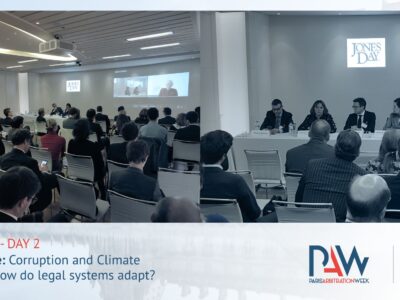
🎤The part of Compliance Law in the fight against Corruption and Climate Change, in

  ► Full reference: Frison-Roche, M.A., The part of Compliance Law in the fight against Corruption and Climate Change, in Paris Arbitration Week (PAW), Compliance: Corruption and Climate Change – how legal systems adapt?, Jones Day, March 29, 2022. Debate with Mathias Audit coordinated by Claire Pauly, Vice-President of the Paris Arbitration Week.  - ► Presentation of the intervention: After the presentation made by Mathias Audit of the consideration of facts of corruption, notably by the red flags method, in an arbitration trial, it seems a low-performing system of proof in compliance: the more diligent a party is in showing that it tried to meet its compliance obligations, the more it is exposed to demonstrating its own failure to doing so.  It seems a perversity … Therefore, I can understand why companies often so dislike Compliance Law because more they make efforts, more they put money and more they are punished… But this representation is not totally exact. My first observation is about the definitions themselves. It is particularly important to have a precise definition of “compliance obligations”, to not confuse them with obligations coming from Criminal Law. The confusion between Criminal Law and Compliance Law is frequent, maybe because what Compliance Law want to eradicate is also prohibited by Criminal Law, for instance corruption. Indeed, technically criminal legal rules and compliance legal rules have many points of contacts, but they are not the same: the obligations are different, the legal persons obliged are different, the reasoning are different the purposes are different. Because the general definition of Criminal Law and Compliance Law are different. Criminal Law, very old branch of Law, which prohibits and sanctions corruption, does it for everyone because the singular behavior is wrong (to corrupt; to be corrupted). Compliance Law is a very new branch of Law, is a systemic branch of economic Law, which wants to eradicate in the future mechanisms because they destroy economic systems, such as corruption does. Its wants that not to protect moral values but to protect economic systems. Therefore, Compliance Law asks some entities, large companies, to do something only because they are in position to do so: to detect and to prevent this corruption, in order to obtain in the future, the protection against this systemic risk threating the economic systems. The compliance legal tools are more in Ex Ante than in Ex Post: risk mapping, audit, code of conduct, training, obtention of information through the chains of suppliers. The proof to give is not the non-corruption everywhere from everyone but this concrete action of prevention and education, companies being entities helping public authorities in this global fight. More precisely, in this definition Compliance Law is not the general obligation to obey the regulations applicable (because this is simply the definition of Law itself, applicable to everybody). Compliance Law is a very new branch of Law which exists only for some systemic “global policies” (as the title of your manifestation says) applicable only on systemic entities (large companies) in a global perspective: for instance, fighting corruption, fighting money laundering, fighting climate change, fighting discrimination between human beings. In your example, for fighting corruption, specific legal obligations are taken, such as FCPA (with extraterritorial effects) or in French legal system the so-called the 2016 “Sapin 2” Law. These obligations don’t concern everybody: they concern entities in position to do so: large companies. My second remark is about the burden of proof. These compliance obligation or compliance duties are obligations of means. Companies are obliged to adopt Compliance plans, organize risk mapping, and so on. A lot of them organize them through code of compliance, or code of ethic, or code of corporate social responsibility, because Compliance Law is in an intimacy with Corporate Law. Because Compliance Law is a very concrete branch of law, these disposals are adopted at the level of the group and replicated in the contracts with suppliers. But he success of these compliance tools is only an obligation of means. For instance the supervisory authority does not require the company to have seen all the risks, in their existence or their exact quantification. In this sense, about money laundering, the French Financial Markets Authority said that the setup of these compliance tools must be “effective”, but after that the company must only do its “best efforts” to aim an “efficient” result (obligation de moyens). The French Regulatory Authority for the digital space says the same about the eradication of speeches of hate that Compliance Law oblige digital companies to fight (using the term of obligation de moyens). Moreover, about corruption, the Commission of sanction of the French Anticorruption Agency said in a decision of July 2019 that the firm is free to choose the technics to detect and to prevent the corruption (confirming that Compliance is not just following what the Regulator says), but offered a legal certainty:  if the company just follows what the Regulators had said in its guideline (rule based compliance behavior), it is no more possible to punish it. My third remarks could be a proposal for a more efficient system of proof. It is true that the burden of proof is on the company’s shoulders. But the object of proof is not the absence of corruption (it would not be possible…). The object of proof is the existence of due diligence to detect and prevent corruption. Companies must prepare that, must constitute these proofs by advance.  “Due diligence” is a legal concept frequently used in Compliance Law. Regulators, supervisors, and courts ask companies to show the reality of these diligences. It would not be sufficient to present the cost of Compliance… It will be sufficient to show the effectivity of Compliance programs freely adopted, taking in consideration the guidelines released by public authorities. Public authorities say they want to help companies to diffuse an effective “culture of compliance” : a dialogue with civil and corporate courts, not only with criminal courts would be efficient, for instance for the protection of human rights.    In a second part of this debate, on Climate change and Compliance, Claire Pauly asked the question: "My question is two-fold: do you consider that climate change issues should be treated in the same way as corruption issues? And do you think that arbitrators are well suited to tackle those issues, by upholding the method applied to determine and demonstrate corruption issues?". The response has been: Firstly, on the technical similarity between fighting Corruption and fighting Climate Change in Compliance Law, it is the same perspective effectively. If we come back to the definition of Compliance Law, the Compliance tools are organized to obtain in the future systemics results, such as no more corruption, no more money laundering, what we can name “Monumental goals”. This is a political decision: to design the future for excluding some systemic catastrophes. Corruption is an example of systemic risk; but climate change is another one. Fighting against Climate Change is a Monumental Goal, of the same nature than fighting Corruption. As everyone knows, we suffer of a lack of tools to address one of this fundamental challenge of our times which is climate change (more difficult than corruption…). But we are lucky to have some Compliance legal tools: we need to use them, because we have so few techniques about this Climate issue… And Compliance Law is the more adequate branch of Law because it is an Ex-Ante branch of Law : generally, its obligations are on the future, and the Climate change drama is in the future also. We can already see that Compliance Law is applicable to Climate Change issue It is easy to see it through the legal techniques.  In the French legal system, the Sapin 2 law invented in 2016 some new compliance techniques, such as risk mapping, audit, due diligence, to detect and prevent corruption. One year after, in 2017, the so-called Loi Vigilance took the same techniques, copying exactly the legal dispositions of Sapin 2 in this law to oblige large companies to detect and to prevent violation of human rights and environmental obligation, not only inside the corporate group but also through the supply chains. The manager will be accountable for that. On February 23, 2022, the European Commission adopted a proposal for a European Directive in the same direction of a “global policy” to impose a “corporate sustainability due diligence” on large companies, notably for fighting climate change. This new text will be effective in two years in the Internal legal systems. By a rules-based analysis and a principle-based analysis, we can see this is the same reasoning. Of course, this “corporate sustainability due diligence” is only an obligation of means. But it is extremely ambitious, linked to the direct consideration of the Corporate Social Responsibility. And I guess it will be efficient because all these tools are not only Ex Post but also Ex Ante: when the issue is to exclude the catastrophic perspective of the disappearance of the humankind on our planet, having Compliance Law, this Ex-Ante branch of law, is so precious!   Secondly, about the role of Arbitration in this issue, I am tempted to say: everyone is required in this global crucial policy! It is quite difficult for a national court to decide on this sort of issue because Climate change is a global issue, while arbitrators are global judges. Technically it is necessary and technically possible that Arbitration takes its place, because these due diligences about detection, prevention, action for a better Climate balance are organized non only in corporate mechanisms, such as code of conduct, corporate commitments, or manager remuneration calculation, but also a lot of contractual dispositions. We will see a lot of new legal techniques: a lot of international public global policies will be adopted. The obligation to give information about that not only to investor but also to stakeholders will be adopted worldwide. The technique of “compliance by design” will be used on the corporate policy of fighting against Climate change. Meanwhile, the classical branch of law, were Compliance Law steps in, will remain active, such as International Law, Corporate Law, Tort Law Contract Law, where Arbitration is so central. So, in short, your question was: are Arbitrators able to deal with climate change issue? my response is: “oh, yes!” - ► Read the repport made by the  fait par la Paris Week of Arbitration ( on the distinction between Compliance Law and Criminal Law, and their articulation) -   Pour aller plus loin⤵️ Frison-Roche, M.-A. (ed), Compliance Monumental Goals, 2022. Frison-Roche, M.-A. (ed), Compliance Jurisdictionalisation, 2022. -  

Analyses

💬 “Faire du Droit pour qu’à l’avenir le monde soit moins injuste” – à propos du projet de directive européenne sur le devoir de vigilance. (“Making Compliance Law for a world less unfair in the future” – about the draft European directive on the corporate sustainability due diligence)

► Full Reference: Frison-Roche, M.A.,, "Faire du Droit pour qu'à l'avenir le monde soit moins injuste" – à propos du projet de directive européenne sur le devoir de vigilance ("Making Compliance Law for a world less unfair in the future" – about the draft European directive on the corporate sustainability due diligence), interview with Olivia Dufour, Actu-Juridique,  March 24, 2022.  - 💬 read the interview (in French)  - ► Interview English Summary: This interview comments on the draft directive presented by the European Commission aimed at unifying European Union Law about Corporate Sustainability Due diligence in global supply chains to protect environnement and human rights effectively, putting companies under same legal rules. including non-European companies. The interview emphasizes that this text and reinforces Compliance Law perspective in that the legal instruments are Ex Ante, aim at the functioning of groups, constitute incentives, and seek effectiveness to prevent violations of human rights and the environment, 80% of which taking place outside the European Union. The goal is both ethical, for example to fight against child labor and the endangerment of people, and systemic: the promoting of a sustainable economy, through the help of companies which have some power in value chains which are global.  This future directive clearly shows the difference between simple "conformity" (just obeying all applicable regulations…) and "compliance", illustrated here: aiming to achieve "monumental goals", here fighting against attacks on the climate balance and protect people, to obtain in the future these damages do not occur or are reduced.  -   

Working papers

🚧 Conceiving Power

► Full reference: M.-A. Frison-Roche, Conceiving Power, Working Paper, December 2021 - 📝 This Working Paper serves as the basis for an article to be published in the collective book drawn up in tribute to Professor Emmanuel Gaillard.    - ► Working Paper summary: In 1985, Emmanuel Gaillard's central work came out under the title Le pouvoir en droit privé  (The Power in Private Law)📎1Gaillard, E., Le pouvoir en droit privé, préf. Cornu. G., coll. ..., Economica, 1985., but when it was defended in 1981, his thesis directed by Dean Cornu was entitled La notion de pouvoir en droit privé (The notion of Power in Private Law) 📎2Gaillard, E., La notion de pouvoir en droit privé, thèse .... ; . Let's give full force to the original title of the thesis.   The deletion of the term notion perhaps implies that by defining something the essential is done, that there would be something of a pleonasm in aiming at The notion of Power and The Power, as Law likes to economise on words.   But it was indeed a renewed, simpler and more powerful conception of the notion of Power, containing the entire regime necessarily imputed, that this work imposed, henceforth illuminating positive Law. Emmanuel Gaillard's definition, on the other hand, goes beyond Private Law. We would gladly have argued in favour of retaining the heading for the term Notion, proposing instead to dispense with the reference to Private Law alone …. Perhaps it was because the concept is so vast that in this seminal thesis its scope was restricted to Private Law, since the author already had to account for the sheer multiplicity of manifestations in this part of the legal system; Or perhaps it was because the concept of 'Power' is so familiar in Public Law that it would have needed less definition in Public Law (which, moreover, is so diversely proposed in this more political area, which is already careful on principle to distinguish between powers, which must always be plural in order to be separated), and that it was therefore reasonable to want to arrive at a single concept of Power in Private Law, where the notion of subjective rights is more familiar.  However, Emmanuel Gaillard's definition of Power as a prerogative placed, by legal rule or contract, in the hands of the person invested with them for the benefit, at least in part, of others, covers both Public and Private Law. This even contributes to the solidity of this thesis and explains why it flourishes today in legal systems where the distinction between Private Law and Public Law is weakening. The power of this definition lies in its simplicity. Simple and brave minds are often the most fruitful. As Dean Gérard Cornu points out in his preface, the author, in particular because he bases himself more on positive law, for example that relating to the powers of corporate officers, does not get bogged down in discussions between authors only to end up preferring one over the other. He arrives at a definition that is close to our everyday experience: the one we experience when we collect an envelope on behalf of someone else and the agent asks us in what capacity we claim to be doing this on his behalf. We then show him our 'power', the legal power to do so for the benefit of the person to whom the letter is addressed, and can thus exercise the power to withdraw the letter, even though it is personal. When legal and common sense come together, it is a good omen, not only in terms of form, because everyone can understand it and the Law must remain comprehensible, but also in terms of substance, because everyone must be able to control the exercise of a power that is exercised for and over others. For this letter addressed to someone else, the person who has been able to take it by virtue of the power conferred on him/her, could just as easily open it and read it, then destroy it or give it to the worst enemy of the person to whom it was addressed. In Power, there is always might to do, and the danger to others that Power contains therefore.  This highly legal definition of Power not only distances the holder from his/her own interests, but also channels the Power thus granted to the person who benefits from it. In this respect, Emmanuel Gaillard not only distinguished between Power and subjective right, but also identified the right amount of power required for this power to effectively fulfill this 'Mission', through the notion of abuse of power, when the holder uses for other beneficiaries this power that was conferred on him/her for this sole purpose. What is more, this concept makes it possible to distinguish Power from discretionary force, because the holder of Power thereby exercises factual , by acting for others, deciding for others, deciding on others. Because Power is inseparable from might, but might must remain the means of power and no more, the Law shall produce the antibodies that are not only the theory of abuse of power but also an Ex Ante responsibility that accounts must always be rendered, either to the other for whom everything is done or to a third party. For this third party is often there from the outset, the guardianship judge for example: because the Power was put in place because of the beneficiary's weakness, both in himself/herself and because of the situation, an impartial and disinterested third party is needed to ensure proper execution from the outset, without there even being a dispute. In this respect, how useful this thesis is for thinking about what Supervision is today!   This thesis, so clear, so simple and so strong, goes beyond Private or Civil Law. It is both much more restrictive than the more factual and political definition of Oower, which would be the ability to do something, and much broader than the usual definitions, since it embraces and legitimises de jure all situations where a person acts legally for the benefit of another.  Dean Cornu shows, moreover, in two sentences that such a notion of power also captures the office of the judge, who has power over others only to serve them 📎3"En droit processuel, l'office du juge aurait donné à l'auteur un renfort. Pour le juge, il n'est point de pouvoir sans devoir. Au-delà de la distinction de ce qu'il a obligation de faire ou faculté d'apprécier, il y a toujours, au creux de ce qu'il peut, le sceau de ce qu'il doit, un devoir gardien - comme un âme - de l'exercice du pouvoir." (p.5).. The definition corresponds to the mission of one who has power only to fulfill his office. It suits so well the conception we have today of Administration, especially if it takes the form of independent authorities. Moreover, Power thus contains its own limit in its very definition, since others are present in it: the holder has power only to serve others. From then on, it is only a power because it is a kind of Charge. Emmanuel Gaillard immediately uses the term: "Un individu se voit confier une charge qu'il exerce dans un intérêt au moins partiellement distinct du sien propre"  ("An individual is entrusted with an office which he exercises in an interest at least partially distinct from his own") 📎4n°3, p.9. . Dean Carbonnier, who reformed the legislation in this area 📎5🕴️J. Carbonnier, 📗Essai sur les lois, 1992 (on the guardianship).,, emphasised that the guardian has a public duty because the State entrusts him/her with a child. In the same way parental authority is a charge on the parents for the benefit of the children. More generally, Power is a burden that the Law places on a person to satisfy the interests of another. This definition offered by Emmanuel Gaillard in 1981, anchored in Private Law only insofar as it is the entire legal system, is premonitory of the Regulatory and Compliance Law as it unfolds today. It would be enough to continue the Gaillard's sentences, as if they had been half-written, to finish them 40 years later and find in them the mechanisms of Supervision of companies by public authorities which are now in place not to reduce their power but to ensure that they exercise it for the benefit of others 📎6S. in a general way, 🕴️M.-A. Frison-Roche (ed.), 📕Régulation, Supervision, Compliance, 2017.. The whole evolution of Company Law and Financial Law is here. Between the lines of this thesis, which develops the notion of duty 📎7Cornu, préface précitée : "Tous les pouvoirs sont, à double face, des pouvoirs-devoirs" (p.5)., we can also see what positive Law is developing today, in particular through the 'duty of Vigilance', this personal responsibility for the benefit of others (I). The definition of Power thus conceived contains within itself its regime and enables us to anticipate it better today: because the holder exercises Power only for others, at least partially, he is consubstantially accountable for it, responsibility being only one form of this accountability; because this service must be effective and others must benefit fully from it, because unlike the subjective right which allows the holder freely not to use his might, Power has never been the 'most absolute' availability to use his/her might: it is even the opposite. It is the expression of a Power assigned to a purpose, compelling the holder to use his/her Power to that end.  But it is equally necessary for the holder to have all the might to do so, otherwise the very notion of 'Power' is meaningless. This is the definition that should be given to the principle of Proportionality: the person on whom the Power rests must have not more power than is necessary, but all the power necessary to achieve the Monumental Goals for which the Power has been entrusted to him/her, so that others may derive full benefit from it (II).  In today's positive Law, the definition of Power as a Duty is found not only in Private Law but also in Public Law, not least because pure might, i.e. those that do not account for the use of their might, are in decline while concern for others is on the increase. The days of discretionary powers are over, and the increased independence of those who exercise Power over others requires them to be accountable. Beyond this Accountability, the personal Responsibility of those who have the Power to serve others is being established. But, no doubt because the Law is slow to evolve, the correlative idea that the holder of Power must have all the powers required to carry out his/her mission is less entrenched:  As Emmanuel Gaillard has shown, the Law has only gone part of the way in sanctioning excesses of power, when the holder uses his/her power for other goals, but it has not yet clearly established that the holder – sometimes forced – of a Power is legitimate in using all the means required to achieve the result for which this Power, i.e. a charge and a duty, has been conferred on him/her.   No doubt we need to read Emmanuel Gaillard's thesis again in all its potential, to imagine the reading we could do today of what he could have written as if on blank pages that would write themselves, a magical thesis where everything is already there, a thesis so short (250 pages) and so beautiful, so dense that it already contains the Law of the Future. The Law of the Future 📎8On Compliance Law as a Law of the Future, s. 🕴️M.-A. Frison-Roche, 📝Compliance Monumental Goals, beating heart of Compliance Law, in 🕴️M.-A. Frison-Roche (ed.), 📘Compliance Monumental Goals, 2023. On the consequences for Liability Law, which is now looking to the Future, s. 🕴️M.-A. Frison-Roche, 🚧Ex Ante Responsibility, 2021.  where there must be much more responsibility for the benefit of others📎9Sur la notion de "Responsabilité Ex Ante", v. Frison-Roche, M.-A., La responsabilité Ex Ante", in Archives de Philosophie du Droit, La responsabilité, 2022. and powers since this notion includes others who are the beneficiaries. Droit de l'Avenir where Emmanuel Gaillard will be present, in particular thanks to this work of doctrine offered in 1981.  So that, in practical terms, those who are entrusted with looking after others – for example, today all companies obliged by Compliance Law to look after others so that they are not destroyed by hatred in the digital space, by corruption in the economic system or by climate change in a projected future – do not find themselves challenged by the same Law for the means of exercising this power for the benefit of others, for example when this involves 'judging'. Dean Cornu himself emphasised the identity of the two offices. -                         Lire les développement ci-dessous⤵ - 🌐 follow Marie-Anne Frison-Roche on LinkedIn 🌐follow Marie-Anne Frison-Roche on Instagram 🌐subscribe to the Newsletter MAFR Regulation, Compliance, Law