General Law and Civil Law

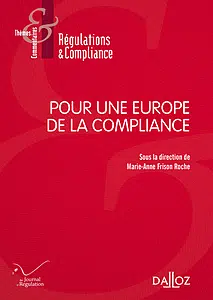
Couverture – Pour une Europe de la Compliance

Publication director

🏗️ copublishing and direction of the collection: 📚Régulations & Compliance

Collection Régulations & Compliance Publication of🕴️M.-A. Frison-Roche (ed.), Collection Régulations & Compliance Pour une Europe de la Compliance (For the Europe of the Compliance), 2019

🌐 follow Marie-Anne Frison-Roche on LinkedIn 🌐 subscribe to the Newsletter MAFR Regulation, Compliance, Law - ► Full Reference: M.-A. Frison-Roche (ed.), Pour une Europe de la Compliance (For the Europe of the Compliance), series “Régulations & Compliance“, Dalloz, 2019, 124 p.  - This volume is the continuation of the books dedicated to Compliance in this collection. ► Read the presentations of the other books in the series: the following books: 🕴️M.-A. Frison-Roche (ed.), Les outils de la Compliance (Compliance Tools), 2021 🕴️M.-A. Frison-Roche (ed.), Les Buts Monumentaux de la Compliance (Compliance Monumental Goals), 2022 🕴️M.-A. Frison-Roche (ed.), La juridictionnalisation de la Compliance (Compliance Jurisdictionalisation), 2023 🕴️M.-A. Frison-Roche and M. Boissavy (eds.), Compliance et droits de la défense. Enquête interne – CJIP – CRPC (Compliance and rights of the defence. Internal investigation – French Judicial Public Interest Agreement – French guilty plea procedure), 2024 🕴️M.-A. Frison-Roche (ed.), L’Obligation de Compliance (Compliance Obligation), 2025 🕴️M.-A. Frison-Roche (ed.), Compliance et Contrat (Compliance and Contract), forthcoming 🕴️L. Laref (ed.), Compliance et vigilance bancaire (Compliance and Banking Vigilance), forthcoming 🕴️M.-A. Frison-Roche, Le système juridique global des noms de domaine. Structure multi-acteurs et durabilité de l’Internet (The Global Legal System of Domain Names. Multi-Stakeholder Structure and Sustainability of the Internet), forthcoming 🕴️M.-A. Frison-Roche (ed.), Le système probatoire de la Compliance, forthcoming   the previous books: 🕴️N. Borga, J.-Cl. Marin and J.-Ch. Roda (eds.), Compliance : l’entreprise, le régulateur et le juge (Compliance: the Company, the Regulator and the Judge), 2018 🕴️M.-A. Frison-Roche (ed.), Régulation, Supervision, Compliance (Regulation, Supervision, Compliance), 2017 🕴️M.-A. Frison-Roche (ed.), Internet, espace d’interrégulation (Internet, Space of Interregulation), 2016 Read the presentations of the other titles of the collection. - ► General presentation of the book: This book is written in French. The topic is : “For the Europe of the Compliance“. See below its general presentation in English.  The political dimension is intrinsic to the Compliance Law. Indeed, compliance mechanisms consist of internalizing in certains companies the obligation to implement goals of general interest set by Public Authorities. These public bodies control the Ex Ante reorganization that implies for these companies and punish Ex Post the possible structural inadequacy of these compagnies, becoming transparent for this purpose.  This new mode of governance establishes a continuum between Regulation, Supervision, Compliance (book published in 2017) and renew the links between Companies, Regulators and Judges1Frison-Roche, M.-A., Compliance, see.  This political dimension must be increased: the Compliance Law of Compliance must today be used to build Europe. One can observe not only the construction of the  European Compliance Law, object-by-object, sector-by-sector, purpose-by-purpose, but also the construction of the European Compliance Law that transcends and unifies them. Becoming independent of American Law and ceasing to be in reaction, even on the defensive, the Compliance Law contributes to the European project, offering it a higher ambition, that Europe can carry and, by this way, can carry the Europe itself, not only to preserve the European economy from corruption or money laundering, but by claiming the protection of nature and human beings. This is why the book describes the “reasons and objectives” of the Europe of the Compliance, which makes it possible to describe, detect and even predict the ways and means. - ► Understand the book through the Table of Contents and the summaries of each article:  🕴️M.-A. Frison-Roche, 📝Avant propos  🕴️K. Lenaerts, 📝Le juge de l’Union européenne dans une Europe de la compliance 🕴️M.-A. Frison-Roche, 📝Un droit substantiel de la compliance, appuyé sur la tradition européenne humaniste   I. LES RAISONS ET LES OBJECTIFS D’UNE EUROPE DE LA COMPLIANCE (THE REASONS AND OBJECTIVES OF THE EUROPE OF THE COMPLIANCE)  🕴️X. Musca, 📝Construire une Europe de la compliance en donnant une meilleure place aux entreprises 🕴️P. Vimont, 📝La place de la diplomatie dans l’avancée d’une Europe de la compliance 🕴️P. Sellal, 📝Les vertus de la compliance : une réponse possible aux faiblesses de l’Union européenne ? 🕴️J.-J. Daigre, 📝Compliance, entreprise et Europe   II. LES VOIES ET MOYENS D’UNE EUROPE DE LA COMPLIANCE  (THE WAYS AND MEANS OF THE EUROPE OF THE COMPLIANCE) 🕴️J.-Cl. Marin, 📝Quels outils pour la construction du droit de la compliance en Europe ? 🕴️M. Canto-Sperber, 📝La compliance et les définitions traditionnelles de la vertu 🕴️T. Bonneau, 📝Compliance et secteur bancaire et financier en Europe 🕴️C. Duchaine, 📝L’Agence française anticorruption, à l’appui de l’Europe de la compliance 🕴️D. Martin, 📝Les contraintes et les vertus de la compliance 🕴️A. de La Cotardière, 📝Construire une Europe de la compliance lisible pour les entreprises -

Working papers

Analysis of blockchains with regard to the uses they can fulfill and the functions that the ministerial officers must ensure

First of all, this working document was used as a support for an oral intervention done in French on the general topic.  L'officier ministèriel est-il soluble dans la blockchain ? (Is the ministerial officer soluble in the blockchain?) at the "Club du Droit", which took place at the Conseil supérieur du Notariat on May 14, 2019, in Pars. Consult the general presentation of the conference (in French). Then it serves as a basis for an article to be published in the Revue Defrénois (in French). - Introduction & Summary. The technical analysis of the confrontation between the tool that is the blockchain and the function that ensure these particular people who are the "ministerial officers"1Sur la confrontation déjà faite dans l'analyse économique de la "régulation" et la fonction notariale, v. Frison-Roche, M.-A., ...., might make it possible to deduce the use that they must make of it. . For this, it is necessary to keep in mind this distinction so simple: the blockchain is a tool, a thing, a machine, an algorithm, a mechanical, mathematical power, while the ministerial officer is a human being. This refers to the distinction that the Western legal system, whether Civil Law or Common Law, poses as summa divisio: the distinction between human beings and things. This first distinction is formulated so that we do not treat human beings as things, since they are legally qualified as "person"2Frison-Roche, M.A., Pour protéger les êtres humains, la nécessité éthique de la notion juridique de personne, 2018. . This is not a natural idea, because if the opportunity arises we would be inclined to treat the other human being as thing. It would be nice and effective. But Law, in its first principle, opposes it, to protect the one who can not afford to be a wolf for the other. This political reason implies that this distinction remains very clear and strong. Now, many try at any moment to make us forget it. For this essential distinction to remain effective, not only should we not imagine human beings as things (reduced to their bodies, for example, or reduced to mechanical acts of consumption3Anders, G., notamment dans son ouvrage central L'obsolescence de l'homme (1956), présentant l'être humain réduit à l'état de "machine désirante" par une société de pure et simple consommation. Le souci qu'il en a comme philosophe rejoint le souci qu'en avait Jacque Ellul, comme juriste, s'inquiétant de la "société technicienne" (...). Or, les machines correspondent aujourd'hui au dessin que ces auteurs du milieu du XXième siècle en faisaient. De la même façon, Alain Supiot rapporte à Kafka le souci du "machinisme" dans le fonctionnement des institutions humaines (....) ; il ne fait notamment dans son analyse de Kafka comme "artiste de la Loi" (2019).), like this is notably described and denounced by Alain Supiot in his successive works4Par exemple Supiot, A., La gouvernance par les nombres, 2015 ; Mondialisation ou globalisation ? Les leçons de Simone Weil, 2019 ; Le droit au XXIème siècle : droit, technique et écoumène (dernière leçon au Collège de France, 22 mai 2019). Sur cette idée folle et dévastatrice qu'il faut faire davantage confiance aux machines qu'il ne faut faire confiance aux êtres humains, ce qui justifierait donc de "mécaniser" les autres humains, idée folle reprise le plus souvent par les auteurs avec entrain, v. par ex. Caprioli, E.A., La blockchain ou la confiance dans la technologie, JCP 2016. 672, n° 3. , but it is also necessary that, especially by an imagined vocabulary, one represents things as acting like people, whereas it does not only machines and tools. But technology represents more and more things with anthromophormi forms and reactions , through robots which "speak", "intelligent" machines, etc. The economic success of promoters of machines and other human-like robots, mechanical solutions presented as "intelligent", is based on forgetting the distinction between the person and things. It is certainly possible to erase this distinction from our system of thought. The difficulty is that it is the basis of Western Lawl5Frison-Roche, M.-A., La disparition de la distinction de jure entre la personne et les choses : gain fabuleux, gain catastrophique, 2017.  and that there are strong reasons to keep it because this distinction protects the weak human being from injustice, permits him and her to participate in the general  order, to avoid an order built on a pure balance of power which can only lead to violence. It is this background that is played in the practical questiond of insertion of blockchains and other technologies and the way in which the various professions must exercise their functions today. If these tools are consistent with these functions, or even improve them, professionals must welcome them without suspicion, or even participate directly in developing them. If these tools are not capable of fulfilling certain functions entrusted to these professionals, then these functions must not be inadvertently or maliciously inserted into a blockchain, whose capacity for preservation and reliability does not amount to anything, because a thing doesn't have any ability to think. This is why we must start from the functions, by dinstinguising the technical function of conservation, duplication and elaboration of acts (I). It seems that assuming the technical reliability of preservation and duplication acquired through the blockchain, as soon as there is a part of elaboration in the act, human intervention must step in because a machine is unfit to check the facts. Here we find the distinction between the retranscribed negotium, this retranscription never being mechanical, and the instrumentum itself, which, split from what gave rise to it, can be subjected to duplicative and conservation technologies. These technologies of conservation and duplication could be so efficient that the notions of original and copy could be questioned because of the reliability of the blockchain (II). Thus the blockain is an effective technology on the instrumentum as documents divided from the negotium, but it can not guarantee the correspondence between the two ; it has only the reliability in the conservation, the availability and the duplication to infinity of the instrumentum, of what is extremely useful, and justifies that ministerial officers incorporate this technology. But the function of these are not limited to being agents of conservation and duplicators. We do not simply move from the copyist monk to the blockchain. The main and so precious function of the ministerial officers is to check the accuracy of the mentions of the instrumentum in relation to the reality of the negotium. This is so precious for a market economy to have this correspondance6Frison-Roche, M.-A., L'acte authentique, acte de marché, 2010. . The ministerial officer does so as a human being, while a machine can neither check this correspondence nor advise the parties – especially not the weak part in the negotium. This is why the State – which has never ignored the effectiveness of "decentralization" techniques – has decentralized its office and its correspondance. With a sole and autonomous machine, it is not possible to know if  acts correspond to the objective reality of the transactions (their object) as well as to their subjective reality (consent). If we choose not to entrust this to human beings carrying this function, for which a machine is unfit, it would be a political choice It will have a price (III). This would be the choice of a very liquid and unsecured market (without intermediary, with the benefit of lower cost in Ex Ante and higher risk for the long term). In policy, the balance is always between security and liquidity, especillay in financial systemic policy. This was done by American Law, wich prefered low costs and high liquidity, especially for real estate loans, which were securitized by subprime mortgages. For the moment, this choice is not made in this sense by European Law, safety concern in the elaboration of the acts being preferred and the distinction between the human aptitude and the mechanical aptitude remaining. And we know that in the first system the reajustment takes the form of a general crisis, which reinjects the reality of the negotiums, lost in the instrumentums.  What price are we ready to pay ? Once this distinction is clearly made, because the elaboration of an acte mus be made bye the ministerial officer, human being invested by the State of the particular charge ensures the accuracy of the mentions of the act with the reality of people, wills, obligations and goods, it is all the more expedient for ministerial officiers to organize themselves to develop blockchain technology. Indeed, once this act has been developed reliably, ans as such deserves to be "authentic", because of the continuum between elaboration, preservation and duplication, because it is up to the ministerial officiers to draw up the deeds more incontestably reliable. It is up to them to equip themselves with the technological means of best conservation and duplication of acts elabored by them (IV). 

Articles

Guerre larvée autour de la GPA

Working papers

🚧 Having a good behavior in the digital space

►  Complete reference : Frison-Roche, M.-A., Having a good behavior in the digital space, working paper, April 2019. - 📝  This working document serves as a basis for a contribution to the collective book dedicated to Professor Michel Vivant, article written en French.   Summary: The jurist sees the world through the way he learns to speak1Cornu, G., Linguistique juridique, 2005. , legal vocabulary build by Law itself, whether in common law or in civil law. Thus, we think we are dealing with the human being who does not move, taken by the legal notion expressed by the term "person", their body and their biological development in time, from the birth to the death, holding entirely in this hollow of that word "person", while the behavior of the human being with regard to the world, others and things, are grouped in other branches of Law: the Contract and Tort Law and the Property Law, which are only what people do with and about things. The Law of the Environment has already come to blur this distinction, so finally so strange because this classical conception refers to a person taken firstly in his immobility (Law of individuals), and then in his only actions (Contrats and Tort Law, Property Law). Indeed, the very notion of "environment" implies that the person is not isolated, that he/she is "surrounded", that he/she is what he/she is and will become because of what surrounds him/her ; in return the world is permanently affected by his/her personal action. On second thought, when once "Law of Individuals" was not distinguished from Family Law, the human being was more fully restored by this division in the legal system that not only followed him/her from birth to death but also in him/her most valuable interactions: parents, siblings, couples, children. Thus Family Law was finer and more faithful to what is the life of a human being. To have instituted Law of Individuals, it is thus to have promoted of the human being a vision certainly more concrete, because it is above all of their identity and their body about what Law speaks, astonishing that we have not noticed before that women are not men like the others. To have instituted the Law of the people, it is thus to have promoted of the human being a vision certainly more concrete, because it is above all of his identity and his body that one speaks to us, astonishing that the we have not noticed before that women are not men like the others2Frison-Roche, M.-A. & Sève, R., Le Droit au féminin (ed.), 2003. without however remembering that abstraction is sometimes the best of protections3Under this "mask" of the "subject of Law", we are all equal. S. Archives de Philosophie du Droit, Le sujet de droit, 1989..  But it is also to have isolated human beings, split from what they do, what they touch, what they say to others. It is by taking legally a static perception of a "man without relationship". We have gone from the legal individualism of the Law of the sole man. From this concrete vision, we have all the benefits but Law, much more than in the eighteenth century, perceives the human being as an isolated subject, whose corporeality ceases to be veiled by Law4Baud, J.P., L'affaire de la main volée. Histoire juridique du corps humain, 1993. , but for whom the relation to others or to things does not define him or her. Which brings the human being a lot closer to things. An human being who is a legal subject who does what they wants, as they can, limited by the force of things. But in fact things are so powerful and the human being, in fact, so weak. For example, the marks people leave are erased by time. Their grip on the world stops at the extent of their knowledge, the time and money they have, building to use better their own time and to reach projects that they designed, In this conception, Person and Liberty are one, returning the subject to their solitude. This freedom will come into conflict with the need for order, expressed by society, social contract, state, law, which imposes limits on freedom of one to preserve freedom of the other, as recalled by the French Déclaration des Droits de l'Homme  of 1789. Thus, it is not possible de jure to transform every desire in action,, even though the means would be within reach of the person in question, because certain behaviors are prohibited in that they would cause too much disorder and if they are nevertheless committed, they are punished for order to return. Thus, what could be called "law of behavior", obligations to do and not to be put in criminal, civil and administrative Law, national and international Law, substantial Law and procedural Law :they will protect the human being in movment pushed by the principle of freedom forward others and thing, movement inherent in their status as a Person.  The human being is therefore limited in what they want to do. In the first place by the fact: their exhausting forces, their death that will come, the time counted, the money that is lacking, the knowledge that they does not even know not holding, all that is to say by their very humanity; Secondly, by the Law which forbids so many actions …: not to kill, not to steal, not to take the spouse of others, not to pass as true what is false, etc. For the human being on the move, full of life and projects, Law has always had a "rabat-joy" side. It is for that reason often ridiculous and criticized because of all its restraining regulations, even hated or feared in that it would prevent to live according to our desire, which is always my "good pleasure", good since it is mine. Isolated and all-powerful, the human being alone not wanting to consider other than its desire alone. Psychoanalysis, however, has shown that Law, in that it sets limits, assigns to the human being a place and a way of being held with respect to things and other persons. If one no longer stands themselves by the prohibition of the satisfaction of all desire (the first of which is the death of the other), social life is no longer possible5On neurosis as a constitutive mode of child sociability, s. Lebovici, S., "C'est pas juste", in La justice. L'obligation impossible, 1994. . Thank to the Law, everyone follows the same Rule at the table, from which a discussion can take place between guests and without which it can not6Read the article of Alain Supiot about the idée of Rule common of all, under the discussion between all, presented by this author through the artwork of Kafka : "Kafka, artiste de la loi", 2019; Kafka is very present in the work of Alain Supiot, for example in his First Lesson in the Collège de France, 2012, or in an Introduction of La Gouvernance par les nombres ; This latter book is now available in English : Governance by numbers. The making a legal model of allegiance, 2017 (translated by S. Brown). . You stand straight in your chair, you do not eat with your fingers, you do not speak with your mouth full, you do not interrupt the speaker. Admittedly, one often learns at the beginning of the learning of the Law that one should not confuse "politeness" and Law. That these rules are politeness and that this is not Law … But this presentation aims to make it possible to admit that the criterion of Law would be in the effectiveness of a sanction by the public power: the fine, the prison, the confiscation of a good, which the rudeness does not trigger whereas Law would imply it: by this way we are thus persuaded of the intimacy between the public power (the State) and Law… But later, after this first lesson learned, the doubt comes from the consubstansuality between Law and State. Is it not rather appropriate to consider that Law is what must lead everyone to "behave well" with regard to things and people around them? The question of punishment is important, but it is second, it is not the very definition of Law. The French author Carbonnier pointed out that the gendarme's "kepi" is the "Law sign", that is to say what it is recognized without hesitation, but it is not its definition. The first issue dealt with by Law is then not so much the freedom of the person as the presence of others. How to use one's freedom and the associated deployment of forces in the presence of others? How could I not using it when I would like to harm them, or if the nuisance created for them by the use of my free strength is indifferent to me7That's why splitting Persons Law and Family Law masks another reality: the family is not made up of third parties. The links are there. They pre-exist. Starting from the only Persons Law pushes to think one can "build" his/her  family by links drawn on white paper: the contracting of the families made up of individuals becomes thinkable, even natural. How can Law lead me to use my means for their benefit while our interests do not converge?  We do not use our force against others because we have interest or desire, we do not give him the support of our strength while he indifferent us, because Law holds us. If the superego was not enough. If Law and the "parental function of the States" did not make alliance. We do it because we hold ourselves Or rather we were holding ourselves. Because today a new world has appeared: the digital world that allows everyone not to "hold" himself, that is to say to constantly abuse others, never to take them into consideration, to attack massively. It's a new experience. It is not a pathological phenomenon, as is delinquency (which simply leads to punishment), nor a structural failure in a principle otherwise admitted (which leads to regulatory remedies) but rather a new use, which would be a new rule: in the digital space, one can do anything to everyone, one is not held by anything or anyone, one can "let go" (I). This lack of "good behavior" is incompatible with the idea of ​​Law, in that Law is made for human beings and protect those who can not afford to protect themselves; that is why this general situation must be remedied  (II).

Reports

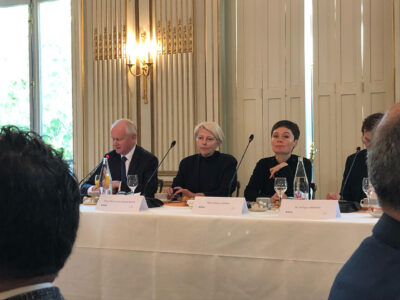
📓 L’apport du Droit de la Compliance dans la Gouvernance d’Internet (The contribution of Compliance Law in the Governance of Internet))

► Full Reference: M.-A. Frison-Roche, L'apport du Droit de la Compliance dans la Gouvernance d'Internet  (The contribution of Compliance Law to the Internet Governance), Report asked by the French Government, published the 15th of July 2019, 139 p. - ► Report Summary. Governing the Internet? Compliance Law can help. Compliance Law is for the Policy Maker to aim for global goals that they require to be achieved by companies in a position to do so. In the digital space built on the sole principle of Liberty, the Politics must insert a second principle: the Person. The respect of this One, in balance with the Freedom, can be required by the Policy Maker via Compliance Law, which internalises this specific pretention in the digital companies. Liberalism and Humanism become the two pillars of Internet Governance. The humanism of European Compliance Law then enriches US Compliance law. The crucial digital operators thus forced, like Facebook, YouTube, Google, etc., must then exercise powers only to better achieve these goals to protect persons (against hatred, inadequate exploitation of data, terrorism, violation of intellectual property, etc.). They must guarantee the rights of individuals, including intellectual property rights. To do this, they must be recognized as "second level regulators", supervised by Public Authorities. This governance of the Internet by Compliance Law is ongoing. By the European Banking Union. By green finance. By the GDPR. We must force the line and give unity and simplicity that are still lacking, by infusing a political dimension to Compliance: the Person. The European Court of Justice has always done it. The European Commission through its DG Connect is ready.   ► 📓 Read the reporte (in French) 📝 Read the Report Summary in 3 pages (in English) 📝 Read the Report Summary in 6 pages (in English) -   ►  Plan of the Report (4 chapters): an ascertainment of the digitization of the world (1), the challenge of civilization that this constitutes (2), the relations of Compliance mechanisms as it should be conceived between Europe and the United States, not to mention that the world is not limited to them, with the concrete solutions that result from this (3) and concrete practical solutions to better organize an effective digital governance, inspired by what is particularly in the banking sector, and continuing what has already been done in Europe in the digital field, which has already made it exemplary and what it must continue, France can be force of proposal by the example (4). -   📝  Read the written presentation of the Report done by Minister Cédric O (in French). 🏛 Listen to the oral  presentation of the Report by Minister Cédric O durant the parliamentary discussion of the law against hate contente on the Internet (in French). -   💬 Read the interview published the 18 July 2019 : "Gouvernance d'Internet : un enjeu de civilisation" ( "Governing Internet: an Issue of Civilization"), given in French,  📻 Listen the Radio broadcast of July 21, 2019 during which its consequences are applied to the cryptocurrency "Libra" (given in French) 🏛 Presentation of the Report to the Conseil Supérieur de l'Audiovisuel- CSA (French Council of Audiovisual) on Septembre 5, by a discussion with its members presentation (in French) 💬 Read the  Interview published the 20 December 2019 : "Le droit de la compliance pour réguler l'Internet" ("Compliance Law for regulate Internet"), given in French -     read below the 54 propositions of the Report ⤵️ - 🌐 follow Marie-Anne Frison-Roche on LinkedIn 🌐follow Marie-Anne Frison-Roche on Instagram 🌐subscribe to the Newsletter MAFR Regulation, Compliance, Law 

Articles in a non-legal collective publication

FRISON-ROCHE, Marie-Anne

Creating “Regulation Law” at Dauphine

Full reference: Frison-Roche, M.-A., Creating "Regulation Law" at Dauphine, in Huault, I. and Bouchard, B. (ed.), 50 years of Research in Dauphine. 1968-2019, 2019, pp. 110-114 Read Marie-Anne Frison-Roche's article (in French)   Read also:  The foreword of the book written by Bruno Bouchard (in French) The preface of the book written by Ivar Ekeland (in French) The table of contents of the book (in French)

Books

🏗️ direction of the collection: 📚Droit et Économie

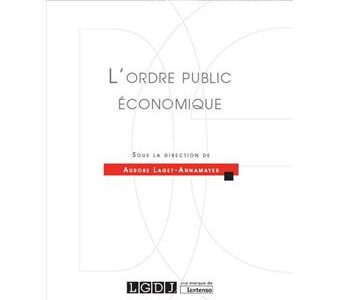
L’ordre public économique (Economic Public Order)

Full reference : Laget-Annamayer, A. (ed.), L'ordre public économique ("Economic Public Order"), coll. "Droit et Économie", Lextenso – LGDJ éditions, 2018, 397p.   This collective book is published in French.    This is the 32nd volume published in this collection.   Often launched as an all-encompassing expression, both by the doctrine and by the judge, public economic order remains a mysterious concept whose substance and contours are difficult to know, simply because it is liable to fluctuate according to its apprehension and depending on the economic and social context. Yet the expression has become widely used, almost incantatory, like a label, and there is therefore undoubtedly a gap between its invocation and its meaning in Law. It is to this discrepancy, and in an attempt to reduce the mystery, that this work is devoted. Not stopping at the only vision of public economic order in internal Public Law, he tries to seek the meanings of it in Comparative Law, in European and International Law, without omitting the historical, privatist or economic vision. It is therefore to this rich overview treated by specialists from different legal fields and beyond that this book invites. It does not aim to put an end to the debate, but on the contrary to arouse it in the context of reflections on the relationship between Law and Economics of which everyone knows the importance. Authors are : Olivier Baillet, Jacques Caillosse, Aurélien Camus, Jacques Chevallier, Dominique Custos, Pierre Delvolvé, Samuel Ferey, Sébastien Hourson, Pascale Idoux, Jean-Philippe Kovar, Aurore Laget-Annamayer, Jérémy Martinez, Francesco Martucci, Jeanne Mesmin d’Estienne, Claire Mongouachon, Eric Naim-Gesbert, Guillaume Richard, Jean-Marc Sorel, Pascal de Vareilles-Sommières.   Read the forth of cover. Read the Table of Contents.   See the whole collection in which this book is published
Couverture – GPA : dire oui ou dire non

Books

GPA : DIRE OUI OU DIRE NON

Working papers

🚧 THE IMPOSSIBLE UNICITY OF THE LEGAL CATEGORY OF WHISTLEBLOWERS

This working paper served as a basis for a conference done in French for the Centre de droit comparé (Center for Comparative Law) in Paris on 23 November 2018. Updated, it has served as a basis for an article published in French in a book of the Société de Législation comparé (Society of Comparative Legislation).   -   "The whistleblowers". This is a new expression. Which wins a full success. Barely heard once, we hear it everywhere … A theme not only of academic teaching, but rather a topic of daily conversation. Because it is every day that we speak about it, in terms more or less graceful. For example President Donald Trump on October 1, 2019 told the press he "wants to interrogate" the whistleblower who would have unlawfully denounced him and would not have, according to him, the right to conceal his own identity, evidence in this according Donald Trump of the false character of his assertions against him, while his lawyer indicates on October 6, 2019 that he does not speak on behalf of a single whistleblower thus taken apart but of a plurality people who gave information against the President of the United States. Even the most imaginative scriptwriters would not have written twists as abruptly or so fast. Spectators, we wait for the next episode, secretly hoping for climbs and slashs. Precisely if we go to the cinema, it is still a whistleblower whose dedication and success, or even drama, we are told, for the benefit of the global society, and especially of Democracy, since the secrets are fought for the benefit of the truth. Thus, the movie The Secret Man designates Mark Felt as the first whistleblower. Returning to what is often presented as a more "serious" media, for example in France the radio "France Culture" we can learn the story of a historian who worked as an archivist on events that the political power would have wanted to keep hidden by possibly destroying their traces but that his profession led to preserve1On the more general fact that cinema is undoubtedly the medium which most seriously restores the state of the Law, c. Frison-Roche, M.-A., Au coeur du Droit, du cinéma et de la famille : la vie, 2016.: here it is expressly presented to the studious listeners as a "whistleblower" … While the same radio is trying to find the one that could be, as in a kind of contest, the "first whistleblowers"2L'histoire du premier lanceur d'alerte, France Culture, septembre 2019. ?. This rewriting of History can be made because finally Voltaire for Calas, or Zola for Dreyfus did they anything else?  It is also a topic of legislative debate since in the United States the Dodd-Frank Act of 2010 inserted in the 1934 law that established the Securities & Exchanges Commission (SEC) a complete system for retribution and remuneration of whistleblowers, while after elaborating guidelines about about in 20123European Commission, Guidelines on Whistleblowing, 6 of December 2012, SEC(2012) 679 final, updated on 23 of April 2018. , the European Commission has published the text on November 20, 2018 in order to give the character a unified European status, in the device gradually developed to protect the one that was presented in 2018 as who  like that : ""The new whistleblowers' protection rules will be a game changer. In the globalised world where the temptation to maximise profit sometimes at the expense of the law is real we need to support people who are ready to take the risk to uncover serious violations of EU law. We owe it to the honest people of Europe.". Step for the Directive of October 7, 2019.  In Europe, the Directive first approved by a Resolution of the European Parliament on 16 April 2019 on protection of persons reporting breaches of Union law and then adopted on 7 October 2019 (Directive 2019/78 (EU) of the European Parliament European Union and the Council of the European Union on the Protection of Persons Reporting Breaches of Union law, will have to be transposed in the next two years to the legal systems of the Member States. is not general, since only "violations of European Union Law" are targeted but the character of the "whistleblower" is more generally referred to: it is "whole"4However, precisely the so common use of plurality ("whistleblowers") raises doubts about the uniqueness of the character. On this question, see. all the first part of the developments of this study, which leads to the conclusion rather than beyond the multitude of particular cases, there are rather two kinds of whistleblowers. V. infra I.. In short, the whistleblower is a star 5The director of the film La fille de Brest says that she considers the whistleblower at the origin of the case of the Pick as a "movie character".. A kind of historical character, covered with blows and glory, going from Voltaire to Snowden, one as the other being incarnated on the screens6Thus, the adventures of Snowden were brought to the screen by Oliver Stone in 2016, Snowden. On the question of knowing whether this film "faithfully reproduces" or not the case, Schetizer, P., Le film Snowden est-il à la hauteur de la réalité?, 2017. This article is favorable to the whistleblower, and to the film which tells us with emotion his case, in particular because (sic), it is easier than to read the Washington Post. …. Recognized by national legislations, which associate to him a legal regime of protection to such a point that, like a tunic of Nessus, it is this legal regime which will define his character and not the opposite. When we read the French law of December 9, 2016 relative à la transparence à la lutte contre la corruption et à la modernisation de la vie économique (on transparency in the fight against corruption and the modernization of economic life), usually known as "Sapin 2 Act", we note that the lawmaker makes much of this character, because he devotes to him the chapter II: "De la protection des7Underlined by us. lanceurs d'alerte" ("The protection of7Underlined by us. whistle-blowers") and that it is by his very protection that the French Parliament formally opens the door of Law to him and throws it openly. But why a plural? Certainly when we read the recitals of the European Directive of 7 October 2019 on the protection of whistleblowers8About this directive, v. the developments infra, this is only an enumeration of all the subjects about which it is a good idea to to protect them, which encourages us to see in this plural only the index of this non-exhaustive list of topics about which it is good that we are alerted, sign of the lack of definition … Reading the French law known as "Sapin 2" makes us less severe but more perplex. Indeed, from this plurality covered by the title of the chapter devoted to Les lanceurs d'alerte ("The whistleblowers"), there is no longer any question in the rest of the law, in the very definition that follows, Article 6 which opens this chapter devoted the "whistleblowers" offering the player immediately a singular since it begins as follows:  "Un9Underlined by us. lanceur d'alerte est une personne …" (A! footnote-1684 whistleblower is a person …"). No more mention of diversity. The art of legislative writing would have even required that the qualifying article should not be singular but not yet indefinite.  Thus seem to contradict in this law "Sapin 2" itself the very title which presents the character, in that it uses a definite plural ("the whistleblowers") while the article of definition which presents the topic does it by using the singular indefinite : "a whistleblower….". This is a first reason to move forward only in a very cautious way, in this "step by step" that constitutes a word-by-word reading: a gloss. This method consists in taking literally the expression itself. The second reason for this technical choice is that the gloss is well suited to an introduction of a collective work, allowing more specific developments to take place in other contributions, for example on the techniques, the difficulties and the limits of this protection, or the history of it, or the reasons for the arrival in French law of these American or Brithish whistleblowers and the way they develop, or not, in other legal systems or other countries. I will therefore content myself with taking again literally this already legal expression: The (I) launchers (II) of alert (III). See below developments.  

Working papers

🚧 YES TO THE PRINCIPLE OF WILL, NO TO PURE CONSENTS

► Complete reference: Frison-Roche, M.-A., Yes to the principle of the will, No to the pure consents, working document for an article written in French Oui au principe de volonté, Non aux consentements purs, to Mélanges dedicated to Pierre Godé, 2018, available at #lien192 en / article / yes-in-principle-of-the-desire-not in the consent /   ► Summary: Pierre Godé devoted his thesis to defend the freedom of the human being, freedom that the person exercises by showing his will. This will manifests itself, even tacitly, by this trace of "consent". In a liberal society, politically and economically, that is to say a society based on the principle of the will of the person, consent must always be defined as the manifestation of the will, this link between consent and will being indivisible ( I). But by a perversion of liberalism, "consent" has become an autonomous object of the freedom of the person, mechanical consent that has made it possible to transform human beings into machines, machines to desire  and machines to be desired, in a world of " pure consents","where we keep clicking, consenting to all without ever wanting. This consent, which has been split from the free will of the person, is the basis of the markets of the Human and the illiberal democracies, threats against human beings (II). The future of Law, in which Pierre Godé believed, is to continue to aspire to protect the human being and, without countering the free will of the human being as the movement of the law of the consumption had been tempted to, to renew with a liberal movement of Law and to fight against these systems of pure consents (III).   🔻read the article below (in French).