Economic Law, Regulation and Compliance

Organisation of events

📅 Scientific Co-organization of the colloquium “Radioscopie d’une notion : les “buts monumentaux” de la Compliance (“Radioscopy of a notion: the Compliance “monumental goals””), in “Les buts monumentaux de la Compliance” (“Compliance Monumental Goals”)”

► co-organized between Laboratoire DANTE and the Journal of Regulation & Compliance (JoRC), this colloquium) is the core manifestation of the 2021 series of colloquia devoted to the general theme of Compliance Monumental Goals. It will take place on 16th of September 2021, at the Maison du Barreau, in Paris. This first work is in French but  will be the basis of the book in English : Compliance Monumental Goals,    This book will be published in the Compliance & Regulation Series, co-published by the JoRC and Bruylant. ► Presentation of the colloquium Thematic: To understand the notion of "Monumental Goals", it is firstly necessary to take crossed perspectives on them, particularly through the prism of Labor Law, Environmental Law and Enterprise Law. Many questions appear. Does the notion of “Monumental Goals” present any substance in Law? Is it uniformly understood, or do specificities appear, forged by specific cultures and disciplinary practices? What are the sources and implicit references or echoes? Because even if we admit the part of novelty, there is undoubtedly an anchoring in traditional legal concepts, like the general interest or sovereignty. How does the shift from meta-legal (prima facie introduced by the concept) to legal take place, and where do any operational difficulties lie when legal actors are called upon to act? The question of a possible categorization of "Monumental Goals" will thus be explored, through these three legal disciplines whose historicity, goals and implications for firms differ.   These reflections allow to ask why and how these "Monumental Goals" are developed. Indeed, what is the relevance of the association of "Monumental Goals" and Compliance? Beyond theoretical considerations relating to the meaning of Law, is this really an effective alloy encouraging companies to behave differently? By what ways? These questions arise in particular with regard to the imperatives of legal certainty and the operative nature of the concept. The question of "Monumental Goals" will thus be explored by the operational actors of compliance, both those who act within companies and those who act from the lato sensu State sphere, for understanding whether this notion is a pure rhetoric figure or constitutes a particularly promising lever for the evolution of market behavior.   ► with :  🎤 Christophe André, maître de conférences à l'Université Paris – Saclay (lecturer at the Paris-Saclay University) 🎤 Guillaume Beaussonie, professeur à l'Université Toulouse-1-Capitole (law professor at Toulouse-1-Capitole University) 🎤 Regis Bismuth, professeur de droit à Sciences po, Paris (law professor at Sciences po Paris) 🎤 Marie-Emma Boursier, doyen  de l'Université Paris – Saclay (dean of the Paris-Saclay University) 🎤 Muriel Chagny, professeur l'Université Paris – Saclay, directrice du Laboratoire Dante (Professor at the Paris-Saclay University, director of the Laboratory Dante) 🎤 Marie-Anne Frison-Roche, professeur à Sciences po (Paris) (Professor at Sciences Po Paris) 🎤 Isabelle Gavanon, avocate à la Cour d'Appel de Paris (attorney before the Paris Court of Appeal) 🎤 Emma Guernaoui, ATER à l'Université Paris II Panthéon-Assas (ATER at Paris II Panthéon-Assas University) 🎤 Dominique Heintz, avocat à la Cour d' appel de Paris (attorney before the Paris Court of Appeal) 🎤 Christian Huglo, avocat à la Cour d' appel de Paris (attorney before the Paris Court of Appeal) 🎤Dominique de La Garanderie, avocat à la Cour d'appel de Paris (attorney before the Paris Court of Appeal)  🎤 Anne-Valérie Le Fur, professeur à l'Université Paris – Saclay (Professor at Paris-Saclay University) 🎤 Anne Le Goff, secrétaire générale déléguée d'Arkéa (Deputy Secretary general at Arkéa) 🎤 Roch-Olivier Maistre, président du Conseil supérieur de l'audiovisuel (President of the French audiovisual regulation authority) 🎤 Marie Malaurie, professeur à l'Université Paris-Saclay (professor at the Paris-Saclay University) 🎤 Jérôme Marilly, avocat général à la Cour d'Appel de Paris (General attorney before the Paris Court of Appeal) 🎤 Benoît Petit, maître de conférences (HDR) à l'Université Paris-Saclay (lecturer at the Paris-Saclay University)  🎤 Jean-François Vaquieri, Secrétaire Général d'Enedis (Secretary General of Enedis) - Read a detailed presentation below:  

Organisation of events

Co-organization of the colloquium “The Firm instituted as prosecutor and judge of itself by Compliance Law (L’entreprise instituée Tribunal par le Droit de la Compliance)”

This scientific manifestation is placed under the scientific responsibility of Marie-Anne Frison-Roche and Jean-Christophe Roda. It is organized by the Journal of Regulation & Compliance (JoRC) and the Centre de Droit de l'Entreprise of Lyon 3 University.   It is the fourth colloquium of the cycle of colloquia organized in 2021 around the general topic of Juridictionnalization of Compliance.         The different interventions will be then transformed into contributions in the books La juridictionnalisation de la Compliance and Compliance Juridictionnalization  which will be published in the Regulation & Compliance serie, jointly published by the JoRC and Dalloz for the book in French and by JoRC and Bruylant for the book in English.  This colloquium will take place in Lyon 3 on 23rd of June 2021 with a limited audience. It will also be broadcasted in live on Zoom.  To register: https://zoom.us/webinar/register/8516215084724/WN_GoQ25I7pRoKhHuGomVMxYw    Presentation of the topic: Initially, it was through Criminal Law, inseparable from the trial, which forced companies to take charge of monitoring within themselves behavior likely to be deviant, the requirement of Ex Ante to be designed by the 'Ex Post of the jurisdictional. From this reversal of things, there has always remained this presence of the judge and the prosecution bodies in a Compliance Law which is nevertheless defined by its concern for the future and the Ex Ante tools within the company. In doing so, the company becoming on the one hand a judge of itself, on the other hand a prosecutor of itself, it splits up, taking in reverse the most established procedural principles. Moreover, because of the monumental goals which constitute Compliance Law, companies become attorneys and judges of the others, or for the others, the cutting machines and the "supreme courts" being by name instituted to regulate in Ex Ante all different before that it does not become litigation. The Ex Ante of Compliance would then make the Ex Post disappear. Method:  The colloquium which had to take place initially on 8th of April has been postponed to 23rd of June to enable speakers to meet and talk in face to face, with a limited audience.  These exchanges will be captured so that third parties can benefit from them, even before the publication of the works, La Juridictionnalisation de la Compliance and Compliance Juridictionalization, within which this work constitutes the basis for the development of a specific chapter. Five practical cases will first be examined in five specific sectors, where this institution of the firm as prosecutor and judge of itself is particularly observable before both specific and more cross-sectoral themes are examined and discussed.   Will speak : 🎤Luc-Marie Augagneur, attorney before Lyon Court of Appeal, CVS Law Firm 🎤Alexis Bavitot, senior lecturer at Lyon 3 University  🎤Alain Bruneau, chief compliance officer at Natixis 🎤Jean-Marc Coulon, Head of Legal Infrastructure at Bouygues Construction 🎤Marie-Anne Frison-Roche, director of the Journal of Regulation & Compliance (JoRC) 🎤Cécile Granier, senior lecturer at Lyon 3 University  🎤Xavier Hubert, director of Compliance at Engie 🎤Jérémie Jourdan-Marques,  professor at Lyon 2 University 🎤Jérémy Heymann, professor at Lyon 3 University 🎤Daphnée Latour, attorney before Paris Court of Appeal  🎤Christophe Lapp, founding partner of Altana law firm 🎤Samir Merabet, senior lecturer at Lyon 3 University  🎤Béatrice Oeuvrard, Public Policy Manager at Facebook France 🎤Jean du Parc, Bâtonnier  🎤Jean-Christophe Roda, professor at Lyon 3 University and director of the Centre de droit de l'entreprise (Center of Company Law) 🎤Jean-Baptiste Siproudhis, director Ethics, Integrity and CSR at Thalès

Organisation of events

Co-organization of the colloquium “Public norms and Compliance in time of crisis : monumental goals put to a test” (“Normes publiques et Compliance en temps de crise : les buts monumentaux à l’épreuve”)

This scientific manifestation is placed under the scientific direction of Marie-Anne Frison-Roche, Pascale Idoux, Antoine Oumedjkane and Adrien Tehrani. It is organized by the Journal of Regulation & Compliance (JoRC) and by the Faculté de Droit et de Science Politique de l'Université de Montpellier (Centre de Recherches et d'Etudes Administratives de Montpellier and Centre du Droit de l'Entreprise). This manifestation is part of the cycle of colloquia organized in 2021 around the general topic of Compliance Monumental Goals.        The interventions will give rise to the production of articles which will be part of the books Les bus monumentaux de la Compliance and Compliance Monumental Goals which will be published in the Series Regulations & Compliance, coedited by the JoRC and Dalloz for the French version and by the JoRC and Bruylant for the English version.  This manifestation will take place on Zoom on 17th of May 2021.  Registrations: anouk.leguillou@mafr.fr  Assistance to this event may be validated as part of the continuing education of lawyers. In addition, scientific videos will be extracted and disseminated later.   Presentation of the topic: In the overall problematic of "Monumental goals", this conference retains a particular case: that of the crisis and the emergency situation that it generates. First of all, in general, does the importance of public norms in the emergency context engendered by a crisis situation imply a marginalization of Compliance? Don't private actors also have their place in these circumstances, at the service of the "monumental goals" that the public authorities want to maintain, or even which appear specifically? Secondly, more concretely, we have been living for many months in a health crisis. By taking it as a framework and, within it from particular cases, how public and private actors react, act, adjust? and how do the courts assess these movements? Going from the most general to the most specific, this conference aims to identify criteria, limits, of what could be specific rules when the emergency of a crisis meets Compliance, and will examine specific situations.   Working method: The conference is therefore built on a general issue, which was the subject of a "working paper", written by Antoine Oumedjkane, Adrien Tehrani and Pascale Idoux, on which the speakers will have thought in advance and from which they are intended to study the question from their particular perspective. The conference, which is essentially interactive, therefore begins with an outline of the main lines of this general work. It is followed by the examination of concrete practical cases. They are as follows: 1️⃣ hydroalcoholic gel, its manufacture, price, availability, 2️⃣ information and regulation on all media in Covid period 3️⃣ the use of the bicycle during the state of health emergency A first conclusion, thematically limited, will relate to Revealed by the crisis situation, the place of private initiative in Compliance Law. A second, more general, undoubtedly open-ended conclusion is drawn from this confrontation between general reflection and concrete cases which must be resolved in a particular crisis.   Will speak:    Jean-Bernard Auby, Emeritus Professor of Sciences po (Paris)   Julien Bonnet, Professor at Montpellier University and member of the CERCOP   Guylain Clamour, Dean of Montpellier Law School   Marie-Anne Frison-Roche, agrégée des Facultés de droit, Professor of Regulation and Compliance Law at Sciences Po (Paris) and Director of the Journal of Regulation & Compliance (JoRC)   Pascale Idoux, Professor at Montpellier University    Pascale Léglise, adjointe au directeur des libertés publiques et des affaires juridiques (Deputy Director of Civil Liberties and Legal Affairs) of the Ministère de l'intérieur (Home Ministry)   Michèle Léridon, Member of the Conseil supérieur de l'audiovisuel (French Media Regulator), President of the working group Pluralisme, déontologie, supervision des plateformes en ligne (Pluralism, Deontology, Supervision of Online Platforms)   Antoine Oumedjkane, Researcher of the Centre de recherche et d'études administratives (Research and Administrative Studies Center) of Montpellier University   Nelly Sudres, Maître de conférences at Montpellier University and member of the Centre de Recherches et d'Etudes Administratives (Research and Administrative Studies Center) of Montpellier University   Adrien Tehrani, Professor at Montpellier University and member of the Centre du Droit de l'Entreprise (Company Law Center)   Xavier Vallad, Group Legal Director, Intermarché   ⤵️Read a more detailed presentation of the manifestation below:

Organisation of events

Co-organization of the colloquium “Compliance and Arbitration” (“Compliance et arbitrage”)

This scientific event is placed under the scientific responsibility of Marie-Anne Frison-Roche and Jean-Baptiste Racine. It is organized by the Journal of Regulation & Compliance (JoRC) and by the Centre de recherche sur la Justice et le Règlement des Conflits (CRJ)  of the  Panthéon-Assas (Paris II) University, with the active support of the International Chamber of Commerce ICC. This event is the third colloquium of the 2021 colloquia cycle around the general theme of Compliance Juridictionnalization.      The different interventions will be then transformed into contributions in the books La juridictionnalisation de la Compliance  and Compliance Juridictionnalization  which will be published in the Regulation & Compliance serie, jointly published by the JoRC and Dalloz for the book in French and by JoRC and Bruylant for the book in English.  This colloquium will take place the 31st of March 2021. The manifestation will be live broadcasted on Zoom. To register: https://u-paris2-fr.zoom.us/webinar/register/WN_sPSB4aUUQTWDWDnNcYt3sA   Presentation of the theme:  The arbitrator is the ordinary judge of international trade. It was natural that he or she encountered Compliance: by definition Compliance Law takes hold of the whole world and follows the paths of international trade while it can only be deployed with the help of institutions which, by nature are spreading around the world and need authorities like the Courts. The conference is based on the already perceptible connection points between Compliance and Arbitration to better identify what is emerging for tomorrow: contradiction or convergence between the two; weakening or consolidation. We are already seeing the impact that Compliance can have on the arbitrator's treatment of corruption or the consideration of money laundering. More generally, where do we stand with the arbitrator's knowledge of the many technical issues related to compliance? Beyond these, will the courts and arbitrators be able to achieve the goals, themselves new, sometimes monumental, pursued by Compliance Law? Through this joint exploration of these avenues, the fate of compliance clauses inserted in contracts, the relevance in the matter of private codes of conduct, etc. will be examined. Tomorrow, as of today, is the arbitrator a full and complete judge of Compliance Law? How, with what specificities and what controls?   Notably will speak: Mathias Audit, professeur à l'Université Panthéon-Sorbonne – Paris I (full professor at Sorbonne – University – Paris)   Dominique Bourrinet, General Counsel of Société générale group  ​ Cécile Chainais, director of the Centre de Recherche sur la Justice et le Règlement des Conflits (CRJ) and professeur à l'Université Panthéon-Assas (Paris II) (Full professor at Panthéon-Assas (Paris II) University)    Claire Debourg, professeure à l'Université Paris X- Nanterre (Full professor at Paris X – Nanterre)    Marie-Anne Frison-Roche, professeur à Sciences Po – Paris (Full Professor at Sciences Po – Paris)) and Director of the Journal of Regulation & Compliance (JoRC)   Catherine Kessedjian, professeur émérite de l'Université Panthéon-Assas (professor emeritus of Panthéon-Assas – Paris II University)   Elie Kleiman, partner, Jones Day Law Firm   Alexis Mourre, president of the ICC International Court of Arbitration   Jean-Baptiste Racine, professeur à l'Université Panthéon-Assas – Paris II (Full Professor at Panthéon-Assas – Paris II University)   François-Xavier Train, professeur à l'Université Paris X-Nanterre (Full Professor at Paris X-Nanterre University)   Eduardo Silva-Romero, Dechert Law Firm      Read a detailed presentation of the colloquium below:     

Organisation of events

Organization and scientific co-direction of the cycle of colloquia : “Compliance Monumental Goals”

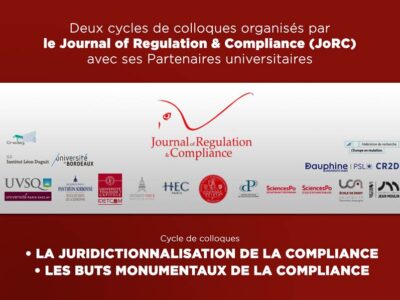
Like the precedent cycles dedicated to the general topic of Compliance, aiming to build a "Compliance Law" and aiming also to be published in the series Regulation & Compliance, coedited by the Journal of Regulation & Compliance and Dalloz, this cycle continues to deepen a specific aspect of this emerging branch of Law which has been applied before being designed.   The year 2020-2021 will give rise to two full and distinct cycles, the former deepening a key concept of Compliance Law, that are "monumental goals" and the later deepening a phenomenon with multiple roots and consequences: "the juridictionnalization of Compliance".  Compliance Monumental Goals has been proposed in 2016.   These various conferences will take place in different places, according to the role played by the very numerous universities which, this year once again, support the Journal of Regulation & Compliance for the realization of this cycle. This cycle will give rise to two books, one in French: Les Buts Monumentaux de la Compliance, and the other in English : Compliance Monumental Goals.  This cycle of colloquia Compliance Monumental Goals will start in October 2020 and will take place until December 2021.   First colloquium: 17th of May 2021: Public norms and Compliance in time of crisis: monumental goals put to a test, co-organized by the JoRC and the Montpellier University Law School, under the scientific direction of Marie-Anne Frison-Roche, Pascale Idoux and Adrien Tehrani: more information about this manifestation here   Second colloquium : 16th of September 2021, Compliance Monumental Goals: Radioscopy of a Notion, co-organised by the JoRC and Saclay University, under the scientific direction of Christophe André, Marie Malaurie and Benoît Petit  : more information about this manifestation here   Third colloquium: 4th of November 2021: Effectivity of Compliance and international competitiveness, co-organized by the JoRC and the Centre de recherches en Economie et Droit de l'Université Paris II, under the scientific direction of Laurent Benzoni, Bruno Deffains and Marie-Anne Frison-Roche: more information about this manifestation here

Organisation of events

Organization and scientific co-direction of the cycle of colloquia : “The juridictionnalization of Compliance”

Like the precedent cycles dedicated to the general topic of Compliance, aiming to build a "Compliance Law" and aiming also to be published in the series Regulation & Compliance, coedited by the Journal of Regulation & Compliance and Dalloz, this cycle continues to deepen a specific aspect of this emerging branch of Law which has been applied before being designed.   The year 2020-2021 will give rise to two full and distinct cycles, the former deepening a key concept of Compliance Law, that are "monumental goals" and the later deepening a phenomenon with multiple roots and consequences: "the juridictionnalization of Compliance".  The juridictionnalization of Compliance is perhaps as ancient as Compliance mechanisms themselves.   These various conferences will take place in different places, according to the role played by the very numerous universities which, this year once again, support the Journal of Regulation & Compliance for the realization of this cycle. This cycle will give rise to two books, one in French: La Juridictionnalisation de la Compliance, and the other in English : Juridictionnalization of Compliance.  This cycle of colloquia The juridictionnalization of Compliance will start in October 2020 and will take place until December 2021.   Inaugural colloquium:  Compliance juridictionnalization: why? Who? How? Where? and Toward What? , organized by the JoRC under the scientific direction of Marie-Anne Frison-Roche : read more information here   Second Colloquium: 31st of March 2021 :  Arbitration and Compliance, co-organized by the JoRC and Paris II University, under the scientific direction of Marie-Anne Frison-Roche and Jean-Baptiste Racine : read more information here   Third colloquium : 23rd of June 2021 : The firm instituted as Court by Compliance Law, co-organized by the JoRC and the équipe de recherche Louis Josserand of Lyon 3 University, under the scientific direction of Marie-Anne Frison-Roche and Jean-Christophe Roda : read more information here    Fourth colloquium: September 2021 :  Which judges for Compliance? , co-organized by the JoRC and the CR2D of Paris-Dauphine University, under the scientific direction of Marie-Anne Frison-Roche and  Sophie Schiller : read more information here ​ Fifth colloquium: October 2021 :  Compliance Law, crucible between American Procedure Law and Procedure Law, co-organized by the JoRC and the Brussels University, under the scientific direction of Marie-Anne Frison-Roche and Arnaud van Waeyenberge: read more information here   Sixth colloquium:  Proportionnality, Compliance balance, co-organized by the JoRC and IDETCOM of Toulouse University, under the scientific direction of Marie-Anne Frison-Roche and Lucien Rapp: read more information here

Organisation of events

Co-organization of the conference “Geographic significance in the choice and use of Compliance tools”

The cycle of conferences Les outils de la Compliance (The Compliance tools) began in November 2019 and runs until June 2020. It is organized by The Journal of Regulation & Compliance and all of its partner universities. It includes a conference more particularly devoted to the theme of "La prégnance géographique dans le choix et l'usage des outils de la Compliance" ("Geographic significance in the choice and use of Compliance tools"). See the other thematics, others dates and other particular manifestations,  builting the complete cycle   Conference and Debate  (in French)  Thuesday, February 4, 2020, 16h30– 19h30  Law & Political Sciences School Doyen Louis Trotabas Avenue, 06050 Nice Cedex. Amphithéâtre Bonnecarrère, Villa Passiflore,   General Presentation:  Compliance is a global phenomenon. In this, it illustrates the problematic of a Global Law. However, it should not be inferred that Compliance is applied in the same way everywhere in the world. Like any legal institution, it is integrated into a preexisting legal framework, shaped by culture and history. The aim of the conference is to explore geographic significance in Compliance Tools, that is to say the potentially different way in which these tools are chosen and used depending on the geographic area concerned. The three geographic areas studied will mainly be Europe, the United States and Africa. Opportunity will thus be given to highlight the convergences and divergences in the implementation of Compliance Tools in a geographic vision of the institution.   Under the scientific direction of Jean-Baptiste Racine, professor at the University Côté d'Azur (Law & Political Sciences School of Nice), GREDEG-CREDECO, CNRS UMR 7321 With the interventions of: – Jean-Baptiste Racine, professor at the University Côté d'Azur , Nice – Mahmoud Mohammed Salah, Law professor at the University of Nouakchott, Mauritany – Karen Coppens, Dechert LLP – Mads Andenas, Law professor at the University of Oslo, Norway – Marie-Anne Frison-Roche, Law professor at Sciences Po, Paris   -   -   Read the registration procedure  for this conference. Consult the gele calendar of upcoming events. Consult the presentation of the book to be published "Compliance Tools".   Go back to general presentation of the Conferences' cycle "Compliance Tools".   Inscription : anouk.leguillou@mafr.fr -      

Organisation of events

Co-organization of the conference “The expertises required in the Ex Ante of Compliance”

The cycle of conferences Les outils de la Compliance (The Compliance tools) began in November 2019 and runs until June 2020. It is organized by The Journal of Regulation & Compliance (JoRC) and all of its partner universities. It includes a conference more particularly devoted to the theme of "Les expertises requises dans l'Ex Ante de la Compliance" ("The expertises required in the Ex Ante of Compliance"). See the other thematics, other dates and other particular manifestations,  building the complete cycle   Conference – Debate  Wednesday, January 29, 2020, 18h30-20h  in the amphitheater of the Paris Chamber of Commerce and Industry  Friedland Avenue, 27, 75008 Paris   General Presentation After examining various specific tools, such as Risk mapping or Incentives, these showing that the tools only have their efficiency through their use designed and carried out by human beings, endowed themselves with the required expertise. But it is often because it is very difficult to identify and define these "skills" that operators subject to the Ex Ante Compliance obligations end up entrusting this observance to machines, via Compliance by Design … The mass of what should actually be observed leads to favoring massification expertise, as the "Regtech" handle it. But the rules being a living thing, Company Law adjoins Governance and one must know both. In the same way as the mastery of Ex Ante supposes that one always thinks of Ex Post (sanction for failure in the Ex Ante), so that this Ex Post does not appear, under its unwelcome face of Repressive Law which therefore must be anticipated and therefore present in Ex Ante. In the same way, Tax Compliance presupposes that the State must be present in the good technical conception of Compliance. Compliance being the means by which States internalize their "monumental goals", or even confront each other under the mask of companies, it is then international policies in question, and this political expertise is required in Ex Ante. -   under the scientific direction of Marie-Anne Frison-Roche, professor fo Regulatory Law Compliance Law at Sciences Po.   with  : –  –  Antoinette Gutierrez-Crespin, partner, department  Forensic & Integrity Services EY France. – François Barrière and Sidne Koenigsberg, Skadden – Pierre Vimont, Senior Fellow, Carnegie Europe –  Benjamin Jean, president of Open Law –  Thomas Amico, Linklaters     - Read the registration procedure  for this conference. Consult the general calendar of upcoming events. Consult the presentation of the book to be published "Compliance Tools".   Go back to general presentation of the Conferences' cycle "Compliance Tools".   Inscription : anouk.leguillou@mafr.fr        

Organisation of events

Co-organization of the conference “La cartographie des risques /Risk mapping”

The conferences cycle Les outils de la Compliance (The Compliance tools) taking place between November 2019 and June 2020 organized by The Journal of Regulation & Compliance and all the Partner Universities will start this year on the theme of "La cartographie des risques" (Risk Mapping) .    -   Conference – Debate (in French)  jeudi Thursday, November 28, 2019. 19h15 – 21h15 at the Economics Department of Sciences Po  28 rue des Saints-Pères 75007 Paris Amphithéâtre Simone Veil   Under the scientific coordination of Guillaume Sarrat de Tramezaigues, Executive Director fo the  Economics Department of Sciences po.   Risk Mapping is defined as a process of identifying, evaluating and prioritizing risks: it is an integral and fundamental part of an effective global strategy for managing these risks.  As a central tool for Compliance, this approach may not be radically new, but the Risk Mapping Technique is now renewed and sometimes compromised by the emergence of new Risks, often due to their new mutiform nature. Moreover, the primacy of the new pair of "Political Risks/Compliance Risks" tends to increase the vulnerability of organizations obliged by new legal provisions to draw up these maps, whereas these tools must also protect these organizations.  Before discussing it with the audience, the speakers will explain through their experience the place of this tool in Compliance, by looking at how Risk Mapping is articulated with the logic of value creation through risk-taking, inherent in entrepreneurial and political action. This good understanding is not only essential for the company, but also for the administrative and judicial authorities which control or sanction firms.   Especially with the interventions of: – Marie-Anne Frison-Roche, full professor of Regulatory Law and Compliance Law, Sciences Po – Jean-François Guillemin, former general secretary of the Bouygues Group – Lamia Liabes, Chief Operating Office, HSBC France – Guillaume Sarrat de Tramezaigues, executive Director fo the  Economics Department of Sciences po     Inscription : anouk.leguillou@mafr.fr -   This first event is more specifically   organized by the Economics Department of Sciences po. It opens the cycle of conferences organized by the Journal of Regulation & Compliance (JoRC) (see the partners of this cycle), whose general theme is Les outils de la Compliance (The Compliance tools). Read the General Presentation of the Conferences Cycles.   This manifestation will be the basis for a book.    Read the conditions for inscription, and conditions for access les conditions d'accès (in French). -  

Organisation of events

Organization and scientific codirection of the cycle of conferences “Les outils de la Compliance” (Compliance Tools)

As the previous cycles devoted to the general theme of Compliance and aiming to build a "Compliance Law", having the same vocation to be published in the series Regulation & Compliance, co-published by the Journal of Regulation & Compliance (JoRC) and the Editions Dalloz, this cycle takes a particular aspect of this branch of the Law being built and developed, which was applied even before being conceived. Since pragmatism preceded or even prevailed, the theme chosen this year is: Les outils de la Compliance (Compliance Tools). These conferences will be in French These tools are very diverse, not only among themselves but according to the sectors in which they are deployed or according to the geographical areas in which they are applied. It is necessary to apprehend them by going beyond the description of the instrument literally shown, as the texts or the promoters show it, without immediately going up to too large  generalities. For this reason, some conferences will focus on specific, well-identified mechanisms, such as risk mapping or alert. They may also consider how Compliance Law uses more general tools to achieve its goals, such as lawsuits, incentives or new technologies. This will make it possible to problematize more clearly perceptible difficulties in Compliance  Law, such as the adequacy or inadequacy of the constraint in relation to the aims, the consideration or not of the legal and political geography, the articulation or not of the tools between them. These various conferences will take place in several places, according to the part taken by the different university structures that this year contribute to the Journal of Regulation & Compliance (JoRC) for the realization of the cycle. The result will be two books, one in French: Les outils de la Compliance, the other in English: Compliance Tools.   This cycle of conferences about Compliance tools will begin in November 2019 and will last until June 2020.   First conference: 28 November 2019, La cartographie des risques (Risk Mapping), Sciences po. This conference will be in French. Its publication will be in French and in English. Conditions of inscription (in French).  Calendar of the entire conferences.     Le Journal of Regulation & Compliance (JoRC) works with :    The School of Public Affairs of Sciences Po, The Department of Economics of Sciences po, The  École de Droit of the Panthéon-Sorbonne University (Paris I), The École doctorale de Droit privé of Panthéon-Assas University (Paris 2), The Centre Perelman of l'Université Libre de Bruxelles, The GREDEG of the Sophia-Antipolis University (Nice), The Centre Louis Josserand of the Faculté Lyon III. The Faculté de Droit of Toulouse, TheFaculté de Droit of Clermont-Ferrand.     This cycle of conferences is supported by : The Chambre de Commerce et d'Industrie de Paris. The Ecole de Formation du Barreau de Paris.