Organisation of events

Organisation of events

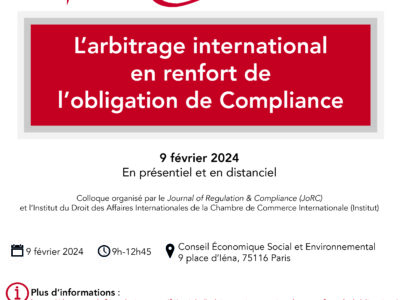
🧱Co-organisation of the Symposium 🧮L’arbitrage international en renfort de l’Obligation de Compliance (International Arbitration in support of the Compliance Obligation)

► Full Reference: L. Aynès, M.-A. Frison-Roche, J.-B. Racine and E. Silva-Romero (dir.), L’arbitrage international en renfort de l’obligation de Compliance (International Arbitration in support of the Compliance Obligation), Journal of Regulation & Compliance (JoRC) and Institute of World Business Law of the ICC (Institute), Conseil Économique Social et Environnemental (CESE), Paris, February 9, 2024 - consult on LinkedIn a general présentation of this event, which links to a presentation and a report of each speech - 🏗️This symposium takes place in the cycle of symposiums organised by the Journal of Regulation & Compliance (JoRC) and its partners Universities, focusing in 2023-2024 on the general theme of the Compliance Obligation - 📚The works will then be inserted in the books: 📕L’obligation de Compliance, to be published in the 📚Régulations & Compliance Serie, co-published by the Journal of Regulation & Compliance (JoRC) and Dalloz, published in French. 📘Compliance Obligation, to be published on the 📚Compliance & Regulation Serie, co-published by the Journal of Regulation & Compliance (JoRC) and Dalloz, published in English. - ► General presentation of the symposium: “Compliance Obligation” appears to be far from International Arbitration if Compliance Law is only understood in terms of binding regulations or even Criminal Law. Arbitration would only have contact with Compliance Obligation in a repulsive way, when a person claims to have enforced a contract before an arbitration court that disregards a compliance prohibition, e.g. corruption or money laundering. It is therefore from a negative angle that the cross-over has taken place. The fact that Arbitration Law respects the requisite of Criminal Law is nothing new. Moreover, the power of Compliance in its detection and prevention tools, particularly in terms of evidence, no doubt increases the global efficiency. But Compliance Obligation is based on Monumental Goals, notably linked to global human rights and active ambitions about environment and climate which, particularly in the value chain economy, take the legal form of compliance clauses, or even compliance contracts, or various commitments and plans, which the parties can ask the international arbitrator to enforce. They will do so even more as arbitrators are often the only international, or even global, judges available. The use they will do of Contract Law, Quasi-Contract Law, Enforcement Law, Tort Law, reinforces Compliance Law in a global dimension. - - ► Interviennent : 🎤 Laurent Aynès, emeritus Professor at Paris 1 Panthéon-Sorbonne University, Attorney, Darrois Villey Maillot Brochier (Paris) 🎤 Marie-Anne Frison-Roche, Professor of Regulatory and Compliance Law, Director of the Journal of Regulation & Compliance (JoRC) 🎤 Jean-François Guillemin, former General Secretary of the Bouygues Group 🎤 Christophe Lapp, Attorney, Advant Altana (Paris) 🎤 Jean-Baptiste Racine, Full Professor at Paris Panthéon-Assas University (Paris 2) 🎤 Eduardo Silva-Romero, President of the Institute of World Business Law of the ICC (Institute), Attorney, Wordstone (Paris) - 🧮Read a detailed presentation of the event below⤵️

Organisation of events

🧱Co-organisation of the Symposium 🧮Compliance et contrats publics (Compliance and public contracts)

► Full Reference: M.-A. Frison-Roche, C. Gilles and A. Oumedjkane (dir.), Compliance et contrats publics (Compliance and public contracts), Journal of Regulation & Compliance (JoRC), Centre de recherches et d’études administratives de Montpellier (CREAM) and Centre d’Études et de Recherches Comparatives Constitutionnelles et Politiques (CERCOP) of the Montpellier University, Faculté de droit et de science politique de Montpellier, January 12, 2024 - consult a general presentation of this event on LinkedIn, linking to a presentation of each speech (in French) - 🏗️This symposium takes place in the cycle of symposiums organised by the Journal of Regulation & Compliance (JoRC) and its partners Universities, focusing in 2023-2024 on the general theme of the Compliance Obligation - 📚The works will then be inserted in the books: 📕Compliance et contrat, to be published in the 📚Régulations & Compliance Serie, co-published by the Journal of Regulation & Compliance (JoRC) and Dalloz, published in French. 📘Compliance & Contract, to be published on the 📚Compliance & Regulation Serie, co-published by the Journal of Regulation & Compliance (JoRC) and Dalloz, published in English. - ► General presentation of the symposium: Compliance is developing throughout the legal system, through both Public and Private Law techniques. Public Contract Law bears witness to this in two ways: through its scope, in that Compliance applies to economic relationships entered into by public bodies, and through its object, which internalises a reconciliation between their economic interests and a set of other general interest objectives, or “Monumental Goals”, a reconciliation for which public bodies have traditionally been responsible. In addition to unilateral acts, contracts have their rightful place as a practical means of achieving this reconciliation. Its flexibility allows for negotiation and adjustment of the burdens to be placed on the co-contracting parties. The aim of this symposium is to link the different manifestations of the Compliance Obligation in public contracts and thus give coherence to policies which are still too often considered in a watertight manner because they relate to very different aims and areas. Firstly, at the procurement stage, the promotion of responsible or innovative procurement, particularly from an environmental point of view, is one of the signs of Compliance’s presence. On a completely different note, the same is true of the CJEU’s challenge to the automatic application of bans on tendering, which prevent contracting authorities from ruling on a candidate’s reliability by taking into account the compliance programmes implemented by companies since their conviction. Secondly, at the litigation stage, the Conseil d’État‘s (French Council of State) recent broad recognition of the illegality of an administrative contract on the grounds of a breach of ethical obligations has tempered the drive to make contracts more secure, drawing the consequences of the major drive for transparency in public life that has been underway since 2013. The aim of the morning session will be to understand the various forms of the Compliance Obligation in public contracts. This overview will make it possible, in the afternoon, to aim to unify the Compliance Obligation in public contracts. - - ► Speakers: 🎤Ugo Assouad, PhD student at the Montpellier University, CREAM 🎤Philippe Augé, President of the Montpellier University 🎤Clémence Ballay-Petizon, PhD student at the Montpellier University, CREAM  🎤Yannisse Benrahou, PhD student at Paris-Nanterre University, CRDP 🎤Léon Boijout, PhD student at the Montpellier University, CREAM 🎤Julien Bonnet, Full Professor at the Montpellier University, CERCOP 🎤Guylain Clamour, Dean of the Montpellier Faculty of Law and Political Science 🎤Marie-Anne Frison-Roche, Professor of Regulatory and Compliance Law, Director of the Journal of Regulation & Compliance (JoRC) 🎤Pierre-Yves Gadhoun, Professor at the Montpellier University, CERCOP 🎤Pascale Idoux, Professor at the at the Montpellier University, CREAM 🎤Nedjma Kontoukas, PhD student at the Montpellier University, CREAM 🎤Valentin Lamy, Senior Lecturer at the Lorraine University, IRENEE 🎤Antoine Oumedjkane, Senior Lecturer at Lille University, ERDP 🎤Lucien Rapp, Emeritus Professor at Toulouse Capitole University 🎤Marion Ubaud-Bergeron, Full Professor at the Montpellier University, CREAM  - 🧮Read a detailed presentation of the event below⤵️
Organisation of events

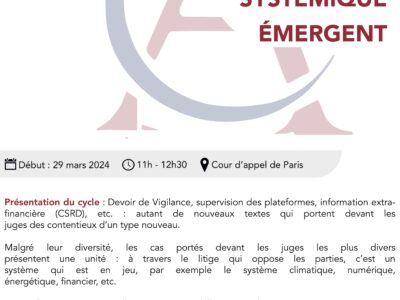
🧱⚙️Coordination of the cycle of conference-debates 🧮Contentieux Systémique Émergent – CSE (Emerging Systemic Litigation – ESL)

► Full Reference: M.-A. Frison-Roche, Coordination of the cycle of conference-debates Contentieux Systémique Émergent (Emerging Systemic Litigation), organised on the initiative of the Cour d'appel de Paris (Paris Cour of Appeal), with the Cour de cassation (French Court of cassation), the Cour d'appel de Versailles (Versailles Court of Appeal), the École nationale de la magistrature – ENM (French National School for the Judiciary) and the École de formation des barreaux du ressort de la Cour d'appel de Paris – EFB (Paris Bar School), under the scientific direction of Marie-Anne Frison-Roche - ► This Cycle in few words: Duty of vigilance, supervision of platforms, non-financial information (CSRD), etc.: as many new texts that bring new types of disputes before the courts. Despite their diversity, the cases brought before the most diverse judges present a unity: through the dispute that pits the parties against each other, it is a system that is at stake, for example the climate system, digital system, energy system, financial system, etc. New regulations are just the illustration of this "Emerging Systemic Litigation"; the conference-debates aiming at showing the new fields, new techniques, new standards, etc., in relation to the scale and diversity of stakeholders' expectations. This cycle is designed to encourage cross-fertilisation, so as to provide judges with food for thought ahead of the litigation they will be called upon to deal with. Les réglementations nouvelles ne sont que l’illustration de ce « contentieux systémique émergent » dont la formation a pour objet de montrer les nouveaux champs, les nouvelles techniques, les nouvelles normes, etc., en lien avec l’ampleur et la diversité des attentes des parties prenantes. Le cycle vise à favoriser les échanges croisés, afin d’alimenter la réflexion des magistrats en amont des litiges qui leurs seront soumis. - 🔴Registrations and information requests can be sent to: inscriptionscse@gmail.com 🔴For the attorneys, registrations have to be sent to the following address: https://evenium.events/cycle-de-conferences-contentieux-systemique-emergent/  ⚠️The conference-debates are held in person only, in the Cour d’appel de Paris (Paris Court of Appeal). - ► General Presentation of the Cycle: In 2024, the Cour d’appel de Paris (Paris Court of Appeal) created a new specialised chamber: chamber 5-12 Contentieux émergent – Devoir de vigilance et responsabilité écologique (Emerging litigation – Duty of vigilance and environmental liability). Vigilance litigation is an example of what is emerging more generally: Systemic Litigation, often linked to technologies. This calls for a new way of judging, organising procedures and relations between professionals. A series of conference-debates on Emerging Systemic Litigation (ESL) is being organised jointly by the Paris Court of Appeal, the Versailles Court of Appeal, the Cour de cassation (French Court of cassation), the École nationale de la magistrature – ENM (French National School for the Judiciary) and the École de formation des barreaux du ressort de la Cour d'appel de Paris – EFB (Paris Bar School), under the scientific responsibility of Professor Marie-Anne Frison-Roche. In this context, a series of conference-debates involving professionals from a wide range of backgrounds is being proposed on the following themes: 🧮the very notion of "Emerging Systemic Litigation" and the role of the judiciary in it (29 March 2024): read the report of this event   🧮vigilance, insofar as it gives rise to Systemic Litigation, notably because it takes legal form in numerous contracts, for example in employment relationships (26 April 2024): read the report of this event   🧮the inclusion in Emerging Systemic Litigation of information reliability techniques, particularly with regard to content available on platforms (27 May 2024): read the report of this event   🧮the way in which artificial intelligence is generating Systemic Litigation and the influence of new specific texts (24 June 2024): read the report of this event   🧮sustainability, a principle of systems found in reports and transitively in disputes concerning their development, their standards and even their control (9 September 2024): read the programme of this event   🧮new evidentiary techniques required by Emerging Systemic Litigation, to account for systemic needs, e.g. climate and digital systems, and how firms respond to them (14 October 2024): read the programme of this event   🧮Vigilance General Procedural Law, in that it incorporates the Systemic dimension of Vigilance Litigation (18 November 2024): read the programme of this event   🧮institutional and case law feedback from courts on Emerging Systemic Litigation (16 December 2024): read the programme of this event - 🧮read below the full programme of this cycle of conference-debates⤵️

Conferences

🏗️Cycle of symposiums 2023 on Compliance Obligation

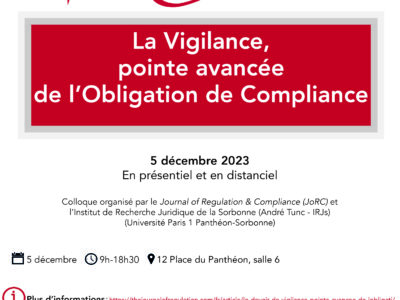
🧮Vigilance, advanced point of the Compliance Obligation

► Full Reference: Journal of Regulation & Compliance (JoRC) and Institut de Recherche Juridique de la Sorbonne (André Tunc – IRJS) of Paris 1 Panthéon-Sorbonne University, La Vigilance, pointe avancée de l’Obligation de Compliance (Vigilance, advanced point of the Compliance Obligation), Paris 1 Panthéon-Sorbonne University, December 5, 2023, 12 place du Panthéon, salle 6. - - 🏗️ This symposium takes place in the cycle of symposiums organised by the Journal of Regulation & Compliance (JoRC) and its partner Universities, focusing in 2023 on the general theme of Compliance Obligation. - - ► This symposium is organised by the Journal of Regulation & Compliance (JoRC) and Paris 1 Panthéon-Sorbonne University, through its Institut de Recherche Juridique de la Sorbonne (André Tunc – IRJS). This symposium is held in French. the symposium is under the scientific direction of 🕴️Marie-Anne Frison-Roche, 🕴️Mustapha Mekki , and 🕴️Jean-Christophe Roda. - To register for a physical presence: anouk.leguillou@mafr.fr (as places are limited, you will be asked to confirm 48 hours in advance). To register for an online presence, via Zoom: Click HERE 🧮 The event will take place at Paris 1 Panthéon-Sorbonne University, 12 place du Panthéon 75005, in Salle 6, on 5 December 2023. - ► Présentation of the theme : The Vigilance Obligation is difficult to define because of the multiplicity of texts and cases in which it can be understood. This is particularly true of the Vigilance mechanism, which illustrates, and even emphasises, the Vigilance Obligation. Through international texts, French law and European texts that have been adopted or are in the process of being adopted, the constraints of vigilance, but also the structures and actions that companies have put in place and the actions that stakeholders have taken, Vigilance has highlighted aspects of the Compliance Obligation, and even modified it. The revelatory effect thus produced and the movement thus unleashed, whose roots run deep and whose systemic effects are very significant, justify a greater focus on mechanisms that are interconnected, whereas they are sometimes perceived in silos, which makes it difficult to understand the whole picture. In the same way, because Vigilance is the advanced point of the Compliance Obligation, we can better distinguish and articulate what is sector-specific, in particular in banking and finance or in digital matters, and articulate them with what Vigilance has, like Compliance, of a more general nature. What’s more, the intensity of Vigilance varies according to its ambitions and the position of the company subject to it, which is reflected in the variations in legal qualification, ranging from a duty to a criminally sanctioned obligation. The different legal systems reflect these developments in their legislation, case law and the practice of companies and stakeholders in specific ways, because these different techniques express standards of behaviour and accountability, which are directly reflected in evidential requirements, concepts of responsibility and institutional translations through possible regulatory bodies. As a result, the symposium is divided into three parts. After a general introduction on the systemic relationships between Vigilance and Compliance, the first part will focus on the variation in Vigilance Intensities, the advanced point of Compliance, the second part will look at the Tensions that Vigilance generates or exacerbates, and the third part will look at the Modalities that Vigilance uses in Compliance systems. - The proceedings of this colloquium will form the basis of one chapter in the books: 📕L’obligation de Compliance, in the collection 📚Régulations & Compliance, copublished by the Journal of Regulation & Compliance (JoRC) and Dalloz. 📘Compliance Obligation, in the collection 📚Compliance & Regulation, copublished by the Journal of Regulation & Compliance (JoRC) and Bruylant. - Speakers: 🎤Laurence Dubin, Professor at Paris 1 Panthéon-Sorbonne University 🎤Marie-Anne Frison-Roche, Professor of Regulatory & Compliance Law, director of the Journal of Regulation & Compliance (JoRC) 🎤Bernard Haftel, Professor at Paris-Nord University 🎤Marie Lamoureux, Professor at Aix-Marseille University 🎤Grégoire Loiseau, Professor at Paris 1 Panthéon-Sorbonne University 🎤Véronique Magnier, Professor at Paris-Saclay University 🎤Gilles J. Martin, Emeritus Professor at Côte d’Azur University, member of the Groupe de Recherche en Droit, Économie, Gestion (GREDEG) of the CNRS 🎤Mustapha Mekki, Professor at Paris 1 Panthéon-Sorbonne University 🎤Jean-Christophe Roda, Professor at Jean Moulin Lyon 3 University 🎤Anne-Claire Rouaud, Professor at Paris 1 Panthéon-Sorbonne University - 🔻 read a detailed presentation of the manifestation below 🔻

Conferences

🧮Compliance, Vigilance and Mediation

► Full Reference: Journal of Regulation & Compliance (JoRC) and Conseil national des Barreaux (CNB), Compliance, vigilance et médiation (Compliance, Vigilance and Mediation), November 30, 2023, Amphithéâtre du Conseil national des barreaux. - - ► The symposium is organised by the Journal of Regulation & Compliance (JoRC) and the Conseil national des barreaux (CNB). This symposium is held in French. The symposium is placed under the scientific direction of 🕴️Matthieu Boissavy, 🕴️Hirbod Dehghani-Azar and 🕴️Marie-Anne Frison-Roche. - ► Presentation of the theme: To increase respect for human rights and the environment in the context of corporate social responsibility and compliance, public authorities and companies have for several years been implementing instruments and processes for dialogue between companies on the one hand and stakeholders inside and outside the company on the other. Among these, mediation is regularly highlighted as a necessary and fruitful process for reaching agreements that benefit employees and civil society players, as well as the environment and society as a whole. John Ruggie, Special Representative of the Secretary-General on human rights and transnational corporations and other business enterprises, in his report of 21 March 2011, Guiding Principles on Business and Human Rights, recommends mediation as an effective and appropriate non-judicial grievance mechanism. The ISO 26000 standard on social responsibility also explicitly refers to the use of mediation in the section Actions and related expectations (6.3.2.6) and say that an organisation should establish or ensure the availability of redress mechanisms for its own use and for that of its stakeholders. For these mechanisms to be effective, they should be […] based on dialogue and mediation: the process should aim to remedy breaches through mutually agreed solutions reached through dialogue between the parties. Where a judgment is desirable, the parties should retain the right to reach it through separate, independent mechanisms. Similarly, the French law No. 2017-399 of 21 March 2017 relative au devoir de vigilance des sociétés mères et des entreprises donneuses d’ordre (on the duty of vigilance of parent companies and ordering companies) has given rise to disputes relating to the design and application of vigilance plans by certain companies subject to this law. Mediation has been proposed by the courts, sometimes accepted, and we know that some have been successful. At the same time, the draft European Directive on Corporate Sustainability Due Diligence (CS3D) is likely to impose or extend obligations relating to the duty of vigilance on a large number of companies in the European Union, for the respect of human rights and the environment by companies in global value chains. The result of all this is that respect for human rights within organisations and companies depends on recourse to the courts, on cooperation processes such as mediation, both project mediation and mediation specific to the resolution of disputes, while recourse to the courts will not suffice to rapidly make respect for these obligations effective. The legislator and the parties concerned are aware of this, and they refer to the use of mediation as necessary to help both civil society actors committed to respect for human rights and the environment and companies to reach agreements on compliance with these obligations. Lawyers, mediators and people assisting stakeholders and companies have an important role to play in the success of these mediations. In collaboration with the Journal of Regulation and Compliance (JoRC), the Conseil national des barreaux (CNB) is organising a half-day conference on “Compliance, vigilance et médiation” (“Compliance, Vigilance and Mediation“) to train lawyers to this activity, which will develop either as an extension of another activity or as its own activity, and which has major implications for individual rights, society and the environment. - ► Construction of the symposium: After a general introduction to the triptych of Compliance, Vigilance and Mediation and the links that it implies, the first part of the event will focus on the contribution of Mediation to the effectiveness of Compliance and, more particularly, to its most advanced aspect, the duty of vigilance. After a debate on this topic, the second part of the event will focus on the conduct of project mediation or dispute resolution in such a context. A conclusion will enable us to draw immediate lessons from the information and exchanges that have taken place. - Speakers: Matthieu Boissavy, attorney at the Paris Bar, vice-president of the Commission Liberté et droits de l’homme of the CNB 🎤Matthieu Brochier, attorney at the Paris Bar 🎤Stéphanie Brunengo, attorney at the Aix-en-Provence Bat, mediator 🎤Malik Chapuis, judge in the 3rd chamber of the Tribunal judiciaire de Paris (Paris First Instance Civil Court) 🎤Bruno Deffains, professor at Paris Panthéon-Assas University 🎤Hirbod Dehghani-Azar, attorney at the Paris Bar, president of the Commission Modes alternatifs de règlements des Règlements (MARD) of the CNB 🎤Marie-Anne Frison-Roche, professor of Regulatory Law and Compliance Law, director of the Journal of Regulation & Compliance (JoRC) 🎤Jérôme Gavaudan, president of the CNB 🎤Thibault Goujon-Bethan, professor at Jean Moulin Lyon 3 University 🎤Céline Haye Kioussis, legal director if the BPCE Group 🎤Stéphane de Navacelle, attorney at the Paris Bar 🎤Lori Roussey, Data Protection Officer, founder and Director of Data Rights Stephanie Smatt Pinelli, litigation legal director, Orano Group - 🔻 Read a detailed presentation of the event below:

Conferences

🏗️Cycle of symposiums 2023 on Compliance Obligation

🧮Compliance : Obligation, devoir, pouvoir, culture (Compliance: obligation, duty, culture, power)

► Full Reference: Journal of Regulation & Compliance (JoRC), Centre de recherche sur la justice et le règlement des conflits (CRJ) and Centre de recherche en économie (CRED) of University Paris Panthéon-Assas (Paris II), Compliance: Obligation, devoir, pouvoir, culture, (“Compliance: obligation, duty, power, culture”), Salle des Conseils, University Panthéon-Assas, Place du Panthéon, 12, Paris, June 13 & 14, 2023. - 🏗️ This symposium takes place in the cycle of symposiums organised by the Journal of Regulation & Compliance (JoRC) and its partner Universities, focusing in 2023 on the general theme of Compliance Obligation. ► This symposium is organised by the Journal of Regulation & Compliance (JoRC) and the University of Panthéon-Assas (Paris II), through its Centre de recherche sur la justice et le règlement des conflits (CRJ) and its Centre de recherches en économie et droit (CRED). This symposium is held in French. the symposium is under the scientific direction of 🕴️Bruno Deffains,🕴️Marie-Anne Frison-Roche and 🕴️Jean-Baptiste Racine.   To registrer for a physical presence: anouk.leguillou@mafr.fr (the number of places is limited, you will be asked to confirm 48 hours before). To register for a online presence: Click HERE    🧮The event takes place in the buildings Salle des Conseils of the Panthéon-Assas University (Paris II), Place du Panthéon, 12, 75005 Paris, on 14 June 2023 from 9:00 to 18:30. - ► Presentation of the theme:  “The “Obligation” is at the heart of many disciplines. Compliance techniques very often take the form of obligations. But to mention only the first questions that come to mind and in cases, especially those that are referred to the courts, it is paradoxically not so much Contract Law and Tort Law that have been used, since Compliance Law is on the one hand often assimilated to the mass of applicable regulations and its unilaterality characteristic of Regulatory Law, the branch of Law that Compliance Law extends, and on the other hand it is often associated with ethics, morality, a shared culture, everything that seems to distance it from Obligation. The notions of “duty” and “commitment” are increasingly taking their place in Compliance Law, although their scope is still uncertain. This is why, beyond the multiplicity of “compliance obligations”, one may ask whether there is an “obligation to comply”, what its definition would be and its relationship with everything that, in Compliance Law, is not one obligation. It is the topic of this conference and the articles that will follow to identify what will be this hypothesis, which is becoming more and more frequent and could become the standard. - Method chosen to deal with the topic: For contributing to what will later become the book on the Compliance Obligation, constituting its first chapter aimed at identifying what could be a definition of Compliance Obligation, the method is not to start from the legal instruments of compliance but rather for each of the contributors to draw on their discipline, which they has mastered technically, in order to project it and formulate what, on the basis of this previous mastery and according to his or her own conception, is or should be, or should not be, the Compliance Obligation. Each speaker gives a half-hour presentation on his topic, which is followed by a 15-minute debate. - The proceedings of this colloquium will form the basis of the first chapter in the books: 📕L’obligation de Compliance, in the collection 📚Régulations & Compliance, copublished by the Journal of Regulation & Compliance (JoRC) and Dalloz. 📘Compliance Obligation, in the collection 📚Compliance & Regulation, copublished by the Journal of Regulation & Compliance (JoRC) and Bruylant. - Speakers: 🎤Jean-Sébastien Borghetti, professor of Law at the Panthéon-Assas University (Paris II) 🎤Louis d’Avout, professeur à l’Université Paris Panthéon-Assas (Paris II) 🎤Bruno Deffains, professor of Law & Economics at the Panthéon-Assas University (Paris II) 🎤Benoît Frydman, professor at the Université Libre de Bruxelles (ULB) 🎤Marie-Anne Frison-Roche, professor of Regulation & Compliance Law, director of the Journal of Regulation & Compliance (JoRC) 🎤Daniel Gutmann, professor at the Law School of the Panthéon-Sorbonne University (Paris I) 🎤Anne-Valérie Le Fur, professor at the Saclay University 🎤Gilles Lhuilier, professor at the ENS of Rennes, director of the department Droit, Economie, Gestion 🎤Etienne Maclouf, professor of gestion at the Panthéon-Assas University (Paris II) 🎤Stéphane Mouton, professor of Law at the Toulouse 1-Capitole University 🎤Jean-Baptiste Racine, professor of Law at the Panthéon-Assas University (Paris II) René Sève, director of the Association française de philosophie du droit – AFPD and of the Archives de Philosophie du Droit – APD 🎤Marta Torre-Schaub, director of research at the CNRS, Institute of legal and philosophical sciences of the Sorbonne, University Panthéon-Sorbonne (Paris I) - 🔻 read a detailed presentation of the manifestation below:

Conferences

🏗️Cycle of Symposiums 2023 on Compliance Obligation

🧮Le juge face aux clauses et aux contrats de compliance (The Judge facing clauses and contracts of Compliance)

► Full Reference: Journal of Regulation & Compliance (JoRC) and Law Faculty of Perpignan, Le juge face aux clauses et aux contrats de compliance (The Judge facing clauses and contracts of Compliance), Faculty of Perpignan, 7 April 2023. -   🏗️This symposium takes place in the cycle of symposiums organised by the Journal of Regulation & Compliance (JoRC) and its partner Universities, focusing in 2023 on the general theme of Compliance Obligation.   ► This symposium is organised by the Journal of Regulation & Compliance (JoRC) and the Law Faculty of the University of Perpignan. This symposium is held in French. This symposium is under the scientific direction of 🕴️Walid Chaiehloudj et 🕴️Marie-Anne Frison-Roche.   🧮The event takes place in the premises of the University of Perpignan, on Friday 7 April 2023, from 9:00 to 18:30. It takes place in a hybrid way. - Presentation of the theme:  The Compliance obligation will increasingly take the form of contracts. This is because the texts unilaterally adopted by Public Authorities oblige economic operators to adopt clauses to give concrete form to the legal obligations of Compliance, for instance active prevention of corruption or effective vigilance in the value chain to avoid environmental or human rights violations. It also comes from the fact that companies, for many reasons, commit themselves to contribute to the efficacy achievement of the Monumental Goals of Compliance, with the contract being the most natural, balanced and flexible way to achieve this. In this multiple contractual activity, which can manifest itself either in complete contracts, “compliance contracts”, or in stipulations that more or less deviate from the regulations, the judge is never far away, because the judge is always, regardless of the legal system and the type of contract, active in this matter.   The general relationship between the Judge and Compliance Law has just been the subject of a series of symposiums and the publication of a book, La juridictionnalisation de la Compliance (Compliance Jurisdictionalisation, to be published in English). The aim here is to refocus the perspective on what happens when the judge is facing a contract that has Compliance issues at stake or, at the very least, contains Compliance stipulations. The purpose of this symposium and the articles that will follow is to study this hypothesis, which is becoming more and more frequent and could become the standard. - Some speakers: 🎤 Sarah Andjechairi-Tribillac, Senior lecturer at University of Perpignan 🎤 Jean-Baptiste Barbieri, Senior lecturer at University Panthéon-Assas (Paris 2) 🎤 Walid Chaiehloudj, Professor at Perpignan University 🎤 Marie-Anne Frison-Roche, Professor of Regulation and Compliance Law, director of the Journal of Regulation & Compliance (JoRC) 🎤 Thibault Goujon-Bethan, Professer at Lyon 3 University 🎤 Nicolas Ida, Senior lecturer at Aix-Marseille University 🎤 Hania Kassoul, Senior lecturer at Côte d’Azur University 🎤 Rebecca Legendre, Professor at Paris Nanterre University 🎤 Grégoire Leray, Professor at Côte d’Azur University 🎤 Yves Picod, Emeritus Professor at Perpignan University 🎤 Marc Segonds, Professor at Toulouse Capitole University 🎤 Sandrine Tisseyre, Professor at Toulouse Capitole University 🎤 Antoine Touzain, Professor at Rouen University - The proceedings of this colloquium will form the basis of a specific part in the books: 📕L’obligation de Compliance, in the collection 📚Régulations & Compliance, copublished by the Journal of Regulation & Compliance (JoRC) and Dalloz. 📘Compliance Obligation, in the collection 📚Regulation & Compliance, copublished by the Journal of Regulation & Compliance (JoRC) and Bruylant.

Organisation of events

🧱Co-organisation id the Course ENM 🧮Droit de la Compliance

► Full reference: M.-A. Frison-Roche, co-organisation de la formation ENM Droit de la Compliance, co-organisé entre l'École nationale de la magistrature et le Journal of Regulation & Compliance (JoRC), les 2 et 3 février 2023.  - ► General presentation of the course: The two-day session is designed for magistrates and practicing lawyers who are not necessarily specialized, to enable them, based on concrete cases, to understand the issues, objectives, and methods of compliance mechanisms in companies, including the increasing judicialization and the supranational dimension strengthen, modifying the office of the judge and the role of lawyers. The analysis is made from the angle of Civil Law (contract, tort), Company Law, Labor Law and Criminal Law, but also governance, financial markets, regulatory, climate and digital issues. - ► Brief bibliography:  M.-A. Frison-Roche (dir.), Compliance Jurisdictionalisation, coll. "Régulations & Compliance", Journal of Regulation & Compliance (JoRC) and Dalloz, 2023. ​M.-A. Frison-Roche (dir.), Compliance Monumental Goals, coll. "Régulations & Compliance", Journal of Regulation & Compliance (JoRC) and Dalloz, 2022. M.-A. Frison-Roche (dir.), Compliance Tools, coll. "Régulations & Compliance", Journal of Regulation & Compliance (JoRC) and Dalloz, 2021. N. Borga, J.-Cl. Marin, J.-Ch. Roda (dir), Compliance : l'entreprise, le régulateur et le juge, coll. Régulations & Compliance, Journal of Regulation & Compliance (JoRC) and Dalloz, 2018. M.-A. Frison-Roche (dir.), Pour une Europe de la Compliance, coll. "Régulations & Compliance", Journal of Regulation & Compliance (JoRC) and Dalloz, 2019. M.-A. Frison-Roche (dir.), Régulation, Supervision, Compliance, coll. "Régulations", Journal of Regulation & Compliance (JoRC) and Dalloz, 2017. - ► Will speak:  🎤François Ancel, Judge at the Première chambre civile de la Cour de cassation ( First civil chamber of the Court of Cassation) 🎤Guillaume Beaussonie, Professor at Toulouse 1 Capitole University  🎤Jean-François Bohnert, Procureur national financier  🎤Gilles Briatta, Group General Secretary of the Groupe Société Générale  🎤Marie-Anne Frison-Roche, Director of the Journal of Regulation & Compliance (JoRC) 🎤Cécile Granier, senior lecturer at Jean-Moulin Lyon 3 University  🎤Jean-Michel Hayat, Premier Président honoraire de la Cour d'appel de Paris 🎤Christophe Ingrain, Avocat à la Cour  🎤Anne-Valérie Le Fur, Professor at Versailles Saint-Quentin-en-Yvelines University  🎤Stanislas Pottier, Senior Advisor to the General Management of Amundi 🎤Jean-Baptiste Racine, Professeur à l'Université Panthéon-Assas (Paris II) 🎤Juliette Thery, Membre du Collège de l'Arcom - Lire une présentation détaillée de la manifestation ci-dessous⤵️

Organisation of events

⚙️scienfica organisation of a public manifestation

🧱Scientific Organisation of the Conference 🧮L’office du juge et les causes systémiques (“The office of the judge and systemic causes”)

► Full Reference: Frison-Roche, M.-A., coordination and moderation of the conference L'office du juge et les causes systémiques (""The Office of the Judge and systemic causes"), in Cycle of Conferences, Penser l'office du juge ("Thinking the Office of the Judge"), Grand Chamber of the Cour de cassation, Paris, May 9, 2021, 17h-19h. The conference is held in French. - ► General presentation of the conference: the conference is based on the intervention of three judges, Christophe Soulard, Fabien Raynaud, and François Ancel, who think and debate among themselves on a hypothesis: the existence of "systemic causes". The hypothesis is that beyond and through the diversity of disputes and cases that are submitted to the most diverse judges, there is a category of cases that are systemic, which means containing in what is submitted to the judge for resolution a system.  If such a category exists, which also raises the question of the diversity of systems and the difficulty arising from their submission to rules that are not legal (for example economic, biological, financial "laws", etc.) , then the judge should take this into account, both in the procedure and in the judgment they make on the case and in the way they formulate et restitute this judgment. - 📝read the presentation of this conference by the Cour de cassation (in French) 📝read the program of the cycle of conferences 2022 (in French) -  🎥see the conference video (in French)  🎥 see the synthesis video of the conference, made in situ by Marie-Anne Frison-Roche (in French)   - ​✏️read the notes taken during the conference to make the synthesis (in French) 📝read the article of Marie-Anne Frison-Roche restituting this conference, published in the Recueil Dalloz (in French) - ►read the works, basis of the two interventions of Marie-Anne Frison-Roche 🚧 L'hypothèse de la "cause systémique (made before the conference to prepare it), available en English 📝Synthese of the conference (made during the conference) -

Conferences

📅 Cycle of Colloquia 2021 around Compliance monumental goals

📅 Compliance effectivity and International competitiveness (Effectivité de la Compliance et compétitivité internationale)

This scientific event is part of the 2021 colloquium cycle, organized by the Journal of Regulation & Compliance (JoRC) and its Universities partners, around the general theme of Compliance Monumental Goals. It is organized by the Journal of Regulation & Compliance (JoRC) and by the Paris Center for Law and Economics  of the Panthéon-Assas University (Paris II). This scientific event is placed under the scientific responsibility of Laurent Benzoni, Bruno Deffains and Marie-Anne Frison-Roche.     📅 The colloquium will take place in the Salle du Conseil (Panthéon-Assas University) on Thursday, November 4, 2021 from 1.30pm until 6.30pm. 🎥 The colloquium will be edited on video by the Journal of Regulation & Compliance.    Presentation of the topic :  Speakers: 🎤 Laurent Benzoni, professor of Economics at Panthéon-Assas University (Paris II), Tera Consultants 🎤Bruno Deffains, professor of Economics at Panthéon-Assas University (Paris II), director of the CRED 🎤 Marie-Anne Frison-Roche, Law professor at Sciences Po – Paris, director of the JoRC 🎤 Antoine Gaudemet, Law professor at Panthéon-Assas Université (Paris II), director of the Compliance Officer D.U. 🎤 Sabine Lochmann, CEO of Vigeo Eiris, Global Director of Moody’s ESG Solutions 🎤Frédéric Marty, economist, researcher at CNRS, member of GREDEG Côte d’Azur University 🎤 Stanislas Pottier, senior advisor to the General Management, Amundi 🎤 Jean-Christophe Roda, Law professor at Lyon 3 University   The different interventions will be then transformed into contributions in the books  Les buts monumentaux de la Compliance and  Compliance Monumental Goals  which will be published in the Regulation & Compliance serie, jointly published by the JoRC and Dalloz for the French edition and by JoRC and Bruylant for the book in English.   Read a detailed presentation of the colloquium below:  

Conferences

📅 Cycle of colloquia 2021 around Compliance Monumental Goals

📅 Compliance and Proportionality. From the Control of Proportionality to the Proportionality of the Control (Compliance et Proportionnalité. Du contrôle de proportionnalité à la proportionnalité du contrôle)

►This scientific manifestation is placed under the scientific responsibility of Marie-Anne Frison-Roche and Lucien Rapp. This manifestation is organized by the Journal of Regulation & Compliance (JoRC) and by the IDETCOM of Toulouse-I-Capitole University. 📅 This colloquium is part of the cycle of colloquia organized in 2021 around the general topic about Compliance Monumental Goals     - ► Interventions during this colloquium will be the base for a specific chapter in : Les buts monumentaux de la Compliance,    forthcoming in the series Regulations & Compliance, co-published by the Journal of Regulation & Compliance (JoRC) with Dalloz. Compliance Monumental Goals,    forthcoming in the series Compliance & Regulation, co-published by the Journal of Regulation & Compliance (JoRC) and Bruylant. - The colloquium will take place, a priori, on site in Toulouse, on October 14, 2021. It will be broadcasted in live online. 🎥 Videos will be extracted. ► Presentation of the topic : Compliance Law tends towards “Monumental Goals”. This puts the concern, the calculation and the control of proportionality at the center. Proportionality is one of the most common references for compliance practices and strategies, but paradoxically, one of the least well defined. Perhaps even one of the most elusive. For the German Federal Constitutional Court in Karlsruhe, the principle of proportionality allows the quantitative easing policies of the European Central Bank (ECB) to be monitored. This principle is linked to nothing less than the principle of democracy and is the basis of the control of ultra vires. In French law, proportionality refers to the provisions of Article 8 of the Déclaration des droits (Bill of Rights) of 1789, according to which the law should only establish penalties that are strictly and obviously necessary. In many areas of civil or business life, the compliance of behavior and the consequences of non-compliance are assessed on the basis of a graded assessment by the censor (competitor, regulator or judge). Proportionality calls for action, which opens up a margin of appreciation to take into account the facts or circumstances. It also allows for the exercise of control over abuse of rights or excess of power. It goes beyond the office of the judge or the censor to forge one of its tools: the control of proportionality, which is obviously not the proportionality of the control. How to integrate proportionality into compliance practices and strategies? Does it introduce a certain tolerance in the assessment of situations and is it thus a factor of rediscovered freedom in the development of risk matrices? Conversely, is it not synonymous with increased vigilance on the part of compliance officers, by leaving open the possibility of a reinforced control of their acts or decisions, by the evaluation of their advisability and not of their conformity alone?   ► Working method: 🚧  The colloquium is built around 4 topics, which would be prepared in 4 working papers. 🚧  The writing of each working paper will have been entrusted by experts. Secondly, these working papers will be available to be criticized by two practionners of Compliance technics. For each topic, there will be these three sequences: Presentation of the topic by the author of the working paper ; Discussion by the two discussants, who will have read the working paper previously ; Discussion with the public onsite and online. The four topics chosen are: 1️⃣ Proportionality and Conformity 2️⃣ Proportionality and Evaluation 3️⃣ Proportionality and Normativity 4️⃣  Proportionality and Sanction    ►  registrations and information : attendance to the manifestation is free, onsite or online every registration for an attendance onsite will be supported by Toulouse-I-Capitole University information will be available on a website opened by Toulouse-I-Capitole University - ►Will speak, notably : 🎤 Marie-Anne Frison-Roche, professor of Regulation and Compliance Law, director of the Journal of Regulation & Compliance 🎤 Alexandra Mendoza-Carminade, professor at Toulouse-I-Capitole University 🎤Lucien Rapp, professor at Toulouse-I-Capitole University 🎤 Marc Segonds, professor at Toulouse-I-Capitole University -   See the program below:

Conferences

📅 Cycle of colloquia 2021 around Compliance Juridictionnalization

📅 Which judges for Compliance Law ? (Quels juges pour la Compliance?)

►This scientific event is placed under the scientific responsibility of Marie-Anne Frison-Roche, Juliette Morel Maroger and Sophie Schiller. It is organized by the Journal of Regulation & Compliance (JoRC) and by the Centre de recherche en Droit (CR2D) of Paris Dauphine-PSL University. This event is part of the 2021 colloquia cycle around the general theme of Compliance Jurisdictionalisation.   ►The interventions will be then transformed into a chapter in the books: contributions in the  La Juridictionnalisation de la Compliance , to be published the Regulation & Compliance series ries, jointly published by the Journal of Regulation & Compliance (JoR)C and Dalloz Compliance Jurisdictionalisation, <img class="emoji" style="background-attachment: initial !important; background-clip: initial !important; background-image: none !important; background-origin: initial !important; background-position: initial !important; background-repeat: initial !important; background-size: initial !important; border: none !important; box-shadow: none !important; box-sizing: border-box; color: #666666; display: inline !important; font-family: lato,helvetica,arial,lucida,sans-serif; font-size: 25px; height: 1em !important; margin: 0px 0.07em !important; max-width: 100%; outline: 0px; padding: 0px !important; text-size-adjust: 100%; vertical-align: -0.1em !important; width: 1em !important;" src="https://s.w.org/images/core/emoji/13.0.1/svg/1f4da.svg" alt="” />   to be published in the Compliance & Regulation Series , co published by the Journal of Regulation & Compliance (JoRC) and  Bruylant. - This colloquium will take place in Paris Dauphine-PSL University in September 2021.   Presentation of the topic :  Judges, regulatory and supervisory authorities, or even authorities specially instituted by Compliance Law, such as the Agence Française Anticorruption (French Anticorruption Agency), must implement it. The colloquium aims initially to identify and discuss the procedural rules that they then specifically implement, in particular when the strong requirements of Compliance Law, efficiency and immediacy, new negotiation techniques and commitment, must be articulated with the traditional procedural requirements that remain. The question arises in particular as to whether the rules of a fair trial should apply (or can they be similar in transactional procedures and in the context of judicial procedures, and how the control by judges operates during homologation) in transactional procedures, with more or less specific treatment of the evidence used. Secondly, the colloquium considers the way in which the different judges assess the different constitutive standards of Compliance Law. These are often soft Law and depending on whether the judge is repressive, administrative, or European, his or her assessment will not be legally of the same scope or of the same nature, which together leads to an issue of articulation of method. Due to the breadth of the subject, certain sectors will be particularly examined, in particular the banking sector. Thirdly, the way in which the judge himself or herself applies Compliance Law will be examined, in what appears to be a balance between pedagogy and sanction. It then appears to play a triple role, in that it ensures compliance with standards but also in that it must find effective solutions in a Law which is more in Ex Ante than in Ex Post and that it must support operators so that they act effectively, by mastering their obligations. The motivation for decisions then appears to be a primary issue. Because this last phase concerns the even more direct relationship between the judge and the operators and stakeholders, this theme is intended to give rise to a presentation and a round table. - Will speak notably:    Claudie Boiteau, Professor at Paris Dauphine-PSL University, Member of the Centre de Recherche en Droit de l’Université Paris Dauphine-PSL (CR2D).   Jean-François Bohnert, Financial National Prosecutor   Olivier Catherine, Secretary General at Sonepar   Nicolas Cayrol, Professor at Tours Law School and Director of the Institut d’Etudes Judiciaires François Grua   Jean-Michel Darrois, Attorney, Darrois, Villey, Maillot, Brochier Law Firm   Marie-Laure Denis, President of the CNIL   Eric Dezeuze, Attorney, Bredin Prat Law Firm   Marie-Anne Frison-Roche, Professor at Sciences Po (Paris), Director of the JoRC   Juliette Morel-Maroger, Professor at Paris Dauphine-PSL University   Sophie Scemla, Associate attorney, Gide Law Firm   Sophie Schiller, Professor at Paris Dauphine-PSL University   Read a more detailed presentation below:

Organisation of events

📅 Scientific Co-organization of the colloquium “Radioscopie d’une notion : les “buts monumentaux” de la Compliance (“Radioscopy of a notion: the Compliance “monumental goals””), in “Les buts monumentaux de la Compliance” (“Compliance Monumental Goals”)”

► co-organized between Laboratoire DANTE and the Journal of Regulation & Compliance (JoRC), this colloquium) is the core manifestation of the 2021 series of colloquia devoted to the general theme of Compliance Monumental Goals. It will take place on 16th of September 2021, at the Maison du Barreau, in Paris. This first work is in French but will be the basis of the book in English : Compliance Monumental Goals,    This book will be published in the Compliance & Regulation Series, co-published by the JoRC and Bruylant. ► Presentation of the colloquium Thematic: To understand the notion of “Monumental Goals”, it is firstly necessary to take crossed perspectives on them, particularly through the prism of Labor Law, Environmental Law and Enterprise Law. Many questions appear. Does the notion of “Monumental Goals” present any substance in Law? Is it uniformly understood, or do specificities appear, forged by specific cultures and disciplinary practices? What are the sources and implicit references or echoes? Because even if we admit the part of novelty, there is undoubtedly an anchoring in traditional legal concepts, like the general interest or sovereignty. How does the shift from meta-legal (prima facie introduced by the concept) to legal take place, and where do any operational difficulties lie when legal actors are called upon to act? The question of a possible categorization of “Monumental Goals” will thus be explored, through these three legal disciplines whose historicity, goals and implications for firms differ. These reflections allow to ask why and how these “Monumental Goals” are developed. Indeed, what is the relevance of the association of “Monumental Goals” and Compliance? Beyond theoretical considerations relating to the meaning of Law, is this really an effective alloy encouraging companies to behave differently? By what ways? These questions arise in particular with regard to the imperatives of legal certainty and the operative nature of the concept. The question of “Monumental Goals” will thus be explored by the operational actors of compliance, both those who act within companies and those who act from the lato sensu State sphere, for understanding whether this notion is a pure rhetoric figure or constitutes a particularly promising lever for the evolution of market behavior. ► with : 🎤 Christophe André, maître de conférences à l’Université Paris – Saclay (lecturer at the Paris-Saclay University) 🎤 Guillaume Beaussonie, professeur à l’Université Toulouse-1-Capitole (law professor at Toulouse-1-Capitole University) 🎤 Regis Bismuth, professeur de droit à Sciences po, Paris (law professor at Sciences po Paris) 🎤 Marie-Emma Boursier, doyen de l’Université Paris – Saclay (dean of the Paris-Saclay University) 🎤 Muriel Chagny, professeur l’Université Paris – Saclay, directrice du Laboratoire Dante (Professor at the Paris-Saclay University, director of the Laboratory Dante) 🎤 Marie-Anne Frison-Roche, professeur à Sciences po (Paris) (Professor at Sciences Po Paris) 🎤 Isabelle Gavanon, avocate à la Cour d’Appel de Paris (attorney before the Paris Court of Appeal) 🎤 Emma Guernaoui, ATER à l’Université Paris II Panthéon-Assas (ATER at Paris II Panthéon-Assas University) 🎤 Dominique Heintz, avocat à la Cour d’ appel de Paris (attorney before the Paris Court of Appeal) 🎤 Christian Huglo, avocat à la Cour d’ appel de Paris (attorney before the Paris Court of Appeal) 🎤Dominique de La Garanderie, avocat à la Cour d’appel de Paris (attorney before the Paris Court of Appeal) 🎤 Anne-Valérie Le Fur, professeur à l’Université Paris – Saclay (Professor at Paris-Saclay University) 🎤 Anne Le Goff, secrétaire générale déléguée d’Arkéa (Deputy Secretary general at Arkéa) 🎤 Roch-Olivier Maistre, président du Conseil supérieur de l’audiovisuel (President of the French audiovisual regulation authority) 🎤 Marie Malaurie, professeur à l’Université Paris-Saclay (professor at the Paris-Saclay University) 🎤 Jérôme Marilly, avocat général à la Cour d’Appel de Paris (General attorney before the Paris Court of Appeal) 🎤 Benoît Petit, maître de conférences (HDR) à l’Université Paris-Saclay (lecturer at the Paris-Saclay University) 🎤 Jean-François Vaquieri, Secrétaire Général d’Enedis (Secretary General of Enedis) - Read a detailed presentation below:  

Conferences

Compliance Jurisdictionnalisation: Why? Who? How? When? Where? Toward What? in “Compliance Jurisdictionalisation” : qui, comment, où, vers quoi ?, in “La juridictionnalisation de la Compliance”

This scientific manifestation is placed under the scientific responsibility of Marie-Anne Frison-Roche. It is organized by the Journal of Regulation & Compliance (JoRC). It constitutes the inaugural colloquium of the cycle of colloquia in 2021 on the general topic Compliance Jurisdictionalisation.   The work will then be incorporated into the two books La juridictionnalisation de la Compliance and Compliance Jurisdictionalization which will be published in the Regulations & Compliance series, co-edited by the JoRC with Dalloz for the book in French and with Bruylant for the book in English. This colloquium will be held in Paris in 2021.   Presentation of the topic: Because Compliance Law is the extension of Regulatory Law, it is experiencing the same movement of Juridictionnalisation. First of all conceived as the goal of protecting systems and people, even if they seem beyond reach, this has led to the establishment of private companies as judges of themselves, to be structurally the judges and judged, those who act and those who observe. The duty of vigilance has increased this transformation. As in Regulatory Law, which is an Ex Ante branch of Law, the procedure, which is an Ex Post branch of Law, governs the functioning of companies, transfiguring Company Law under the term “governance”. The shock and transformation once received by Administrative Regulatory Authorities has been heightened by the fact that companies have been further seized by the repressive Courts on the one hand and by an American repressive Law on the other hand, two different cultures. There are therefore many technical difficulties that must first be identified and formulated and then resolved. The easiest is in a first step to ask the following questions : Why? Who? How? When? Where? Toward What?          

Organisation of events

Co-organization of the colloquium “The Firm instituted as prosecutor and judge of itself by Compliance Law (L’entreprise instituée Tribunal par le Droit de la Compliance)”

This scientific manifestation is placed under the scientific responsibility of Marie-Anne Frison-Roche and Jean-Christophe Roda. It is organized by the Journal of Regulation & Compliance (JoRC) and the Centre de Droit de l’Entreprise of Lyon 3 University.   It is the fourth colloquium of the cycle of colloquia organized in 2021 around the general topic of Juridictionnalization of Compliance.   The different interventions will be then transformed into contributions in the books La juridictionnalisation de la Compliance and Compliance Juridictionnalization  which will be published in the Regulation & Compliance serie, jointly published by the JoRC and Dalloz for the book in French and by JoRC and Bruylant for the book in English. This colloquium will take place in Lyon 3 on 23rd of June 2021 with a limited audience. It will also be broadcasted in live on Zoom. To register: https://zoom.us/webinar/register/8516215084724/WN_GoQ25I7pRoKhHuGomVMxYw   Presentation of the topic: Initially, it was through Criminal Law, inseparable from the trial, which forced companies to take charge of monitoring within themselves behavior likely to be deviant, the requirement of Ex Ante to be designed by the ‘Ex Post of the jurisdictional. From this reversal of things, there has always remained this presence of the judge and the prosecution bodies in a Compliance Law which is nevertheless defined by its concern for the future and the Ex Ante tools within the company. In doing so, the company becoming on the one hand a judge of itself, on the other hand a prosecutor of itself, it splits up, taking in reverse the most established procedural principles. Moreover, because of the monumental goals which constitute Compliance Law, companies become attorneys and judges of the others, or for the others, the cutting machines and the “supreme courts” being by name instituted to regulate in Ex Ante all different before that it does not become litigation. The Ex Ante of Compliance would then make the Ex Post disappear. Method:  The colloquium which had to take place initially on 8th of April has been postponed to 23rd of June to enable speakers to meet and talk in face to face, with a limited audience. These exchanges will be captured so that third parties can benefit from them, even before the publication of the works, La Juridictionnalisation de la Compliance and Compliance Juridictionalization, within which this work constitutes the basis for the development of a specific chapter. Five practical cases will first be examined in five specific sectors, where this institution of the firm as prosecutor and judge of itself is particularly observable before both specific and more cross-sectoral themes are examined and discussed.   Will speak : 🎤Luc-Marie Augagneur, attorney before Lyon Court of Appeal, CVS Law Firm 🎤Alexis Bavitot, senior lecturer at Lyon 3 University 🎤Alain Bruneau, chief compliance officer at Natixis 🎤Jean-Marc Coulon, Head of Legal Infrastructure at Bouygues Construction 🎤Marie-Anne Frison-Roche, director of the Journal of Regulation & Compliance (JoRC) 🎤Cécile Granier, senior lecturer at Lyon 3 University 🎤Xavier Hubert, director of Compliance at Engie 🎤Jérémie Jourdan-Marques, professor at Lyon 2 University 🎤Jérémy Heymann, professor at Lyon 3 University 🎤Daphnée Latour, attorney before Paris Court of Appeal 🎤Christophe Lapp, founding partner of Altana law firm 🎤Samir Merabet, senior lecturer at Lyon 3 University 🎤Béatrice Oeuvrard, Public Policy Manager at Facebook France 🎤Jean du Parc, Bâtonnier 🎤Jean-Christophe Roda, professor at Lyon 3 University and director of the Centre de droit de l’entreprise (Center of Company Law) 🎤Jean-Baptiste Siproudhis, director Ethics, Integrity and CSR at Thalès

Conferences

📅 Cycle of colloquia 2021 around Compliance Jurisdictionalisation

📅 The Firm instituted as prosecutor and judge of itself by Compliance Law (L’entreprise instituée procureur et juge d’elle-même par le Droit de la Compliance)

►This scientific manifestation is placed under the scientific responsibility of Marie-Anne Frison-Roche and Jean-Christophe Roda. It is organized by the Journal of Regulation & Compliance (JoRC) and the Centre de Droit de l’Entreprise of Lyon 3 University.   📅  It is one of the colloquia of the cycle of colloquia organized in 2021 around the general topic of Jurisdictionalisation of Compliance.   ►The interventions will be then transformed into a chapter in the books:  La Juridictionnalisation de la Compliance , to be published in the Regulation & Compliance series, jointly published by the Journal of Regulation & Compliance (JoR)C and Dalloz Compliance Jurisdictionalisation, <img class="emoji" style="background-attachment: initial !important; background-clip: initial !important; background-image: none !important; background-origin: initial !important; background-position: initial !important; background-repeat: initial !important; background-size: initial !important; border: none !important; box-shadow: none !important; box-sizing: border-box; color: #666666; display: inline !important; font-family: lato,helvetica,arial,lucida,sans-serif; font-size: 25px; height: 1em !important; margin: 0px 0.07em !important; max-width: 100%; outline: 0px; padding: 0px !important; text-size-adjust: 100%; vertical-align: -0.1em !important; width: 1em !important;" src="https://s.w.org/images/core/emoji/13.0.1/svg/1f4da.svg" alt="” />   to be published in the Compliance & Regulation Series , co published by the Journal of Regulation & Compliance (JoRC) and  Bruylant. - This colloquium will take place in Lyon 3 on 23rd of June 2021 with a limited audience. It will also be broadcasted in live on Zoom. To register: https://zoom.us/webinar/register/8516215084724/WN_GoQ25I7pRoKhHuGomVMxYw   ► Presentation of the topic: Initially, it was through Criminal Law, inseparable from the trial, which forced companies to take charge of monitoring within themselves behavior likely to be deviant, the requirement of Ex Ante to be designed by the ‘Ex Post of the jurisdictional. From this reversal of things, there has always remained this presence of the judge and the prosecution bodies in a Compliance Law which is nevertheless defined by its concern for the future and the Ex Ante tools within the company. In doing so, the company becoming on the one hand a judge of itself, on the other hand a prosecutor of itself, it splits up, taking in reverse the most established procedural principles. Moreover, because of the monumental goals which constitute Compliance Law, companies become attorneys and judges of the others, or for the others, the cutting machines and the “supreme courts” being by name instituted to regulate in Ex Ante all different before that it does not become litigation. The Ex Ante of Compliance would then make the Ex Post disappear. ► Method:  The colloquium which had to take place initially on 8th of April has been postponed to 23rd of June to enable speakers to meet and talk in face to face, with a limited audience. These exchanges will be captured so that third parties can benefit from them, even before the publication of the works, La Juridictionnalisation de la Compliance and Compliance Juridictionalization, within which this work constitutes the basis for the development of a specific chapter. Five practical cases will first be examined in five specific sectors, where this institution of the firm as prosecutor and judge of itself is particularly observable before both specific and more cross-sectoral themes are examined and discussed.   ►speakers : 🎤 Luc-Marie Augagneur, Attorney before Lyon Court of Appeal, CVS Law Firm 🎤Ale xis Bavitot, Senior lecturer at Lyon 3 University 🎤 Alain Bruneau, Chief compliance officer at Natixis 🎤 Jean-Marc Coulon, Head of Legal Infrastructure at Bouygues Construction 🎤 Marie-Anne Frison-Roche, Director of the Journal of Regulation & Compliance (JoRC) 🎤 Cécile Granier, Senior lecturer at Lyon 3 University 🎤 Xavier Hubert, Director of Compliance at Engie 🎤 Jérémie Jourdan-Marques, Professor at Lyon 2 University 🎤 Jérémy Heymann, Professor at Lyon 3 University 🎤 Daphnée Latour, Attorney, DL Avocats, Paris 🎤 Christophe Lapp, Founding partner of Altana law firm 🎤 Samir Merabet, Senior lecturer at Lyon 3 University 🎤 Béatrice Oeuvrard, Public Policy Manager at Facebook France 🎤 Jean du Parc, Bâtonnier 🎤 Jean-Christophe Roda, Professor at Lyon 3 University and director of the Centre de droit de l’entreprise (Center of Company Law) 🎤 Jean-Baptiste Siproudhis, Director Ethics, Integrity and CSR at Thalès