Publication director
🏗️ copublishing and direction of the collection: 📚Régulations & Compliance
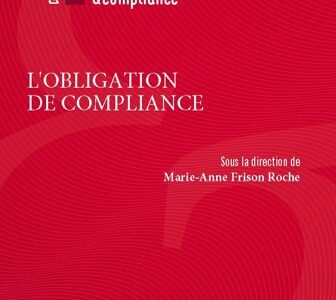
- ► Full Reference: M.-A. Frison-Roche (dir.), L’Obligation de Compliance, coll.”Régulations & Compliance“, Journal of Regulation & Compliance (JoRC) and Dalloz, 2025. - 📘 At the same time, a book in English, Compliance Obligation, is published in the collection copublished by the Journal of Regulation & Compliance (JoRC) and the Éditions Bruylant. - 🧮the book follows the cycle of colloquia organised by the Journal of Regulation & Compliance (JoRC) and its Universities partners in 2023 and 2024. - 📚this volume is one of a series of books devoted to Compliance in this collection. ► Read the presentations of the other books in the series: the following books: 🕴️M.-A. Frison-Roche (ed.), 📕Compliance et Contrat, forthcoming 🕴️L. Laref (ed.), 📕Compliance et vigilance bancaire, forthcoming 🕴️M.-A. Frison-Roche, 📕Le système juridique de l’adressage de l’Internet. Une structure multi-acteurs, gage de durabilité (The Legal System of Internet Addressing. A Multi-Stakeholder Structure, the Pledge of its Sustainability), forthcoming 🕴️M.-A. Frison-Roche (ed.), 📕Le système probatoire de la Compliance, forthcoming the previous books: 🕴️M.-A. Frison-Roche and M. Boissavy (eds.), 📕Compliance et droits de la défense. Enquête interne – CJIP – CRPC, 2024 🕴️M.-A. Frison-Roche (ed.), 📕La juridictionnalisation de la Compliance, 2023 🕴️M.-A. Frison-Roche (ed.), 📕Les Buts Monumentaux de la Compliance, 2022 🕴️M.-A. Frison-Roche (ed.), 📕Les outils de la Compliance, 2021 🕴️M.-A. Frison-Roche (ed.), 📕Pour une Europe de la Compliance, 2019 🕴️N. Borga, J.-Cl. Marin and J.-Ch. Roda (eds.), 📕Compliance : l’entreprise, le régulateur et le juge, 2018 🕴️M.-A. Frison-Roche (ed.), 📕Régulation, Supervision, Compliance, 2017 🕴️M.-A. Frison-Roche (ed.), 📕Internet, espace d’interrégulation, 2016 📚see the global presentation of all the books of the collection. - ► General presentation of this book: Compliance is sometimes presented as something that cannot be avoided, which is tantamount to seeing it as the legal obligation par excellence, Criminal Law being its most appropriate mode of expression. It is sometimes presented as something that the company does out of ethical concern, self-regulation which is the opposite of legal obligation. For the moment, therefore, there is no single vision of the Compliance Obligation. This is all the less the case because of the multitude of texts, themselves constantly evolving and changing, which inject such a wide range of compliance obligations that we give up trying to establish any unity, thinking that, on a case-by-case basis, we will define a regime and a legal constraint of greater or lesser strength, aimed at one subject or debtor or another, for the benefit of one or other. This lack of unity, due to the absence of a definition of the Compliance Obligation, makes the application of the texts difficult to foresee and therefore makes the Judge fearful, even though he/she is going to take on more and more importance. This book asks the practical questions: What is Compliance obliging? Who is obliged to comply? and How far are we obliged to comply? and provides answers, Compliance practices, constraints and innovations will be better mastered and anticipated by all those they affect: companies, stakeholders, technicians, lawyers, consultants, institutions and courts. - 🏗️general construction of this Book: The book opens with a double Introduction. The first, which is freely accessible, consists of a summary of the book, while the second, which is substantial, deals with the unified conception that we can, and indeed should, have, of the “Compliance Obligation”, without losing the concrete and active character that characterises this branch of law. The first Part of the book aims to define the Compliance Obligation. To this end, Chapter I deals with the Nature of this obligation. Chapter II deals with the Spaces of the Compliance Obligation. The Part II aims to articulate the Compliance Obligation with other branches of Law. The Part III of the book looks at the way in which the possibility of obliging and the means of obliging are provided. To this end, Chapter I deals with the Convergence of the Sources of the Compliance Obligation. Chapter II considers International Arbitration as a reinforcement of the Compliance Obligation. To this end, Chapter I deals with the Convergence of the Sources of the Compliance Obligation. Chapter II considers International Arbitration as a reinforcement of the Compliance Obligation. The last Part of the book is devoted to Vigilance, the leading edge of the Compliance Obligation. Chapter I is devoted to a study of the various sectors, and analyses the Intensities of the Vigilance Obligation. Chapter II deals with the Variations in Tension generated by the Vigilance Obligation. Finally, Chapter III deals with the New Modalities of the Compliance Obligation, highlighted by the Vigilance Imperative. - TABLE OF CONTENTS ANCRER LES OBLIGATIONS DE COMPLIANCE SI DIVERSES DANS LEUR NATURE, LEURS REGIMES ET LEUR FORCE POUR DEGAGER L’UNITE DE L’OBLIGATION DE COMPLIANCE LA RENDANT COMPREHENSIBLE ET PRATIQUABLE (ANCHOR COMPLIANCE OBLIGATIONS, SO DIVERSE IN THEIR NATURE, THEIR REGIMES AND THEIR FORCE, TO BRING OUT THE UNITY OF THE COMPLIANCE OBLIGATION MAKING IT COMPREHENSIBLE AND PRACTICABLE) ♦️ Obligation de Compliance : construire une structure de compliance produisant des effets crédibles au regard des Buts Monumentaux visés par le Législateur (Compliance Obligation: building a compliance structure that produces credible results with regard to the Monumental Goals targeted by the Legislator), by 🕴️Marie-Anne Frison-Roche TITRE I. CERNER L’OBLIGATION DE COMPLIANCE (IDENTIFYING THE COMPLIANCE OBLIGATION) CHAPITRE I : LA NATURE DE L’OBLIGATION DE COMPLIANCE (THE NATURE OF THE COMPLIANCE OBLIGATION) Section 1 ♦️ La volonté, le cœur et le calcul, les trois traits cernant l’Obligation de Compliance (Will, Heart and Calculation, the three traits encercling the Compliance Obligation), by 🕴️Marie-Anne Frison-Roche Section 2 ♦️ De la dette à l’obligation de compliance (From the Debt to the Compliance Obligation), by 🕴️Bruno Deffains Section 3 ♦️ Obligation de Compliance et droits humains (Compliance Obligation and Human Rights), by 🕴️Jean-Baptiste Racine Section 4 ♦️ L’Obligation de Compliance et les mutations de la souveraineté et de la citoyenneté (Compliance Obligation and changes in Sovereignty and Citizenship), by 🕴️René Sève Section 5 ♦️ La définition de l”obligation de compliance confrontée au droit de la cybersécurité (The definition of the Compliance Obligation in Cybersecurity Law) by🕴️Michel Séjean CHAPITRE II : LES ESPACES DE L’OBLIGATION DE COMPLIANCE (SPACES OF THE COMPLIANCE OBLIGATION) Section 1 ♦️ Entités industrielles et Obligation de compliance (Industrial entities and Compliance Obligation), by 🕴️Etienne Maclouf Section 2 ♦️ L’Obligation de Compliance dans les chaînes de valeur (The Compliance Obligation in Value Chains), by 🕴️Lucien Rapp Section 3 ♦️ Compliance et conflits de lois. Le droit international de la vigilance-conformité à partir de quelques applications récentes sur le continent européen (Compliance and conflict of laws. International Law of Vigilance-Conformity, based on recent applications in Europe), by 🕴️Louis d’Avout TITRE II. ARTICULER L’OBLIGATION DE COMPLIANCE AVEC DES BRANCHES DU DROIT (ARTICULATING THE COMPLIANCE OBLIGATION WITH BRANCHES OF LAW) Section 2 ♦️ Droit fiscal et obligation de compliance (Tax Law and Compliance Obligation), by 🕴️Daniel Gutmann Section 3 ♦️ Le droit processuel, prototype de l’Obligation de Compliance (General Procedural Law, prototype of the Compliance Obligation), by 🕴️Marie-Anne Frison-Roche Section 4 ♦️ Le droit des sociétés et des marchés financiers face à l’Obligation de Compliance (Corporate and Financial Markets Law facing the Compliance Obligation), by 🕴️Anne-Valérie Le Fur Section 4 ♦️ Transformation de la gouvernance et obligation de vigilance, by 🕴️Véronique Magnier Section 5 ♦️ Le rapport entre le Droit de la responsabilité civile et l’Obligation de Compliance (The link between Tort Law and Compliance Obligation), by 🕴️Jean-Sébastien Borghetti Section 6 ♦️ Dimensions environnementales et climatiques de l’Obligation de Compliance (Environmental and Climatic Dimensions of the Compliance Obligation), by 🕴️Marta Torre-Schaub Section 7 ♦️ Droit de la concurrence et Droit de la Compliance (Competition Law and Compliance Law), by 🕴️Jean-Christophe Roda Section 8 ♦️ L’Obligation de Compliance en Droit global (The Compliance Obligation in Global Law), by 🕴️Benoît Frydman & 🕴️Alice Briegleb Section 9 ♦️ Les juges du droit des entreprises en difficulté et les obligations de compliance (Judges of Insolvency Law and Compliance Obligations), by 🕴️Jean-Baptiste Barbièri TITRE III. COMPLIANCE : DONNER ET SE DONNER LES MOYENS D’OBLIGER (COMPLIANCE : GIVE AND TAKE THE MEANS TO OBLIGE) CHAPITRE I : LA CONVERGENCE DES SOURCES (CONVERGENCE OF SOURCES) Section 1 ♦️ Obligation sur obligation vaut (Compliance Obligation on Obligation works), by 🕴️Marie-Anne Frison-Roche Section 2 ♦️ Les technologies disponibles, prescrites ou proscrites pour satisfaire Compliance et Vigilance (Technologies available, prescribed or prohibited to meet Compliance and Vigilance requirements), by 🕴️Emmanuel Netter Section 3 ♦️ Contrainte légale et stratégie des entreprises en matière de Compliance (Legal Constraint and Company Strategies in Compliance matters), by 🕴️Jean-Philippe Denis & Nathalie Fabbe-Costes Section 4 ♦️ La loi, source de l’Obligation de Compliance (The Law, source of the Compliance Obligation), by 🕴️Jean-Baptiste Blanc Section 5 ♦️ Opposition et convergence des systèmes juridiques américains et européens dans les règles et cultures de compliance (Opposition and Convergence of American and European Legal Systems in Compliance Rules and Cultures), by 🕴️Raphaël Gauvain & 🕴️Blanche Balian Section 6 ♦️ Ce à quoi les engagements engagent qu’est un engagement (What a ), by 🕴️Marie-Anne Frison-Roche CHAPITRE II : L’ARBITRAGE INTERNATIONAL EN RENFORT DE L’OBLIGATION DE COMPLIANCE (INTERNATIONAL ARBITRATION IN SUPPORT OF THE COMPLIANCE OBLIGATION) Section 1 ♦️ Comment l’arbitrage international peut être un renfort de l’Obligation de Compliance (How International Arbitration can reinforce the Compliance Obligation), by 🕴️Laurent Aynès Section 2 ♦️ La considération par l’Arbitrage de l’Obligation de Compliance pour une place d’arbitrage durable (Arbitration’ consideration of Compliance Obligation for a Sustainable Arbitration Place), by 🕴️Marie-Anne Frison-Roche Section 3 ♦️ L’usage de l’arbitrage international pour renforcer l’obligation de Compliance : l’exemple du secteur de la construction (The use of International Arbitration to reinforce the Compliance Obligation: the example of the construction sector), by 🕴️Christophe Lapp Section 4 ♦️ L’arbitre, juge, superviseur, accompagnateur ? (The Arbitrator, Judge, Supervisor, Support) , by 🕴️Jean-Baptiste Racine TITRE IV. LA VIGILANCE, POINTE AVANCÉE DE L’OBLIGATION DE COMPLIANCE (VIGILANCE, SPEARHEAD OF THE COMPLIANCE OBLIGATION) Section 1 ♦️ La Vigilance, pointe avancée et part totale de l’Obligation de Compliance (….), by 🕴️Marie-Anne Frison-Roche CHAPITRE I : LES INTENSITÉS DE L’OBLIGATION DE VIGILANCE, POINTE AVANCÉE DU SYSTÈME DE COMPLIANCE (INTENSITIES OF THE VIGILANCE OBLIGATION, SPEARHEAD OF THE COMPLIANCE SYSTEM) Section 2 ♦️ L’intensité de l’Obligation de Vigilance selon les secteurs : le cas des opérateurs financiers (Intensity of the Vigilance Obligation by Sectors: the case of Financial Operators), by 🕴️Anne-Claire Rouaud Section 3 ♦️ L’intensité de l’Obligation de Vigilance selon les secteurs : le cas des opérateurs bancaires et d’assurance (Intensity of the Vigilance Obligation by Sectors: the case of Banking and Insurance Operators), by 🕴️Mathieu Françon Section 4 ♦️ L’intensité de l’obligation de vigilance selon les secteurs : le cas des opérateurs numériques (Intensity of the Vigilance Obligation by Sectors: the case of Digital Operators), by 🕴️Grégoire Loiseau Section 5 ♦️ L’Obligation de vigilance des opérateurs énergétiques (The Vigilance obligation of Energy Operators), by 🕴️Marie Lamoureux CHAPITRE II : LES DISPUTES AUTOUR DE L’OBLIGATION DE VIGILANCE, POINTE AVANCÉE DU SYSTÈME DE COMPLIANCE, DANS SON RAPPORT AVEC LA RESPONSABILITÉ Section 1 ♦️ Le rapport entre le droit de la responsabilité civile et l’obligation de compliance, by 🕴️Jean-Sébastien Borghetti Section 2 ♦️ Repenser le concept de responsabilité civile à l’aune du devoir de vigilance, pointe avancée de la compliance (Rethinking the Concept of Civil Liability in the light of the Duty of Vigilance, Spearhead of Compliance), by 🕴️Mustapha Mekki Section 3 ♦️ Tensions et contradictions entre les instruments relatifs à la vigilance raisonnable des entreprises, by 🕴️Laurence Dubin Section 4 ♦️ Compliance, Vigilance et Responsabilité civile : mettre en ordre et raison garde (Compliance, Vigilance and Civil Liability: put in order and keep the Reason), by 🕴️Marie-Anne Frison-Roche CHAPITRE III : LES MODALITÉS NOUVELLES DE L’OBLIGATION DE COMPLIANCE, MISES EN LUMIÈRE PAR L’IMPÉRATIF DE VIGILANCE (NEW MODALITIES OF THE COMPLIANCE OBLIGATION, HIGHLIGHTED BY THE VIGILANCE IMPERATIVE) Section 1 ♦️ Clauses et contrats, modalités de l’obligation de vigilance (Clauses and Contracts, terms and conditions of implementation of the Vigilance Obligation), by 🕴️Gilles J. Martin Section 2 ♦️ La preuve de la bonne exécution de la Vigilance au regard du système probatoire de Compliance (Proof that Vigilance has been properly carried out with regard to the Compliance Evidence System), by 🕴️Jean-Christophe Roda TITRE V. LE JUGE ET L’OBLIGATION DE COMPLIANCE (THE JUDGE AND THE COMPLIANCE OBLIGATION) Section 1 Section 1 ♦️ Devoir de vigilance et litiges commerciaux : une compétence à partager ?, par 🕴️François Ancel Section 2 ♦️ Les enjeux présents à venir de l’articulation des principes de procédure civile et commerciale avec la logique de compliance (Present and Future Challenges of Articulating Principles of Civil and Commercial Procedure with the Logic of Compliance), by 🕴️Thibault Goujon-Bethan Section 3 ♦️ Le juge de l’amiable et la compliance (The amicable settlement judge and compliance), by 🕴️Malik Chapuis Section 4 ♦️ Le juge adéquat pour l'effectivité de l'Obligation de Compliance (The Adequate Judge for the Effectiveness of the Compliance Obligation), by 🕴️Marie-Anne Frison-Roche L’OBLIGATION DE COMPLIANCE : VISION D’ENSEMBLE (COMPLIANCE OBLIGATION : OVERVIEW) ♦️ L’obligation de compliance, charge portée par les entreprises systémiques donnant vie au Droit de la Compliance. – lignes de force de l’ouvrage (The Compliance Obligation, a burden borne by Systemic Companies giving life to Compliance Law – key points of the book (free access) by 🕴️Marie-Anne Frison-Roche - 🌐follow Marie-Anne Frison-Roche on LinkedIn 🌐follow Marie-Anne Frison-Roche on Instagram 🌐subscribe to the Newsletter MAFR Regulation, Compliance, Law 🌐subscribe to the VideoNews MAFR Surplomb 🌐subscribe to the Newsletter MaFR Law & Art