Publication director
🏗️ copublishing and direction of the collection: 📚Compliance & Regulation

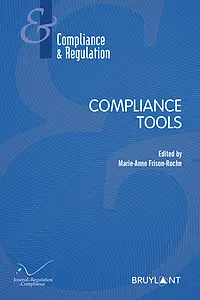
► Full Reference: Frison-Roche, M.-A. (ed.), Compliance Tools, series “Régulations & Compliance“, Journal of Regulation & Compliance (JoRC) & Bruylant, 2021. This book in English is the first title of this collection integrally dedicated to Compliance Law, in that it is the extension of Regulation Law. - Read the titles of this series in English co-published by Bruylant. This collection in English is articulated with a collection co-published between the Journal of Regulation & Compliance and Dalloz. Thus, in parallel, a book in French, Les Outils de la Compliance is published. - 📅 This book is published after a cycle of colloquiums organised by the Journal of Regulation & Compliance (JoRC) and Partners Universities. - ► General Presentation of the collective book: The political dimension of Compliance Law lies in the goals it aims to achieve. To achieve them, the concern for these goals is internalized in “crucial operators”, which may be obliged to concretize “monumental goals” set by public authorities. These public bodies control the Ex Ante reorganization that this implies for these companies and sanction Ex Post the possible inadequacy of the companies, which have become transparent to this end. The effectiveness and efficiency of this internalization, without which the statement of these goals is worth nothing, is based on the Compliance tools that are deployed. These appear to be very diverse but their substantial unity (topic which will be the subject of a forthcoming book) makes it possible to study the tools put in place from a unique perspective, by not isolating them in a particular branch of Law, Criminal law or International Law for example, but by measuring what is common to them, notably Anticipation, Trust, Commitment, Responsibility, Incentive, and so on. If the Compliance tools vary, it is rather not only according to the sectors, finance and banking appearing then as the advanced point of the general Compliance Law, for example in environmental matters, but also according to the countries and the cultures. It is in fact about them that legal cultures seem to oppose. The book aims to understand these “tools” by going beyond the description of each instrument, for which we already have many monographs, for analyzing them through the issues of Risks, required Expertises, Training. Sovereignty claims, Incentives, mechanical aptitude of Technologies. It is through these themes that are analyzed by the authors, experts in the field, what we always want to understand better: Compliance Programs, Whistle blowing, Mapping, Sanctions, Extraterritoriality, etc. - Read the summary of the book. Read the foreword, summarizing all the contributions. Présentation of the book contributions: 📝Amico, Th., Compliance or the passage from ex post to ex ante: A Copernican revolution for the criminal lawyer? 📝Banck, A., The maturity of the Compliance tool’s user, first criterion of the choice of the salient tool 📝Burlingame, Coppens R., Power, N, Lee, D.H., Anti-Corruption Compliance: Global Dimension of Enforcement and Risk Management 📝Calandri, L., Incentive(s) and Self-Regulation(s): which place for Compliance Law in the Audiovisual Sector? 📝Causse, H., Compliance Training: Through and Beyond Traditional Legal Training 📝Frison-Roche, M.-A., Describing, designing and correlating Compliance Tools to have a better use of it 📝Frison-Roche, M.-A., Building by Law the Unicity of Compliance Tools from the Definition of Compliance Law by its “Monumental Goals” 📝Frison-Roche, M.-A., Drawing up Risk Maps as an obligation and the paradox of the “Compliance risks” 📝 Frison-Roche, M.-A., Incentives and Compliance, a couple to propel 📝 Frison-Roche, M.-A., Resolving the contradiction between sanctions and incentives under the fire of Compliance Law 📝 Frison-Roche, M.-A., Rights, primary and natural Compliance tools 📝 Frison-Roche, M.-A., Training: content and container of Compliance Law 📝 Galland, M., The Regulator’s Inspection of the Effectiveness of the Compliance Tools Implemented by the Company 📝 Granier, C., The Normative Originality of Compliance by Design 📝 Guillaume, N., Compliance risk mapping: first insights of challenges, limits and good practices 📝Guttierez-Crespin, A., Audit of Compliance Systems 📝 Koenigsberg, S. and Barrière, F., The Development of Attorney’s Compliance Expertise 📝 Larouer, M., The Manifestation of Incentives Mechanisms in French Compliance Law 📝 Merabet, S., Morality by Design 📝 Pailler, L., Technological Tools, Compliance by Design and GDPR: the Protection of Personal Data from Design 📝 Racine, J.-B., Geographical dominance in the choice and the use of Compliance Tools. Introductory remarks 📝Rapp, L., Incentive Theory and Governance of Space Activities 📝 Roda, J.-C., Compliance by design in antitrust: between innovation and illusion 📝 Salah, M., Conception and Application of Compliance in Africa 📝 Tardieu, H., Data Sovereignty and Compliance 📝 Thouret, T., Training and Compliance, Two Correlated Information Transmission Tools