Lectures Related to Justice and Procedure

Conferences

Conference

🎤Les spécificités à concevoir dans l’audience publique des contentieux systémiques de vigilance (The Specific Features of Public Hearings to conceive on Vigilance Systemic Litigation), in 🧮Le Droit processuel de la Vigilance (Vigilance General Procedural Law)

► Full Reference: M.-A. Frison-Roche, "Les spécificités à concevoir dans l'audience publique des contentieux systémiques de vigilance" ("The Specific Features of Public Hearings to conceive on Vigilance Systemic Litigation"), in Le Droit processuel de la Vigilance (Vigilance General Procedural Law), in cycle of conference-debates "Contentieux Systémique Émergent" ("Emerging Systemic Litigation"), organised on the initiative of the Cour d'appel de Paris (Paris Cour of Appeal), with the Cour de cassation (French Court of cassation), the Cour d'appel de Versailles (Versailles Court of Appeal), the École nationale de la magistrature – ENM (French National School for the Judiciary) and the École de formation des barreaux du ressort de la Cour d'appel de Paris – EFB (Paris Bar School), under the scientific direction of Marie-Anne Frison-Roche, November 18, 2024, 11h-12h30, Cour d'appel de Paris, Cassin courtroom - 🕴️An other speaker to this conference is Natalie Fricero, Emeritus Professor at Côte d'Azur University 🧮see the full programme of this event - ⚙️This event was conceived as part of the "Emerging Systemic Litigation" cycle of conference-debates, organized by the Paris Court of appeal, in conjunction with the French Court of cassation, the Versailles Court of appeal, the French National School for the Judiciary and the Paris Bar School, under the scientific direction of Marie-Anne Frison-Roche. - ► English Summary of the conference:  - follow Marie-Anne Frison-Roche on LinkedIn follow Marie-Anne Frison-Roche on Instagram subscribe to the Newsletter MAFR Regulation, Compliance, Law subscribe to the Newsletter Surplomb, par MAFR

Conferences

Conference

🎤Choix et embranchements de compétences lorsqu’un enjeu de vigilance est allégué (Choice and Branching of Jurisdiction when a Vigilance issue is Alleged), in 🧮Le Droit processuel de la Vigilance (Vigilance General Procedural Law)

► Full Reference: M.-A. Frison-Roche, "Choix et embranchements de compétences lorsqu'un enjeu de vigilance est allégué" ("Choice and Branching of Jurisdiction when a Vigilance issue is Alleged"), in Le Droit processuel de la Vigilance (Vigilance General Procedural Law), in cycle of conference-debates "Contentieux Systémique Émergent" ("Emerging Systemic Litigation"), organised on the initiative of the Cour d'appel de Paris (Paris Cour of Appeal), with the Cour de cassation (French Court of cassation), the Cour d'appel de Versailles (Versailles Court of Appeal), the École nationale de la magistrature – ENM (French National School for the Judiciary) and the École de formation des barreaux du ressort de la Cour d'appel de Paris – EFB (Paris Bar School), under the scientific direction of Marie-Anne Frison-Roche, November 18, 2024, 11h-12h30, Cour d'appel de Paris, Cassin courtroom - 🕴️An other speaker to this conference is Natalie Fricero, Emeritus Professor at Côte d'Azur University 🧮see the full programme of this event - ⚙️This event was conceived as part of the "Emerging Systemic Litigation" cycle of conference-debates, organized by the Paris Court of appeal, in conjunction with the French Court of cassation, the Versailles Court of appeal, the French National School for the Judiciary and the Paris Bar School, under the scientific direction of Marie-Anne Frison-Roche. - ► English Summary of the conference: This speech opens the conference. It therefore logically focuses on the question of "jurisdictional competence". It is divided into successive points which are progressively linked to each other. The first point consists to insist on this rule : the organisation of the courts and their jurisdiction can never be detached from the substance of the matter in dispute. This explains why the issue of jurisdiction is such a source of passion for as long as the very definition of Vigilance remains so contentious, and why the 2021 legislature's belief that it could put out the fire has only served to exacerbate it. The second point relates to the first proposed solution, i.e. maintaining the exclusivity of the Paris First Judicial Court, which is acceptable in principle because by specialising judges acquire a "technical competence" but which presents a very damaging "Bibendum risk". The third point relates to the second solution proposed, namely the reference to the Motulskian notion of the 'basis of demand', which provokes a fork in the road, with the risk of interminable conflicts and divergent interpretations. The fourth point is the need to find the best solution, i.e. the least bad solution, consisting above all of forming practical alliances, without requiring new texts, for this particular type of litigation which does not come under any branch of Law and which justifies a dialogue between the heads of the courts.           - 🔓read the key points of this speech below ⤵️ - follow Marie-Anne Frison-Roche on LinkedIn follow Marie-Anne Frison-Roche on Instagram subscribe to the Newsletter MAFR Regulation, Compliance, Law subscribe to the Newsletter Surplomb, par MAFR

Conferences

Conference

🎤Considérer la géographie pour réussir le Devoir de Vigilance (Taking Geography into account for a successful Vigilance Duty), in 🧮Devoir de vigilance, quelles perspectives africaines ? Regards croisés en droit international, droit comparé et droit OHADA

► Full Reference: M.-A. Frison-Roche, "Considérer la géographie pour réussir le Devoir de Vigilance" ("Taking Geography into account for a successful Vigilance Duty"), concluding speech in Devoir de vigilance, quelles perspectives africaines ? Regards croisés en droit international, droit comparé et droit OHADA (Vigilance Duty : what African perspectives? Cross-analysis of International Law, Comparative Law and OHADA Law), Institut de Recherche en Droit des Affaires et du Patrimoine (IRDAP), Bordeaux, 15 November 2024. - 🧮see the full programme of this manifestation (in French) - ► English summary of this concluding speech: This concluding speech was made "on the bench", i.e. directly after listening to all the day's speakers. It is not, therefore, based on an a priori conception of the subject, but on the impression that emerged from the whole, as one speaker followed another. The general impression is that these compliance instruments, of which the vigilance tool is the spurred head, are only appropriate if they fulfill the purpose for which they were devised and imposed, which presupposes that they are appropriate to the concrete situations to which they apply: to the country, to the legislation that shapes and expresses this country, to its economy, to its population. There is certainly room for improvement. But Vigilance legal instruments, like Compliance Law, are new mechanisms that are in the process of taking shape: we must seek to improve them and find solutions: 🧱🕴🏻mafr, 🚧Duty of Vigilance: the way forward, 2024   This is not easy, especially if we get lost in the jigsaw puzzle of texts and decisions in which the vigilance technique fits, particularly at French, European and international level: 🧱🕴🏻mafr, 🚧Vigilance, a piece of the European puzzle, 2023   Listening to all the many and varied speakers, it is clear that progress needs to be made to ensure that the Vigilance instrument takes greater account of the concrete situations reflected in the various legal systems of African countries, and in particular the unified OHADA legal system. It can be done, as long as everyone is willing to bear it in mind. 🧱🕴🏻J.-B. Racine, 📝Geographical dominance in the choice and the use of compliance tools. Introductory remarks, in 🧱🕴🏻mafr (ed.), 📘Compliance Tools, 2021   The speakers demonstrated that the good feelings of Paris or Brussels can pave the way for African hell, for example when about the children labour. The same is true of the fight against corruption, as Mohamed Salah showed. 🧱🕴🏻M.M. Salah ,📝Conception and Application of Compliance in Africa, in 🧱🕴🏻mafr (ed.), 📘Compliance Tools, 2021 - Meanwhile, listening to each other, it appears that often, despite using the same words, the speakers were not talking about the same thing, particularly not in terms of what the very term "Vigilance" refers to, the difference between the French and English being a challenge because "due diligences" are not the same than Vigilance duty . This is a sign that what we call a duty, or an obligation, or a spontaneous commitment, or a legal order criminally sanctioned, which are not at all the same thing, shows the immaturity of this notion of "Vigilance". What's more, we sometimes talk about the climate, or human rights, or the need to fight corruption or money laundering. These latter concerns are undoubtedly covered by texts classified under Compliance Law, some of which assert that Vigilance is the cutting edge, while others claim that Compliance is alien to or merely a component of Vigilance, because Vigilance embraces ethics, while Compliance is merely obedience to the norm ('conformity'). It is clear that the absence of an agreement on definitions is a handicap in practice, as we do not know which legal regime will apply. This uncertainty is problematic in practice because the regulations don't  lay down definitions which alone make it possible to deduce the outline of the obligations of each party, particularly not those of the companies, which ask for instructions for use. Companies receive contradictory interpretations for the same situation, depending on who you are dealing with (a regulator or an NGO for example) or depending on the text (a text specific to the industrial activity, a text specific to the country, or a text from the country of the ordering company on the duty of vigilance, or a text from ordinary contract law or a text that will come from a soft law that remains rather mysterious).   This uncertainty feeds the passion that surrounds the issue of vigilance, with everyone speaking out, the specialists who want to talk about it being suspected of being a technocrat or captured, and those who don't speak out being the local population for whom others speak out. As a result, two phenomena are set to persist, which we had hardly anticipated but which are set to increase: the contractualisation of all vigilance mechanisms and the jurisdictionalisation of all vigilance organisation. - The first phenomenon is the contracting of Vigilance. This contractualisation is the means by which companies have been carrying out their legal compliance obligations for years, using a contractual art that is becoming increasingly sophisticated. We have very little information on these contracts, which are nonetheless what allow companies to obey the regulations and also to add to them, a combination of obedience and contractual freedom, the effects of which in practice have not yet been fully measured. 🧱🕴🏻mafr, 🚧Will, Heart and Calculation, the Three Traits Encercling the Compliance Obligation, 2024 🧱🕴🏻mafr (ed.), 📘Compliance and Contract, 2025   But they do raise essential questions. Firstly, they will bring back the jurisdiction of general courts , for example the commercial courts (tribunaux de commerce) in France, and the courts of the countries where the industrial operations take place: moreover, they are the natural route to international arbitration. They are a new type of contract, since they structure "value chains" (a managerial concept). 🧱🕴🏻mafr, 🚧Compliance Contract, Compliance Clauses, 2022   There are two key issues concerning these contracts: they directly concern African countries, their economic activity and their populations, as described throughout all the speeches. The first is to know who governs the structural apparatus constituted by these 'regulatory contracts' through which chains of activity are built as durable structures. Who is strong and who is weak, between companies and states? The second is to find out how much of the reality of the country and of local economic activity is taken into account by the subsidiary, and how much consideration is given to the local people involved: are the people who are actually involved really "taken into consideration" when we speak for them? Who is best placed to speak on their behalf, to defend them, to get to know them? If we want to contextualise, refine and get to know the situation as closely as possible, in other words if we want to have definitions so that we know what we are talking about, but at the same time start from geographical and human realities, then it is the Judge who appears because the court starts from the facts. - This is the second phenomenon that has emerged and is set to increase: the jurisdictionalisation of Vigilance. 🧱🕴🏻mafr (ed.), 📘Compliance Jurisdictionalisation, 2023 This is understandable, since the judge is able to take cognisance of the facts, the situation in Uganda or Tanzania, and what is often referred to as the "extraterritoriality" of the Compliance mechanisms being thus compensated for. However, the exclusive jurisdiction of the Paris Court of First Instance (decided in France by a 2021 law) may become more difficult, as it is even further away from Africa than the ordering company is. But it is precisely the contract judges who can be called upon to rule on the basis of Contract Law. This central role of the judge raises a number of procedural difficulties that have either not yet been resolved, moreover are not still being perceive 🧱🕴🏻mafr (dir.), 🧮Le Droit processuel de la Vigilance (Vigilance Genreral Procedural Law), 2024   At the interface between procedure and substance, evidentiary issues require the development of a new evidentiary system. When the relevant facts are in Africa but the company accountable for them is in France under legislation adopted in Europe, this must be taken into account. 🧱🕴🏻mafr, 📝The Judge, the Compliance Obligation and the Company. The Compliance Evidence System, in 🧱🕴🏻mafr (ed.), 📘Compliance Jurisdictionalisation, 2023   What's more, since the Monumental Goal is to prevent, manage and detect risks, it is the future that is the main object of proof. A difficult subject by its very nature of the future, which calls for caution. Caution is to be expected from Judges, who may prefer the solution of an agreement: the contract and the commitment come back, for example through mediation, among the methods of conflict resolution. But as close as possible to where it happens, OHADA's courts can then be called upon to hear States and populations.   What is more, in contractualisation (at which point the two major phenomena, contractualisation and jurisdictionalisation, enter into a dialectic), the clauses work together to activate the natural judge of the international contract, including vigilance clauses: the international arbitrator. 🧱🕴🏻L. Aynès, 📝How international arbitration can reinforce the Compliance Obligation, in 🧱🕴🏻mafr (ed.), 📘Compliance Obligation, 2025   OHADA has institutional arbitration mechanisms. Now is the time to guide them so that they open up Africa to Vigilance and open up Vigilance to Africa. In concrete terms. - follow Marie-Anne Frison-Roche on LinkedIn follow Marie-Anne Frison-Roche on Instagram subscribe to the Newsletter MAFR Regulation, Compliance, Law subscribe to the Newsletter Surplomb, par MAFR

Articles in a legal collective publication

💬”Les droits de la défense sont au bénéfice de tout le monde, y compris de l’entreprise elle-même” (The rights of defence benefit everyone, including the company itself)

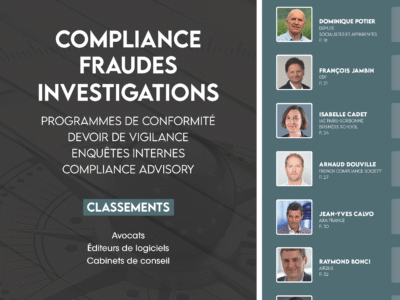
► Full Reference: M.-A. Frison-Roche, "Les droits de la défense sont au bénéfice de tout le monde, y compris de l’entreprise elle-même" (The rights of defence benefit everyone, including the company itself), interview by Chloé Lassel, in Guide Compliance Fraudes Investigations, edition 2024, ed. Décideurs, Oct. 2024, pp. - 💬read the interview (in French) its  présentation on LinkedIn (in French) - ► Presentation of this interview by Décideurs juridiques : "Directrice du Journal of Regulation & Compliance (JoRC) et fondatrice de l’École européenne de droit de la régulation et de la compliance, Marie-Anne Frison-Roche revient sur la révolution du droit de la compliance, son articulation avec les enquêtes internes et les droits de la défense, la place que vont y prendre les contrats et l’arbitrage international." ("Marie-Anne Frison-Roche, Director of the Journal of Regulation & Compliance (JoRC) and founder of the European School of Regulatory and Compliance Law, looks back at the revolution in Compliance Law, its relationship with internal investigations and the rights of the defence, and the role that contracts and international arbitration will play in it. - ► Questions asked, Answers given:  Décideurs. Question : La compliance est au cœur des préoccupations des entreprises depuis plusieurs années. Pouvez-vous expliquer ce que c’est exactement ? (Compliance has been a key concern for companies for several years. Can you explain what it is exactly?) Marie-Anne Frison-Roche. English summary Answer: 'Compliance' should not be confused with 'Compliance', which I defined in 2016. Compliance Law is an extension of Regulatory Law, by freeing the latter from the existence of a sector as a prerequisite and a regulatory authority as an indicator. Internalised in the company, it manifests itself, for example, in Vigilance mechanisms, which are its cutting edge. Through Compliance, the political authority asks companies to help it achieve "Monumental Goals", as I have suggested, standards in which this new branch of Law is anchored (anti-money laundering, anti-corruption, sustainability, etc.).   D. Q. : Les entreprises doivent désormais être enquêtrices et juges de ce qu’il leur arrive. Voire transmettre aux autorités, lorsqu’il le faut, des informations pouvant les incriminer. Comment concilier ces obligations avec les droits de la défense ? (Companies must now be investigators and judges of what happens to them. When necessary, they can even pass on incriminating information to the authorities. How do you reconcile these obligations with the rights of the defence?) MaFR. English summary A.: In 2023, I proposed this expression of companies as "prosecutors and judges of themselves", and the place that this should give to the rights of the defence, and in 2024 I will work out the right balance between internal investigations and the rights of the defence. For the moment, this balance has not been achieved.   D. Q. : Dans l’un de vos ouvrages, François Ancel, conseiller à la première chambre civile de la Cour de cassation, écrit que la compliance renouvelle l’office du juge. Comment concilier cette idée avec l’office habituel du juge qui est celui de se prononcer sur des faits avérés et non pas futurs ? (In one of your books, François Ancel, judge in the First Civil Chamber of the French Court of Cassation, writes that Compliance is renewing the role of the judge. How do you reconcile this idea with the judge's usual role, which is to rule on proven facts rather than future ones?) MaFR. English summary A.: Indeed, In this book La juridictionnalisation de la compliance (Compliance Jurisdictionalisation), he stresses that the role of the civil and commercial courts is being profoundly renewed, in particular because they must deal with what I described in 2021 as "Systemic Litigation" and must rule on the future. From then on, the ordinary courts will take centre stage.   D. Q. : Le recours aux clauses de compliance est-il une solution pour être à la hauteur des ambitions de la compliance et de ses exigences ? (Is the use of compliance clauses a solution for living up to the ambitions and requirements of compliance?) MaFR. English summary A.: Indeed, in 2022, I developed the concepts of 'Compliance Contract' and 'Compliance clauses', by which companies implement their legal compliance obligations. This gives rise to Regulatory Contracts, particularly in business chains. This gives a great deal of leeway and power, but also Responsibility, to the companies that invent them.   D. Q. : Le recours aux arbitrages doit-il être privilégié ? (D. Q. Should recourse to arbitration be preferred?) MaFR. English summary A.: It has to be. Because there is a contract. Even though Compliance is closely bound up with the legal obligations and public order, and possibly international public order. Even if this is not yet apparent, Compliance and International Arbitration are natural allies. - follow Marie-Anne Frison-Roche on LinkedIn follow Marie-Anne Frison-Roche on Instagram subscribe to the Newsletter MAFR. Regulation, Compliance, Law subscribe to the Newsletter Surplomb, par MAFR
Articles

Interview

💬Compliance & arbitrage : les prémices d’une symbiose (💬Compliance & Arbitration: the beginnings of a symbiosis)

► Full Reference: M.-A. Frison-Roche, E. Silva Romero, G. Filhol, V. Autret, B. Sillaman et K. Hennessee, Compliance & arbitrage : les prémices d’une symbiose, propos recueillis par O. Delaunay, LJA Magazine, septembre-octobre 2024, pp. 12-20 - 💬read the collective interview (in French) - read the presentation of this interview on LinkedIn - ► Topics covered during this collective interview:  The development of Compliance in an international environment The Arbitrator and the concept of Compliance Linking Arbitration and Compliance systems - ► Summary of my interventions: Compliance Law appears to be developing in the context of international trade and Arbitration. For my part, I placed particular emphasis on the fact that the first reports were the result of "negative reports" between Compliance and Arbitration, through Criminal Law and the obligation of arbitrators to ensure that they don't give effectivity to pacts of corruption. But the future lies in a more 'positive' and fruitful relationship between this new branch of law, Compliance Law, and the solid prospect offered by Arbitration, in that the arbitrator, this natural judge of international trade, will be able to support the contractualisation of Compliance obligations, particularly about due diligences in structural chains of activities and duty of vigilance. Thus competent, the international arbitrator must respond to what the Monumental Goals in which Compliance Law is rooted expect of him/her: to provide solutions and remedies to issues that often concern an entire chain of activity or an entire sector in a more systemic perspective than in a traditional conception. This applies not only to investment arbitration, but also, for instance, to infrastructure arbitration. The concern for sustainability and the systemic perspective must be integrated into the reasoning and produce appropriate case law, a sort of new doctrine in the arbitration order, that will make more attractive the arbitration place that will most solidly link the skills of specialists in Compliance Law and Arbitration Law. - follow Marie-Anne Frison-Roche on LinkedIn follow Marie-Anne Frison-Roche on Instagram subscribe to the Newsletter MAFR. Regulation, Compliance, Law subscribe to the Newsletter Surplomb, by MAFR

Conferences

Conference

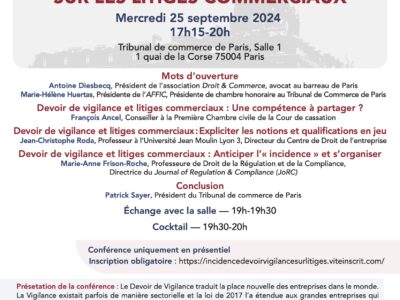
🎤Devoir de vigilance et litiges commerciaux : Anticiper l'”incidence” et s’organiser (Duty of vigilance and Commercial Litigation: Anticipating the “impact” and getting organised), in 🧮L’incidence du devoir de vigilance sur les litiges commerciaux (The Impact of the Duty of Vigilance on Commercial Litigation)

► Full Reference: M.-A. Frison-Roche, "Devoir de vigilance et litiges commerciaux : Anticiper l'"incidence" et s’organiser" ("Duty of vigilance and Commercial Litigation: Anticipating the "impact" and getting organised"), in L'incidence du devoir de vigilance sur les litiges commerciaux (The Impact of the Duty of Vigilance on Commercial Litigation), Tribunal de commerce de Paris (Paris Commercial Court), Droit & Commerce and Association Française en Faveur de l'Institution Consulaire (AFFIC), Tribunal de commerce de Paris, September 25, 2024, 17.15pm to 20pm - read the report of this speech on LinkedIn (in French) - 🧮see the full programme of this event (in French) - 🧱consult the scientific coordination sheet of this event - consult on LinkedIn a general presentation of this event (in French) - ► English Summary of the conference: After listening to the enlightening speeches of François Ancel and Jean-Christophe Roda, I had the great opportunity to emphasise, as they did, that the duty of vigilance, in the respect of French laws of 2017 and 2021, with a view to the transposition of the CS3D, does not imply, so brutally as has been said, a lack of knowledge by judges other than those of the Tribunal judiciaire de Paris (Paris First Instance Civil Court) of this new Law, which is the extension of Compliance Law, as François Ancel reminded us. Because Commercial Court judges deal with Contract Law on a daily basis, and because companies build their value chains through contracts that should be described as "regulatory contracts", the duty of vigilance has an "impact" on these disputes. These disputes may be of a "systemic" nature. This can only result not in jurisdictional trenches, but in "shared jurisdiction", along the lines drawn by François Ancel. This sharing must be built through a dialogue between judges, a necessary method on which Patrick Sayer concluded this elaborate conference on an essential and forward-looking subject. - follow Marie-Anne Frison-Roche on LinkedIn follow Marie-Anne Frison-Roche on Instagram subscribe to the Newsletter MAFR Regulation, Compliance, Law subscribe to the Video Newsletter MAFR Surplomb

Videos

Interview

🎥Companies and compliance: more aggressive justice and judges, in the 🎬series of talks on Compliance Law, in 📺Open windows on management

► Full reference:  M.-A. Frison-Roche, "Entreprises et compliance : une justice et des juges plus offensifs" ("Companies and compliance: more aggressive courts and judges"), interview conducted by Jean-Philippe Denis as part of a series of interviews on Compliance Law, in Fenêtres ouvertes sur la gestion (Open windows on management), broadcast by J.-Ph. Denis, Xerfi Canal, recorded December 12, 2023, released on June 14, 2024. - consult the December 2023 presentation of the interview on LinkedIn - watch the interview video on LinkedIn, with English subtitles - 🧱consult the general presentation of this series of interviews on Compliance Law - ► Starting point: Since 2016, Marie-Anne Frison-Roche has been building Compliance Law, notably through a collection co-published in French with Editions Dalloz and co-published in English with Editions Bruylant:  🧱read the presentation in English of the series in French, Régulations & Compliance ➡️click HERE  🧱read the presentation of the series in English, Compliance & Regulation ➡️click HERE - ► Summary of interview:   Jean-Philippe Denis. Question :  Marie-Anne Frison-Roche.  Answer. :  - J.-Ph D. Q. : Thus MaFR. A. : Yes,  - J.-Ph. D. Q. : Thus MaFR. A. : Yes,  -

Conferences

conference

🎤Participation au panel “Une Gouvernance responsable : vers un mieux vivre ensemble ?” (“Responsible corporate governance: towards a better way of living together”), in 🧮Grenelle du Droit 5

► Full Reference: M.-A. Frison-Roche, Participation in the panel "Une Gouvernance responsable : vers un mieux vivre ensemble ?" ("Responsible governance: towards a better way of living together"), in Grenelle du Droit 5. L'avenir de la filière juridique, Association française des juristes d'entreprise ("The future of the legal profession"), AFJE), Cercle Montesquieu and Paris Panthéon-Sorbonne University, Campus Port-Royal Université Paris 1 Panthéon-Sorbonne, 1 rue de la Glacière, 75013 Paris, June 12, 2024 - 🧮See the full programme of this event (in French) - watch the interview made just after this round-table discussion (in French) - 🪑🪑🪑🪑🪑 will also be taking part in this round-table discussion: 🕴️Yves Garagnon, Chairman of Dilitrust, 🕴️Pierrick Le Goff, lawyer, partner at De Gaulle Fleurance, 🕴️Sabine Lochmann, Chairman of Ascend, 🕴️Vincent Vigneau, President of the Commercial, Economic and Financial Chamber of the Cour de cassation (French Judicial Supreme Court) - ► English presentation of my intervention in this event's opening plenary  round-table: In this plenary round table which opens the event, devoted to the theme of 'responsible corporate governance', for my interventions based on my work I will have the opportunity to address more particularly these different perspectives: How the new Compliance Law, which gives concrete expression to the responsibility of enterprises in a new relationship with States and with civil society, constitutes a 'legal revolution 💡for the record, mafr,📝Compliance Law, 2016 ; (ed.) 📘Compliance Monumental Goals, 2022   how the judgment handed down by the Tribunal judiciaire de Paris (Paris First Instance Civil Court) on 28 February 2023 (Total Ouganda case) is remarkable and already constitutes a turning point in case law 💡for the record, mafr, 🎤audition as amica curiae, hearing of 26 October 2022 before the first instance Paris Court; (ed)📘Compliance Jurisdictionalisation, 2024   how the relationship between States and enterprises is being renewed by this profound legal movement expressed by Compliance Law 💡for the record, mafr et M. Boissavy (ed.), 📕Compliance et droits de la défense – Enquêtes internes, CJIP, CRPC, mafr (dir.), 📘 Compliance Obligation, 2025   how internal lawyers have a decisive and central role to play in this movement, particularly in the mechanism of vigilance / corporate sustainability due diligence, the "cutting edge" of Compliance Law, 💡for the record, mafr, 📝Contract of Compliance, Compliance stipulations, 2023 ; (ed.), 📘Compliance and Contract, 2025   what is meant by the "Ex Ante responsibility" of enterprises, which does not necessarily entail their Ex Post liability, a distinction which lawyers are the guardians of 💡for the record, mafr, 📝La responsabilité Ex Ante, pilier du Droit de la Compliance ("Ex-Ante Responsability, Compliance Law Pillar"), 2021   how European Compliance Law is profoundly humanist, an identity that distinguishes European Compliance from American Compliance and, above all, from Chinese Compliance. 💡for the record, mafr (ed.), 📕Pour une Europe de la Compliance ("For the Europe of the Compliance"), 2017 - read the  article about this round table written by Delphine Bauer in Actu-Juridique (in French) - follow Marie-Anne Frison-Roche on LinkedIn follow Marie-Anne Frison-Roche on Instagram subscribe to the Newsletter MAFR Regulation, Compliance, Law

Videos

🕴️MaFR interviews 🕴️Eduardo Silva-Romero

🎥Compliance Law: International Arbitration and geopolitics, Interview with 🕴️Eduardo Silva Romero by🕴️Marie-Anne Frison-Roche, 🎬 Series of talks on Compliance Law, in 📺 Open windows on management

► Full reference: E. Silva-Romero, "Droit de la Compliance : Arbitrage International et géopolitique" ("Compliance Law: International Arbitration and Geopolitics"), interview conducted by M.-A. Frison-Roche as part of a series of interviews on Compliance Law, in Fenêtres ouvertes sur la gestion (Open windows on management), broadcast by J.-Ph. Denis, Xerfi Canal, recorded December 12, 2023, recorded April 27, 2024 - 🌐consult the presentation of Eduardo Silva-Romero's interview on LinkedIn - 🎥view the full interview on Xerfi Canal -   ► Starting point: In 2023, Eduardo Silva-Romero wrote a contribution:📝What place is there for compliance in investment arbitration?, in the book 📘Compliance Jurisdictionalisation 🧱read the presentation of this contribution ➡️click HERE - ► Summary of interview: Marie-Anne Frison-Roche. Question: What is the place of Compliance in international investment arbitration and, first of all, what is its specificity?   Edouardo Silva-Romero. Answer: International investment arbitration is based on a treaty, generally signed between two States, which agree to protect the investments that companies make in the host State. The resulting disputes may give rise to this specific type of arbitration.   Compliance has a special place here, because if the investment is tainted by corruption or fails to respect human rights, it will not be protected by the arbitrators, as the host state is no longer bound. - MaFR. Q.: So, through Compliance, states can assert their sovereignty?   E.S-R. A.: Yes, through the social dimension of Compliance, States can assert their social conception and impose it in investment arbitration. - MaFR. Q.: Is the attractiveness of the Paris marketplace enhanced?   E.S-R. A.: The International Court of Arbitration is headquartered in Paris, and it's clear that this presence, combined with Compliance's humanistic approach to investment arbitration, is an essential element of attractiveness. Because of the technicalities involved, it is essential for international arbitrators to master compliance law in order to participate in this new element of attractiveness, as it takes the form of rules of public order, and this is also how the Paris Court of Appeal exercises its control over awards. -

Videos

🏛️Audition by a commission or public body

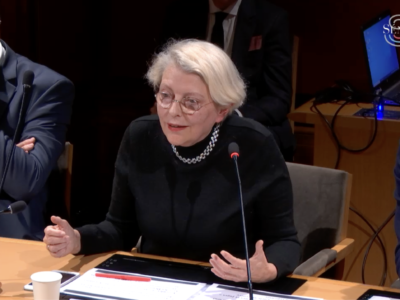
🏛️Audition by the French National Assembly’s Law Commission on the confidentiality of legal advice (the “Legal Privilege à la française”)

► Full reference: M.-A. Frison-Roche, Audition by the French National Assembly's Law Commission on the confidentiality of legal advice  (the "Legal Privilege à la française"), 8 April 2024. - I had expressed my opinion on the need for French legal system to better ensure the confidentiality of legal opinions drawn up by internal lawyers in companies, in an article published in 2023 in the French academic journal Recueil Dalloz: "La compliance, socle de la confidentialité nécessaire des avis juridiques élaborés en entreprise (Compliance Law, the cornerstone of the necessary confidentiality of legal opinions drawn up by companies". Compliance, the cornerstone of the necessary confidentiality of legal opinions drawn up by companies).  Following on from this article, and as a specialist in Regulatory and Compliance Law, I was invited by the French National Assembly's Law Commission to give my opinion on the proposed law n°2022 on the confidentiality of consultations by in-house lawyers ( Proposition de loi n°2022 relative à la confidentialité des consultations des juristes d'entreprises), often named in French Legal privilege à la française. -     ► Summary of this presentation: I have shown that we must start not from the person (external lawyer / in-house lawyer, for instance) and not even centrally from the information in question (branch of Law by branch of Law), but from the Goals pursued, i.e. from Compliance Law. In this respect, we must not be misled. We could do so by confusing mechanical "conformity" with this new branch of Law: Compliance Law. Conformity is merely a tool of Compliance Law. Out of concern for the correct use of the French language, as "Compliance" appears to many to be an American term, the proposed law uses the term "conformité" but refers to Compliance Law. Conformity" is merely the mechanical obligation to obey the applicable rules, which is the fate of any subject of law, subject to the mandatory rules, a passive position common to everyone in a State governed by the Rule of Law. Compliance Law is quite different, with conformity being just one of its tools. On the one hand, Compliance Law imposes an active obligation, and on the other, it targets only certain legal subjects: companies.  For them, it is a matter of ensuring that certain goals set by the legislator are actually achieved, which becomes effectively and efficiently possible thanks to the power of companies (financial power, organizational power, management power, information power, location power, information power). These "Monumental Goals" are either negative (preventing systems from collapsing) or positive (ensuring that systems improve). For companies to play this role – a role that is not required of other "ordinary" people, as they are not "in a position" to take on such a burden, particularly in terms of finance and organization – those in charge of organizing themselves and taking action, i.e. companies, must "detect and prevent" system failures (as required by laws such as US FCPA, French so-called Sapin 2 and Vigilance laws, European CSRD and CS3D, etc.). To "detect and prevent", which is an order from the Legislator, companies need to know the weaknesses of their organization and of the people they answer to, in order to remedy them: "remediation" is a "remedy" to ensure the "sustainability" of "systems". This set of key concepts lies at the heart of Compliance Law, the branch of law That focuses on the future. It is the legal opinions, for example, and in particular the report resulting from internal investigations, that enable those who decide and control this organization (the managers) to fulfill the role entrusted to them by the State. If these opinions are not confidential, the result is not the remediation and preservation of global systems (competitive, climatic, digital, energy, banking, financial systems, etc.): the effective managerial solution in Ex-Ante then consists not in seeking information but, conversely, in not seeking this information, since obtaining it will lead to the weakening of the company through the sanction that the information produces, for lack of confidentiality. The interests of the system, the State and the company are disjointed, because Compliance Law implies their alliance, which is what the confidentiality of legal opinions produces. This is why Compliance Law must, by its very nature, ensure the confidentiality of legal advice. -   When asked about the actual text of the proposal, I felt that the explanatory memorandum was particularly relevant, since the link between Compliance Law (admittedly called "conformité" in the proposed bill by a rather too mechanical respect for the French legal language, from which the French legislator has so far been unable to dispense….) is clear, that this confidentiality is attached to the document, that the company can waive it, and that it is clearly distinct from professional secrecy, all three of which should be approved. For my part, I've suggested a change to the procedure, which must be open to the confidentiality process. Indeed, public authorities, such as Competition and Regulatory Authorities, are rather hostile to this confidentiality. Having contributed a great deal to the development of Regulatory Law, and continuing to do so, I believe that Competition and Regulatory Authorities have a logic that needs to be understood. It is as follows: Regulatory Authorities are Ex-Ante (this was less true for the Competition Authorities, but it too is increasingly so) and are in a situation of information asymmetry. Their first concern is to combat this asymmetry. If we translate this into legal terms, it means that in order to carry out their mission of general interest, they must seek out all available information. However, legal opinions, and in particular the internal investigation report, are what I have described as "evidence treasure". In their logic, the Competition and Regulatory Authorities want to seize it. There is therefore a conflict between two general interest logics: the general interest of the Monumental Goals of Compliance Law actively served by companies, at the behest of the Legislation, which requires the confidentiality of legal opinions, and the general interest of the action of Regulators who fight against information asymmetry and seek to seize the evidential treasures of legal opinions. For the reasons given above, I believe that the Monumental Goals of Compliance must prevail. All the more so as the rights of the defence converge to this end. Ultimately, however, it is up to the Judge, in the event of open conflict, to balance these two claims, which are based on the service of the general interest.  However, reading the proposition, it seems to me that the rather complicated procedure entrusts this to a multiplicity of judges… But since it is indeed Compliance Law which is the best basis for "legal privilege à la française", Compliance Law, which is the extension of Regulatory Law and whose advanced point is the Vigilance duty, it would be more appropriate and logical to entrust this litigation to the exclusive jurisdiction of the Paris Judicial Court. This court has already the exclusive competence for litigation about Vigilance. This would have another fortunate effect: on appeal, the dispute would be brought before the Paris Court of Appeal, which has exclusive jurisdiction (barring exceptions) over disputes concerning decisions on French Competition and Regulatory Authorities. The judges of the "Pôle 5" (12 chambers specializing in economic law) of the very specific court are seasoned and would be well-suited to strike the necessary balance between the two general interests involved. I think a procedural amendment to the proposed text along these lines would be welcome. -   ► See in my work those that may be of interest with regard to this hearing (all with English summary, many with bilingual working paper) ⤵️   🕴️M.-A. Frison-Roche, 📝Le rôle du juge dans le déploiement du Droit de la Régulation par le Droit de la Compliance, in 📗Conseil d'État et Cour de cassation, De la Régulation à la Compliance : quel rôle pour le Juge ?, 2024.   🕴️M.-A. Frison-Roche, 📝Compliance et conformité : les distinguer pour mieux les articuler, 2024. 🕴️M.-A. Frison-Roche (dir.),📕L'obligation de compliance, 2024. 🕴️M.-A. Frison-Roche et M. Boissavy (dir.), 📕Compliance et droits de la défense, 2024. 🕴️M.-A. Frison-Roche (dir.), 📕Compliance et droits de la défense, Les Buts Monumentaux de la compliance,  2022. 🕴️M.-A. Frison-Roche, 📝Contrat de compliance, clauses de compliance, 2022. 🕴️M.-A. Frison-Roche, 📝Le Droit de la compliance, 2016. - 🌐 follow Marie-Anne Frison-Roche on LinkedIn 🌐follow Marie-Anne Frison-Roche on Instagram 🌐subscribe to the Newsletter MAFR Regulation, Compliance, Law 🌐subscribe to the Video Newsletter MAFR Surplomb

Conferences

🎤Les voies d’innovations juridiques face aux nouveaux “défis climatiques” (“Innovative legal solutions to the new “climate challenges””), in 🧮Nouveaux défis – Regards croisés : Droit, Économie et Finance. Quel Droit face au Changement Climatique ? (“New challenges – Crossed perspectives : Law, Economics and Finance. What Law in the Face of Climate Change?”)

► Full Reference: M.-A. Frison-Roche, "Les voies d'innovations juridiques face aux nouveaux "défis climatiques" ("Innovative legal solutions to the new "climate challenges""), in C. Arnaud, O. de Bandt et B. Deffains (dir.), Nouveaux défis – Regards croisés : Droit, Économie et Finance. Quel Droit face au Changement Climatique ? (("New challenges – Crossed perspectives : Law, Economics and Finance. What Law in the Face of Climate Change?"), Banque de France (French Central Bank) and CRED/Paris Panthéon-Assas University, Paris, Centre de Conférence de la Banque de France, April 2, 2024 - 🧮See the full programme of this event - 🔲see the slides, basis of this conference (in French) - ► Summary of this conference: In response to the question of how the Law can produce 'innovations' to meet the 'climate challenges', the process is based on the three traditional sources of Law, which are, firstly, laws and regulations, secondly, the commitments of individuals, mainly contracts, and thirdly, court rulings. At first sight, the Law in its traditional conception and practice is weak in the face of climate change. This weakness is inherent in the nature of climate change, which is at once future, global and systemic, in the face of these three sources of Law, which do not address all three dimensions at once. The scale of the legal innovation required to ensure that one or more articulated sources can grasp the future, the global and the systemic is therefore clear. And yet this is what is happening. As far as laws and regulations are concerned, they do not seem very appropriate because they are, by their very nature, a territorial limit, and international treaties are very difficult to negotiate. The interweaving of European regulations, for example the CSRD and the CS3D, which mirror each other, may be more effective. As far as 'commitments' are concerned, a concept which in Law is not very precise outside of contracts and liability cases📎1🕴️M.-A. Frison-Roche, 📝What a commitment is, in 🕴️M.-A. Frison-Roche (ed.), 📘Compliance Obligation, 2024., contracts are above all a means for companies to fulfill their legal obligations, and a contract always implies a judge. At first sight, however, the judge is the least well placed to respond to 'climate challenges', particularly in France where he is said or wished to be powerless, where he rules on the past and where, especially the civil judge, he settles a one-off dispute between two singular parties. But a major change has occurred with the emergence of a new branch of law: the Compliance Law, a teleological branch of Law whose legal normativity is lodged in the Monumental Goals📎2🕴️M.-A. Frison-Roche, 📝Compliance Monumental Goals, beating heart of Compliance Law, in 🕴️M.-A. Frison-Roche (ed.), 📘Compliance Monumental Goals, 2023. that it pursues, namely the preservation of systems, for example the climate system. In France, the so-called "Sapin 2" law in 2016, followed by the so-called "Vigilance" law in 2017, illustrate this. And the Judge is at the centre of it all. In this global, systemic, extraterritorial perspective, the object of which is the future – Compliance Law is, moreover, rejected by many legal experts – the legislative innovation is major. Indeed, the law of 23 March 2017, known as "Vigilance" designated large companies, because they are "powerful", because they are "in a position to act" to "detect and prevent" breaches of the environment and human rights. The 2017 law copied the "compliance tools"📎3🕴️M.-A. Frison-Roche (ed.), 📘Compliance Tools, 2021. put in place by the Sapin 2 anti-corruption law: risk mapping, plans, alerts, audits, internal investigations, and so on.  Only large companies are subject to the Compliance Law, notably the Vigilance Law, since they are the only ones in a position to act, in this case "parent companies or principals", and borders are no longer limits since the obligation, creating personal liability for the company📎4🏛️Conseil constitutionnel (French Constitutional Council), March 23, 2017, decision No. 2017-750 DC, Loi relative au devoir de vigilance des sociétés mères et des entreprises donneuses d’ordre., extends throughout the "value chain". The notion and fact of "systemic dispute" is emerging before the courts. In France, the Paris Court of First Instance has exclusive jurisdiction. European legislation is proving more difficult to draw up, because although it is compulsory to provide information on these "extra-financial" subjects (CSRD), the directive on the duty of vigilance, which has just been adopted, does not go any further than the French law of 2017. On the second point, that of commitments, we are only at the beginning. Judges do not transform ethical statements into "unilateral legal commitments", and vigilance does not transform company law into co-management. But contracts do form a global network through which companies adjust their various legal obligations. This is why arbitrators, the only "global judges", will soon be involved in this systemic litigation📎5🕴️M.-A. Frison-Roche (ed.), 📘Compliance Obligation, 2024, of which a chapter is dedicated to "International Arbitration in support of the Compliance Obligation"., and more general case law is to come on "compliance contracts and clauses"📎6🕴️M.-A. Frison-Roche, 🚧Compliance contract, compliance clauses, 2022 ; 🕴️M.-A. Frison-Roche (ed.), 📘Contrat and Contract, 2024.. But the most innovative aspect undoubtedly comes from the courts. Perhaps and notably in France because it is from where we least expect it, the civil courts, that the imagination comes, but also the guarding of the great principles of the Rule of Law, because for the moment the case law is reasonable. This innovation has not come about proprio motu: the judges are not taking action, it is the NGOs that are conducting a kind of litigation policy, systematically giving formal notice to the major energy companies, but also to the major banks and insurers on climate issues, alleging non-compliance with their vigilance plans. The interim relief judge at the Paris Court of First Instance must then provide answers in systemic disputes, of which the so-called "Total Uganda"📎7🏛️Tribunal judiciaire de Paris (Paris First Instance Civil Court), summary rulings, February 28, 2023, No. RG 22/53943 and 22/53942, Total Ouganda. case is an example. The courts are demonstrating a great deal of innovation. The Court of First Instance's interim relief judge has appointed amici curiae📎8🕴️N. Cayrol, 📝L'amicus curiae, mesure d'instruction ordinaire, 2022., the Paris Court of Appeal has set up a specialised chamber📎9On the creation on the new 5-12 Chamber, Contentieux émergent – Devoir de vigilance et responsabilité écologique see 🕴️J. Boulard, 💬Contentieux systémique : "Il est important, pour les magistrats, de rester au plus près des réalités" (Systemic litigation: "It is important for judges to remain as close as possible to reality"), March 28, 2024., and training conferences have been set up on this "Emerging Systemic Litigation"📎10🕴️M.-A. Frison-Roche, 💬"Nous voyons émerger aujourd’hui le contentieux systémique" ("We are now seeing the emergence of the Systemic Litigation"), March 28, 2024 ; 🕴️M.-A. Frison-Roche, Coordination and animation of cycle of conference-debates 🧮Contentieux Systémique Émergent (Emerging Systemic Litigation). . In conclusion, Law is in the process of being rebuilt through a new branch of Law, Compliance Law, whose the very purpose, as an extension of and going beyond Regulatory Law📎11🏛️Conseil d'État (French Council of State) and 🏛️Cour de cassation (French Court of cassation), 📗De la régulation à la compliance : quel rôle pour le juge ? (From Regulation to Compliance: what role for the Judge?), 2024; 🕴️M.-A. Frison-Roche, 🚧The deployment of Regulatory Law through Compliance Law in the European project, 2023 ; 🚧Compliance Law loses the ties of Regulation Law but retains its principles : consequences for companies, 2018 ; 🚧From Regulation Law to Compliance Law, 2017., is to preserve systems, in particular the climate system, in a profoundly renewed role for judges📎12🕴️M.-A. Frison-Roche, 📝Le rôle du juge dans le déploiement du droit de la régulation par le droit de la compliance et ;🕴️Fr. Ancel, 📝Quel rôle pour le juge aujourd’hui dans la compliance ? Quel office processuel du juge dans la compliance ?, in 🏛️Conseil d'État et 🏛️Cour de cassation, 📗De la régulation à la compliance : quel rôle pour le juge ?, 2024 ; 🕴️Fr. Ancel, 📝Le principe processuel de compliance, un nouveau principe directeur du procès ?, in M.-A. Frison-Roche (dir.), 📕La juridictionnalisation de la Compliance, 2023 ; 🕴️M.-A. Frison-Roche, 📝Le Juge requis pour une Obligation de Compliance effective, in 🕴️M.-A. Frison-Roche (dir.), 📕L'Obligation de Compliance, 2024.. - follow Marie-Anne Frison-Roche on LinkedIn follow Marie-Anne Frison-Roche on Instagram subscribe to the Newsletter MAFR Regulation, Compliance, Law

Conferences

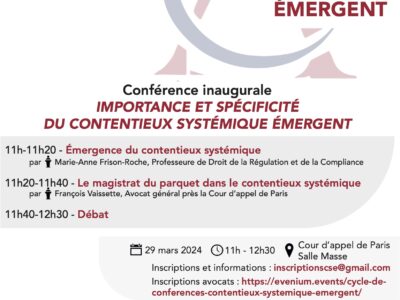
🎤L’émergence du contentieux systémique (Emergence of the Systemic Litigation), in 🧮Importance et spécificité du Contentieux Systémique Émergent, cycle of conference-debates “Contentieux Systémique Émergent”

► Full Reference: M.-A. Frison-Roche, "L’émergence du Contentieux Systémique" ("Emergence of the Systemic Litigation"), in Importance et spécificité du Contentieux Systémique Émergent (Importance and specificity of the Emerging Systemic Litigation), in cycle of conferences-debates "Contentieux Systémique Émergent" ("Emerging Systemic Litigation"), organised on the initiative of the Cour d'appel de Paris (Paris Cour of Appeal), with the Cour de cassation (French Court of cassation), the Cour d'appel de Versailles (Versailles Court of Appeal), the École nationale de la magistrature – ENM (French National School for the Judiciary) and the École de formation des barreaux du ressort de la Cour d'appel de Paris – EFB (Paris Bar School), under the scientific direction of Marie-Anne Frison-Roche, March 29, 2024, 11h-12h30, Cour d'appel de Paris, salle Masse - 🧮see the full programme of this event - 🧮see the programme of the entire cycle Contentieux Systémique Émergent - consult on LinkedIn the report of this speech (in French) - consult on LinkedIn a general présentation of this event, which links to a presentation and a report of each speech (in French) - 🧱consult the scientific coordination sheet of this event, which gives an account of the various speeches made - 🔲see the slides used to support this intervention (in French) - 🚧read the bilingual Working Paper which is the basis of this speech - ► English Summary of the conference: We are seeing the emergence of what should be referred to as a category of its own: the "Systemic Litigation". This concept, proposed in 2021📎1🕴️M.-A. Frison-Roche, 🚧The hypothesis of Systemic Cases brought before the Judge, 2021., refers to the hypothesis in which a system is 'involved' in a particular 'case' submitted to the judge. The presence of a system should not be confused with a systemic analysis of a phenomenon. The term 'cause' must be understood in the procedural sense, as used in article 5 of the Code civil (French Civil Code). Specifically, the prohibition contained in article 5 of the French Civil Code does not apply because a system thus involved calls for factual responses and solutions and not necessarily general and abstract solutions: the solution of a systemic nature and scope, that the presence of a system in a cause calls for, may be a factual solution, even if it radiates out from the system as a whole. But precisely because the presence of a system in the case often gives rise to a question that is itself systemic, the judge, if he wishes to comply with article 4 of the French Civil Code, must respond not only a minima by not evading the question, for example of systemic risks, but also fully by providing systemic solutions, for example remedies to preserve in the future the solidity and durability of the systems involved in the case.    These systems may be of different kinds: banking, financial, transport, health, energy, digital, algorithmic or climatic. Their presence in cases brought to the attention of judges, the variety and difficulties of which will be seen in later contributions, leads to basic questions relating to the emergence of Systemic Litigation: firstly, how can Systemic Litigation be defined? Secondly, what makes this category of litigation emerge? The answers to these two questions have essential practical consequences.  The new solutions must be based on a classic distinction, used in particular in criminal and administrative proceedings, which are more objective, but also in civil proceedings, notably by Hébraud, namely the distinction between the "party to the dispute/litigation" and the "party to the proceedings". Depending on whether it is accepted that the system should be considered as a "party to the litigation", which would allow it, through an entity that is legitimate in expressing it, to allege claims and formulate demands against an adversary, or as a "party to the proceedings", a much broader category, which would allow the judge to hear the interests of the systems involved without individuals being able, on behalf of a system, to formulate claims against or for the benefit of a party to the litigation.     This makes it possible to innovate while preserving the measure of which the judge is the guardian.   - follow Marie-Anne Frison-Roche on LinkedIn follow Marie-Anne Frison-Roche on Instagram subscribe to the Newsletter MAFR Regulation, Compliance, Law

Articles

💬”Nous voyons émerger aujourd’hui le contentieux systémique”, contrepoint à l’entretien du Premier Président de la Cour d’appel de Paris Jacques Boulard, 💬Contentieux systémique : “Il est important, pour les magistrats, de rester au plus près des réalités”

► Full Reference: M.-A. Frison-Roche, ""Nous voyons émerger aujourd’hui le contentieux systémique"" (""We are now seeing the emergence of the Systemic Litigation""), interview with Olivia Dufour, counterpoint to the interview with the Premier Président de la Cour d'appel de Paris (First President of the Paris Court of Appeal) Jacques Boulard, "Contentieux systémique : "Il est important, pour les magistrats, de rester au plus près des réalités"" ("Systemic litigation: "It is important for judges to remain as close as possible to reality""), Actu-Juridique, March 28, 2024 - 💬read the interview (in French) - This interview is a counterpoint to the interview conducted with Jacques Boulard, Premier Président de la Cour d'appel de Paris (First President of the Paris Court of Appeal), on the Court of Appeal's threefold initiative in establishing the Conseil de Justice Économique – CJE (Economic Justice Council), the additional chamber (5-12) to hear vigilance litigation in particular  and the setting up of the series of conference-debates on the Contentieux Systémique Émergent (Emerging Systemic Litigation): read the interview (in French). This interview highlights Marie-Anne Frison-Roche's position at the Conseil de Justice Économique and her role as scientific director of the series of conference-debates.  As a counterpoint, the journal conducts a specific interview with Marie-Anne Frison-Roche on the specific issue of the Contentieux Systémique Émergent (Emerging Systemic Litigation) cycle. - ► Presentation of the interview by the journal : "Marie-Anne Frison-Roche, professeur de droit de la régulation et de la compliance et responsable scientifique du cycle « Contentieux systémique émergent » nous explique la notion de contentieux systémique et l’importance de la démarche engagée par le Premier président." (Free translation : "Marie-Anne Frison-Roche, Professor of Regulatory Law and Compliance Law and Scientific Director of the "Contentieux systémique émergent" ("Emerging Systemic Litigation") cycle, explains the concept of Systemic Litigation and the importance of the approach adopted by the First President.") - For the record, the 2024 conference-debates of the "Contentieux systémique émergent" ("Emerging Systemic Litigation") cycle: Conférence inaugurale – Vendredi 29 mars 2024, de 11h à 12h30, IMPORTANCE ET SPÉCIFICITÉ DU CONTENTIEUX SYSTÉMIQUE ÉMERGENT   Deuxième conférence – Vendredi 26 avril 2024, de 11h à 12h30, LA VIGILANCE, NOUVEAU CHAMP DE CONTENTIEUX SYSTÉMIQUE   Troisième conférence – Lundi 27 mai 2024, de 11h à 12h30, LES TECHNIQUES DE SUPERVISION DES CONTENUS NUMÉRIQUES DISPONIBLES SUR LES PLATEFORMES   Quatrième conférence – Lundi 24 juin 2024, de 11h à 12h30, L’INTELLIGENCE ARTIFICIELLE, NOUVEAU CHAMP DE CONTENTIEUX SYSTÉMIQUE   Cinquième conférence – Lundi 9 septembre 2024, de 11h à 12h30, LA PORTÉE DES NORMES DE DROIT DUR, DE DROIT SOUPLE ET DES NORMES TECHNIQUES DANS LE CONTENTIEUX SYSTÉMIQUE ÉMERGENT   Sixième conférence – Lundi 14 octobre 2024, de 11h à 12h30, LES TECHNIQUES PROBATOIRES ADÉQUATES DANS LE CONTENTIEUX SYSTÉMIQUE ÉMERGENT   Septième conférence – Lundi 18 novembre 2024, de 11h à 12h30, DISCUSSION OUVERTE   Conférence de clôture de l’année 2024 – Lundi 16 décembre 2024, de 16h à 18h, L’EXPÉRIENCE DES JURIDICTIONS DANS LE CONTENTIEUX SYSTÉMIQUE ÉMERGENT - ► For the record, presentation of the interview of the Premier Président (First President) by the journal (in French): "Vendredi 29 mars aura lieu la première conférence-débat du cycle de formation « Contentieux systémique émergent » à la Cour d’appel de Paris. Cette initiative s’inscrit dans le cadre d’une politique qui a menée à la création d’un Conseil de justice économique ainsi qu’à la mise en place d’une nouvelle chambre dédiée au devoir de vigilance et à la responsabilité écologique. Le Premier président de la Cour d’appel de Paris, Jacques Boulard, nous explique les objectifs et les enjeux de ces innovations.". - - follow Marie-Anne Frison-Roche on LinkedIn follow Marie-Anne Frison-Roche on Instagram subscribe to the Newsletter MAFR Regulation, Compliance, Law

Articles

💬You Porn : La CJUE face au défi de la protection des mineurs

► Full Reference: M.-A. Frison-Roche, "You Porn : La CJUE face au défi de la protection des mineurs" ("You Porn: The CJEU faces the challenge of protecting minors"), interview with Olivia Dufour, Actu-Juridique, March 11, 2024 - 💬read the interview (in French) - ► Presentation of the interview by the journal (in French): "Depuis bientôt deux ans, l’Arcom tente de contraindre les sites pornographiques à mettre en place des procédés techniques sérieux de contrôle d’âge des internautes qui accèdent à leurs sites, afin que la protection des mineurs organisée par le droit pénal soit effective. Il y a à la fois une procédure civile en cours, basée notamment sur le décret qui met en œuvre ce dispositif, et un recours administratif, contestant la légalité du décret sur lequel s’appuie le régulateur pour mettre en demeure les sites d’adopter ces dispositifs techniques. Dans ce dernier contentieux, le Conseil d’État a, par sa décision du 6 mars 2024, adressé plusieurs questions préjudicielles à la CJUE pour déterminer quelle était la marge de manœuvre des États membres à l’encontre des sites qui ne respectent pas leur législation. Nous avons demandé au professeur Marie-Anne Frison-Roche, spécialiste de droit de la compliance, de nous éclairer sur les enjeux de ce contentieux hors normes.". - ► Questions asked (in French):  Pouvez-vous nous rappeler brièvement la genèse de ce cas manifestement complexe ? C’est la première fois qu’apparaît dans une décision de justice la notion de « cause systémique » dont vous êtes l’auteure. De quoi s’agit-il exactement ? Sur ces entrefaites, une décision de la CJUE est venue bouleverser la donne… Revenons au recours devant le Conseil d’État contre le décret, il semble que le Conseil d’État avait donc le choix entre deux solutions : suivre la CJUE et donc renoncer à protéger les enfants de la pornographie en France ou bien s’émanciper de cette jurisprudence européenne au risque de se le voir reprocher. Qu’a-t-il décidé finalement ? - follow Marie-Anne Frison-Roche on LinkedIn follow Marie-Anne Frison-Roche on Instagram subscribe to the Newsletter MAFR Regulation, Compliance, Law

Conferences

🎤Préalable : ce qu’est un engagement (Prerequisite: the Commitment), in 🧮L’arbitrage international en renfort de l’obligation de Compliance

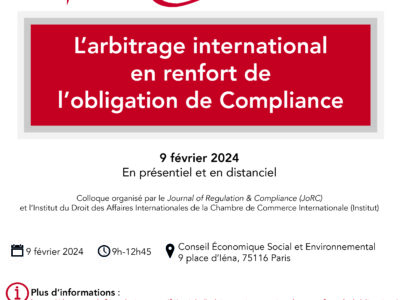
► Full Reference: M.-A. Frison-Roche, "Préalable : ce qu'est un engagement" ("Prerequisite: the Commitment"), in L. Aynès, M.-A. Frison-Roche, J.-B. Racine and E. Silva-Romero (dir.), L'arbitrage international en renfort de l'obligation de Compliance (International Arbitration in support of the Compliance Obligation), Journal of Regulation & Compliance (JoRC) and Institute of World Business Law of the ICC (Institute), Conseil Économique Social et Environnemental (CESE), Paris, February 9, 2024 - 🧮see the full programme of this event - consult on LinkedIn a general presentation of this event, which links to a presentation of each speech (in French) - 🧱consult the scientific direction sheet of this event, which gives an account of the various speeches made - 🔲see the slides used to support the presentation (in French) - 🎤see a presentation of the conference "Préalable : ce qu'est l'Obligation de Compliance" ("Prerequisite: what is the Compliance Obligation"), given at the same symposium - 🎤see a presentation of the conference "Le renforcement des engagements de Compliance par le renvoi Ex Ante à l'arbitrage international" ("Reinforcing Compliance commitments by referring Ex Ante to International Arbitration") which was finally not pronounced but will be the subject of an 📝article in the forthcoming book 📘Compliance Obligation  - ► Presentation of the conference: Having defined the Compliance Obligation in "Préalable : ce qu'est l'Obligation de Compliance" ("Prerequisite: what is the Compliance Obligation"), I set out to define what a commitment is. No one doubts that commitments, as words, constitute facts that can engage the liability of companies if there are inconsistencies or lies. The question today is whether a commitment can constitute a legal act, binding in ex ante. Companies make commitments either to fulfil their legal Compliance obligations, which is simply obeying the law, or to express their own wishes, either for themselves or for others. The cases are often confused, even though the scope is not the same. If the commitment takes the form of a contract, Compliance is concerned if the contract is used as an Ex Ante Compliance Tool📎1🕴️M.-A. Frison-Roche (ed.), 📘Compliance Tools, 2021., either if the entire contract has this purpose, or if a compliance clause is inserted, and an arbitration clause may be linked to it. The commitment, a concept that comes more from the Economics of Regulation, was conceived between a Regulatory Authority and a Company: it is the unilateral decision of the Authority that gives legal force to the commitment. Case law confirms this (Conseil d'État (French Council of State)📎2🏛️Conseil d'État (French Council of State), 21 April 2023, No. 464349, Sté Orange v. Arcep. and Conseil constitutionnel (French Constitutional Council)📎3🏛️Conseil constitutionnel (French Constitutional Council), 19 March 2021, decision No. 2021-891 QPC, Association Générations futures et autres.) and this is particularly clear in Competition Law, but it is also true of the convention judiciaire d'intérêt public – CJIP (French Judicial Public Interest Agreement). If commitment is central to Compliance, particularly Vigilance, it is because Compliance Law is an extension of Regulatory Law📎4🕴️M.-A. Frison-Roche, 🚧From Regulation Law to Compliance Law ; 🚧Compliance Law loses the ties of Regulation Law but retains its principles: consequences for companies, 2018 ; 🚧The deployment of Regulatory Law through Compliance Law in the European project, 2023.. The company is forcibly instituted by the Compliance regulator, particularly in value chains, or on digital spaces (DSA). In drawing up a plan, the company is fulfilling its legal obligation. But if we were to consider that it is a commitment, then we would also have to consider that the plan is the result of its will, that it must consult the stakeholders in its preparation, but that the source of the plan is its will: the provisions are not stipulations, are not applications of the law, but unilateral voluntary provisions. In this respect, and because its source is the will of the company (which does not prevent its co-construction), a plan could contain a "graduated offer" of arbitration. This offer could be included in commitments that are less regulated by law, such as those made in the context of CSR. - follow Marie-Anne Frison-Roche on LinkedIn follow Marie-Anne Frison-Roche on Instagram subscribe to the Newsletter MAFR Regulation, Compliance, Law

Conferences

🎤Le renforcement des engagements de compliance par le renvoi Ex Ante à l’arbitrage international (Reinforcing Compliance commitments by referring Ex Ante to International Arbitration), in 🧮L’arbitrage international en renfort de l’obligation de Compliance

► Full Reference: M.-A. Frison-Roche, “Le renforcement des engagements de Compliance par le renvoi Ex Ante à l’arbitrage international” (“Reinforcing Compliance commitments by referring Ex Ante to International Arbitration”) (planned but not delivered), in L. Aynès, M.-A. Frison-Roche, J.-B. Racine and E. Silva-Romero (dir.), L’arbitrage international en renfort de l’obligation de Compliance (International Arbitration in support of the Compliance Obligation), Journal of Regulation & Compliance (JoRC) and Institute of World Business Law of the ICC (Institute), Conseil Économique Social et Environnemental (CESE), Paris, February 9, 2024 - 🧮see the full programme of this event - consult on LinkedIn a general presentation of this event, which links to a presentation of each speech (in French) - 🧱consult the scientific direction sheet of this event, which gives an account of the various speeches made - 🔲see the slides that were to support the presentation (in French) - 📝This conference, which was to be delivered, and the Working Paper on which it is based are to be linked with the article to be published in the book📘Compliance Obligation  - 🎤see a presentation of the conference “Préalable : ce qu’est l’Obligation de Compliance” (“Prerequisite: what is the Compliance Obligation”), given at the same symposium - 🎤see a presentation of the conference “Préalable : ce qu’est un engagement” (“Prerequisite: the Commitment”), given at the same symposium - ► Presentation of the conference: It was initially planned that I would speak on the subject Le renforcement des engagements de Compliance par le renvoi Ex Ante à l’arbitrage international (Reinforcing Compliance commitments through the Ex Ante referral to International Arbitration), but it was agreed with the other organisers of the symposium that after defining the concept of the Compliance Obligation📎1🕴️M.-A. Frison-Roche, 🎤Préalable : ce qu'est l'obligation de Compliance (Prerequisite: the Compliance Obligation), in 🧮L'arbitrage international en renfort de l'obligation de Compliance (International Arbitration in support of the Compliance Obligation), 2024. I would refocus my second speech, mentioned above, on what a Commitment is📎2M.-A. Frison-Roche, Préalable : ce qu'est un engagement 🕴️M.-A. Frison-Roche, 🎤Préalable : ce qu'est un engagement (Prerequisite: the Commitment), in 🧮L'arbitrage international en renfort de l'obligation de Compliance (International Arbitration in support of the Compliance Obligation), 2024., an essential prerequisite for dealing with the subject of International Arbitration in support of the Compliance Obligation. Developments on Reinforcing Compliance commitments through the Ex Ante referral to International Arbitration will appear in the forthcoming books: L’obligation de Compliance (in French), Compliance Obligation (in English). Nevertheless, if I had dealt with this subject, I would have raised the following points: I would have shown that the inclusion of an offer of arbitration in the field of Compliance implies considering it in a contract as well as in a non-contractual commitment, and studying which category of Compliance Obligation the offer may apply to. I would have added that this insertion benefits from taking the form of a “graduated offer”, in a crescendo organised by the company ex ante and offered to the stakeholders: conciliation, mediation and arbitration, in “circles of trust”📎3🕴️M.-A. Frison-Roche, 🚧Compliance and Trust, 2017.. This is supported by the current French amicable settlement policy. The result was that I had to prepare a long “preliminary” discussion of what a “commitment” is, without which it seemed difficult to talk in concrete terms about the effective insertion of an offer of arbitration if we did not know whether such links or words had a constraining effect on the person issuing them in relation to the person benefiting from them. After discussions with the other speakers, it became clear that it would be more effective to give a talk devoted solely to the question of the legal definition of commitment. We therefore decided to allocate this second speaking slot to the notion of commitment. Since the written words do not have the same constraints, it will take up the initial construction, insisting on the different supports, either compliance contracts, or associations with compliance clauses, relating to different Compliance obligations, in particular on information or audit or Vigilance📎4🕴️M.-A. Frison-Roche, 🚧Compliance contract, compliance clauses, 2022., because the company must have the legal power corresponding to the mission that the State entrusts to it through Compliance📎5🕴️M.-A. Frison-Roche, 🚧Conceiving Power, 2021.. The offer must be carefully drafted to explain its purpose, and its organisation must prove the reality of this purpose: to give access to a judge to people affected by the company’s activity, and not to block it. This will therefore be available in detail in the forthcoming books: M.-A. Frison-Roche (ed.), 📕L’obligation de Compliance M.-A. Frison-Roche (ed.), 📘Compliance Obligation - follow Marie-Anne Frison-Roche on LinkedIn follow Marie-Anne Frison-Roche on Instagram subscribe to the Newsletter MAFR Regulation, Compliance, Law

Conferences

🎤Préalable : ce qu’est l’obligation de Compliance (Prerequisite: the Compliance Obligation), in 🧮L’arbitrage international en renfort de l’obligation de Compliance

► Full Reference: M.-A. Frison-Roche, "Préalable : ce qu'est l'obligation de Compliance" ("Prerequisite: the Compliance Obligation"), in L. Aynès, M.-A. Frison-Roche, J.-B. Racine and E. Silva-Romero (dir.), L'arbitrage international en renfort de l'obligation de Compliance (International Arbitration in support of the Compliance Obligation), Journal of Regulation & Compliance (JoRC) and Institute of World Business Law of the ICC (Institute), Conseil Économique Social et Environnemental (CESE), Paris, February 9, 2024 - 🧮see the full programme of this event - consult on LinkedIn a general presentation of this event, which links to a presentation of each speech (in French) - 🧱consult the scientific direction sheet of this event, which gives an account of the various speeches made - 🔲see the slides used to support the presentation (in French) - 🎤see a presentation of the conference "Préalable : ce qu'est un engagement" ("Prerequisite: the Commitment"), given at the same symposium - 🎤see a presentation of the conference "Le renforcement des engagements de Compliance par le renvoi Ex Ante à l'arbitrage international" ("Reinforcing Compliance commitments by referring Ex Ante to International Arbitration") which was finally not pronounced but will be the subject of an 📝article in the forthcoming book 📘Compliance Obligation  - ► Presentation of the conference: I have first dealt with the very definition of the Compliance Obligation. After showing that the relationship between Compliance Law and International Arbitration will naturally develop, because the companies subject to it are international, because they contractualise their legal Compliance obligations and because Compliance is being jurisdictionalised📎1🕴️M.-A. Frison-Roche (ed.), 📘Compliance Jurisdictionalisation, 2024., the arbitrator being the natural judge since he is a global judge and the judge of the contract, I pointed out that Compliance Law does not simply entrust arbitration with the task of preventing evils, such as corruption pacts, but that it creates positive obligations for companies: to detect and prevent behaviour whose systemic effect is deleterious. This culture of compliance is achieved either through compliance contracts📎2🕴️M.-A. Frison-Roche, 🚧Compliance contract, compliance clauses, 2022. (which outsource the handling of audits, alerts, the drawing up of plans, etc.), or through compliance clauses📎2🕴️M.-A. Frison-Roche, 🚧Compliance contract, compliance clauses, 2022., which are inserted into distribution or supply contracts, etc.; arbitration clauses are linked to these. Thus, the alliance between Compliance and Contract is an indirect mode of alliance between Arbitration and Compliance Obligation. The obligation of Compliance which then takes concrete form consists for the company not in making effective Ex Ante all the regulations which apply to it (conception of conformity which is at once unreasonable, blind and impossible), but in making its best efforts, which it must make visible (see Compliance Evidence System📎3🕴️M.-A. Frison-Roche, 📝The Judge, the Compliance Obligation and the Company. The Compliance Evidence System, in 🕴️M.-A. Frison-Roche (ed.), 📘Compliance Jurisdictionalisation, 2024.) to achieve Monumental Goals. These Monumental Goals are systemic. The aim is to protect systems from collapse (Negative Monumental Goals) or to make them better (Positive Monumental Goals)📎4🕴️M.-A. Frison-Roche, 📝Compliance Monumental Goals, Beating Heart of Compliance Law, in🕴️M.-A. Frison-Roche (ed.), 📘Compliance Monumental Goals, 2023.. By making companies accountable, via this Ex Ante Law whose object is the future, the systemic evils of corruption, money laundering, discrimination, climate change and hatred are combated, thus finding substantial unity. The Positive Monumental Goals aim to engender sustainability, security, respect for human beings, etc. in systems, be they banking, financial, digital, climatic, etc. The role of the Judge, and therefore also that of the Arbitrator, is renewed. - follow Marie-Anne Frison-Roche on LinkedIn follow Marie-Anne Frison-Roche on Instagram subscribe to the Newsletter MAFR Regulation, Compliance, Law

Conferences

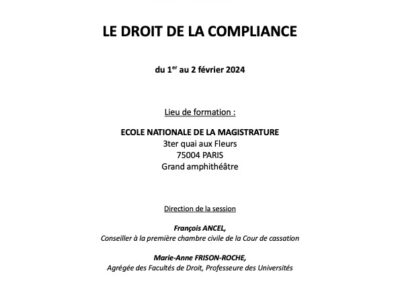
🎤Droit de la compliance : tour d’horizon (Compliance Law: Overview), in 🧮Droit de la compliance (Compliance Law)

► Full Reference: M.-A. Frison-Roche, "Droit de la compliance : tour d'horizon" ("Compliance Law: Overview"), in Droit de la compliance (Compliance Law), École nationale de la magistrature – ENM (French National School for the Judiciary) in collaboration with the École de Formation professionnelle des Barreaux du ressort de la cour d'appel de Paris – EFB (Paris Bar School), Paris, February 1, 2024. - ► This conference is given in French - 🧮see the full programme of this event (in French) - consult on LinkedIn a general presentation of this event, which links to a presentation of each speech (in French) - 🧱consult the scientific direction sheet of this event, which gives an account of the various speeches made - 🔲see the slides used to support the presentation (in French) - 🎤see a presentation of the other speech about "Compliance et Responsabilité civile : comprendre et raison garder" ("Compliance and Civil Liability: understanding and keeping our heads"), given at the same symposium - ► Presentation of the conference: Compliance Law is mysterious in itself, because it is still in creation1🕴️M.-A. Frison-Roche, 📝Naissance d'une branche du Droit : le Droit de la Compliance (Birth of a branch of Law : Compliance Law), to be published., because its presence and power are felt, but it is difficult to grasp it. It is necessary, however, because it deals with the most important, even the most dramatic, facts and carries with it the greatest ambitions. Magistrates must also "make the effort" to participate in the "adventure of Compliance Law", because it affects, and even overturns, all subjects, and because the Prosecutor and the Judge play an increasing role in it2🕴️M.-A. Frison-Roche (ed.), 📘Compliance Jurisdictionalisation, 2023.. Because the purpose of this conference is to introduce the two days of a training course designed for magistrates and open to lawyers, it only provides an "overview" of, so that we do not get lost in the sprawling regulations, the global mechanisms and the political ambitions that permeate them. Therefore, without going into any of the subjects, it is about opening up four ways of entering what is a branch of Law that is being born before our eyes: 1. Understanding Compliance Law through "regulations" 2. Understanding Compliance Law through "tools"3🕴️M.-A. Frison-Roche (ed.), 📘Compliance Tools, 2020. 3. Understanding Compliance Law through "methods" 4. Understanding Compliance Law through "goals"4🕴️M.-A. Frison-Roche (ed.), 📘Compliance Monumental Goals, 2023. The four approches are legitimate because the four dimensions are articulated in the legal system, notably case law. But the more positive Law is consolidated, the more its normativity through the goals that give normativity, or even a simplicity without which the whole is not humanly controllable. These Goals are Monumental and Europe bears them more and better than other areas of the world5🕴️M.-A. Frison-Roche (ed.), 📕Pour une Europe de la Compliance (For the Europe of the Compliance), 2019.. - follow Marie-Anne Frison-Roche on LinkedIn follow Marie-Anne Frison-Roche on Instagram subscribe to the Newsletter MAFR Regulation, Compliance, Law

Conferences

🎤Conclusion. Compliance et contrats publics : une alliance naturelle (Conclusion. Compliance and Public Contracts: a natural alliance), in 🧮Compliance et contrats publics

► Full Reference : M.-A. Frison-Roche, "Conclusion. Compliance et contrats publics : une alliance naturelle" ("Conclusion. Compliance and Public Contracts: a natural alliance"), in M.-A. Frison-Roche, C. Gilles & A. Oumedjkane (dir.), Compliance et contrats publics (Compliance and public contracts), Journal of Regulation & Compliance (JoRC), Centre de recherches et d’études administratives de Montpellier (CREAM) and Centre d’Études et de Recherches Comparatives Constitutionnelles et Politiques (CERCOP) of the Montpellier University, Faculté de droit et de science politique de Montpellier, 39 rue de l’Université, Amphiteatre C Paul Valéry, January 12, 2024 - 🧮see the full programme of this event - ✏️read the notes taken on the spot to draw up the symposium conclusion - consult on LinkedIn a general presentation of this event, which links to a presentation of each speech (in French) - 🧱consult the co-organisation sheet of this event, giving an account of the various speakers - ► English Summary of the conference: Firstly, it would appear that, as with all the contracts studied in the area of Compliance, public contracts are, for the public authorities or public companies, an instrument through which they implement the Compliance Obligation imposed on them by the laws and regulations. Public bodies involved in public contracts are particularly concerned because of the points of contact, even intimacy, between Compliance Law and the general interest. But the contract, whether public or private, remains in its classic conception what results from the expression of two wills which exchange their consents📎1🕴️M.-A. Frison-Roche, 🚧Compliance contract, Compliance clauses, 2022..   Secondly, in terms of free will, public contracts can be the means by which public bodies and their co-contractors express their conception of what needs to be done to preserve the future, for example in environmental and social matters. On the contrary, the seemingly technical issue of exclusions from public contracts, whether they be automatic exclusions or optional exclusions, expresses the extent to which economically powerful players (public authorities, municipalities, public companies) take care of each other. In this respect, Compliance Law runs counter to Competition Law📎2🕴️M.-A. Frison-Roche, 🚧Competition Law and Compliance Law, 2018. and profoundly affects Public Procurement Law.   But thirdly, the public contract, in that it expresses the general interest by its very nature, its ex ante nature reinforces regulatory action and the nature of Compliance as an extension of Regulation📎3🕴️M.-A. Frison-Roche (ed.), 📕Régulation, Supervision, Compliance (Regulation, Supervision, Compliance), 2017.. It appears to be the most appropriate instrument for this new branch of Law, without the need for it to be transformed. This underlines the extent to which Compliance Law must draw on classical Law, in this case Administrative Law.   Moreover, fourthly, the public contract appears to be the model for the Compliance Contract. The public contract is a model first of all because of the central place of the general interest. The "Monumental Goals" in which the substantive definition of  Compliance Law is anchored📎4🕴️M.-A. Frison-Roche, 📝Compliance Monumental Goals, beating heart of Compliance Law, in 🕴️M.-A. Frison-Roche (ed.), 📘Compliance Monumental Goals, 2022. are a development of this. Admittedly, this concern for the general interest drives the public entity, but the "raison d'être" of companies more generally also incorporates it through "governance", profoundly renewed by Compliance. The public contract is also a model because the contract is handled by a powerful party, in this case the public entity. The subject of Compliance Law is the powerful company, and only that company, chosen because it is powerful and because it uses that power to achieve the Monumental Goals. In this respect, the "exorbitant powers" that characterise the public contractor are reconstituted either by Compliance laws or by stipulations, which confer on all obliged or voluntary companies – by virtue of CSR, which has many points of contact with Compliance Law as long as it is not confused with obeying the applicable regulations (which is what "conformity" is)📎5🕴️M.-A. Frison-Roche, 📝Reinforce the Judge and the Lawyer to impose Compliance Law as a characteristic of the Rule of Law, in 🕴️M.-A. Frison-Roche (ed.), 📘Compliance Jurisdictionalisation, 2023. – a power over the co-contractor, or even over third parties, equivalent to that of the public entity📎6🕴️M.-A. Frison-Roche, 🚧Use of private companies by Compliance Law to serve Human Rights, 2023..  The judge is the one who, through contractual litigation, both public and private, will bring to life these Monumental Goals desired by the State, carried by powerful entities (administration, companies), pledge of the Rule of Law📎7🕴️M.-A. Frison-Roche, 📝Reinforce the Judge and the Lawyer to impose Compliance Law as a characteristic of the Rule of Law, in 🕴️M.-A. Frison-Roche (ed.), 📘Compliance Jurisdictionalisation, 2023.. These include contractual mechanisms for information, audit, disclosure, control, collaboration, supervision, etc., through which the company, whether private or public, takes charge of the structure it has created, for example the value chain it masters📎8🕴️M.-A. Frison-Roche, 📝Assessment of whistleblowing and the obligation of vigilance regarding International Competitiveness, in 🕴️M.-A. Frison-Roche (ed.), 📘Compliance Monumental Goals, 2022..   It can therefore be concluded that this logic of a public contract as an instrument of administrative action to achieve goals of general interest, now fully taken up in Compliance Law, must be acculturated into the Ordinary Contract Law and must be preserved in Public Contract Law, which presupposes a new balance with Competition Law, which for a long time carried within Public Law a contract model without concern for sustainability or the collective interest. To achieve this, dialogue between judges is essential. The Conseil d'État (French Council of State) and the Cour de cassation (French Court of cassation) set the example📎9Conseil d'État (French Council of State) and Cour de cassation (French Court of cassation), 📗Du droit de la régulation au droit de la compliance : quel rôle pour le juge ?, La Documentation Française, 2024 (to be published).. - 📝This conference will be followed by an article, "The public contract, model of the Compliance Contract", which will be published in the book 📘Compliance and contract. - follow Marie-Anne Frison-Roche on LinkedIn follow Marie-Anne Frison-Roche on Instagram subscribe to the Newsletter MAFR Regulation, Compliance, Law