Organisation of Academic Events Related to Global Law

Organisation of events

⚙️Co-organisation of the symposium 🧮Durabilité de l’Internet : le rôle des opérateurs du système des noms de domaine. Compliance et Régulation de l’espace numérique (Sustainability of the Internet: the role of the operators of the domain name system. Compliance and regulation of the digital space)

- ► Full Reference: M.-A. Frison-Roche & G. Loiseau (dir.), Durabilité de l’Internet : le rôle des opérateurs du système des noms de domaine. Compliance et régulation de l’espace numérique (Sustainability of the Internet: the role of the operators of the domain name system. Compliance and regulation of the digital space), Journal of Regulation & Compliance (JoRC) and Institut de Recherche Juridique de la Sorbonne (André Tunc – IRJS), Paris 1 Panthéon-Sorbonne University, 21 Fabruary 2025 - ► General presentation of this symposium: The digital space has been built on and as a system. Its primary interest is of a negative nature: it consists of to be preserved against the prospect of systemic failure, of not collapsing. Like all other systems, this ‘Monumental Goal’ specific to the digital system justifies resources that incorporate this concern for the future. As with all systems, it integrates and relies on the specific technical nature of this system. The digital space is largely based on the invention, technology and architecture of domain names. Domain names, as an addressing system, enable users to enter the digital space and find other Internet users. The uniqueness and solidity of the domain name system, entrusted to a single root and decentralisation, makes this community possible for those who use the digital space and ensures the technical durability required, without which the digital space would be compromised. The architecture, operation, operators and what they do under the control of legislators, regulators, judges and legal subjects are therefore examined from a dual technical and legal perspective, in the light of the imperative of sustainability. This allows to progress in 4 stages. Firstly, to examine the permanence in time and space of the domain name system, insofar as it is the foundation of the Internet and the digital system. This technical construction gives rise to legal qualifications, not only for the present but also for the future, since the Web3 offers new technical solutions. Secondly, this technical sustainability is an imperative that is built into the operators of the domain names themselves, which are inter-linked not only at national level but also at global level, this cross-linking being necessary for the security of the system. The State is present through public law techniques that enable surveillance, control and possible recovery. Thirdly, it imposes constraints on the operators subject to them in order to serve this monumental goal of technical sustainability, and these constraints themselves generate as many powers as they need to usefully achieve this mission. This proportionality must be at the heart of the method and the requirements. The relationship between constraints and powers also stems from it. Fourthly, this imperative of technical sustainability, which is global in nature, gives way to imperatives of societal sustainability, more localised in space and time, when domain name operators are called upon by the legitimate authors of binding standards, legislators in the first instance, to express concerns such as the protection of people involved in the digital space and whose rights are compromised or who are in danger. This second type of sustainability, which is more localised and less inherent in the architecture of the Internet, is justified by the available power of the operators concerned and their adherence to social imperatives. The resulting constraints and powers are therefore not the same. The 2 sustainabilities must then be articulated in a conception that is both teleological and pragmatic. - - ► Speakers (they will speak in French, but the book to be published will be in English): 🎤Pierre Bonis, Chief Executive Officer of the Association française pour le nommage Internet en coopération (Afnic) 🎤Lucien Castex, Adviser of the Afnic Chief Executive Officer for Research internet and society and Internet governance 🎤Marie-Anne Frison-Roche, Full Professor of Regulatory and Compliance Law, Director of the Journal of Regulation & Compliance (JoRC) 🎤Claire Leveneur, Senior Lecturer at Paris-Est Créteil University 🎤Grégoire Loiseau, Full Professor at Paris 1 Panthéon-Sorbonne University 🎤Samir Merabet, Full Professor at the University of West Indies 🎤Antoine Oumedjkane, Senior Lecturer at Lille University 🎤Frédéric Sardain, attorney at law, Jeantet law firm - read below a detailed presentation of this event⤵️
Organisation of events

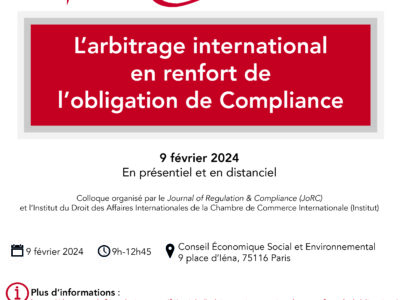
🧱Co-organisation of the Symposium 🧮L’arbitrage international en renfort de l’Obligation de Compliance (International Arbitration in support of the Compliance Obligation)

► Full Reference: L. Aynès, M.-A. Frison-Roche, J.-B. Racine and E. Silva-Romero (dir.), L’arbitrage international en renfort de l’obligation de Compliance (International Arbitration in support of the Compliance Obligation), Journal of Regulation & Compliance (JoRC) and Institute of World Business Law of the ICC (Institute), Conseil Économique Social et Environnemental (CESE), Paris, February 9, 2024 - consult on LinkedIn a general présentation of this event, which links to a presentation and a report of each speech - 🏗️This symposium takes place in the cycle of symposiums organised by the Journal of Regulation & Compliance (JoRC) and its partners Universities, focusing in 2023-2024 on the general theme of the Compliance Obligation - 📚The works will then be inserted in the books: 📕L’obligation de Compliance, to be published in the 📚Régulations & Compliance Serie, co-published by the Journal of Regulation & Compliance (JoRC) and Dalloz, published in French. 📘Compliance Obligation, to be published on the 📚Compliance & Regulation Serie, co-published by the Journal of Regulation & Compliance (JoRC) and Dalloz, published in English. - ► General presentation of the symposium: “Compliance Obligation” appears to be far from International Arbitration if Compliance Law is only understood in terms of binding regulations or even Criminal Law. Arbitration would only have contact with Compliance Obligation in a repulsive way, when a person claims to have enforced a contract before an arbitration court that disregards a compliance prohibition, e.g. corruption or money laundering. It is therefore from a negative angle that the cross-over has taken place. The fact that Arbitration Law respects the requisite of Criminal Law is nothing new. Moreover, the power of Compliance in its detection and prevention tools, particularly in terms of evidence, no doubt increases the global efficiency. But Compliance Obligation is based on Monumental Goals, notably linked to global human rights and active ambitions about environment and climate which, particularly in the value chain economy, take the legal form of compliance clauses, or even compliance contracts, or various commitments and plans, which the parties can ask the international arbitrator to enforce. They will do so even more as arbitrators are often the only international, or even global, judges available. The use they will do of Contract Law, Quasi-Contract Law, Enforcement Law, Tort Law, reinforces Compliance Law in a global dimension. - - ► Interviennent : 🎤 Laurent Aynès, emeritus Professor at Paris 1 Panthéon-Sorbonne University, Attorney, Darrois Villey Maillot Brochier (Paris) 🎤 Marie-Anne Frison-Roche, Professor of Regulatory and Compliance Law, Director of the Journal of Regulation & Compliance (JoRC) 🎤 Jean-François Guillemin, former General Secretary of the Bouygues Group 🎤 Christophe Lapp, Attorney, Advant Altana (Paris) 🎤 Jean-Baptiste Racine, Full Professor at Paris Panthéon-Assas University (Paris 2) 🎤 Eduardo Silva-Romero, President of the Institute of World Business Law of the ICC (Institute), Attorney, Wordstone (Paris) - 🧮Read a detailed presentation of the event below⤵️

Organisation of events

📅 Scientific Co-organization of the colloquium “Radioscopie d’une notion : les “buts monumentaux” de la Compliance (“Radioscopy of a notion: the Compliance “monumental goals””), in “Les buts monumentaux de la Compliance” (“Compliance Monumental Goals”)”

► co-organized between Laboratoire DANTE and the Journal of Regulation & Compliance (JoRC), this colloquium) is the core manifestation of the 2021 series of colloquia devoted to the general theme of Compliance Monumental Goals. It will take place on 16th of September 2021, at the Maison du Barreau, in Paris. This first work is in French but will be the basis of the book in English : Compliance Monumental Goals,    This book will be published in the Compliance & Regulation Series, co-published by the JoRC and Bruylant. ► Presentation of the colloquium Thematic: To understand the notion of “Monumental Goals”, it is firstly necessary to take crossed perspectives on them, particularly through the prism of Labor Law, Environmental Law and Enterprise Law. Many questions appear. Does the notion of “Monumental Goals” present any substance in Law? Is it uniformly understood, or do specificities appear, forged by specific cultures and disciplinary practices? What are the sources and implicit references or echoes? Because even if we admit the part of novelty, there is undoubtedly an anchoring in traditional legal concepts, like the general interest or sovereignty. How does the shift from meta-legal (prima facie introduced by the concept) to legal take place, and where do any operational difficulties lie when legal actors are called upon to act? The question of a possible categorization of “Monumental Goals” will thus be explored, through these three legal disciplines whose historicity, goals and implications for firms differ. These reflections allow to ask why and how these “Monumental Goals” are developed. Indeed, what is the relevance of the association of “Monumental Goals” and Compliance? Beyond theoretical considerations relating to the meaning of Law, is this really an effective alloy encouraging companies to behave differently? By what ways? These questions arise in particular with regard to the imperatives of legal certainty and the operative nature of the concept. The question of “Monumental Goals” will thus be explored by the operational actors of compliance, both those who act within companies and those who act from the lato sensu State sphere, for understanding whether this notion is a pure rhetoric figure or constitutes a particularly promising lever for the evolution of market behavior. ► with : 🎤 Christophe André, maître de conférences à l’Université Paris – Saclay (lecturer at the Paris-Saclay University) 🎤 Guillaume Beaussonie, professeur à l’Université Toulouse-1-Capitole (law professor at Toulouse-1-Capitole University) 🎤 Regis Bismuth, professeur de droit à Sciences po, Paris (law professor at Sciences po Paris) 🎤 Marie-Emma Boursier, doyen de l’Université Paris – Saclay (dean of the Paris-Saclay University) 🎤 Muriel Chagny, professeur l’Université Paris – Saclay, directrice du Laboratoire Dante (Professor at the Paris-Saclay University, director of the Laboratory Dante) 🎤 Marie-Anne Frison-Roche, professeur à Sciences po (Paris) (Professor at Sciences Po Paris) 🎤 Isabelle Gavanon, avocate à la Cour d’Appel de Paris (attorney before the Paris Court of Appeal) 🎤 Emma Guernaoui, ATER à l’Université Paris II Panthéon-Assas (ATER at Paris II Panthéon-Assas University) 🎤 Dominique Heintz, avocat à la Cour d’ appel de Paris (attorney before the Paris Court of Appeal) 🎤 Christian Huglo, avocat à la Cour d’ appel de Paris (attorney before the Paris Court of Appeal) 🎤Dominique de La Garanderie, avocat à la Cour d’appel de Paris (attorney before the Paris Court of Appeal) 🎤 Anne-Valérie Le Fur, professeur à l’Université Paris – Saclay (Professor at Paris-Saclay University) 🎤 Anne Le Goff, secrétaire générale déléguée d’Arkéa (Deputy Secretary general at Arkéa) 🎤 Roch-Olivier Maistre, président du Conseil supérieur de l’audiovisuel (President of the French audiovisual regulation authority) 🎤 Marie Malaurie, professeur à l’Université Paris-Saclay (professor at the Paris-Saclay University) 🎤 Jérôme Marilly, avocat général à la Cour d’Appel de Paris (General attorney before the Paris Court of Appeal) 🎤 Benoît Petit, maître de conférences (HDR) à l’Université Paris-Saclay (lecturer at the Paris-Saclay University) 🎤 Jean-François Vaquieri, Secrétaire Général d’Enedis (Secretary General of Enedis) - Read a detailed presentation below:  

Organisation of events

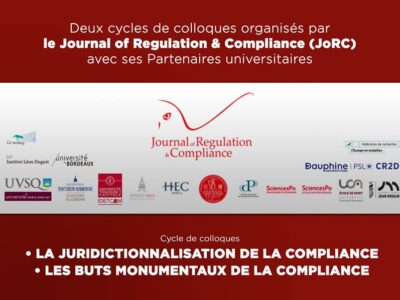
Organization and scientific co-direction of the cycle of colloquia : “The juridictionnalization of Compliance”

Like the precedent cycles dedicated to the general topic of Compliance, aiming to build a “Compliance Law” and aiming also to be published in the series Regulation & Compliance, coedited by the Journal of Regulation & Compliance and Dalloz, this cycle continues to deepen a specific aspect of this emerging branch of Law which has been applied before being designed. The year 2020-2021 will give rise to two full and distinct cycles, the former deepening a key concept of Compliance Law, that are “monumental goals” and the later deepening a phenomenon with multiple roots and consequences: “the juridictionnalization of Compliance”. The juridictionnalization of Compliance is perhaps as ancient as Compliance mechanisms themselves. These various conferences will take place in different places, according to the role played by the very numerous universities which, this year once again, support the Journal of Regulation & Compliance for the realization of this cycle. This cycle will give rise to two books, one in French: La Juridictionnalisation de la Compliance, and the other in English : Juridictionnalization of Compliance.  This cycle of colloquia The juridictionnalization of Compliance will start in October 2020 and will take place until December 2021. Inaugural colloquium: Compliance juridictionnalization: why? Who? How? Where? and Toward What? , organized by the JoRC under the scientific direction of Marie-Anne Frison-Roche : read more information here   Second Colloquium: 31st of March 2021 : Arbitration and Compliance, co-organized by the JoRC and Paris II University, under the scientific direction of Marie-Anne Frison-Roche and Jean-Baptiste Racine : read more information here   Third colloquium : 23rd of June 2021 : The firm instituted as Court by Compliance Law, co-organized by the JoRC and the équipe de recherche Louis Josserand of Lyon 3 University, under the scientific direction of Marie-Anne Frison-Roche and Jean-Christophe Roda : read more information here   Fourth colloquium: September 2021 : Which judges for Compliance? , co-organized by the JoRC and the CR2D of Paris-Dauphine University, under the scientific direction of Marie-Anne Frison-Roche and Sophie Schiller : read more information here ​ Fifth colloquium: October 2021 : Compliance Law, crucible between American Procedure Law and Procedure Law, co-organized by the JoRC and the Brussels University, under the scientific direction of Marie-Anne Frison-Roche and Arnaud van Waeyenberge: read more information here   Sixth colloquium: Proportionnality, Compliance balance, co-organized by the JoRC and IDETCOM of Toulouse University, under the scientific direction of Marie-Anne Frison-Roche and Lucien Rapp: read more information here